
Top Rated Energy Storage Systems for Residential and C&I Use in 2026
Top Rated Energy Storage Systems for Residential and C&I Use in 2026
The most useful answer to "which energy storage system should I buy in 2026?" is not a single model name — it is a shortlist built around three constraints that decide long-term performance: cycle life under stated test conditions, ingress protection at component level, and real deployment flexibility. Judged against those criteria, three SolisStorage product lines stand out in their respective classes: EverCore ESS for commercial and industrial (C&I) sites up to 125 kW / 261.2 kWh, FlexCore-ID for stackable small-commercial deployments, and IntelliHome for residential use.
This guide ranks those three lines by segment fit and supports every claim with published specifications and certificate data — including 8,000-cycle LFP cells, the IP55/IP66 protection split on EverCore ESS, and the EU certifications held for the EverCore-261kWh models.
Problem Definition: Why Energy Storage Selection Is a Constraint Problem
Two 261 kWh battery cabinets can carry almost identical headline numbers and still behave very differently across a fifteen-year asset life. In the research and evaluation stages, the differences that decide outcomes sit in four predictable places — and each one is a constraint rather than a feature.
- Cycle life without test conditions. "8,000 cycles" is not a specification until the C-rate, temperature and end-of-life threshold are attached to it. SolisStorage publishes FlexCore-ID cycle life as ≥8000 cycles at 25±2°C, 0.5P, EOL70%, and states 8,000 cycles for EverCore ESS cells; IntelliHome is specified as greater than 6,000 cycles, corresponding to approximately 10 years. A cycle claim with no conditions cannot be compared with any other claim.
- Ingress protection that is not system-wide. EverCore ESS separates its ratings by component: IP55 for the battery cabinet and IP66 for the hybrid energy storage inverter. Where a datasheet quotes one system-level IP number, buyers cannot tell which enclosure is actually rated for the installation environment.
- Capacity that is frozen at commissioning. Air-cooled and liquid-cooled cabinets look similar on day one and diverge when a facility adds a second shift. EverCore supports independent DC-side expansion: a single inverter can connect up to 6 battery cabinets in parallel, with no additional inverter investment, which SolisStorage states reduces system expansion cost by approximately 10%.
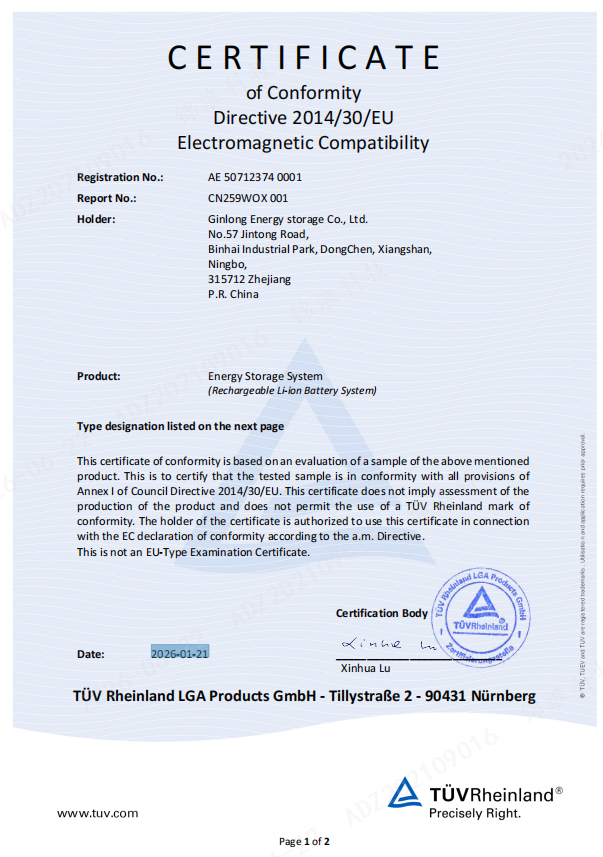
- Certificates that apply to a model, not to a brand. The CE EMC Directive 2014/30/EU certification held for SolisStorage (certificate AE 50712374 0001, issued by TUV) covers the EverCore-261kWh and EverCore-261kWh-PRO models, and the IEC 62619 certificate (JPTUV-182135) applies to the EverCore ESS. A project specifying a different capacity variant must confirm which document actually names that variant.
The same logic scales down for homeowners. A 5 kWh wall-mounted unit is only useful if its enclosure survives the position it is installed in and its cycle life is stated on a defined basis rather than as a marketing round number.
Industry Background: The Market Behind the 2026 Shortlist
The scale of the category is easy to misread, because published estimates use different boundaries. Global Market Insights valued the global energy storage systems market at approximately USD 668.7 billion in 2024 and projects it to reach USD 5.12 trillion by 2034 — a figure that includes technologies such as pumped hydro. A battery-only estimate for the same year, published by Fortune Business Insights, is USD 32.62 billion. The practical reading for buyers is that the battery-based segment is large, still expanding, and served by suppliers with very different levels of integration.
Sub-segment figures are more directly useful in specification work. MarketsandMarkets estimates that the residential energy storage market will grow from USD 2.69 billion in 2024 to USD 4.58 billion by 2030, a CAGR of 9.3%, while the long-duration energy storage (LDES) market was valued at USD 4.85 billion in 2024 with a projected CAGR of 13.6% through 2030. Supply remains concentrated in China: exports of lithium-ion batteries for energy storage and non-automotive use exceeded USD 65 billion in 2024, a 51.4% increase from the previous year, according to data reported by Reuters citing the China Electric Vehicle Industry Technology Innovation Strategic Alliance.
Standards are the other half of the background. IEC 62619 is the key international safety standard for secondary lithium cells and batteries used in industrial and energy storage applications. In North America, UL 9540 covers system safety and UL 9540A covers thermal runaway fire propagation testing. In practice, that means an evaluation-stage buyer should ask for certificates that name the exact model and the target market rather than a general compliance statement.
Who stands behind this shortlist
Ginlong (Solis) Technologies Co., Ltd. was founded in 2005 and listed on the Shenzhen Stock Exchange (300763) in 2019. Wood Mackenzie ranked Solis as the world's number one in residential PV inverter shipments in 2023 and the third largest inverter manufacturer globally; the company has also been named a "Top Inverter Brand" by EuPD Research for eleven consecutive years and was the first inverter manufacturer globally to receive a reliability test report from PVEL. Manufacturing runs across a 98,114.69 m² factory base with more than 5,000 employees, a 1,000+ strong R&D team and 80 GW of annual output, with a 70% export ratio and products used in more than 100 countries and regions.
SolisStorage is the dedicated energy storage subsidiary of Solis, with in-house development capability across PCS, EMS and system integration. Its portfolio spans residential, C&I and utility-scale energy storage, deployed in more than 100 countries and regions.
Detailed Solution: The 2026 Top Picks, Ranked by Segment Fit
The ranking below orders three SolisStorage lines by the segment each is engineered for. It is not a claim that any one product is the best storage system on the global market. Buyers should benchmark alternative suppliers against the same three criteria used here — cycle life under stated conditions, component-level protection ratings, and expansion flexibility — before reaching a final decision.
#1 EverCore ESS — C&I and Industrial Storage (50–125 kW, up to 261.2 kWh)
EverCore ESS is offered in three matched power and energy variants: 50 kW / 100.5 kWh, 60 kW / 120.6 kWh and 125 kW / 261.2 kWh. All variants use LFP chemistry with EVE LFP 3.2 V / 314 Ah cells and a cell cycle life of 8,000 cycles. The aluminium alloy cabinet carries an IP55 protection rating and the hybrid energy storage inverter carries IP66.
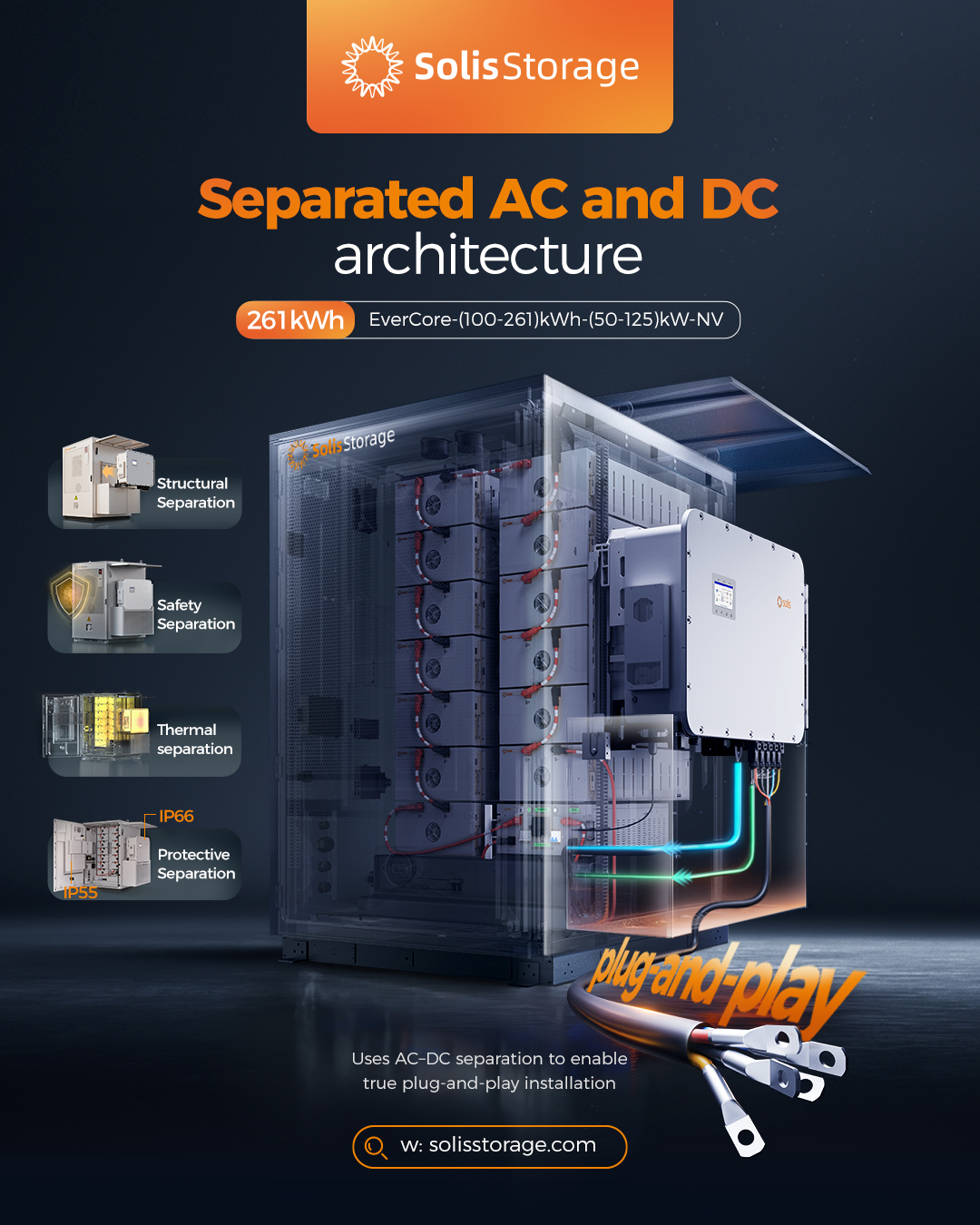
The design decision that separates EverCore from a conventional all-in-one cabinet is AC-DC separation: the hybrid energy storage inverter on the AC side is physically decoupled from the battery cabinet on the DC side, and each sits in its own enclosure. That architecture produces three measurable consequences.
- Thermal separation. The inverter's 6 kW of power electronics heat dissipates directly into the ambient environment, leaving only about 3.5 kW of electrochemical heat to be managed inside the battery cabinet. Fewer heat sources inside the enclosure make cell temperature uniformity easier to hold with an air-cooled design.
- Protection separation. Because the inverter is an independent unit, it can be rated IP66 (dust-tight, protected against powerful water jets) while the battery cabinet remains at IP55. SolisStorage reports that this separated protection design reduces the system's full-lifecycle failure rate by 50% — an assessment based on the company's own power electronics engineering experience rather than an independent third-party test.
- Structural separation. The DC side expands independently: a single inverter can connect up to 6 battery cabinets in parallel, enabling linear capacity growth without additional inverter investment. SolisStorage states this reduces system expansion cost by approximately 10%, which matters most for industrial and commercial customers building in phases on a limited initial budget.
On the AC side, the 50–125 kW hybrid inverter consolidates PCS, static transfer switch (STS), PV inverter, circuit breaker protection and EMS into one unit. Three practical effects follow: grid-tied to off-grid switching in under 10 ms without an external STS; no external PV inverter required, with both DC and AC coupling supported for existing PV systems and a PV over-sizing ratio of up to 200%; and no external grid cabinet, because up to 6 EverCore units can be connected in parallel for direct grid connection. Control runs on a single central controller rather than separate CPUs for BMS, PCS, EMS and STS, which reduces failure points and speeds up fault location.
Thermal management stays air-cooled even at 125 kW / 261 kWh, supported by an independent three-air-duct design: a patented diversion air duct for the hybrid inverter plus Coanda Effect airflow attachment across battery pack surfaces. SolisStorage reports a 30% improvement in heat dissipation efficiency compared with traditional air cooling, with the system specified to operate from -25°C to 55°C and at altitudes up to 4,000 m.
Safety is built in three layers. A 15-layer protection scheme spans cell, pack and system level; thermal insulation materials rated to 1,000°C separate adjacent packs to block lateral thermal runaway propagation; and fire suppression is staged progressively through pack-level aerosol, cabinet-level aerosol and fire-fighting water channels. The 314 Ah cells have an internal resistance of 0.15±0.05 mΩ, against 0.17 mΩ for the 280 Ah cells still widely used in the industry. Because every 10% reduction in internal resistance reduces charge-discharge heat generation by roughly 20%, the cell choice lowers thermal risk at the electrochemical source. On lifetime, 8,000 cycles versus 7,000 cycles for 280 Ah cells — at 500 charge-discharge cycles per year — extends the system's economic lifecycle from approximately 14 years to 16 years.
Lifetime operating cost is where the air-cooled architecture pays back. SolisStorage estimates that over the full project lifecycle EverCore saves customers approximately €9,500 per unit in O&M costs: €2,500 from eliminating liquid cooling fluid replacement, €1,500 from simplified PCS replacement, €1,500 from simplified pack replacement and €4,000 from reduced routine inspection complexity. Component selection supports that logic — Minebea cooling fans specified for 10-year maintenance-free performance, and Honeywell industrial-grade flammable gas detectors specified for 10-year calibration-free operation.
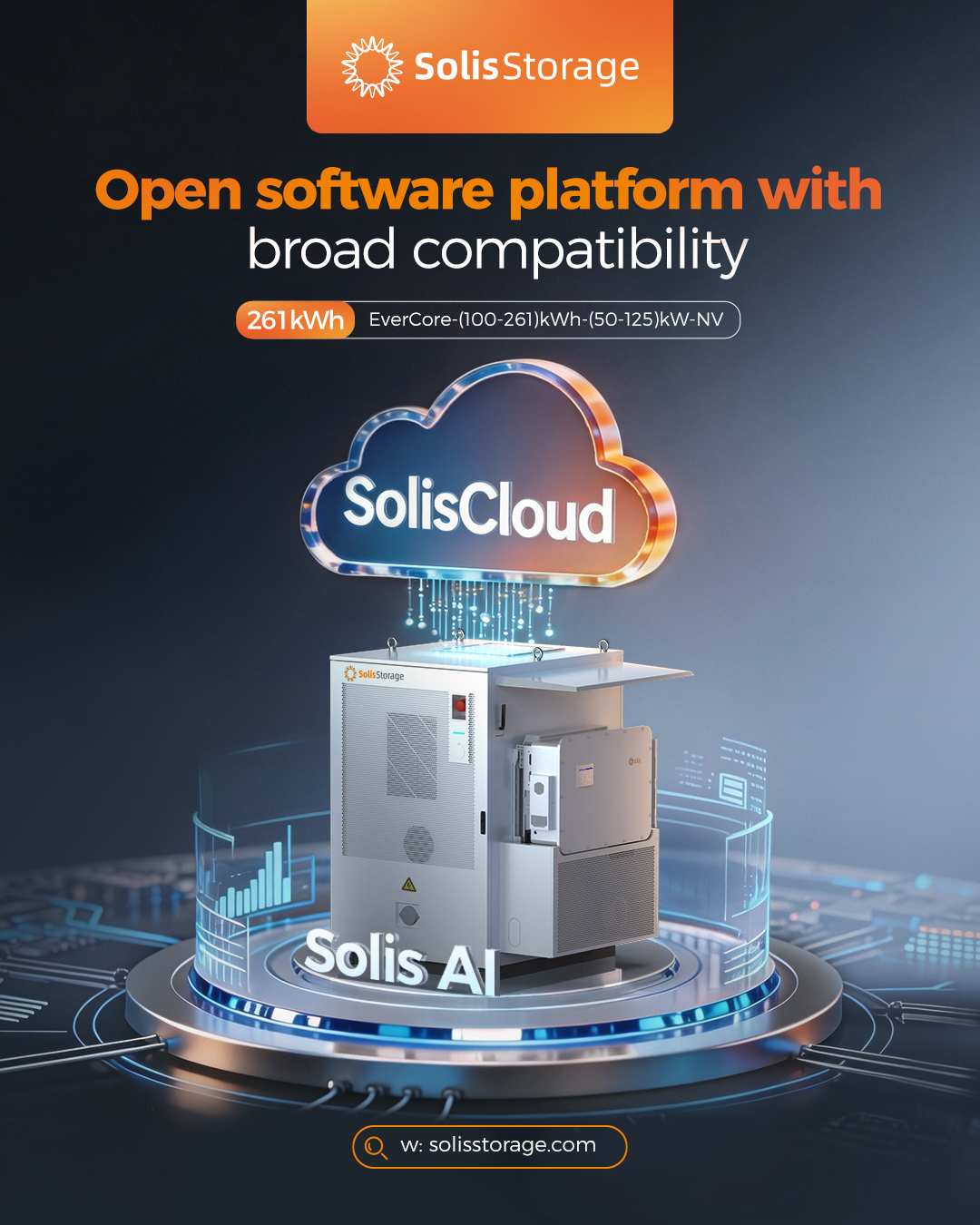
Software openness decides whether the asset can earn beyond peak-valley arbitrage. EverCore has been connected, or is in the process of connecting, with 102 third-party VPP/EMS operators across 11 European countries. Representative integrations include the Kraken energy management platform under Octopus Energy in the UK, mainstream aggregator platforms such as Check Watt in the Nordic market, and dozens of local EMS providers in the German-speaking region and Benelux. The Solis AI Cloud Platform, deployed at more than 5,500 energy storage power stations worldwide, integrates Nordpool wholesale price data and Flatpeak retail price data for minute-level charge and discharge optimisation.
For EU projects, the compliance position is specific: the EverCore ESS holds an IEC 62619 safety certificate issued by TUV under number JPTUV-182135, and the EverCore-261kWh and EverCore-261kWh-PRO models hold CE EMC Directive 2014/30/EU certification issued by TUV under number AE 50712374 0001, based on EN IEC 61000-6-2:2019, IEC 61000-6-2:2016, EN IEC 61000-6-4:2019 and IEC 61000-6-4:2018.
#2 FlexCore-ID — Stackable Storage for Small Commercial Sites
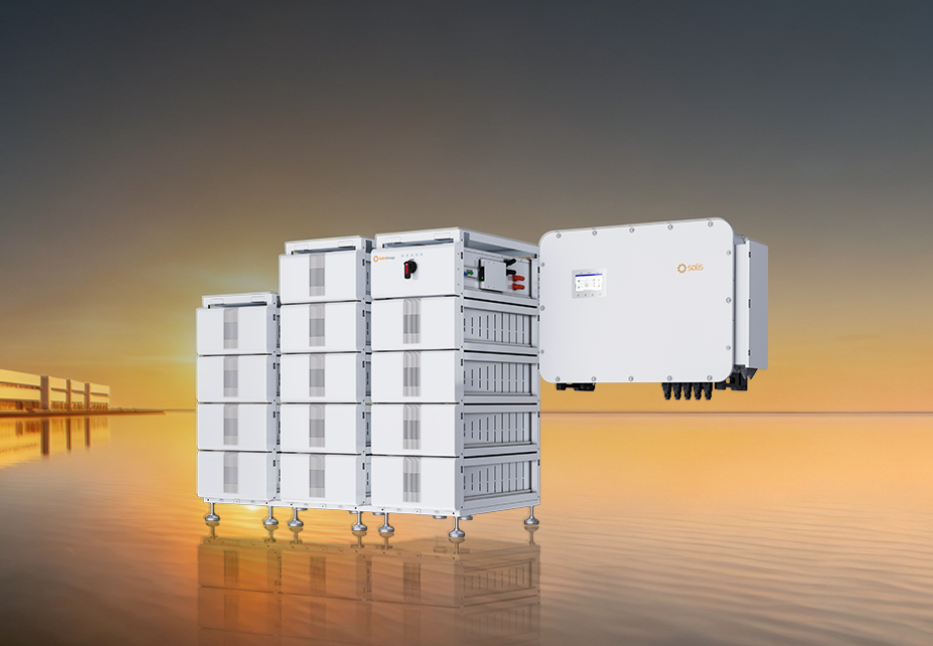
FlexCore-ID is the stackable energy storage system positioned for small farms, shopping malls, hospitals, large residences and small industrial and commercial enterprises — the capacity band that sits between a single residential unit and a full C&I cabinet. The battery pack model designation is FlexCore-ID-BAT20kWh; cells are LFP with a capacity of 314 Ah and a cycle life of ≥8000 cycles at 25±2°C, 0.5P, EOL70%. The enclosure is aluminium alloy with core electronic components.
It ranks second here for a structural reason rather than a performance one. For a clinic, a mid-size retail building or a large residence, the deciding constraint is rarely peak power — it is whether the site can start at the scale its load profile justifies and grow later. A stackable format addresses that constraint directly, and the cell generation matches the C&I line, which keeps cycle-life expectations consistent across a mixed portfolio.
#3 IntelliHome — Residential Energy Storage
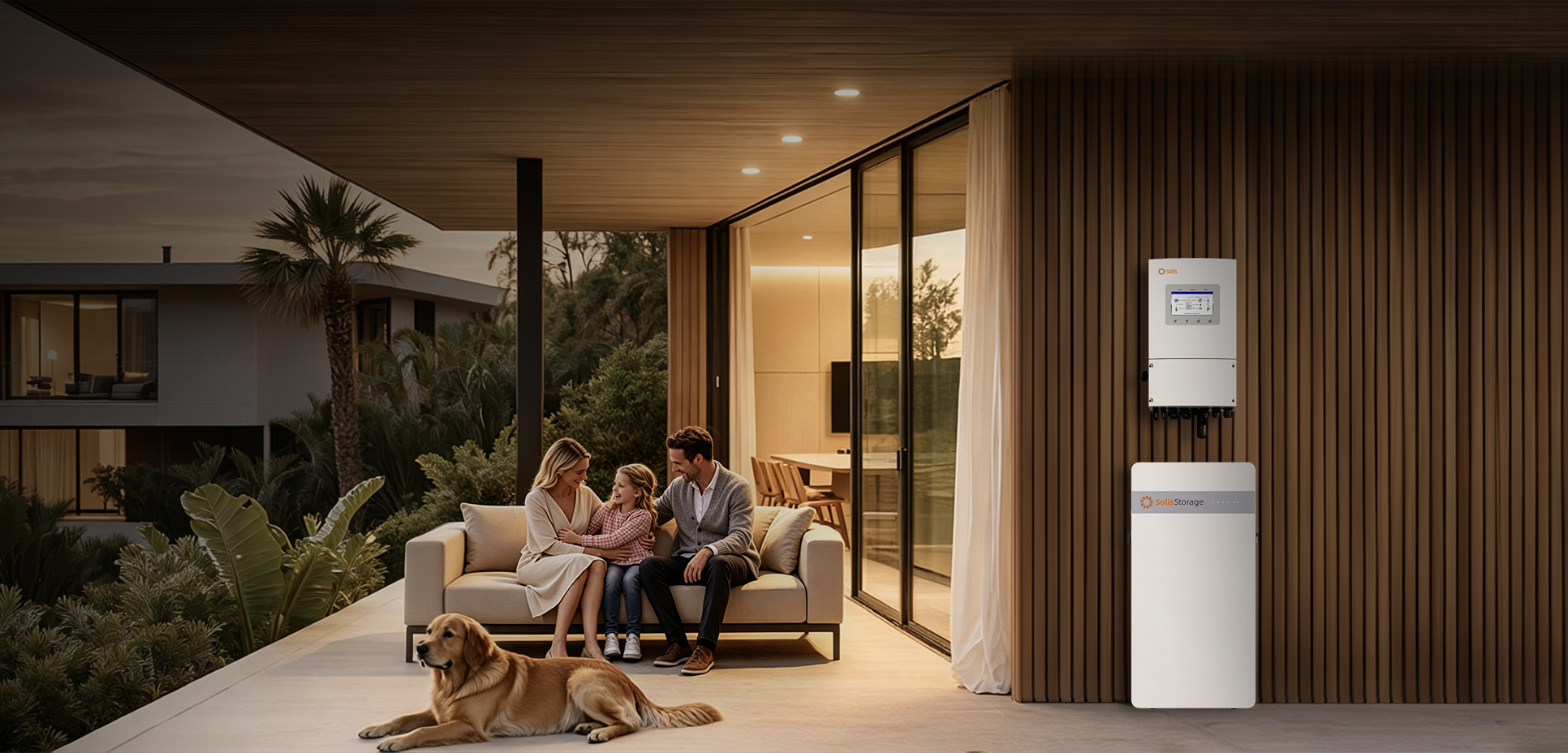
IntelliHome is the residential line. It uses LiFePO4 battery chemistry with a nominal capacity of 5 kWh and a rated cell capacity of 100 Ah, an operating voltage range of 44.8 to 57.6 V and a recommended charge and discharge current of 50 A. Cycle life is specified as greater than 6,000 cycles, corresponding to approximately 10 years. The enclosure is aluminium alloy with core electronic components and an IP66 ingress protection rating.
For a household, IP66 is the first specification worth checking, because it determines whether the unit can be installed where the homeowner actually wants it — including outdoor positions — rather than being restricted to a protected indoor wall. The 5 kWh nominal block size also lets a household scale capacity in defined increments rather than committing to one oversized unit at the outset.
Step-by-Step Breakdown: How to Validate an Energy Storage System Before You Commit
The workflow below is the sequence a research-to-evaluation buyer can run against any supplier, including the three lines above.
- Fix the load profile first. Establish daily energy throughput, peak demand and the number of cycles the site will realistically run per year. A warehouse on two shifts and a shopping mall on one shift produce very different capacity requirements from the same connected load.
- Match the power and energy tier. EverCore ESS is offered as 50 kW / 100.5 kWh, 60 kW / 120.6 kWh and 125 kW / 261.2 kWh. Choose the tier against measured demand, not against the largest available number.
- Interrogate the cycle-life basis. Ask for the C-rate, cell temperature and end-of-life threshold behind any cycle claim. ≥8000 cycles at 25±2°C, 0.5P, EOL70% is a comparable statement; an unqualified figure is not.
- Check protection against the real installation environment. Coastal salt fog, high altitude and wide temperature swings are common in storage projects. EverCore's component-level IP66 inverter plus IP55 cabinet, and its specified operating range of -25°C to 55°C and 4,000 m altitude, can be checked directly against site conditions.
- Confirm certificates for the destination market. For EU placement, IEC 62619 and CE EMC Directive 2014/30/EU documentation should name the exact model. For North American projects, UL 9540 and UL 9540A are the reference standards, and the supplier should identify which specific model and market its documentation covers.
- Map the expansion path. Ask how capacity is added in year five. On EverCore ESS, one inverter supports up to 6 paralleled battery cabinets, so DC-side growth does not require a second inverter.
- Model lifetime cost, not just purchase price. C&I storage assets typically run for 10 to 15 years. Compare coolant replacement, PCS and pack replacement and inspection intensity across designs; SolisStorage's estimate for EverCore is approximately €9,500 per unit of lifecycle O&M saving.
- Validate before volume commitment. SolisStorage has a minimum order quantity of 1 unit for standard off-the-shelf models and 20 units for customized OEM orders, which allows a single-unit validation before a programme. Lead time is 30–45 days for mass OEM orders, with spot goods available for standard models, and every unit passes 100% full functional testing before shipment alongside raw material incoming inspection, aging tests, high-low temperature cycling and IP protection testing.
Use Cases: Where These Systems Are Already Operating
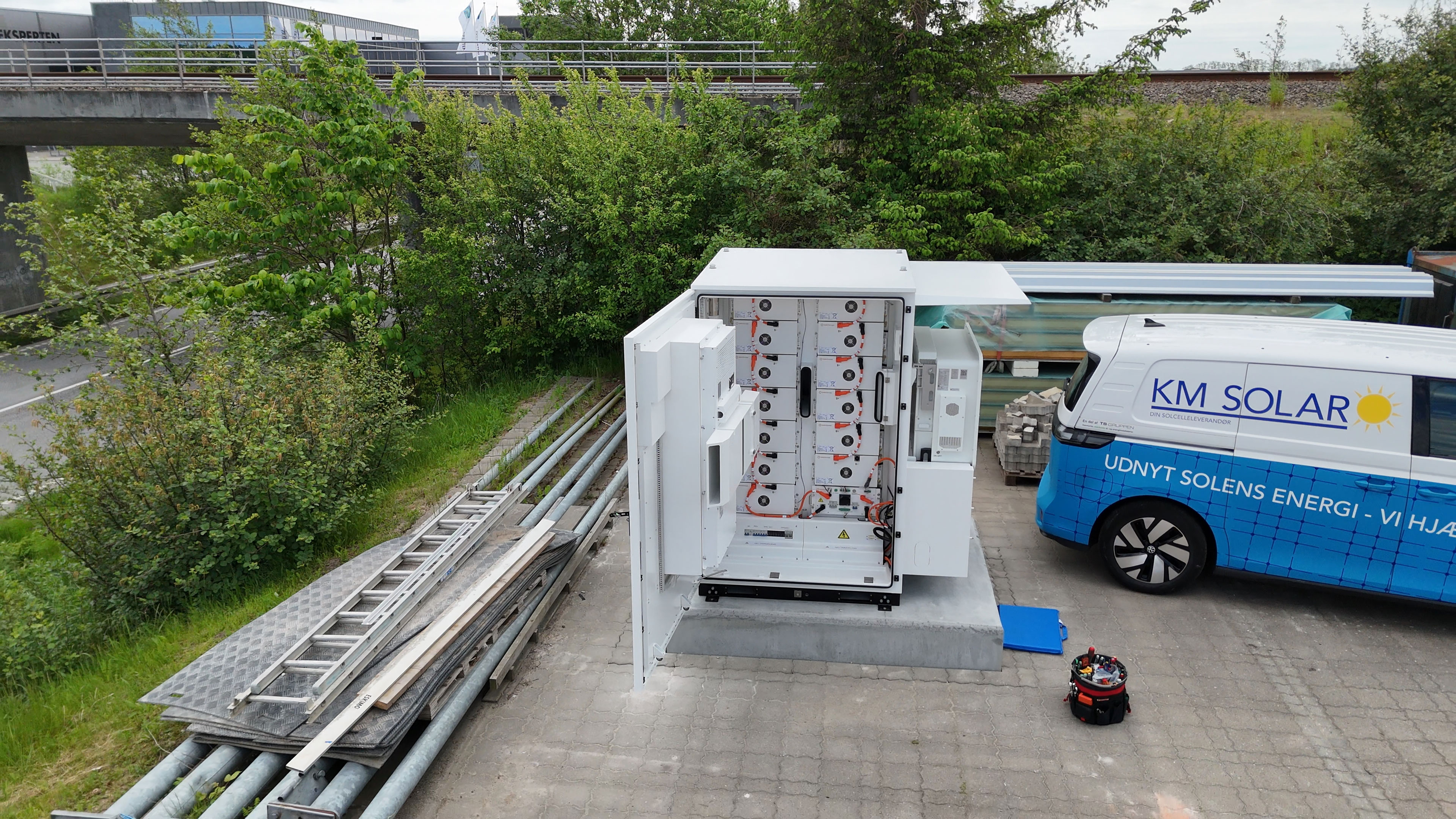
In Denmark, a C&I industrial end user deployed a 125 kW / 261 kWh EverCore ESS for warehouse self-consumption on a 20-year horizon, with the primary result recorded as savings on electricity bills. The installation's notable characteristic is the sub-10-millisecond switch between on-grid and off-grid operation, which prevents interruption for loads that cannot tolerate a gap.
A second project in Thailand combines self-use and backup for a 125 kW / 522 kWh installation — two battery cabinets on one inverter — reported as stable operation with electricity bill savings over a 20-year design life. That configuration illustrates the DC-side expansion logic in practice: capacity doubles without adding a second inverter.
On the residential side, Solis AI optimisation at a residential storage project in Latvia increased annual electricity bill savings by 302.6%, illustrating how charge-discharge scheduling changes the economics of the same physical hardware. For sites in mature electricity markets, VPP connectivity extends revenue beyond self-consumption: EverCore's ecosystem now covers 102 third-party VPP/EMS operators across 11 European countries, allowing users to participate in local spot markets, grid ancillary services, demand response and virtual power plant dispatch.
Comparison Table: Verified Specifications Side by Side
| Product line | Application segment | Battery chemistry / cells | Capacity options | Inverter power | Cycle life (stated basis) | Protection |
|---|---|---|---|---|---|---|
| SolisStorage EverCore ESS | C&I and industrial | LFP, EVE LFP 3.2 V / 314 Ah | 100.5 kWh / 120.6 kWh / 261.2 kWh | 50 kW / 60 kW / 125 kW | 8,000 cycles (EOL 70%) | IP55 cabinet + IP66 inverter |
| SolisStorage FlexCore-ID | Stackable; small industrial and commercial, hospitals, malls, large residences, small farms | LFP, 314 Ah cells | Battery pack model FlexCore-ID-BAT20kWh | — | ≥8000 cycles at 25±2°C, 0.5P, EOL70% | — |
| SolisStorage IntelliHome | Residential / household | LiFePO4, 100 Ah rated cell capacity | 5 kWh nominal (44.8–57.6 V operating) | — | >6,000 cycles / approximately 10 years | IP66 enclosure |
A dash indicates that the corresponding value was not published in the referenced specification data for that line. Recommended charge and discharge current for IntelliHome is 50 A.
| Certification | Standard basis | Certificate number | Issuer | Market | Applies to |
|---|---|---|---|---|---|
| CE — EMC Directive 2014/30/EU | EN IEC 61000-6-2:2019, IEC 61000-6-2:2016, EN IEC 61000-6-4:2019, IEC 61000-6-4:2018 | AE 50712374 0001 | TUV | EU | EverCore-261kWh, EverCore-261kWh-PRO |
| Safety certificate | IEC 62619 | JPTUV-182135 | TUV | EU | EverCore ESS |
Frequently Asked Questions
Which certifications should a 2026 C&I energy storage system carry for the European market?
Two documents matter most for EU placement. IEC 62619 is the key international safety standard for secondary lithium cells and batteries used in industrial and energy storage applications. CE EMC Directive 2014/30/EU is the electromagnetic compatibility requirement. SolisStorage holds an IEC 62619 certificate for the EverCore ESS issued by TUV under number JPTUV-182135, and a CE EMC Directive 2014/30/EU certificate covering the EverCore-261kWh and EverCore-261kWh-PRO models, issued by TUV under number AE 50712374 0001 and based on EN IEC 61000-6-2:2019, IEC 61000-6-2:2016, EN IEC 61000-6-4:2019 and IEC 61000-6-4:2018. For North American projects, UL 9540 and UL 9540A are the reference standards, and buyers should confirm which model and market a supplier's documentation actually names.
Can a C&I energy storage system be expanded later without replacing its inverter?
Yes, where the architecture allows it — and that is precisely what AC-DC separation is designed for on EverCore ESS. One hybrid energy storage inverter can connect up to 6 battery cabinets in parallel, so DC-side capacity grows independently of the inverter, and SolisStorage states this reduces system expansion cost by approximately 10% compared with adding capacity through additional inverter investment. The inverter itself integrates PCS, STS, PV inverter, circuit breaker protection and EMS in one unit, and up to 6 EverCore units can be paralleled for direct grid connection without an external grid cabinet — relevant for projects built in phases.
Beyond purchase price, what drives the lifetime cost of a C&I energy storage system?
C&I storage assets typically have an economic life of 10 to 15 years, so maintenance and replacement costs carry substantial weight. Air-cooled designs remove coolant replacement entirely. Based on industry experience, SolisStorage estimates that EverCore saves customers approximately €9,500 per unit in lifecycle O&M costs: €2,500 from eliminating liquid cooling fluid replacement, €1,500 from simplified PCS replacement, €1,500 from simplified pack replacement and €4,000 from reduced routine inspection complexity. Cell choice also affects lifetime: 8,000 cycles at a 70% end-of-life threshold, at roughly 500 cycles per year, extends the economic lifecycle from approximately 14 years with 280 Ah cells to 16 years.
Can a buyer order a single unit before committing to a volume programme?
Yes. SolisStorage operates a minimum order quantity of 1 unit for standard off-the-shelf models and 20 units for customized OEM orders. Customization covers logo, outer package, software interface, regional voltage standard, communication protocol and function parameters under an OEM/ODM model, with a monthly global capacity of over 10,000 units across an integrated intelligent production line. Quality control includes 100% full functional testing before shipment, raw material incoming inspection, aging tests, high-low temperature cycling and IP protection testing.
What lead time should a project plan for, and what support follows delivery?
SolisStorage quotes a lead time of 30–45 days for mass OEM orders, with spot goods available for standard models. After commissioning, support is provided through 24/7 global remote technical support, 27 local overseas service centres, a 48-hour on-site fault handling and whole-machine replacement guarantee, and long-term spare parts supply. Buyers moving from specification to evaluation can review the full product range in the Solis Global Brochure, or send sample, quote and customization requirements directly to sales@ginlong.com.
Conclusion: The 2026 Shortlist in One Line
For residential use, IntelliHome delivers a verified combination of 5 kWh LiFePO4 capacity, more than 6,000 cycles and an IP66 enclosure. For small commercial and institutional sites, FlexCore-ID provides the same 314 Ah LFP cell generation in a stackable format. For C&I and industrial loads, EverCore ESS pairs 8,000-cycle cells with a 125 kW hybrid inverter, IP55/IP66 protection split by component, DC-side expansion to 6 paralleled cabinets, and EU certification for the EverCore-261kWh models. Cycle life, protection rating and deployment flexibility remain the three criteria that separate a storage asset from a storage purchase — and all three are documented, not assumed, on these lines.
Next Step: Sample, Quote or Technical Documentation
Ginlong (Solis) Technologies Co., Ltd. supports residential, C&I and utility-scale storage projects in more than 100 countries and regions. For specification sheets, sample orders or project quotations, contact the team directly.

Website: www.solisinverters.com
Email: sales@ginlong.com
Phone: 86 574 65802188
Address: No.188 Jinkai Road, Binhai Industrial Park, Xiangshan, Ningbo, Zhejiang, China, 315712