
Energy Storage System Application Guide: Farms, Hospitals, Malls, and Warehouses
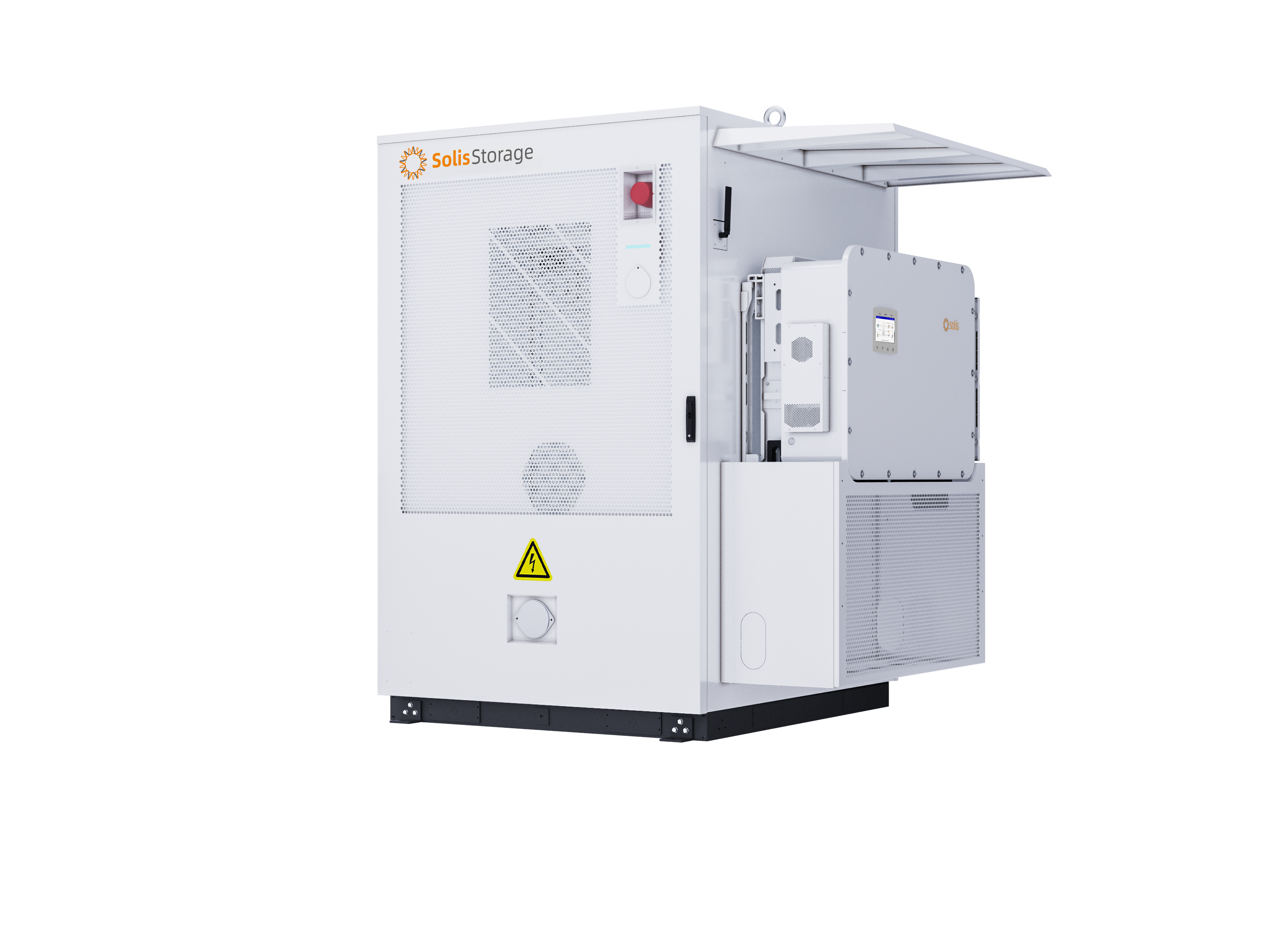
An energy storage system is specified correctly only when the application is defined first. SolisStorage, the energy storage subsidiary of Ginlong (Solis) Technologies Co., Ltd., organises its portfolio around three application tiers: IntelliHome for residential sites, FlexCore-ID for stackable deployments covering small farms, shopping malls, hospitals, large residences, and small industrial and commercial enterprises, and EverCore ESS for commercial and industrial (C&I) and grid-support applications.
This guide maps those three platforms to four project types that dominate early-stage enquiry — farms, hospitals, malls, and warehouses. It explains how capacity, inverter power, protection class, and operating mode are selected for each, and it documents two deployed reference configurations: a 125 kW / 522 kWh self-consumption and backup installation in Thailand, and a 125 kW / 261 kWh warehouse self-consumption project in Denmark with on-grid / off-grid switching in under 10 ms.
Problem Definition: Why Application Fit Decides ESS Sizing
Buyers in the research stage usually arrive with one number in mind: kilowatt-hours. That number answers very little on its own. Whether an energy storage system performs as intended depends on three variables that no single datasheet can resolve — the shape of the load, the resilience requirement, and the physical environment of the site.
Load shape. A warehouse with a large rooftop PV array and a daytime operating shift is chasing self-consumption of PV power: the goal is to store generation that would otherwise be exported and use it during the same operating day. A shopping mall behaves differently — its consumption peaks with HVAC and footfall, so the commercial objective is usually peak load shifting against a demand-based tariff. A hospital runs continuous critical loads around the clock, which makes self-consumption a secondary benefit rather than the primary driver.
Resilience requirement. The tolerance for interruption separates project types far more sharply than capacity does. A precision process or a clinical area cannot accept a long transfer gap, while a warehouse lighting circuit can. This is why transfer time, not capacity, is often the binding constraint in technical specification.
Physical environment. Farms and warehouses are frequently installed outdoors. The application data behind these deployments specifies IP66 and IP55 protection and C5 anti-corrosion certification for household outdoor and industrial outdoor environments, with operation under a wide temperature range, coastal salt fog, and high altitude conditions. A site on a coastal plain and a site at altitude therefore impose different hardware requirements even when their electrical loads are identical.
The practical consequence: the first specification question is not "how many kilowatt-hours", but "which platform does this load, this resilience requirement, and this environment point to".
Industry Background: Demand Is Moving from Product Purchases to Project Fit
Storage demand is expanding quickly enough that application guidance now matters more than product discovery. The global energy storage systems market was valued at approximately USD 668.7 billion in 2024 and is projected to reach USD 5.12 trillion by 2034 (Global Market Insights). Within that total, the residential energy storage market is estimated to grow from USD 2.69 billion in 2024 to USD 4.58 billion by 2030, at a CAGR of 9.3% (MarketsandMarkets), while the long-duration energy storage (LDES) segment was valued at USD 4.85 billion in 2024 and is expected to grow at a CAGR of 13.6% through 2030 (MarketsandMarkets).
Supply has scaled in parallel. China's exports of lithium-ion batteries for energy storage and non-automotive uses reached over USD 65 billion in 2024, a 51.4% increase from the previous year (Reuters / China Electric Vehicle Industry Technology Innovation Strategic Alliance).
Regulatory frameworks have also narrowed the selection space. IEC 62619 is the key international safety standard for secondary lithium cells and batteries used in industrial and energy storage applications (IEC / TÜV SÜD), and systems entering North America must comply with UL 9540 for system safety and UL 9540A for thermal runaway fire propagation testing (UL Solutions). Buyers therefore evaluate fewer, better-documented options — and compare them against a specific site rather than against a catalogue.
Ginlong (Solis) Technologies Co., Ltd. was established in 2005 and is listed on the Shenzhen Stock Exchange (stock code: 300763), with more than 20 years of experience in power electronics. The company operates a manufacturing facility covering 98,114.69 m2 with an annual production capacity of 80 GW, employs over 5,000 staff including an R&D team of over 1,000 engineers, and exports to more than 100 countries and regions, with export business accounting for 70% of total sales. Solis was ranked first worldwide in residential PV inverter shipments in 2023 and third largest inverter manufacturer globally (Wood Mackenzie), and its energy storage platforms operate across more than 300,000 energy storage sites worldwide.
Detailed Solution: Matching the Platform to the Project Type
IntelliHome — Residential Energy Storage Systems
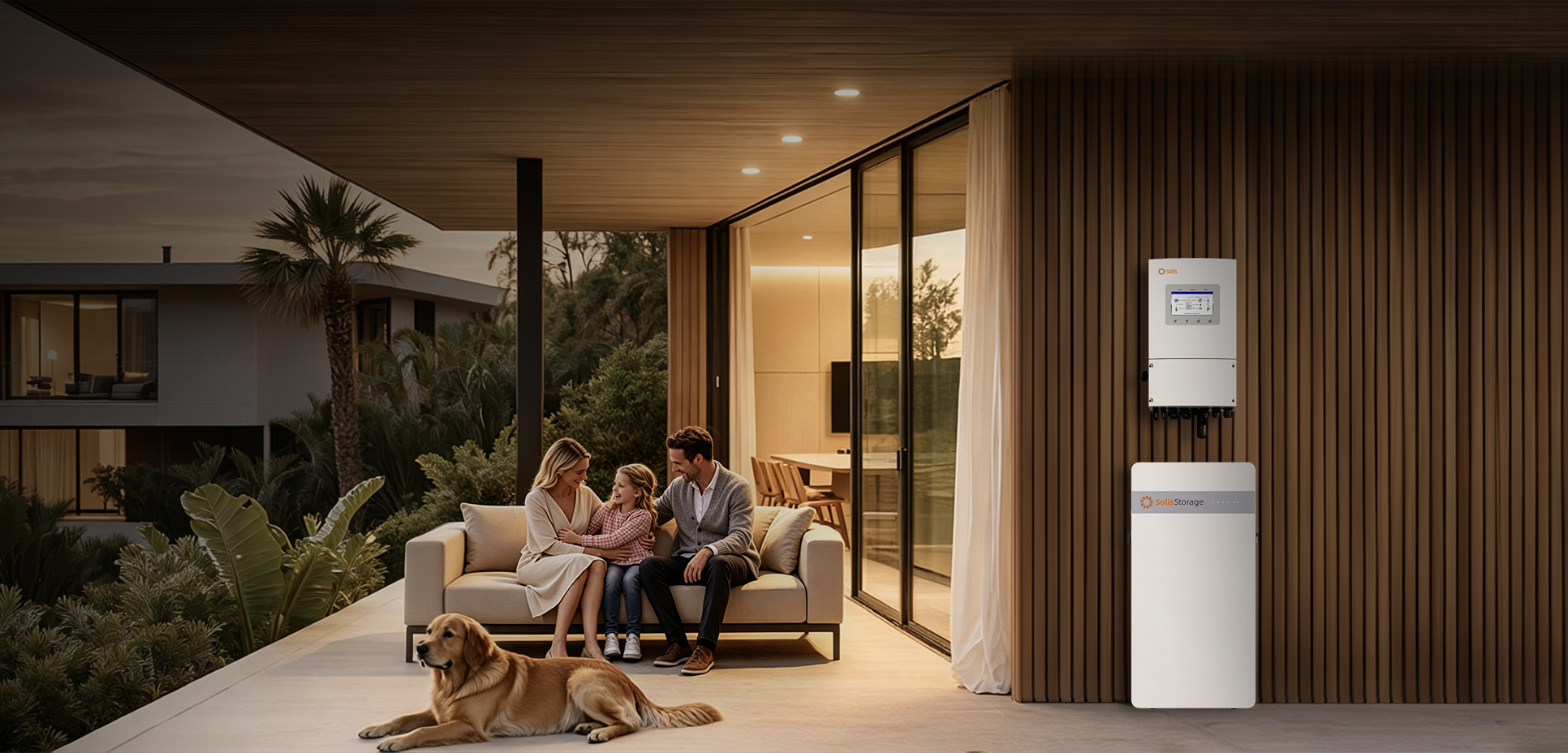
IntelliHome is a residential energy storage system intended for residential and household scenarios. It uses LiFePO4 battery chemistry with a nominal capacity of 5 kWh and an operating voltage range of 44.8 to 57.6 V. The rated cell capacity is 100 Ah, and the recommended charge / discharge current is 50 A. Cycle life is greater than 6,000 cycles, corresponding to 10 years, and the ingress protection rating is IP66. The casing combines an aluminium alloy structure with core electronic components.
For a single large residence, the platform fits projects where the objective is daytime PV self-consumption plus household backup, and where the electrical load is modest enough that a 5 kWh nominal storage block is the correct starting point. Where the load profile is larger — a large residence with high simultaneous demand, or a site that also serves a small commercial function — the sizing question moves to the stackable tier below.
FlexCore-ID — Stackable Systems for Small Commercial and Institutional Sites
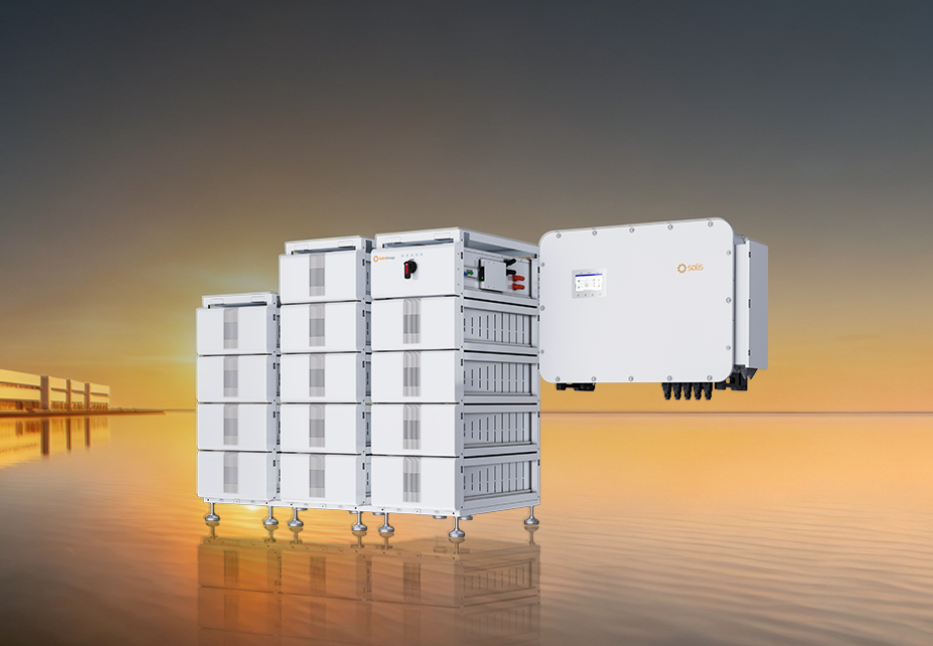
FlexCore-ID is a stackable energy storage system designed for small farms, shopping malls, hospitals, large residences, and small industrial and commercial enterprises. It uses LFP battery chemistry with a cell capacity of 314 Ah and a cycle life of ≥8,000 cycles at 25±2°C, 0.5P, EOL 70%. The battery pack model is FlexCore-ID-BAT20kWh, and the system is constructed with an aluminium alloy casing and core electronic components.
The stackable concept is where the application logic becomes visible. A farm rarely needs its full storage capacity on day one; a hospital or a mall may add capacity as loads change. Because FlexCore-ID is built on a modular battery pack platform, capacity is expanded in increments rather than through a complete system replacement — a structure that matches phased construction and expanding site demand. The 314 Ah LFP cell platform is also shared with the EverCore ESS platform, which simplifies specification and spares planning for buyers operating more than one site type.
EverCore ESS — C&I and Grid-Support Applications
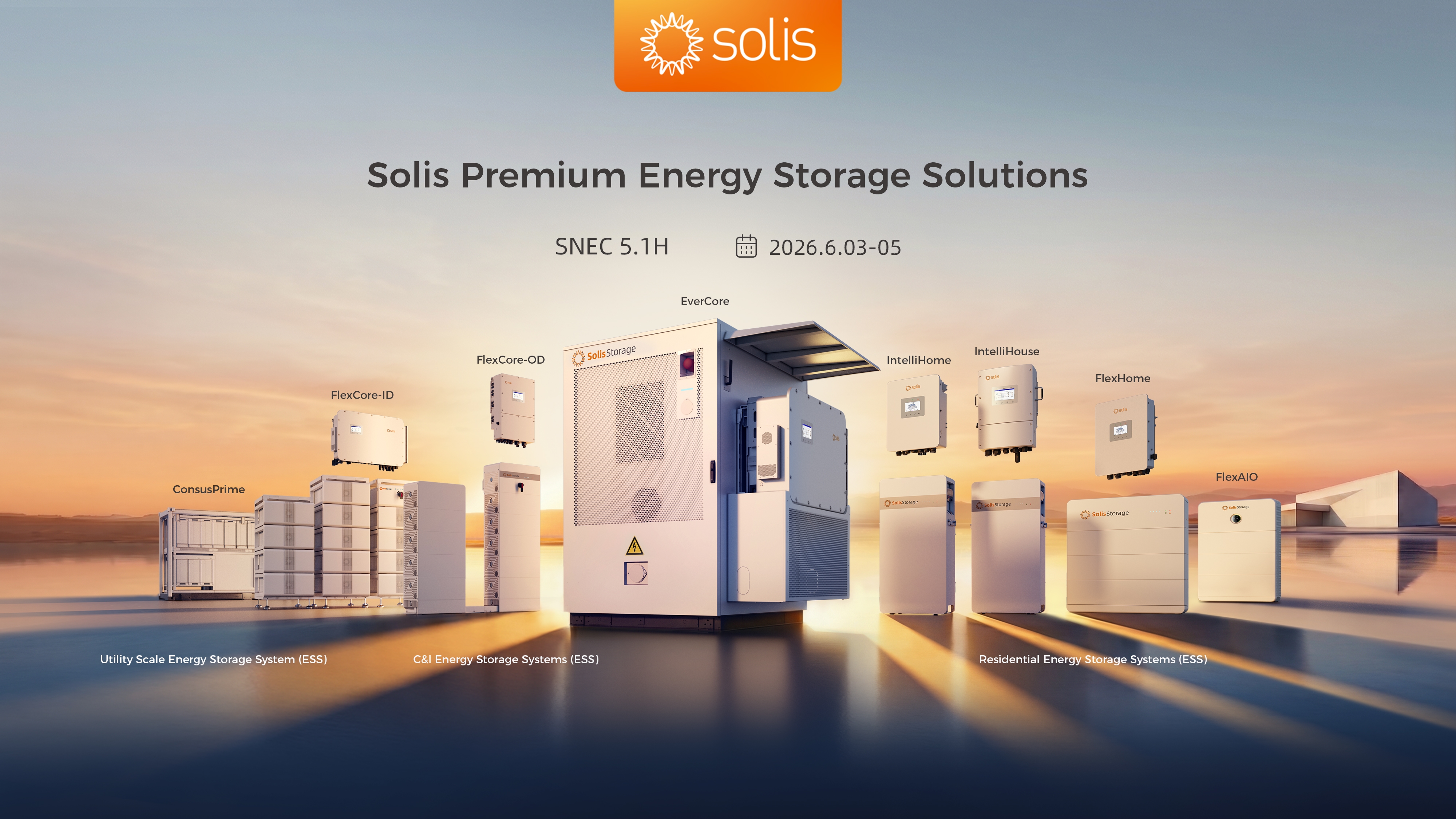
EverCore ESS is a C&I energy storage system designed for commercial and industrial applications within the renewable energy and power grid industry. Available rated energy capacities are 100.5 kWh, 120.6 kWh, and 261.2 kWh, with inverter power ratings of 50 kW, 60 kW and 125 kW. The cell type is EVE LFP 3.2 V / 314 Ah with a cycle life of 8,000 cycles. The cabinet carries IP55 protection and the inverter carries IP66.
Architecture. EverCore separates the AC and DC sides physically, decoupling the hybrid energy storage inverter from the battery cabinet. The 50–125 kW hybrid inverter integrates the PCS (power conversion system), STS (static transfer switch), PV inverter, circuit breaker protection, and EMS (energy management system) into one unit. Practically, this produces three specification outcomes buyers should note:
- Seamless grid-tied / off-grid switching in less than 10 ms without an external STS, which matters where power quality requirements are strict.
- No external PV inverter is required; both DC and AC coupling are supported for existing PV systems, with a PV over-sizing ratio of up to 200%.
- No external grid cabinet is required, and up to six EverCore units can be connected in parallel for direct grid connection.
On the DC side, one inverter can connect up to six battery cabinets in parallel, enabling linear expansion of storage capacity without additional inverter investment — a design that suits industrial and commercial customers with limited initial budgets who need phased construction. Control is handled by a single central controller rather than separate CPUs for BMS, PCS, EMS, and STS, which reduces the number of communication links and simplifies fault location.
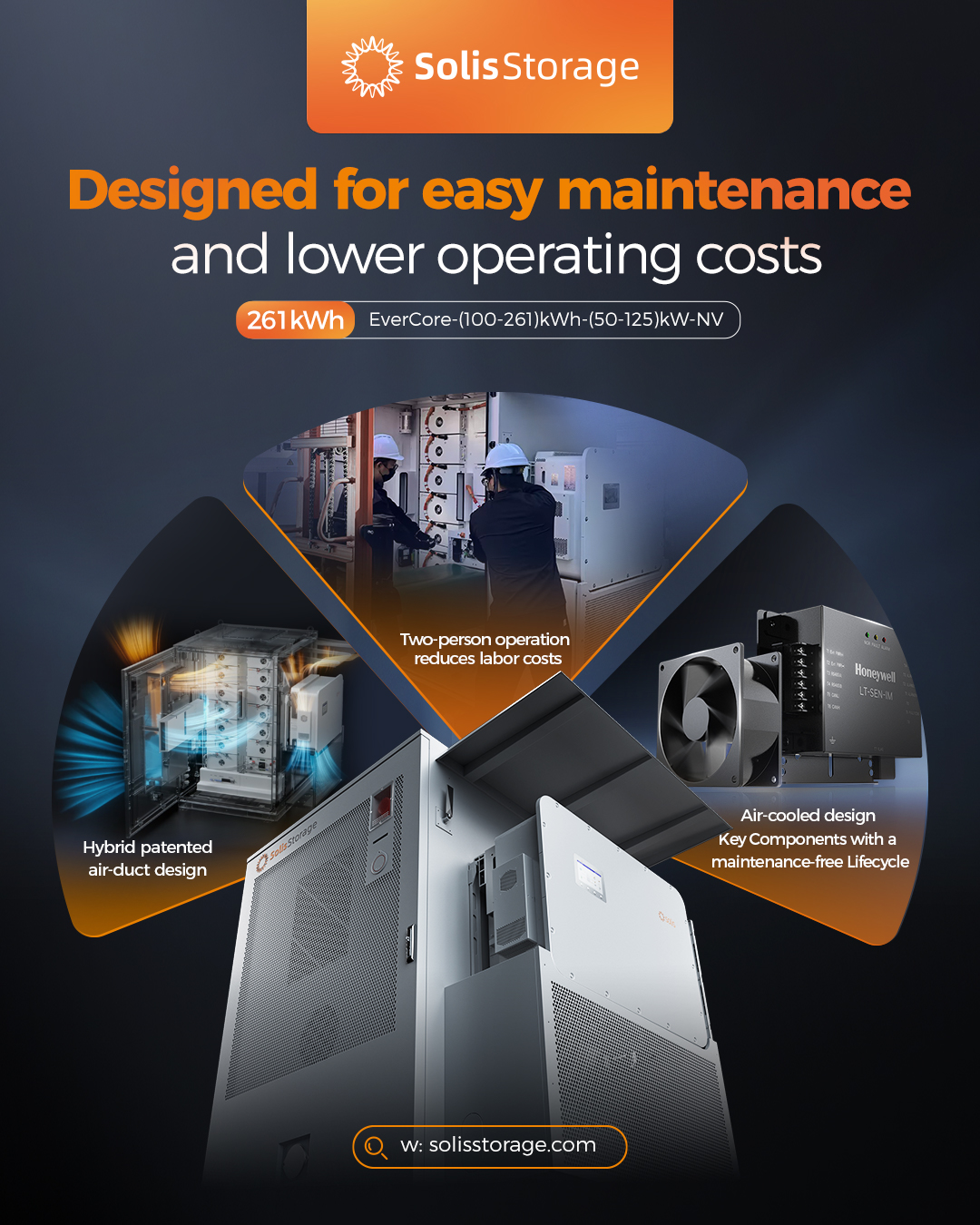
Thermal and environmental envelope. EverCore retains air cooling for the 125 kW / 261 kWh platform, using an independent three-air-duct design that combines a diversion air duct for the inverter with Coanda Effect airflow attachment on the battery pack surfaces. This raises system heat dissipation efficiency by approximately 30% compared with traditional air cooling. Combined with IP66 / IP55 protection and C5 anti-corrosion requirements for outdoor installation, the system operates across a temperature range of -25°C to 55°C and at altitudes up to 4,000 metres.
Safety structure. EverCore uses a 15-layer protection system spanning cell, pack, and system level. Thermal insulation materials resistant to 1,000°C are placed between packs to block lateral propagation of thermal runaway, and fire suppression follows a three-stage progressive mechanism: pack-level aerosol, cabinet-level aerosol, and fire-fighting water channels. The A-grade 314 Ah LFP cells used in the platform have an internal resistance of 0.15±0.05 mΩ, lower than the 0.17 mΩ of standard 280 Ah cells, and achieve 8,000 cycles at 0.5C with remaining capacity ≥70%.
Grid services and software openness. Beyond peak load shifting, frequency regulation, and backup power supply, EverCore is designed for participation in grid ancillary services and Virtual Power Plant (VPP) dispatch. The platform has been connected, or is in the process of connecting, with 102 third-party VPP / EMS operators across 11 European countries, including integration with the Kraken energy management platform under Octopus Energy in the UK market and mainstream aggregator platforms such as Check Watt in the Nordic market. The Solis AI Cloud Platform has been deployed at more than 5,500 energy storage power stations worldwide and integrates Nordpool wholesale and Flatpeak retail price data for dynamic charge-discharge optimisation.
Step-by-Step Breakdown: Sizing and Mode Selection in Six Steps
The sequence below converts a site description into a buildable configuration. It applies to all three platforms, though steps three to five only become available at EverCore scale.
- Profile the load and the tariff. Separate daytime generation, daytime load, and peak-demand windows. This determines whether the commercial objective is self-consumption of PV power, peak load shifting, or both.
- Classify the resilience requirement. Decide whether the site needs grid-tied operation only, off-grid capability, or seamless backup switching. Hospital and precision-process sites usually resolve here.
- Select the capacity tier. For EverCore ESS, choose from 100.5 kWh, 120.6 kWh, or 261.2 kWh, and note that a single inverter can connect up to six battery cabinets in parallel if the project will be built in phases.
- Match inverter power. Select 50 kW, 60 kW or 125 kW to align with the site's maximum simultaneous demand and PV coupling approach. The hybrid inverter already contains the PCS, STS, PV inverter, breaker protection, and EMS.
- Choose the operating mode. Confirm whether the system will run grid-tied, off-grid, or with seamless backup switching, and whether it will operate 24/7 continuously. Where switching speed is critical, EverCore switches in under 10 ms without an external STS.
- Verify the site envelope. Check temperature range, coastal salt fog exposure, altitude, and required anti-corrosion class. Outdoor industrial sites specify IP66 and IP55 protection with C5 anti-corrosion certification, and the deployment must be planned with LFP batteries, monitoring sensors, and the Solis AI smart energy management platform.
Decision rule in one line: residential load and residential backup → IntelliHome; small farm, mall, hospital, large residence, or small industrial / commercial site with phased capacity → FlexCore-ID; larger C&I load, grid-support duty, or VPP participation → EverCore ESS.
Use Cases: Two Deployed Reference Configurations
Thailand — 125 kW / 522 kWh for Self-Consumption and Backup
The Thai deployment installed a 125 kW / 522 kWh system combining self-consumption and backup power supply. The configuration illustrates how the three variables interact in a single project: the inverter rating defines the site's power capability, the battery capacity defines how long self-consumption and backup can be sustained, and the DC-side expansion capability of the platform allows battery capacity to grow beyond the initial power rating without replacing the inverter. For buyers planning phased investment, this is the pattern to study — power first, energy capacity in stages.
Denmark — 125 kW / 261 kWh Warehouse with Sub-10 ms Switching
The Danish project is a 125 kW / 261 kWh warehouse installation whose primary objective is self-consumption, with on-grid / off-grid switching completed in under 10 ms. A warehouse profile suits this design well: PV generation and load both occur during the operating day, so the value comes from consuming stored generation rather than exporting it. The sub-10 ms transfer matters because it determines whether the site's equipment rides through a grid event without an interruption that would be visible to sensitive loads.
Read together, the two projects show that warehouses and industrial sites are typically sized around self-consumption and switching performance, while sites with continuous critical load are sized around backup duration and transfer speed. Neither decision can be made from a capacity figure alone.
Comparison Table: Platform Fits at a Glance
| Platform | Designed application | Chemistry & cell | Capacity options | Cycle life | Protection |
|---|---|---|---|---|---|
| IntelliHome | Residential / household | LiFePO4, 100 Ah rated cell capacity | 5 kWh nominal | >6,000 cycles / 10 years | IP66 |
| FlexCore-ID | Small farms, shopping malls, hospitals, large residences, small industrial and commercial enterprises | LFP, 314 Ah cell | Stackable pack platform; battery pack model FlexCore-ID-BAT20kWh | ≥8,000 cycles at 25±2°C, 0.5P, EOL 70% | Aluminium alloy casing with core electronic components |
| EverCore ESS | C&I, renewable energy and power grid industry | EVE LFP 3.2 V / 314 Ah | 100.5 kWh / 120.6 kWh / 261.2 kWh | 8,000 cycles | IP55 cabinet + IP66 inverter |
| Project type | Typical primary objective | Platform path |
|---|---|---|
| Farm | Self-consumption with backup; outdoor exposure to salt fog, temperature range and altitude | FlexCore-ID (small farm) → EverCore ESS as load grows |
| Hospital | Backup power supply continuity and switching performance | FlexCore-ID → EverCore ESS for larger loads |
| Shopping mall | Peak load shifting against demand-based tariffs | FlexCore-ID → EverCore ESS for C&I scale |
| Warehouse | Self-consumption of PV power, with on-grid / off-grid switching | EverCore ESS (C&I) |
Platform assignments above reflect the designed application ranges stated for each SolisStorage product family and the two deployed configurations described in this guide.
FAQ
1. What protection and anti-corrosion ratings does an outdoor energy storage system need?
For household outdoor and industrial outdoor environments, the required scenario specification is IP66 and IP55 protection together with C5 anti-corrosion certification, with operation under a wide temperature range, coastal salt fog, and high altitude. On EverCore ESS, the battery cabinet is rated IP55 and the inverter is rated IP66, and the system operates from -25°C to 55°C and at altitudes up to 4,000 metres. Where the project targets regulated markets, IEC 62619 is the key international safety standard for secondary lithium cells and batteries in industrial and energy storage applications, and North American market access requires compliance with UL 9540 for system safety and UL 9540A for thermal runaway fire propagation testing.
2. How does the system maintain supply during a grid outage?
EverCore ESS integrates the PCS, STS, PV inverter, circuit breaker protection, and EMS into a single hybrid inverter unit and performs seamless grid-tied / off-grid switching in less than 10 ms without an external STS. The system operates in grid-tied mode, off-grid mode, and seamless backup switching, supporting 24/7 continuous operation. This is the mechanism behind the Danish warehouse deployment, where a 125 kW / 261 kWh system combines self-consumption with on-grid / off-grid switching under 10 ms.
3. What drives the lifetime cost of a C&I energy storage system?
Initial capital expenditure is only part of the calculation, because C&I projects typically have an asset lifecycle of 10 to 15 years. Based on industry experience, the EverCore configuration saves approximately €9,500 per unit in O&M costs over the full project lifecycle, made up of €2,500 from eliminating liquid cooling fluid replacement, €1,500 from simplified PCS replacement, €1,500 from simplified pack replacement, and €4,000 from reduced routine inspection complexity. Component selection reinforces this: Minebea cooling fans are rated for 10-year maintenance-free operation, and Honeywell industrial-grade flammable gas detectors are rated for 10-year calibration-free operation. Cell economics also matter — at 0.5C the 314 Ah LFP cells achieve 8,000 cycles, which at 500 cycles per year extends the economic lifecycle from roughly 14 years to 16 years.
4. Can a configuration be validated before full deployment?
Yes — the practical route is to send the project's load profile, site conditions, and target operating mode to the SolisStorage technical team, who will review the configuration and discuss sample and quotation arrangements. Requests can be sent to sales@ginlong.com or by phone on +86 574 65802188, and the Solis Global Brochure provides the platform overview used for initial scoping: download the brochure (PDF).
5. What information shortens project scoping and lead time?
Five inputs typically determine how quickly a configuration can be returned: the site's temperature range, coastal salt fog exposure and altitude with the required anti-corrosion class; the load profile including daytime generation and peak demand windows; the required operating mode (grid-tied, off-grid, or seamless backup switching); the target capacity tier and inverter power from the available 100.5 / 120.6 / 261.2 kWh and 50 / 60 / 125 kW options; and whether the site will participate in grid ancillary services or VPP dispatch. On VPP participation, EverCore has been connected or is in the process of connecting with 102 third-party VPP / EMS operators across 11 European countries, and the Solis AI Cloud Platform is deployed at more than 5,500 energy storage power stations worldwide.
Conclusion
Application fit, not capacity, is the deciding variable in energy storage specification. IntelliHome covers residential and household requirements with LiFePO4 chemistry, 5 kWh nominal capacity and IP66 protection. FlexCore-ID covers small farms, shopping malls, hospitals, large residences, and small industrial and commercial enterprises with a stackable LFP platform built on 314 Ah cells and a ≥8,000-cycle rating. EverCore ESS covers C&I and grid-support work with 100.5 / 120.6 / 261.2 kWh capacity options, 50 / 60 / 125 kW inverter ratings, IP55 cabinet and IP66 inverter protection, sub-10 ms switching, and an open software ecosystem for VPP participation.
The two reference deployments reinforce the same logic: the Thai 125 kW / 522 kWh installation combines self-consumption and backup, while the Danish 125 kW / 261 kWh warehouse project pairs self-consumption with on-grid / off-grid switching under 10 ms. In both cases, sizing started from the load, the resilience requirement, and the physical site — the sequence this guide set out in six steps.

Next step: share your site conditions, load profile, and target operating mode, and the SolisStorage team will review the configuration and discuss sample and quotation arrangements.
Email: sales@ginlong.com | Phone: +86 574 65802188 | Website: www.solisinverters.com | Download the Solis Global Brochure (PDF)
Ginlong (Solis) Technologies Co., Ltd., No.188 Jinkai Road, Xiangshan, Ningbo, Zhejiang, China 315712.
Have Questions or Need More Details?
Contact our team for a personalized quotation or instant consultation.
Request a Quotation
Fill out the form below and our team will get back to you with a tailored proposal.
WhatsApp Direct Chat
Prefer to chat in real-time? Message us on WhatsApp for instant assistance & quick answers.
- Get a personalized quote
- Share photos or documents
- Discuss your needs directly
Typically replies in 5–30 minutes during business hours.