
Energy Storage System Head-to-Head: EverCore vs. FlexCore-ID
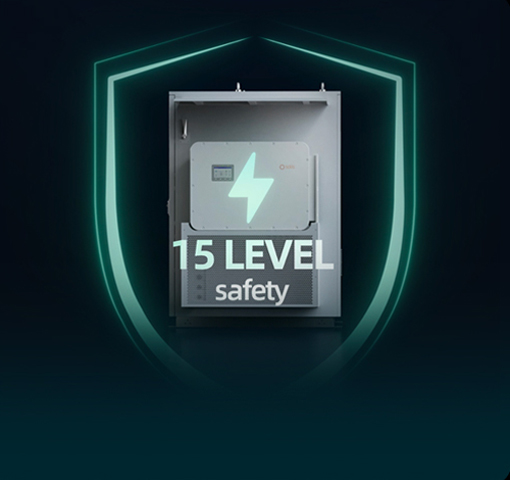
Two energy storage paths inside the same SolisStorage portfolio can both look correct on a single-line diagram. EverCore ESS is a commercial and industrial (C&I) energy storage system built around a 50/60/125 kW hybrid energy storage inverter paired with a 100.5 kWh, 120.6 kWh or 261.2 kWh battery cabinet. FlexCore-ID is a stackable energy storage system built on 314 Ah LFP cells arranged in 20 kWh battery packs, aimed at small commercial, institutional and large-residential sites.
Both use LFP chemistry. Both are specified at 8,000 cycles. The difference between them is not the cell — it is how much power the site needs at one moment, how much capacity it expects to add later, and where the equipment has to survive for the next decade.
This head-to-head compares the two paths against the four criteria that decide most projects: load profile, backup versus self-consumption goals, scalability, and installation environment. It then adds the layer that usually decides the next ten years of a project — service, software and supply continuity.
Why This Decision Outlasts the Equipment Quote
A C&I energy storage project is typically planned around a 10 to 15 year asset lifecycle. Capital expenditure is visible at approval stage. Operating expenditure is not. Owners compare quotes line by line, then discover that the harder cost sits in fluid replacement schedules, pack replacement logistics, inspection hours and the availability of spare parts five years after commissioning.
Choosing between EverCore ESS and FlexCore-ID is therefore not a two-line-item comparison. It is a choice between two operating models:
- EverCore ESS assumes a fixed, power-dense load centre. The site knows roughly how much power it needs, wants that power delivered from one integrated block, and expects capacity to be added later on the DC side rather than by installing a second power block.
- FlexCore-ID assumes an incremental site. Demand grows in small steps, the available footprint is limited, and the owner would rather buy 20 kWh now than commit to a cabinet-scale capacity that will sit idle for two years.
Mismatching these two models is the most common and most expensive error in storage procurement. A 20 kWh step-growth design installed on a site with a concentrated industrial load will hit its power ceiling long before it hits its energy ceiling. A cabinet-scale C&I system installed on a site that only ever needed small capacity will deliver returns on unused capacity for the whole asset life.
Decision rule: size the power block first, then size the energy. Power determines what the site can actually back up and switch. Energy determines how long it can do it. The two systems in this comparison differ more in power architecture than in cell chemistry.
Where the Energy Storage Market Stands in 2026
The context for this decision has changed materially. BloombergNEF's energy storage market outlook projects global annual energy storage deployment, excluding pumped hydro, to reach 92 GW in 2025. In the United States, the Solar Energy Industries Association reported that the U.S. energy storage industry installed 57.6 GWh of new capacity in 2025, described by the publisher as the largest year of new additions on record.
Standards have moved at the same pace. ANSI/CAN/UL 9540:2023 covers energy storage systems intended to receive and store energy for delivery to loads or the local or area electric power system, and its scope explicitly includes both residential and non-residential installations. In practice, that means a single procurement team may now be evaluating a residential-scale stack and an industrial cabinet under the same safety framework.
What this means for a project team is straightforward. Energy storage is no longer a pilot category with loose specification habits. It is a procurement category with familiar selection pressures — power, capacity, protection, expansion path and service coverage — and those pressures diverge sharply between an industrial site with a concentrated high-power load and a smaller site that grows capacity in 20 kWh steps.
The Two Paths in the SolisStorage Portfolio
SolisStorage is the energy storage subsidiary of Ginlong (Solis) Technologies Co., Ltd. (Shenzhen Stock Exchange: 300763), a company founded in 2005 whose portfolio spans residential, commercial and industrial, and utility-scale energy storage. Solutions are deployed in more than 100 countries and regions, operating across diverse grid conditions and climates.
EverCore ESS — a C&I energy storage system for fixed, high-power sites
EverCore ESS is offered in 100.5 kWh, 120.6 kWh and 261.2 kWh battery cabinet configurations with 50 kW, 60 kW or 125 kW hybrid energy storage inverter options, using LFP chemistry. The hybrid energy storage inverter is IP66 rated; the battery cabinet is IP55.
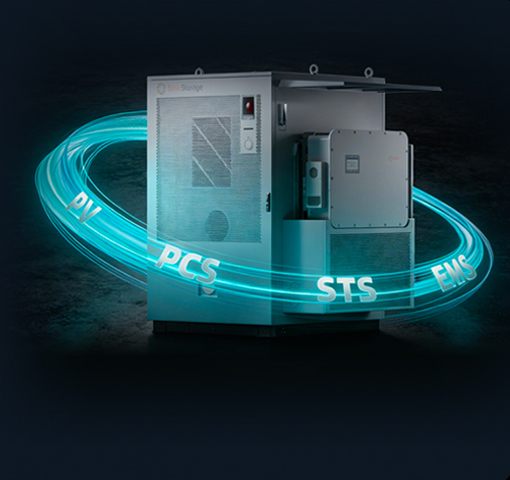
Its defining architectural choice is AC–DC separation: the hybrid energy storage inverter sits on the AC side as an independent unit, and the battery cabinet sits on the DC side. That physical split produces three practical effects.
Thermal separation. The inverter dissipates roughly 6 kW of power heat directly into ambient air, leaving about 3.5 kW of electrochemical heat to be managed inside the battery cabinet. That allows an air-cooled design to approach the cell temperature uniformity of liquid-cooled systems. Combined with an independent three-air-duct design and a Coanda Effect airflow attachment technique on the battery pack surface, SolisStorage reports a 30% improvement in heat dissipation efficiency compared with traditional air cooling.
Protection separation. Because the inverter is a separate unit, it can carry an IP66 rating while the cabinet carries IP55. SolisStorage's engineering assessment puts the resulting reduction in full-lifecycle failure rate at 50%. The cabinets are also specified with C4-grade anti-corrosion coating, operation from −25°C to 55°C, and altitude tolerance up to 4,000 m.
Structural separation. One inverter can connect up to six battery cabinets in parallel, so storage capacity grows linearly on the DC side without an additional inverter purchase. SolisStorage reports that this design reduces system expansion costs by approximately 10%.
On the power side, the 125 kW hybrid inverter integrates PCS, static transfer switch, PV inverter, circuit breaker protection and EMS into one unit. It supports grid-tied to off-grid switching in under 10 ms without an external STS, supports both DC and AC coupling of existing PV systems, allows a PV over-sizing ratio of up to 200%, and removes the need for an external grid cabinet. Up to six EverCore units can be paralleled for direct grid connection. A single central controller manages the whole system through one control core, which reduces the number of communication links and simplifies fault location compared with distributed multi-CPU topologies.
FlexCore-ID — a stackable energy storage system for phased and smaller sites
FlexCore-ID is built on LFP cells rated at 314 Ah, arranged in 20 kWh battery packs, with a rated cycle life of at least 8,000 cycles at 25±2°C, 0.5P, to end-of-life 70%. Its stackable 20 kWh pack format targets small commercial, institutional and large-residential sites where capacity is added in small increments rather than in one cabinet-sized step.
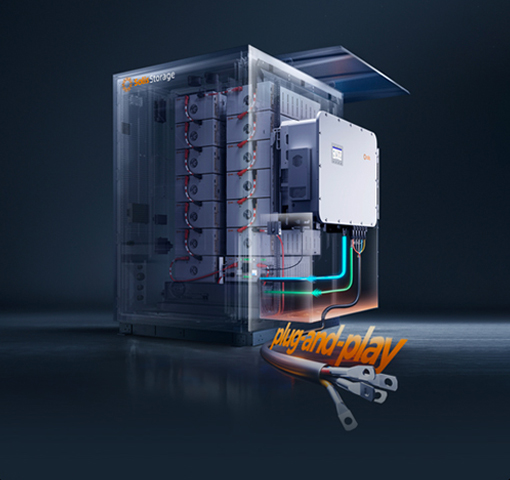
Because both systems use LFP chemistry and 314 Ah class cells, the chemistry conversation is not the differentiator. What changes is the format. EverCore ESS pairs a fixed outdoor cabinet with a matched power block. FlexCore-ID's design point is module-by-module growth on sites where the load, the budget or the available footprint arrives in stages.
EverCore ESS vs. FlexCore-ID: Head-to-Head Specification View
The table below compares only the specifications published in the SolisStorage reference set. Cells marked with a dash are not published for that model in this reference set and should be confirmed against the project-specific datasheet before sign-off.
| Decision criterion | EverCore ESS | FlexCore-ID |
|---|---|---|
| Intended site type | Commercial and industrial | Small commercial, institutional and large-residential |
| Battery chemistry | LFP | LFP |
| Cell capacity class | A-grade 314 Ah LFP cells | 314 Ah |
| Battery pack / cabinet capacity | 100.5 / 120.6 / 261.2 kWh | 20 kWh per battery pack |
| Inverter power options | 50 / 60 / 125 kW | — |
| Rated cycle life | 8,000 cycles at 0.5C, remaining capacity ≥70% | ≥8,000 cycles at 25±2°C, 0.5P, EOL 70% |
| Protection ratings | IP66 inverter / IP55 battery cabinet, C4-grade anti-corrosion | — |
| Operating environment | −25°C to 55°C, altitude up to 4,000 m | — |
| Scaling model | Up to 6 battery cabinets per inverter; up to 6 units in parallel | Stackable 20 kWh battery packs |
| Grid / off-grid switching | Under 10 ms, without external STS | — |
| Typical build-out rhythm | Single-stage, fixed capacity with DC-side expansion | Phased, incremental capacity |
Read across the table and the pattern is clear: the two columns differ most on power and expansion rhythm, and least on chemistry and cycle life. That is the opposite of how many procurement scorecards are built.
A Five-Step Site Fit Framework
Installers and EPC teams can shorten the selection process by working through five questions in order. Each question eliminates one path or confirms it.
Step 1 — Read the load profile, not the annual consumption
Annual kilowatt-hours tell you how much energy a site moves. They do not tell you what the site can switch. The relevant figure is the simultaneous peak load that must be carried during a grid event. A site whose peak demand sits near or above the 50 kW to 125 kW inverter band belongs on the EverCore ESS path, where the power block is integrated and switching happens in under 10 ms. A site whose peak demand is modest but whose daily energy consumption is what drives the bill belongs on the FlexCore-ID path, where capacity is added in 20 kWh steps.
Step 2 — Separate backup from self-consumption
Backup and self-consumption pull the specification in different directions. If the primary goal is uninterrupted operation for precision equipment, the inverter's switching behaviour and transient performance matter more than total capacity. EverCore ESS is specified for grid-tied to off-grid switching in under 10 ms without an external static transfer switch, which is the relevant figure for industrial equipment that will not tolerate a longer interruption. If the primary goal is bill reduction through daily charge and discharge cycles, then usable energy, cycle life and round-trip losses drive the decision — and both paths are specified at 8,000 cycles, so the choice returns to capacity granularity and installed cost.
Step 3 — Decide how capacity will grow
Phased construction changes the economics. EverCore ESS allows one inverter to serve up to six battery cabinets in parallel, so a site can start with one cabinet and add DC-side capacity later without buying another inverter. SolisStorage reports that this reduces system expansion costs by approximately 10%. FlexCore-ID approaches the same problem from the other end, adding capacity in 20 kWh pack steps. The question to answer honestly is whether the next capacity increment is closer to 20 kWh or to a full cabinet, and how many years away it is.
Step 4 — Match the installation environment
Outdoor sites, coastal air, dust, high ambient temperatures and altitude all narrow the field. EverCore ESS is specified with an IP66 hybrid energy storage inverter, an IP55 battery cabinet, C4-grade anti-corrosion coating, operation from −25°C to 55°C and altitude tolerance to 4,000 m. Where a site is indoors, climate-controlled and small, those ratings are not the binding constraint — available footprint and incremental capacity are.
Step 5 — Price the lifecycle, not the cabinet
A C&I storage asset is planned over 10 to 15 years, and both paths have been designed with that horizon in mind. SolisStorage estimates that EverCore saves approximately €9,500 per unit in operation and maintenance costs over the full project lifecycle — €2,500 from eliminating liquid cooling fluid replacement, €1,500 from simplified PCS replacement, €1,500 from simplified pack replacement, and €4,000 from reduced routine inspection complexity. Component selection reflects the same logic: Minebea cooling fans are specified with 10-year maintenance-free performance, and Honeywell industrial-grade flammable gas detectors are specified as 10-year calibration-free. Replacement handling is also simplified — the PACK is lighter, replacement steps are reduced by 55%, and two technicians can complete the task with specialised tools without heavy lifting equipment.
For an installer, this matters commercially as much as technically. A design that a two-person crew can service with hand tools converts a multi-day site visit into a short call-out, which changes the service margin on the whole contract.

Where Each Path Fits: Practical Use Cases
EverCore ESS fits sites where the load is concentrated and the risk of downtime is expensive. Documented application areas include industrial manufacturing, low-carbon industrial parks, hospitals, cold chain logistics, small-scale agriculture, and on-grid and off-grid applications. These are sites where a single integrated power block, protection ratings that survive outdoor mounting, and DC-side expansion without a second inverter purchase all matter at once.
FlexCore-ID fits sites where capacity arrives in stages. Small commercial premises, institutional buildings and large residences typically start with a modest backup or self-consumption requirement and grow it as tariffs change, as additional loads are added, or as the site's PV array is expanded. A stackable 20 kWh pack format lets the owner match spend to need instead of pre-purchasing capacity.
There is also a hybrid scenario worth naming: an industrial park or a multi-building campus where a central EverCore ESS serves the high-power load and smaller FlexCore-ID stacks serve auxiliary buildings. Both systems share LFP chemistry and a common service organisation, so the operating model stays consistent across the site.
The Long-Term Layer: Service, Software and Supply Continuity
For a 10 to 15 year asset, the hardware decision is the first decision, not the last. Three long-term layers separate a workable installation from a durable one: market access for the software, service coverage for the hardware, and supply continuity for spare parts.
Software and market access. EverCore operates in an open software ecosystem. It has been connected, or is in the process of connecting, with 102 third-party VPP and EMS operators across 11 European countries. Representative integrations include the Kraken energy management platform under Octopus Energy in the UK market, aggregator platforms such as Check Watt in the Nordic market, and dozens of local EMS providers across the German-speaking region and Benelux. Solis' self-developed AI Cloud Platform has been deployed at more than 5,500 energy storage power stations worldwide and integrates Nordpool wholesale price data with Flatpeak retail price data to build a multi-source price forecasting model. In a residential storage project in Latvia, Solis AI optimisation increased annual electricity bill savings by 302.6%.
Service coverage. After-sales support includes 24/7 global remote technical assistance, 27 local overseas service centers, 48-hour on-site fault handling with a whole-machine replacement guarantee, and long-term spare parts supply. For an owner comparing two paths in the same portfolio, this is identical service coverage under one organisation — an important simplification when a site mixes both models.
Quality and supply continuity. Every unit undergoes a 100% full functional test before shipment, alongside raw material incoming inspection, aging test, high-low temperature cycle test and IP protection test. Monthly production capacity is over 10,000 units globally. Typical production lead time is 30–45 days for mass OEM orders, with spot goods available for standard models.
Frequently Asked Questions
What protection ratings and operating conditions do EverCore ESS and FlexCore-ID support?
EverCore ESS separates its AC and DC sides, so protection is rated per unit: the hybrid energy storage inverter is IP66, meaning dust-tight and protected against powerful water jets, while the battery cabinet is IP55. The cabinets are specified with C4-grade anti-corrosion coating and operate from −25°C to 55°C at altitudes up to 4,000 m. For North American projects, ANSI/CAN/UL 9540:2023 is the applicable safety standard for energy storage systems, and its scope covers both residential and non-residential installations. Protection ratings for FlexCore-ID are confirmed per project configuration.
How far can each system scale after commissioning?
EverCore ESS scales on the DC side first: a single hybrid energy storage inverter can connect up to six battery cabinets in parallel, and up to six EverCore units can be paralleled for direct grid connection without an external grid cabinet. SolisStorage reports that this design reduces system expansion costs by approximately 10%. FlexCore-ID scales in 20 kWh battery pack increments, which suits sites that add capacity in small, frequent steps rather than in one large block. In both cases the expansion path should be defined before the first order, because it determines the site layout, cabling and protection scheme.
Which path has the lower long-term operating cost?
SolisStorage estimates that EverCore saves customers approximately €9,500 per unit in operation and maintenance costs over the full project lifecycle — €2,500 from eliminating liquid cooling fluid replacement, €1,500 from simplified PCS replacement, €1,500 from simplified pack replacement, and €4,000 from reduced routine inspection complexity. Supporting component choices include Minebea cooling fans specified with 10-year maintenance-free performance and Honeywell industrial-grade flammable gas detectors specified as 10-year calibration-free. For FlexCore-ID, the equivalent lifecycle cost depends on how many 20 kWh increments the site actually deploys, so the comparison is best run against a specific load profile rather than against list specifications alone.
Can a project be validated before a full order is placed?
Yes. The minimum order quantity is 1 unit, and delivery terms are FOB Ningbo or EXW (Ex Works) factory delivery. Acceptance criteria are factory acceptance testing plus on-site installation and commissioning. Payment terms follow a deposit, payment before or after shipment, and a final acceptance payment, with specific terms depending on customer tier, order size and regional policy. Commissioning acceptance is the point at which the installed system is handed over against the agreed performance conditions.
What is the production lead time, and what support continues after commissioning?
Typical production lead time is 30–45 days for mass OEM orders, with spot goods available for standard models; monthly production capacity is over 10,000 units globally. After commissioning, support includes 24/7 global remote technical assistance, 27 local overseas service centers, 48-hour on-site fault handling with a whole-machine replacement guarantee, and long-term spare parts supply. To map either path against an actual load profile, you can download the Solis global brochure or reach the SolisStorage team directly at sales@solisstorage.com.
Conclusion: Match the Power Block to the Site, Then Let the Portfolio Do the Rest
The EverCore ESS versus FlexCore-ID decision resolves more cleanly than most head-to-head comparisons, because the two systems do not compete on chemistry. Both use LFP cells in the 314 Ah class. Both are specified at 8,000 cycles. The divergence sits in three places: the power block, the expansion rhythm, and the environment the equipment has to survive.
Choose EverCore ESS when the site has a concentrated peak load that needs an integrated 50/60/125 kW hybrid inverter, an IP66 inverter and IP55 cabinet for outdoor mounting, operation from −25°C to 55°C, and a DC-side expansion path that adds up to six battery cabinets per inverter. Choose FlexCore-ID when the site is small commercial, institutional or large-residential, and when capacity genuinely arrives in 20 kWh steps rather than in cabinet-sized blocks.
Whichever path is chosen, the same long-term layer applies: open third-party VPP and EMS integration, an AI scheduling platform deployed across thousands of stations, 24/7 remote support backed by 27 overseas service centers, 48-hour on-site fault handling, and long-term spare parts supply. That shared layer is what makes the comparison a genuine portfolio decision rather than a vendor decision.
Compare Both Paths Against Your Own Load Profile
Send the site's peak load, daily energy profile, backup requirement and installation environment, and the SolisStorage team will indicate which energy storage system path fits — and how the capacity should be staged over the next ten years.
Brochure: Solis Global Brochure V3.9 (PDF)
Email: sales@solisstorage.com
Website: www.solisinverters.com
Have Questions or Need More Details?
Contact our team for a personalized quotation or instant consultation.
Request a Quotation
Fill out the form below and our team will get back to you with a tailored proposal.
WhatsApp Direct Chat
Prefer to chat in real-time? Message us on WhatsApp for instant assistance & quick answers.
- Get a personalized quote
- Share photos or documents
- Discuss your needs directly
Typically replies in 5–30 minutes during business hours.