
Fixed vs. Stackable BESS: EverCore vs. FlexCore-ID Decision Guide
Integrators rarely lose money on the first phase of a commercial and industrial (C&I) storage project. They lose it on the second phase — when the site load has grown, the original enclosure is already full, and the only way to add capacity is to buy a second inverter or build a second power conversion path.
That is why the choice between a fixed-capacity battery energy storage system and a stackable one is a procurement decision, not an engineering footnote. It sets the price of changing your mind.
Problem Definition: The Second-Phase Problem in C&I Storage Sizing
Most storage projects are approved against a load profile captured in a single year. Sites, however, do not stay still. A warehouse adds refrigerated space. A factory adds a night shift or a second production line. A retail site adds EV chargers. Within three to five years, the peak demand that justified the original design has moved.
Two failure modes follow, and both are expensive:
- Oversizing at day one. The system is built for a peak that will not arrive for years. Capital sits in cells that cycle less than they could, and the project's return is diluted by idle capacity.
- Undersizing with a rigid architecture. The system fits today's load precisely, but when the load grows, expansion requires a second inverter, a second AC connection, or a full enclosure replacement — not just more batteries.
The variable that separates these outcomes is expansion granularity: how small a step the architecture allows you to take when capacity has to increase. Everything else — footprint, protection rating, inverter sizing — is downstream of that single number.
There is also a trap in the way quotes are compared. Upfront capital expenditure is the most visible number in a storage evaluation and the least complete. A C&I storage asset typically operates for 10 to 15 years, during which maintenance, component replacement and inspection labour accumulate. Two systems with similar nameplate capacity and similar purchase prices can diverge substantially once lifecycle operating cost is included.
Industry Background: Why Scalability Became a Procurement Criterion
Storage is no longer a pilot category. BloombergNEF projected that global annual energy storage deployment, excluding pumped hydropower, would reach 92 GW in 2025 — an all-time high. In the United States, the Solar Energy Industries Association reported that the storage industry installed 57.6 GWh of new capacity in 2025, describing it as the largest year of new additions on record.
Growth at that scale changes what buyers optimise for. When storage was a demonstration asset, the question was whether a system would work. Now that storage is a routine capital line item, the question is how it behaves across a ten-year horizon — including the years after the original design assumption stops being true.
This is where the supplier's own architecture philosophy matters. Ginlong (Solis) Technologies Co., Ltd. (Shenzhen Stock Exchange: 300763) was founded in 2005 and manufactures solar inverters and energy storage systems; SolisStorage is its dedicated energy storage subsidiary, with in-house development across PCS, EMS and system integration. Wood Mackenzie ranked the company #1 globally in residential inverter shipments in 2023, and it reported 100 GW of cumulative global shipments as of June 2024 — a scale base that shapes how it designs C&I systems.
Two product philosophies sit inside that portfolio. EverCore ESS is an integrated, fixed-capacity C&I system that expands at cabinet level. FlexCore-ID is a stackable design built from 20 kWh packs, expanding at pack level. They solve the same category of problem with different granularity.
Detailed Solution: Two Architectures, Two Expansion Logics
EverCore ESS: Separation Outside, Integration Inside
EverCore's defining decision is the physical separation of AC and DC: the hybrid energy storage inverter (AC side) is decoupled from the battery cabinet (DC side), with each component in its own dedicated space. This is the core architectural difference relative to alternatives such as Huawei, Sigen and SolaX, and it produces three consequences that a project planner can actually price.
Thermal separation. Because the inverter sits outside the battery cabinet, roughly 6 kW of power-stage heat dissipates directly into ambient air, leaving only about 3.5 kW of electrochemical heat to be managed inside the cabinet. That thermal headroom is what allows an air-cooled system to reach temperature uniformity close to liquid-cooled designs. EverCore's air-cooling design combines a patented diversion air duct for the inverter with Coanda-effect airflow attachment across battery pack surfaces, improving heat dissipation efficiency by 30% compared with traditional air cooling.
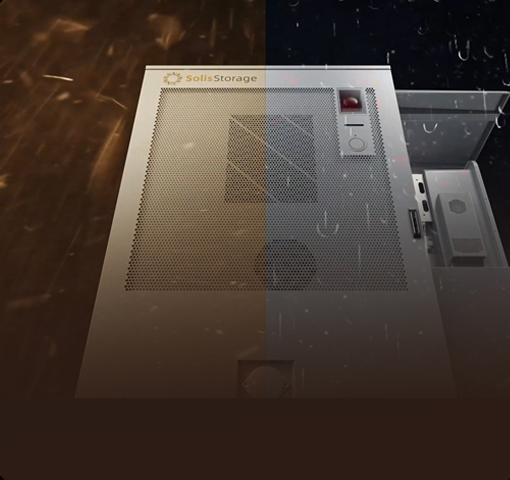
Protection separation. As an independent unit, the hybrid inverter achieves an IP66 rating — dust-tight and protected against powerful water jets — while the battery cabinet maintains IP55. The combined system carries C4-grade anti-corrosion coating and operates from −25 °C to 55 °C at altitudes up to 4,000 m. Based on its field experience, Solis has concluded that this separated protection design reduces full-lifecycle failure rate by 50%.
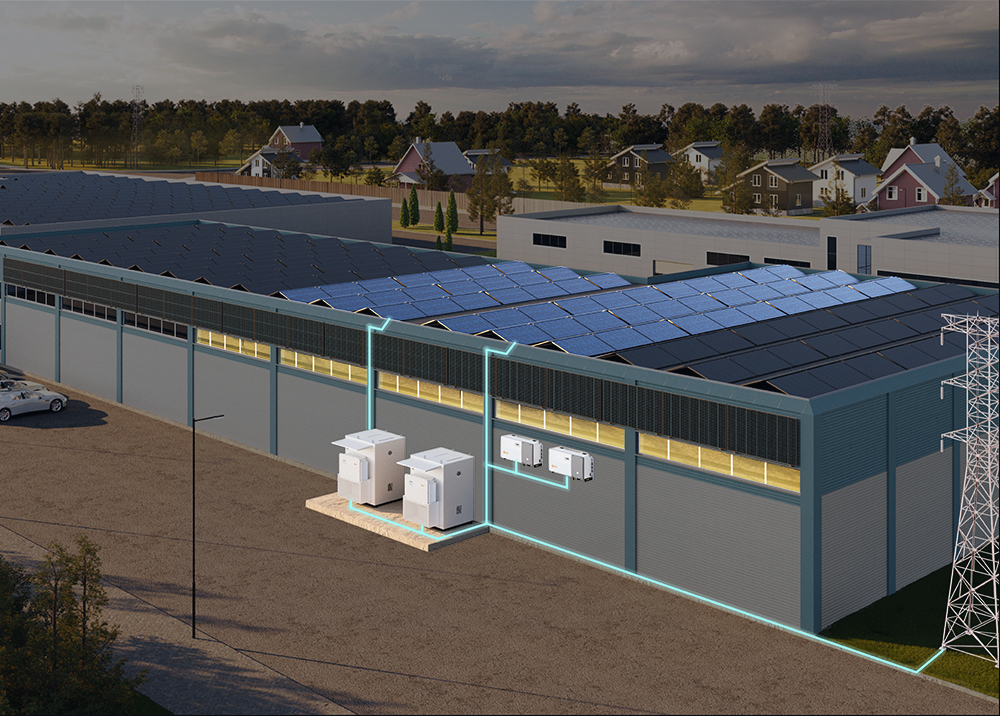
Structural separation. This is the scalability lever. A single EverCore inverter can connect up to six battery cabinets in parallel, so storage capacity expands linearly without additional inverter investment — a design Solis estimates reduces system expansion cost by approximately 10%. Up to six EverCore units can also be paralleled for direct grid connection without an external grid cabinet.
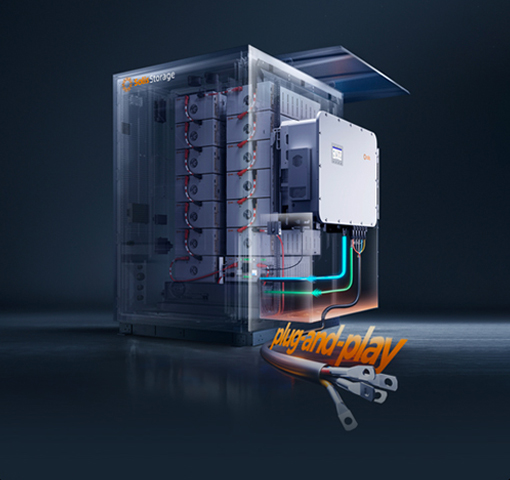
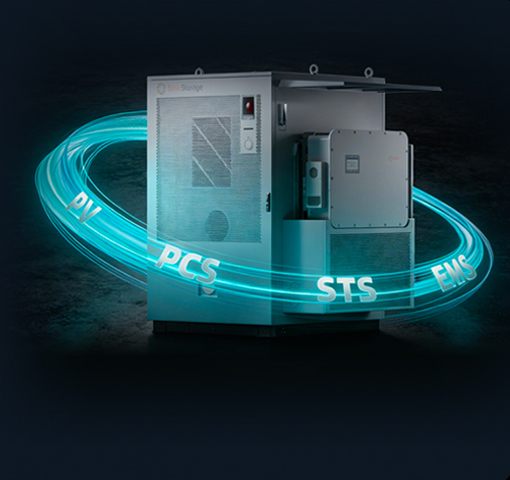
Inside that architecture sits a fully integrated four-in-one power electronics package: a 50–125 kW hybrid energy storage inverter combining PCS, static transfer switch (STS), PV inverter, circuit breaker protection and EMS in one unit. The practical consequences for a project are specific:
- Seamless grid-tied to off-grid switching in less than 10 ms, without an external STS — relevant where precision industrial equipment cannot tolerate a transfer gap.
- No external PV inverter is required, and both DC and AC coupling are supported for existing PV arrays, with a PV over-sizing ratio of up to 200%.
- No external grid cabinet is required, which simplifies the construction procedure and reduces the number of interfaces the integrator has to coordinate.
Control architecture follows the same logic. Traditional systems distribute independent CPUs across BMS, PCS, EMS and STS, creating a multi-brain topology with protocol compatibility and latency risk, and requiring joint troubleshooting across multiple vendors. EverCore uses a single central controller that schedules the whole system, reducing failure points and shortening fault location and response time.
FlexCore-ID: Granularity as the Design Principle
FlexCore-ID takes the opposite route. Rather than integrating everything into one fixed enclosure and expanding by cabinet, it builds capacity from 20 kWh packs using 314 Ah cells, so a project can add storage in small steps at the point of installation.
The distinction matters when the first-phase load is genuinely small. If a site's day-one demand justifies only a modest capacity, a pack-level architecture lets the initial investment sit closer to actual demand, and each subsequent increment is sized against measured consumption rather than a forecast. The trade-off is a different footprint logic: instead of one integrated cabinet, space is consumed incrementally as packs are added, and siting and enclosure protection have to be validated for each stack position.
Neither approach is universally superior. EverCore wins on integration density, protection architecture and coordinated single-controller operation; FlexCore-ID wins on granularity of change. The decision framework below is designed to make that trade-off explicit before a purchase order is issued.
Step-by-Step Breakdown: A Five-Step Selection Sequence
Step 1 — Define the load horizon, not the load snapshot
Model the site at three points: today, year five and year ten. If the year-ten projection is a multiple of today's peak, the project needs an expansion path, not a single fixed rating. If the year-ten projection is within the cabinet steps the architecture permits, a fixed-capacity design is usually simpler and cheaper to engineer.
Step 2 — Choose the expansion granularity
Convert the growth curve into steps. EverCore expands at cabinet level, with a single inverter supporting up to six battery cabinets in parallel. FlexCore-ID expands at pack level in 20 kWh increments. Ask one question: how much capacity would be stranded if each expansion step had to be twice as large as the actual need?
Step 3 — Test the footprint against the site, including the second phase
Physical space is often the binding constraint, and it is the constraint most often evaluated only for phase one. An integrated architecture concentrates the footprint and removes external equipment, which can release space elsewhere in the plant room. A pack-based architecture distributes the footprint and grows with each added pack. Plan both phases on the same site drawing before signing.
Step 4 — Verify the electrical and environmental boundary
Confirm what has to be bought outside the storage system itself. Requires an external STS? Requires an external PV inverter? Requires an external grid cabinet? Each external component adds procurement, installation and a future failure point. Then check the environment: EverCore's IP66 inverter and IP55 battery cabinet, C4 anti-corrosion coating, −25 °C to 55 °C range and 4,000 m altitude capability cover sites from Middle East high-temperature deserts to cold European locations. Sites outside that envelope need a different specification discussion entirely.
Step 5 — Price the lifecycle, not the quotation
Compare total cost of ownership across the full operating period, not the invoice. Solis estimates that EverCore saves approximately €9,500 per unit in O&M cost over a full project lifecycle by eliminating liquid-cooling fluid replacement (€2,500), simplifying PCS replacement (€1,500), simplifying pack replacement (€1,500) and reducing routine inspection complexity (€4,000). Component selection supports the same logic: Minebea industrial cooling fans are specified for 10-year maintenance-free operation, and Honeywell industrial-grade flammable gas detectors are specified as 10-year calibration-free, avoiding annual recalibration cost. On the service side, the pack is lighter and replacement steps are reduced by 55%, so two technicians can complete the task with specialised tools and no heavy lifting equipment.
Cell choice feeds the same calculation. EverCore uses A-grade 314 Ah LFP cells developed for C&I duty. Internal resistance is 0.15±0.05 mΩ, below the 0.17 mΩ of standard 280 Ah cells, and every 10% reduction in internal resistance cuts charge-discharge heat generation by roughly 20% — thermal risk managed at the electrochemical source. At a 0.5C charge-discharge rate the cell achieves 8,000 cycles with remaining capacity ≥70%, roughly 14% above the 7,000 cycles of a traditional 280 Ah cell. At 500 cycles per year, that extends the system's economic lifecycle from approximately 14 years to 16 years.
Step 6 — Check whether revenue can scale, not only capacity
In mature electricity markets, C&I storage revenue has moved beyond peak-valley arbitrage into grid ancillary services (FCR/aFRR/mFRR), demand response and virtual power plant dispatch. Capacity that cannot participate in those markets is capacity that earns less. EverCore is connected, or in the process of connecting, with 102 third-party VPP and EMS operators across 11 European countries — including the Kraken platform under Octopus Energy in the UK, Check Watt in the Nordic market, and dozens of local EMS providers in the German-speaking region and Benelux. The Solis AI Cloud Platform, deployed at more than 5,500 energy storage power stations worldwide, integrates wholesale price data (Nordpool) and retail price data (Flatpeak) to optimise charge-discharge strategy. Either way, confirm the EMS and VPP integration path with your supplier before committing to a configuration.

Use Cases: Which Architecture Fits Which Project
Industrial manufacturing with phased build-out. Production lines are added in discrete blocks, and each block changes the peak. Cabinet-level expansion keeps the inverter investment fixed while capacity grows. For sites with limited initial capital that need phased construction, this design carries particular financial value.
Low-carbon industrial parks. Multiple tenants, staggered onboarding and an existing PV array are the common pattern. DC or AC coupling to existing PV, up to 200% PV over-sizing and no requirement for an external PV inverter simplify the electrical interface.
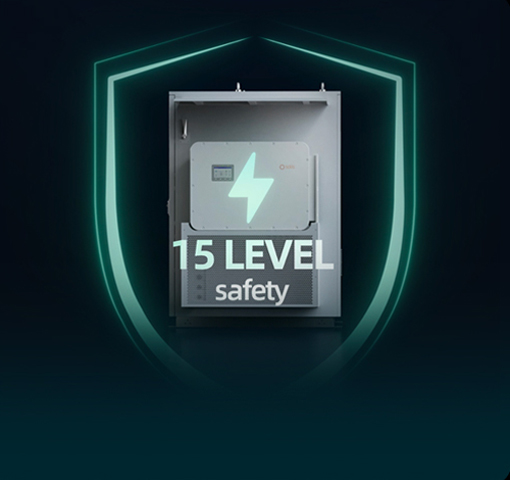
Hospitals and precision facilities. Transfer continuity dominates. Sub-10 ms grid-tied to off-grid switching without an external STS is the relevant specification, together with a three-stage fire suppression design — pack-level aerosol, cabinet-level aerosol and fire-fighting water channels — and 1,000 °C-resistant thermal insulation between packs as part of a 15-layer protection system.
Cold chain logistics. Refrigeration load is continuous and the outdoor environment is often harsh. C4 anti-corrosion coating and the −25 °C to 55 °C operating window reduce the engineering work needed to protect the asset.
Small-scale agriculture and retail sites with uncertain growth. Where first-phase demand is small and the growth path is unclear, pack-level granularity in 20 kWh steps allows the project to start close to measured demand and add capacity as consumption is confirmed, rather than pre-committing capital to a forecast.
On-grid and off-grid hybrid sites. Off-grid capability, PV coupling and parallel operation up to six units are architectural features that apply to both product families' application space; the selection between fixed and stackable should then be driven by expansion granularity and footprint.
Comparison Table: EverCore vs. FlexCore-ID by Decision Criterion
| Decision criterion | EverCore ESS (fixed capacity) | FlexCore-ID (stackable) |
|---|---|---|
| Project profile it suits | Defined load profile with growth expected in cabinet-scale steps; phased industrial build-out | Small or uncertain first-phase load with incremental growth |
| Capacity and power rating | 100–261 kWh; 50–125 kW hybrid energy storage inverter (PCS + STS + PV inverter + breaker protection + EMS in one unit) | Capacity built from 20 kWh packs; system size follows the number of packs deployed |
| Expansion granularity | Cabinet level — one inverter supports up to 6 battery cabinets in parallel; up to 6 units can be paralleled for direct grid connection | Pack level — 20 kWh increments added at the installation point |
| External equipment required | No external STS, no external PV inverter, no external grid cabinet | Confirm the full AC-side and protection equipment schedule for the selected inverter during configuration |
| Footprint planning | Concentrated integrated cabinet footprint; external equipment eliminated | Footprint grows with each added pack; siting must be planned for the final stack, not the first |
| Protection and environment | Inverter IP66, battery cabinet IP55, C4-grade anti-corrosion coating, −25 °C to 55 °C, altitude up to 4,000 m | Validate enclosure protection and siting against the site's environmental conditions for every stack position before sign-off |
| Cell platform | A-grade 314 Ah LFP cells: internal resistance 0.15±0.05 mΩ; 8,000 cycles at 0.5C with remaining capacity ≥70% | 314 Ah cells |
| Expansion cost logic | Linear DC-side expansion without additional inverter investment; system expansion cost reduced by approximately 10% (Solis estimate) | Incremental capital matched to each added 20 kWh pack |
FAQ: Fixed vs. Stackable BESS Selection Questions
1. What protection and compliance requirements should I verify before choosing between a fixed and a stackable BESS?
Protection should be verified at the level of the individual enclosure, not the system as a whole. On EverCore, the hybrid energy storage inverter carries IP66 protection while the battery cabinet carries IP55, and the system is finished with C4-grade anti-corrosion coating, operating from −25 °C to 55 °C and at altitudes up to 4,000 m. On a stackable configuration, enclosure protection and siting must be validated for each stack position before sign-off. Separately, market access is governed by standards rather than by product claims: ANSI/CAN/UL 9540:2023 covers energy storage systems used in residential and non-residential installations, but that describes the scope of the standard, not the certification status of any specific product. Request the current certification documents for the exact model and configuration you are purchasing.
2. How much capacity can I add later, and does expansion require a second inverter?
On the fixed-capacity EverCore ESS, one hybrid energy storage inverter supports up to six battery cabinets in parallel, so DC-side capacity can be expanded linearly without additional inverter investment — Solis estimates this reduces system expansion cost by approximately 10%. Up to six EverCore units can also be paralleled for direct grid connection without an external grid cabinet. On FlexCore-ID, expansion happens at pack level in 20 kWh increments. The correct question to ask your supplier is not "how much can I add" but "what is the smallest step I can take, and what does that step cost in equipment, labour and downtime."
3. How does the fixed-versus-stackable choice affect total cost over the project lifecycle?
Purchase price is the smallest part of the answer. Solis estimates that EverCore saves approximately €9,500 per unit in O&M cost across a full project lifecycle by removing liquid-cooling fluid replacement (€2,500), simplifying PCS replacement (€1,500), simplifying pack replacement (€1,500) and reducing routine inspection complexity (€4,000). Maintenance design supports that estimate: Minebea industrial cooling fans are specified for 10-year maintenance-free operation and Honeywell flammable gas detectors for 10-year calibration-free operation. Pack handling is also lighter, with replacement steps reduced by 55% so that two technicians can complete the work with specialised tools and no heavy equipment. On the comparison set used in Solis' own product positioning, the platform is stated as offering 5% lower cost than alternatives. Model both architectures across the full operating period before comparing quotations.
4. Can we validate the configuration on a sample or pilot before committing to a full project?
Yes — and for phased projects this is usually the cheapest risk reduction available. A pilot configuration validates three things at once: whether the transfer behaviour matches the site's tolerance (EverCore switches between grid-tied and off-grid operation in under 10 ms without an external STS), whether the thermal management holds under the site's actual duty cycle, and whether the EMS integration path reaches the markets you intend to monetise. Samples, configuration reviews and project quotations can be requested directly from SolisStorage at sales@solisstorage.com.
5. How should we plan delivery and commissioning when the project may expand in later phases?
Plan phase two on the same drawing as phase one. Confirm the equipment boundary first: EverCore requires no external STS, no external PV inverter and no external grid cabinet, which removes three procurement lines and three interfaces from the construction schedule, and up to six units can be paralleled for direct grid connection. Pay attention to the expansion path as well — DC-side expansion is a parallel-connection exercise on the battery cabinet side, so the physical space and cable routing for later capacity should be reserved at the initial installation. Delivery schedules, final pricing and lead times are confirmed per configuration at the quotation stage, so the phase-one equipment list and the phase-two expansion plan should be submitted together.
Next Step: Size the Architecture Against Your Growth Curve
Send SolisStorage your phase-one load profile and your five-year expansion plan. The team will return a configuration recommendation covering the fixed-capacity EverCore ESS, the stackable FlexCore-ID architecture, or a combination — together with the equipment boundary, footprint plan and lifecycle cost logic behind it.
Email: sales@solisstorage.com | WhatsApp: +86 158-5815-3307 | Website: www.solisinverters.com
Download the full product and company documentation: Solis Global Brochure V3.9 (PDF)
Conclusion: Pick the Granularity Your Project Can Afford to Live With
EverCore and FlexCore-ID are not competing answers to the same question. They are two answers to two different questions about change.
EverCore is the right starting point when the load profile is defined, the site environment is demanding, and growth arrives in blocks large enough to justify cabinet-level expansion. Its AC-DC separation architecture keeps 6 kW of inverter heat outside the battery cabinet and leaves only about 3.5 kW of electrochemical heat to manage internally; it delivers IP66 inverter protection and IP55 battery cabinet protection with C4-grade anti-corrosion coating; and it allows a single inverter to drive up to six battery cabinets, with up to six units paralleled for direct grid connection. Combined with 8,000-cycle 314 Ah cells, a single central controller and an ecosystem of 102 third-party VPP and EMS operators across 11 European countries, it is a system designed to be expanded and operated rather than replaced.
FlexCore-ID is the right starting point when the first-phase load is small and the growth path is genuinely uncertain, and when the cost of over-committing capital at day one exceeds the cost of adding capacity in 20 kWh steps. Its value is not raw integration density; it is the option to defer.
SolisStorage is the dedicated energy storage subsidiary of Ginlong (Solis) Technologies Co., Ltd. (Shenzhen Stock Exchange: 300763), a company founded in 2005 whose products are used in more than 100 countries and regions worldwide, with services spanning residential, commercial and industrial, and utility-scale applications. That breadth is the reason both architectures exist in the same portfolio — because the right answer depends on how the project expects to grow, not on which single design is more advanced.
Start with the growth curve. The architecture follows from it.
Have Questions or Need More Details?
Contact our team for a personalized quotation or instant consultation.
Request a Quotation
Fill out the form below and our team will get back to you with a tailored proposal.
WhatsApp Direct Chat
Prefer to chat in real-time? Message us on WhatsApp for instant assistance & quick answers.
- Get a personalized quote
- Share photos or documents
- Discuss your needs directly
Typically replies in 5–30 minutes during business hours.