Stackable ESS for Small Farms and Retail Malls: A Practical Application Guide
Stackable ESS for Small Farms and Retail Malls: A Practical Application Guide
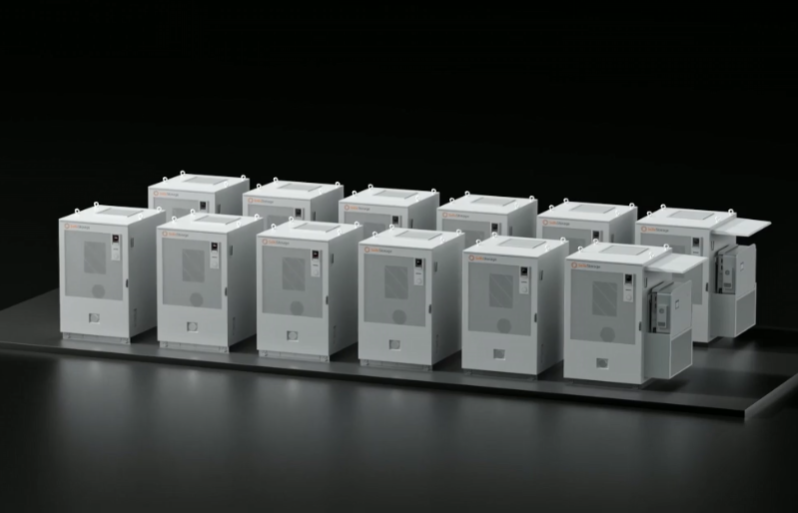
A stackable energy storage system (ESS) lets a site start with one battery cabinet and add capacity later on the same inverter. For a small farm, a shopping mall, a clinic or a small industrial workshop, that one design decision usually decides whether storage gets financed this year or stays in a spreadsheet.
This guide is written for the people who sign off on such projects: farm owners and farm managers, retail facility managers, hospital facility engineers, owners of small industrial plants, and the EPCs and distributors who support them. It covers FlexCore-ID, the stackable energy storage platform from SolisStorage, and explains where a stackable system fits, how to size and deploy one, what a realistic expansion path looks like, and which questions to ask before purchase.
SolisStorage is the energy storage business of Ginlong (Solis) Technologies Co., Ltd. (Shenzhen Stock Exchange: 300763), a manufacturer founded in 2005 whose products are used in more than 100 countries and regions.
The Sizing Problem That Small Farms and Retail Malls Share
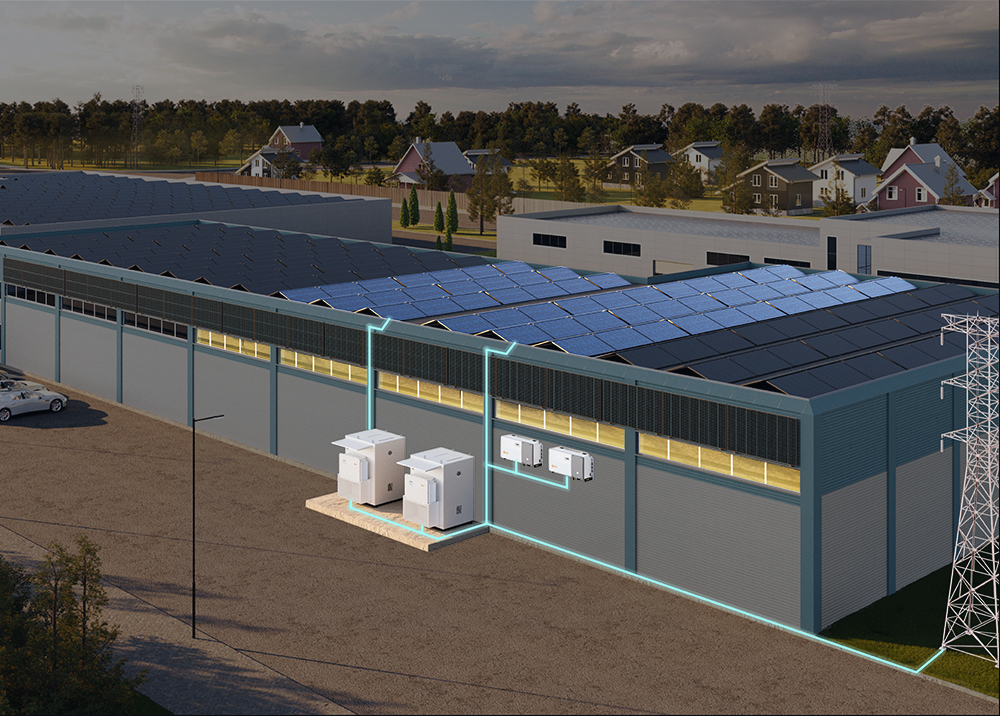
Storage product lines are usually split into three blocks: residential systems for homes, commercial and industrial (C&I) cabinets for factories and large buildings, and utility-scale systems for grid assets. Many small farms, shopping malls, hospitals and small industrial workshops fall into the space between them. Their peak demand is too high for a residential system to be useful, but a full-scale C&I commitment on day one is difficult to justify.
Four problems recur in that gap:
- Capital is released in stages; hardware is not. Farm and retail investments are usually approved in phases, and the second phase often depends on the savings from the first. A fixed-size cabinet forces either an early over-commitment or a separate project later.
- Peaks are short but expensive. In a retail mall the demand peak is driven by HVAC, refrigeration, lighting and escalator load. On a farm it is driven by irrigation pumping and cold-room compressors concentrated into a few hours. Both site types pay for capacity they use briefly.
- Some loads cannot stop. Cold chains, refrigeration, point-of-sale systems and hospital diagnostic equipment need continuity, and any transfer gap becomes a service problem rather than an electrical one.
- The equipment has to survive the site. Storage is often placed outdoors, where coastal salt spray, dust, monsoon rain and seasonal temperature swings are normal. Any architecture that depends on a liquid cooling loop adds a maintenance task that small sites rarely have staff to perform.
Stackable architecture answers the first two problems directly: capacity is bought in cabinets, not in whole systems, and every cabinet is used for peak shifting from the day it is commissioned. The third and fourth problems are answered by the electrical and thermal design of the platform, which is covered in the sections below.
Industry Background: Where Stackable Storage Sits Today
Energy storage has moved from a niche add-on to a mainstream infrastructure category. Global Market Insights valued the global energy storage systems market at approximately USD 668.7 billion in 2024 and projects it to reach USD 5.12 trillion by 2034. That headline figure includes all storage technologies, which is why it is so much larger than battery-only estimates such as the USD 32.62 billion reported by Fortune Business Insights; buyers comparing market forecasts should check the technology scope before drawing conclusions.
The segments closest to the farm and retail case are still growing well on their own. MarketsandMarkets estimates the residential energy storage market will grow from USD 2.69 billion in 2024 to USD 4.58 billion by 2030, a CAGR of 9.3%, while the long-duration energy storage (LDES) market was valued at USD 4.85 billion in 2024 and is expected to grow at a CAGR of 13.6% through 2030. Supply-side momentum is visible as well: China's exports of lithium-ion batteries for energy storage and non-automotive uses reached over USD 65 billion in 2024, a 51.4% increase on the previous year, according to Reuters and the China Electric Vehicle Industry Technology Innovation Strategic Alliance.
Compliance frameworks have matured alongside the market. IEC 62619 is the key international safety standard for secondary lithium cells and batteries used in industrial and energy storage applications. For North America, UL 9540 covers system safety and UL 9540A covers thermal runaway fire propagation testing. In practice, the certification path usually decides which products a site can even consider.
On the supply side, Solis (Ginlong Technologies) was ranked by Wood Mackenzie as the world's number one in residential PV inverter shipments in 2023 and as the third largest inverter manufacturer globally. SolisStorage, the group's energy storage business, builds on that power-electronics base with a portfolio spanning residential energy storage, C&I systems and utility-scale applications. The stackable format is the part of that portfolio aimed squarely at small farms, malls, clinics and small industrial sites.
Detailed Solution: How FlexCore-ID's Stackable Architecture Works
FlexCore-ID is SolisStorage's stackable energy storage system: an LFP battery platform built on 314 Ah cells with a battery cycle life of 8,000 cycles or more (≥8,000 cycles), designed so capacity can be added cabinet by cabinet on a single inverter instead of purchased as one fixed block.
Platform facts at a glance
Cell platform: A-grade 314 Ah LFP, cycle life ≥8,000 cycles. Expansion logic: one hybrid inverter serves up to 6 battery cabinets; up to 6 units can be paralleled. Protection: IP66 inverter, IP55 battery cabinet, C4-grade anti-corrosion. Operating range: -25 °C to +55 °C, up to 4,000 m altitude. Transfer: grid-tied to off-grid in under 10 ms without an external STS.
The cell platform: 314 Ah LFP and ≥8,000 cycles
Cell choice is the part of an ESS decision that is hardest to reverse, because it sets the replacement timeline for a 10–15 year asset. SolisStorage's C&I cell platform uses A-grade 314 Ah LFP cells developed for energy storage duty, rather than the 280 Ah cells still widely used in the category.
Two documented performance differences follow from that. Internal resistance is 0.15 ± 0.05 mΩ, against 0.17 mΩ for standard 280 Ah cells, and every 10% reduction in internal resistance reduces charge-discharge heat generation by roughly 20% — heat that would otherwise have to be managed inside the cabinet. Cycle life at a 0.5C charge-discharge rate is 8,000 cycles with remaining capacity of at least 70%, against roughly 7,000 cycles for the 280 Ah generation. Based on 500 charge-discharge cycles per year, that moves the system's economic lifecycle from approximately 14 years to approximately 16 years. For a site running a daily peak-shaving cycle, the difference lands directly in project IRR.
AC–DC separation: what it changes on a small site
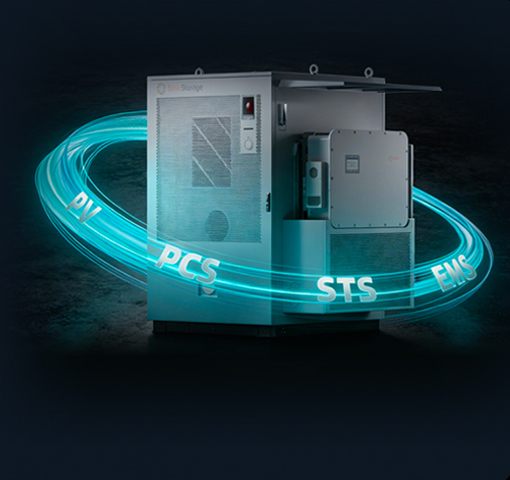
The architecture keeps the hybrid energy storage inverter (AC side) physically separate from the battery cabinet (DC side), so each component sits in its own enclosure and its own thermal environment. In the 125 kW / 261 kWh class, about 6 kW of power-electronics heat is dissipated directly to ambient, leaving roughly 3.5 kW of electrochemical heat to be managed inside the battery cabinet. That separation is what allows close thermal uniformity while keeping an air-cooled design.
Protection benefits follow the same logic. As a standalone unit, the inverter reaches IP66 (dust-tight, protected against powerful water jets) while the battery cabinet maintains IP55. Drawing on its power-electronics experience, SolisStorage states that this separated protection design reduces the system's full-lifecycle failure rate by 50%. A C4-grade anti-corrosion coating supports outdoor placement, and the platform is designed to operate from -25 °C to +55 °C and at altitudes up to 4,000 m.
Cooling is handled by an independent three-air-duct design that combines a patented diversion air duct for the hybrid inverter with Coanda-effect airflow attachment across battery pack surfaces. SolisStorage reports a 30% improvement in heat dissipation efficiency compared with traditional air cooling — the reason a large-capacity cell platform can be deployed without a liquid cooling loop.
Stacking logic: one inverter, up to six battery cabinets
This is the feature that defines the product class. A single hybrid inverter supports up to six battery cabinets connected in parallel, enabling linear capacity expansion without additional inverter investment; SolisStorage estimates this reduces system expansion cost by approximately 10%. For a farm that needs one cabinet at harvest and a second six months later, or a mall operator rolling storage across several buildings, the savings compound with each phase.
The 50–125 kW hybrid energy storage inverter integrates PCS, STS (static transfer switch), PV inverter, circuit breaker protection and EMS in one unit. Three practical consequences matter at the site level:
- Seamless grid-tied and off-grid switching in under 10 ms without an external STS, which suits refrigeration, lighting and precision equipment.
- No external PV inverter is needed; DC and AC coupling both work with existing PV, and the PV over-sizing ratio can reach 200%.
- Up to six units can be paralleled for direct grid connection, removing the need for an external grid cabinet and simplifying construction.
Control architecture is deliberately simplified. Instead of independent CPUs for BMS, PCS, EMS and STS communicating over multi-node links, the platform uses a single central controller. Fewer communication nodes mean fewer failure points and faster fault location — a benefit that shows up years later, when a site needs a fault diagnosed without a multi-vendor call.
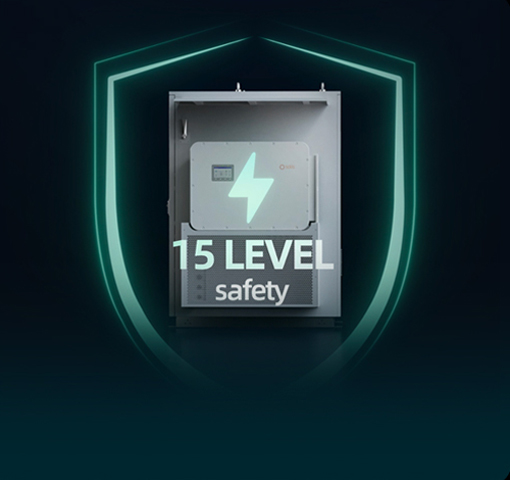
Safety architecture across cell, pack and system
Safety is the factor that decides insurance underwriting and, in many buildings, site approval. The platform uses a 15-layer protection system spanning cell, pack and system levels. Physical isolation between packs relies on thermal insulation materials rated to 1,000 °C, which block lateral thermal runaway propagation at source. Fire suppression is progressive in three stages: pack-level aerosol, cabinet-level aerosol and fire-fighting water channels. Honeywell industrial-grade flammable gas detectors add a further layer and are specified as 10-year calibration-free, which removes the annual calibration cost typical of conventional gas sensors.
Monitoring, software and market participation
A stackable system is only as useful as the scheduling behind it. Solis' AI cloud platform has been deployed at more than 5,500 energy storage power stations worldwide. It combines Nordpool wholesale price data with Flatpeak retail price data to build a multi-source price forecast and optimise charge-discharge strategy at minute-level granularity. One documented optimisation case, at a residential storage project in Latvia, increased annual electricity bill savings by 302.6%.
Software openness matters more as markets mature. In Europe, C&I storage revenue has extended beyond basic peak-valley arbitrage into grid ancillary services (FCR, aFRR, mFRR), demand response and virtual power plant (VPP) dispatch. The platform is connected, or in the process of connecting, with 102 third-party VPP and EMS operators across 11 European countries. Named integration examples include the Kraken energy management platform under Octopus Energy in the UK, aggregator platforms such as Check Watt in the Nordic market, and dozens of local EMS providers in the German-speaking region and Benelux. For a small site, this is the difference between acting alone on a tariff and participating in markets through an aggregator.

Service, spares and long-term support
For a small operator, the service model is part of the product. Support terms include 24/7 global remote technical support, 27 local overseas service centers, 48-hour on-site fault handling and whole machine replacement guarantee, and long-term spare parts supply. Every unit undergoes 100% full functional testing before shipment, together with raw material incoming inspection, aging test, high-low temperature cycle test and IP protection test.
Maintenance was designed around the same reality. Packs are lighter, and replacement steps are reduced by 55%; no heavy equipment is required, and two technicians can complete the task with specialized tools. Minebea cooling fans are specified as industrial-grade motors with 10-year maintenance-free performance. Over the full project lifecycle, SolisStorage's lifecycle analysis puts the O&M saving at approximately €9,500 per unit, made up of eliminating liquid-cooling fluid replacement (about €2,500), simplifying PCS replacement (about €1,500), simplifying pack replacement (about €1,500) and reducing routine inspection complexity (about €4,000).
Step-by-Step Breakdown: Deploying a Stackable ESS on a Working Site
The deployment sequence below is written for a farm, mall, clinic or small plant that is installing storage for the first time. Each step produces an output that the next step depends on.
- Profile the load before sizing anything. Collect a full year of interval or monthly meter data and identify the peak demand windows, the time-of-use tariff structure and the seasonal pattern. On a farm, note irrigation and cold-room schedules; in a mall, note HVAC and refrigeration duty. This step decides the target: demand-charge reduction, peak shifting, backup for specific loads, or a combination.
- Decide the stack count and the phasing. With a single inverter supporting up to six battery cabinets, the first decision is not total capacity but the starting point: how many cabinets cover phase one, and at what load threshold phase two is triggered. SolisStorage estimates that DC-side expansion of this kind reduces expansion cost by approximately 10%, because no additional inverter is purchased.
- Confirm site conditions and placement. Check enclosure ratings against the actual installation position: IP66 for the inverter and IP55 for the battery cabinet, C4-grade anti-corrosion coating, an operating window of -25 °C to +55 °C, and suitability up to 4,000 m altitude. Because the platform is air-cooled, no liquid cooling infrastructure or fluid service interval needs to be planned.
- Plan the PV and grid interface. If PV already exists, choose DC or AC coupling; the platform supports both and allows a PV over-sizing ratio up to 200%. If backup is required, confirm switchover behaviour — grid-tied to off-grid in under 10 ms without an external STS. Where multiple units are used, up to six can be paralleled for direct grid connection, avoiding an external grid cabinet.
- Commission and validate. Acceptance criteria are factory acceptance testing plus on-site installation and commissioning. Pre-shipment testing already includes 100% full functional test, raw material incoming inspection, aging, high-low temperature cycling and IP protection testing, so commissioning can focus on site integration and control settings.
- Operate, monitor and optimise. Once live, scheduling can be managed through the Solis AI cloud platform, with charge-discharge strategies optimised against price forecasts. If the local market allows, the site can be enrolled with an aggregator for demand response or ancillary services through the platform's VPP and EMS integrations.
- Agree the service relationship up front. Confirm remote support terms, the nearest of the 27 overseas service centers, on-site response times, spare parts availability and the replacement procedure. Typical production lead time is 30–45 days for mass OEM orders, with spot goods available for standard models; monthly production capacity is over 10,000 units globally, which is what keeps a phased rollout on schedule.
Use Cases: Farms, Retail Malls, Hospitals and Small Industrial Sites
Small farms
Farm load is concentrated and seasonal: irrigation pumping, cold rooms, milking and packing equipment, often running against a tariff window that the farm cannot shift. A stackable system fits because capacity can follow the season. One cabinet commissioned before harvest can be matched by a second cabinet once the first bill comparison is available, on the same inverter. Where a remote plot has no reliable grid connection, the grid-tied and off-grid switching and the ability to couple existing PV with up to 200% over-sizing keep the investment useful in both modes.
Retail malls
Retail sites combine a predictable daily profile with a hard continuity requirement. Peak shifting against HVAC, lighting and refrigeration load reduces demand charges, while the sub-10 ms transfer keeps refrigeration and point-of-sale systems stable during grid disturbance. Because the design is air-cooled and rated for outdoor placement, cabinets can be positioned in service yards or on parking structures without a fluid loop. Operators running several buildings also benefit from a single electrical standard: the same cabinet type can be deployed at each site with different stack counts.
Hospitals and clinics
Healthcare facilities place the emphasis on transfer speed and hazard control rather than on arbitrage. In under 10 ms switching without an external STS supports precision equipment that cannot tolerate a long transfer gap, and the layer structure — 1,000 °C thermal barriers between packs, three-stage progressive fire suppression and industrial-grade gas detection — is the part of the design that speaks to site safety reviews and insurance underwriting.
Small industrial enterprises
Small plants usually already have PV and a variable load driven by motors, compressors and charging equipment. The relevant advantages are DC or AC coupling to existing PV, PV over-sizing up to 200%, power quality support and a maintenance model that a small engineering team can execute: packs replaced by two technicians using specialized tools, with replacement steps reduced by 55% and no heavy lifting equipment required.
For distributors and EPCs serving these segments
The same platform logic supports channel businesses. A single cabinet is a viable minimum order quantity, standard models are available from spot stock, and monthly production capacity exceeds 10,000 units globally, which makes small repeat orders practical rather than a scheduling problem. Documented best-fit applications for the platform include industrial manufacturing, low-carbon industrial parks, hospitals, cold chain logistics and small-scale agriculture, in both on-grid and off-grid configurations.
Comparison Table: Stackable ESS vs. Huawei, Sigen and SolaX Evaluation Dimensions
Buyers evaluating a stackable ESS usually shortlist SolisStorage alongside Huawei, Sigen and SolaX. The table below lists the documented characteristics of the FlexCore-ID platform against the verification question to raise with each alternative supplier. No specifications are stated for the other brands here, because the source material does not document them; the second column is deliberately a checklist rather than a claim.
| Decision dimension | SolisStorage stackable ESS (documented) | What to verify with Huawei / Sigen / SolaX |
|---|---|---|
| Architecture | Hybrid energy storage inverter physically separated from the battery cabinet (AC–DC separation); PCS, STS, PV inverter, breaker protection and EMS integrated in a 50–125 kW unit | Whether inverter and battery are separable units that can be serviced independently |
| Cell and cycle life | A-grade 314 Ah LFP cells; cycle life ≥8,000 cycles | Cell format, supplier grade and the test conditions behind any cycle-life figure |
| Thermal management | Air-cooled, three-air-duct design; 30% higher heat dissipation efficiency than traditional air cooling | Cooling method, and whether it introduces a fluid service interval |
| Protection | IP66 inverter, IP55 battery cabinet, C4-grade anti-corrosion coating | Enclosure and corrosion ratings for outdoor or rooftop installation |
| Grid and off-grid | Switching in under 10 ms without an external STS; up to 6 units paralleled for direct grid connection | Whether an external STS or grid cabinet is required |
| PV integration | DC or AC coupling with existing PV; PV over-sizing up to 200% | Supported coupling options and over-sizing ratio |
| Expansion path | One inverter supports up to 6 battery cabinets; expansion cost reduced by approximately 10% | Incremental cost and procedure for adding capacity later |
| Maintenance | Pack replacement steps reduced by 55%; two technicians, specialized tools, no heavy equipment | Pack weight, tooling and documented replacement procedure |
| Software ecosystem | 102 third-party VPP/EMS operators across 11 European countries connected or in process | Which aggregators and market platforms operate in your region |
| Documented best-fit applications | Industrial manufacturing, low-carbon industrial parks, hospitals, cold chain logistics, small-scale agriculture, on-grid and off-grid | Reference projects in your own segment |
| Commercial terms | MOQ 1 unit; FOB Ningbo or EXW factory delivery; 30–45 day lead time for mass OEM orders | MOQ, Incoterms and quoted lead time |
| Service model | 24/7 remote support; 27 local overseas service centers; 48-hour on-site fault handling and whole machine replacement guarantee; long-term spare parts | Local service presence and committed response times |
One commercial data point deserves context rather than repetition: SolisStorage's published comparison positions the platform at approximately 5% lower cost than the Huawei, Sigen and SolaX alternatives it is compared with. Cost positioning of this kind should always be validated against a landed-cost quote that includes inverter, cabinets, STS, grid cabinet and service terms — which is exactly what the two right-hand columns of the table are designed to collect.
FAQ: Stackable ESS for Small Farms and Retail Malls
1. Which safety and grid standards should a stackable ESS for a small farm or retail site meet?
In international markets, IEC 62619 is the key safety standard for secondary lithium cells and batteries used in industrial and energy storage applications. For North America, UL 9540 covers system safety and UL 9540A covers thermal runaway fire propagation testing. Certification is only half the compliance picture for an outdoor farm or a rooftop mall installation, however. The FlexCore-ID platform is designed with IP66 protection on the hybrid inverter and IP55 on the battery cabinet, a C4-grade anti-corrosion coating, and an operating window from -25 °C to +55 °C at altitudes up to 4,000 m. Its safety architecture spans cell, pack and system levels with 15 protection layers, thermal insulation rated to 1,000 °C between packs, and three-stage progressive fire suppression: pack-level aerosol, cabinet-level aerosol and fire-fighting water channels.
2. Can a stackable system run a farm or mall 24/7 and still shift peak load?
Yes. A single hybrid inverter supports up to six battery cabinets in parallel, and up to six units can be paralleled for direct grid connection without an external grid cabinet. Switching between grid-tied and off-grid operation takes under 10 ms without an external STS, which matters for refrigeration, point-of-sale terminals and diagnostic equipment that cannot tolerate a long transfer gap. Peak shifting is handled by a single central controller that schedules the whole system rather than coordinating separate BMS, PCS, EMS and STS CPUs. The published thermal data behind that continuous duty is a 30% improvement in heat dissipation efficiency versus traditional air cooling, and the 314 Ah LFP cells are rated for ≥8,000 cycles, which is the figure that determines how many daily peak-shaving cycles the asset can absorb.
3. What drives the cost, and does phased expansion change the economics?
The main cost drivers are inverter capacity, the number of battery cabinets, PV coupling hardware and any grid-side equipment. Because one inverter can serve up to six battery cabinets, DC-side expansion avoids a second inverter purchase; SolisStorage estimates this reduces system expansion cost by approximately 10% — the structural difference between a stackable design and a fixed-size cabinet for a site that is building in phases. Lifecycle operating cost is the second lever: the published lifecycle analysis puts the O&M saving at approximately €9,500 per unit, made up of eliminating liquid-cooling fluid replacement (about €2,500), simplifying PCS replacement (about €1,500), simplifying pack replacement (about €1,500) and reducing routine inspection complexity (about €4,000). In its published comparison with Huawei, Sigen and SolaX, SolisStorage positions the platform at approximately 5% lower cost; buyers should validate that against a landed-cost quote.
4. Can we validate the system on one unit before scaling up?
Yes. The minimum order quantity is 1 unit, and standard models are available from spot stock. Every unit undergoes 100% full functional testing before shipment, together with raw material incoming inspection, aging test, high-low temperature cycle test and IP protection test. Acceptance criteria are factory acceptance testing plus on-site installation and commissioning, so a single cabinet can be commissioned as a pilot and measured against real meter data before further cabinets are ordered.
5. What is the lead time, and what support continues after commissioning?
Typical production lead time is 30–45 days for mass OEM orders, with monthly production capacity of over 10,000 units globally and spot goods available for standard models. After commissioning, support includes 24/7 global remote technical assistance, 27 local overseas service centers, 48-hour on-site fault handling with a whole machine replacement guarantee, and long-term spare parts supply. For a farm, a clinic or a multi-site retail operator, that service structure is what keeps a phased rollout manageable — and it is the part of an ESS decision that is hardest to change later. To review the full platform scope, download the Solis global brochure, or send your load profile to sales@ginlong.com for a sizing check against your own tariff.
Conclusion: Start Small, Expand on Evidence
For small farms and retail malls, the practical question is rarely whether storage works — it is whether a system sized for today can still be the right system in three years. FlexCore-ID answers that with a stackable architecture: LFP cells rated for ≥8,000 cycles, one inverter serving up to six battery cabinets, physically separated AC and DC sides, air cooling that removes the fluid-service burden, and an ecosystem of VPP and EMS integrations that lets a small site participate in markets that were previously reserved for larger assets.
The deployment path is deliberately incremental: profile the load, start with the cabinets phase one requires, validate against real meter data, then expand on the same inverter. Combined with a service model built on 24/7 remote support, 27 overseas service centers and long-term spare parts, that structure keeps the decision reversible — which is what makes it financeable in the first place.
Next step
Share your site profile — peak demand, tariff structure, critical loads and available space — and the SolisStorage team can return a stack count and a phased expansion plan for your farm, mall, clinic or plant.
Brochure: Solis Global Brochure V3.9 (PDF) | Email: sales@ginlong.com | WhatsApp: +86 158-5815-3307 | Website: www.solisinverters.com