
What Is a Commercial and Industrial Energy Storage System (C&I ESS)?
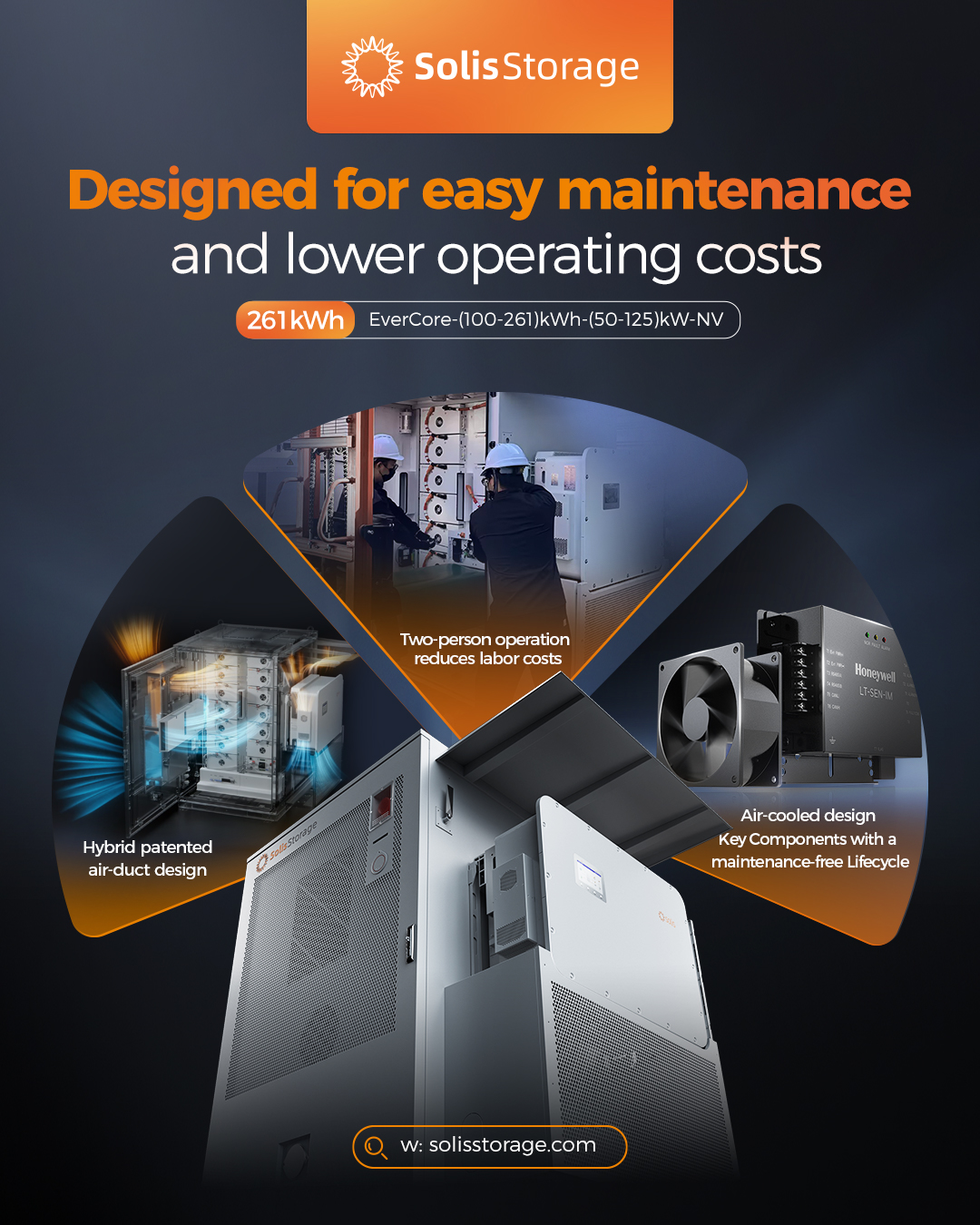
EverCore ESS pairs a battery cabinet with a separate hybrid energy storage inverter — the architecture that defines most modern C&I systems.
What Is a Commercial and Industrial Energy Storage System (C&I ESS)?
A commercial and industrial energy storage system (C&I ESS) is a battery-based system sized and engineered to store electricity for a business, campus, or grid-connected facility rather than for a single household. It charges from on-site solar, from the grid at low-price hours, or from both, and discharges when the site needs power, when grid prices peak, or when the grid operator calls for support. A C&I ESS typically combines lithium iron phosphate (LFP) battery cabinets, a power conversion system, a static transfer switch for backup, an energy management system, and thermal and fire protection in one engineered package.
This article explains what a C&I ESS does, the five functions that justify the investment — self-consumption, backup power, peak shaving, frequency regulation, and virtual power plant (VPP) participation — and how the category is built in practice. The EverCore ESS from SolisStorage, the energy storage subsidiary of Ginlong (Solis) Technologies Co., Ltd., is used throughout as a working reference for the specifications and architecture involved.
The Problem a C&I ESS Solves
A C&I ESS exists because electricity supply and electricity demand rarely line up. On a factory site, solar generation peaks at midday while the heaviest loads often run in the morning and evening. On a cold-storage warehouse, demand is flat but the tariff is not. On a hospital campus, an outage is not a billing event — it is a clinical risk. Three structural gaps recur across commercial and industrial sites:
- Time mismatch. Power is generated or purchased at one moment and consumed at another. Without storage, the surplus is exported at whatever price the market offers and the deficit is bought back at retail or peak rates.
- Capacity mismatch. Site transformers and grid connections are sized for a peak that occurs only a few hours per month. Storage can shave that peak instead of paying for a larger connection.
- Value mismatch. A site's load profile is a resource in liberalised electricity markets. Fast, controllable discharge has a price — for frequency response, for demand response, for balancing — but only if the asset can be dispatched and aggregated.
A C&I ESS is the hardware and control layer that converts these three gaps into revenue, savings, or resilience. That is also why C&I systems are specified differently from residential systems: the duty cycles are longer, the inverters are larger, the protection requirements are stricter, and the software must talk to external market platforms.
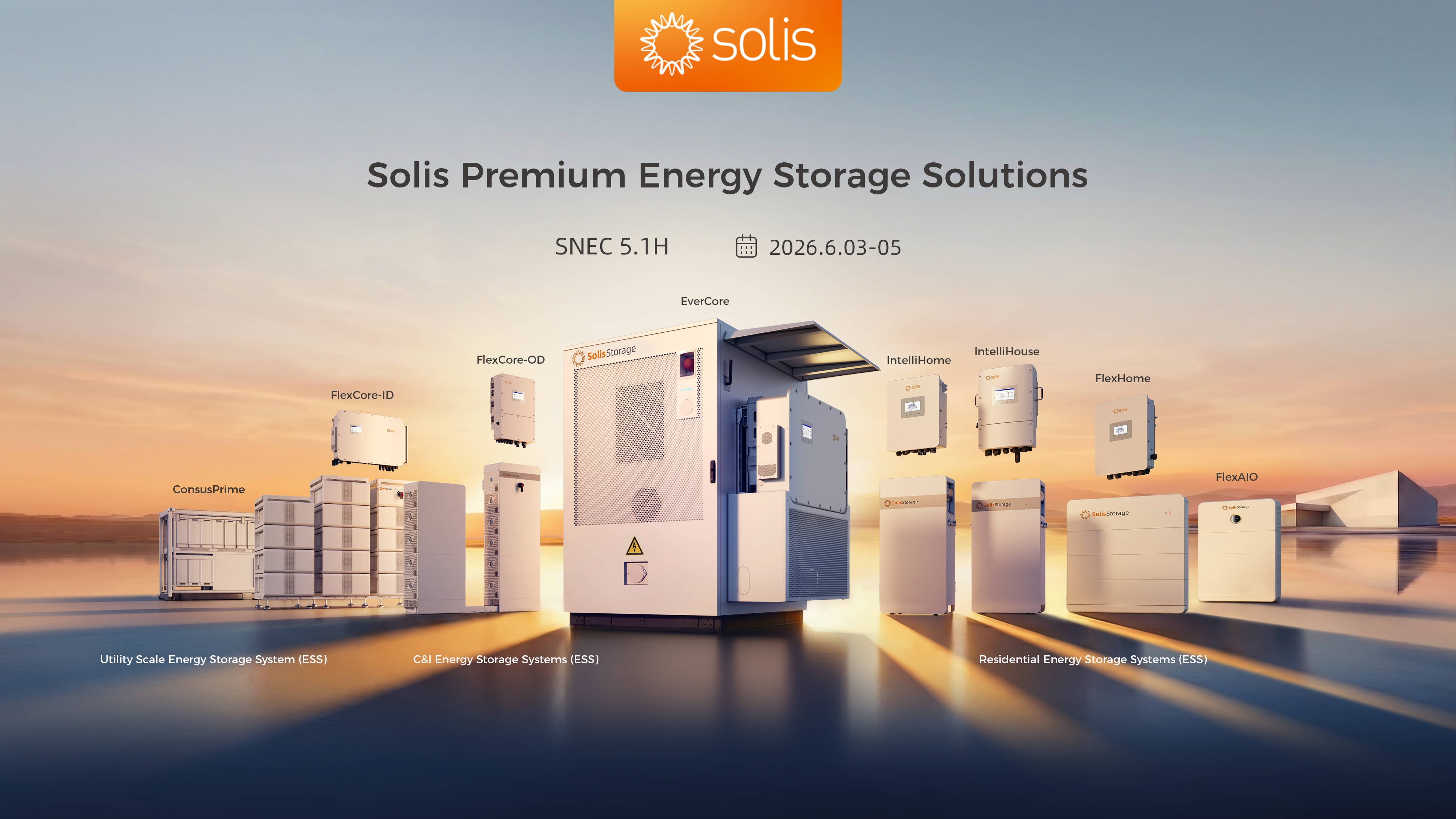
A C&I ESS is engineered around a site load profile, not around a single appliance — battery capacity and inverter power are sized separately.
Industry Background: Why C&I Storage Moved From Pilot to Standard Equipment
C&I storage grew out of two adjacent industries: solar inverters and grid-scale battery systems. Inverter manufacturers brought power electronics, grid-code knowledge, and manufacturing scale; battery suppliers brought cell chemistry and cycle life. The category crystallised when those two capabilities were integrated into a single dispatchable asset that a business could own.
Market scale is now substantial. BloombergNEF projected global annual energy storage deployment, excluding pumped hydro, to reach 92 gigawatts in 2025 — a figure that describes a mainstream industry rather than an emerging pilot category. Standards have followed. ANSI/CAN/UL 9540:2023 covers energy storage systems intended to receive and store energy for delivery to loads or the local electric power system, and its scope includes both residential and non-residential installations, which means a C&I system is evaluated as a complete assembly, not as a loose collection of components.
Commercial drivers have shifted at the same time. In mature electricity markets, the business case has moved beyond simple peak–valley arbitrage toward multi-product revenue: frequency containment and restoration reserves, demand response, capacity markets, and aggregation through virtual power plants. That shift changed what buyers must ask for. A C&I ESS that cannot be dispatched by a third-party aggregator is worth less than one that can — a point returned to under VPP participation below.
The Five Core Functions of a C&I ESS
Most C&I projects stack several functions onto one asset. The five below are the ones that appear in nearly every commercial justification, and each places a different requirement on the system.
1. Self-consumption of on-site PV power
Self-consumption means storing surplus solar generation on site and using it later instead of exporting it. It is the simplest function to model: the value equals the difference between the export price forgone and the retail price avoided, multiplied by the energy shifted. It also drives a technical requirement — the ESS must coexist with existing PV, either DC-coupled through a hybrid inverter or AC-coupled on the AC side. The EverCore hybrid inverter supports both DC and AC coupling, which matters for retrofit projects where a PV array and its inverters are already installed.
2. Backup power and seamless switching
Backup power is the function that is hardest to price and easiest to justify after the first outage. A C&I ESS with an integrated static transfer switch can island a protected load from a failed grid supply and continue running. Switching speed determines which loads survive. The EverCore hybrid inverter is specified to complete grid-tied to off-grid switching in under 10 ms without an external STS, a timescale relevant to precision industrial equipment rather than only to lighting and IT loads.
3. Peak shaving and peak load shifting
Peak shaving discharges the battery to cap site demand below a set threshold; peak load shifting moves consumption from high-tariff to low-tariff periods. Both reduce the maximum power drawn from the grid, which is the variable that drives demand charges and, in constrained networks, the size — and cost — of the grid connection itself. A C&I system sized at 100.5 kWh, 120.6 kWh, or 261.2 kWh with a 50 kW, 60 kW, or 125 kW inverter, as in the EverCore range, can be matched to the shape of the site load rather than to a fixed template.
4. Frequency regulation and grid ancillary services
Frequency regulation requires fast, precise, bidirectional response to grid frequency deviations. It is a control problem as much as a chemistry problem: the system must receive a dispatch signal, respond within the required window, and account for the energy and cycle consumption it incurs. Storage earns revenue here because it can absorb and inject power without the ramp constraints of thermal generation. In practice, participation depends on the local market rules and on the aggregator platform that represents the asset.
5. Virtual power plant (VPP) participation
A VPP aggregates many distributed assets so that a portfolio can bid into markets that a single site could never access. For a C&I owner, the practical question is whether the system's energy management layer is open enough to be integrated. Solis reports that EverCore has been connected, or is in the process of being connected, with 102 third-party VPP and EMS operators across 11 European countries, with integrations including the Kraken platform in the UK market and aggregator platforms in the Nordic market. Whether or not a given site uses those specific platforms, the design principle is the one to evaluate: closed hardware limits revenue, open interfaces expand it.
What Is Actually Inside a C&I ESS
A C&I ESS is best understood as five subsystems working as one asset. Buyers who evaluate only the battery are evaluating roughly half the system.
- Battery cabinet and cells. LFP chemistry dominates the category because of its cycle life and thermal stability. EverCore uses A-grade 314 Ah LFP cells in an EVE 3.2 V configuration, with a rated cell cycle life of 8,000 cycles.
- Power conversion system and inverter. The inverter converts DC battery energy to AC and back. In integrated designs the PCS, static transfer switch, PV inverter, circuit breaker protection, and energy management system sit in one unit — the approach taken by the 50–125 kW EverCore hybrid energy storage inverter.
- Energy management system (EMS) and controls. The EMS decides when to charge, discharge, island, or bid. Control topology matters: a single central controller reduces the number of communication links and failure points compared with separate controllers for battery management, PCS, EMS, and STS.
- Thermal management. Heat is the primary ageing mechanism in a battery cabinet. EverCore retains air cooling with an independent three-air-duct design and reports a 30% improvement in heat dissipation efficiency relative to conventional air cooling.
- Protection and safety layers. Enclosure ratings, anti-corrosion coating, cell-level and pack-level isolation, and fire suppression define where a system can be installed and how it is insured.
Enclosure and environmental ratings belong in this list because they determine site eligibility. The EverCore cabinet is rated IP55 and the inverter IP66; Solis specifies operation from −25 °C to 55 °C and at altitudes up to 4,000 m, which covers both hot desert climates and cold European winters. Street-level and industrial-outdoor installations typically also demand anti-corrosion protection, which is why the underlying application requirements reference C5-grade anti-corrosion alongside IP55 and IP66 protection.
EverCore ESS as a Reference Design
The EverCore ESS is a C&I energy storage system from SolisStorage, designed for commercial and industrial applications in the renewable energy and power grid industry. Two design choices define it and are worth examining because they recur across the category.
AC–DC separation. Instead of packing inverter and battery into one thermal envelope, EverCore physically separates the hybrid energy storage inverter (AC side) from the battery cabinet (DC side). The inverter dissipates its heat to ambient air; only the electrochemical heat remains inside the cabinet. That separation also allows different protection levels per unit — IP66 for the inverter, IP55 for the cabinet — and lets the DC side grow independently: a single inverter can connect up to six battery cabinets in parallel, adding capacity without a second inverter.
Chemistry and duty cycle. The 314 Ah LFP cells are specified for 8,000 cycles with remaining capacity at or above 70%. Solis states that at a 0.5C charge–discharge rate this extends the economic life of the system relative to 280 Ah cells rated at 7,000 cycles. For a buyer comparing quotations, this is the parameter that should be normalised first, because cycle life and usable capacity together determine lifetime throughput, not nameplate energy.
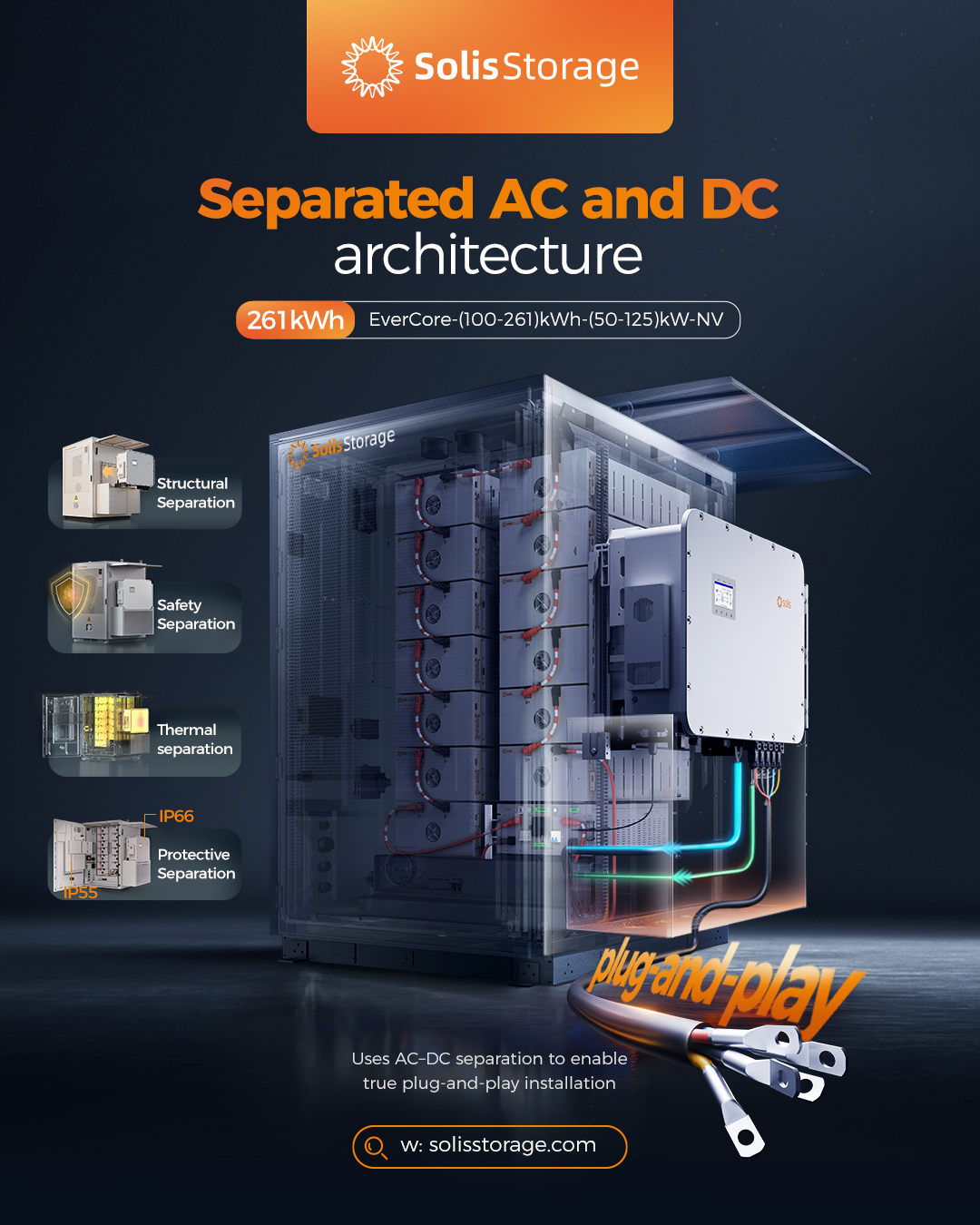
Battery cabinet and inverter are separate units in the EverCore architecture, so capacity can be expanded on the DC side without replacing the AC-side equipment.
Step-by-Step: How a C&I ESS Project Is Assembled
Step 1 — Measure the load before sizing the system. Collect 12 months of interval data and tariff structure. The output is a load profile and a set of candidate values: energy to shift, peak to shave, backup duration required.
Step 2 — Size energy and power separately. Energy capacity (kWh) determines how long the system can run; inverter power (kW) determines how much it can deliver at once. A 261.2 kWh cabinet with a 125 kW inverter and a 100.5 kWh cabinet with a 50 kW inverter serve different load shapes even though both are the same product family.
Step 3 — Choose the architecture. Decide between a fixed configuration and one that can grow. Where a site expects phased construction, DC-side expansion — up to six cabinets per inverter on EverCore — avoids paying for the AC side twice.
Step 4 — Verify site and compliance conditions. Confirm enclosure ratings, corrosion class, ambient temperature and altitude limits, fire-safety requirements, and the certification path for the destination market before ordering, not after delivery.
Step 5 — Integrate PV, EMS, and market access. Confirm whether the system will be DC- or AC-coupled to existing solar, verify the PV oversizing ratio the inverter supports, and check that the EMS can connect to the aggregator or market platform the business intends to use.
Step 6 — Commission and operate. C&I systems are specified for 24/7 continuous operation and an asset life commonly planned over 10 to 15 years, so commissioning should include the O&M routine, spare-parts plan, and remote monitoring access, not only a functional test.
Where C&I ESS Systems Are Used
Commercial buildings and shopping malls. High daytime demand, PV on the roof, and demand charges that reward peak shaving. Stackable systems such as FlexCore-ID are positioned for shopping malls, hospitals, large residences, and small commercial enterprises, while EverCore covers larger C&I loads.
Hospitals and critical facilities. The priority is continuity, so switching time and islanding capability matter more than arbitrage revenue.
Farms and agri-industrial sites. Irrigation, cold storage, and processing loads are seasonal and often weakly connected; storage reduces both peak draw and outage exposure.
Warehouses and light manufacturing. Rooftop PV plus storage raises self-consumption and protects production equipment from voltage events.
Renewable plants and utility companies. Grid-side applications include energy storage system integration, grid stability retrofitting, peak shaving, frequency regulation, and VPP-related projects — the project types Solis lists for the EverCore ESS, with deployments across markets including Australia, Germany, France, and others.
Comparison: Residential, Stackable, and C&I Systems
The table below compares three SolisStorage product families on published specifications. It is included to show where the C&I category sits, not to rank one product above another — the correct choice depends on the site.
| Parameter | IntelliHome (Residential) | FlexCore-ID (Stackable) | EverCore ESS (C&I) |
|---|---|---|---|
| Battery chemistry | LiFePO4 | LFP, 314 Ah cell | LFP (EVE, 3.2 V / 314 Ah) |
| Rated energy capacity | 5 kWh nominal | 20 kWh battery pack (FlexCore-ID-BAT20kWh) | 100.5 / 120.6 / 261.2 kWh |
| Power rating | Recommended charge/discharge current 50 A; 44.8–57.6 V | Not stated in the specification used here | 50 / 60 / 125 kW inverter |
| Cycle life | >6000 cycles / 10 years | ≥8000 cycles at 25±2 °C, 0.5P, EOL 70% | 8000 cycles |
| Ingress protection | IP66 | Not stated in the specification used here | IP55 cabinet + IP66 inverter |
| Casing / material | Aluminum alloy + core electronic components | Aluminum alloy + core electronic components | Aluminum alloy + core electronic components |
| Intended applications | Residential / household | Small farms, shopping malls, hospitals, large residences, small C&I | Commercial & industrial, renewable energy and power grid |
Specifications as published by SolisStorage. Values are not directly interchangeable between families; the comparison illustrates positioning, not equivalence.
How to Evaluate a C&I ESS: Seven Decision Criteria
- Lifetime throughput, not nameplate energy. Multiply usable energy by rated cycles. A higher cycle count at a stated end-of-life capacity threshold is worth more than a marginally larger cabinet.
- Thermal design. Ask how heat is removed and what that implies for maintenance. Air cooling avoids coolant replacement; liquid cooling may suit higher power densities. The trade-off should be explicit in the quotation.
- Expandability. Phased sites should confirm how capacity grows — for example, how many battery cabinets one inverter supports — and whether expansion requires new AC-side equipment.
- Protection and site suitability. Match IP ratings, corrosion class, temperature range, and altitude rating to the actual installation environment, including coastal and high-altitude sites.
- Safety architecture. Look for physical isolation between packs, staged fire suppression, and cell-level selection. EverCore is described by Solis with a 15-layer protection approach spanning cell, pack, and system level, including 1,000 °C-rated thermal insulation between packs.
- Software openness. Confirm which VPP and EMS platforms the system can connect to in the target market before assuming ancillary-service revenue.
- O&M simplicity. Maintenance is a lifecycle cost, not an afterthought. Solis estimates that EverCore's elimination of coolant replacement and simplified component replacement saves roughly €9,500 per unit over a project lifecycle; treat this as a vendor estimate to be verified against the site's own service contract.
Frequently Asked Questions
What protection and environmental ratings does a C&I ESS need for outdoor installation?
Outdoor C&I installations generally require an enclosure rating that resists dust and water ingress plus corrosion protection for the site's atmosphere. The EverCore ESS is specified with an IP55 battery cabinet and an IP66 inverter, and Solis lists C5-grade anti-corrosion among the requirements for industrial-outdoor and coastal-salt-fog conditions. Its stated operating envelope is −25 °C to 55 °C and up to 4,000 m altitude. Separately, ANSI/CAN/UL 9540:2023 covers energy storage systems for both residential and non-residential installations, so certification should be confirmed for the complete assembly, not only for the battery.
How much energy and power does a C&I ESS deliver, and how long does it last?
Capacity and power are specified separately. In the EverCore ESS range, rated energy capacity options are 100.5 kWh, 120.6 kWh, and 261.2 kWh, paired with inverter power ratings of 50 kW, 60 kW, and 125 kW. Cycle life is 8,000 cycles using 314 Ah LFP cells; Solis states that at a 0.5C charge–discharge rate the cells retain at least 70% capacity at end of life. The FlexCore-ID stackable system specifies ≥8000 cycles at 25±2 °C, 0.5P, EOL 70%, and the residential IntelliHome specifies greater than 6000 cycles, corresponding to 10 years.
Where do lifecycle costs come from in a C&I ESS?
Upfront capital expenditure is only one component of a 10-to-15-year asset. Maintenance routines, coolant or consumable replacement, component replacement intervals, and inspection complexity all affect the operating cost. Solis positions the EverCore air-cooled architecture as an O&M simplification: no coolant replacement, simpler PCS and pack replacement, and reduced inspection complexity, with an estimated lifecycle saving of approximately €9,500 per unit. Buyers should treat vendor estimates as a starting point and compare them against the service terms actually offered in their market.
Can a C&I ESS be expanded later or matched to existing PV?
Both are configuration questions rather than product limits. On EverCore, a single hybrid inverter can connect up to six battery cabinets in parallel, so storage capacity can be added without additional inverter investment — useful for phased construction. For solar integration, the same inverter supports both DC and AC coupling for existing PV systems, with a PV oversizing ratio of up to 200%. Sites that expect to grow should confirm these two parameters in writing at the quotation stage.
How do I get project-specific information on the EverCore ESS?
Start with the load profile and site conditions, then request the specification package for the capacity and power combination that matches them. SolisStorage can be reached at sales@solisstorage.com or +86 574 65802188, and the Solis global brochure can be downloaded here: Solis Global Brochure V3.9. Product information is published at www.solisinverters.com.
Conclusion
A C&I energy storage system is a battery asset engineered around a business load profile: it stores surplus PV, carries a site through a grid outage, caps demand peaks, provides fast grid services, and connects to the aggregators that turn flexibility into revenue. Its value comes from the combination — chemistry, inverter, controls, thermal design, protection, and software — rather than from any single specification.
For buyers at the research stage, the practical next step is not to compare headline kWh figures but to normalise cycle life, protection ratings, expandability, and platform compatibility against the site's actual load data. Systems such as the EverCore ESS from SolisStorage provide one concrete reference point for that comparison, built on 314 Ah LFP cells, 8,000-cycle life, and a separated AC–DC architecture designed for maintenance and phased expansion.
Project reviews, sizing support, and commercial discussions are handled directly with the SolisStorage team.
Planning a C&I storage project?
Share your load profile, site conditions, and target functions — self-consumption, backup, peak shaving, or market participation — and request the matching EverCore configuration and documentation.
Email: sales@solisstorage.com | Phone: +86 574 65802188 | Download the Solis Global Brochure
Have Questions or Need More Details?
Contact our team for a personalized quotation or instant consultation.
Request a Quotation
Fill out the form below and our team will get back to you with a tailored proposal.
WhatsApp Direct Chat
Prefer to chat in real-time? Message us on WhatsApp for instant assistance & quick answers.
- Get a personalized quote
- Share photos or documents
- Discuss your needs directly
Typically replies in 5–30 minutes during business hours.