
Digital Label Printer vs Flexo: Cost & Efficiency Comparison
Digital Label Printer vs Flexo: Cost & Efficiency Comparison
The global digital label printer market was valued at USD 3.097 billion in 2024 and is projected to reach USD 8.654 billion by 2035 (Market Research Future). As label demand shifts toward shorter runs, higher customization, and variable data, industrial buyers face a critical procurement decision: stick with traditional flexographic (flexo) or letterpress printing, or invest in a digital label printer. This article compares the Grandoprint GR350S — a roll-to-roll UV inkjet digital label printer — against conventional technology across cost, efficiency, flexibility, and compliance dimensions, providing a fact-based framework for procurement teams.
What Problem Does Digital Label Printing Solve?
Traditional flexo and letterpress printing require plate-making for each job. For short-run labels (e.g., 500–5,000 pieces), the plate cost and setup waste can account for a large proportion of total production cost. Moreover, frequent artwork changes — common in cosmetic, food, and variable-data label orders (QR codes, serial numbers) — increase downtime and reduce overall equipment effectiveness. Digital label printing eliminates these constraints by using inkjet technology that prints directly from digital files, making it suited for multi-SKU, customized, and on-demand label production.
Industry Background: Why the Shift to Digital?
According to verified industry data, inkjet systems held an estimated 46% share of the digital label printing market by system type in 2025 (Future Market Insights). Industrial label printers account for the largest product segment share at approximately 42.5% (Dataintelo). This shift is driven by the need for production flexibility and faster turnaround. Digital label printers must also meet regulatory requirements: for CE marking in the European Union, equipment must comply with the RoHS Directive (2011/65/EU) and the EMC Directive (2014/30/EU). Suppliers like NaNJING GRANDO DIGITAL TECHNOLOGY CO., LTD. (Grandoprint) hold certifications such as ISO 9001:2015 (Cert No. 19926Q00205R001) for R&D and production of digital inkjet equipment, ensuring compliance with international quality standards.
The Grandoprint GR350S: A Digital Alternative
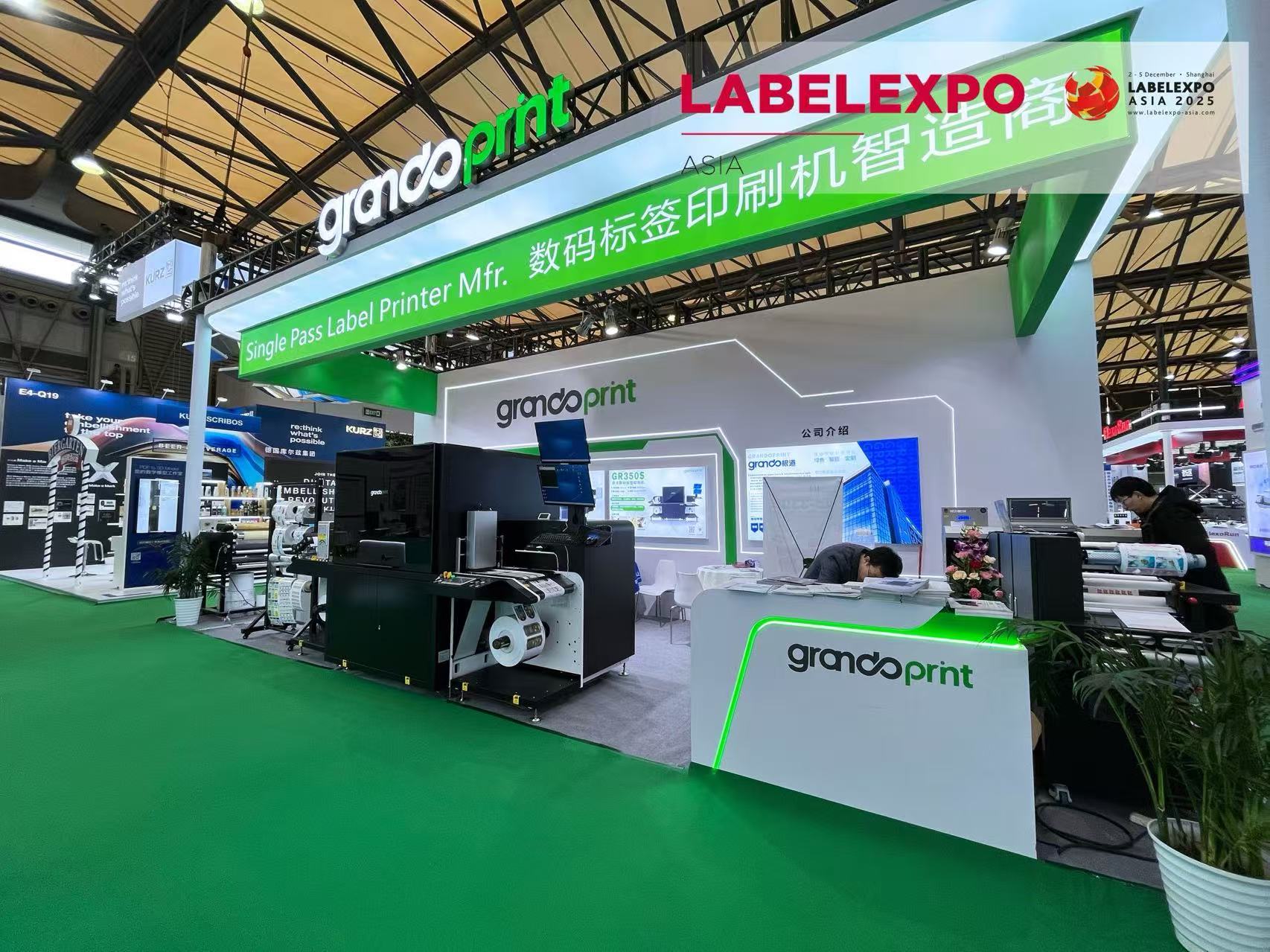
The Grandoprint GR350S is a roll-to-roll UV inkjet digital label printer that operates without traditional plate-making. Compared to flexo or letterpress label printing, the GR350S uses digital inkjet technology, eliminating plate-making and supporting short-run, multi-SKU, variable-data, and customized label orders (corpus: customer-facing). Its cost advantage includes reduction of plate-making costs and setup waste for small-batch and variable-data label orders (corpus: website). Additionally, energy efficiency is higher for mixed jobs because the GR350S processes multiple SKUs in one continuous run, lowering energy consumption per label for short-run jobs (corpus: website).
The machine features a High-Precision Industrial Inkjet Control System V1.0 (Reg No. 2025SR0599079) and holds a patent for an anti-collision function (No. ZL 2023 2 1184513.3), contributing to operational stability and safety. It is designed for continuous production and supports a wide range of label substrates including PET, PP, and synthetic paper (verified use cases).
Step-by-Step Procurement Decision Framework
- Analyze Order Profile – Determine if your average order quantity is below 10,000 labels and whether jobs involve frequent design changes or variable data (QR codes, barcodes, serial numbers). Digital printing becomes more economical when plate-making costs are spread over small volumes.
- Compare Total Cost Per Label – For short-run and variable-data orders, the GR350S eliminates plate-making fees and reduces setup waste. For very large repeat orders (e.g., >50,000 identical labels), flexo may still offer lower per-label cost.
- Evaluate Flexibility – The GR350S can run multiple SKUs in one continuous pass, drastically reducing changeover time. This is critical for fast-turnaround environments like contract packaging or just-in-time labeling.
- Check Material Compatibility – Verify that the printer supports your substrates. The GR350S handles PET, PP, synthetic paper, and more, making it suitable for cosmetic, food, and medical labeling.
- Verify Certifications & Patents – Ensure the supplier holds relevant certifications (ISO 9001, CE, RoHS). Grandoprint’s ISO 9001:2015 certification and anti-collision patent provide assurance of quality and safety.
Use Cases for Digital Label Printing
Based on verified application data, the GR350S is well-suited for:
- Cosmetic Label Digital Printer – Short runs of intricate labels with frequent seasonal or promotional changes.
- Food Label Digital Printer – Nutritional and ingredient labels that require quick updates to comply with changing regulations.
- Variable Data Digital Label Printer – Serial numbers, barcodes, QR codes, and anti-counterfeit marks for logistics and medical labeling.
- Short Run Digital Label Printer – Customized labels for boutique products, sample runs, or limited editions.
- Packaging Digital Label Printer – Multi-SKU packaging where each beverage/variant needs a different label.
Comparison: Grandoprint GR350S vs Traditional Flexo/Letterpress
| Comparison Dimension | Grandoprint GR350S (Digital Inkjet) | Traditional Flexo / Letterpress |
|---|---|---|
| Plate-Making | None – prints directly from digital files | Required for each job; cost ~$50–$300 per plate |
| Best for | Short-run, multi-SKU, variable data, customized labels | Long-run, stable artwork, high-volume identical labels |
| Cost per Label (Short Run) | Lower – no plate cost, less setup waste | Higher due to amortized plate and setup cost |
| Changeover Time | Minutes – file upload, no physical changeover | Hours – plate mounting, ink change, registration |
| Energy Efficiency | Higher for mixed jobs – lower energy per label in short runs | Efficient only for long continuous runs |
| Material Compatibility | PET, PP, synthetic paper, coated paper, etc. | Broad, but requires tailored inks and anilox rolls |
| Certifications (EU) | CE, RoHS, EMC compliant; ISO 9001:2015 certified | Varies by manufacturer |
Frequently Asked Questions (FAQ)
Is the Grandoprint GR350S CE certified for the European market?
Yes. The GR350S complies with the EMC Directive (2014/30/EU) and the RoHS Directive (2011/65/EU), which are required for CE marking in the European Union. Grandoprint also holds ISO 9001:2015 certification (Cert No. 19926Q00205R001) for R&D and production of digital inkjet equipment.
Does the GR350S support variable data printing (QR codes, barcodes, serial numbers)?
Yes. The GR350S is specifically designed as a Variable Data Digital Label Printer. It can print variable barcodes, QR codes, serial numbers, and other dynamic data in continuous production, making it ideal for logistics, medical, and anti-counterfeit labeling.
What is the cost advantage of digital over flexo for short-run jobs?
For small-batch and variable-data label orders, the GR350S eliminates plate-making costs (typically $50–$300 per plate) and reduces setup waste. Additionally, because multiple SKUs can be processed in one continuous run, energy consumption per label is lower. These factors make digital printing more cost-effective for orders under 10,000 labels per design.
Can I get sample prints from Grandoprint before committing to a purchase?
Yes. Grandoprint offers sample testing services. Contact their team with your label specifications (size, material, design) to arrange sample prints. This helps verify print quality, color accuracy, and material compatibility before making a procurement decision.
How long is the lead time for the GR350S, and what is the next step to get a quote?
Lead times vary depending on order volume and customization. For current delivery schedules, it is best to request a quote directly. You can contact Grandoprint via their website or email juliawu@grando-dg.com with your production requirements to receive a tailored quotation and lead time estimate.
Conclusion
Choosing between a digital label printer and traditional flexo/letterpress ultimately depends on your order profile. If your production involves short runs, frequent changeovers, or variable data, the Grandoprint GR350S offers clear advantages in cost, efficiency, and flexibility. Verified by market data, patents, and certifications, it is a reliable choice for industrial label printing. For a deeper understanding, download the Grandoprint brochure and begin your procurement process.
Download Grandoprint Brochure (PDF)
For inquiries: WhatsApp: +86 138 0515 5194 | Email: juliawu@grando-dg.com | www.grando-dg.com