
Travel Makeup Bag vs. Standard Packing Cubes: Which Serves Your Brand Better?
Travel Makeup Bag vs. Standard Packing Cubes: Which Serves Your Brand Better?
Short answer: a dedicated travel makeup bag and a standard packing cube set are not competing products — they compete for the same shelf slot, the same tooling budget, and the same customer's packing routine. The deciding variable is the fill format your target customer already buys for.
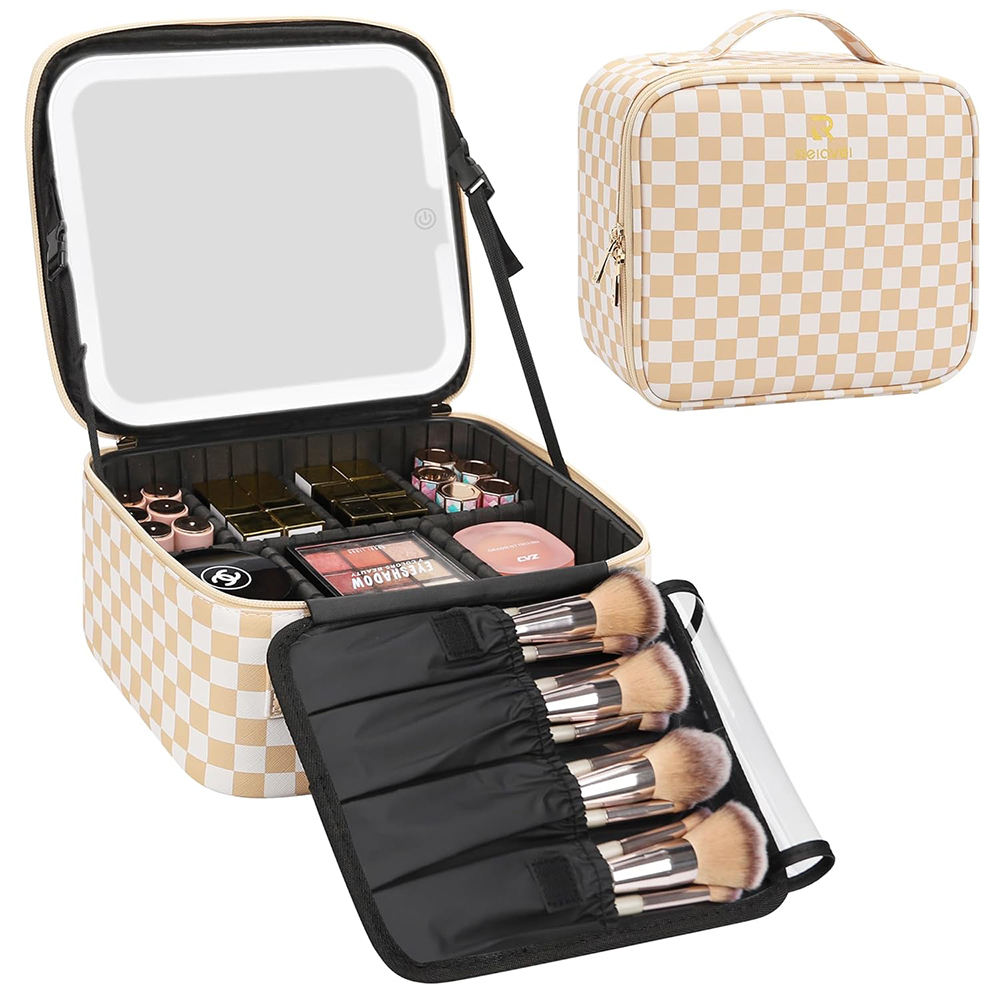
A travel makeup bag such as model GS-MB-001 is built around a fixed footprint for cosmetics and toiletries: 20 × 15 × 8 cm, 0.2 kg, zipper closure, foldable. A standard packing cube set in polyester is built around flexible clothing volume — the specification on file records 1 kg for the set, a soft handle, a foldable form, and a zipper closure.
This guide is written for sourcing buyers, brand owners, and distributors in the Light Industry & Daily Use sector who are deciding where to allocate SKU slots and customization spend in a travel storage line. All product specifications below come from the product data of Great Shine Houseware Ltd., a houseware manufacturer founded in 2013 that exports 100% of its output to the USA and lists travel storage among its core product categories.
Problem Definition: Why These Two Formats Get Confused
Both formats fold. Both close with a zipper. Both can be produced in a geometric pattern, and both sit under the same retail heading of "travel storage." A buyer scanning a supplier catalogue sees two SKUs that look like variations of each other, and the natural instinct is to treat them as interchangeable line extensions.
That instinct produces three concrete problems:
- Retail cannibalization. Two SKUs that answer the same shopper question compete for the same peg. If both items are positioned as generic "travel organization," the lower-priced one absorbs the sale and the second listing only dilutes shelf productivity.
- Duplicated artwork and tooling spend. Each SKU carries its own packaging design, product photo set, insert, and listing copy. Running two overlapping SKUs doubles that fixed cost without doubling category coverage.
- Listing and feed confusion. Titles and images that describe both formats in the same language reduce the precision of product feeds and make it harder for a shopper to self-select the item they actually need.
The real difference is not "bag versus bag." It is fixed containment versus variable volume. GS-MB-001 holds a defined 20 × 15 × 8 cm volume, which suits items that must stay upright, separated, and accessible — cosmetics, toiletries, brushes. A packing cube set is built to compress and reorganize soft goods, which is consistent with its recorded weight of 1 kg for the set rather than 0.2 kg for a single structured bag.
A practical decision rule: if your customer's main packing problem is keeping liquids contained and reachable, the travel makeup bag is the correct SKU. If the problem is consolidating clothing inside a suitcase, the packing cube set is the correct SKU. Where both problems exist in one market, position the two items as complementary rather than substitutable, and separate them by price point and by use occasion.
Industry Background: Where These Two Formats Sit
Travel storage products sit inside a broader multi-use and reusable bag category that has been expanding. Fortune Business Insights valued the global reusable shopping bag market at USD 15.64 billion in 2025 and projected it to reach USD 28.87 billion by 2034. The same source placed Asia Pacific first in 2025 with a 24.23% revenue share, ahead of North America and Europe.
Those figures should be read directionally rather than as one settled number. Business Research Insights forecast USD 12.11 billion for 2026, and Zion Market Research reported USD 11.25 billion for 2023. The gap comes from scope — reusable shopping bags alone versus a wider grocery bag definition — and from differing research methodology. For a buyer, the useful signal is the direction of demand toward reusable, foldable, multi-use formats, which is a structural property that both products in this comparison share.
The travel storage application scenario is documented across the United States, Germany, Canada, Italy, South Korea, and Japan. Within that scenario, the recorded function is storage and organization, the matched equipment is luggage, and the special requirements listed are eco-friendly materials, washability, and durability. Production for this scenario runs on sewing operations — which is the technical reason a buyer can source a makeup bag, a packing cube set, and adjacent bag-format products from the same manufacturing base instead of three separate vendors.
That shared manufacturing base also explains a recurring sourcing pattern. Distributors who already run reusable shopping bags bulk programs, or who buy custom reusable grocery bags from a grocery bag factory, often extend the same purchasing structure into travel storage, because cutting, zipper insertion, sewing, folding, and inspection are common to both. The part that does not transfer is the compliance file — covered in the FAQ section below.
Detailed Solution: Specifying Both Formats Before You Choose
The travel makeup bag: model GS-MB-001
GS-MB-001 is recorded as a Travel Makeup Bag in the Travel Makeup Bags product type, under the applicable industry of Travel Storage. Its specified parameters are:
- Size: 20 × 15 × 8 cm
- Weight: 0.2 kg
- Closure: Zipper
- Style: Foldable
- Pattern: Geometric
- Material: 600D Oxford Fabric, Canvas, Eco-friendly TPU, PVC, and custom fabric available
- Customization scope: Full OEM/ODM
The material list is the commercially important line. 600D Oxford and canvas constructions are typically chosen where abrasion tolerance and a softer textile hand-feel matter to the end user. Eco-friendly TPU and PVC options address wipe-clean and moisture-barrier requirements, which is relevant for a bag that sits beside liquids. Because the customization scope is Full OEM/ODM, a brand can change fabric, artwork, and structure rather than only printing a logo onto a fixed body.
Material decisions across the wider bag category are not uniform, and that matters if you also buy reusable bags. Polypropylene bags hold a 46% production share of the reusable bag market on the strength of durability and cost-effectiveness, according to Business Research Insights. A brand building both a reusable shopping bag line and a travel storage line therefore makes two separate material decisions, not one.
The standard packing cube set
The packing cube set on file is recorded under the model designation Travel Storage Bag, with the product type Packing cubes set and the applicable industry Bags & Luggage. Its specified parameters are:
- Material: Polyester
- Weight: 1 kg (set)
- Closure: Zipper
- Feature: Foldable
- Style: Fashion
- Pattern: Geometric
- Handle / strap: Soft handle
- Trolley rod: No
- Gender: Unisex
- Application: Travel Storage
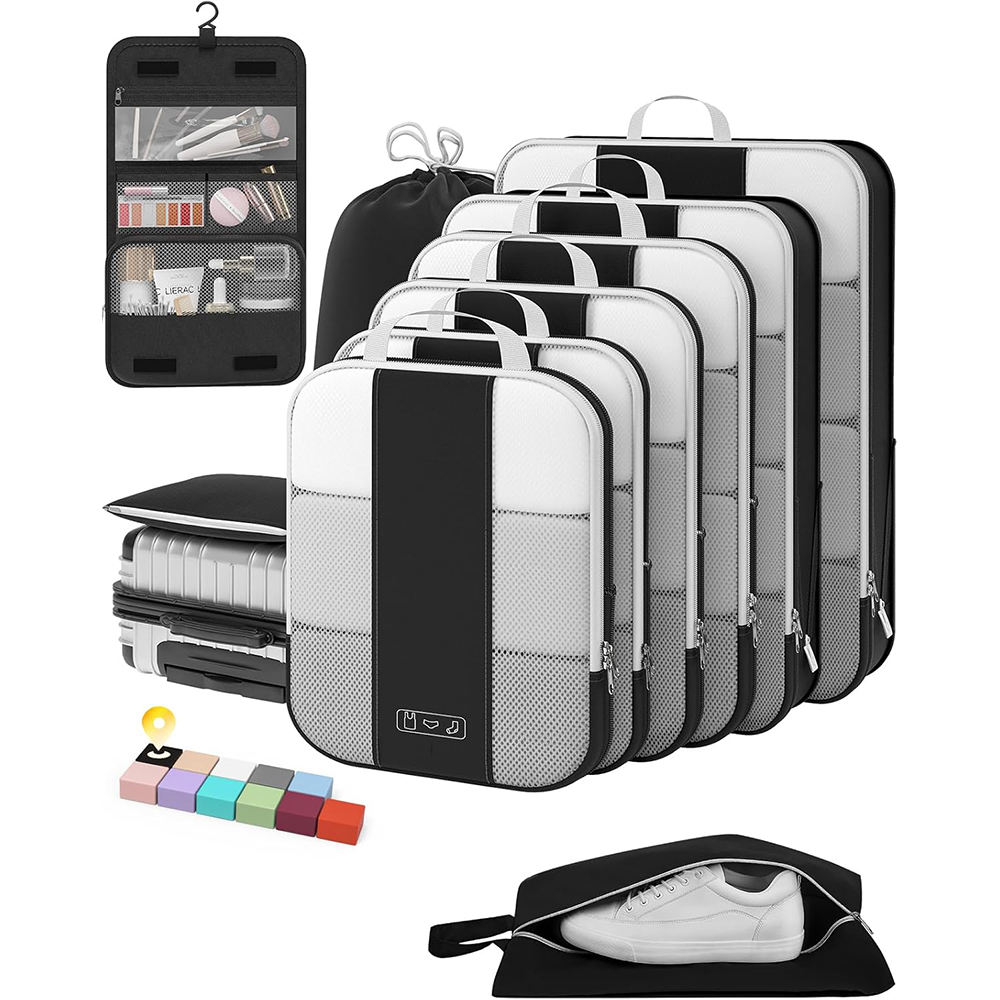
Two recorded details separate this set from the makeup bag. First, weight: 1 kg for the set against 0.2 kg for GS-MB-001. Second, hardware: the packing cube set carries a soft handle and no trolley rod, which positions it as an in-luggage organizer rather than a carry item. The GS-MB-001 specification does not record a handle or strap, so that element has to be confirmed per project rather than assumed.
Three tests that separate the two formats
Test 1 — Fill format. Cosmetics and toiletries need fixed geometry that keeps items upright and reachable. Clothing and soft goods need flexible volume. Match the SKU to the fill, not to the price point you would prefer to sell at.
Test 2 — Material expectation. GS-MB-001 offers 600D Oxford Fabric, Canvas, Eco-friendly TPU, PVC, and custom fabric options. The packing cube set is specified in polyester. If your brand promise rests on a premium textile story, the makeup bag gives you more room to express it. If your promise is value and light weight, polyester is the simpler answer, and the 1 kg set weight becomes the planning constraint instead of the price tag.
Test 3 — Customization depth. GS-MB-001 carries a Full OEM/ODM scope, which supports private-label structure changes rather than artwork alone. The customization scope for the packing cube set is not specified in the supplied data, so any private-label program built on that format must confirm fabric, sizing, and artwork flexibility with the supplier before tooling is committed.
Step-by-Step Breakdown: A Six-Step Selection Process
- Map the fill format before the product. Write down what your customer packs. If liquids, brushes, and small cosmetics dominate, the fixed 20 × 15 × 8 cm interior of GS-MB-001 is the closer match. If clothing volume dominates, the packing cube set is the closer match. This step prevents the most expensive mistake in travel storage sourcing: buying a format because it photographs well.
- Set the material tier against the shelf price. For GS-MB-001, choose between 600D Oxford Fabric, Canvas, Eco-friendly TPU, PVC, or a custom fabric. For the packing cube set, polyester is the recorded specification. Note where a material change also changes the compliance file — TPU and PVC choices move you into different documentation requirements than a textile-only construction.
- Model the weight and carton impact. The recorded difference is 0.2 kg for GS-MB-001 versus 1 kg for the packing cube set. This affects carton planning, freight calculations, and marketplace weight-based fee tiers. Run the numbers on the full selling unit, including packaging, before you finalize a landed-cost assumption.
- Confirm customization scope in writing. GS-MB-001 is recorded with Full OEM/ODM scope. For the packing cube set, the customization scope is not specified in the supplied data. Do not assume parity between the two SKUs on a quotation; ask for the customization scope of each item separately, in writing.
- Validate with a physical sample. Test three things on the sample: zipper closure performance, fold behaviour, and material hand-feel against the shelf price tier you are targeting. For GS-MB-001, check the 20 × 15 × 8 cm interior against the actual cosmetics your customer carries. For the packing cube set, confirm the soft handle and the absence of a trolley rod against how the set will be merchandised.
- Decide single-SKU or dual-SKU positioning. If you carry both, separate the narratives. Position GS-MB-001 as on-the-go organization for cosmetics and toiletries, and position the packing cube set as an in-suitcase packing system. Give them different price points so they do not compete for the same peg, and keep their listing images visually distinct.
Use Cases: Where Each Format Earns Its Slot
1. Cosmetics-led travel accessory brands
Brands whose customer is already buying cosmetics organizers need fixed geometry, not flexible volume. GS-MB-001 gives them a defined 20 × 15 × 8 cm interior, a 0.2 kg unit weight for lightweight parcels, a foldable form, and a full OEM/ODM scope covering fabric, artwork, and structure. The 600D Oxford and canvas options support a mid-to-premium positioning; the Eco-friendly TPU and PVC options support a wipe-clean proposition.
2. Retailers building a travel-organization endcap
The standard packing cube set fits the universal endcap shopper: polyester, 1 kg for the set, zipper closure, foldable, soft handle, unisex, and a fashion-oriented style read. It does not need to be explained against a specific product category, which makes it easier to merchandise across a general travel aisle.
3. Distributors already running a bag program
Many distributors in this sector do not buy a single product; they buy a category. If your existing portfolio includes custom reusable shopping bags, custom reusable grocery bags, or reusable grocery bags bulk purchased through a grocery bag supplier, adding a travel storage SKU lets you consolidate shipments and negotiate a single production calendar instead of running two supplier relationships. The manufacturing base overlaps — fabric cutting, zipper insertion, sewing, folding, inspection — while the product positioning does not. Buyers who source from a wholesale grocery bag or custom grocery bag program will recognize the same production environment recorded for travel storage: sewing-led assembly with washability and durability as the stated requirement.
4. Multi-market private-label programs
The travel storage application scenario is documented as common in the United States, Germany, Canada, Italy, South Korea, and Japan, with eco-friendly materials, washability, and durability listed as the special requirements and luggage named as the matched equipment. For a private-label program covering several of those markets, the practical split is a cosmetics SKU for markets with strong beauty accessory demand and a packing-cube SKU for markets with stronger general luggage demand. Great Shine Houseware Ltd. exports 100% of its output to the USA, which simplifies documentation for US-facing programs specifically.
Comparison Table: GS-MB-001 vs. a Standard Packing Cube Set
| Comparison point | Travel Makeup Bag (GS-MB-001) | Standard Packing Cube Set |
|---|---|---|
| Product type | Travel Makeup Bags | Packing cubes set |
| Model reference | GS-MB-001 | Travel Storage Bag (model designation on file) |
| Primary fill format | Cosmetics and toiletries in a fixed footprint | Clothing and soft goods in flexible volume |
| Material | 600D Oxford Fabric, Canvas, Eco-friendly TPU, PVC, custom fabric available | Polyester |
| Dimensions | 20 × 15 × 8 cm | Not recorded in the supplied specification |
| Weight | 0.2 kg | 1 kg (set) |
| Closure | Zipper | Zipper |
| Form factor | Foldable | Foldable |
| Pattern | Geometric | Geometric |
| Handle / strap | Not recorded in the supplied specification | Soft handle |
| Trolley rod | Not recorded in the supplied specification | No |
| Style positioning | Travel Makeup Bag | Fashion |
| Target gender | Not recorded in the supplied specification | Unisex |
| Applicable industry | Travel Storage | Bags & Luggage |
| Customization scope | Full OEM/ODM | Not recorded in the supplied specification |
How to read this table: cells marked "not recorded" are not marketing omissions — they indicate that the supplied specification does not confirm the value. Treat them as items to confirm with the supplier rather than as negative attributes.
Frequently Asked Questions
Do food-contact grocery bag regulations apply to a travel makeup bag or a packing cube set?
No — the two product families sit under different rule sets, and this is the most common compliance assumption buyers get wrong. EU Regulation (EC) No. 1935/2004 and Regulation (EU) 10/2011 govern safety and chemical migration for grocery bags intended for food contact. In many US states, including California, a minimum thickness of 2.25 mils is used as the benchmark for a bag to qualify as reusable. Travel makeup bags and packing cubes are not food-contact packaging, so those specific requirements do not transfer to them. What does transfer is material documentation: Great Shine Houseware Ltd. states that its products can be SGS/BV approved and that it has passed customer-required factory inspections, including Big Lots and Sedex. If you run both a reusable grocery bag line and a travel storage line, keep the two compliance files separate.
Can one manufacturer supply both a travel makeup bag and a packing cube set?
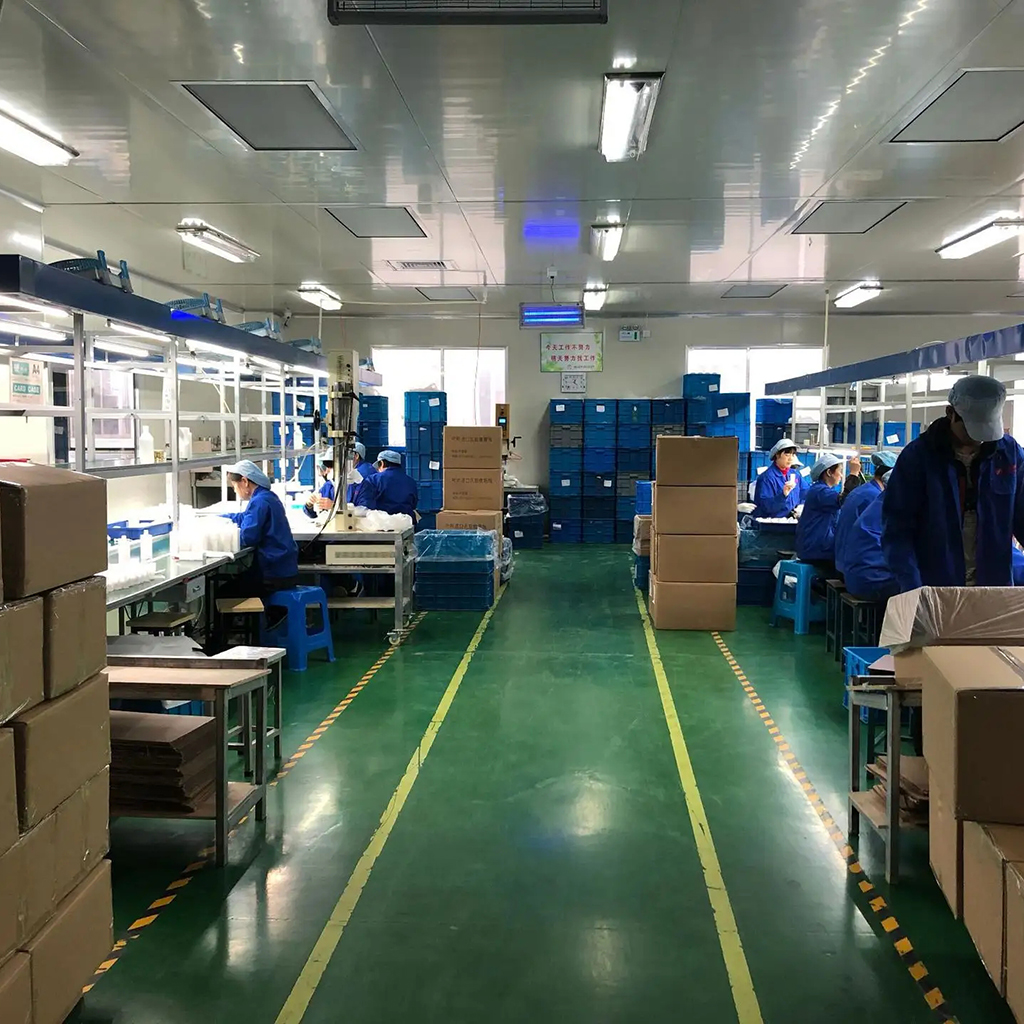
Yes, and the reason is shared process rather than shared product. Both formats depend on fabric sourcing, cutting, zipper insertion, sewing, folding, and final inspection — sewing is the recorded working condition for the travel storage application scenario. Great Shine Houseware Ltd. was founded in 2013, employs 50 people, records an annual output of 200,000 pieces, and maintains a research and development team of 10 professionals. Its main product categories include storage boxes, storage bags, travel storage series, laundry storage, and hanging storage. Sourcing both SKUs from one supplier consolidates quality control and shipping instead of splitting them across two vendors. The two items remain distinct products, however: GS-MB-001 carries a Full OEM/ODM customization scope, while the customization scope recorded for the packing cube set is not specified in the supplied data and must be confirmed per project.
Which format is more cost-efficient for a first production run?
Cost efficiency here is driven by four variables that are on file rather than by a unit price: material class, unit weight, hardware, and customization depth. GS-MB-001 is recorded at 0.2 kg with a material menu spanning 600D Oxford Fabric, Canvas, Eco-friendly TPU, PVC, and custom fabric, which means one body pattern can be positioned across different price tiers. The packing cube set is recorded at 1 kg for the set, which affects freight and carton planning more heavily than the makeup bag does. Customization depth also changes cost: GS-MB-001 carries a Full OEM/ODM scope, so artwork, structure, and fabric can all move; for the packing cube set that flexibility is unconfirmed. Unit pricing and minimum order quantities are not part of the supplied specification and should be requested per program rather than estimated.
What should a sample evaluation cover before placing a program order?
Four checks: closure performance, since both formats use a zipper closure; fold behaviour, since both are recorded as foldable; the handle arrangement, where the packing cube set carries a soft handle and no trolley rod while the makeup bag specification does not record a handle at all; and material hand-feel against the shelf price tier you are targeting. For GS-MB-001, test the 20 × 15 × 8 cm interior against the actual cosmetics your customer carries and check the 0.2 kg weight against your parcel or carton plan. Great Shine Houseware Ltd. maintains a sample room and a 10-person research and development team, so fabric and artwork variants can be validated before tooling is committed.
What supports consistent repeat supply for a travel storage line?
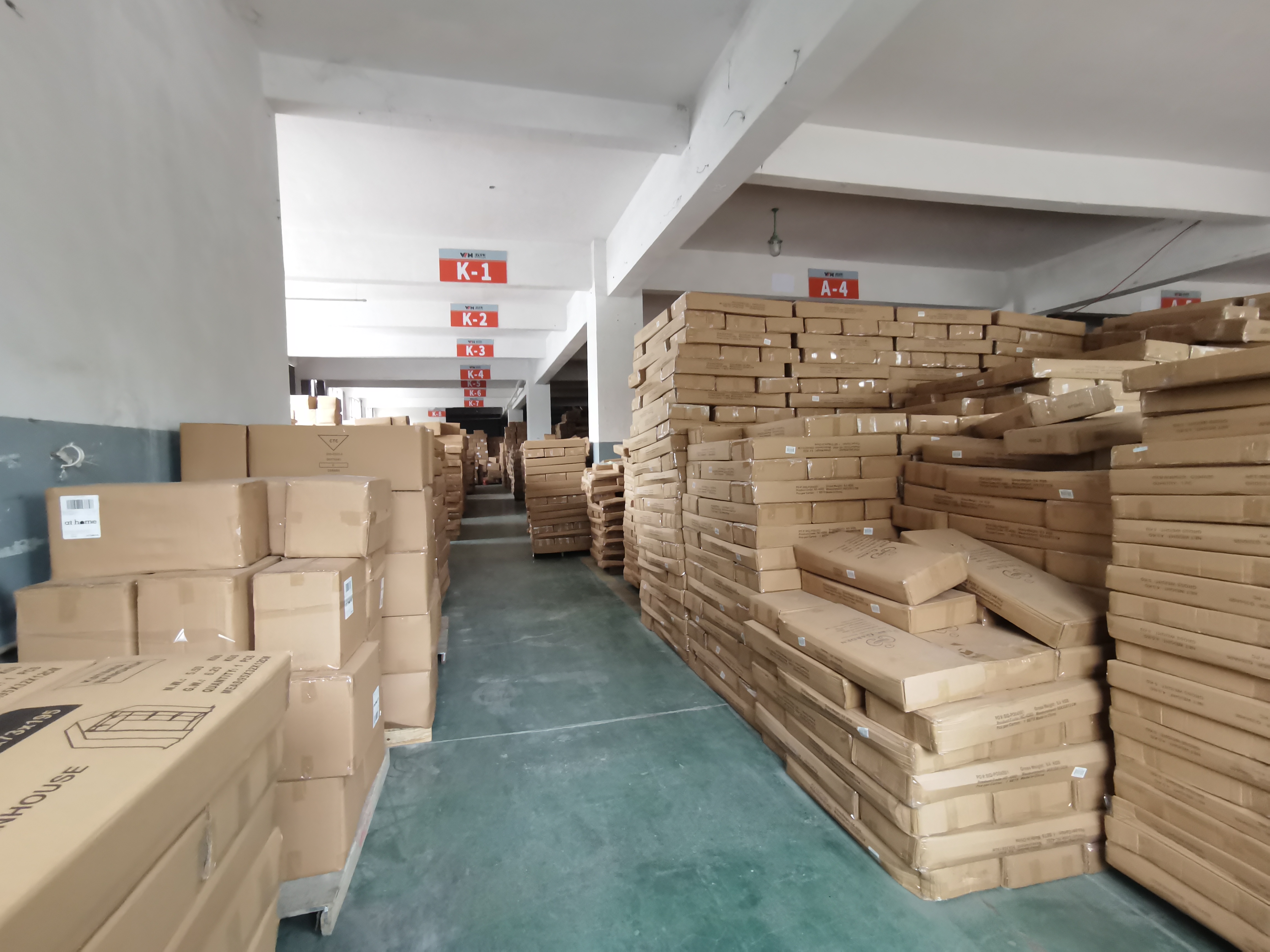
Repeat supply depends on production continuity and export discipline rather than on the product type. Great Shine Houseware Ltd. exports 100% of its output to the USA, records an annual output of 200,000 pieces, and operates warehouse, shipping, and quality-inspection functions alongside its sewing and production capacity. The travel storage scenario itself is documented as requiring eco-friendly materials, washability, and durability — requirements that must hold in every repeat run, not only in the first sample. For buyers planning a multi-season travel storage line, the practical next step is to send the fill-format brief, the target market list, and the fabric direction, then request a sample and a quotation for the specific configuration.
Conclusion: Choosing Without Guessing
The choice between a travel makeup bag and a standard packing cube set is not a quality question — it is a positioning question. GS-MB-001 answers a fixed-containment need with a 20 × 15 × 8 cm footprint, 0.2 kg unit weight, zipper closure, foldable form, and a Full OEM/ODM scope spanning 600D Oxford Fabric, Canvas, Eco-friendly TPU, PVC, and custom fabric. The standard packing cube set answers a variable-volume need with polyester construction, a 1 kg set weight, a soft handle, no trolley rod, and a unisex, fashion-oriented read.
Three decisions follow from that. If your customer packs cosmetics, choose GS-MB-001 and let the fabric menu carry your brand story. If your customer packs clothing, choose the packing cube set and plan around its 1 kg set weight. If your customer does both, carry both — but separate them by occasion, by price point, and by listing imagery so they do not compete for the same peg.
Underneath the product choice is a supply-chain choice. A manufacturer with shared sewing, zipper, folding, and inspection processes can serve a travel storage line and an adjacent bag program without adding a vendor. Great Shine Houseware Ltd., founded in 2013, exports 100% to the USA and records an annual output of 200,000 pieces from a 50-person operation supported by a 10-person R&D team.
Next Step: Sample and Quotation Request
If your travel storage line needs a defined answer instead of a catalogue browse, send the fill-format brief, the target market, and the fabric direction. Great Shine Houseware Ltd. will confirm the configuration, provide a sample, and quote the program.
Contact: Jack · sales11@g-shine07.com · Tel / WhatsApp: +86 177 0171 9207
Address: Room 506, Building B, NO.58 Tanzhu Road, Minhang District, Shanghai, China
Website: greatshine07.com · Blog: blog.greatshine07.com
