Automotive Electrical Connector Compliance Guide for PCB Connector Buyers
An automotive electrical connector is qualified by evidence, not by appearance. Two PCB connectors can share the same 2.00 mm pitch, the same pin count and the same board footprint, while only one of them sits inside a quality management system that an automotive customer will accept, carries a defined ingress protection rating, and publishes a current rating that is honestly derated at 100 °C.
Buyers moving from research into evaluation usually discover this late. The part number matches, the sample mates, and then the programme stalls on a document: the certificate scope does not cover the process, the IP rating was quoted without the cable assembly it was tested with, or the MOQ and lead time do not fit the build schedule.
- Certification scope — which certificate actually covers the part, the process and the site
- Environmental sealing — IP rating, sealing materials, operating temperature window
- Electrical ratings — voltage, current and derating at temperature, contact resistance, insulation resistance, dielectric withstanding voltage
- Mechanical and assembly behaviour — vibration and shock, mating cycles, locking, floating tolerance, mounting method
- Commercial terms — MOQ, lead time, monthly capacity and customization scope
Greenconn Technology (Shenzhen) Co., Ltd (Greenconn) is a connector manufacturer founded in 1998 that develops and produces board-to-board connectors, wire-to-board connectors, wire-to-wire connectors, waterproof connectors, floating board-to-board connectors, high-speed board-to-board connectors and custom connector solutions. The company operates four manufacturing facilities across China and Vietnam, with offices in several Chinese cities as well as Taipei, Osaka, Houston and Munich.
Problem Definition: Where Automotive Connector Evaluation Breaks Down
Most qualification failures in automotive connector sourcing are not technical failures. They are interpretive ones. A buyer reads a claim more broadly than the underlying document supports, and the gap only becomes visible during a customer audit or an end-of-line test.
1. Certificate presence treated as certificate coverage
IATF 16949:2016 certificate 160319060-2, issued by DEKRA to Greenconn and valid from 2026-04-03 to 2029-04-02, states its scope as the design and manufacture of hardware stamping parts. That is a genuine automotive quality-system credential, and it is also a scope statement that a careful buyer reads line by line. The useful question is never “do you hold IATF 16949?” but “which process, which product and which site does this certificate cover, and does that match how my part is actually made?”
2. Ratings read without derating context
The Greenconn RAST 2.5 connector CSGA106 is rated 4 A per pin at an ambient temperature of 60 °C and 2 A per pin at 100 °C. Both figures are correct and both come from the same datasheet. A buyer who carries “4 A” into a 100 °C engine-bay calculation has specified a part that will not behave as assumed. Derating is not a footnote; it is the rating.
3. IP ratings read without test-basis context
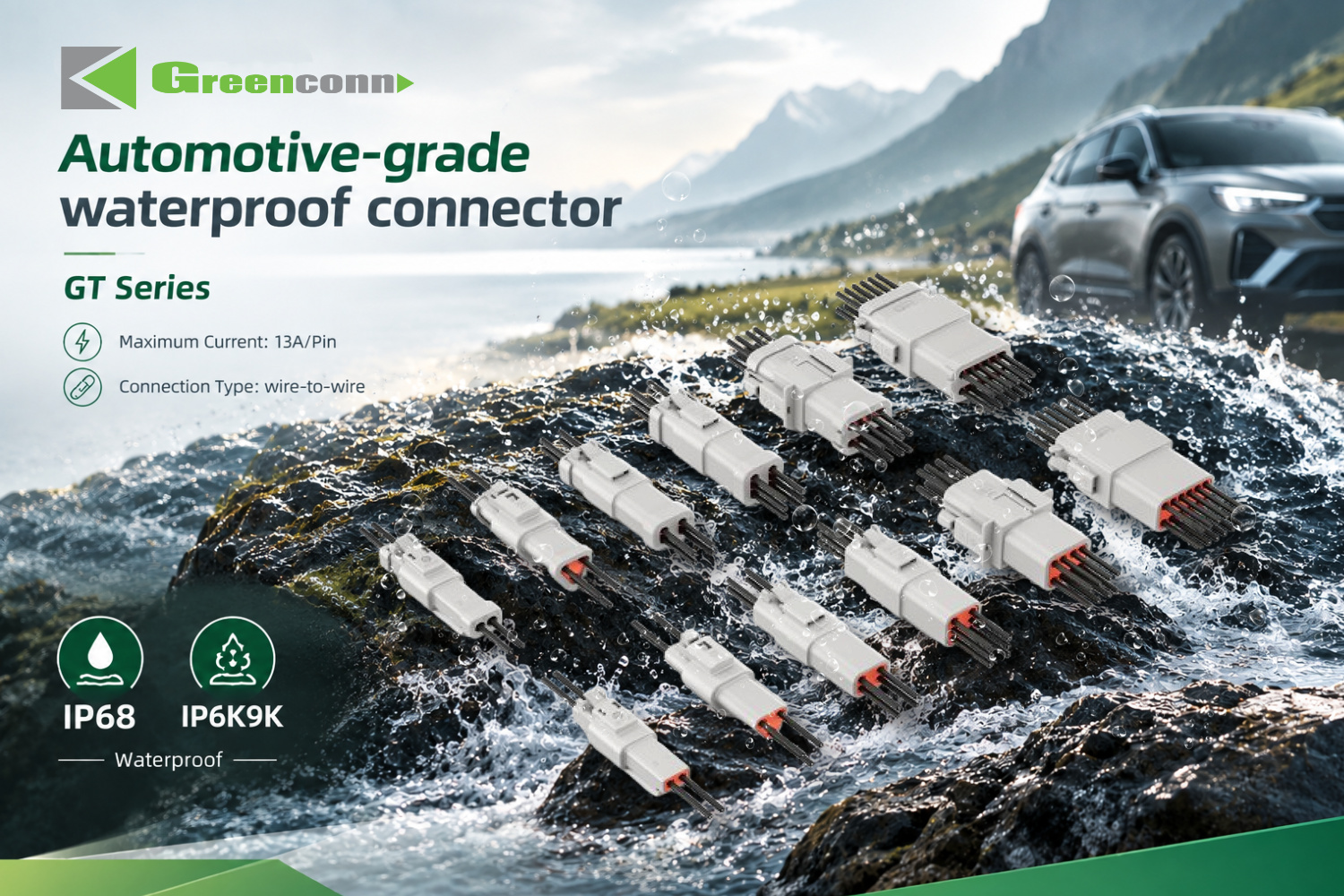
IP68 and IP6K9K describe performance under defined test conditions, not a universal guarantee. A sealed connector keeps water and dust out because the housing, the sealing elements, the mating interface and the wire entry points work together as a system, and because the assembly is tested in the configuration it will be used in. Protection levels are therefore only meaningful when read alongside the specific application requirements.
4. Compliance standards assumed rather than specified
USCAR-2, published by SAE International, is the performance standard for automotive electrical connector systems in low-voltage road vehicle applications, covering the 0–20 VDC range. It is the correct reference for a 12 V or 24 V harness connector and the wrong reference for a high-voltage traction circuit. Naming the standard is not enough; the voltage class, the test schedule and the acceptance criteria have to be specified per programme.
5. Commercial terms discovered after design-in
MOQ and lead time are engineering constraints as much as purchasing ones. A connector that passes every technical check but arrives on a four-week cycle against a three-week build plan creates the same schedule risk as a non-compliant part.
Industry Background: Why the Constraint Set Keeps Tightening
The commercial context explains why automotive buyers now audit connectors more closely than they did a decade ago.
Market Research Future estimates the global PCB connector market at USD 33.83 billion in 2025, projected to reach USD 47.96 billion by 2035. Within that market, Global Market Insights reports that board-to-board connectors were the largest PCB connector type in 2025, accounting for approximately 24.3% share and USD 4,459.8 million in revenue. Separately, Kings Research values the automotive connector market at USD 6.82 billion in 2025 and projects USD 11.39 billion by 2033, citing electric vehicles and advanced driver-assistance systems as demand drivers.
Trade publication Connector Supplier has described board-to-board connectors as an important component in the automation and IIoT applications associated with Industry 4.0. That is a qualitative signal rather than a measurement, but it points in the same direction as the market figures: more electronic content per vehicle and per machine, packed into smaller spaces, with tighter tolerance budgets.
The practical consequence is that “automotive connector” is not one specification. Vehicle electrification and denser electronics push related requirements into battery and hybrid transmission assemblies, seat and occupant-sensing modules, electric power steering, infotainment and domain controllers, exterior lighting, and ADAS sensor stacks. Each location carries a different combination of temperature, vibration, sealing and current constraints.
Greenconn produces 345,000,000 pieces annually from a 106,000 m² manufacturing footprint, with 800 employees and a 69-engineer R&D team, and exports around 70% of its output to global markets. Its engineering scope covers connector design, tooling, precision stamping, plating, injection moulding, automated assembly, testing and quality control — the process chain that determines whether a connector can be held to an automotive tolerance at volume.
Detailed Solution: The Five Constraint Groups, With Verifiable Values
1. Certification scope — read the certificate, not the logo
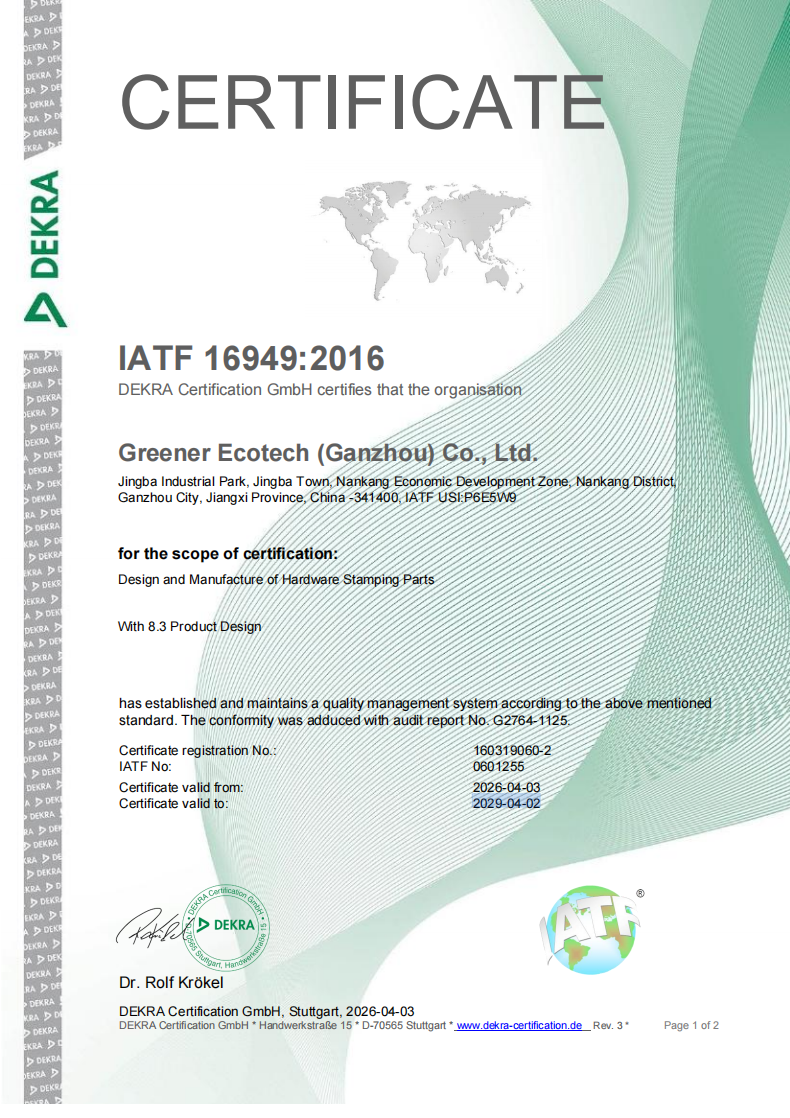
For each certificate a supplier presents, record five data points: standard and edition, certificate number, issuing body, validity period, and scope including site coverage. The table below shows what that looks like for Greenconn.
| Certification | Standard | Certificate no. | Issuing body | Validity | Stated scope |
|---|---|---|---|---|---|
| IATF 16949 | IATF 16949:2016 | 160319060-2 | DEKRA | 2026-04-03 to 2029-04-02 | Design and manufacture of hardware stamping parts |
| ISO 9001 | ISO 9001:2015 | 030825002C | DEKRA | 2025-08-18 to 2028-08-17 | Manufacture of connectors |
| ISO 14001 | ISO 14001:2015 | 111121007/1C | DEKRA | 2024-11-28 to 2027-11-28 | Manufacture of connectors |
| ISO 45001 | ISO 45001:2018 | 450224015 | DEKRA | 2024-02-28 to 2027-02-27 | Manufacture of connectors |
| ISO 13485 | GB/T 42061-2022 / ISO 13485:2016 | G25Q2GZ1104R0S | Guardian Independent Certification (Beijing) Co., Ltd. | 2025-01-02 to 2028-01-01 | Design and production of electronic connectors (radiofrequency ablation systems, dynamic blood glucose meters) |
These certificates are stated as applicable to the EU market. The ISO 13485 scope is deliberately narrow — it names the medical device categories it covers — which is exactly the level of precision a buyer should expect from a manufacturer that understands audit documentation. The listed product coverage associated with these certifications includes the GC01 Board-to-Board Floating Connector, the GD01 High-speed Floating Connector, the GB05 and GB01 Wire-to-Board Connectors, the GA01 and GT Wire-to-Wire Connectors, the CFAD102 FPC/FFC Connector, the CSGA106 RAST 2.5 Connector, the CSGA110 RAST 5.0 Connector and the ATZ605 Press-Fit Connector.
2. Environmental sealing and material selection
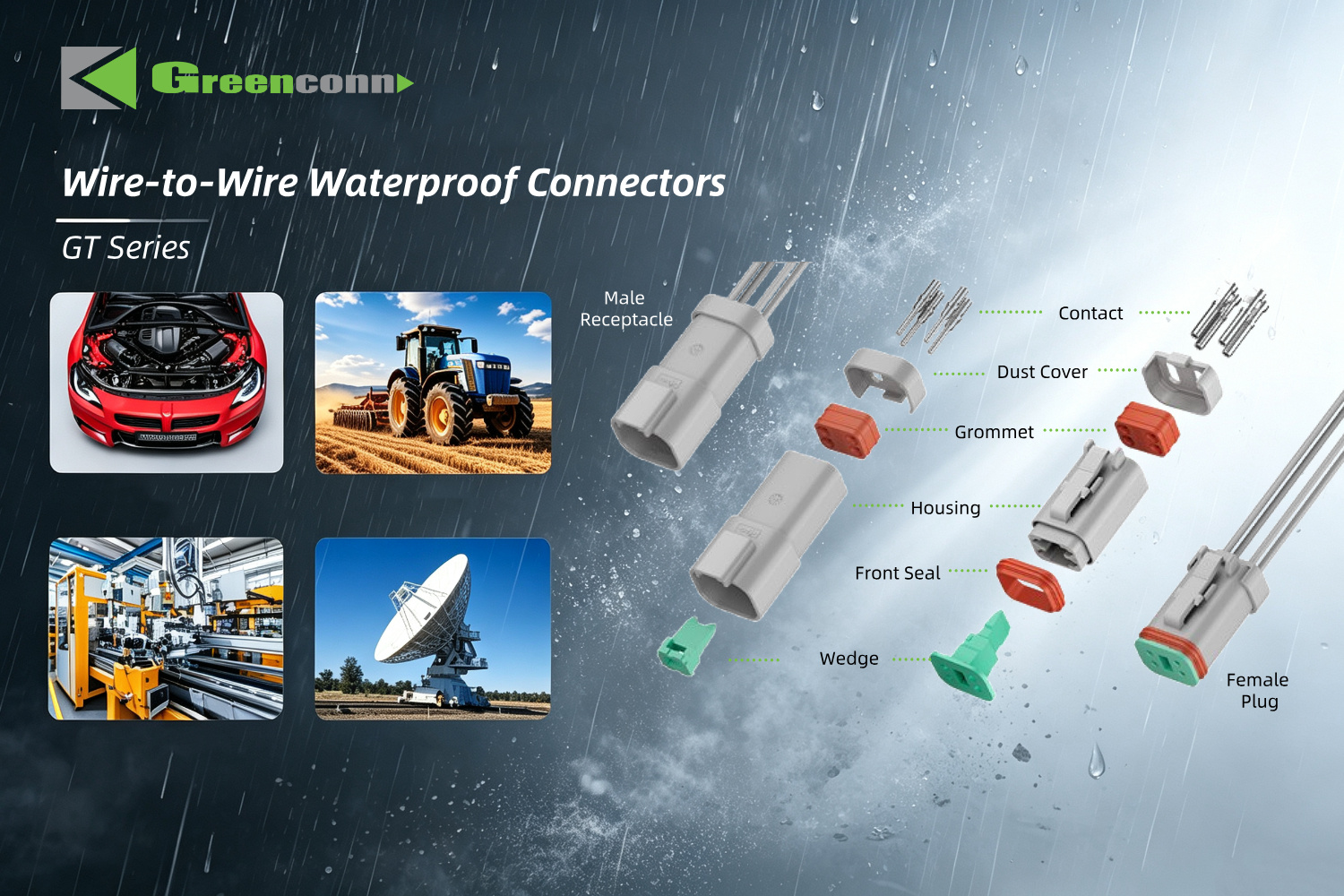
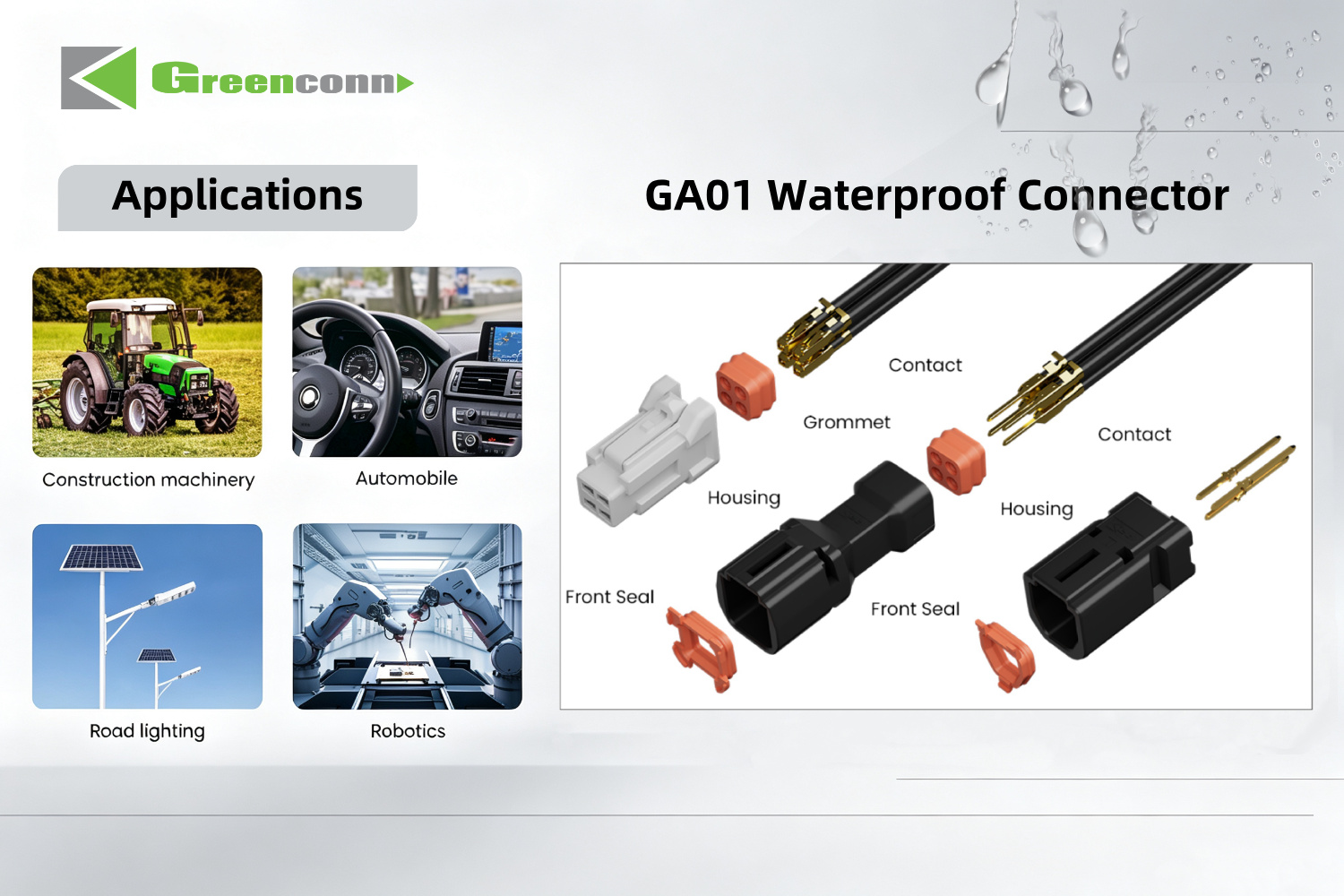
Two wire-to-wire families are specified for sealed automotive and outdoor duty. The GT series is rated IP68 and IP6K9K, with a 250 V AC/DC voltage rating, a maximum contact current rating of 13 A, a 1500 V AC dielectric withstanding voltage sustained for one minute, 20 mΩ contact resistance, 1000 MΩ insulation resistance and an operating range of −55 °C to +125 °C on AWG14–AWG20 wire. The GA01 series is rated IP67, with a 2.20 mm pitch, 250 V AC/DC, per-pin current ratings of 5.0 A on 20 AWG, 4.0 A on 22 AWG, 3.5 A on 24 AWG and 3.0 A on 26 AWG, 650 V AC dielectric withstanding voltage, 30 mΩ maximum contact resistance and an operating range of −40 °C to +105 °C.
Material choice follows the environment. The GT housing is PA66 with a silicone seal; the GA01 housing is PBT with a silicone seal. Both use a 180° cable exit angle. Because water and dust enter a connector through the mating interface, the terminals and the wire entry points, sealing performance depends on the housing, the sealing components, the mating interface and the locking structure working together after mating — which is why an IP rating should always be read together with the cable assembly and the exposure conditions of the specific application.
3. Electrical ratings and temperature derating
Electrical ratings must be taken as a set rather than individually. A connector is not defined by its current rating alone; it is defined by voltage rating, current rating at a stated ambient temperature, dielectric withstanding voltage, contact resistance and insulation resistance together. The RAST families illustrate the derating principle most clearly: CSGA106 and CSGA110 are both rated 4 A per pin at 60 °C and 2 A per pin at 100 °C, while their dielectric withstanding voltages differ at 500 V AC and 1200 V AC respectively.
Contact resistance and insulation resistance readings matter just as much in low-level signal paths. The FPC/FFC connector CFAD102, for example, is rated 30 mΩ maximum contact resistance with 500 MΩ minimum insulation resistance at a 0.50 mm pitch — values chosen for small-signal integrity rather than power transfer.
4. Mechanical and assembly behaviour
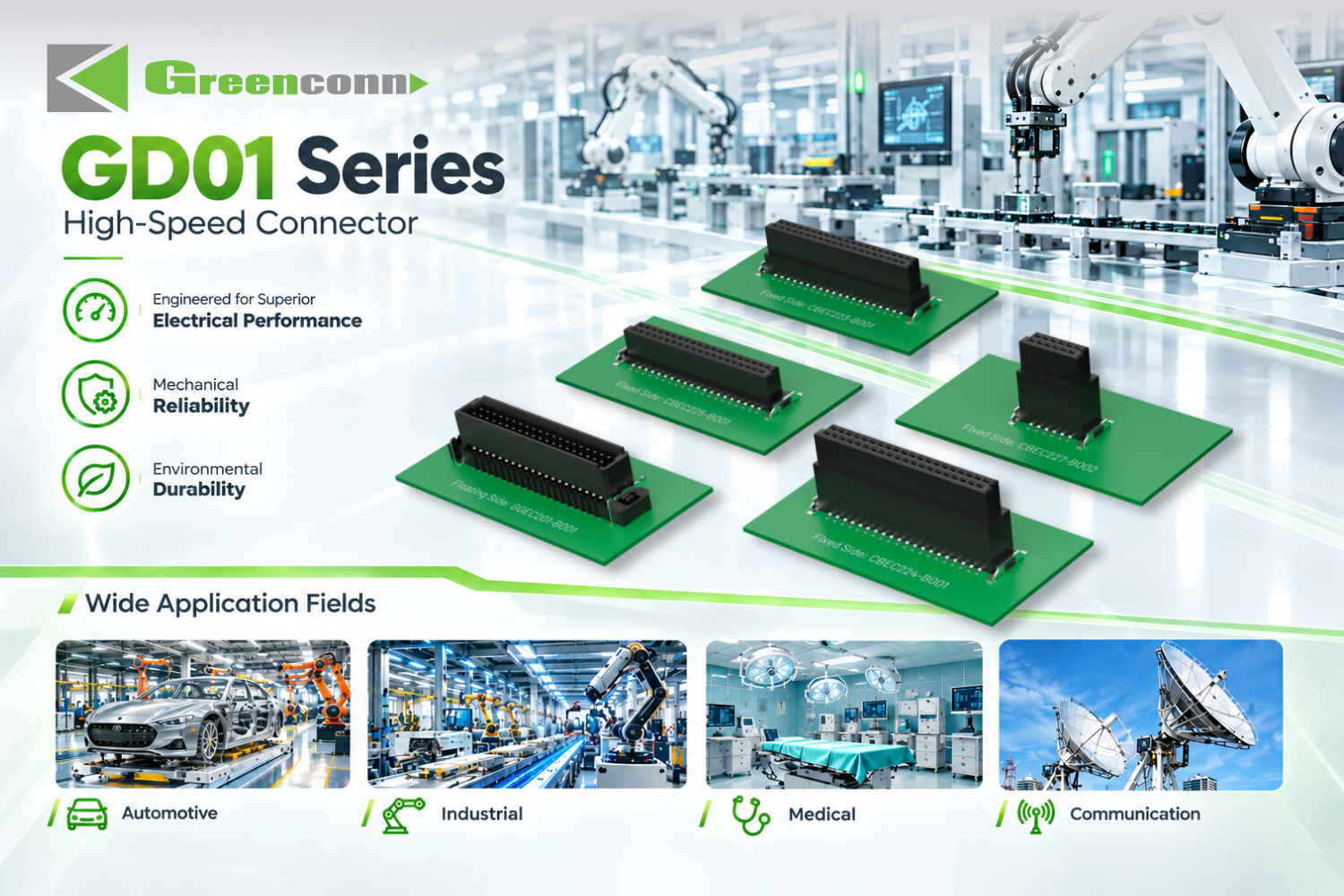
Mechanical evaluation is where automotive and industrial programmes diverge fastest. The GD01 high-speed floating board-to-board connector is specified for sinusoidal vibration of 10–2000 Hz at 20 g, half-sine shock of 50 g for 11 ms, 500 mating cycles, and an operating range of −55 °C to +125 °C, with a data transmission speed of 8 Gbps and an insulation resistance of 10,000 MΩ. It uses SMT mounting and a soldering temperature of 260 ± 5 °C for 5–15 seconds.
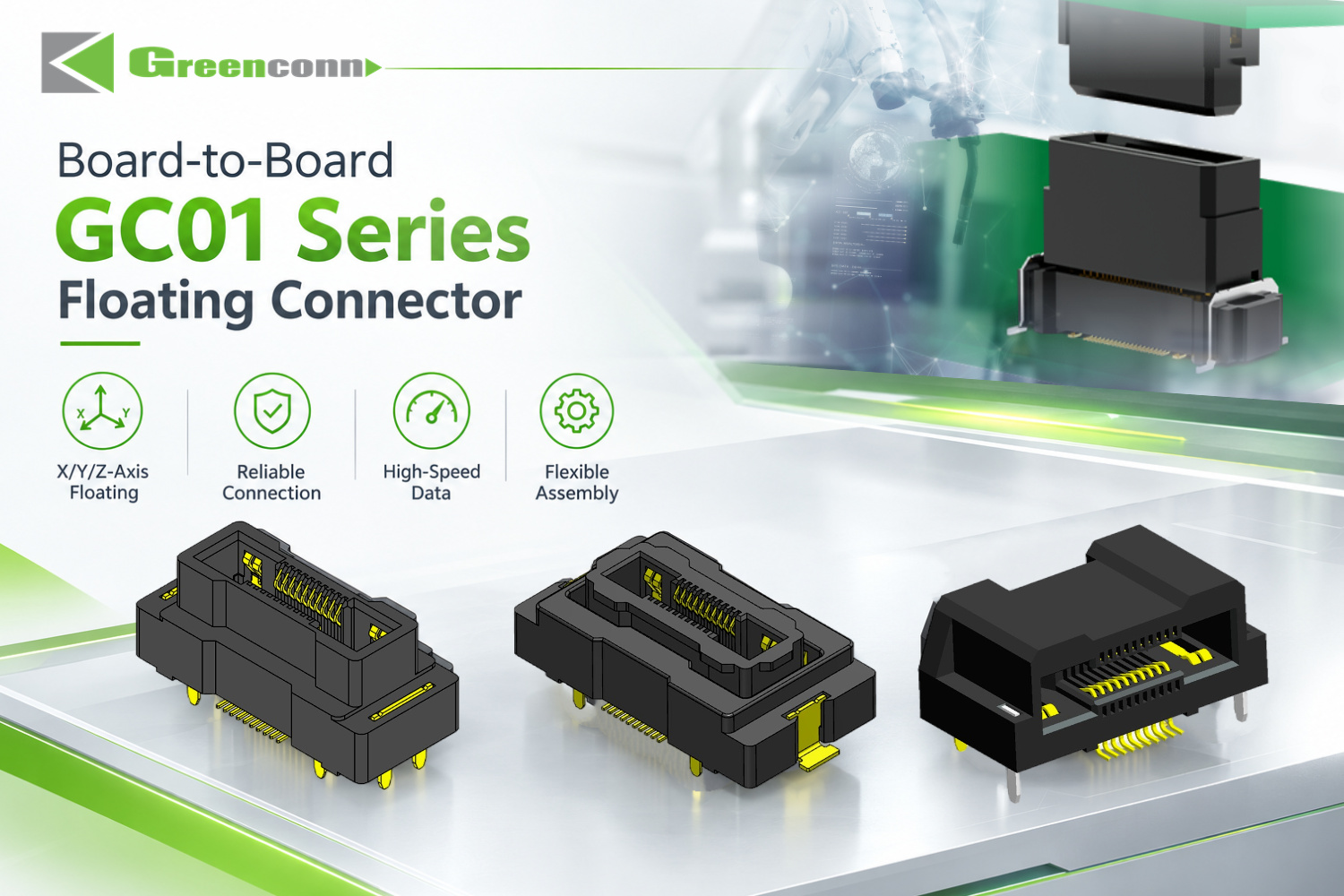
Alignment tolerance is the second mechanical constraint. The GC01 floating board-to-board connector is rated for floating compensation in the X/Y axes at a 0.50 mm pitch, with 2×10 to 2×60 pin options, signal contact ratings of 0.5 A per pin and power contact ratings of 3 A per pin, 100 mating cycles and mating heights from 9.5 mm to 31 mm. Tape-and-reel packaging and positioning posts support automated SMT assembly, and weld tabs reinforce the soldered connection.
Locking and polarisation complete the mechanical picture. The GB05 wire-to-board wafer connector uses a locking and polarization design, and the RAST series offers locking, keying and positioning options with multiple colour codes so that line operators can verify orientation visually. The GB01 connector adds terminal protection with a 2–15 pin range and a 1.25 mm pitch.
5. Commercial terms and customization
Greenconn states an MOQ of 5,000 pieces, a lead time of 4 weeks and a monthly production capacity of 28,750,000 pieces. Production supports both OEM and ODM models, with AQL sampling inspection as the stated quality-control method and after-sales support through local dealers and offices. Customization is offered across voltage, current, pin count, contact resistance, high-speed data rate, pitch, mounting type, locking mechanism, floating range, stacking height, overall dimensions, IP rating, housing material, contact material, plating thickness, contact plating and overmolding material.
Step-by-Step Breakdown: Qualifying an Automotive Electrical Connector
- Define the constraint set. Write down the voltage class, current per contact, maximum ambient temperature, required IP rating, applicable vibration standard (for example USCAR-2 for low-voltage road vehicle systems in the 0–20 VDC range), mating cycles, mounting method and annual volume before contacting any supplier.
- Match connector family and pitch. Use the constraint set to narrow the family: wire-to-wire for sealed cable-to-cable runs, wire-to-board for harness-to-PCB interfaces, board-to-board for stacked PCB architectures, and FPC/FFC where a flexible cable must connect to a board. Pitch follows from the space budget.
- Verify certification coverage. Request the certificate number, issuing body, validity dates and scope, then map that scope onto the process used to make your specific part. A certificate that covers stamping does not automatically describe assembly or moulding.
- Cross-check ratings against derating and test conditions. Read current ratings at the actual ambient temperature, confirm the dielectric withstanding voltage exceeds the application’s isolation requirement, and check that the IP rating was evaluated in a comparable cable assembly.
- Validate mechanical and assembly behaviour. Confirm vibration and shock performance, mating cycle count, locking or polarisation features, floating range where multiple connectors share the same PCB pair, and that the mounting method and packaging suit your SMT line.
- Confirm commercial feasibility and lock the documentation. Agree MOQ, lead time and volume ramp against the capacity quoted, record the customization fields that apply, and store the certificate and datasheet set as the approval package rather than leaving it in email threads.
Use Cases: How the Constraints Resolve in Practice
The same engineering logic appears in different forms across automotive and adjacent harsh-environment programmes.
| Application | Series | Constraint driving the selection |
|---|---|---|
| NEV battery systems | GT | IP68 / IP6K9K sealing; mixed power and signal connectivity in one interface; anti-loosening design against sustained vibration |
| Hybrid transmission systems in new energy vehicles | GT | Up to 13 A per contact; 250 V AC/DC rating; 1500 V AC dielectric withstanding voltage; −55 °C to +125 °C operating range |
| Automotive seat sensing systems | GA01 | IP67 sealing; compact 2.20 mm pitch; anti-vibration locking; −40 °C to +105 °C operating range |
| Automotive electric power steering (EPS) modules | GB01, GB05 | Compact module integration; terminal protection; stable connectivity under continuous mechanical load |
| Automotive infotainment (IVI) and multi-board architectures | GC01, GD01 | Floating compensation for multi-connector PCB pairs; integrated signal and power contacts; high-speed transmission |
| Automotive lighting systems | CSGA106, CSGA110 | IDC piercing termination without pre-stripping; locking, keying and colour-coded error-proofing on the assembly line |
| Intelligent automotive high-speed board-to-board links | GD01 | 8 Gbps transmission; 10–2000 Hz / 20 g vibration; 50 g / 11 ms half-sine shock; SMT-compatible packaging |
| Outdoor LED display and industrial automation boards | GC01, GD01 | Multi-directional floating capability; signal integrity under thermal cycling and mechanical stress |
Comparison Table: Greenconn Connector Series and Their Published Ratings
The table below consolidates published series data so that a buyer can screen families against a constraint set in one pass. All values are as stated in the manufacturer’s product data.
| Series | Type | Pitch | Voltage | Current | Other ratings | Temperature | Notes |
|---|---|---|---|---|---|---|---|
| GT | Wire-to-wire, automotive-grade waterproof | — | 250 V AC/DC | 13 A max per contact | 1500 V AC dielectric withstanding / 1 min; 20 mΩ contact resistance; 1000 MΩ insulation resistance | −55 °C to +125 °C | IP68, IP6K9K; AWG14–AWG20; 180° cable exit; PA66 housing, silicone seal |
| GA01 | Wire-to-wire, automotive-grade waterproof | 2.20 mm | 250 V AC/DC | 5.0 A (20 AWG); 4.0 A (22 AWG); 3.5 A (24 AWG); 3.0 A (26 AWG) | 650 V AC dielectric withstanding / 1 min; 30 mΩ max contact resistance; 1000 MΩ min insulation resistance | −40 °C to +105 °C | IP67; AWG20–AWG26; PBT housing, silicone seal |
| GB05 | Wire-to-board wafer | 2.00 mm | 125 V AC/DC | 3.00 A | 1000 V AC dielectric withstanding / min; 25 mΩ max contact resistance; 100 MΩ min insulation resistance | −40 °C to +125 °C | Locking and polarization design; harsh-environment resistance |
| GB01 | Wire-to-board wafer | 1.25 mm | 50 V AC/DC | 1 A | 500 V AC dielectric withstanding / min; 30 mΩ max contact resistance; 100 MΩ min insulation resistance | −25 °C to +85 °C | 2–15 pin options; locking and terminal protection |
| GC01 | Board-to-board floating | 0.50 mm | 250 V AC | Signal 0.5 A/pin; power 3 A/pin | Signal contact resistance 70 mΩ max; power 20 mΩ max; signal insulation 100 MΩ min; power 1000 MΩ min | −55 °C to +105 °C | Mating height 9.5–31 mm; 100 mating cycles; X/Y floating; tape & reel |
| GD01 | High-speed floating board-to-board | 1.27 mm | 500 V AC dielectric withstanding / min | 1.7 A/pin | 8 Gbps; 25 mΩ contact resistance; 10,000 MΩ insulation resistance; 10–2000 Hz 20 g vibration; 50 g / 11 ms shock | −55 °C to +125 °C | 500 mating cycles; SMT; solder 260 ± 5 °C |
| CSGA106 | RAST 2.5 IDC | 2.50 mm | 32 V AC/DC | 4 A/pin at 60 °C; 2 A/pin at 100 °C | 500 V AC dielectric withstanding / 1 min; 10 mΩ contact resistance; 1000 MΩ insulation resistance | −40 °C to +130 °C | 2–15 pin; AWG22–AWG24; 100 mating cycles |
| CSGA110 | RAST 5.0 IDC | 5.00 mm | 32 V AC/DC | 4 A/pin at 60 °C; 2 A/pin at 100 °C | 1200 V AC dielectric withstanding / 1 min; 10 mΩ contact resistance; 1000 MΩ insulation resistance | −40 °C to +125 °C | 2–9 pin; AWG22–AWG24; locking, keying and positioning options |
| CFAD102 | FPC/FFC wire-to-board | 0.50 mm | 50 V AC/DC | 0.50 A | 30 mΩ max contact resistance; 500 MΩ min insulation resistance; 500 V dielectric withstanding voltage | −25 °C to +85 °C | Compact high-density layout; secure locking mechanism |
| ATZ605 | Press-fit terminal | — | — | 2 A | Plating: nickel 40–88 µin, matte tin 60–120 µin; PCB hole diameter Ø0.85 mm | −40 °C to +105 °C | Solderless press-fit connection; reel packaging |
Frequently Asked Questions
What certification documentation should a buyer request from an automotive electrical connector supplier?
Request five data points for every certificate: the standard and edition, the certificate number, the issuing body, the validity period, and the stated scope including site coverage. A certificate without a scope statement does not tell you whether your part is covered. For reference, the certifications documented for Greenconn are IATF 16949:2016 (certificate 160319060-2, DEKRA, valid 2026-04-03 to 2029-04-02, scope: design and manufacture of hardware stamping parts); ISO 9001:2015 (certificate 030825002C, DEKRA, valid 2025-08-18 to 2028-08-17, scope: manufacture of connectors); ISO 14001:2015 (certificate 111121007/1C, DEKRA, valid 2024-11-28 to 2027-11-28); ISO 45001:2018 (certificate 450224015, DEKRA, valid 2024-02-28 to 2027-02-27); and ISO 13485:2016 (certificate G25Q2GZ1104R0S, issued by Guardian Independent Certification (Beijing) Co., Ltd., valid 2025-01-02 to 2028-01-01, scope: design and production of electronic connectors for radiofrequency ablation systems and dynamic blood glucose meters). These certificates are stated as applicable to the EU market.
How do I identify UL-certified board-to-board connector manufacturers?
Treat UL recognition as a separate evidence item from ISO or IATF management-system certification. A supplier can hold ISO 9001:2015, IATF 16949:2016 and ISO 13485:2016 certificates — as Greenconn does, with certificate numbers 030825002C, 160319060-2 and G25Q2GZ1104R0S, covering products that include the GC01 Floating Board-to-Board Connector and the GD01 High-speed Floating Connector — without that establishing UL recognition for a specific connector part. To identify a genuinely UL-certified board-to-board connector, request the UL file number together with the exact part number or product family it covers, then verify that file with UL directly before design-in. If UL recognition is a programme requirement, make it a required document at the design-in stage rather than discovering the gap at purchase order stage.
Which connector series are designed for automotive-grade waterproof applications?
Two wire-to-wire families are specified for sealed automotive and outdoor duty. The GT series is rated IP68 and IP6K9K, with a 250 V AC/DC voltage rating, up to 13 A per contact, a 1500 V AC dielectric withstanding voltage and an operating range of −55 °C to +125 °C on AWG14–AWG20 wire. The GA01 series is rated IP67, with a 2.20 mm pitch, 250 V AC/DC, up to 5.0 A per pin on 20 AWG wire and an operating range of −40 °C to +105 °C on AWG20–AWG26 wire. Both use silicone sealing elements; the GT housing is PA66 and the GA01 housing is PBT. Because water and dust enter through gaps around the mating interface, terminals and wire entry points, a sealed connector maintains its protection only when the housing, sealing components, mating interface and locking structure work together — so the IP rating should always be evaluated together with the cable assembly and the actual exposure conditions.
What MOQ, lead time and production capacity apply to automotive connector programmes?
Greenconn states an MOQ of 5,000 pieces, a lead time of 4 weeks and a monthly production capacity of 28,750,000 pieces, against an annual output of 345,000,000 pieces. Production supports both OEM and ODM models, with AQL sampling inspection as the stated quality-control method and after-sales support provided through local dealers and offices. Because MOQ and lead time are normally quoted per series and per configuration, both should be confirmed against the specific part drawing and annual volume before the build schedule is fixed.
How does a buyer start a connector qualification or sample evaluation?
Start with the constraint set: define the voltage class, current per contact, maximum ambient temperature, IP requirement, applicable vibration standard, mating cycles, mounting method and annual volume, then ask the supplier to confirm in writing which series satisfies all of them. Sample and quotation requests for standard or customised connector programmes can be sent to Greenconn at sales@greenconn.com or +86-755-27070050, and the full product and capability overview is available in the Greenconn introduction brochure.
Conclusion
Selecting an automotive electrical connector is a documentation decision as much as a mechanical one. The five constraint groups — certification scope, environmental sealing, electrical ratings and derating, mechanical behaviour, and commercial terms — cover the questions that determine whether a PCB connector survives design-in review, not just whether it mates on the bench.
Greenconn’s published data shows what traceable evidence looks like in practice: certificate numbers with scopes and validity dates, current ratings stated alongside the ambient temperature at which they apply, IP ratings tied to housing and seal materials, vibration and shock figures quoted with their test parameters, and commercial terms expressed as MOQ, lead time and monthly capacity. Buyers who work through those items before design-in spend their engineering time on the product rather than on the audit.
Next step: request a quotation or sample evaluation
Send your constraint set — voltage, current, temperature, IP requirement, vibration standard, mounting method and annual volume — and Greenconn’s engineering team will confirm which series meets it.
Email: sales@greenconn.com
Tel: +86-755-27070050
Website: www.greenconn.com
Address: #1309, No.1 Building, Zhongliangyunjing Square, Guangming District, Shenzhen, Guangdong, China 518106
Download the full product and capability overview: Greenconn Introduction Brochure (PDF)