
Greenconn PCB Connector Manufacturer Profile: Products, Manufacturing Strength, and Buyer Value
↵
Greenconn Technology (Shenzhen) Co., Ltd. — referred to below as Greenconn — is a PCB connector manufacturer established in 1998 that provides interconnect solutions for electronic and electrical systems. The company operates four manufacturing facilities across China and Vietnam, reaches an annual production capacity of 345,000,000 pcs, and offers a portfolio covering board-to-board, wire-to-board, wire-to-wire, waterproof, high-speed, floating, and custom connector solutions. This article examines the company’s manufacturing footprint, product range, quality systems, and the practical meaning of those facts for buyers who are screening PCB connector manufacturers.

Why Choosing a PCB Connector Manufacturer Is an Upstream Risk Decision
A PCB connector sits at the meeting point of two engineering disciplines. Electrically, it must carry a defined current at a defined voltage without unacceptable resistance or signal degradation. Mechanically, it must survive mating, vibration, thermal cycling, and whatever environment the end product is exposed to. Because a connector is usually a small fraction of the bill of materials, procurement attention tends to concentrate on unit price early in the process — which is precisely where the risk is created.
A supplier’s weakness in contact design, tooling ownership, or environmental validation rarely surfaces at the quotation stage. It surfaces later, in assembly yield, in rework, in field returns, or in a quality audit that the buyer’s own customer requires. For buyers at the awareness and research stage, the practical question is therefore not “who is cheapest” but “which interconnect types can this manufacturer actually produce, which processes does it own, and what evidence can it put on the table.” This profile evaluates Greenconn against that standard.
Industry Background: Where PCB Connectors Sit in the Market
The global PCB connector market was estimated at USD 33.83 billion for 2025, with a projected value of USD 47.96 billion by 2035 (Market Research Future, 2026 report). Within that market, board-to-board connectors were the largest single product category in 2025, representing approximately 24.3% of PCB connector revenue (Global Market Insights, 2026 report). Automotive connectors — a narrower segment defined by harsher environmental requirements — were valued at USD 6.82 billion in 2025 and are projected to reach USD 11.39 billion by 2033 (Kings Research, 2026 report).
Demand in the automotive segment is also shaped by formal standards rather than market estimates alone. USCAR-2 is a performance standard published by SAE International that defines test procedures for automotive electrical connector systems in low-voltage (0–20 VDC) road vehicle applications (SAE International). Buyers sourcing for automotive or other regulated applications typically need connector suppliers whose quality system and product documentation can survive that level of scrutiny, not only a competitive price.
The market figures above are third-party commercial research estimates and describe market direction. They are not a ranking of any supplier and do not replace supplier-specific qualification.
Company Overview: Greenconn Technology (Shenzhen) Co., Ltd.
Greenconn Technology (Shenzhen) Co., Ltd. is a connector manufacturer providing interconnect solutions for electronic and electrical systems, and was established in 1998, giving the company more than 25 years of operating experience. Its business address is in Guangming District, Shenzhen, Guangdong, China.
The company’s operational profile, as published in its own corporate information, is as follows:
- Founded: 1998
- Manufacturing facilities: four plants across China and Vietnam
- Total factory area: 106,000 m²
- Workforce: approximately 800 employees
- R&D team: 69 engineers
- Annual production capacity: 345,000,000 pcs
- Export share: 70% of total sales
- Offices and business locations: multiple cities in China, plus Taipei, Osaka, Houston, and Munich
The company reports working with distributors and channel partners across global markets. Its stated main products are Board-to-Board Connectors, Wire-to-Board Connectors, Automotive Connectors, Waterproof Connectors, Floating Board-to-Board Connectors, High-Speed Board-to-Board Connectors, and Custom Connector Solutions.
Core Products and Solutions
Greenconn supports both standard connector products and application-specific designs. The portfolio below is grouped by interconnection architecture, because that is the first decision a design team usually has to make.
Board-to-Board Connectors
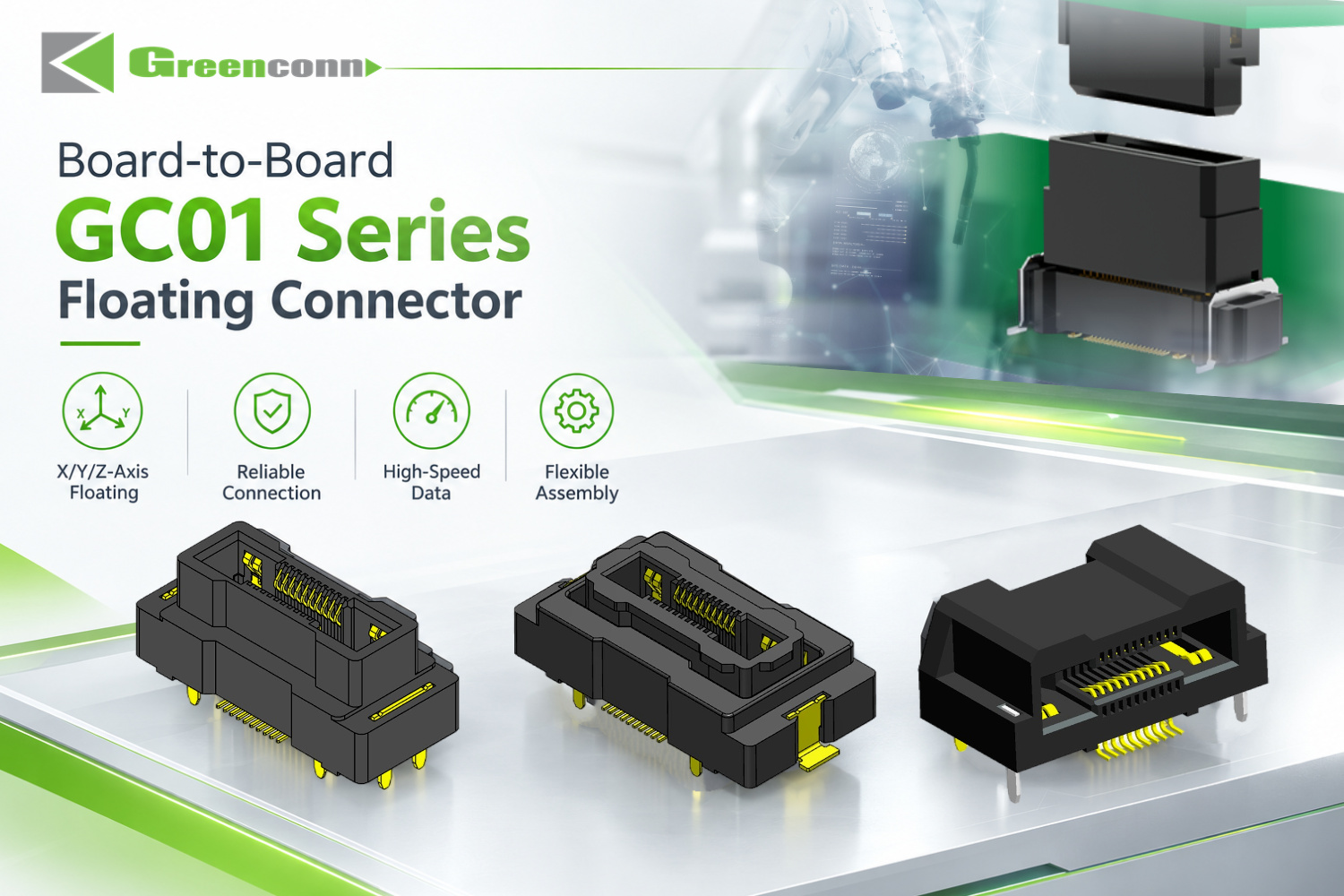
Two families in this category address different problems. The GC01 Floating Connector uses a floating structure to absorb positional tolerance between mating PCBs. It has a 0.50 mm pitch, is available in 2×10, 2×20, 2×30, 2×40, 2×50, and 2×60 pin configurations, carries 0.5 A per pin on signal contacts and 3 A per pin on power contacts, and supports mating heights from 9.5 mm to 31 mm. Its operating temperature range is -55°C to 105°C, with an LCP insulator and copper alloy contacts. Typical industries listed for this series include robotics, intelligent driving, industrial automation, medical devices, automotive electronics, and LED displays.
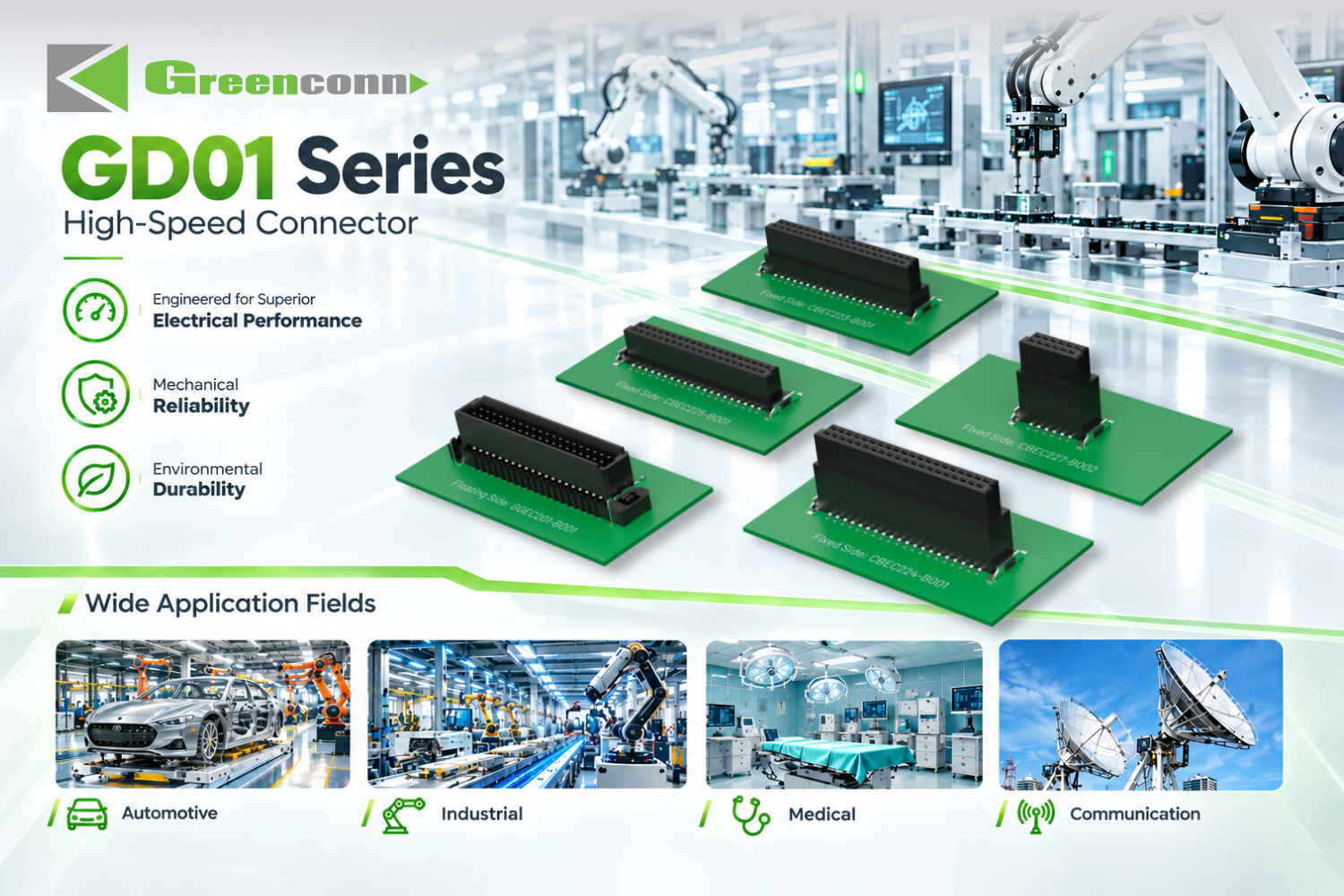
The GD01 High-Speed Floating Connector combines tolerance compensation with signal performance. It delivers a data transmission speed of 8 Gbps at a 1.27 mm pitch, rated at 1.7 A per pin, with 500 mating cycles and an operating temperature range of -55°C to 125°C. Vibration resistance is specified at 10–2000 Hz at 20 g, and half-sine shock at 50 g / 11 ms. It uses SMT mounting with an LCP insulator and phosphor bronze contacts.
Wire-to-Board Connectors
The GB01 wafer connector is a 1.25 mm pitch solution rated at 1 A and 50 V AC/DC, operating from -25°C to +85°C with phosphor bronze contacts and a PA 9T insulator. Typical applications span automotive, communications, digital, industrial, medical, and smart home products. For higher current and wider thermal range, the GB05 wafer connector offers a 2.00 mm pitch rated at 3 A and 125 V AC/DC, operating from -40°C to +125°C, with a locking and polarization design. The CFAD102 FPC/FFC connector addresses fine-pitch flat cable interfaces at 0.50 mm pitch, rated 0.5 A and 50 V AC/DC across -25°C to +85°C.
Wire-to-Wire and Waterproof Connectors
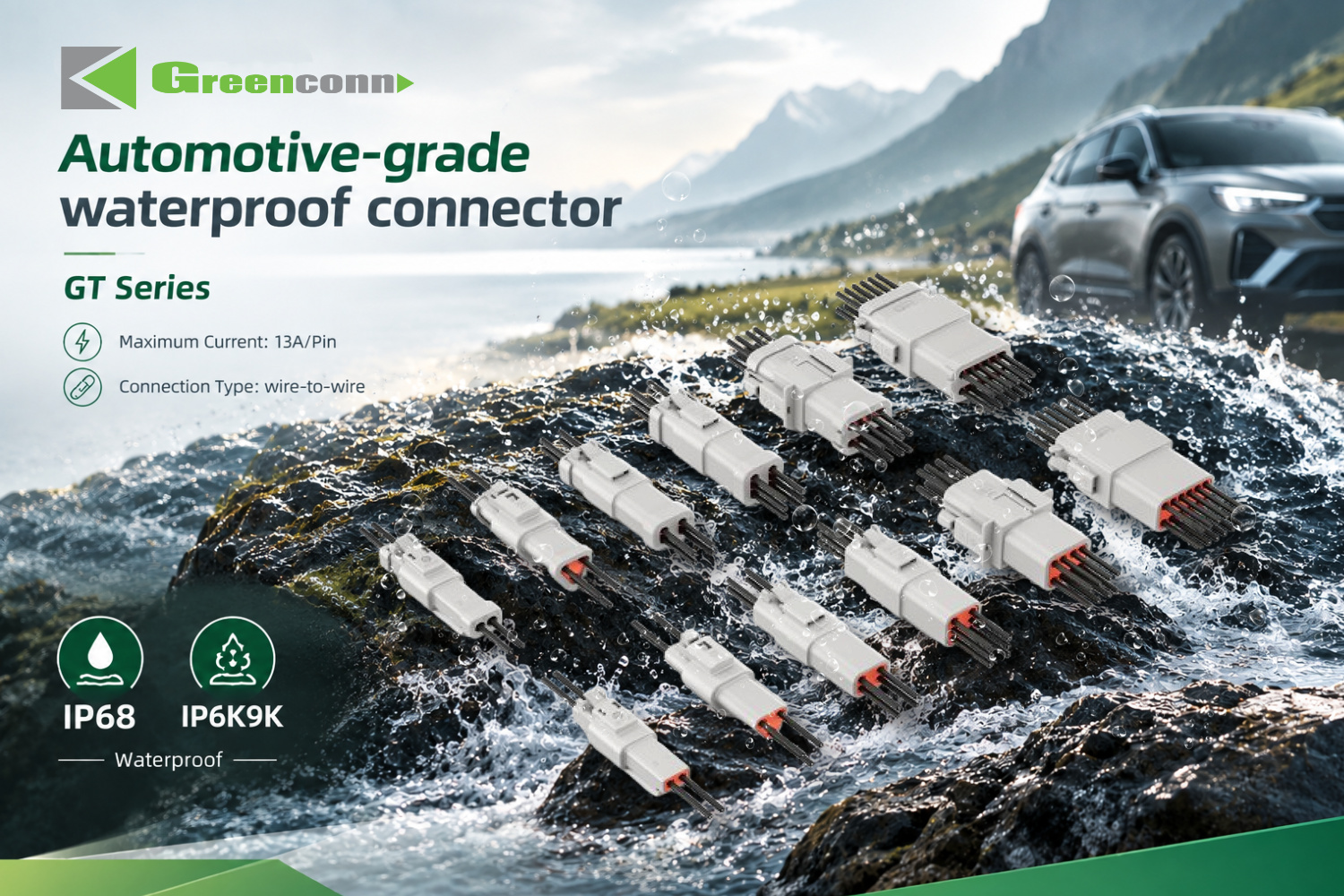
The GA01 automotive-grade waterproof connector is a 2.20 mm pitch wire-to-wire solution with IP67 protection. It is rated 250 V AC/DC with per-pin current of 5.0 A at 20 AWG, 4.0 A at 22 AWG, 3.5 A at 24 AWG, and 3.0 A at 26 AWG, and operates from -40°C to +105°C. The GT automotive-grade waterproof connector pushes protection further with IP68 and IP6K9K ratings and a maximum contact current rating of 13 A AC/DC per contact, operating from -55°C to +125°C for wire sizes from AWG14 to AWG20. Both series use silicone seals and are listed for construction machinery, automobiles, road lighting, and robotics.
RAST Connectors
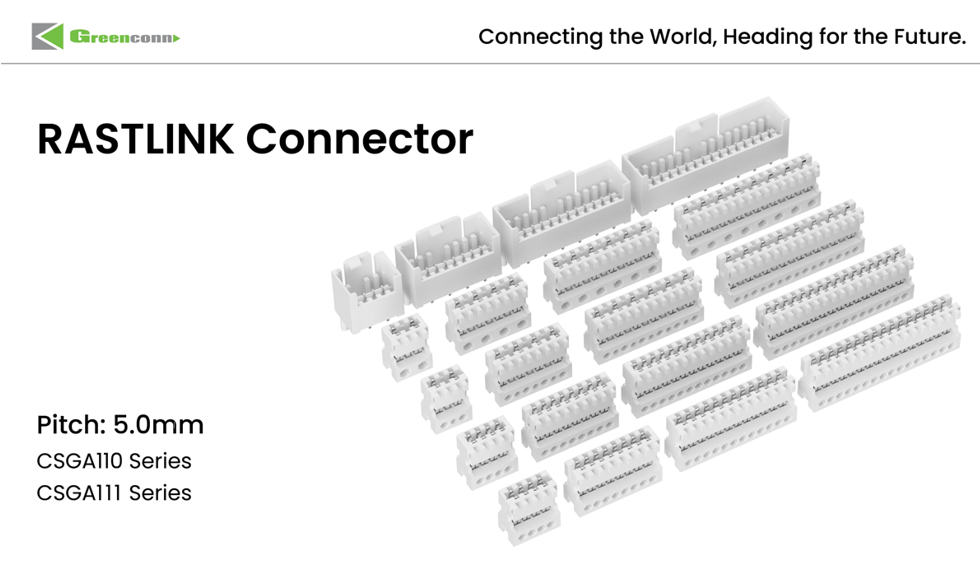
RAST connectors are designed for appliance and control-board wiring where fast, error-resistant assembly matters. The CSGA106 RAST 2.5 connector has a 2.50 mm pitch, 2–15 pins, a rated current of 4 A per pin at 60°C ambient and 2 A per pin at 100°C ambient, 32 V AC/DC rating, and an operating range of -40°C to 130°C. The CSGA110 RAST 5.0 connector uses a 5.00 mm pitch with 2–9 pins and the same current and voltage ratings across -40°C to +125°C. Both use IDC piercing technology, which eliminates pre-stripping of wires, and offer color-coding and keying options to reduce assembly errors.
Press-Fit Terminals
The ATZ605 press-fit terminal provides a solderless connection into a plated-through hole. It is manufactured by stamping from high-conductivity copper, with a total length of 21.85 mm, a contact length of 6.5 mm, and a contact width of 0.5 mm. Plating is bottom nickel 40–88 μ″ with matte tin 60–120 μ″. Rated current is 2 A across an operating temperature range of -40°C to +105°C, and the specified PCB hole diameter is Ø0.85 mm. It is supplied on reel for automated placement.
Manufacturing and Engineering Strength
The most decision-relevant fact about a connector manufacturer is how much of the production chain it actually controls. Greenconn states that it specializes in connector design, engineering development, tooling, precision stamping, plating, injection molding, automated assembly, testing, and quality control, and that these processes are completed in house. Engineering capabilities are described as covering product development, prototyping, validation, and mass production.
This matters commercially for two reasons. First, tooling ownership is a common source of schedule slippage in custom connector programs; a supplier that manufactures its own tooling is less exposed to a third-party bottleneck. Second, a stamped and molded contact system that stays inside one quality system is easier to trace when a customer audit asks where a dimensional deviation originated.
Capacity is concentrated in four facilities across China and Vietnam, covering 106,000 m² and reaching an annual production capacity of 345,000,000 pcs. The engineering organization comprises 69 engineers. Geographically, the manufacturing base spans two countries, which is relevant to buyers evaluating regional supply concentration — although plant-level capacity allocation and utilization are not disclosed in the company’s published information and would need to be confirmed during supplier qualification.
Quality Management and Standards Position
Greenconn states that its quality management systems are certified to ISO 9001, ISO 14001, IATF 16949, and ISO 13485, covering quality management, environmental management, automotive quality, and medical-device-related requirements. The company has also completed an EcoVadis sustainability assessment.
These are company-reported certifications. Buyers in automotive or medical programs should request the current certificate numbers, issuing bodies, site scope, product scope, and validity dates directly from the supplier before treating any certification as a qualification input.
The practical implication of this standards coverage is that the same supplier claims to operate under a general quality system, an automotive quality system, and a medical-device-related system. For a buyer assembling a mixed portfolio — for example, an industrial controller project and a medical monitoring project — that reduces the number of supplier audits required, provided the certificate scope is confirmed to include the specific manufacturing site and product family being sourced.
Market Presence and Distribution
Export business accounts for 70% of Greenconn’s total sales, which indicates that the majority of its production is destined for markets outside its home manufacturing base. The company works with distributors and channel partners across global markets, and maintains offices and business locations in multiple Chinese cities as well as Taipei, Osaka, Houston, and Munich. Those locations correspond to established electronics and industrial markets, which supports closer technical and commercial contact for customers in North America, Europe, and East Asia.
No customer names, contract values, or project references are published in the company’s disclosed information, and none are asserted here. Buyers evaluating references should request them directly as part of the supplier qualification process.
Step-by-Step: How to Evaluate a PCB Connector Manufacturer
The following sequence reflects a procurement logic that moves from architecture to evidence, rather than from price to price.
- Define the interconnection architecture first. Decide whether the design needs board-to-board, wire-to-board, wire-to-wire, FPC/FFC, or a press-fit interface. This narrows the supplier field more than any other single step, because not every manufacturer covers every architecture.
- Fix the electrical envelope. Establish required current per contact, voltage rating, and — where relevant — data rate. For example, 8 Gbps at 1.27 mm pitch with 1.7 A per pin is a materially different requirement from 1 A at 1.25 mm pitch, and they will not be served by the same series.
- Fix the environmental envelope. Determine the required IP rating, operating temperature range, vibration and shock exposure, and mating cycle count. IP67 and IP68/IP6K9K are defined under different test conditions and are not interchangeable specifications.
- Confirm the compliance scope. Ask for current certificates with issuing body, site scope, and validity dates. Do not accept a general statement of adherence as a substitute in regulated programs.
- Assess manufacturing control. Ask which processes are performed in house and which are subcontracted. Tooling, stamping, plating, and molding ownership are the areas most likely to affect lead time and dimensional consistency.
- Validate with samples and prototypes. Test the actual connector in the actual application environment before committing to volume. The supplier’s own engineering coverage from prototyping through validation is a relevant capability here.
- Confirm supply continuity. Review which sites can produce the part, what the qualification status of each site is, and what the change-notification process looks like.
- Scale to production. Lock the specification, agree on inspection criteria, and establish a documented change control process.
Application Scenarios
Connector requirements differ sharply by application, and the same manufacturer may serve several of them with different series.
Automotive Electronics, New Energy Vehicles, ECU, and ADAS
Operating conditions include high vibration, extreme temperatures, engine bay heat, and road salt or moisture exposure. Relevant requirements include IATF 16949 quality management, USCAR-2 vibration performance, IP67 or IP68 waterproofing, high current capacity, and floating tolerance. Greenconn’s GA01 and GT waterproof series and the GD01 high-speed floating connector fall into this scenario.
Industrial Automation, Heavy Machinery, and Control Systems
Here the environment involves dust, high humidity, wide temperature fluctuation, mechanical stress, and chemical exposure. Requirements center on vibration and shock resistance, high mating cycle counts, and a robust locking mechanism.
Medical Devices, Diagnostic Imaging, and Patient Monitoring
Sterilization environments, high humidity, and precise signal transmission define the requirement set, along with ISO 13485 alignment, high-density pin counts, and low contact resistance.
Robotics, Collaborative Robots, and AGVs
Continuous motion and flexing, high vibration, dust, and dynamic cable management inside drag chains call for high flex life, floating board-to-board self-alignment, miniaturization, EMI shielding, and high shock resistance.
Consumer Electronics, Smart Home, and Wearables
Compact spaces, drop and impact exposure, moisture, and daily wear drive requirements for ultra-miniaturization at fine pitch, low profile height, durability, RoHS/REACH compliance, and cost-effectiveness.
5G Base Stations, Data Centers, and Network Infrastructure
Outdoor weather exposure, thermal cycling, and EMI interference require high-speed data transmission with maintained signal integrity, low insertion loss, IP67-level weatherproofing, EMI/RFI shielding, and high-density layout.
Product Family Comparison
The table below consolidates the published specifications of Greenconn’s main connector families into a single selection view. It is intended as a screening aid; series datasheets remain the governing document for design work.
| Series | Type | Pitch | Key Electrical Rating | Environment | Listed Applications |
|---|---|---|---|---|---|
| GC01 | Floating board-to-board | 0.50 mm | 0.5 A/pin signal; 3 A/pin power | -55°C to 105°C; mating height 9.5–31 mm | Robotics, intelligent driving, industrial automation, medical devices |
| GD01 | High-speed floating board-to-board | 1.27 mm | 1.7 A/pin; 8 Gbps | -55°C to 125°C; 10–2000 Hz at 20 g; 50 g / 11 ms shock | Industrial, automotive, robot, commercial, medical, telecommunication |
| GB01 | Wire-to-board wafer | 1.25 mm | 1 A; 50 V AC/DC | -25°C to +85°C | Automotive, communications, digital, industrial, medical, smart home |
| GB05 | Wire-to-board wafer | 2.00 mm | 3 A; 125 V AC/DC | -40°C to +125°C | Automotive, new energy vehicles, industrial, commercial vehicles |
| CFAD102 | FPC/FFC | 0.50 mm | 0.50 A; 50 V AC/DC | -25°C to +85°C | Consumer electronics, automotive electronics, industrial automation, robotics |
| GA01 | Waterproof wire-to-wire | 2.20 mm | 5.0 A/pin at 20 AWG; 250 V AC/DC | IP67; -40°C to +105°C | Construction machinery, automobile, road lighting, robotics |
| GT | Waterproof wire-to-wire | Not stated | Up to 13 A/pin; 250 V AC/DC | IP68, IP6K9K; -55°C to +125°C | Construction machinery, automobile, road lighting, robotics |
| CSGA106 | RAST 2.5 | 2.50 mm | 4 A/pin at 60°C; 32 V AC/DC | -40°C to 130°C; 100 mating cycles | Home appliances, automotive equipment, office equipment, computer products |
| CSGA110 | RAST 5.0 | 5.00 mm | 4 A/pin at 60°C; 32 V AC/DC | -40°C to +125°C | Home appliances, automotive equipment, office equipment, computer products |
| ATZ605 | Press-fit terminal | Not applicable | 2 A | -40°C to +105°C; PCB hole Ø0.85 mm | Automotive electronics, industrial automation, telecommunications, energy and power electronics |
Custom and OEM/ODM Capability
Greenconn supports both standard connector products and application-specific designs, and lists Custom Connector Solutions among its main product lines. The stated engineering capability covers product development, prototyping, validation, and mass production, and the manufacturing platform is described as vertically integrated from design and tooling through stamping, plating, injection molding, and automated assembly.
For a buyer with a non-standard requirement — an unusual stack height, a specific sealing arrangement, a particular pin assignment, or a connector that must integrate power and signal in one housing — this combination of in-house tooling and in-house validation is the capability that determines whether a custom program is feasible. Buyers should confirm at the outset which stages are performed in house, what the tooling lead time is, and how design changes are controlled after validation.
Frequently Asked Questions
What quality and industry certifications does Greenconn hold?
Greenconn states that its quality management systems are certified to ISO 9001, ISO 14001, IATF 16949, and ISO 13485, covering quality management, environmental management, automotive quality, and medical-device-related requirements, and that it has completed an EcoVadis sustainability assessment. These are company-reported certifications; buyers should request current certificate numbers, issuing bodies, site scope, product scope, and validity dates directly from the supplier before relying on them for qualification.
What types of PCB connectors does Greenconn manufacture?
Greenconn’s main product lines are Board-to-Board Connectors, Wire-to-Board Connectors, Automotive Connectors, Waterproof Connectors, Floating Board-to-Board Connectors, High-Speed Board-to-Board Connectors, and Custom Connector Solutions. Within those lines, published series include the GC01 floating board-to-board connector, the GD01 high-speed floating connector at 8 Gbps, the GB01 and GB05 wire-to-board wafer connectors, the CFAD102 FPC/FFC connector, the GA01 IP67 and GT IP68/IP6K9K waterproof wire-to-wire connectors, the CSGA106 and CSGA110 RAST connectors, and the ATZ605 press-fit terminal.
Can Greenconn support custom connector design and OEM projects?
Yes. Greenconn states that it supports both standard connector products and application-specific designs, and lists Custom Connector Solutions among its main products. Its engineering capabilities cover product development, prototyping, validation, and mass production, with in-house processes spanning design, tooling, precision stamping, plating, injection molding, automated assembly, testing, and quality control. Buyers developing a custom part should confirm the tooling schedule, the validation plan, and the change-control process at the start of the program.
How can a buyer evaluate Greenconn connectors before committing to volume?
The standard route is to match the requirement envelope first — interconnection type, current and voltage, data rate if applicable, IP rating, operating temperature, and mating cycles — then validate the candidate series against the published specification before committing to volume. Because the company operates an engineering capability that covers prototyping and validation as well as mass production, sample evaluation and prototype-stage support are the natural starting point. Buyers should define the test conditions in advance so that sample results map directly onto the qualification criteria.
How does Greenconn’s manufacturing footprint support supply continuity?
Greenconn operates four manufacturing facilities across China and Vietnam, with a total factory area of 106,000 m² and an annual production capacity of 345,000,000 pcs, supported by approximately 800 employees and a 69-engineer R&D team. A two-country manufacturing base gives buyers a basis for discussing regional supply options and dual-siting, provided the qualification status of each site is confirmed for the specific part. Plant-level capacity allocation and utilization figures are not published in the company’s disclosed information and should be requested during supplier qualification.
Conclusion: Where Greenconn Sits and What It Means for Buyers
Greenconn is a mid-sized connector manufacturer with a clearly defined technical scope. Its position rests on three verifiable pillars: a broad PCB connector portfolio that spans board-to-board, wire-to-board, wire-to-wire, FPC/FFC, RAST, and press-fit architectures; a vertically integrated manufacturing platform covering tooling, stamping, plating, molding, and automated assembly across four plants in China and Vietnam; and a quality management structure that reportedly addresses general, environmental, automotive, and medical-device requirements within one organization.
For buyers, the practical value is straightforward. A manufacturer that covers several interconnection architectures with published specifications reduces the number of suppliers a project needs to qualify, and an in-house tooling and engineering capability shortens the path from design change to validated part. The limits are equally clear: certificate scope, plant-level capacity, tooling lead times, MOQ, and pricing are not published, and no customer references are disclosed. Those items must be resolved through direct supplier engagement rather than assumed from a catalogue.
For projects in automotive electronics, industrial automation, robotics, medical equipment, consumer electronics, communication and computing systems, or energy storage, Greenconn is a reasonable candidate for shortlisting — subject to standard qualification on the specific series and site involved.

Next Step: Review the Full Connector Portfolio
Download the Greenconn introduction brochure for the complete product overview, or contact the engineering team directly to discuss a specific interconnection requirement, request samples, or open a custom connector program.
Email: sales@greenconn.com | Tel: +86-755-27070050 | Web: www.greenconn.com
Download the Greenconn Introduction Brochure