
PCB Connector Long-Term Partnership: Acceptance & Supply FAQ
PCB Connector Long-Term Partnership: Acceptance & Supply FAQ
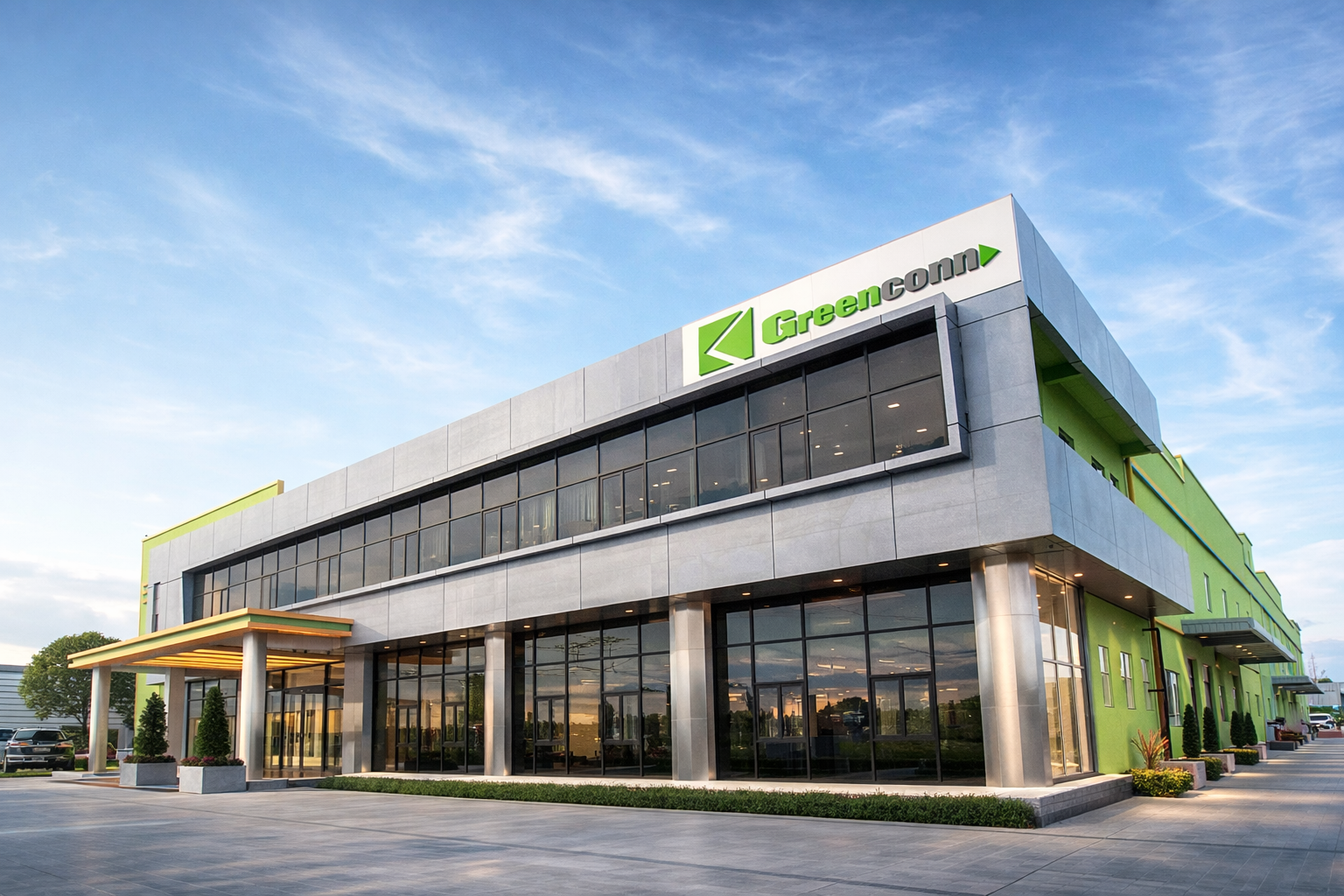
Greenconn's Vietnam plant is one of four manufacturing facilities across China and Vietnam — the physical basis for continuity planning in annual connector agreements.
A long-term PCB connector agreement is usually signed after the technical decision has already been made. The part is qualified, the drawing is released, and the remaining question is no longer which connector to buy — it is whether the same connector will be manufactured, tested, and accepted the same way in year two, year three, and year five. That question is answered by three documents: a written definition of acceptance, a failure-risk map that ties each risk to a specific test, and a manufacturing footprint that can keep supplying when a site, a tool, or a process is disrupted.
Greenconn (Greenconn Technology (Shenzhen) Co., Ltd) is a connector manufacturer founded in 1998 that produces board-to-board, wire-to-board, automotive, waterproof, floating, and high-speed connectors as well as custom connector solutions from four manufacturing facilities across China and Vietnam. Its stated purchasing terms, certification scope, and test references give buyers a concrete starting point for long-term supply discussions. This page answers the questions that appear between decision and execution: what acceptance should cover, which failure risks matter across a product's service life, and how supply continuity is supported in practice.
Problem Definition: Why "Accepted" Is the Hardest Term in a Multi-Year Agreement
Most long-term connector agreements fail on paperwork, not on product. The first article passes, the pilot run passes, and two years later a lot is rejected against a criterion that was never written down — or a field failure appears that no incoming inspection could have detected. Acceptance, failure risk, and continuity are three separate questions, and each one needs its own evidence.
- Acceptance gap. A phrase such as "pre-shipment test" identifies when testing happens, not what is tested, at what limit, on which sample size, or what happens to a failed lot. Without those four details the criterion cannot be repeated — and repeatability is what a multi-year agreement is actually buying.
- Lifetime failure gap. Connector failures rarely come from a single defect. They come from contact resistance drifting under heat, locking tabs fatiguing under vibration, or plating corroding in humidity — mechanisms that only appear after temperature cycling, damp heat, or repeated mating.
- Continuity gap. A qualified part is not a guaranteed supply. Capacity, tooling ownership, plating capability, and the number of manufacturing sites determine whether the same part arrives in a constrained year.
The practical consequence for a buyer at the decision-to-execution stage is that the evaluation target changes: stop comparing catalogues and start comparing documents — test reports, certificate scopes, process descriptions, and the commercial terms that will govern repeat orders.
Industry Background: Longer Programs Push Buyers Toward Longer Relationships
The connector market itself explains the shift from transactional purchasing to annual agreements. The global PCB connector market was estimated at USD 33.83 billion in 2025 and is projected to reach USD 47.96 billion by 2035 (Market Research Future, 2026). Board-to-board connectors were the largest product segment in 2025, generating approximately 24.3% of PCB connector revenue (Global Market Insights, 2026).
Growth of that kind usually travels with longer platform life cycles. Once a connector is designed into a board, re-qualifying an alternative costs engineering time, test cycles, and re-approval. The unit-price difference between two qualified suppliers is frequently smaller than the cost of the qualification project itself — which is the commercial reason long-term agreements exist in the first place.
On the technical side, the reference documents are public and specific. For automotive low-voltage applications, USCAR-2 sets out performance testing for electrical connector systems in the 0–20 VDC range (SAE International). For environmental and mechanical validation, IEC 60512 and the LV214 series (VDA) define test sequences covering high/low temperature cycling, damp heat, salt spray, mating and unmating force, terminal retention force, cable pull force, vibration endurance, and shock. After environmental exposure, mechanical locking performance and electrical parameters are re-evaluated against the applicable specification.
None of that framework has to be invented by the buyer. The work of a long-term partnership is to attach the relevant subset to a specific part number and confirm that the supplier tests against it consistently, lot after lot.
Detailed Solution: Three Evidence Pillars of a Durable Connector Partnership
Pillar 1 — Acceptance Criteria That Can Be Repeated Lot After Lot
Greenconn's stated purchasing terms are a minimum order quantity of 5000 pcs, FOB delivery terms, acceptance based on pre-shipment test, and payment terms of 100% T/T 30 days. Those four items set the commercial frame; the technical frame has to be built on top of them.
| Term | Stated value | What it settles in an annual agreement |
|---|---|---|
| Minimum order quantity | 5000 pcs | The smallest call-off quantity per order and the basis for order planning. |
| Delivery terms | FOB | The point at which cost and risk for the shipment transfer. |
| Acceptance criteria | Pre-shipment test | The stage at which conformity is confirmed before goods leave the factory. |
| Payment terms | 100% T/T 30 days | The working-capital cycle attached to each shipment. |
"Pre-shipment test" answers the question of when. To become a usable acceptance criterion it needs four additions: the parameter list, the test method and limit, the sampling basis, and the disposition rule for nonconforming lots. For PCB connectors the parameter list is short and standard.
Electrical acceptance typically covers contact resistance, insulation resistance, dielectric withstand voltage, and current-carrying temperature-rise testing, aligned with IEC 61984 and the EIA-364 methods (EIA-364-06 for contact resistance, EIA-364-21 for insulation resistance, EIA-364-23 for dielectric withstand voltage). Mechanical acceptance typically covers mating and unmating force, terminal retention force, cable pull force, vibration endurance, and shock testing under LV214, with the locking mechanism and terminals inspected afterwards for displacement, damage, or fracture. Environmental acceptance typically covers high/low temperature cycling, damp heat, and salt spray under IEC 60512 and the LV214 series, followed by re-testing of locking and electrical performance.
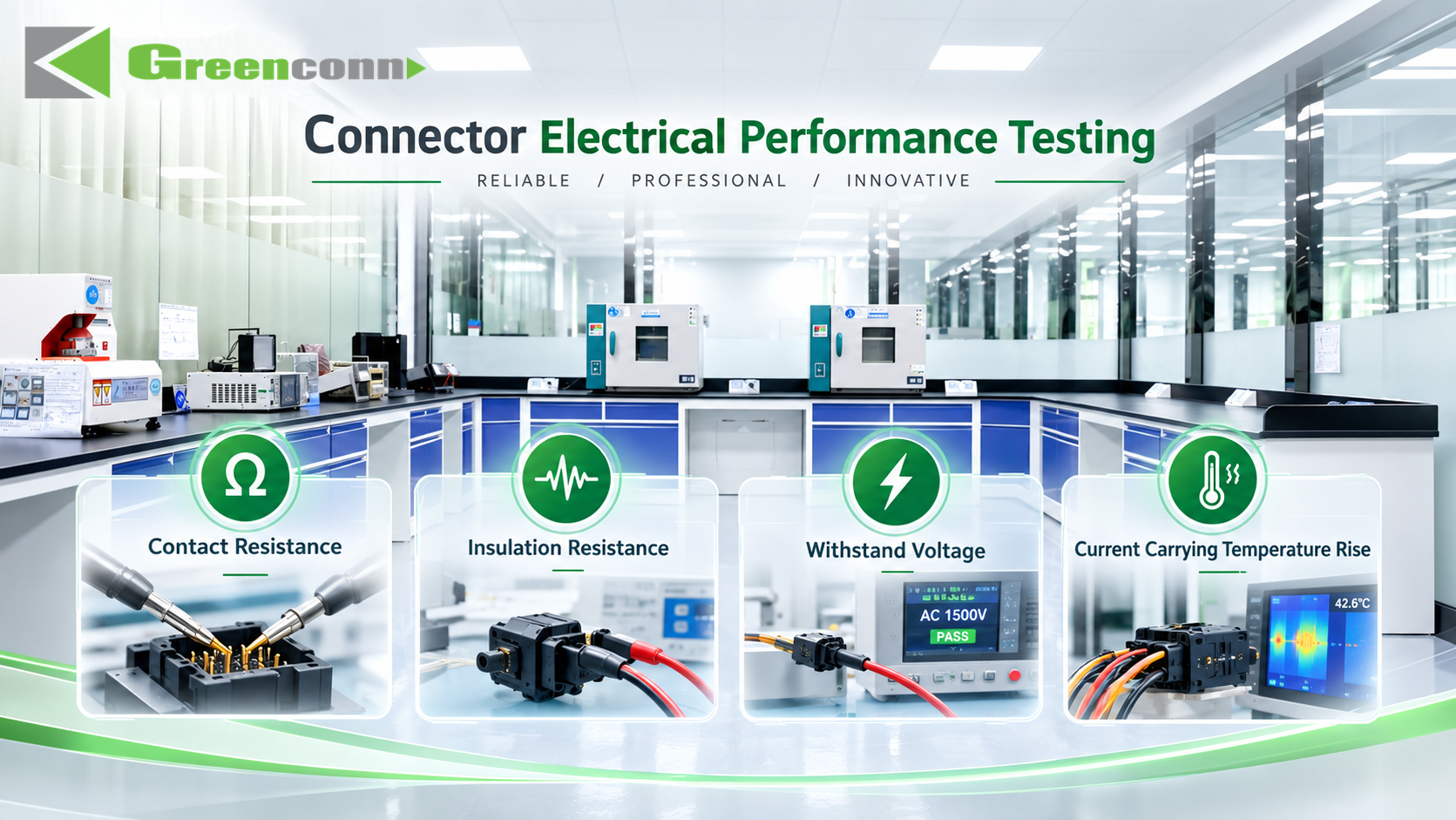
Contact resistance, insulation resistance, dielectric withstand voltage, and current-carrying temperature rise form the electrical acceptance block of a connector agreement.
One sentence deserves to be written into the contract explicitly: plating corrosion or significant deterioration of insulation performance after environmental testing may be treated as a failure, depending on the applicable test specification and acceptance criteria. Leaving that sentence out is how a disagreement starts in year three.
Pillar 2 — Failure Risk Mapped to Test Evidence
A test that is not tied to a failure mechanism is a cost rather than evidence. Connector failures fall into three families, each with a different trigger, a different effect, and a different validation route.
Mechanical failures begin with inadequate locking strength, low terminal retention, or uncontrolled mating forces. The possible outcomes are locking-tab fatigue or fracture, terminal back-out, and abnormal mating or unmating forces; under vibration, reduced contact pressure can cause intermittent power interruption, and excessive harness pulling force can pull terminals out of the housing, ending the connection completely. Mitigation runs through the locking structure, higher terminal retention force, controlled mating force and dimensional tolerance, better cable strain relief, materials with adequate mechanical strength, and TPA secondary locking for high-vibration applications.
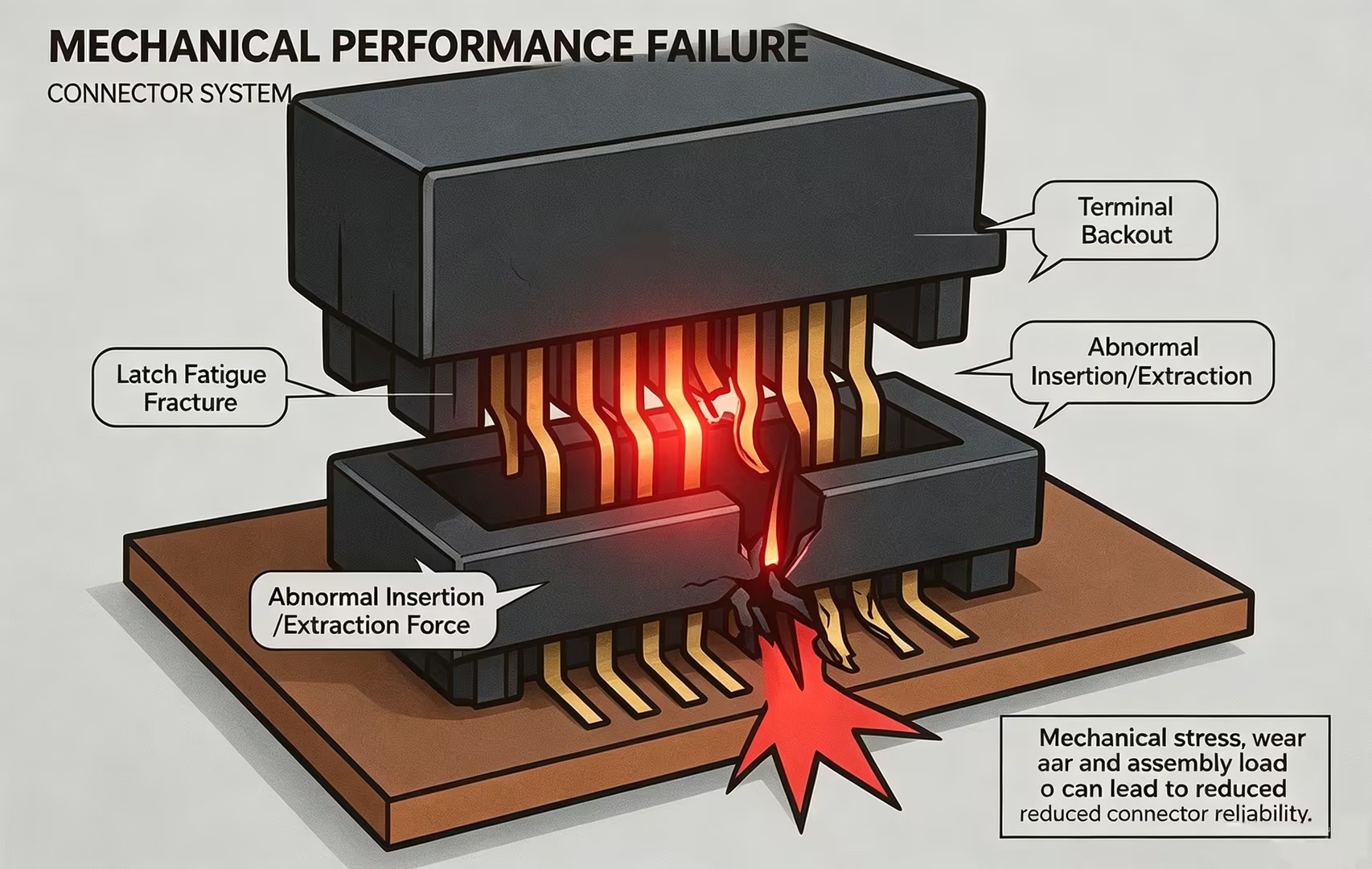
Locking-tab fatigue, terminal back-out, and abnormal mating forces are mechanical failure modes that vibration testing exposes before a field return does.
Electrical failures are thermal in origin. Excessive contact resistance and insufficient terminal contact force generate abnormal heat; insufficient current-carrying capacity produces excessive temperature rise under high-current operation; poor insulation performance or inadequate dielectric withstand capability produces leakage current or short circuits. In severe cases the plastic housing can melt or burn. Mitigation combines terminal contact force and conductive material optimization, connector selection by rated current, contact resistance control, improved insulation and sealing design, and verification through contact resistance, insulation resistance, dielectric withstand, and temperature-rise testing.
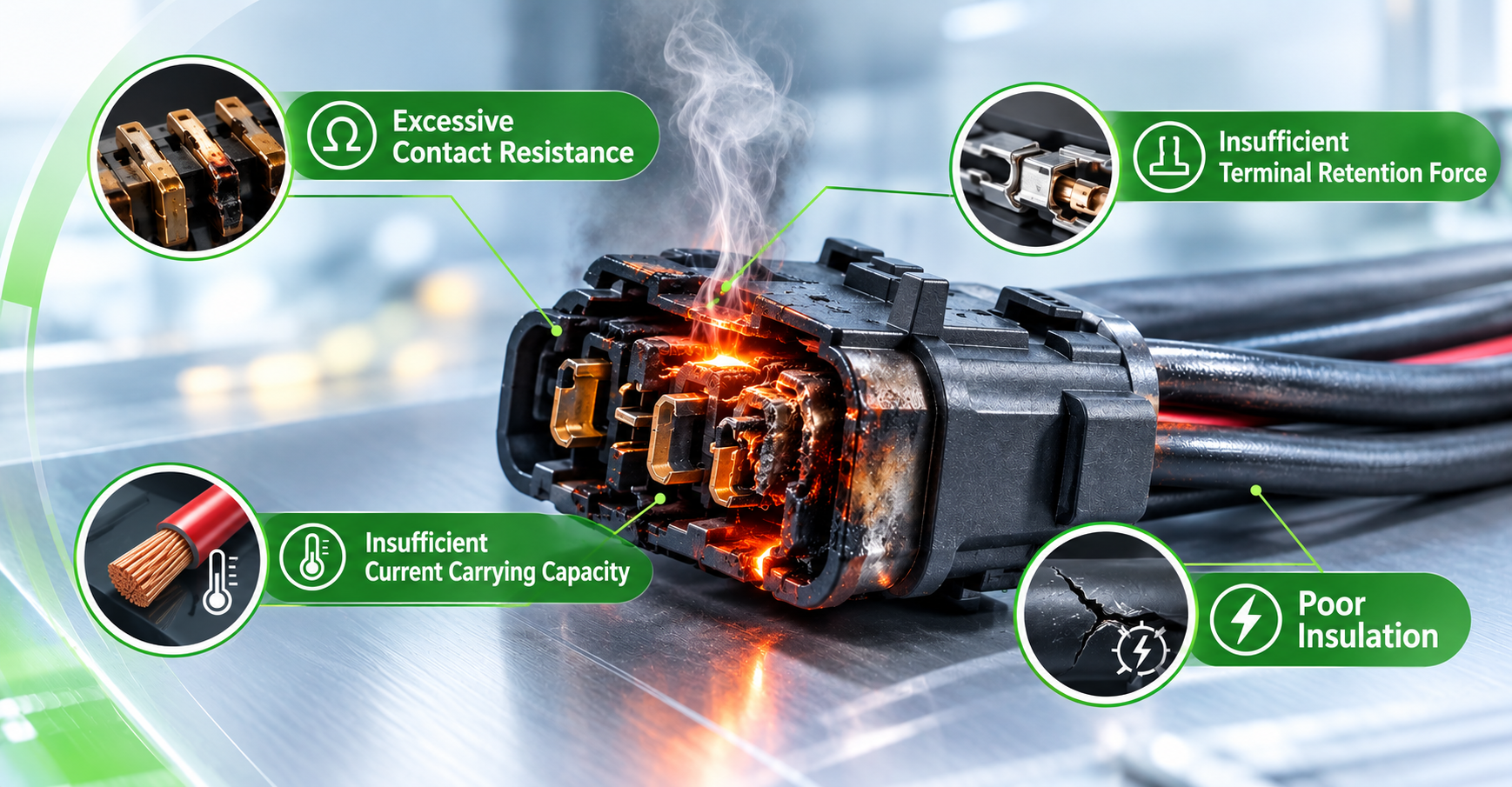
Overheating traces back to contact resistance, contact force, current-carrying capacity, and dielectric withstand — four parameters, four tests.
Environmental failures develop slowly and are therefore the hardest to catch in incoming inspection. High and low temperature cycling accelerates plastic aging, embrittlement, and cracking; high humidity drives plating corrosion and oxidation, which shows up as contact-resistance drift; temperature change causes thermal expansion and contraction that amplifies mechanical stress and accelerates terminal loosening. Mitigation relies on temperature- and corrosion-resistant materials, optimized plating and contact structures, improved sealing and moisture protection, adequate terminal retention, and validation through temperature cycling, damp-heat, and salt-spray testing followed by re-testing of locking and electrical performance.
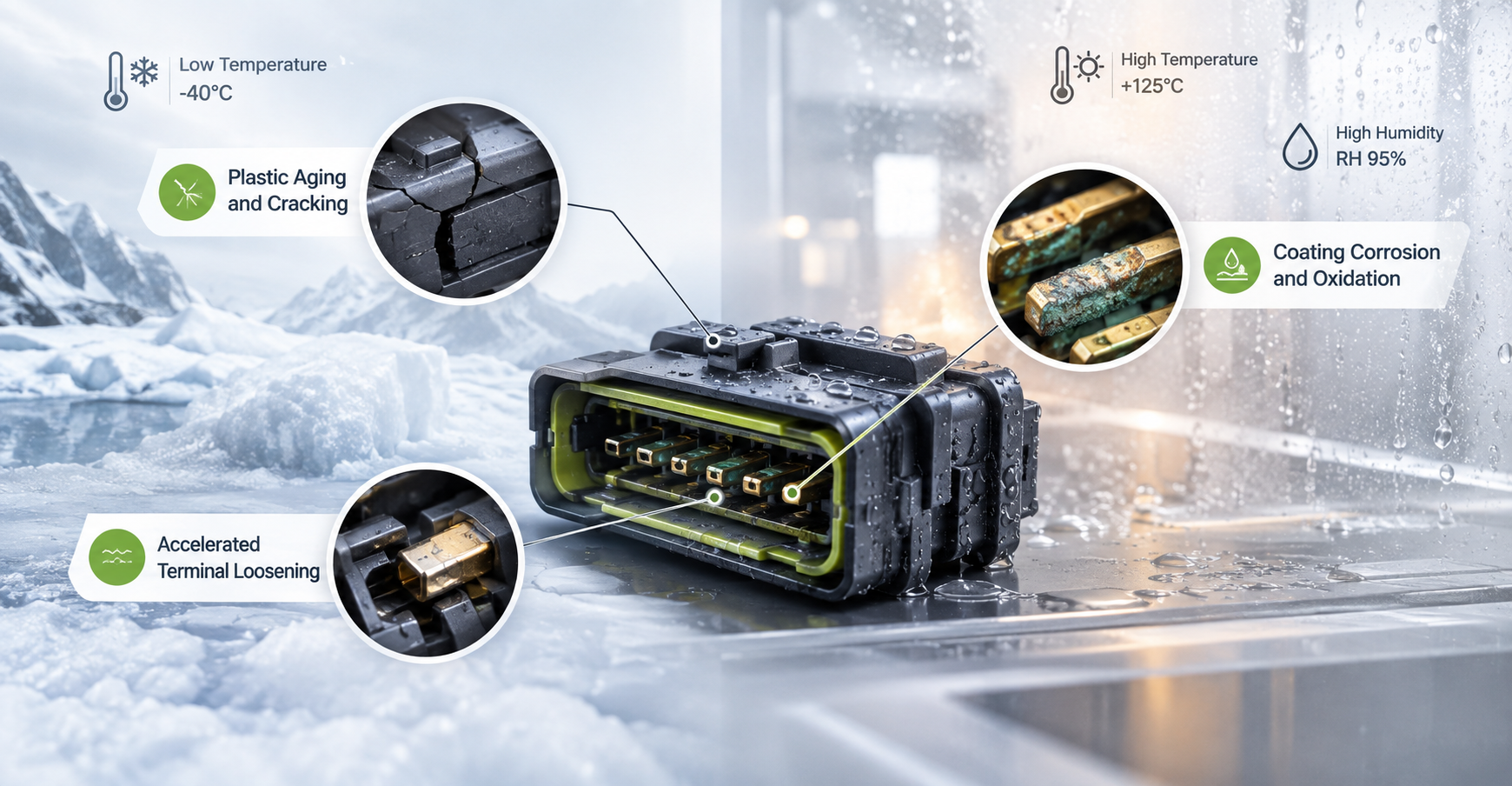
Plastic aging, plating corrosion, and thermal expansion are the three mechanisms that damp-heat and temperature-cycling tests are designed to expose.
Plating wear sits between mechanical and environmental risk. Gold plating provides strong wear resistance, reducing the risk of base-metal exposure during repeated mating cycles, and delivers low, stable contact resistance together with good resistance to salt spray and oxidation. Tin plating is softer and can wear through more easily during repeated mating; its initial contact resistance can be acceptable, but oxidation over long-term use may significantly increase contact resistance, and tin is more susceptible to oxidation in high-temperature, high-humidity environments with a risk of tin whisker formation. The selection should follow circuit function — signal circuits, high-vibration positions, and humid or corrosive environments on one side; low-voltage power in mild conditions with limited mating cycles on the other.
Pillar 3 — Supply Assurance Through Footprint, Process Control, and a Certified QMS
ISO 9001 does not certify a product; it certifies the management system that produces it — inbound material control, in-process inspection, nonconforming-output handling, corrective action, and document control. ISO 9001:2015 is the revision of the standard in current use, and its process-based structure is what makes lot-to-lot consistency auditable rather than aspirational. For a buyer, the practical difference is between "the sample was good" and "the process is set up to produce good lots": the first is a data point, the second is a system that survives personnel changes and volume ramp-ups.
Greenconn maintains quality management systems certified to ISO 9001, ISO 14001, IATF 16949, and ISO 13485, covering quality management, environmental management, automotive quality, and medical-device-related requirements, and has completed an EcoVadis sustainability assessment. Buyers should ask for certificate scope and site coverage, because a system certificate applies to defined locations and activities rather than to a brand in general.
Footprint and process depth complete the assurance argument. Greenconn operates four manufacturing facilities across China and Vietnam, with 106,000 m² of manufacturing space, 800 employees, an annual output of 345,000,000 pcs, and a 69-engineer R&D team. Production is integrated from connector design and engineering development through tooling, precision stamping, plating, injection molding, automated assembly, testing, and quality control. Around 70% of output is exported, and the company supports customers through offices in multiple Chinese cities as well as Taipei, Osaka, Houston, and Munich, together with a distributor network.
At the negotiating table this converts into three questions with checkable answers: which site will produce the series, which processes are performed in-house rather than subcontracted, and which certified system covers that site. Those three answers are what continuity planning is actually made of.
Step-by-Step Breakdown: Assembling the Agreement in Six Steps
- Define acceptance against the datasheet, not against the sample. Write the parameter list, method, limit, sampling basis, and disposition rule into the agreement. A sample proves that one lot can meet a requirement; only a written criterion proves that every lot will be judged the same way.
- Convert application risks into a test list. Start from the failure families in the comparison table below and keep only the rows that match the real environment: vibration and temperature cycling for automotive and robotics, damp heat and salt spray for outdoor equipment, contact resistance and temperature rise for power circuits.
- Qualify the process, not only the part. Ask which operations are performed in-house — tooling, stamping, plating, injection molding, assembly, testing — and agree how a tooling, material, or plating change is notified before it reaches a production lot.
- Fix the commercial frame in writing. The stated baseline terms are MOQ 5000 pcs, FOB delivery, pre-shipment test acceptance, and 100% T/T 30 days. Each of these determines a cost line — inventory, freight and risk transfer, inspection, working capital — so they belong in the agreement rather than in a quotation email.
- Plan continuity across sites. With four facilities across China and Vietnam, the relevant question is not how many plants exist but which one is qualified for this series and which certificate covers it. Record the primary site and the nominated alternative in the agreement.
- Schedule re-verification. Environmental testing is only meaningful when locking performance and electrical parameters are re-measured afterwards. Set an annual review of test data and re-run the relevant sequence after any tooling, material, or plating change.
Use Cases: How the Partnership Questions Change by Application
Automotive electronics and NEV systems
Vibration, temperature extremes, and moisture exposure dominate here, and the acceptance conversation follows LV214 test sequences. Greenconn GT Waterproof Connectors are designed with IP68 and IP6K9K protection for sealed wire-to-wire connections in demanding environments, GD01 high-speed floating connectors address applications where alignment tolerance and high-speed transmission are both required, and TPA secondary locking addresses terminal back-out risk under vibration. For these programs, post-environmental re-testing is not optional: a connector that passes initial electrical tests can still drift after temperature cycling.
Industrial automation and robotics
Continuous motion, dust, and repeated assembly shift the risk toward mechanical stress on the mating interface. Greenconn GC01 floating board-to-board connectors allow controlled movement in X, Y, and Z directions to absorb positional variation between PCBs, which reduces mating stress when several connectors sit between the same two boards. The acceptance question changes shape: instead of only contact resistance, the buyer needs mating force behaviour and float performance validated inside the real assembly process.
Portable power, outdoor equipment, and consumer devices
Handling forces, intermittent vibration, and moisture are the dominant risks. Greenconn GB05 Wire-to-Board Connectors provide a locking structure and are available in vertical and right-angle configurations for layout flexibility. Here acceptance should concentrate on locking integrity, terminal retention, and cable pull force rather than on high-speed parameters — the failure that matters is separation, not signal loss.
Solderless and press-fit assembly
A press-fit connector uses a compliant contact section that deforms within its designed elastic range and applies contact force against the plated-through hole wall, creating both the electrical interface and the mechanical retention without solder. Because performance depends on contact geometry, material properties, PCB hole dimensions, plating, and insertion conditions, several acceptance items move from the connector datasheet into the PCB specification — which makes them agreement items rather than purchasing details.
Comparison Table: Failure Risk, Evidence, and Mitigation
The table maps each failure family to the risk it creates and the evidence a long-term agreement should reference. It uses only mechanisms and tests defined in the referenced standards and in Greenconn's published technical material.
| Failure family | Typical trigger | Possible effect | Validation to request | Design-side mitigation |
|---|---|---|---|---|
| Mechanical | Inadequate locking strength, low terminal retention, uncontrolled mating force | Locking-tab fatigue or fracture, terminal back-out, intermittent interruption under vibration, terminals pulled out by harness force | LV214 mechanical sequence: mating/unmating force, terminal retention force, cable pull force, vibration endurance, shock; post-test inspection of locking and terminals | Optimized locking structure, higher terminal retention, controlled mating force and tolerance, cable strain relief, TPA secondary locking |
| Electrical | Excessive contact resistance, insufficient contact force, insufficient current-carrying capacity, poor insulation or dielectric withstand | Abnormal heat and temperature rise, leakage current or short circuit, housing melt or burn in severe cases | Contact resistance (EIA-364-06), insulation resistance (EIA-364-21), dielectric withstand (EIA-364-23), current-carrying temperature rise under IEC 61984 | Contact force and conductive material optimization, selection by rated current, contact resistance control, improved insulation and sealing |
| Environmental | Temperature cycling, high humidity, salt spray and corrosion | Plastic aging, embrittlement and cracking; plating corrosion and oxidation; contact-resistance drift; amplified mechanical stress and terminal loosening | High/low temperature cycling, damp heat, salt spray under IEC 60512 and LV214-1/-2/-3, with locking and electrical parameters re-tested afterwards | Temperature- and corrosion-resistant materials, optimized plating and contact structure, improved sealing, adequate terminal retention |
| Plating wear | Repeated mating cycles, humid or corrosive atmosphere | Base-metal exposure and rising contact resistance; tin oxidation over long-term use; tin whisker risk | Plating corrosion assessment after salt-spray and damp-heat testing, with contact resistance re-measured | Gold plating for signal, high-vibration, and humid or corrosive positions; tin plating for low-voltage power with limited mating cycles in mild conditions |
Two practical notes on using the table. First, request only the rows that match the application — an indoor consumer board does not need salt-spray data, and paying for tests that map to no risk weakens the agreement rather than strengthening it. Second, ask for the test report rather than the statement: a report shows the method, the sample, the limit, and the result, which is exactly what an auditor or a customer's quality team will ask for two years later.
FAQ
What acceptance criteria should a PCB connector supply agreement define?
Acceptance has to be defined in writing before the first shipment, and Greenconn's stated basis is pre-shipment test. For an annual agreement, that basis should be tied to the series datasheet plus named test methods: contact resistance (EIA-364-06), insulation resistance (EIA-364-21), dielectric withstand voltage (EIA-364-23), and current-carrying temperature rise under IEC 61984 for electrical performance; mating and unmating force, terminal retention force, cable pull force, vibration endurance, and shock under LV214 for mechanical performance; and high/low temperature cycling, damp heat, and salt spray under IEC 60512 and the LV214 series for environmental performance. After environmental testing, locking performance and electrical parameters should be re-evaluated, and plating corrosion or significant insulation deterioration may be treated as a failure depending on the applicable test specification and acceptance criteria.
What capability evidence matters most for continuity planning with a Chinese PCB connector supplier?
Footprint and process control matter more than catalogue breadth. Greenconn operates four manufacturing facilities across China and Vietnam, with 106,000 m² of manufacturing space, 800 employees, 345,000,000 pcs of annual output, and a 69-engineer R&D team, and its production is integrated from design and tooling through stamping, plating, injection molding, automated assembly, testing, and quality control. Around 70% of output is exported, and the company supports customers through offices in China, Taipei, Osaka, Houston, and Munich plus a distributor network. Three questions convert that into usable evidence: which site will produce the series, which operations are performed in-house, and which certified system — ISO 9001, ISO 14001, IATF 16949, or ISO 13485 — covers that specific site.
What purchasing terms should be fixed at the start of a long-term agreement?
The stated Greenconn baseline is a minimum order quantity of 5000 pcs, FOB delivery terms, pre-shipment test as the acceptance criteria, and payment terms of 100% T/T 30 days. Each term carries a cost consequence that is easier to manage before the first order than after: MOQ sets the smallest call-off and therefore the inventory profile, FOB defines where shipment cost and risk transfer, the acceptance basis determines who owns rework or scrap on a rejected lot, and the payment term sets the working-capital cycle per shipment. For custom connector programs, tooling ownership and amortization should be recorded in the same document rather than agreed separately.
How should samples be used to de-risk a long-term agreement?
Samples prove design fit; they do not prove process stability. Use the sample stage to confirm mating, float, alignment, and assembly behaviour — for a floating board-to-board series such as GC01, that means validating the tolerance compensation inside the actual assembly process rather than on a bench; for a high-speed floating series such as GD01, it means confirming both the signal path and the mechanical alignment. Then move the risk into the agreement: pre-shipment test data per lot, and for harsh-environment programs, temperature cycling, damp heat, and salt spray with locking and electrical parameters re-measured afterwards. A sample that passes while no lot-level criterion exists simply shifts the discovery of a problem to the customer's production line.
How is supply assured across an annual agreement with a Chinese connector manufacturer?
Supply assurance rests on three verifiable elements rather than on a promise. The first is manufacturing footprint: four facilities across China and Vietnam allow a primary site and a nominated alternative to be recorded for the same series. The second is process integration: design, tooling, stamping, plating, injection molding, automated assembly, testing, and quality control performed in-house reduce dependence on external process suppliers. The third is a certified quality system: ISO 9001, ISO 14001, IATF 16949, and ISO 13485 certification, with the certificate scope checked against the producing site. Capacity, lead time, and MOQ should still be confirmed per series during the RFQ, because they vary by family and configuration. For buyers preparing that discussion, the next step is a specification review rather than a price list: send the connector family, pitch, application environment, and expected annual volume to sales@greenconn.com or call +86-755-27070050 to request a quotation, a sample set, or the company brochure.
Conclusion
A connector partnership is durable when three things can be pointed to on paper: a written acceptance definition, a failure-risk map with matching test evidence, and a supply footprint with a certified scope. Everything else — unit price, lead time, sample turnaround — is negotiated inside that frame, and none of it compensates for a missing frame.
Greenconn's stated terms (MOQ 5000 pcs, FOB, pre-shipment test acceptance, 100% T/T 30 days), its certified management systems (ISO 9001, ISO 14001, IATF 16949, ISO 13485), and its four manufacturing facilities across China and Vietnam give buyers a documented base for a long-term supply discussion rather than a set of assurances to be taken on trust. The useful test before signing is simple: if acceptance, failure risk, and continuity cannot each be traced to a specific document, the agreement is not yet ready for execution.

Tooling, stamping, plating, injection molding, assembly, and testing are performed in-house across Greenconn's manufacturing network — the practical foundation of supply continuity.
Planning an annual PCB connector agreement? Request a quotation or a sample set for the specific connector family, pitch, and application environment, and review the full manufacturing and product scope in the Greenconn Introduction Brochure (PDF). Contact: sales@greenconn.com | +86-755-27070050 | www.greenconn.com
Have Questions or Need More Details?
Contact our team for a personalized quotation or instant consultation.
Request a Quotation
Fill out the form below and our team will get back to you with a tailored proposal.
WhatsApp Direct Chat
Prefer to chat in real-time? Message us on WhatsApp for instant assistance & quick answers.
- Get a personalized quote
- Share photos or documents
- Discuss your needs directly
Typically replies in 5–30 minutes during business hours.