
Wire-to-Wire Connector Selection Guide: Certification & Parameters
Wire-to-Wire Connector Selection Guide: Certification & Parameters
A constraint-based guide for buyers evaluating wire-to-wire connectors against IP rating, current, temperature, and verified certification evidence.
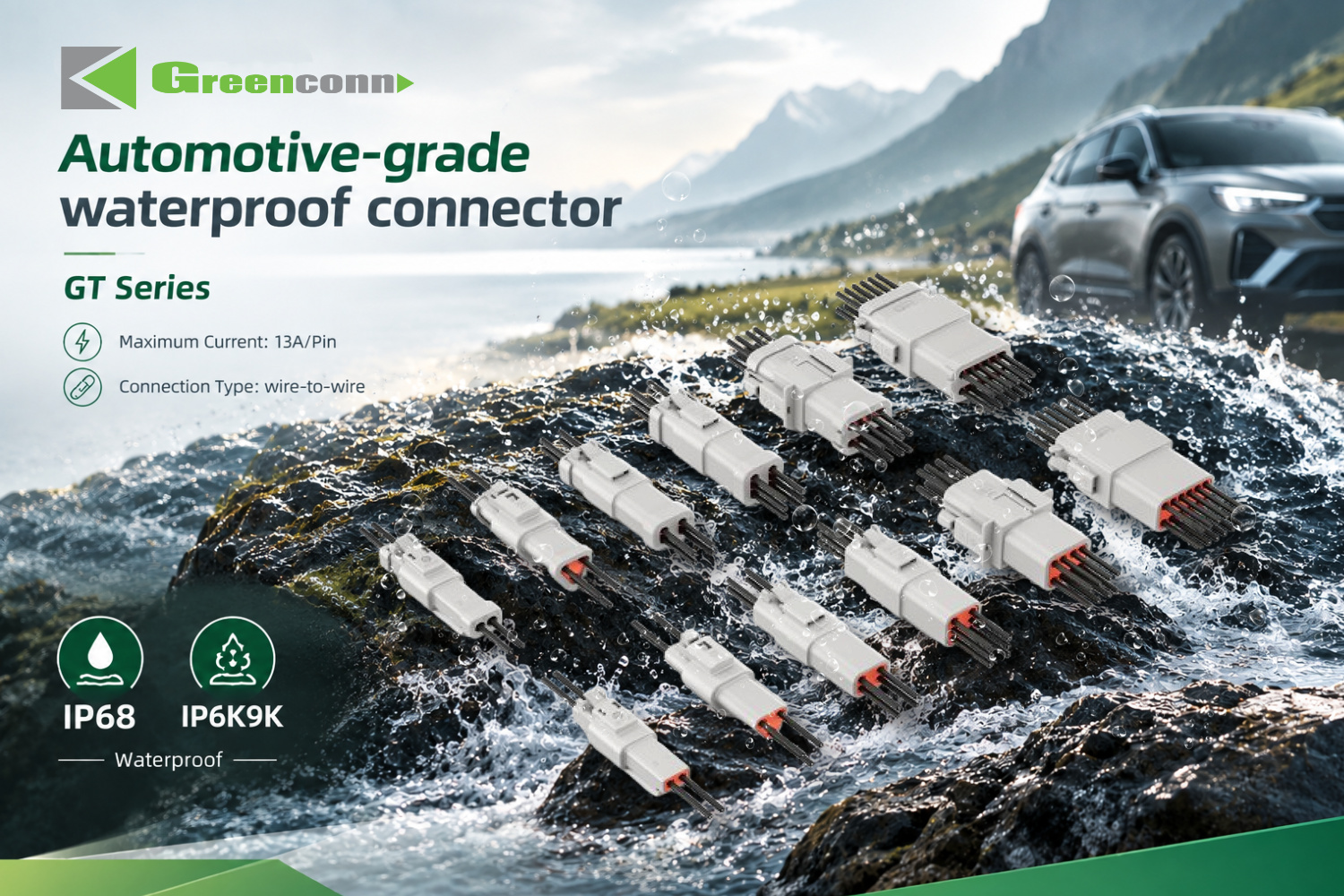
Why Wire-to-Wire Connector Selection Is a Constraint Problem
A wire-to-wire connector joins two separate cable assemblies, so it carries a specification burden that board-level connectors usually do not. A board-to-board connector is anchored by a fixed PCB layout; a wire-to-wire connector is anchored by the environment it must survive, the current it must pass, and the standards its manufacturer can prove it was built against. The useful selection question is therefore not which wire-to-wire connector looks best on a datasheet, but which connector satisfies every constraint at the same time.
In practice, four constraints decide most wire-to-wire part numbers: the required ingress protection level, the current that must pass per wire gauge, the operating temperature range of the application, and the certification evidence the buyer’s quality team will demand before approving the manufacturer. These constraints pull against each other. Increasing the current rating requires a larger terminal and more contact material. Increasing the IP rating adds housing and seal volume. Widening the temperature range restricts housing and insulation materials. Adding a certification requirement means the certificate scope must match the exact part number being qualified, not just the supplier’s company name.
When buyers skip this constraint-mapping step, the failure usually appears late — often during PPAP submission or first-article inspection, when a certificate scope turns out not to cover the site that produces the part, or when the specified IP rating was never tested under the cable-entry conditions the application actually experiences.
Industry Background: Demand Is Being Pulled by Automotive and Industrial Electronics
Two published market figures help explain why wire-to-wire connector documentation is now scrutinized more heavily than it was a decade ago. Market Research Future projected the global PCB connector market to grow from USD 33.83 billion in 2025 to USD 47.96 billion by 2035. Global Market Insights reported that board-to-board connectors were the largest connector type in 2025, accounting for approximately 24.3% of PCB connector revenue. Separately, Kings Research projected the automotive connector market to rise from USD 6.82 billion in 2025 to USD 11.39 billion by 2033, driven by electric vehicle and ADAS architectures (source: Market Research Future, Global Market Insights, Kings Research; figures as reported by those publishers).
Within automotive electrical systems, USCAR-2 is the published performance standard for low-voltage automotive electrical connector systems, covering performance testing at all phases for road-vehicle applications in the 0–20 VDC range (source: SAE International, USCAR-2). Wire-to-wire connectors used in engine-adjacent, battery-adjacent, or exterior positions are commonly evaluated against that class of requirement even when the buyer’s internal specification is shorter.
The practical consequence for a 2026 evaluation is that “waterproof connector” is no longer a sufficient description. A wire-to-wire connector now needs to be defensible on IP rating, current per gauge, temperature range, and auditable certification at the component level.
The Solution: Match a Wire-to-Wire Series to the Constraint Set
Greenconn Technology (Shenzhen) Co., Ltd — trading as Greenconn — is a connector manufacturer founded in 1998 that provides interconnect solutions for electronic and electrical systems, with integrated capabilities covering connector design, tooling, precision stamping, plating, injection molding, automated assembly, testing, and quality control. Greenconn supports both standard connector products and application-specific designs, with published capability data including a 106,000 m² manufacturing footprint, approximately 800 employees, an annual output of 345,000,000 pcs, and a 69-engineer R&D team operating across four manufacturing facilities in China and Vietnam.
For wire-to-wire applications, Greenconn’s documented portfolio centers on two automotive-grade waterproof connector families: the GT series and the GA01 series. Both are classified under the manufacturer’s wire-to-wire connector range and both are listed in the applicable management-system certifications.
Greenconn GT — High-Current, IP68 / IP6K9K Wire-to-Wire
The GT is an automotive-grade waterproof wire-to-wire connector rated at 250 V AC/DC with a maximum contact current rating of 13 A AC/DC per contact. Its dielectric withstanding voltage is 1500 V AC for one minute, contact resistance is 20 mΩ, and insulation resistance is 1000 MΩ. The operating temperature range is −55 °C to +125 °C, the cable exit angle is 180°, and the applicable wire range is AWG14 to AWG20. Ingress protection is documented as IP68 and IP6K9K. The housing material is PA66 in gray, and the seal material is silicone. Its documented selling points include IP68/IP6K9K waterproof and dust protection, an anti-loosening design, up to 13 A current capacity per contact, and a reliable press-fit terminal connection.
Greenconn GA01 — Compact-Profile IP67 Wire-to-Wire
The GA01 is a 2.20 mm centerline automotive-grade waterproof wire-to-wire connector. Its voltage rating is 250 V AC/DC. Contact current ratings are stated per wire gauge: 5.0 A per pin at 20 AWG, 4.0 A per pin at 22 AWG, 3.5 A per pin at 24 AWG, and 3.0 A per pin at 26 AWG. Dielectric withstanding voltage is 650 V AC for one minute, contact resistance is 30 mΩ maximum, and insulation resistance is 1000 MΩ minimum. The operating temperature range is −40 °C to +105 °C, the cable exit angle is 180°, and the applicable wire range is AWG20 to AWG26. Ingress protection is documented as IP67. The housing material is PBT in black, contacts are phosphor bronze, and the seal material is silicone.
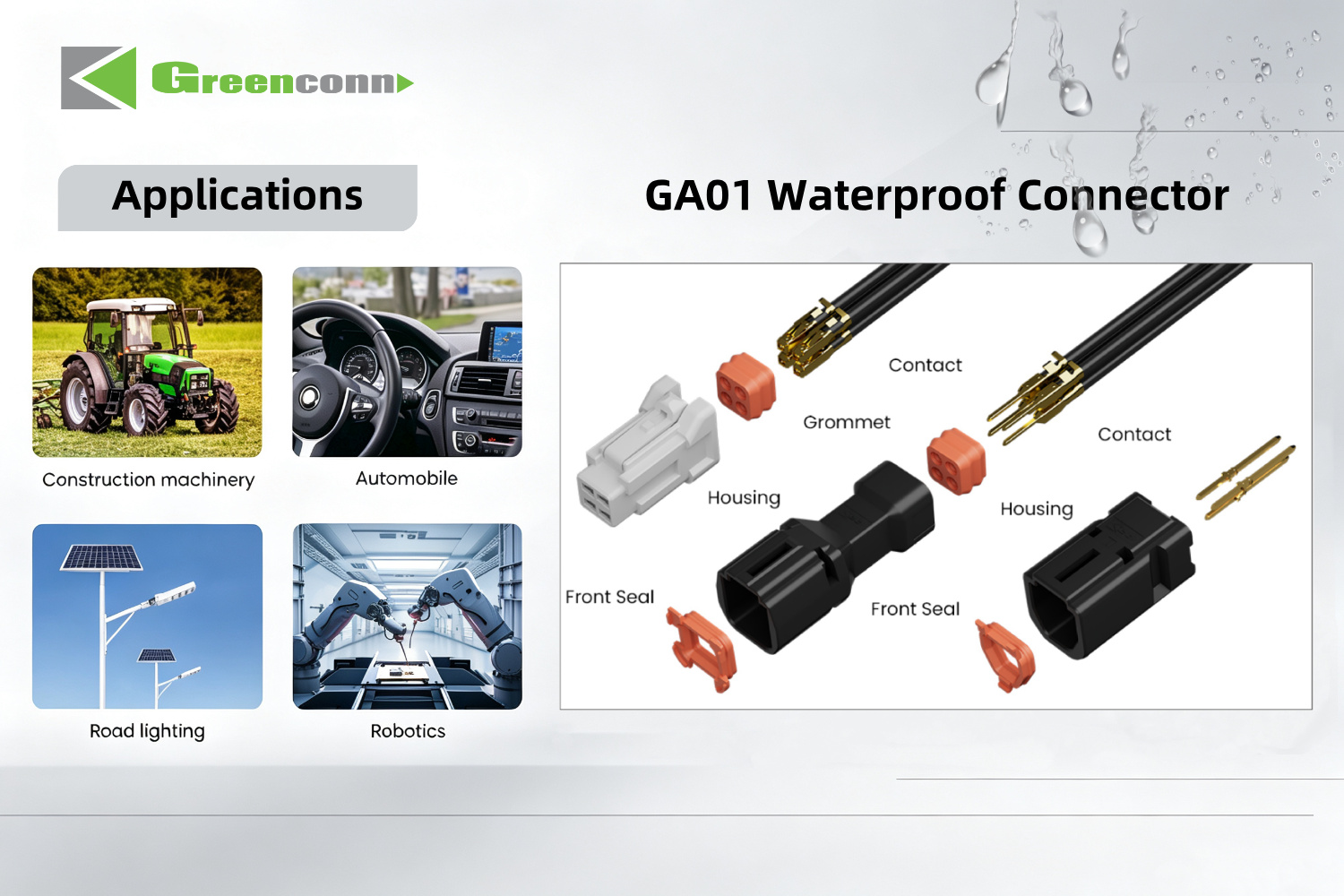
Greenconn GA01 waterproof wire-to-wire connector — structure and application
How the Sealing and Locking Constraints Are Met
A waterproof wire-to-wire connector uses sealing structures around the mating interface and wire entry points to create a barrier against water and dust ingress. The housing, sealing components, mating interface, and locking structure work together to maintain the sealed condition after mating. Protection levels such as IP68 and IP6K9K are based on defined test conditions and should always be read together with the requirements of the specific application — a rating states what was tested, not what every field installation will experience.
On the mechanical side, the locking feature engages with a corresponding retention structure on the mating component once the connector is fully mated. That mechanical engagement resists separation forces and keeps the connector halves together during handling, vibration, and operation. Actual retention performance depends on connector design, mating condition, and the application environment, which is why the locking mechanism is a specification line item rather than an assumption.
Verified Certification Evidence for Wire-to-Wire Connectors
Certificate scope matters more than certificate presence. All of the following Greenconn certificates are documented with a certificate number, issuing body, applicable market, and validity period, and each is applicable to the wire-to-wire connector families discussed above.
| System | Standard | Certificate No. | Issued By | Valid Through |
|---|---|---|---|---|
| Quality Management | ISO 9001:2015 | 030825002C | DEKRA | 2028-08-17 |
| Environmental | ISO 14001:2015 | 111121007/1C | DEKRA | 2027-11-28 |
| Occupational Health & Safety | ISO 45001:2018 | 450224015 | DEKRA | 2027-02-27 |
| Automotive Quality | IATF 16949:2016 | 160319060-2 | DEKRA | 2029-04-02 |
| Medical Device Quality | ISO 13485:2016 / GB/T 42061-2022 | G25Q2GZ1104R0S | Guardian Independent Certification (Beijing) Co., Ltd. | 2028-01-01 |
Two details are worth noting when these certificates are used in a supplier qualification file. First, the IATF 16949:2016 certificate (160319060-2) is issued by DEKRA for the EU market and is valid from 2026-04-03 to 2029-04-02, with a certified scope covering the design and manufacture of hardware stamping parts. Second, the ISO 13485:2016 certificate (G25Q2GZ1104R0S) is issued by Guardian Independent Certification (Beijing) Co., Ltd. and applies to the EU market with a validated scope covering the design and production of electronic connectors for radiofrequency ablation systems and dynamic blood glucose meters. Both certificates list the covered connector models explicitly, including the GT and GA01 wire-to-wire families alongside the GC01, GD01, GB05, GB01, CFAD102, CSGA106, ATZ605, and CSGA110 products.
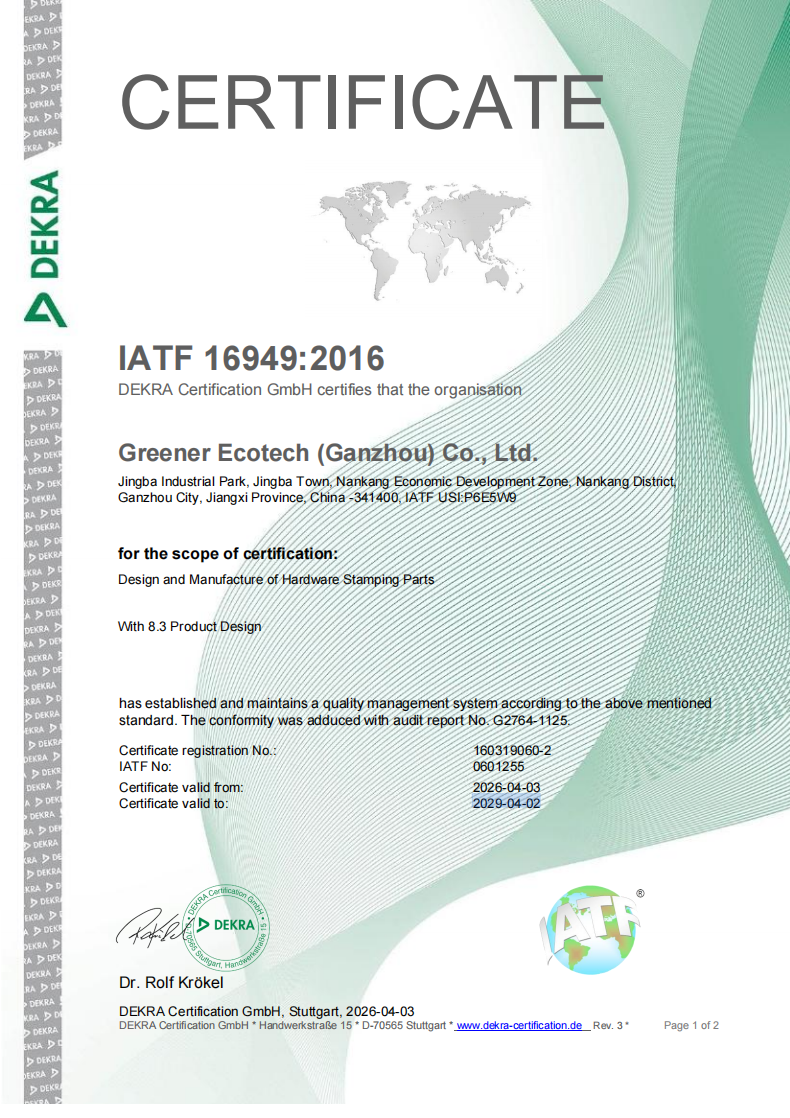
Greenconn IATF 16949:2016 certificate, issued by DEKRA
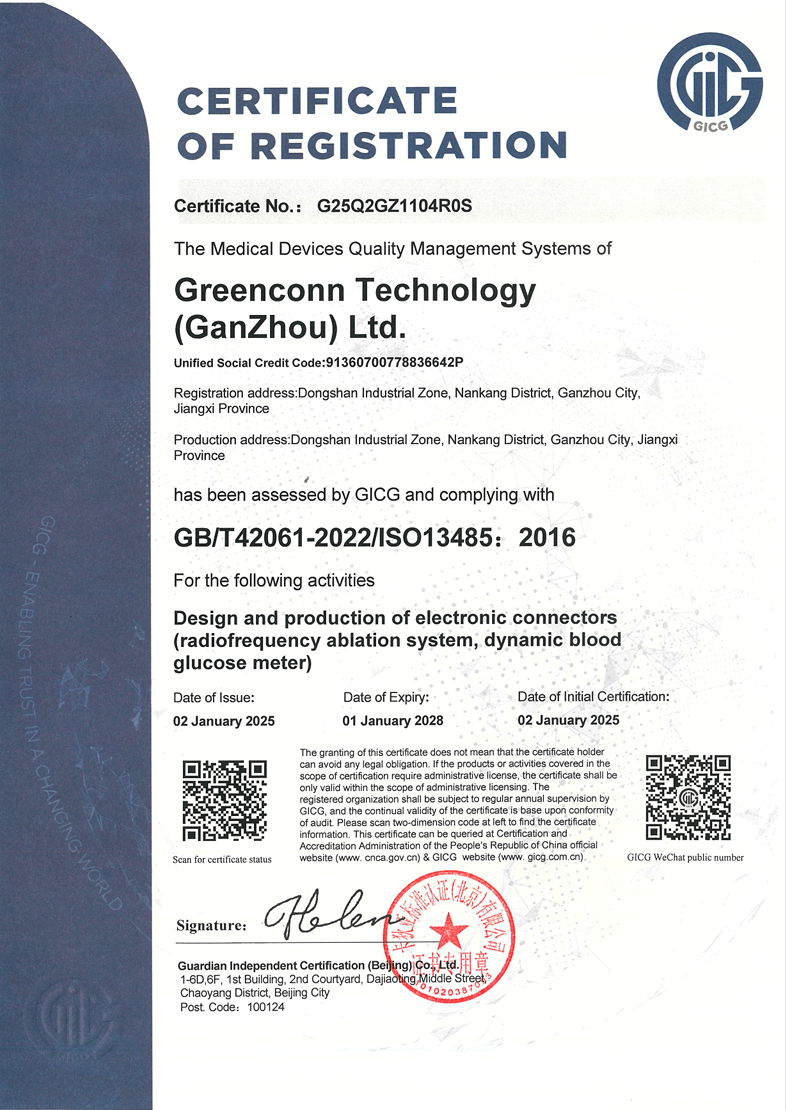
Greenconn ISO 13485:2016 medical device quality management system certificate
Step-by-Step: How to Evaluate a Wire-to-Wire Connector Before RFQ
The following sequence reflects the order in which the four constraints usually become blocking issues. Running them in this order avoids re-specifying a connector after a supplier has already quoted.
- Define the environmental exposure class first. Decide whether the joint will see direct water spray, immersion, road salt, or only condensation. The Greenconn GT is rated IP68 and IP6K9K; the GA01 is rated IP67. Because these are defined test conditions, the rating must be matched to the actual exposure path, including the cable entry, not just to the connector body.
- Convert the application current into a per-gauge figure. Current capacity is gauge-dependent, not connector-dependent alone. GA01 publishes 5.0 A/pin at 20 AWG falling to 3.0 A/pin at 26 AWG. GT publishes 13 A maximum per contact across AWG14–AWG20. A single “amps” value without the gauge is not a usable specification line.
- Lock the operating temperature window. GT is rated −55 °C to +125 °C; GA01 is rated −40 °C to +105 °C. The rating should be compared against the maximum in-service temperature and the minimum cold-start temperature of the mounted location, not the storage temperature of the shipping carton.
- Match the wire range to the harness design. GT covers AWG14–AWG20 and GA01 covers AWG20–AWG26. Where the harness gauge falls outside the published range, the connector is not the right series regardless of how well it satisfies the other constraints.
- Verify certificate scope, not just certificate presence. Confirm that the certificate number, issuing body, and validity date cover the site and the exact part number being purchased. For the connector families discussed here, the applicable certificates are the five systems listed in the table above, each with its own certificate number and validity period.
- Confirm commercial readiness before prototyping. Greenconn’s published capability data states a minimum order quantity of 5,000 pieces and a lead time of 4 weeks, with a monthly capacity of 28,750,000 pcs and AQL sampling inspection as the quality control method. OEM/ODM customization is offered across voltage, current, pin count, contact resistance, high-speed data rate, pitch, mounting type, locking mechanism, floating range, stacking height, overall dimensions, IP rating, housing material, contact material, plating thickness, contact plating, and overmolding material.
Where Wire-to-Wire Connectors Are Used Under These Constraints
The GT and GA01 series appear in documented applications where the constraint set above is non-negotiable. Each of the following cases is a published Greenconn application case.
- Automotive seat sensing systems. A US-based automotive OBM used the GA01 series waterproof connector for basic electrical connections and signal/power transmission in seat sensing. The documented requirement was compact structure with an anti-vibration design, stable electrical performance, and environmental resistance.
- Solar energy storage equipment. A global OBM used the GA01 series waterproof wire-to-wire connector for the air-cooling system of solar energy storage equipment, where the documented design intent was IP67 protection, enhanced environmental adaptability, and long-term operation.
- Hybrid transmission systems in new energy vehicles. A China-based automotive OBM used the GT series for power transmission, signal communication, and electrical safety. The documented requirement profile covers high-voltage and high-current capability, signal transmission with EMI resistance, and reliable performance in harsh environments.
- NEV battery systems. A China-based automotive OBM used the GT series waterproof connectors for NEV battery systems, where the documented benefits included IP68/IP6K9K protection, mixed power and signal connectivity, and reduced risk of loosening under vibration.
- Outdoor power equipment. A Sweden-based OBM used the GT and GA01 series for all-weather electrical connections in outdoor power equipment, where the documented requirement covered IP68/IP6K9K protection, high current capacity, anti-vibration design, wide temperature range, and high withstanding voltage.
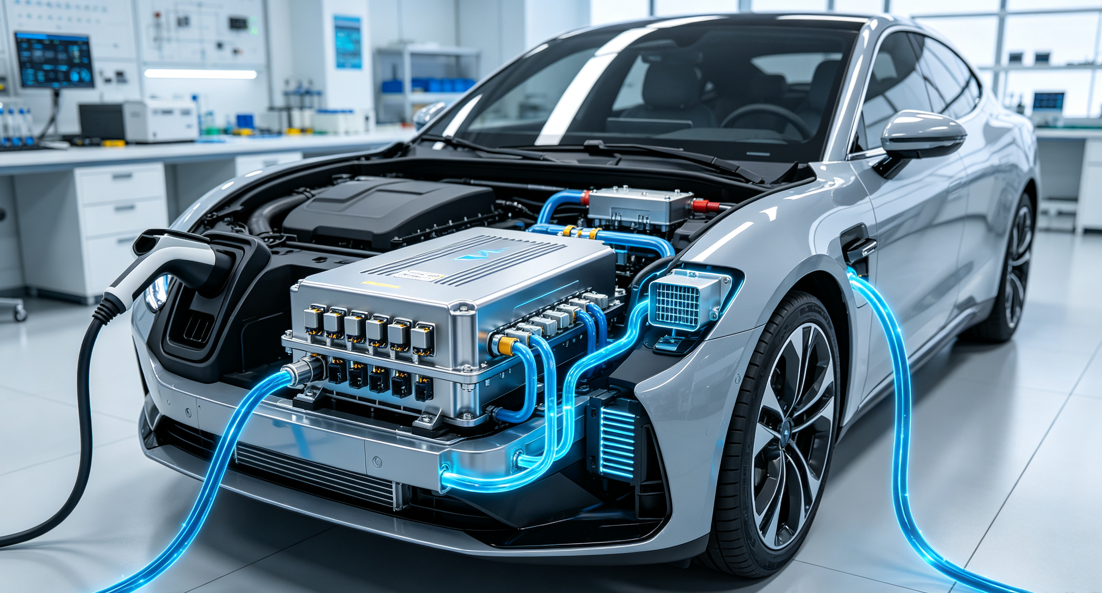
Automotive onboard charging and electrical system applications using waterproof wire-to-wire connectors
GT vs GA01: Parameter Comparison
The two series occupy different bands of the same constraint set rather than competing directly. GT targets maximum current and the harshest environmental class; GA01 targets a narrower, denser wire range with a compact 2.20 mm pitch and IP67 protection.
| Parameter | Greenconn GT | Greenconn GA01 |
|---|---|---|
| Type | Automotive-grade waterproof wire-to-wire connector | Automotive-grade waterproof wire-to-wire connector |
| Centerline (pitch) | Not stated in the provided datasheet | 2.20 mm |
| Voltage rating | 250 V AC/DC | 250 V AC/DC |
| Contact current rating | 13 A max AC/DC | 5.0 A/pin (20 AWG); 4.0 A/pin (22 AWG); 3.5 A/pin (24 AWG); 3.0 A/pin (26 AWG) |
| Dielectric withstanding voltage | 1500 V AC, 1 minute | 650 V AC, 1 minute |
| Contact resistance | 20 mΩ | 30 mΩ max |
| Insulation resistance | 1000 MΩ | 1000 MΩ min |
| Operating temperature | −55 °C to +125 °C | −40 °C to +105 °C |
| Cable exit angle | 180° | 180° |
| Ingress protection | IP68, IP6K9K | IP67 |
| Applicable wire | AWG14–AWG20 | AWG20–AWG26 |
| Housing material | PA66 (Gray) | PBT (Black) |
| Seal material | Silicone (Reddish brown) | Silicone (Reddish brown) |
Values as stated in Greenconn’s published product specifications for the GT and GA01 series.

Greenconn operates four manufacturing facilities across China and Vietnam
Frequently Asked Questions
Which manufacturers hold verified certification for board-to-board or wire-to-wire connectors, and what should a UL-certified buyer check?
No UL file number appears in the verified certification record used for this article, so no UL-certified manufacturer can be named from that evidence. For buyers who require UL recognition, the practical step is to request the UL file number that covers the exact part number under evaluation, because UL recognition is granted at the component level rather than the company level. Where UL is not a hard requirement, the certifications that can be verified from documented certificate numbers include IATF 16949:2016 (certificate 160319060-2), ISO 9001:2015 (030825002C), ISO 14001:2015 (111121007/1C), ISO 45001:2018 (450224015), and ISO 13485:2016 (G25Q2GZ1104R0S). Buyers should always confirm that the certificate scope covers the specific connector family being purchased.
What certifications apply to Greenconn’s wire-to-wire connectors?
Greenconn’s GT and GA01 wire-to-wire connectors are listed under the ISO 9001:2015, ISO 14001:2015, ISO 45001:2018, and IATF 16949:2016 certificates issued by DEKRA, and under the ISO 13485:2016 (GB/T 42061-2022) certificate issued by Guardian Independent Certification (Beijing) Co., Ltd. Each certificate carries its own number and validity period, ranging from 2027-02-27 to 2029-04-02 as of October 2026.
What is the difference between Greenconn’s GT and GA01 wire-to-wire connectors?
GT is built for higher current and harsher environments: 13 A maximum per contact, IP68 and IP6K9K protection, AWG14–AWG20, and an operating range of −55 °C to +125 °C. GA01 is a 2.20 mm pitch connector with IP67 protection and per-gauge current ratings from 5.0 A (20 AWG) down to 3.0 A (26 AWG), operating from −40 °C to +105 °C. In short, GT suits high-current, exterior, or engine-adjacent joints; GA01 suits compact, denser wire-count joints where IP67 protection is sufficient.
What is the minimum order quantity and lead time for wire-to-wire connectors?
Greenconn’s published capability data states a minimum order quantity of 5,000 pieces and a standard lead time of 4 weeks, with a monthly capacity of 28,750,000 pcs. Quality control is performed using AQL sampling inspection, and after-sales support is provided through local dealers and offices. OEM and ODM customization is available for parameters including voltage, current, pin count, pitch, mounting type, locking mechanism, IP rating, housing material, contact material, plating thickness, and overmolding material.
What operating temperature can a waterproof wire-to-wire connector handle?
Temperature capability depends on the series, not on the waterproofing claim alone. The Greenconn GT is rated from −55 °C to +125 °C, while the GA01 is rated from −40 °C to +105 °C. Buyers should match the rating against the maximum in-service temperature of the mounted location and the minimum cold-start temperature, and should treat storage temperature as a separate specification. When the application sits close to either boundary, requesting the series datasheet and any supporting test data before qualification is the safer path.
Conclusion: Select the Constraint Set, Then the Connector
Wire-to-wire connector selection works best in one direction. Define the environmental exposure class, convert the current requirement into a per-gauge figure, lock the operating temperature window, match the wire range, and only then verify certificate scope against the exact part number. Reading those five constraints in order prevents the late-stage corrections that cost the most time during qualification.
The two series in this guide cover opposite ends of the same decision. Greenconn GT addresses joints where 13 A per contact, IP68/IP6K9K protection, and a −55 °C to +125 °C range are required. Greenconn GA01 addresses joints where a 2.20 mm pitch, IP67 protection, and an AWG20–AWG26 wire range are a better match. Both are covered by ISO 9001:2015, ISO 14001:2015, ISO 45001:2018, IATF 16949:2016, and ISO 13485:2016 certifications with documented certificate numbers and validity periods.
For buyers ready to move from evaluation to validation, the practical next step is to request a sample against the specific part number, confirm the certificate scope in writing, and review the current product range against the application constraint set. Sample requests, technical quotations, and custom connector inquiries can be directed to Greenconn at sales@greenconn.com or +86-755-27070050, or submitted through www.greenconn.com.
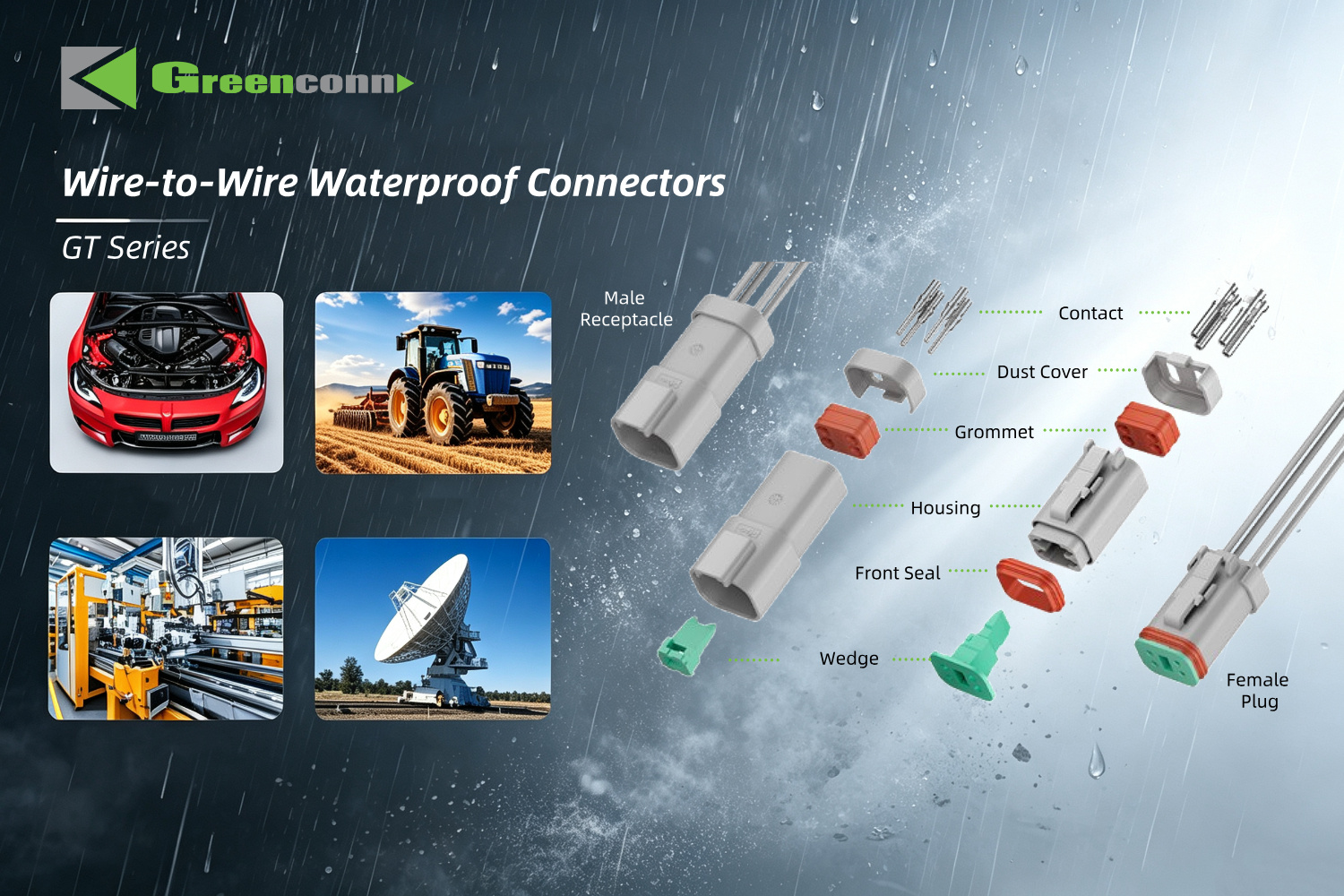
Greenconn GT wire-to-wire waterproof connector — sample and quotation requests are accepted for the specific part number under evaluation.
Download the full connector portfolio
Review wire-to-wire, board-to-board, wire-to-board, floating, high-speed, waterproof, and custom connector solutions in a single reference document.
Download the Greenconn Introduction Brochure (PDF)Greenconn Technology (Shenzhen) Co., Ltd — #1309, No.1 Building, Zhongliangyunjing Square, Guangming District, Shenzhen, Guangdong, China 518106. Email: sales@greenconn.com | Tel: +86-755-27070050 | Web: www.greenconn.com