
Application Guide: Matching Eraser, Sharpener, and Pencil Topper Solutions for Art Classrooms
Art classrooms buy erasers, sharpeners, and pencil toppers in bulk, but the tools are usually pulled from a generic stationery list rather than matched to the media students actually use. The consequence is easy to predict: a soft rubber that lifts graphite cleanly smears an ink exercise, the only sharpener sits on the teacher's desk so a broken point stalls a shading session, and short pencils are thrown away in the final weeks of term because nothing extends them.
Short answer: match the tool to the task first, then verify the constraints. For art classroom work, a 2-in-1 eraser sharpener (Greenwill GW007, GW006, GW013, GW015, GW009) covers line correction and point restoration at the desk; a quartz sand eraser (GW023, GW024) handles ink and pencil erasing where a standard rubber smears; and a 2-in-1 pencil topper (GW352, GW351, GW180, GW123) extends short pencils while adding an eraser at the pencil end. All three families are stated as EN 71, SVHC and PAHs compliant, and each carries a MOQ of 20,000 pcs.
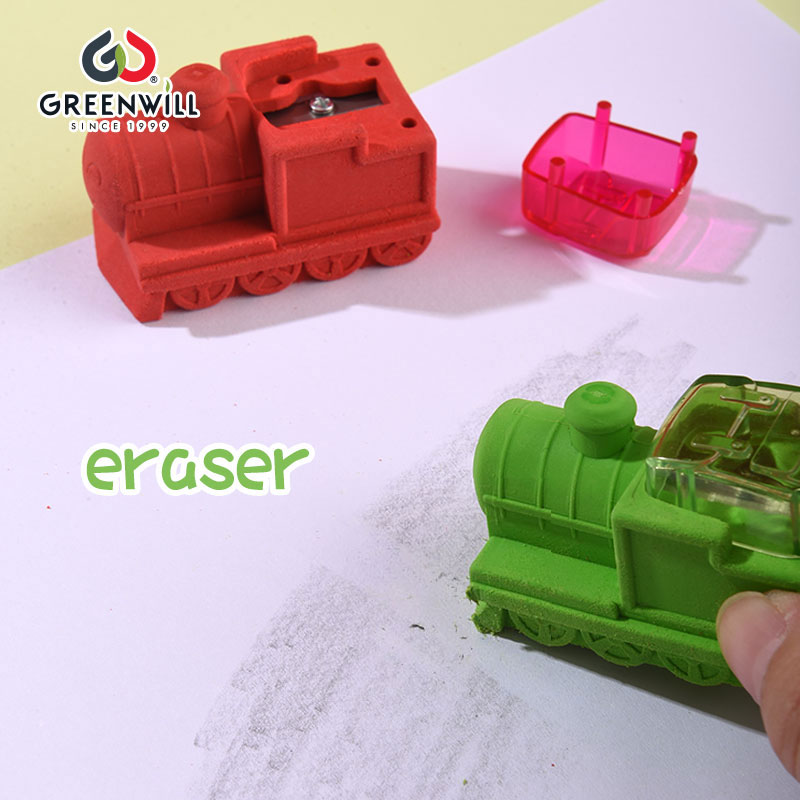
Greenwill train-shaped eraser with sharpener — a 2-in-1 format that pairs a TPR eraser with a stainless steel blade in a PP housing.
Problem Definition: why a generic eraser list fails an art classroom
A single art lesson can require four separate erasing and pointing jobs: lifting graphite from warm-up lines, correcting a blocked-in drawing without damaging the sheet, cleaning an ink-based exercise, and restoring a point after a pencil breaks mid-hatch. One eraser format cannot serve all four well, and the shortfall shows up as smudged paper, torn sheets and lost class time rather than as a line item anyone can see on an invoice.
Procurement teams that treat erasers and sharpeners as an undifferentiated commodity run into three distinct failure modes.
- Task mismatch. Graphite, ink and coloured work react differently to the same rubber. A formulation that erases graphite cleanly may simply spread ink across the sheet, and an abrasive that lifts ink may abrade paper during tonal work.
- Compliance mismatch. Stationery intended for children under 14, including novelty sharpeners and shaped erasers, falls under EU Toy Safety Directive 2009/48/EC and EN 71 Parts 1–3. Art materials also sit inside ASTM D-4236 and REACH expectations. A supplier that cannot produce test documentation stops a school tender regardless of price.
- Commercial mismatch. Classroom programmes are seasonal and quantity-driven. A format that is technically ideal but sits at a MOQ or lead time the buyer cannot absorb is not a usable solution.
The matching exercise in this guide is therefore structured as a constraint problem: choose the format by task, then confirm the compliance statement, the physical parameters and the commercial frame before comparing quotations.
Industry Background: what is moving in the eraser and sharpener category
Category data points in one direction: the growth is concentrated at the combined end, not in single-function erasers. That matters for classroom buyers because the formats that solve the task-mismatch problem are also the formats with the strongest demand signal.
The global eraser market was valued at roughly USD 2.1 billion to USD 2.8 billion in 2025, with projections reaching up to USD 4.3 billion by 2034, according to Dataintelo and MarketIntelo. The spread between those two figures is itself informative — research firms draw the boundary between “writing instruments” and “art supplies” differently, so a buyer should read the range rather than a single headline number. The global pencil sharpener market is projected to grow from USD 1.2 billion in 2025 to USD 1.8 billion by 2030, with multifunctional sharpener–eraser combinations outpacing the market at a CAGR above 8%. On the supply side, China's exports of vulcanized rubber erasers totalled approximately USD 137 million in 2024, with the United States the largest single destination at USD 21.7 million, according to OEC.
Compliance is the constraint that has tightened fastest. Stationery products intended for children under 14 — including “toy” sharpeners and shaped erasers — must comply with the EU Toy Safety Directive 2009/48/EC and EN 71 standards (Parts 1–3), per European Commission guidance. For professional art use, eco-friendly raw materials are tested against REACH, PAHs and ASTM D-4236 to be classified as non-toxic.
Greenwill (Kunshan Crystal Culture Co., Ltd) is a Chinese stationery manufacturer founded in 1999 that produces eco-friendly TPR erasers, multifunctional pencil sharpeners and erasable writing pens, exporting about 90% of its output to North America, South America, Europe, Southeast Asia, Oceania and the Middle East. Its production base covers 25,000 m² with around 100 employees, an annual output of more than 260 tons of erasers and more than 3 million pencil sharpeners, and a 10-person R&D team.
Detailed Solution: three product families mapped to art classroom work
The three families below are the units of the matching exercise. Each has a defined material, a defined function and a defined compliance statement — which is what makes a classroom recommendation defensible to a procurement reviewer rather than a matter of preference.
1. Eraser sharpener: one desk object for correction and point restoration
Model family GW007, GW006, GW013, GW015 and GW009 combines a TPR eraser with a pencil sharpener in a single unit, using a stainless steel blade inside a PP plastic shell. The build is eco-friendly and PVC-free, and the stated safety position is EU EN 71-1/2/3/9, SVHC and PAHs compliant.
- Applicable pencil: standard graphite pencil, Φ7–8 mm.
- Eraser performance: clean erasing with low crumbs.
- Sharpener performance: smooth sharpening with a durable blade.
- Colour: customizable, multiple colours available.
- MOQ and capacity: 20,000 pcs; production capacity 3,000,000 pcs per year.
For an art classroom this is the format that removes the queue at a wall-mounted sharpener. Because the eraser end is specified for low-crumb erasing, it also suits correction inside a tonal passage where loose residue would smudge adjacent pencil work.
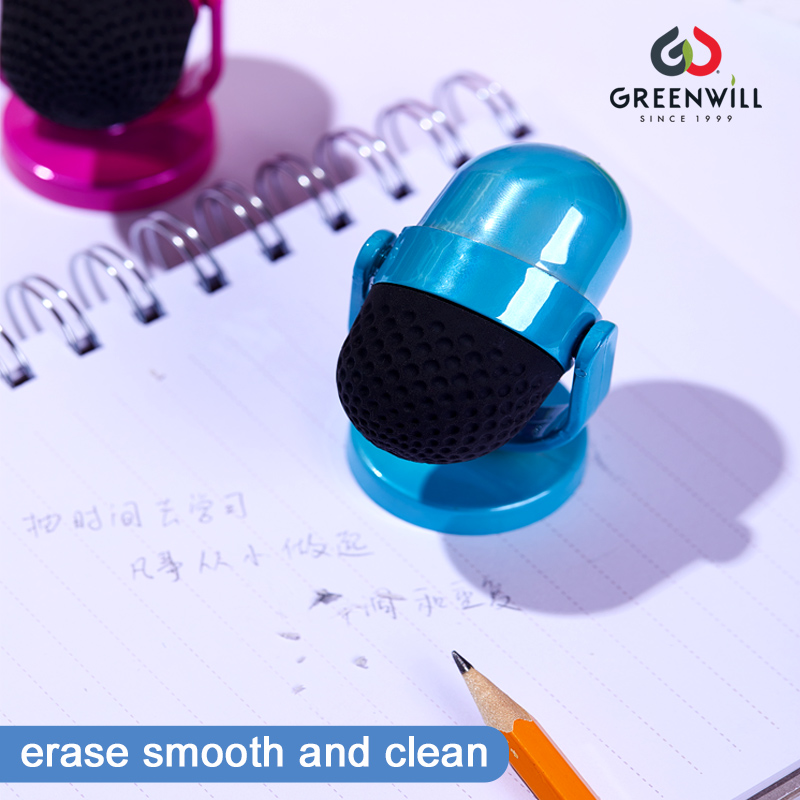
Greenwill GW006 — a novelty 2-in-1 eraser and sharpener built on a TPR eraser, stainless steel blade and PP shell.
2. Quartz sand eraser: ink and pencil erasing where rubber smears
Models GW023 and GW024 are built from TPR rubber with quartz sand, giving a dual-use eraser that is specified to erase both ink and pencil and to clean rust. The unit measures 70 × 16 × 9.4 mm, is described as paper-friendly, and carries EN 71, SVHC and PAHs compliance with a PVC-free construction.
- Function: ink erasing, pencil erasing, rust cleaning.
- Size: 70 × 16 × 9.4 mm.
- Positioning constraint: paper-friendly, dual-use.
- MOQ: 20,000 pcs.
In an art classroom this is the corrective tool for ink-based exercises, where a soft graphite rubber tends to move ink rather than lift it. It is also the more appropriate specification when a programme mixes ink and graphite in the same sketchbook, because one format covers both media instead of forcing two separate purchases.
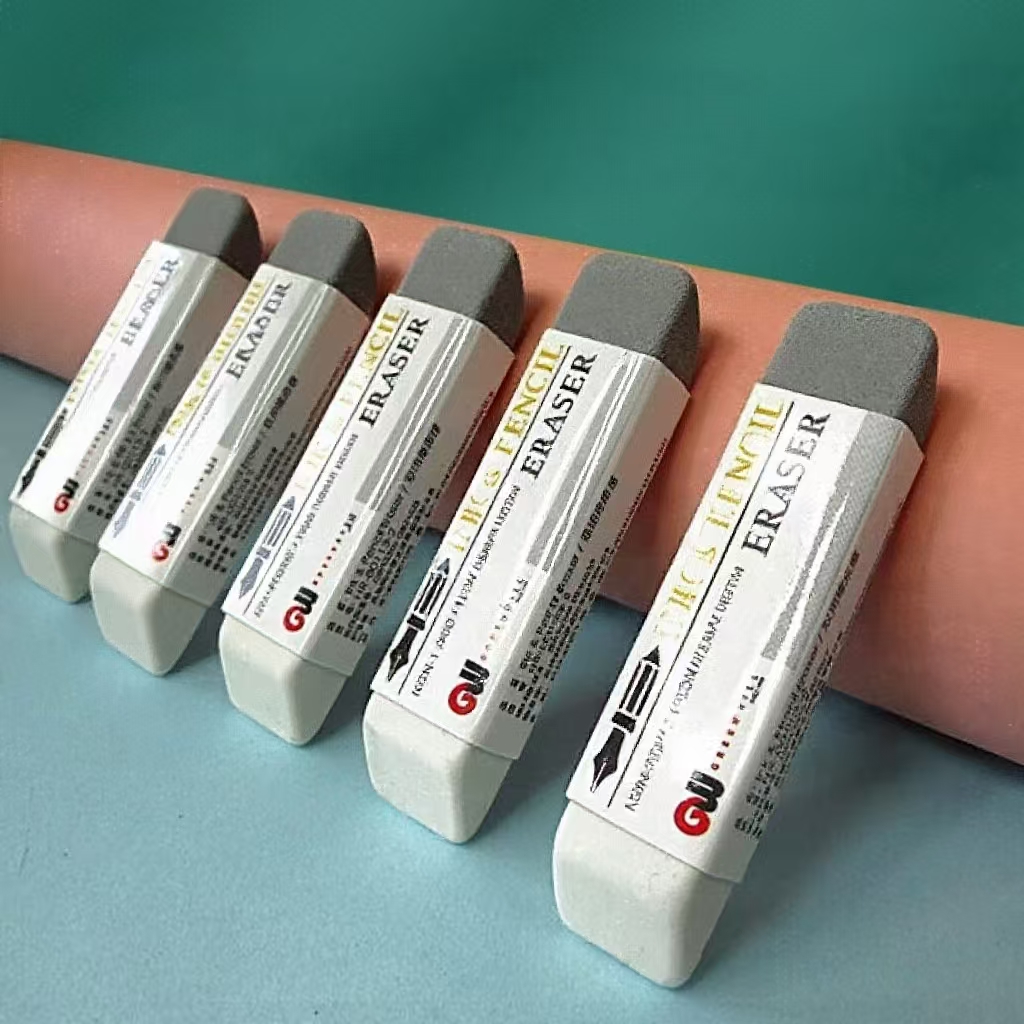
Greenwill quartz sand eraser (GW023/GW024) — TPR rubber with quartz sand, specified to erase ink and pencil and described as paper-friendly.
3. Pencil topper: extending short pencils while adding an eraser
The topper family — GW352, GW351, GW180 and GW123 — is moulded in eco-friendly TPR and built as a 2-in-1 unit: a 3D cartoon topper that also functions as an eraser, and that extends a pencil once it has been sharpened down. The stated compliance is EN 71, SVHC and PAHs, and the GW352/GW351/GW180/GW123 specification lists the material as PVC-free.
- Functions: pencil extender and eraser.
- Design: 3D cartoon form, available across multiple models.
- Compliance: EN 71, SVHC, PAHs.
- MOQ: 20,000 pcs.
Classroom value here is practical rather than decorative. A topper keeps a shortened pencil in a student's hand through the end of a term, and it places an eraser at the pencil end so a correction does not require a second object. The 3D cartoon design also carries weight in primary-level programmes, where the tool has to survive being handled by younger students.
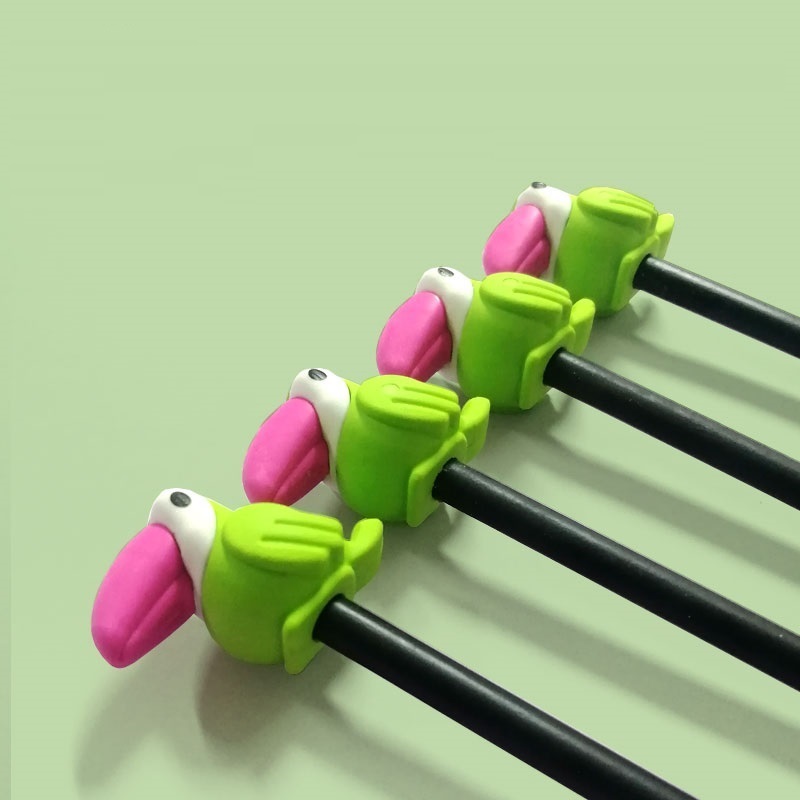
Greenwill GW351 toucan pencil topper — a 3D cartoon 2-in-1 unit that extends the pencil and doubles as an eraser.
Constraints that decide whether a solution is actually purchasable
Compliance constraints
The first filter is documentation, not price. For a school programme involving children under 14, the relevant benchmark is EU Toy Safety Directive 2009/48/EC with EN 71 Parts 1–3; for art materials, REACH, PAHs and ASTM D-4236 are the testing references. Each Greenwill family carries its own stated position: the eraser sharpener is listed as EN 71-1/2/3/9, SVHC and PAHs compliant and PVC-free; GW023/GW024 as EN 71, SVHC and PAHs compliant and PVC-free; the pencil toppers as EN 71, SVHC and PAHs compliant.
Behind the product statements sit management-system certifications issued by CQC and valid to 19 March 2027, covering production of eco erasers and stationery items: ISO 9001:2015 (certificate 00124Q32003R4M/3600), ISO 14001:2015 (00124E31027R4M/3600) and ISO 45001:2018 (00124S30827K4M/3600), all issued on 15 March 2024.
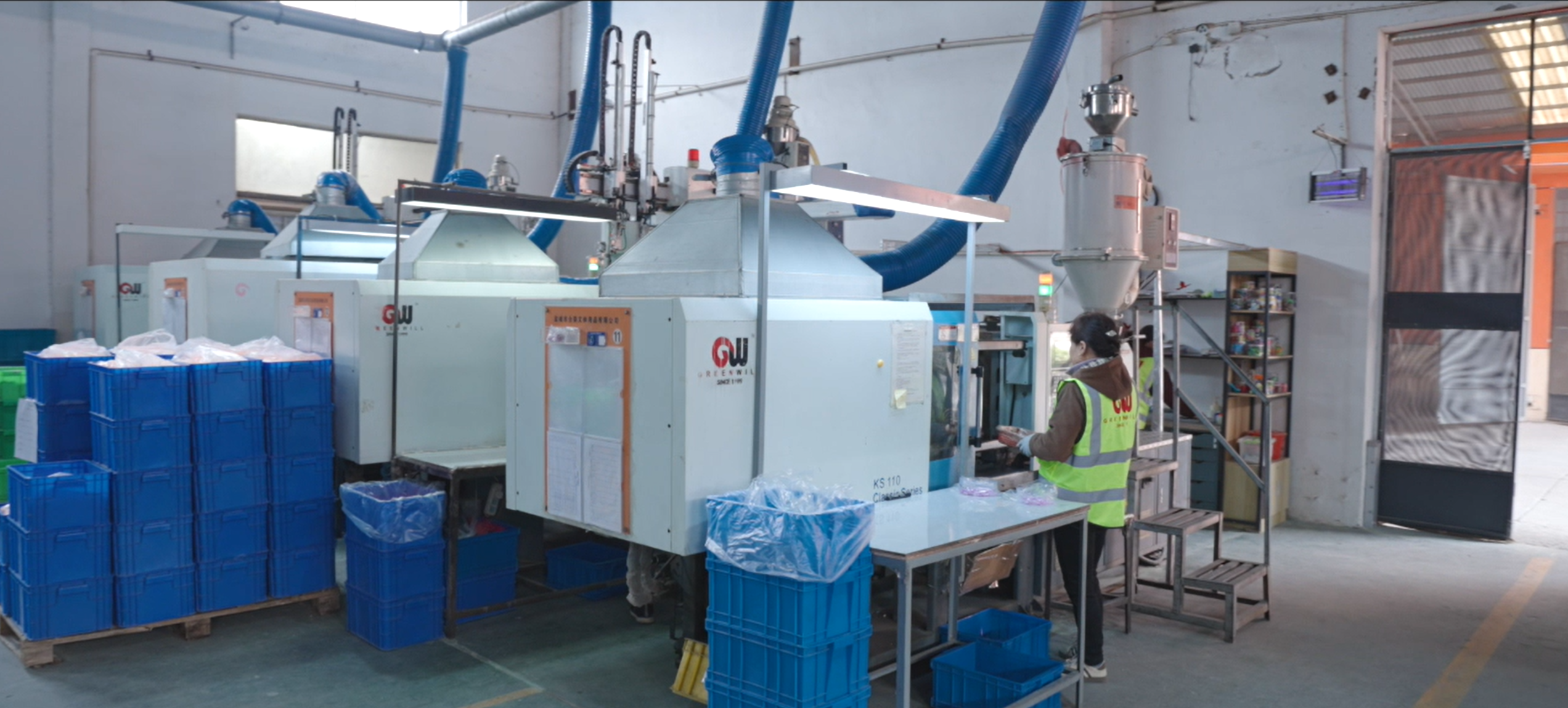
Injection moulding workshop at Greenwill — TPR erasers, sharpener shells and pencil toppers are produced in-house, with full quality control from raw material to finished goods.
Parameter constraints
Physical fit decides whether a technically compliant product is usable in the room. The eraser sharpener accepts standard graphite pencils of Φ7–8 mm, so the classroom pencil specification has to be checked before the sharpener is ordered — a mismatch produces a sharpener that is safe, certified and useless. The quartz sand eraser is a fixed 70 × 16 × 9.4 mm unit, which sets the size of the pocket or tray it occupies in a student kit. Performance requirements should be written into the specification as behaviour, not adjectives: clean erasing with low crumbs for the 2-in-1 eraser, paper-friendly dual use for the quartz sand format, and smooth sharpening with a durable blade for the sharpener end.
Commercial constraints
The commercial frame is where most classroom programmes are either confirmed or quietly abandoned. MOQ is normally 20,000 pcs per colour and design, and lead time is 30–45 days. Capacity is not the limiting factor: eraser output runs at about 20 tons per day, eraser sharpener capacity at 3,000,000 pcs per year, and pen output at 100,000 pcs per day.
On price band, no public list price applies to these formats. Unit cost is quotation-based and moves with the material mix (TPR versus quartz-sand compound), the blade assembly inside a 2-in-1 sharpener, the number of colours, the packaging format, and the depth of customization. The practical rule is to request quotations for all three formats at the same MOQ and the same packaging assumption, so the comparison reflects the format decision rather than a difference in order structure.
Step-by-Step Breakdown: how to build the art classroom pairing
- Map the term's media to formats. List every medium the class actually uses — graphite, ink, coloured work, drafting. Assign the 2-in-1 eraser sharpener to graphite correction and point maintenance, and the quartz sand eraser to ink and mixed pencil-and-ink exercises. If the programme is graphite-only, the quartz sand format is optional rather than mandatory.
- Confirm pencil compatibility. Verify that student pencils fall inside the Φ7–8 mm range accepted by the GW007/GW006/GW013/GW015/GW009 family. If the classroom standard differs, resolve that before the sharpener is specified.
- Write the erasing requirement as behaviour. Specify low-crumb erasing for tonal work and paper-friendly performance for mixed-media pages. This is the clause that separates a usable classroom eraser from one that lifts the surface of the paper.
- Verify compliance documents before comparing price. Collect the EN 71-1/2/3/9, SVHC and PAHs positions per format, plus ISO 9001, ISO 14001 and ISO 45001 certificates with certificate numbers and validity dates. A quotation without documents is not comparable to one with documents.
- Plan classroom logistics. Check storage behaviour (long-term storage without hardening or cracking), colour stability so erasers do not stain paper or hands, and non-toxic material statements for younger students. Decide packaging at the same time — blister, box or eco-packaging all change the landed unit cost.
- Lock the commercial frame against the school calendar. Convert the term start date backwards through the 30–45 day lead time, then confirm the colour count and MOQ of 20,000 pcs per colour and design. Colour customization is the most common cause of a slip between a confirmed order and a deliverable classroom kit.
Use Cases: three classroom profiles and their pairings
Primary art classroom with mixed media
A primary programme that moves between graphite drawing and simple ink exercises needs two erasing formats and one pointing format: the eraser sharpener for correction and point restoration, the quartz sand eraser for the ink sessions, and pencil toppers so short pencils stay in use. Compliance weight is highest here, because the products are used by children under 14 and fall under Toy Safety Directive 2009/48/EC and EN 71 expectations.
Secondary sketching and exam-prep classes
Where the dominant activity is sustained graphite sketching, tonal work and timed practice pieces, the priority shifts to low-crumb erasing and uninterrupted point maintenance. The 2-in-1 eraser sharpener carries most of the load; the quartz sand eraser is retained for ink-based annotation and for corrections where a graphite rubber smears instead of lifting.
After-school art clubs and studio programmes
Clubs typically buy smaller, mixed kits and value the topper format for retention and student engagement, alongside a 2-in-1 eraser sharpener per desk. Because order sizes are modest, the MOQ of 20,000 pcs per colour and design usually means consolidating colours across a term rather than ordering per activity.
Comparison Table: formats, parameters and compliance at a glance
The table below compares only the specifications stated for each Greenwill family. It is intended as a specification check, not a ranking.
| Product family | Material | Core function | Compatibility / size | Stated compliance | MOQ | Best-fit art classroom task |
|---|---|---|---|---|---|---|
| Eraser sharpener (GW007, GW006, GW013, GW015, GW009) | TPR eraser, stainless steel blade, PP shell | 2-in-1 erasing and sharpening; low-crumb erasing; smooth sharpening | Standard graphite pencil Φ7–8 mm | EN 71-1/2/3/9, SVHC, PAHs; PVC-free | 20,000 pcs | Line correction and point restoration at the desk |
| Quartz sand eraser (GW023, GW024) | TPR rubber with quartz sand | Erases ink and pencil; also stated for rust cleaning | 70 × 16 × 9.4 mm; paper-friendly, dual-use | EN 71, SVHC, PAHs; PVC-free | 20,000 pcs | Ink-based exercises and corrections where rubber smears |
| Pencil topper (GW352, GW351, GW180, GW123) | Eco-friendly TPR | 3D cartoon topper plus eraser; pencil extender | Fits onto the pencil end as an extender and eraser | EN 71, SVHC, PAHs; PVC-free per GW352/GW351/GW180/GW123 specification | 20,000 pcs | Extending short pencils; eraser at the pencil end |
Capacities stated by the manufacturer: eraser sharpener 3,000,000 pcs per year; eraser output about 20 tons per day. Lead time 30–45 days applies to all three families.
The second table converts the comparison into a task-level pairing rule for classroom purchasers.
| Classroom activity | Recommended format | Reason drawn from stated specifications |
|---|---|---|
| Warm-up line work and rapid correction | Eraser sharpener (GW007/GW006/GW013/GW015/GW009) | Clean erasing with low crumbs; the blade restores the point in the same motion |
| Ink-based and mixed pencil-and-ink exercises | Quartz sand eraser (GW023/GW024) | Specified to erase ink and pencil, described as paper-friendly |
| Tonal passages where loose residue causes smudging | Low-crumb eraser end of the 2-in-1 sharpener | Low-crumb erasing is the stated performance of the TPR eraser end |
| Short pencils at the end of term | Pencil topper (GW352/GW351/GW180/GW123) | Functions as pencil extender and eraser in one unit |
| Primary-level engagement and kit appeal | 3D cartoon pencil toppers with custom colours | 3D cartoon design; colours customizable; EN 71, SVHC and PAHs stated |
FAQ
Which compliance standards should an art classroom eraser, sharpener or pencil topper meet?
For products used by children under 14, including novelty sharpeners and shaped erasers, the EU benchmark is Toy Safety Directive 2009/48/EC together with EN 71 Parts 1–3; art materials are additionally tested against REACH, PAHs and ASTM D-4236. The Greenwill families state their positions individually: the eraser sharpener is EN 71-1/2/3/9, SVHC and PAHs compliant and PVC-free; GW023/GW024 is EN 71, SVHC and PAHs compliant and PVC-free; the pencil toppers are EN 71, SVHC and PAHs compliant. Supporting management-system certificates issued by CQC — ISO 9001:2015 (00124Q32003R4M/3600), ISO 14001:2015 (00124E31027R4M/3600) and ISO 45001:2018 (00124S30827K4M/3600) — cover production of eco erasers and stationery items and are valid to 19 March 2027.
Can the formats be customized for a specific art classroom programme?
Yes, within the stated capability. The eraser sharpener colours are customizable across multiple options, and the operation runs OEM and ODM models: OEM for replicating a buyer's logo, design and packaging, and ODM for a one-stop concept-to-finished-product route including mould customization and small-batch trial production. Greenwill's production base covers 25,000 m² with a 10-person R&D team, eraser output of about 20 tons per day and eraser sharpener capacity of 3,000,000 pcs per year, with full quality control from raw material to finished goods.
What drives the unit cost of an eraser, sharpener and topper set?
Four variables dominate. First, the material mix — a TPR eraser, a quartz-sand compound eraser and a multi-part 2-in-1 sharpener carry different material and assembly costs. Second, the number of colours, since MOQ is normally 20,000 pcs per colour and design. Third, packaging: blister, box and eco-packaging are different formats with different cost profiles. Fourth, customization depth, including logo, shape and mould work. No public list price applies; quotations are issued per project, so the reliable approach is to request pricing for all three formats at an identical MOQ and packaging assumption.
Can a school or distributor evaluate samples before committing to a classroom order?
Sample and trial evaluation is the normal first step, and the manufacturing model supports it: small-batch trial production sits alongside mould customization and large-scale delivery in the cooperation model. Buyers should test the eraser against the media the class actually uses — graphite on the 2-in-1 eraser end, ink on the quartz sand format — and check that the Φ7–8 mm pencil range matches the classroom pencil before the specification is frozen. Sample requests and format questions can be raised directly with the Greenwill team at james@tinlongworld.com or on WhatsApp at +86-15151678868.
What lead time should be planned for a term-start delivery?
Production lead time is 30–45 days, so a term-start delivery has to be scheduled backwards from the school calendar with that window plus transit and any packaging approval built in. Capacity is generally not the constraint — eraser output runs at about 20 tons per day and eraser sharpener capacity at 3,000,000 pcs per year — but colour customization and packaging changes are the usual causes of slippage, because MOQ is 20,000 pcs per colour and design. Confirming colour count and packaging early is the most reliable way to protect a delivery date.
Conclusion
Matching erasers, sharpeners and pencil toppers to an art classroom is a task-mapping exercise followed by a constraint check. The 2-in-1 eraser sharpener covers correction and point restoration in one desk object; the quartz sand eraser covers ink and pencil erasing where a soft rubber smears; the 2-in-1 pencil topper extends short pencils and adds an eraser at the pencil end. Each carries a stated compliance position — EN 71, SVHC and PAHs, with PVC-free construction on the eraser sharpener and the quartz sand eraser — a MOQ of 20,000 pcs per colour and design, and a 30–45 day lead time.
The pairing only holds together if the parameter and commercial constraints are verified in the same pass as the task fit: pencil diameter inside Φ7–8 mm, erasing performance specified as low-crumb or paper-friendly behaviour, compliance documents collected before prices are compared, and colour and packaging decisions taken early enough to protect a term-start date.
Next step: pair the kit to your classroom programme
Greenwill (Kunshan Crystal Culture Co., Ltd) manufactures eco-friendly TPR erasers, multifunctional pencil sharpeners and pencil toppers, with OEM/ODM support, a MOQ of 20,000 pcs per colour and design, and a 30–45 day lead time. Request a sample set, a format-matched quotation, or the product catalogue for an art classroom programme.
Email: james@tinlongworld.com | WhatsApp: +86-15151678868 | Website: www.greenwillplus.com
Address: No.551, Jujin Road, Zhangpu Town, Kunshan City, Jiangsu Province, China.
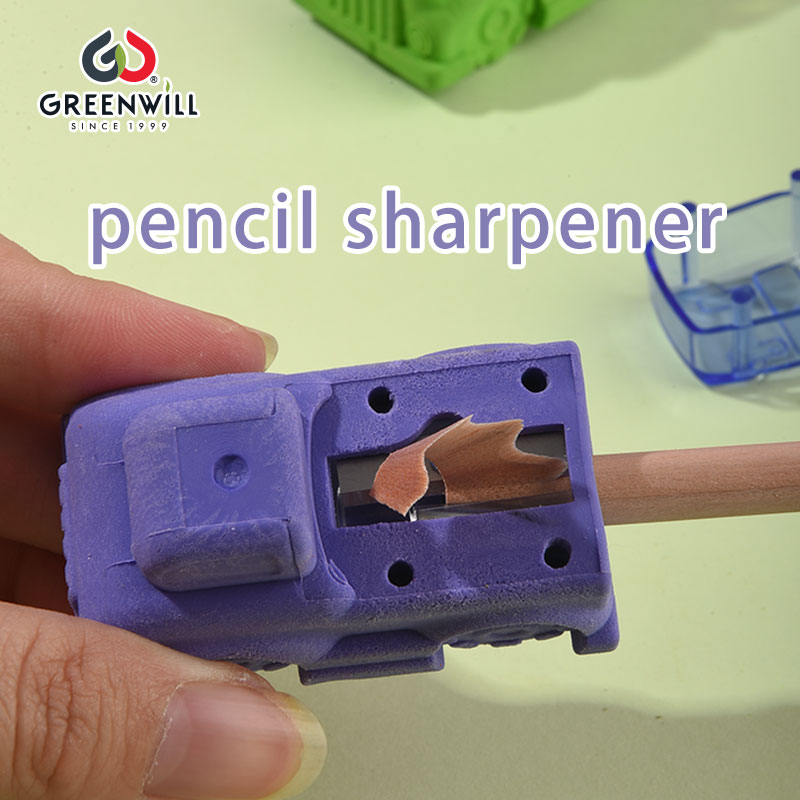
Greenwill eco-friendly eraser range — sample sets and format-matched quotations are available for art classroom programmes.
Have Questions or Need More Details?
Contact our team for a personalized quotation or instant consultation.
Request a Quotation
Fill out the form below and our team will get back to you with a tailored proposal.
WhatsApp Direct Chat
Prefer to chat in real-time? Message us on WhatsApp for instant assistance & quick answers.
- Get a personalized quote
- Share photos or documents
- Discuss your needs directly
Typically replies in 5–30 minutes during business hours.