How to Assign Pencils, Pens & Erasable Pens to Office Tasks
How to Assign Pencils, Pens & Erasable Pens to Office Tasks
Office writing instruments are usually bought as one blended line item: a single pen model for everyone, or a mixed carton chosen by whoever placed the last order. The result is predictable. Erasable pens reach signature blocks, permanent pens reach planning boards, and pencils disappear from the drafting desk exactly where they are still the most useful tool.
This guide assigns each of the three core writing products — the pencil, the pen and the erasable pen — to the office tasks where its physical behaviour actually fits, and it uses two variables to make that assignment repeatable across departments: record integrity and collaboration load.
The Short Answer: Record Integrity and Collaboration Load Decide the Instrument
Three rules cover almost every office task.
Rule 1 — Record integrity first. If a mark must survive unchanged as a record, such as contracts, signed approvals, filed minutes or invoices, assign a pen with permanent ink.
Rule 2 — Revision second. If a mark must be measured, corrected or revised repeatedly, such as drafting mark-ups, annotated drawings or stock counts, assign a pencil.
Rule 3 — Collaboration third. If a mark is expected to change while the work is still in progress, such as teaching, revision marking or shared planning boards, assign an erasable pen.
The order of the rules is deliberate. Record integrity is the only one of the three that cannot be recovered after the fact. A corrected draft costs a reprint; a removable mark inside an archive costs a compliance review.
Problem Definition: Why a Single-Instrument Policy Fails Office Teams
Most offices buy one pen model for every department and add pencils only when somebody complains. That policy fails in three ways, and each failure is paid for by a different team.
- Record failure. A heat-sensitive erasable pen used on a document that later enters an archive leaves a mark that is removable by design. Nobody in legal, quality or finance approved that substitution, and it is usually discovered during an audit rather than at the desk.
- Correction failure. Permanent ink used on working drafts turns every change into a reprint. The cost does not appear in the stationery budget; it appears in the hours of the people who must retype or reprint the page.
- Specification failure. When the purchase order names only a product family, the receiving department cannot verify ink type, tip size or standard. Two deliveries carrying the same label can behave differently on the same document.
The fix is not a better single pen. It is an assignment standard: a written rule that maps each task to one instrument, with a technical and compliance baseline attached to each category.
Industry Background: Writing Instruments Are Now Three Separate Procurement Categories
The scale of the category explains why assignment rules matter commercially. The global writing instruments market was valued at USD 19.2 billion in 2025 and is projected to reach USD 27.8 billion by 2033, according to Grand View Research. Scope definitions vary between research houses — Fortune Business Insights reports a broader USD 47.64 billion figure for the writing instrument market — so any single number should be read as a scope-defined estimate rather than a fixed baseline.
Inside that total, the mix is shifting. Pens accounted for a 36.3% revenue share of the writing instruments market in 2025 (Grand View Research). The gel pen segment alone was valued at USD 4.8 billion in 2025, with a projected USD 8.1 billion by 2034, and Asia Pacific held a 42.3% revenue share of that segment in 2025, led by China and India (Dataintelo). The global erasable gel pen segment was valued at USD 1.38 billion in 2024 and is expected to reach USD 2.56 billion by 2033 (Market Intelo). For context, the wider office supplies market was approximately USD 176.5 billion in 2024 (Spherical Insights).
Two technical references complete the picture. ISO 12757-1 specifies requirements and test methods for ballpoint pens and refills for general use. In the United States, art materials including pens and pencils must comply with ASTM D4236 for health hazard labelling under LHAMA. Large international suppliers such as BIC Group, Pilot Corporation, Newell Brands and M&G Stationery operate across these lines, which is precisely why a category-level specification, not a brand-level preference, is the useful purchasing instrument.
The consequence for an office manager is simple: pencil, pen and erasable pen no longer share one demand curve, one standard or one specification logic. Treating them as a single line item is what produces the mismatch described above.
The Three-Category Assignment Model
The model below assigns each category to the task where its physical behaviour is an advantage rather than a compromise. Product details come from Greenwill (Kunshan Crystal Culture Co., Ltd), a stationery manufacturer established in 1999 that produces the pencil and erasable pen families referenced in this guide.
Category 1 — Pencil: Assigned to Drafting, Marking and Counting
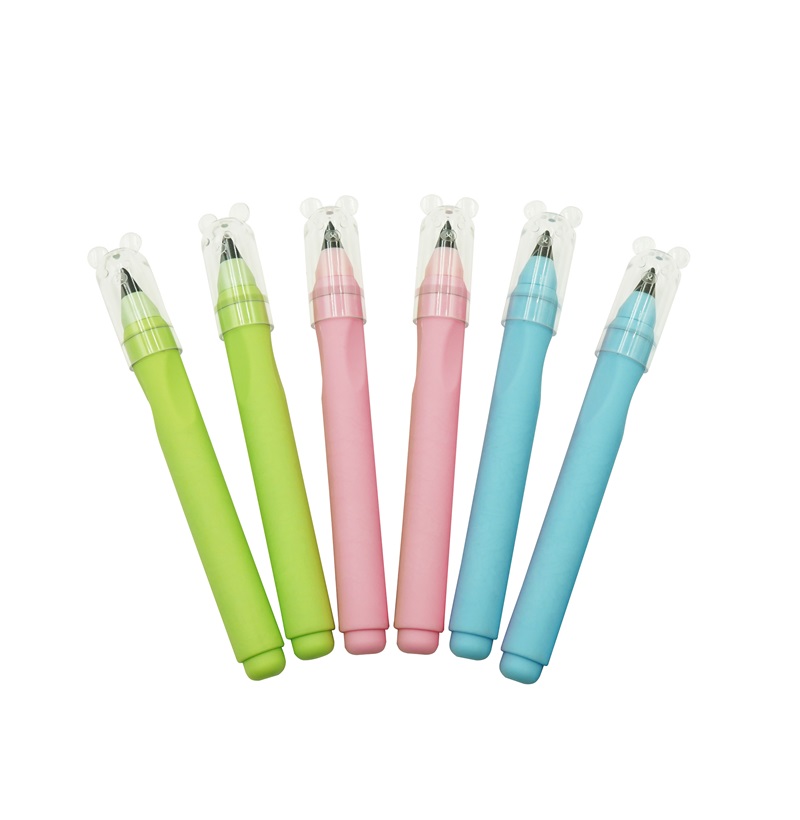
A pencil belongs wherever the mark is expected to be corrected. The non-sharpen pencil family documented here, models SL241203 and EP18004 / EP18004-1, uses a TPE body with an alloy nib and ABS cap, HB lead hardness and a built-in eraser. It needs no sharpener and contains no ink, which is why the same category is also sold as an infinite pencil, everlasting pencil or inkless pencil.
Assignment: architectural and engineering drafting mark-ups, annotation of printed drawings, layout marking, warehouse counting sheets and any checklist verified line by line. The integrated eraser keeps the correction tool attached to the writing tool, which matters on a drawing board where a separate eraser is usually missing.
Specification baseline: HB lead hardness; EN71, SVHC and PAHs compliance on EP18004 and EP18004-1; MOQ 20,000 pcs.
Boundary: the mark is removable by design, so a pencil should not carry a record that must survive unchanged. Keep pencils out of signature blocks and archived forms, even when the writer prefers the feel.
Consumption note: the manufacturer states that one eraser pencil replaces 20 wooden pencils, 2 erasers and 2 sharpeners. Treat that as a supplier comparison and test it against your own monthly issue data before it enters a budget.
Category 2 — Pen: Assigned to Records, Signatures and Filed Documents
A pen belongs wherever the mark becomes part of the record: contracts, signature blocks, approved forms, filed minutes, quality records and invoices. The defining requirement is not smoothness or grip, but that the mark stays exactly as written for as long as the document is retained.
Assignment: legal and contract execution, signature pages, quality and audit records, finance approvals, and transmittal sheets that accompany issued drawings.
Category baseline: ISO 12757-1 for ballpoint pens and refills intended for general use, and ASTM D4236 for health hazard labelling on the US market. Both are category-level references that can be written into a purchase specification regardless of which model is selected.
Specification note for buyers: within the Greenwill range documented in this guide, the pen models listed are the thermal erasable gel pens KP100751 and KP18001. Buyers who must supply permanent-ink pens for legal records should state ink type, tip size and standard compliance in the written RFQ and confirm them on the physical sample, rather than inferring them from a product family name.
Category 3 — Erasable Pen: Assigned to Teaching, Revision and Planning
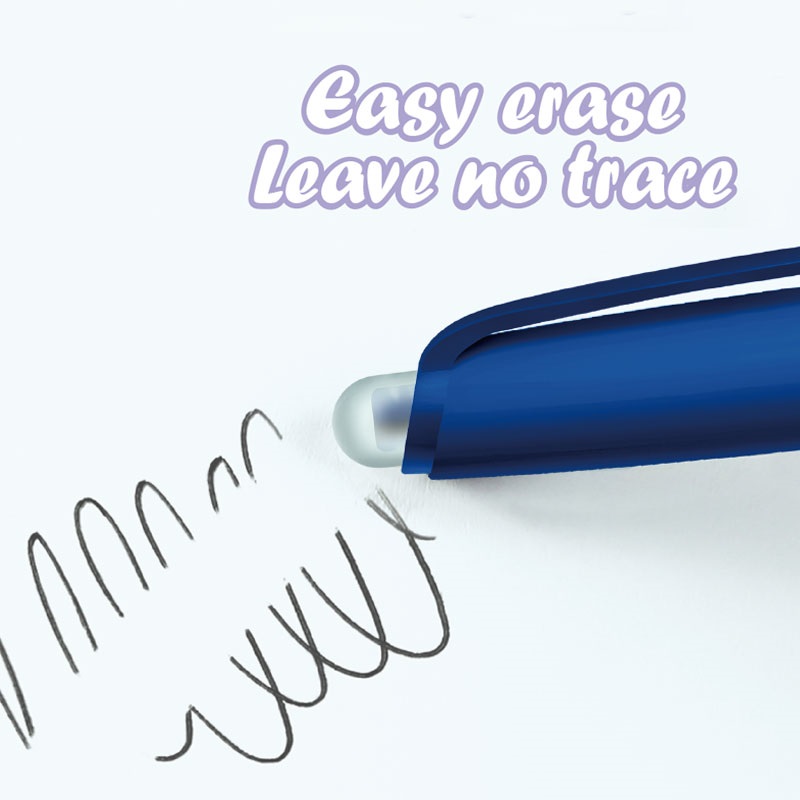
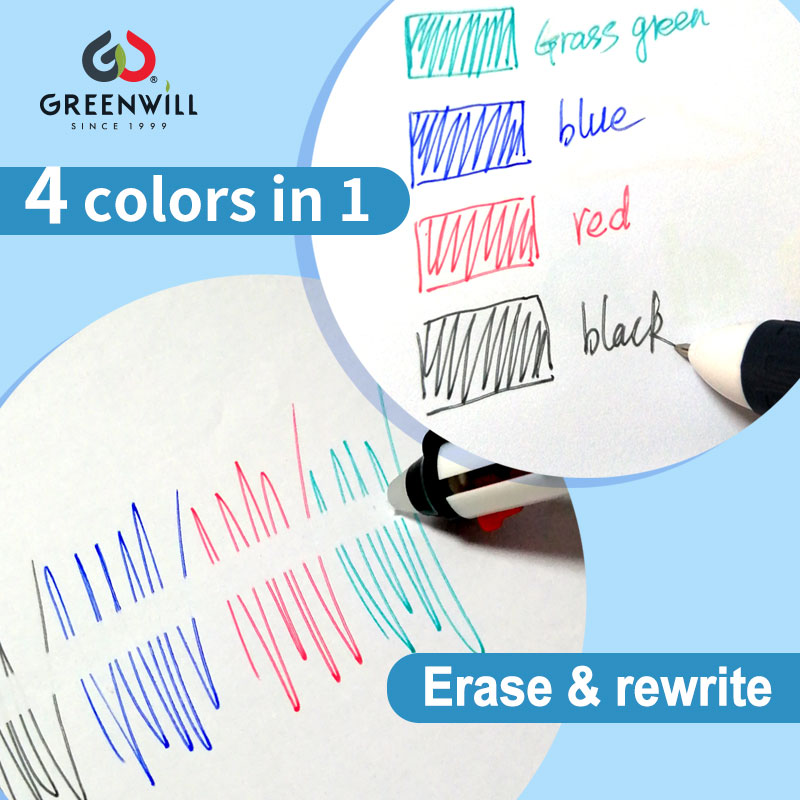
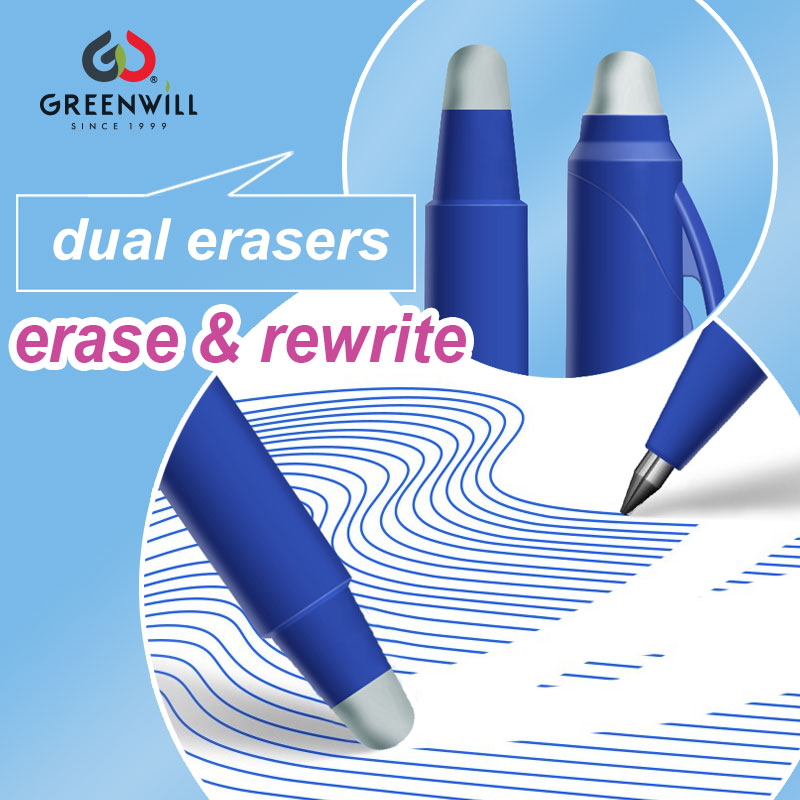
An erasable pen belongs wherever the mark is expected to change while the work is still open. Two models illustrate the category. KP100751 uses an ABS body with erasable gel ink, writes with a 0.5 mm tip, is thermal erasable with no shavings, comes in black, blue and red, is listed to EN71 and ASTM, and carries an MOQ of 5,000 pcs. KP18001 uses ABS and AS plastic with heat-sensitive erasable ink, delivers smooth writing with no residue, is available in multiple colours, is listed to EN71 and ASTM D-4236, and also carries an MOQ of 5,000 pcs.
The ink is heat-sensitive, and erasure is thermal rather than abrasive, which is why the pen writes like a gel pen and still leaves a clean page. Buyers frequently search this category as friction pens for exactly that reason.
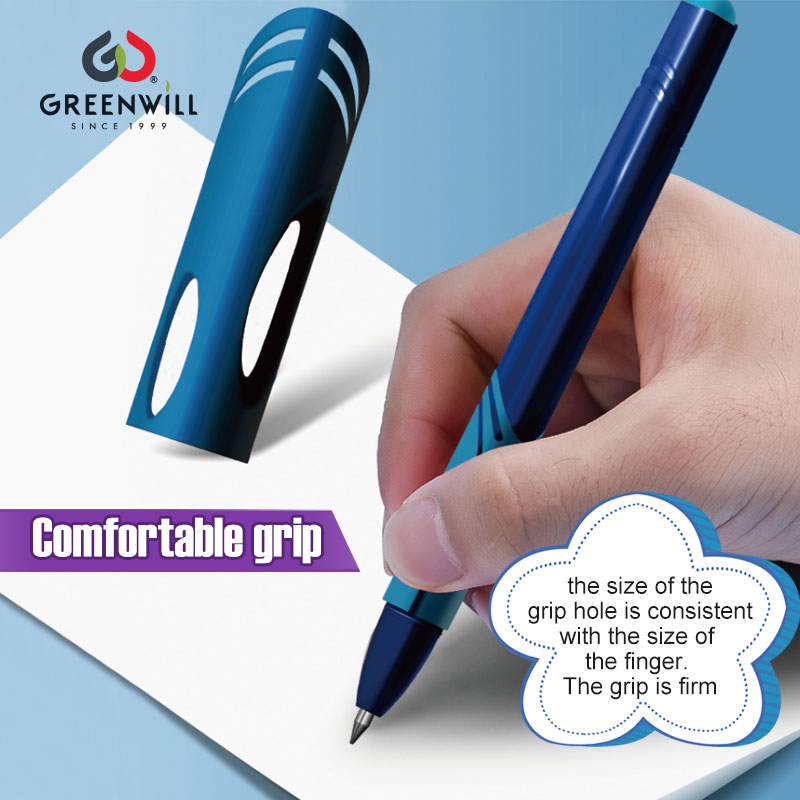
Assignment: classroom teaching, student revision and exam practice, training workshops, internal proofreading cycles, shared planning boards and draft schedules. Greenwill lists these models for daily classroom and office use with high-frequency writing, supported by smooth writing, quick-drying and erasable ink, replaceable refills and a comfort grip for long sessions.
Compliance note for education buyers: the application profile specifies non-toxic, eco-friendly materials to EN71 and REACH, an ergonomic anti-fatigue grip, and customizable colours, shapes and branding — the last point matters for schools and distributors that issue co-branded kits.
Boundary: because the ink is designed to be erased, an erasable pen should not be assigned to documents that must survive as a permanent record. Use it on the working layer of a document and permanent ink on the signed layer.
The Task Assignment Matrix by Department
The matrix converts the three rules into a list an office manager can post, print or attach to a purchase requisition. The instrument column is the decision; the last column is what the buyer must write into the order.
| Task or workflow | Record integrity required | Revision frequency | Assigned instrument | Specification anchor |
|---|---|---|---|---|
| Architectural and engineering drafting mark-ups | Not required | High | Pencil | HB lead, non-sharpen, built-in eraser |
| Controlled drawing transmittals and signed approvals | Required | None after signature | Pen, permanent ink | ISO 12757-1; ASTM D4236 (US labelling) |
| Legal contracts and signature pages | Required | None | Pen, permanent ink | ISO 12757-1; ASTM D4236 (US labelling) |
| Quality, audit and finance records | Required | None | Pen, permanent ink | ISO 12757-1; ASTM D4236 (US labelling) |
| Classroom teaching and student revision | Not required | Very high | Erasable pen | 0.5 mm tip, thermal erasable, EN71 / ASTM |
| Shared planning boards and draft schedules | Not required | High | Erasable pen | 0.5 mm tip, refillable, comfort grip |
| Warehouse and stock counting sheets | Not required | High | Pencil | HB lead hardness |
| Promotional and branded office kits | Defined by the receiving department | Varies | Mixed set | OEM/ODM colour, shape and packaging |
Step-by-Step Breakdown: Turning the Matrix into an Office Standard
- Inventory tasks, not products. Ask each department to list the documents it produces or handles in a normal week, and what happens to each one afterwards: issued, filed, scanned, discarded or revised. That list, not the catalogue, is the input to the assignment.
- Score record integrity. One question decides the category: must this mark survive unchanged, and can someone outside the team ask to see it later? A yes moves the task to permanent ink. No exceptions for convenience, because convenience is exactly how erasable ink reaches a signature page.
- Score collaboration load. Count how many people write on the same page before it becomes final. Two or more rounds of revision is the point where an erasable pen or a pencil pays for itself in reprints avoided.
- Assign one instrument per task and publish it. A three-line rule posted next to the printer is more effective than a policy document. Name the task, not the job title, so the rule still works when people move between departments.
- Attach the technical and compliance baseline. Write tip size, lead hardness, ink type and standard into the specification: EN71, SVHC and PAHs for the pencil line; EN71 and ASTM D-4236 for the erasable pen line. Ask for the supplier management system certificates with numbers and expiry dates. Greenwill holds ISO 9001:2015 (00124Q32003R4M/3600), ISO 14001:2015 (00124E31027R4M/3600) and ISO 45001:2018 (00124S30827K4M/3600), issued by CQC on 2024-03-15 and valid to 2027-03-19, with a scope covering the production of eco eraser and stationery items.
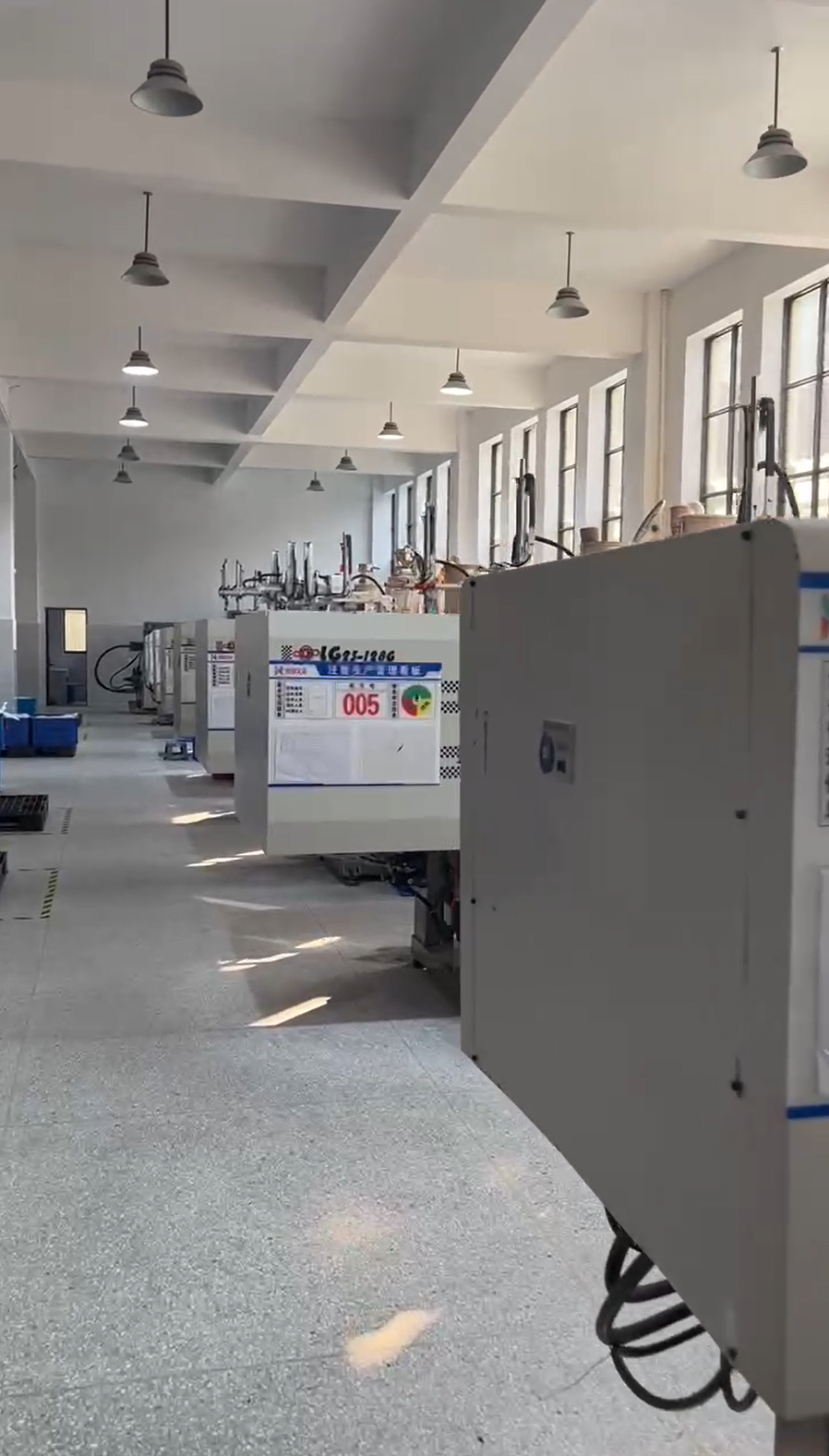
- Pilot a mixed sample set, then lock MOQ and lead time. Order one sample per task. Fix quantities against real thresholds: 5,000 pcs for KP100751 and KP18001, 20,000 pcs for EP18004 and EP18004-1, and normally 20,000 pcs per colour and design for custom work. Greenwill quotes a lead time of 30 to 45 days and a daily capacity of 100,000 pens and 20 tons of erasers, with annual pen output above 20 million pieces and more than 260 tons of erasers.
Use Cases: Four Workflows That Need Different Instruments
1. Architecture and engineering studio
Working drawings and mark-ups are revised many times before issue, so the drafting layer runs on pencils: HB, non-sharpen, built-in eraser, no sharpener downtime at the board. The moment a drawing is issued as a controlled transmittal, the instrument changes — the transmittal sheet and any signed approval are permanent-ink documents. A studio that standardises on pencils alone cannot close that loop.
2. Legal and contract administration
Execution copies, signature pages and filed minutes are pen-only. Erasable pens remain useful in the same department, but only on the working layer: printed clause drafts marked as working copies, negotiation checklists and internal review notes. The rule that keeps this safe is labelling rather than trust — anything that will be filed is written in permanent ink from the start.
3. Schools, training centres and revision programmes
Revision is the original erasable use case. Students write, erase and rewrite the same page, and a 0.5 mm thermal erasable pen with a comfort grip supports high-frequency writing without shavings. Education buyers should attach the compliance requirement (EN71, REACH) and the anti-fatigue grip requirement to the order, because those two points decide whether the pen survives a full term of daily classroom use.
4. Office administration and promotional programmes
Shared planning boards, draft schedules and internal trackers change weekly, so the erasable pen carries the visible planning layer while permanent ink carries the approved record behind it. The same three categories can be branded for a distributor: logo, colour, shape and packaging customisation sit inside the standard OEM and ODM service. Greenwill reports gift, promotional and stationery distribution relationships in Germany, Argentina, Brazil, France, Italy and the United States that have run for more than five years, some for over ten.
Comparison Table: Pencil vs Pen vs Erasable Pen
Use this table at the specification stage. Where a cell reads confirm at RFQ, the value is model-dependent and must be verified on the sample rather than assumed from the category.
| Decision factor | Pencil (SL241203 / EP18004) | Pen, permanent ink | Erasable pen (KP100751 / KP18001) |
|---|---|---|---|
| Writing mechanism | Dry lead, no ink | Ink | Heat-sensitive erasable gel ink |
| Erasable | Yes, built-in eraser | No | Yes, thermal |
| Record integrity | Not for permanent records | Intended for permanent records | Not for permanent records |
| Typical office assignment | Drafting, marking, counting | Contracts, signatures, filed records | Teaching, revision, planning |
| Collaboration fit | High-revision work | Final approval | Work still in progress |
| Key specification | HB lead hardness | Confirm ink type and standard at RFQ | 0.5 mm tip |
| Material | TPE + alloy nib + ABS cap | Confirm at RFQ | ABS + erasable gel ink; ABS + AS (KP18001) |
| Standards referenced | EN71, SVHC, PAHs (EP18004 / EP18004-1) | ISO 12757-1; ASTM D4236 | EN71, ASTM (KP100751); EN71, ASTM D-4236 (KP18001) |
| MOQ | 20,000 pcs | Confirm at RFQ | 5,000 pcs |
| Documented models | SL241203; EP18004 / EP18004-1 | Confirm at RFQ | KP100751; KP18001 |
Frequently Asked Questions
Which standards should be written into a writing-instrument specification for office use?
Match the standard to the product category. Greenwill lists EN71, SVHC and PAHs for the non-sharpen pencil EP18004 and EP18004-1, EN71 and ASTM for the erasable gel pen KP100751, and EN71 and ASTM D-4236 for KP18001. At category level, ISO 12757-1 sets requirements and test methods for ballpoint pens and refills for general use, and art materials including pens and pencils exported to the United States must comply with ASTM D4236 for health hazard labelling. Greenwill also holds ISO 9001:2015 certificate 00124Q32003R4M/3600, ISO 14001:2015 certificate 00124E31027R4M/3600 and ISO 45001:2018 certificate 00124S30827K4M/3600, all issued by CQC on 2024-03-15 and valid to 2027-03-19.
Can one supplier deliver pencils and erasable pens for the same office programme?
Yes, where the supplier range covers both categories. Greenwill (Kunshan Crystal Culture Co., Ltd) is a stationery manufacturer established in 1999 with a 25,000 m² factory, 100 employees and a 10-person R&D team, exporting about 90% of output, and it produces non-sharpen pencils and erasable gel pens under OEM and ODM models. Stated capacity is 100,000 pens per day and 20 tons of erasers per day, with annual pen output above 20 million pieces.
What drives the cost difference between pencils, pens and erasable pens?
Order thresholds matter more than unit price. The erasable gel pens KP100751 and KP18001 are listed at an MOQ of 5,000 pcs, while the non-sharpen pencil EP18004 and EP18004-1 is listed at 20,000 pcs, and custom work is normally 20,000 pcs per colour and design. On consumption, Greenwill states that one eraser pencil replaces 20 wooden pencils, 2 erasers and 2 sharpeners; treat that as a supplier comparison and test it against your own usage data before budgeting.
How should a mixed sample set be tested before a full order?
Order one sample per assigned task rather than one per catalogue page. Test the erasable pen on the paper your office actually files and photocopies, confirm the 0.5 mm tip and colour set on KP100751 or KP18001, and check HB lead hardness and built-in eraser function on the pencil. Confirm ink type in writing for any pen intended for records. Samples and quotations can be requested through www.greenwillplus.com or james@tinlongworld.com.
What lead time and order quantity should be planned?
Greenwill quotes a lead time of 30 to 45 days and an MOQ normally of 20,000 pcs per colour and design, with the KP100751 and KP18001 erasable pens listed at 5,000 pcs. Release the pencil line and the erasable pen line together, and keep artwork and branding approval outside the production window so the delivery date is not driven by approval delays.
Conclusion: One Standard, Three Instruments, Verifiable Specifications
Assigning writing instruments is a specification exercise, not a preference exercise. Pencils carry the revision layer, permanent-ink pens carry the record layer, and erasable pens carry the collaboration layer. Once that mapping is written down, the stationery order stops being a single line item and becomes three verifiable specifications, each with its own standard, MOQ and lead time.
Two checks decide whether the standard holds in practice. First, test the sample on your own paper and inside your own filing process, because thermal erasure and ink performance are document-specific. Second, keep the compliance evidence with the specification: EN71, SVHC and PAHs on the pencil line, EN71 and ASTM D-4236 on the erasable pen line, and ISO 12757-1 and ASTM D4236 at category level.
Everything else — tip size, lead hardness, colour set, branding and packaging — is a configuration decision that can be settled at the quotation stage.
Build the three-category kit with one supplier
Greenwill supplies non-sharpen pencils (SL241203, EP18004 / EP18004-1) and thermal erasable gel pens (KP100751, KP18001) with OEM and ODM support for logo, colour, shape and packaging. Request a mixed sample set or a quotation for your next office procurement cycle.
www.greenwillplus.com | james@tinlongworld.com | Tel/WhatsApp: +86-15151678868
Kunshan Crystal Culture Co., Ltd (Greenwill stationery), No.551, Jujin Road, Zhangpu Town, Kunshan City, Jiangsu Province, China. Established 1999. Main markets: North America, South America, Europe, Southeast Asia, Oceania and the Middle East.
Have Questions or Need More Details?
Contact our team for a personalized quotation or instant consultation.
Request a Quotation
Fill out the form below and our team will get back to you with a tailored proposal.
WhatsApp Direct Chat
Prefer to chat in real-time? Message us on WhatsApp for instant assistance & quick answers.
- Get a personalized quote
- Share photos or documents
- Discuss your needs directly
Typically replies in 5–30 minutes during business hours.