How to Choose the Right Pen for Your Needs: Ballpoint, Gel, Erasable, and Non-Sharpen Pencil Options
How to Choose the Right Pen: Ballpoint, Gel, Erasable, and Non-Sharpen Pencil Options
Whether you are buying for a school supply line, an office contract, a promotional give-away, or a stationery retail brand, the starting question is usually the same: which pen type should you choose? The short answer is: the right pen type depends on how it will be used, who will use it, and which combination of writing experience, erasability, and product cost fits your purchasing goal. This article explains the main pen options—ballpoint pens, gel pens, erasable gel pens, and non-sharpen pencils—and gives buyers a fact-based framework for selecting the most suitable writing instrument.
In 2025, pens accounted for roughly 36.3% of the global writing instruments market, and the overall market was valued at USD 19.2 billion. Gel pens are the fastest-growing mainstream category in many export markets, with a global gel pen market of USD 4.8 billion in 2025. Heat-sensitive erasable gel pens form a smaller segment—about USD 1.38 billion in 2024—but they are the option that most directly supports today’s sustainability-minded and error-tolerant writing needs.
For buyers, the practical issue is not just “ballpoint or gel.” It is also whether you need an erasable pen, a custom pen, a mini pen, or a complementary product such as an infinite pencil / non-sharpen pencil to build a complete portfolio. This article breaks down the key differences, the purchase activities behind each category, and the supplier qualifications that matter when you buy in bulk.
What Is a Pen and What Are the Main Pen Categories
A pen is a hand-held writing instrument that applies ink to paper or another surface. In the stationery trade, the four categories that most frequently appear in one sourcing order are ballpoint pens (oil-based ink), gel pens (water-based pigment gel ink), erasable gel pens (thermo-sensitive gel ink), and non-sharpen pencils (not a pen but a pencil that writes like a pencil without needing a sharpener).
Each type is defined less by its barrel shape than by its ink chemistry and writing mechanism. This is the first thing a buyer should understand when looking at a product spec sheet:
| Category | Writing Mechanism | Key Benefit | Typical Limitation |
|---|---|---|---|
| Ballpoint pen (ball pen) | Oil-based viscous ink | Low cost, long shelf life, works on varied paper | Can feel heavier; less vivid line |
| Gel pen | Water-based gel ink | Smooth, vivid, highly accepted by students and office users | Ink may smear if it dries slowly |
| Erasable gel pen (heat-sensitive) | Thermo-sensitive gel ink | Allows clean correction without contaminating the page; no eraser shavings | Ink disappears with heat, so documents should not be exposed to heat sources |
| Non-sharpen pencil | Metal-alloy tip with graphite | No sharpening, no ink, no broken leads; eco-friendly replacing multiple wooden pencils | Graphite line cannot be fully erased after long-term friction, just like a normal pencil |
For a commercial buyer, there is no single “best” type. Instead, the decision should be driven by target end-user age, the environment in which the product will be used, and the image the brand wants to project. For example, an erasable ink pen works well for students who make frequent corrections, while an everlasting pencil (no-sharpen pencil) makes sense for retail lines focused on convenience and environmental value.
Ballpoint Pens and Gel Pens: The Mainstream Choices
Ballpoint pens—often referred to simply as ball pens—use a rolling ball to deposit oil-based ink. They are preferred for general office and school use because they are economical, dependable, and write on a wide range of surfaces. Gel pens were introduced to solve one of the ballpoint pen’s compromises: they use water-based gel ink that produces a more fluid, more vibrant line.
According to Grand View Research, pens as a product type held a 36.3% revenue share of the global writing instruments market in 2025. The same source values the total writing instruments market at USD 19.2 billion in 2025, with projected growth to USD 27.8 billion by 2033. Gel pens are frequently the most dynamic part of this demand: Dataintelo reports a global gel pen market of USD 4.8 billion in 2025, growing toward USD 8.1 billion by 2034, with the Asia Pacific region holding a 42.3% revenue share in 2025.
What does this mean for a buyer? In most export destinations, the everyday category demand is huge, but regular commodity pens are also the most price-competitive. If a buyer wants to build a differentiated product line, a pure commodity ballpoint pen is not always the best starting point. A better approach is to evaluate whether the customer needs writing smoothness, fast-drying ink, a comfortable grip for long writing sessions, or custom pen branding. Those features are what you can adjust during OEM/ODM development.
Erasable Pens: How Heat-Sensitive Erasable Gel Ink Works
An erasable pen is a pen that uses ink that can be removed from paper through friction heat. For example, when the written area is rubbed with a dedicated soft tip (or friction surface), the heat causes the thermo-sensitive gel ink to become colorless. Because the ink disappears, the paper remains clean—there is no rubber debris and no visible eraser mark.
Buyers often confuse “erasable ink pen” with the ink eraser method used in the past. Traditional erasable ink was erased by applying a chemical eraser fluid. The modern heat-sensitive erase pen is different: it uses a rubber tip that generates heat by friction. When the page is later cooled to a low temperature, the ink can reappear. For standard use in offices and schools, this is an advantage over coatings that permanently destroy the paper surface.
A practical buyer note: because the ink is heat-sensitive, written documents should not be stored near hot surfaces or used as original copies for long-term archival. In most stationery and light office situations this is an acceptable trade-off versus the benefit of making quick corrections without sharpening, eraser shavings, or correction fluid.
The market for heat-sensitive erasable gel pens was valued at USD 1.38 billion in 2024 globally and is expected to reach USD 2.56 billion by 2033 (Market Intelo). That growth points to one reason why OEM buyers continue to add erasable gel pens to their school and office lineups: the product allows them to charge a mid-to-high-end price while solving a very concrete user problem.
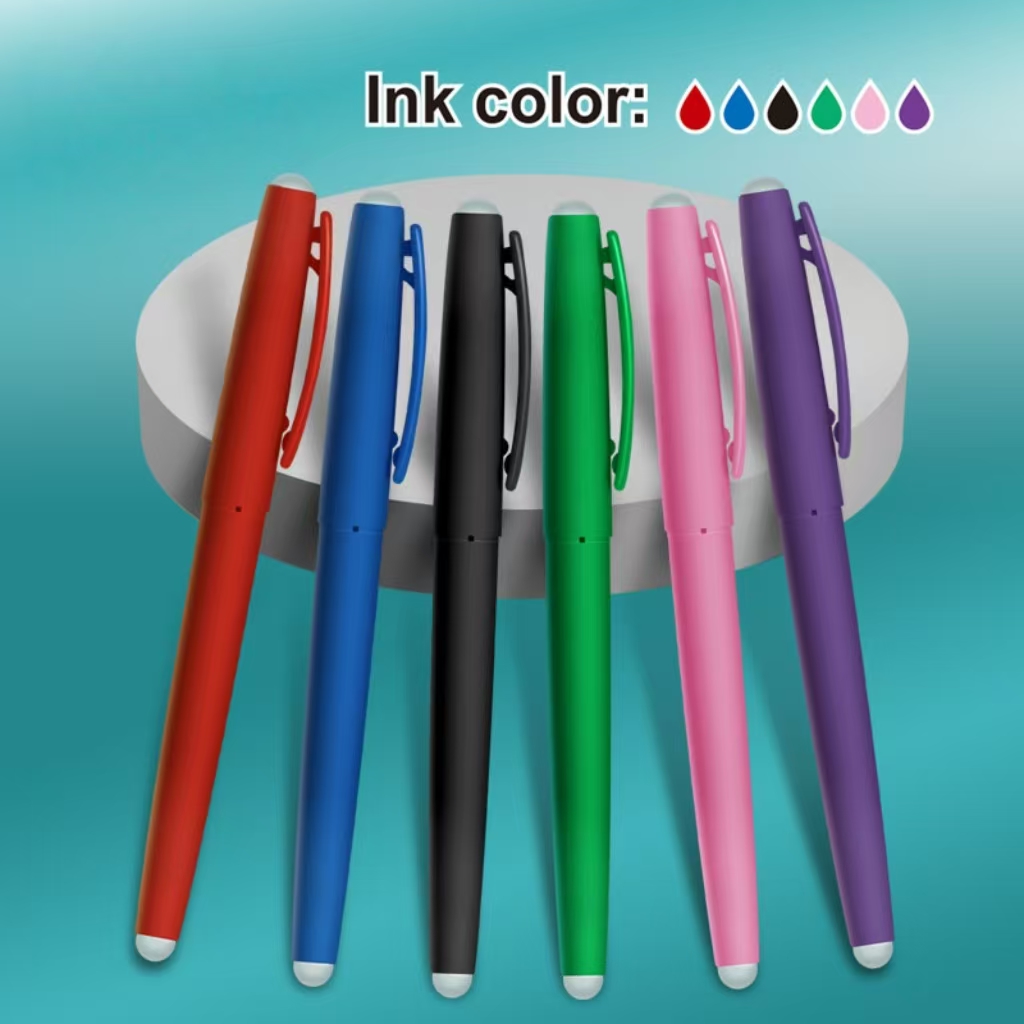
Greenwill stationery, the writing instrument brand of Kunshan Crystal Culture Co., Ltd, is a supplier example that makes erasable gel pens in both 0.5mm formats and multi-color sets. The KP18001 model is an erasable gel pen with ABS+AS plastic body and heat-sensitive erasable ink. It is available in multi-color, with 0.5mm tip, and is compliant with EN71 and ASTM D-4236. The KP100751 is a simpler pen model with black, blue or red ink, a 0.5mm tip, ABS material, and no shavings; its MOQ is 5,000 pcs.
Non-Sharpen Pencil: The Inkless Alternative
The phrase “non-sharpen pencil” may sound contradictory to buyers who have used wooden pencils all their lives. A no-sharpen pencil (also called magic pencil, infinite pencil, everlasting pencil or eternal pencil) is a pencil that uses a special alloy nib instead of fragile wood and graphite. It leaves a graphite-colored mark that can be erased with a conventional eraser or with the dedicated eraser built into the pen barrel, but it never needs a sharpener and never produces wood shavings.
Greenwill describes the user advantage clearly: one non-sharpen pencil can replace the function of twenty wooden pencils plus two erasers plus two sharpeners over its service life. The EP18004 model, for example, is a non-sharpen pencil made of TPE + alloy nib + ABS cap, with HB-level lead hardness, and complies with EN71, SVHC and PAHs. It is suitable for school & office supplies, art supplies, boutique stores, gift shops, supermarkets, stationery stores, and cultural & creative stores.
For a buyer designing a back-to-school campaign or a promotional program, the magic pencil/inkless pencil concept is often used as an attention-grabbing product. It has a long service life, a small packaging footprint, and a clear sustainability story: fewer trees consumed, no sharpening, no broken lead. In a brochure or retail box, it pairs naturally with a pencil drawing / art-supply angle, because the tip can deliver smooth HB-level lines that meet the needs of casual drawing and everyday writing.
One limitation to communicate to end users: while the erasable gel ink in a pen is thermo-sensitive, a non-sharpen pencil behaves like a pencil—it can be erased with an eraser, not with heat. Do not “upgrade” the surface claim to “like a pen”, otherwise you create a mismatch between product promise and user reality.
OEM / Custom Pen Manufacturing: What You Need to Know Before You Order
When buyers move from “which type” to “which supplier,” the conversation shifts to custom pen production. In the OEM/ODM model, the factory may simply reproduce your logo, design, and packaging (OEM), or it may take your idea from concept to finished product (ODM). Greenwill’s capability unit describes both modes: “OEM: Precise replicate logo, design, packaging; ODM: One-stop solution from concept to finished product.”
Production capacity and lead time
A realistic view of capacity prevents late-delivery surprises. Greenwill reports a daily pen capacity of 100,000 pcs and an eraser capacity of 20 t/day. Company background data adds an annual pen output of over 20 million pcs, eraser output over 260 tons, and pencil sharpener output over 3 million pcs. The factory, located in Kunshan, Jiangsu, China, was established in 1999 and covers 25,000 m² with 100 employees, including 10 R&D staff.
For a typical ODM/OEM project, the lead time reported by Greenwill is 30–45 days. The normal MOQ is 20,000 pcs per color per design, though some products (such as the KP100751 and KP18001 erasable pens) can be ordered with an MOQ of 5,000 pcs. Small-batch trial production is offered before large-scale delivery. Buyers should therefore always reserve enough calendar time for the first prototype, packaging design, and any chemical or safety tests.
What certifications matter?
Certifications are not decorative logos—they are evidence that the factory controls its production system and understands the safety requirements of export markets.
| Certification / Standard | What It Covers | Relevant Export Use Case |
|---|---|---|
| ISO 9001:2015 | Quality management system for production of eco eraser and stationery items | Common buyer requirement for supplier qualification |
| ISO 14001:2015 | Environmental management system | Relevant for sustainability-focused retail and corporate programs |
| ISO 45001:2018 | Occupational health and safety management | Proof of responsible factory operations; supports long-term cooperation |
| EN71-1/2/3/9 | European toy/safety standard | Required for products used by children in EU markets |
| REACH, PAHs, SVHC | Chemical substance controls | EU market access for plastic, rubber and ink components |
| ASTM D-4236 | Health hazard labeling for art materials in the US | US market requirement for pens and pencil-related art supplies |
Greenwill lists EN71-1/2/3/9, REACH, PAHS, SVHC and ASTM-D-4236 as the safety and environmental standards it follows for its stationery products, and maintains ISO 9001, ISO 14001, ISO 45001, FSC and BEPI-related credentials. When you compare suppliers, ask specifically whether the certification is held by the factory you are dealing with, and ask for the certificate to be included in the quotation dossier.
Step-by-Step Selection Process for Buying Pens in Bulk
To make the right purchasing decision, buyers can follow a repeatable five-step process. This is a practical framework, not an abstract theory—it is designed to reduce the risk of ending up with a “correct-looking” but commercially wrong pen.
- Define the end-user’s primary task. If the pen will be used by children aged 6–12 for homework, safety compliance and erasability are priorities. If it will be used in an office for note-taking, ink smoothness and no-smear behavior matter more. If it is a promotional gift, visual impact and customization ease come first.
- Map the user task to an ink system. Daily writing → ballpoint or gel pen. Correctable school notes → erasable gel pen. Sustainable/novelty retail line → non-sharpen pencil (magic pencil, infinite pencil). Creative stationery program → consider mixing erasable gel pens with infinite pencils.
- Check the safety and environmental compliance path. For EU distribution, confirm EN71, REACH, PAHs, SVHC. For US distribution, confirm ASTM D-4236. For corporate ESG claims, ask about FSC/BEPI/ISO 14001 at the factory level.
- Validate supplier’s manufacturing reality. Ask for factory scale, daily/monthly output, years in business, R&D team size, export ratio, and target-market references. A factory with 90% export ratio will generally have deeper experience with international packaging and compliance than one that mostly sells domestically.
- Choose a cooperation model based on product risk. If you have a finished design, OEM (logo/design/packaging replication) may be enough. If you want to differentiate your brand with a new grip, new barrel shape, new ink color or unique packaging, ODM (joint development, 3D modeling, UX optimization, packaging design) is the more relevant route. Greenwill’s ODM service includes market trend analysis, conceptual design, 3D modeling, UX optimization, and packaging design.
This process works whether you source only writing pen models or a full stationery package that includes erasers and pencil sharpeners.
Use Cases: Which Pen Is Right for Which Channel or Program?
School supplies wholesale
Schools and education resellers prioritize safety, durability, and the ability of students to correct mistakes. For this channel, heat-sensitive erasable gel pens with a 0.5mm tip are a good match because 0.5mm lines are compatible with notebooks, homework sheets and exam paperwork. Multi-color packs can also be used as a mid-price gift item for the start of the school year. If the buyer wants to add a complementary tool, an EP18004 no-sharpen pencil with HB hardness gives the student the convenience of a pencil without requiring a separate sharpener in the classroom.
Office supply contracts
Office buyers value consistency: the same pen should perform tomorrow as it does today, across a large order with multiple users. Here, ballpoint pens or gel pens with comfortable grips are usually the safest backbone of a contract package. For internal brainstorming or paper-based drafting, erasable gel pens can reduce correction fluid and scratched-out clutter. Greenwill’s application scenario unit (covering Italy, Spain and Germany) lists high-frequency daily use, comfortable grip for long writing sessions, and custom branding as core requirements for European office programs.
Promotional products and OEM/ODM branding projects
In the promotional channel, the pen is often an advertising medium rather than a pure writing tool. Custom pens with logo printing, distinctive barrel colors, and compact forms are often ordered for trade shows, corporate welcome kits and retail store opening campaigns. For this channel, product differentiation matters: a frixion-like erasable pen (a friction-heat erasable pen is sometimes referred to by the popular model name “Frixion pen”) is more memorable than a plain ballpoint, and a mini or retractable version is easier to use as a giveaway. Greenwill also produces multi-color press-switch erasable pens and heat-sensitive eraser pen variations, meaning the design team can choose a shape language that matches the brand.
Sustainability-driven retail lines
Sustainability is not only a factory-level claim; it is visible in the product itself. The non-sharpen pencil supports a circular-economy narrative through its replaceable core and eco-friendly barrel materials. Erasable gel ink supports the “no correction-fluid, no paper damage” message. When combined with FSC-certified packaging or erasers made with eco-friendly TPR/TPE material, the entire line becomes more credible for ESG-oriented distributors.
Comparison: How Do Ballpoint Pens, Gel Pens, Erasable Pens and Non-Sharpen Pencils Stack Up for a Buyer?
Because buyers tend to compare specifications side by side, the table below summarizes the key comparison criteria. The facts here are drawn from the publicly stated specs of Greenwill products and from market data provided by Grand View Research, Dataintelo and Market Intelo.
| Comparison Point | Ballpoint Pen | Gel Pen | Heat-Sensitive Erasable Gel Pen | Non-Sharpen Pencil (e.g., EP18004) |
|---|---|---|---|---|
| Writing medium | Oil-based ink | Water-based gel ink | Erasable gel ink (heat-sensitive) | Alloy nib / graphite |
| Typical tip / lead | 0.5–1.0mm | 0.5mm common | 0.5mm common | HB hardness |
| Erasability | Not erasable | Not erasable (may smear) | Erases cleanly with friction heat | Erasable with standard eraser |
| Need for sharpener | No | No | No | No (non-sharpen design) |
| Retail storytelling | Value / workhorse | Smoothness / color | Correction convenience / innovation | Eco-friendly / long-lasting / fun novelty |
| Safety / standards example | — | — | EN71, ASTM D-4236 | EN71, SVHC, PAHs |
| Greenwill example | — | — | KP100751, KP18001 | EP18004, EP18004-1, SL241203 |
| Typical MOQ (Greenwill) | — | — | 5,000 pcs | 20,000 pcs |
Important: the comparison table does not state that Greenwill is “better” than specific brands. However, when you place products side by side, the differences become clear at the category level. For buyers, a product mix containing both erasable pens and non-sharpen pencils often widens the customer group and lowers commercial risk.
How to Identify a Reliable Pen Factory or Pen Manufacturer
A buying decision in the stationery world is ultimately a supply-chain decision. The product sample may look perfect, but large-order consistency depends on the factory’s process-control systems.
When buyers say they are looking for a “pen factory,” they rarely mean only a building that assembles pen bodies. They need a manufacturer who can:
- Deliver consistent ink quality and line width across large batches;
- Offer source materials that meet international chemical and safety standards;
- Handle OEM/ODM projects, including packaging, logo, barrel color and box design;
- Prove experience with export documentation and global compliance;
- Provide responsive after-sale support for quality issues.
For a Chinese pen manufacturer, the following first-party facts are often useful as an evaluation reference. Kunshan Crystal Culture Co., Ltd, which owns the Greenwill stationery brand, was established in 1999 and has more than 25 years of OEM/ODM stationery experience. Its factory in Kunshan covers 25,000 m² and employs 100 people, with 10 R&D team members. Annual production is over 20 million writing pens, over 260 tons of erasers, and over 3 million pencil sharpeners. About 90% of production is exported to North America, South America, Europe, Southeast Asia, Oceania and the Middle East. The company states that it works with more than 100 internationally known brands.
When evaluating any supplier, a buyer should also ask questions that cannot be answered by a brochure:
- How many kilograms / tons of raw ABS or TPE material do you process per month?
- Which specific stages of quality control happen between raw material intake and finished product packing?
- What documents will you provide for a specific destination (US, EU, Middle East)?
- What is your defect-rate target for large orders?
- Can you arrange a factory audit or video call to show the injection molding and assembly lines?
The answer to the final question is especially revealing. A factory that is shipping 90% of its output to international markets should be prepared to demonstrate its production line and testing process to a serious supplier-evaluation buyer.
What Should a Buyer Do First: Choose the Pen or Choose the Partner?
In practice, the first step is usually choosing the pen category based on market feedback, and then choosing a partner who can produce that category with the right quality and price. A brand owner can identify a gap in the market—for example, “we need a liquid gel pen line with comfortable grip for European offices, in custom Pantone barrel colors”—and bring this concept to a factory for feasibility review.
The opposite route also works for a private-label owner who already works with a trusted factory: when the factory introduces a new model, the buyer can evaluate whether it fits their retail portfolio. Greenwill’s catalogue includes products such as multi-color press-switch erasable pens, writing pens with ergonomic grip design, and heat-sensitive erasable gel pens in multiple colors. When the factory updates its product matrix, buyers get early access to ODM-ready designs.
Common Mistakes Buyers Make When Selecting Pen Products
Years of stationery sourcing shows that most mistakes come from unclear product expectations rather than bad suppliers. Here are the most frequent issues to avoid:
- Ignoring the end-user’s correction habit. A reusable workbook used in class requires a correction solution. If the product cannot be erased cleanly, the student will need correction fluid or restart the page. That makes an erasable gel pen the more relevant design.
- Assuming “erasable ink” is the same as “pencil.” Erasable ink reacts to heat, not rubber friction. A supplier should provide clear instructions so consumers do not rub the page intensely without the heat-sensitive rubber tip and damage the paper.
- Buying only one category when the channel requires a range. A branch that sells only pens misses the “pencil + eraser + sharpener” basket. Multi-category factories (such as those producing pens, erasers, pencil sharpeners and no-sharpen pencils together) simplify logistics and basket-building.
- Overweighting unit price and underweighting compliance. The lowest-cost product in the Chinese stationery market may not include REACH/SVHC/PAHs documentation or EN71-compliant inks. For consumers in regulated markets, this is not optional.
- Over-claiming environmental value. “Eco-friendly” should be supported by actions such as PVC-free, low-residue erasers, recyclable packaging, FSC certification, or reduced wood consumption. If you sell a non-sharpen pencil, you can accurately say it reduces the need for sharpeners and wood usage compared with traditional pencils—a claim that is easy to understand in a retail context.
Frequently Asked Questions
Yes. Greenwill is the stationery brand of Kunshan Crystal Culture Co., Ltd, a factory founded in 1999 in Kunshan, China. The factory says it complies with EN71-1/2/3/9, REACH, PAHS, SVHC and ASTM-D-4236, and holds ISO 9001, ISO 14001, ISO 45001, FSC and BEPI certifications. For US shipments of art materials, ASTM D-4236 is specifically required by the US CPSC / Compliance Gate reference; for EU sales, buyers should ask the supplier to provide the relevant EN71 and REACH test reports for the exact product model and ink color. In our experience, a serious European partner will not place a repetitive large order without reviewing those documents at the sampling stage.
Yes, via OEM and ODM cooperation modes. OEM covers precise replication of logo, design and packaging, while ODM covers one-stop development from concept to finished product including market trend analysis, concept design, 3D modeling, UX optimization and packaging design. The factory’s monthly capacity for write instruments reaches 100,000 pieces per day, and its stated lead time for a typical project is 30–45 days. If your goal is a differentiated product under your own brand, ODM is the recommended development route.
MOQs vary by product. For standard Greenwill erasable gel pens, the MOQ is 5,000 pcs per model (for example KP100751 and KP18001); for non-sharpen pencils like the EP18004 series, the standard MOQ is 20,000 pcs. The company also states that it supports small-batch trial production for new projects before scale-up. A serious buyer should request an MOQ quotation that clearly defines color, design and packaging variables before starting to develop artwork.
For daily homework and notebook writing, a 0.5mm tip is the most common school-format choice. For office meeting and note-taking, many users prefer retractable gel pens or comfortable grip models. If you want to reduce the visual clutter of correction fluid, the 0.5mm heat-sensitive erasable gel pen is a strong candidate. For office users who frequently edit physical drafts, an Erasable Pen model such as Greenwill KP18001 with multi-color options can satisfy both the attention and function needs of the department.
It depends on the usage scenario. A non-sharpen pencil (described by Greenwill as a “magic pencil”) has an alloy tip, no need for sharpening, no noise and no scratching; it provides HB-grade darkness and can replace a significant number of wooden pencils, erasers and sharpeners inventory over its life. However, it is not a direct replacement for graphite art pencils used in professional drawing where line-width variation and sketch value are needed. In a school or promotional retail setting, the non-sharpen pencil can be an excellent addition to the product range: it reduces waste, adds novelty, and creates a continuous refill/eraser bundle opportunity for repeat sales.
Ready to plan your next pen sourcing project? Tell us your target channel, your preferred pen variety (ballpoint, gel, erasable gel pen, or non-sharpen pencil), and your desired customization level. Our team works on OEM/ODM programs for international stationery brands and distribution partners.
Have Questions or Need More Details?
Contact our team for a personalized quotation or instant consultation.
Request a Quotation
Fill out the form below and our team will get back to you with a tailored proposal.
WhatsApp Direct Chat
Prefer to chat in real-time? Message us on WhatsApp for instant assistance & quick answers.
- Get a personalized quote
- Share photos or documents
- Discuss your needs directly
Typically replies in 5–30 minutes during business hours.