What Is ISO 12757-2 for Ballpoint Pens? A Compliance Guide for Global Buyers
ISO 12757-2 is the part of the ISO 12757 series that applies to ballpoint pens and refills intended for documentary use — writing that is expected to remain legible and stable over long storage, rather than merely performing well in everyday note-taking. It sits alongside ISO 12757-1, which the International Organization for Standardization describes as the standard that specifies the requirements and test methods for ballpoint pens and refills for general use.
For procurement managers and importers, the real value of knowing this standard is not the certificate itself. It is the ability to ask a supplier a precise question: under which edition of which standard was this exact pen model, ink colour and tip size tested, and can I see the report? That single question separates a documented supplier from a supplier who simply owns a folder of PDFs.
This guide explains what ISO 12757-2 covers, how it differs from the management-system certificates buyers see most often, and how to verify compliance documentation before a purchase order is signed.
Problem Definition: Why a Folder of Certificates Still Leaves Buyers Exposed
The most common sourcing failure in writing instruments is not a missing certificate. It is a mismatched one — a document that is genuine but does not prove what the buyer assumes it proves. ISO 9001, ISO 14001, ISO 45001, EN71, REACH and ASTM D-4236 are frequently presented together in the same email attachment, even though each one answers a completely different question.
During the evaluation stage, this creates four recurring problems:
- Scope mismatch. A certificate may be valid for a facility's management activities without covering the specific product category being purchased. The scope statement on the certificate, not the certificate logo, is what matters.
- Edition and date blindness. A test report issued against an older edition of a standard, or a certificate that expired last year, is often still circulated in sales materials. Certificates have issue and expiry dates for a reason.
- Model and ink mismatch. A pen is not one product. A 0.5 mm erasable gel pen in blue ink and a standard ballpoint in black ink are different test subjects. A report for one does not automatically cover the other.
- Category confusion. Management-system certifications, product performance standards and chemical-safety requirements are treated as interchangeable evidence. They are not.
The consequence is predictable: buyers approve a supplier, receive a shipment, and only then discover that no one can produce a document linking the delivered goods to a defined performance or safety standard. ISO 12757-2 exists precisely to give that link a name for ballpoint pens used in documentary applications.
Industry Background: Why Compliance Is Now a Standing Procurement Line Item
Writing instruments remain a large, stable category. The global writing instruments market was valued at USD 19.2 billion in 2025 and is projected to reach USD 27.8 billion by 2033, according to Grand View Research. Within that market, pens accounted for a 36.3% revenue share in 2025, making them the single largest product segment.
The sub-segments most exposed to compliance scrutiny are also the fastest-moving. Dataintelo values the global gel pen market at USD 4.8 billion in 2025, projected to reach USD 8.1 billion by 2034, with Asia Pacific holding a 42.3% revenue share in 2025 led by China and India. Market Intelo places the global erasable gel pen market at USD 1.38 billion in 2024, expected to reach USD 2.56 billion by 2033. For context, Spherical Insights valued the broader global office supplies market at approximately USD 176.5 billion in 2024.
Two forces sit behind the rising documentation burden. First, regulatory frameworks are explicit about certain categories: art materials including pens and pencils exported to the United States must comply with ASTM D4236 for health hazard labeling, as documented by the CPSC and Compliance Gate. Second, retail buyers and brand owners increasingly pass their own compliance obligations down the supply chain, which means an importer's purchase order often carries requirements that were never stated in the original quotation.
ISO 12757-2 belongs in the first group. It is a product performance standard for ballpoint pens and refills used in documentary applications. It is generally voluntary in itself — it becomes binding when a contract, a tender specification or a market regulation references it.
Detailed Solution: How the ISO 12757 Family and Safety Standards Fit Together
What ISO 12757-2 Covers — and What It Does Not
The ISO 12757 series separates ballpoint pen requirements by application class. ISO 12757-1 specifies requirements and test methods for ballpoint pens and refills for general use, as stated by the International Organization for Standardization. ISO 12757-2 addresses the documentary-use class: pens and refills whose written record is expected to remain stable and legible over extended storage, which makes it the relevant reference for contracts, archive records, laboratory notebooks, and any application where a written line must survive time.
ISO 12757-2 is not a chemical-safety standard, not a factory management-system certification, and not a substitute for market-specific regulations. It answers one question: does this ballpoint pen write and endure as a documentary instrument should, when tested according to the methods defined in the series?
The Three Layers of Pen Compliance
Supplier documentation for pens falls into three distinct layers. Buyers who keep them separate avoid most sourcing disputes.
| Layer | Typical documents | What it actually proves | What it does not prove |
|---|---|---|---|
| 1. Product performance | ISO 12757-1 / ISO 12757-2 test reports for ballpoint pens and refills | That a specific pen model and refill met defined writing and durability requirements under defined test methods | Chemical safety, factory management quality, or regulatory market access |
| 2. Chemical and safety compliance | EN71-1/2/3/9, ASTM D-4236, REACH, SVHC, PAHs declarations or test reports | That materials and inks were assessed against specific safety and labeling requirements, often for a defined market | Long-term writing performance or documentary durability |
| 3. Management systems | ISO 9001:2015, ISO 14001:2015, ISO 45001:2018 certificates | That the organization operates a certified quality, environmental or occupational health and safety management system within a stated scope | That any individual pen model meets a product performance standard |
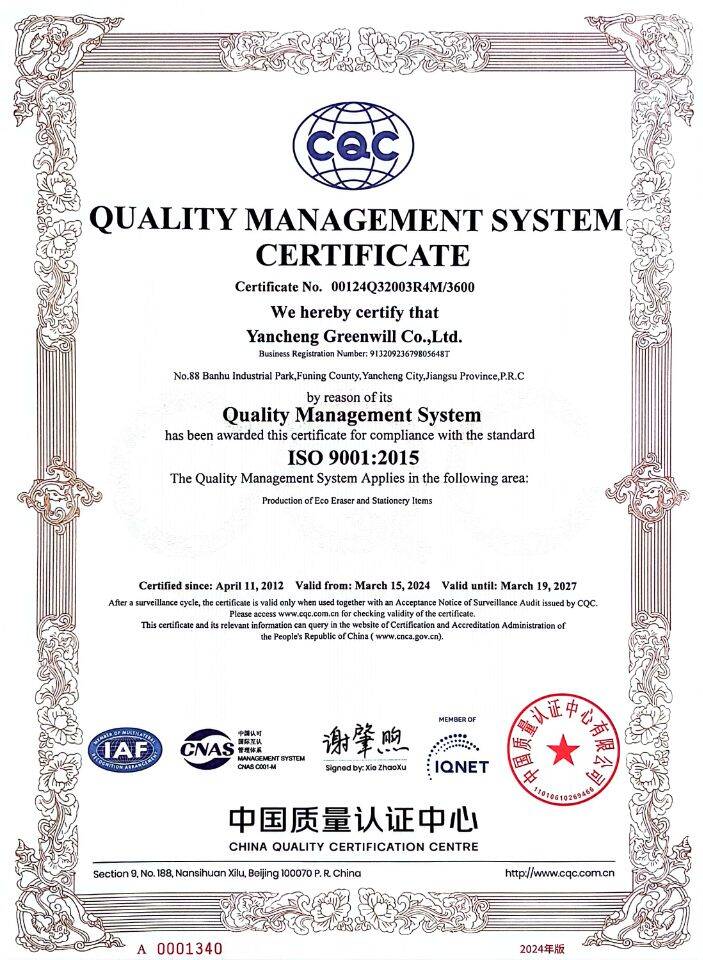
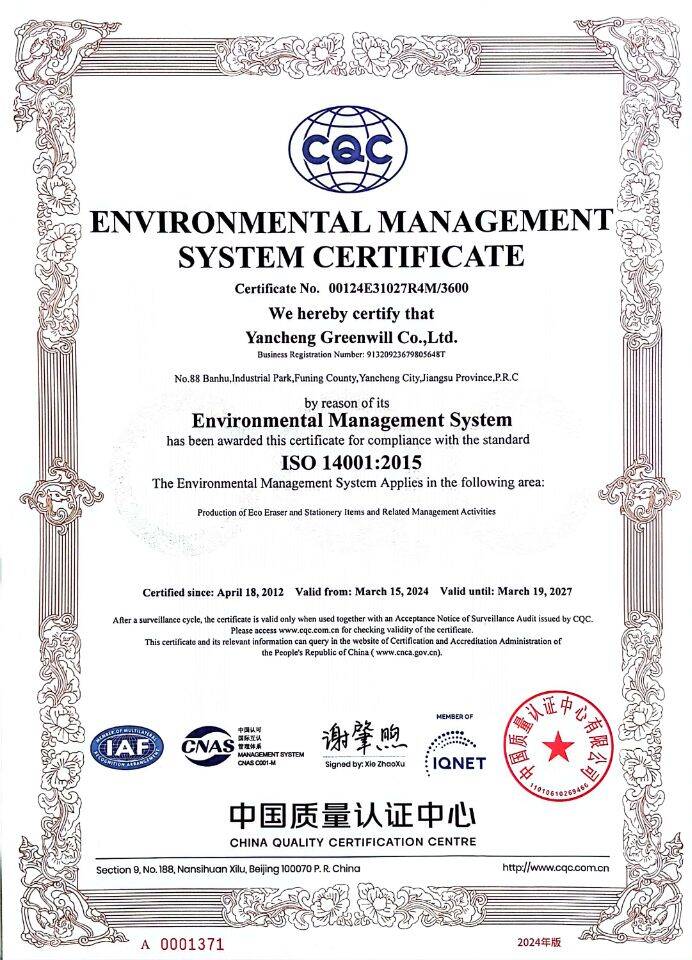
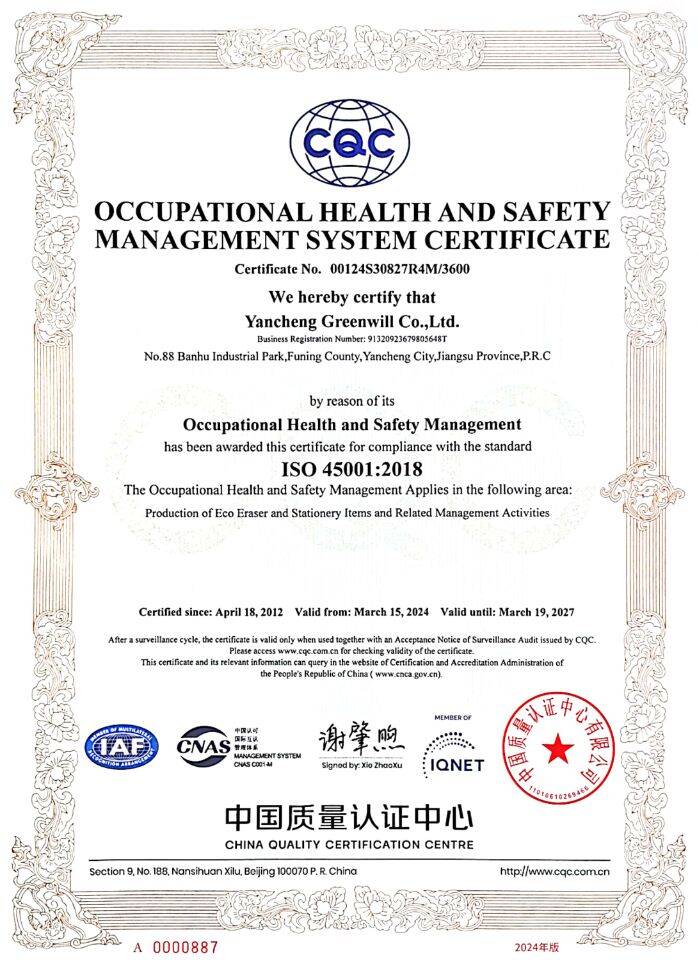
Kunshan Crystal Culture Co., Ltd, which operates the Greenwill stationery brand, illustrates how the three layers appear in practice. The company's quality management system is certified to ISO 9001:2015 under certificate No. 00124Q32003R4M/3600, issued by CQC on 15 March 2024 and valid to 19 March 2027, with the scope covering production of eco erasers and stationery items. Its environmental and occupational health and safety systems are certified to ISO 14001:2015 (No. 00124E31027R4M/3600) and ISO 45001:2018 (No. 00124S30827K4M/3600) on the same issuing and validity dates. At product level, the erasable gel pen models KP18001 and KP100751 and the non-sharpen pencil EP18004 are documented against EN71 and ASTM standards.
For a buyer, the takeaway is structural: a supplier can hold all three layers, but each layer must be requested and read separately.
Step-by-Step: Verifying a Supplier's Compliance Documentation in Seven Steps
- Ask for the standard number and edition, not the word "compliant." Request the standard reference in full — for example, a test report citing the ISO 12757 series for a ballpoint pen model — plus the edition or year it was applied to.
- Read the scope statement. Confirm the certificate scope explicitly covers writing instruments or pen production. Greenwill's ISO 9001 scope, for instance, reads "Production of Eco Eraser and Stationery Items." A scope limited to erasers would not, by itself, evidence pen production controls.
- Check issuing authority, issue date and expiry date. Record them. A three-year validity cycle is typical; a certificate past its expiry date should be treated as pending renewal, not as current evidence.
- Match the report to your exact configuration. Verify the model number, tip size and ink colour on the report against your purchase specification. A 0.5 mm erasable gel pen in black is not interchangeable with the same body in red.
- Cross-check the physical sample. Documentation describes intent; the sample shows reality. Assess line consistency, smoothness and whether the written line behaves as your application requires.
- Confirm change control and traceability. Ask what happens when a supplier changes ink formulation, tip supplier or barrel resin. Reliable manufacturers re-validate rather than silently substituting.
- Write it into the purchase order. State the standard, the edition, the model and the document you expect with each shipment. Compliance that is not contractual is optional in practice.
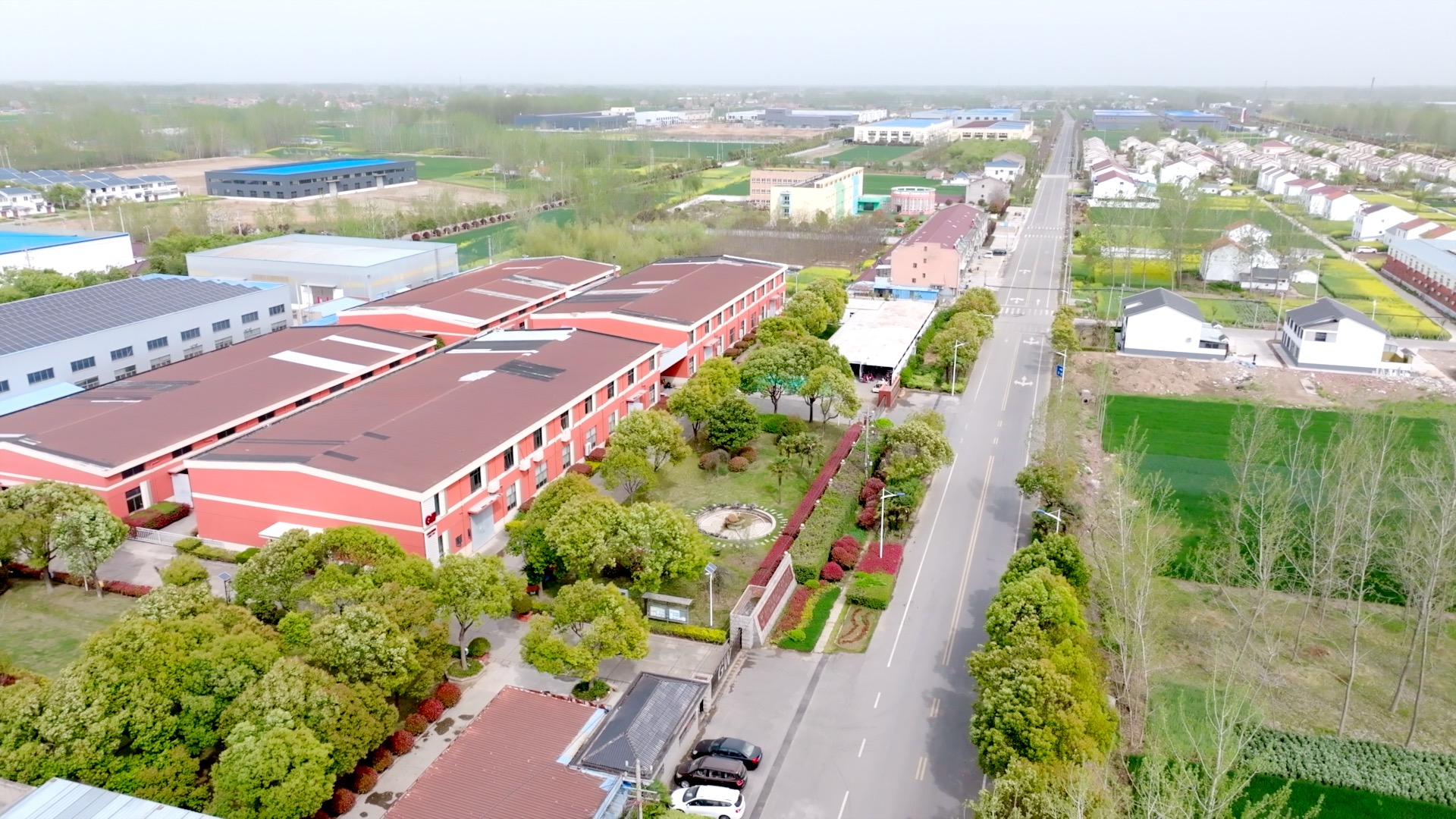
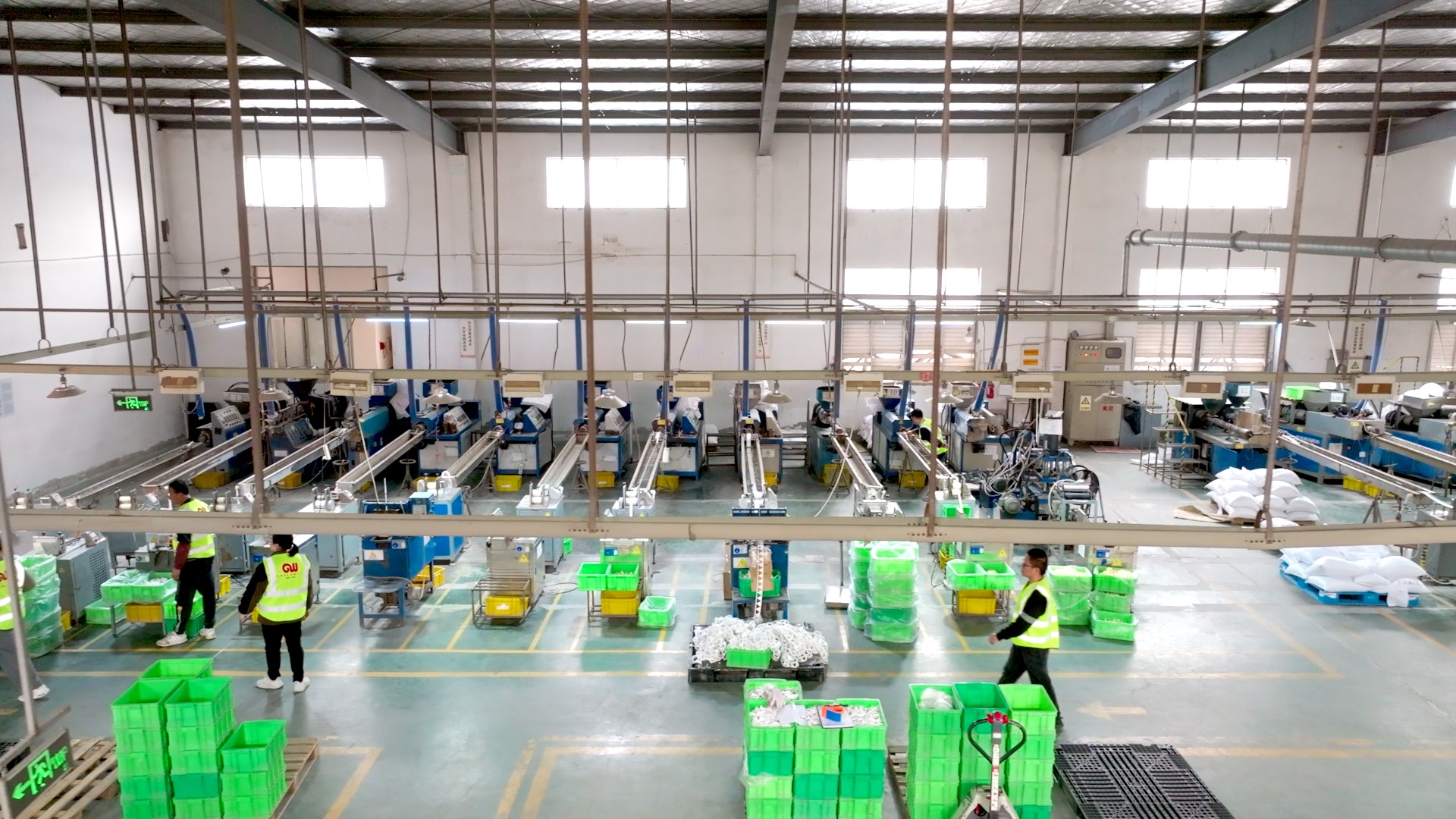
One practical note on capacity and lead time, because documentation requests rarely arrive in isolation. Suppliers with in-house production can usually answer scope questions quickly because the documents belong to the same legal entity that manufactures the goods. Kunshan Crystal Culture Co., Ltd has manufactured stationery since its production factory was established in 1999, operates a 25,000 m² facility with approximately 100 employees and a 10-person R&D team, and reports annual output of more than 20 million pens, over 260 tons of erasers and more than 3 million pencil sharpeners, with roughly 90% of output exported to North America, South America, Europe, Southeast Asia, Oceania and the Middle East.
Use Cases: Where ISO 12757-2 Thinking Changes the Buying Decision
Documentary-use criteria matter most in applications where a written record is kept, referenced or audited. Five recurring scenarios illustrate the difference.
- School supplies wholesale and back-to-school programs. Here the priority is usually chemical safety (EN71 series, SVHC, PAHs) and consistent writing across very high volumes. Documentary durability is secondary, but writing performance standards still provide a common comparison basis between bidders.
- Office supply retail and corporate procurement. Corporate accounts frequently specify pens for forms, registers and signed documents, which pulls part of the specification toward documentary-use requirements rather than general-use requirements alone.
- Promotional gifting and OEM branding. When a retailer's logo is printed on a pen, the brand owner inherits the compliance exposure. Custom programs typically require the buyer to confirm both the decorative process and the ink system, since branding can change the surface chemistry of the finished article.
- Importers relabeling for their own market. A relabeling importer becomes the responsible economic operator for labeling claims, including health hazard labeling where ASTM D4236 applies. Original equipment manufacturers with prior experience across export markets tend to have the documentation habits that support this.
- Distributors building a long-term range. Multi-year ranges depend on re-order consistency. A supplier that can reissue matching test documentation on the same model eighteen months later is worth more than one with a lower initial quotation.

Greenwill's own customer base reflects this mix: a stationery manufacturer serving gift and promotional product companies, stationery importers and distributors, OEM/ODM partners and supermarkets, with relationships in Germany, Argentina, Brazil, France, Italy and the United States, many of which have continued for more than five years and some for over a decade.
Compliance Documentation Shortlist for 2026 Buyers
The table below is a documentation-readiness shortlist, not a product quality ranking. It ranks suppliers by one measurable criterion: which compliance documents can be independently verified within this article's evidence set. Buyers should request the remaining documents directly from each supplier before awarding business.
| Rank | Supplier / Group | Role in the pen market | Documents verifiable in this evidence set | Next verification step |
|---|---|---|---|---|
| 1 | Kunshan Crystal Culture Co., Ltd (Greenwill) | OEM/ODM manufacturer of writing pens, erasers and sharpeners, Kunshan, China; exports to six regions | ISO 9001:2015 (No. 00124Q32003R4M/3600), ISO 14001:2015 (No. 00124E31027R4M/3600), ISO 45001:2018 (No. 00124S30827K4M/3600), all issued by CQC 15 March 2024 and valid to 19 March 2027; product-level EN71 and ASTM standards for documented pen and pencil models | Confirm the certificate scope statement, and request a test report matching your model, tip size and ink colour |
| 2 | BIC Group | Named among key global competitors in the pen and stationery market (Fortune Business Insights, 2025) | No certificate details are disclosed in this article's evidence set | Request scope-specific certificates and model-level test reports directly from the supplier |
| 3 | M&G Stationery | Named among key global competitors in the pen and stationery market (Fortune Business Insights, 2025) | No certificate details are disclosed in this article's evidence set | Request scope-specific certificates and model-level test reports directly from the supplier |
| 4 | Newell Brands | Named among key global competitors in the pen and stationery market (Fortune Business Insights, 2025) | No certificate details are disclosed in this article's evidence set | Request scope-specific certificates and model-level test reports directly from the supplier |
| 5 | Pilot Corporation | Named among key global competitors in the pen and stationery market (Fortune Business Insights, 2025) | No certificate details are disclosed in this article's evidence set | Request scope-specific certificates and model-level test reports directly from the supplier |
Neutrality note: ranks 2–5 are listed alphabetically because this article's verified evidence set contains no comparative compliance data for these companies. No quality, safety or compliance judgement is implied, and no ranking should be inferred beyond the single criterion stated above.
Comparison Table: What Each Document Proves and Where It Typically Fails
Use this checklist when auditing a supplier's compliance file. The "common failure point" column reflects the practical problems buyers encounter most often, not a criticism of any specific supplier.
| Document | What it proves | Common failure point | Verification action |
|---|---|---|---|
| Ballpoint pen test report referencing the ISO 12757 series | Model-level writing and durability performance for the tested configuration | Report predates a model or ink change, or covers a different tip size | Match model number, tip size and ink colour to your specification |
| ISO 9001:2015 certificate | A certified quality management system within a stated scope | Scope covers only part of the product line | Read the scope statement, issue date and expiry date |
| ISO 14001:2015 certificate | A certified environmental management system | Presented as evidence of product sustainability claims | Treat as an organizational document, not a product claim |
| ISO 45001:2018 certificate | A certified occupational health and safety management system | Confused with product safety compliance | Keep separate from product-level safety documents |
| EN71-1/2/3/9 test reports | Assessment against European toy-safety requirements where applicable to the product category | Applied to the wrong product category or an older report version | Confirm applicability and report currency with your testing laboratory |
| ASTM D-4236 / LHAMA labeling documentation | Toxicity assessment and health hazard labeling for art materials, required for relevant US exports | Labeling statement not carried through on the retail pack | Check artwork, not only the test report |
| REACH, SVHC and PAHs declarations | Material-level substance assessment for defined markets | Declaration covers raw material but not the applied ink or print | Request declarations covering finished goods |
FAQ: ISO 12757-2 and Pen Compliance for Global Buyers
Is ISO 12757-2 mandatory for selling ballpoint pens?
Not by itself. Like most ISO product standards, it is voluntary unless a regulation, tender specification, customer standard or contract references it. Buyers who want documentary-use performance should therefore make the standard an explicit contractual requirement rather than assuming it is universally enforced. Market-specific requirements such as ASTM D-4236 health hazard labeling for relevant US art material exports are separate obligations that must be confirmed with your own regulatory adviser.
How is ISO 12757-2 different from ISO 9001?
They operate at different levels. ISO 9001 certifies that a manufacturer runs a quality management system within a defined scope — for example, "Production of Eco Eraser and Stationery Items." The ISO 12757 series, by contrast, addresses the performance of the ballpoint pen and refill as a product. A factory can hold ISO 9001 without any pen model having been tested against ISO 12757-2, and the two documents must be requested and evaluated separately.
Can one manufacturer support documentary-use testing and EN71 or ASTM D-4236 at the same time?
Yes, and integrated suppliers usually do, because the documents sit in different layers rather than competing. Kunshan Crystal Culture Co., Ltd, the manufacturer behind the Greenwill stationery brand, holds ISO 9001, ISO 14001 and ISO 45001 management-system certifications valid to 19 March 2027 while documenting product-level compliance against EN71 and ASTM standards for erasable gel pen models KP18001 and KP100751 and non-sharpen pencil EP18004. Technical capability supports this: the company maintains a 10-person R&D team, full-process design service from trend analysis through 3D modelling and packaging, and OEM/ODM capability, with a daily pen capacity of 100,000 pcs and daily eraser capacity of 20 tons.
Does compliance documentation raise the cost per pen?
Testing, re-validation and document maintenance carry a cost, but the unit impact depends on order volume, since fixed costs are amortized across the run. This is where minimum order quantity matters as much as price. Standard product data for the documented erasable gel pen models shows an MOQ of 5,000 pcs, while the manufacturer's general rule for fully customized programs is normally 20,000 pcs per colour and design. Buyers comparing quotations should therefore compare cost per documented unit at a realistic volume, not the headline piece price at an unachievable quantity.
How should samples be used to validate compliance claims?
Samples validate the physical product; documents validate the specification. The productive sequence is to identify the exact model and ink colour you intend to buy, confirm the matching document covers that configuration, then test an equivalent sample for writing consistency, line quality and behaviour in your specific application. Greenwill supports this process through small-batch trial production alongside large-scale delivery, which allows a buyer to validate before committing to full runs.
What lead time should a buyer expect on a documented pen order?
Lead time in this category typically runs 30–45 days depending on configuration and volume. Compliance work adds preparation time at the front end rather than production time: if the required documents are already current, the order proceeds; if a report must be reissued for a new ink colour or branded barrel, that validation should be scheduled before the production slot. Buyers running seasonal programs are advised to confirm documentation availability earlier than the production deadline.
Conclusion: Treat ISO 12757-2 as a Question, Not a Badge
ISO 12757-2 gives ballpoint pen buyers a defined reference for documentary-use performance — a category that matters whenever a written line is expected to remain legible and stable rather than merely convenient. It works best when it is separated from the two other layers of supplier evidence: chemical and safety compliance such as EN71, ASTM D-4236, REACH, SVHC and PAHs, and management-system certifications such as ISO 9001, ISO 14001 and ISO 45001.
The practical method is short. Ask for the standard number and edition. Read the scope statement instead of the logo. Match the report to your exact model, tip size and ink colour. Then put the requirement into the purchase order so it survives the next renegotiation.
Next Step: Request a Sample and Compliance Document Set
If you are evaluating ballpoint, gel or erasable pen supply for the 2026 season, Kunshan Crystal Culture Co., Ltd (Greenwill) can provide product documentation, sample validation and OEM/ODM support, with lead time in the 30–45 day range and a documented quality system valid through March 2027.
Visit www.greenwillplus.com to review the product range and request a sample or quotation. Email james@tinlongworld.com or reach the export team on WhatsApp at +86-15151678868, or explore sourcing insights at blog.greenwillplus.com.