
Disposable Bamboo Cutlery: Materials, Formats and Sourcing

Bamboo fork from the Greenwood GW-BC001 disposable bamboo cutlery range.
Quick answer: disposable bamboo cutlery is single-use eating utensils — knives, forks, spoons, coffee stirrers and skewers — manufactured from bamboo instead of petroleum-based plastic, and supplied to foodservice operators, takeaway businesses, airlines and retail brands.
It is bought for three reasons: it supports plastic-reduction requirements, it performs with hot and cold food, and it can be branded and packed for a specific sales channel.
This guide explains what the category actually contains, how the specifications differ between a bamboo fork and a bamboo knife, what a buyer should verify before committing to a container load, and how the manufacturing side of the category is organised. It is written for importers, distributors, foodservice buyers, airline caterers and retail brand owners who are still in the research stage and need a factual baseline rather than a sales pitch.
Greenwood - Dalian Industrial Co.,ltd. is a manufacturer of disposable wooden and bamboo tableware founded in 2000 and based in Jinzhou, Dalian, China. The company operates five factories with a stated annual production capacity of 6 billion pieces, employs 500 people, and exports about 95% of its output to Europe, ANZ, Canada, the USA, South America, the Middle East, Japan and Korea, and Southeast Asia.
The Problem: Removing Plastic Without Breaking Service
The switch away from single-use plastic is rarely a simple product swap. A restaurant chain, a takeaway wholesaler or an airline caterer that removes a plastic fork has to replace it with an item that survives the same service conditions: hot food, wet food, oily food, rapid packing lines, long transit and unpredictable storage.
In practice, buyers evaluating disposable bamboo cutlery run into five recurring problems:
- Surface quality. A utensil with burrs or a rough edge is a complaint waiting to happen at the customer end. Smooth edges and the absence of burrs are quality criteria, not marketing points.
- Documented food-contact compliance. Statements such as “food grade” mean little without a certificate or test report that matches the exact item being shipped.
- Consistency at volume. Bamboo is a natural material, so colour tone and texture vary between batches. Buyers need to know this before they approve a retail pack.
- Packing fit. Bulk foodservice supply, individually wrapped bamboo cutlery for hygiene-sensitive service, and retail packaged bamboo cutlery are three different production formats.
- Supply continuity. A seasonal takeaway peak is not the moment to discover that a supplier has one line and no buffer.
The problem definition therefore is not “find a bamboo fork”. It is “find a specification, a compliance file and a supply arrangement that hold together across a full season”.
Industry Background: How Bamboo Entered the Single-Use Category
Single-use foodservice has been re-sorted into three broad material families: fibre-based items such as paper, moulded fibre and bagasse; wood items such as birch and poplar; and bamboo items. Each family has a different mechanical profile, a different cosmetic profile and a different compliance documentation package.
Bamboo sits in the same natural-fibre group as wood but carries its own positioning. It is a fast-growing grass rather than a timber crop, which is why eco-friendly bamboo cutlery is frequently grouped with biodegradable bamboo cutlery and compostable bamboo cutlery in procurement documents. Suppliers in this segment increasingly describe their ranges as 100% biodegradable and compostable, and pair that claim with food-contact testing such as LFGB and FDA.
What has changed on the buying side is the level of documentation expected. Ten years ago a purchase order might specify “wooden fork, 160mm”. Today the same order typically arrives with a request for the LFGB or FDA report, the factory audit status, the packing format, the artwork file for the wrapper, and often a compostability statement. Buyer maturity, not supplier marketing, is what raised the bar.
The result is that the category has split into two tiers. Generic bamboo cutlery is sold on price and is difficult to differentiate. Specified bamboo cutlery — defined size, defined surface finish, defined packing, defined branding and a matching compliance file — is what serious foodservice and retail programmes actually buy.
The Solution in Detail: What a Disposable Bamboo Cutlery Range Contains
A commercial disposable bamboo cutlery set is not one product. It is a family of items that share a material and a manufacturing base but differ in geometry, size and packing. The Greenwood bamboo range (model GW-BC001) is a useful reference because its published specification covers the full family in one place.
Item types inside the range
- Bamboo knife — the cutting item in a bamboo knife and fork set, used for soft and moderate foods rather than dense proteins.
- Bamboo fork — the item that decides most of the perceived quality of a bamboo forks and spoons pair, because tine alignment and edge smoothness are visible to the diner.
- Bamboo spoon — used for soups, desserts and takeaway bowls; the bowl curve and rim finish matter more than length.
- Coffee stirrer — a short-format item for cafés, offices and hotel trays.
- Bamboo skewer sticks — bamboo BBQ skewers and bamboo food sticks for grilling, satay, street food and catering presentation.
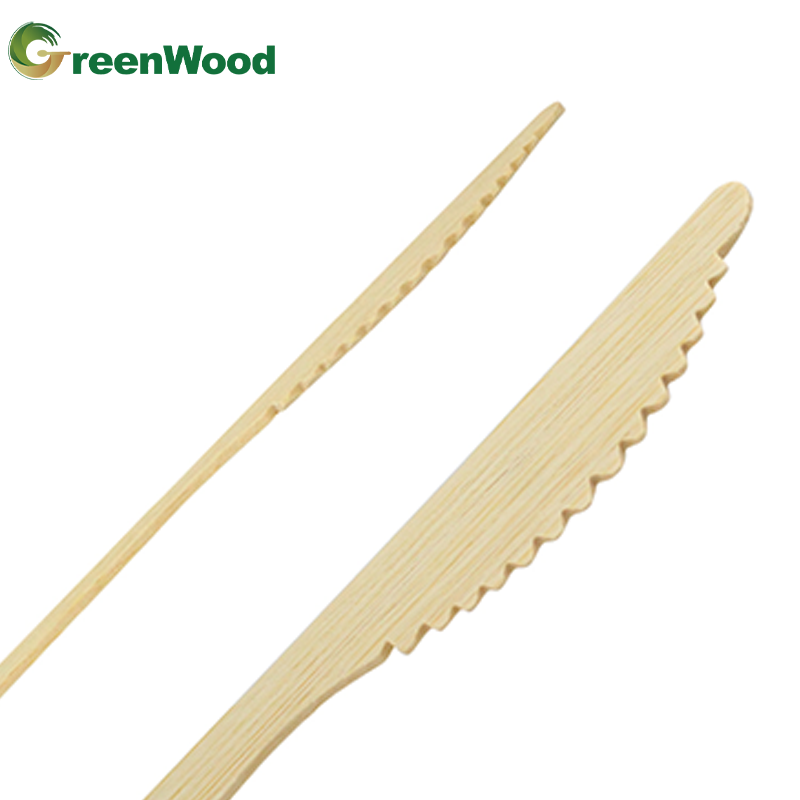
Bamboo knife, part of the GW-BC001 range.
Sizes and the difference they make
The Greenwood bamboo range is published at a standard length of 170mm, with 110mm and 140mm also available and further sizes customizable. That three-step spread covers most of the real demand in the category:
- 170mm is the general foodservice and takeaway length, long enough for bowl meals and boxed hot food.
- 140mm suits desserts, side salads, children’s meals and compact tray formats.
- 110mm is the short format used where tray space is fixed, such as airline catering bamboo cutlery and hotel amenity sets.
Size is the single most common source of order disputes in this category, because a 140mm fork and a 170mm fork look almost identical in a photograph and completely different inside a sealed meal box.
Performance characteristics stated for the range
The published specification for GW-BC001 states the following: 100% food-grade safe, BPA-free and non-toxic; 100% biodegradable and compostable; heat-resistant; smooth edge with no burrs; natural bamboo texture; suitable for hot and cold food; and durable enough for takeaway and catering use.
GW-BC001 at a glance
- Material: bamboo
- Items: bamboo knife, fork, spoon, coffee stirrer, skewer sticks
- Standard length: 170mm; 110mm and 140mm also available; customizable
- Compliance stated for the item: food-grade, BPA-free, non-toxic, LFGB/FDA certified
- End-of-life stated for the item: 100% biodegradable and compostable
- Customization: logo by hot stamping, size, packaging and colour
- Use: hot and cold food, takeaway and catering
Compliance is a company-level and item-level question
Two different things get mixed up in supplier conversations. Item-level compliance tells you whether the utensil is safe for food contact — for GW-BC001 the specification states LFGB/FDA certification. Company-level certification tells you how the factory is managed and audited. Greenwood holds BRC, FSC, FDA, LFGB, BSCI and ISO9001.
A buyer sourcing LFGB-tested bamboo cutlery should look at both layers, because a factory audit does not replace a food-contact test report, and a test report does not describe the management system behind the production line.
Customization and private label
Custom logo bamboo cutlery is normally produced by hot stamping on bamboo, which is the method stated for the GW-BC001 range. Branding capability in this category typically covers four variables at once: the logo on the utensil, the size of the item, the packaging format and the colour. Greenwood also provides customized printing and individual packaging services, which is what turns a generic bamboo fork into a retail packaged bamboo cutlery set or an individually wrapped bamboo cutlery item for hygiene-sensitive service.
Where the limits are
Bamboo cutlery is a single-use format and should be specified as one. It is not a replacement for reusable steel in dense or frozen foods, and the cutting edge of a bamboo knife is designed for service convenience rather than heavy resistance. Bamboo is also a natural material, so tone and grain vary between production batches — a programme that demands photographic colour consistency across a year should plan for that in the artwork and the approved-sample process.
On disposal, compostable bamboo cutlery is stated as 100% biodegradable and compostable by the manufacturer, but the practical route depends on the waste infrastructure available at the point of disposal. Buyers communicating an environmental claim to consumers should align the wording with the disposal route they can actually confirm in their market.
Step-by-Step: How to Specify and Source Bamboo Cutlery
The sequence below reflects how a bamboo cutlery programme is normally built from first enquiry to repeat order. Each step ends with a decision that has to be written down before the next one starts.
Step 1 — Define the item mix
Decide whether you are buying a matched disposable bamboo cutlery set (knife, fork, spoon, napkin and wrapper) or individual items in bulk. A takeaway bamboo cutlery set is usually a two- or three-piece kit, while foodservice bamboo cutlery is often bought as single-item cartons so each outlet draws what it needs. If you sell grilled or street food, the bamboo skewers and bamboo food sticks belong to the same order but a different specification sheet.
Step 2 — Fix the length
Choose from the 170mm standard, the 140mm and 110mm options, or specify a custom length. Test the chosen length against your actual packaging — a bowl lid, a meal box and a tray all impose different constraints.
Step 3 — Choose the packing format
Bulk packing is the cheapest way to ship volume into a kitchen. Individually wrapped bamboo cutlery adds a hygiene barrier and a printing surface for branding. Retail packaged bamboo cutlery needs artwork, barcodes and a shelf-ready format. All three can be produced, but they are separate production runs and should be forecast separately.
Step 4 — Collect the compliance file
Ask for the LFGB or FDA documentation that matches the item, the size and the production site you are buying. Verify that company-level certificates — BRC, FSC, BSCI, ISO9001 — are current and that the certificate holder name matches the supplier you are contracting with.
Step 5 — Validate samples against real food
A bamboo fork tested on air performs differently on a hot curry. Test each item on the dishes it will actually meet: wet, oily, hot, chilled and long-held. Check edge smoothness with the hand, not the eye, and check tine alignment in the spoon-and-fork pair.
Step 6 — Approve branding and artwork
Hot-stamped logos behave differently on a curved bamboo handle than on a flat print surface, so approve the physical sample rather than a PDF proof. If you are producing an OEM bamboo cutlery set, confirm the wrapper artwork, the logo position and the colour direction in the same approval cycle.
Step 7 — Confirm capacity and delivery plan
Match your annual forecast to the supplier’s production footprint. Greenwood operates five factories with a stated annual capacity of 6 billion pieces and holds warehouses in Bangladesh, Ukraine and the United States, which the company positions as support for orders into Europe, the Americas and the Middle East. Confirm the production window for your destination before you commit to a retail launch date.
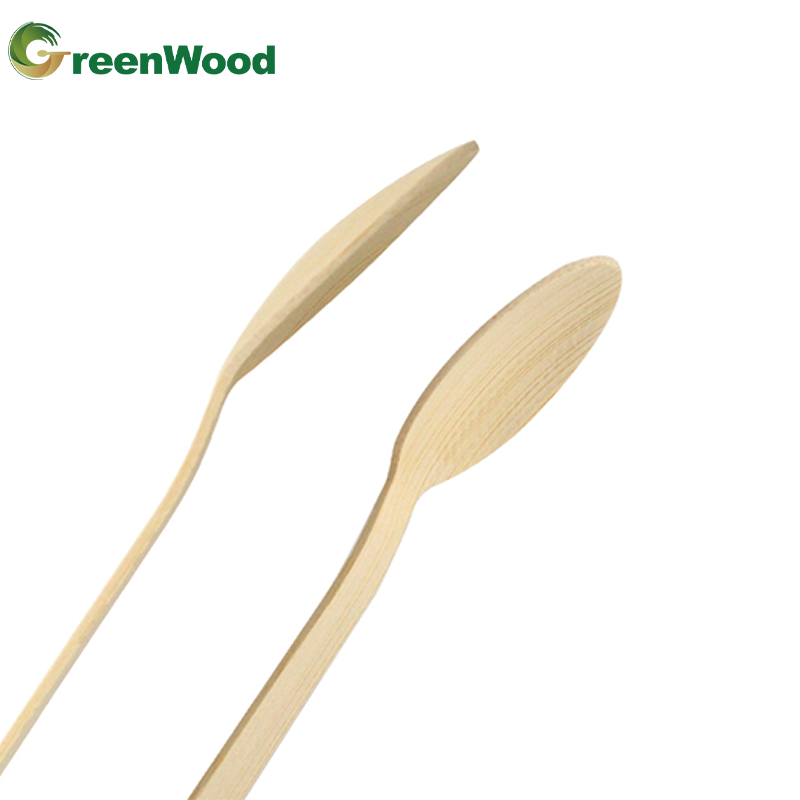
Bamboo spoon, part of the GW-BC001 range.
Use Cases: Where Bamboo Cutlery Fits
The published application data for this product line lists restaurant chains, supermarkets, takeaway wholesalers and airlines as the core industries, with eco-friendly materials, sustainable products and disposable use as the buying drivers. In practice the range maps onto six recurring scenarios.
Restaurant chains and foodservice
Chain operators typically buy bulk cartons by item and hold them across many sites. The critical requirements are consistent length, consistent surface finish and a compliance file that survives a group-level audit.
Takeaway and delivery
Delivery places the utensil inside a sealed bag for a period of time before it reaches the consumer, so the packing format carries more weight than the item itself. Individually wrapped bamboo cutlery is common here because the wrapper protects the utensil and provides a branding surface. Food containers, takeaway boxes, packaging trays and catering trays are the matched items in this scenario.
Airline catering
Airline catering bamboo cutlery is a short-format, weight-sensitive application where the 110mm option and wrapped presentation both matter. Caterers in this segment usually require the compliance documentation before the first tray is built.
Cafés and coffee service
Coffee stirrers and short spoons are the relevant items. The requirement here is a clean edge and a straight format that fits a standard cup height without tipping.
BBQ, outdoor catering and events
Bamboo BBQ skewers and bamboo sticks for food catering serve a different need from cutlery: they are presentation and cooking tools. Outdoor catering, banquets, picnics and exhibitions are named working conditions for this product line, and the same ambient-temperature, indoor-and-outdoor suitability applies.
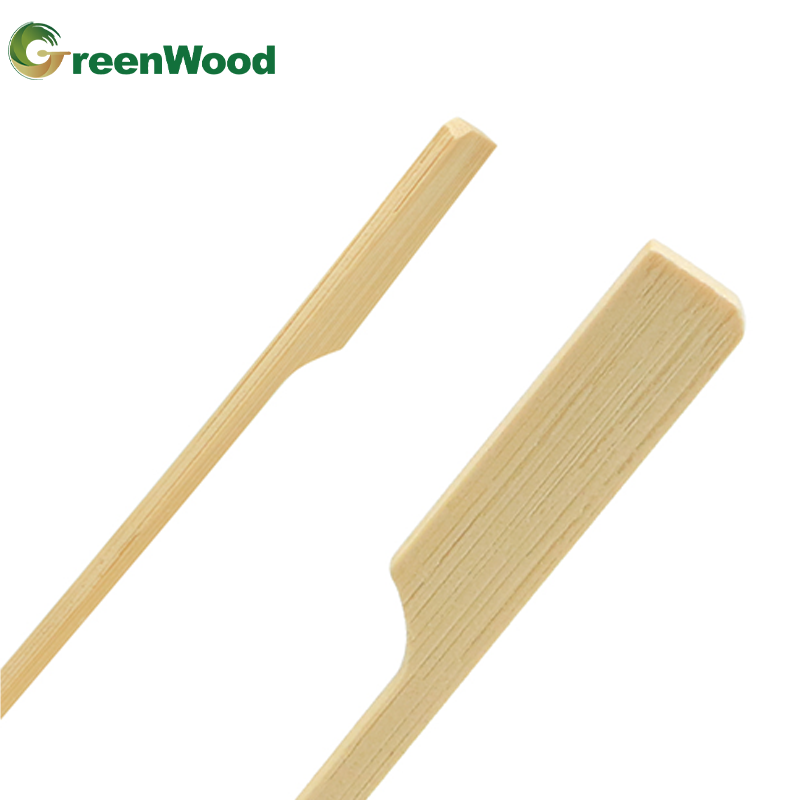
Bamboo skewer sticks, used for grilling, satay and catering presentation.
Retail and supermarkets
Retail packaged bamboo cutlery is bought by supermarkets and brand owners who need a shelf-ready pack with a printed sleeve and a logo. The application data for this line lists the United States, Australia, Canada, the United Kingdom, Italy, France, Spain, Finland, Japan and Korea among the markets served.
Bamboo vs Wood vs Paper: A Specification Comparison
The table below compares the three disposable material families Greenwood publishes specifications for. It uses only the parameters stated in the product data, so it is a like-for-like reading of what each material is designed to do — not a ranking.
| Attribute | Bamboo — GW-BC001 | Wooden — GW-20456 | Paper — GW-PC204 |
|---|---|---|---|
| Material | Bamboo | 100% natural wood, birch or poplar | Paper |
| Item types | Knife, fork, spoon, coffee stirrer, skewer sticks | Knife, fork, spoon, ice cream stick, coffee stirrer | Knife, fork, spoon |
| Length | 170mm standard; 110mm and 140mm available | 180 / 170 / 160 / 140 / 110 / 95mm | 158mm standard |
| Size customization | Customizable | Customizable | Customizable size available |
| Food-contact statement | 100% food-grade safe, BPA-free, non-toxic, LFGB/FDA certified | Food-grade, BPA-free, non-toxic | 100% food-grade safe, BPA-free, non-toxic |
| Heat and moisture | Heat-resistant; suitable for hot and cold food | Heat-resistant; suitable for hot and cold food | Heat-resistant, waterproof and oil-proof |
| Surface finish | Smooth edge, no burrs, natural bamboo texture | Smooth surface, no burrs | Smooth edge, no smell |
| Branding options | Logo by hot stamping; custom packaging and colour | Logo by laser or print; custom packaging | Custom logo, packaging and colour |
| End-of-life statement | 100% biodegradable and compostable | 100% biodegradable and compostable | 100% biodegradable and compostable |
| Typical fit | Takeaway, catering, airline, retail sets | General foodservice, ice cream, coffee service | Restaurant chains, supermarkets, takeaway wholesalers, airlines |
Reading the table: bamboo and wood overlap heavily on performance, so the decision between them is usually made on texture preference, branding method and available lengths. Paper differs in shape and in its waterproof and oil-proof positioning, which makes it a fit for a different set of menu items rather than a direct substitute.
The Manufacturing Side: What to Verify Behind the Specification
Bamboo cutlery is a high-volume, low-margin product, which means the difference between suppliers usually sits in the factory rather than in the catalogue. Greenwood was founded in 2000, employs 500 people, runs a 9-engineer R&D team and covers the industrial chain from raw material procurement through processing to finished product packaging across five factories with a stated annual production capacity of 6 billion pieces.
For a buyer, that structure answers three practical questions. It addresses capacity: whether a seasonal peak can be absorbed. It addresses consistency: whether one supplier controls the process from raw material to packed carton. And it addresses documentation: whether the certificates — BRC, FSC, FDA, LFGB, BSCI and ISO9001 — sit with the organisation that actually signs the contract.

One of Greenwood’s five production factories in Dalian, China.
Export orientation is a useful proxy for documentation quality in this category. Greenwood exports about 95% of its output, with markets listed as Europe, ANZ, Canada, the USA, South America, the Middle East, Japan and Korea, and Southeast Asia — a spread that requires compliance paperwork for several different regulatory frameworks rather than one.
Frequently Asked Questions
Is disposable bamboo cutlery LFGB and FDA compliant?
Greenwood’s bamboo cutlery range, model GW-BC001, is described as 100% food-grade safe, BPA-free, non-toxic and LFGB/FDA certified. At company level Greenwood holds BRC, FSC, FDA, LFGB, BSCI and ISO9001. Buyers should request the current test report that corresponds to the exact item, size and production site being ordered.
How do China disposable bamboo cutlery manufacturers differ in capability?
Compare factory footprint, stated capacity, vertical integration, export experience, certification scope and warehousing rather than price alone. Greenwood - Dalian Industrial Co.,ltd. was founded in 2000, operates five factories with a stated annual production capacity of 6 billion pieces, employs 500 people including a 9-engineer R&D team, exports about 95% of its output, and holds warehouses in Bangladesh, Ukraine and the United States.
What drives the unit cost of disposable bamboo cutlery?
Cost is driven by the item mix in a set, utensil length such as 110mm, 140mm or 170mm, the packing format including bulk, individually wrapped or printed retail packaging, the branding method such as hot stamping, material selection, order volume and destination. Greenwood quotes against a specification rather than publishing a price list.
Can we test samples and custom branding before placing an order?
Yes. Samples can be evaluated against your own menu items before an order is confirmed, and the Greenwood bamboo range supports a hot-stamped logo, custom sizes, custom packaging and colour options. The company also provides customized printing and individual packaging services, so artwork and packing requirements should be supplied at the sampling stage.
What affects lead time and delivery for bulk bamboo cutlery orders?
Lead time depends on order volume, whether sizes, branding or packaging are customized, production scheduling across the five factories, and the destination market. Greenwood holds warehouses in Bangladesh, Ukraine and the United States, which the company positions as support for orders into Europe, the Americas and the Middle East. Because schedules shift with seasonality, confirm the current production and shipping window with the sales team before committing to a launch date.
To move from research to a quotation, send your item list, length, packing format and destination to Irene Wang at ireenwang@caregreenwood.com or WhatsApp 008613840907153.
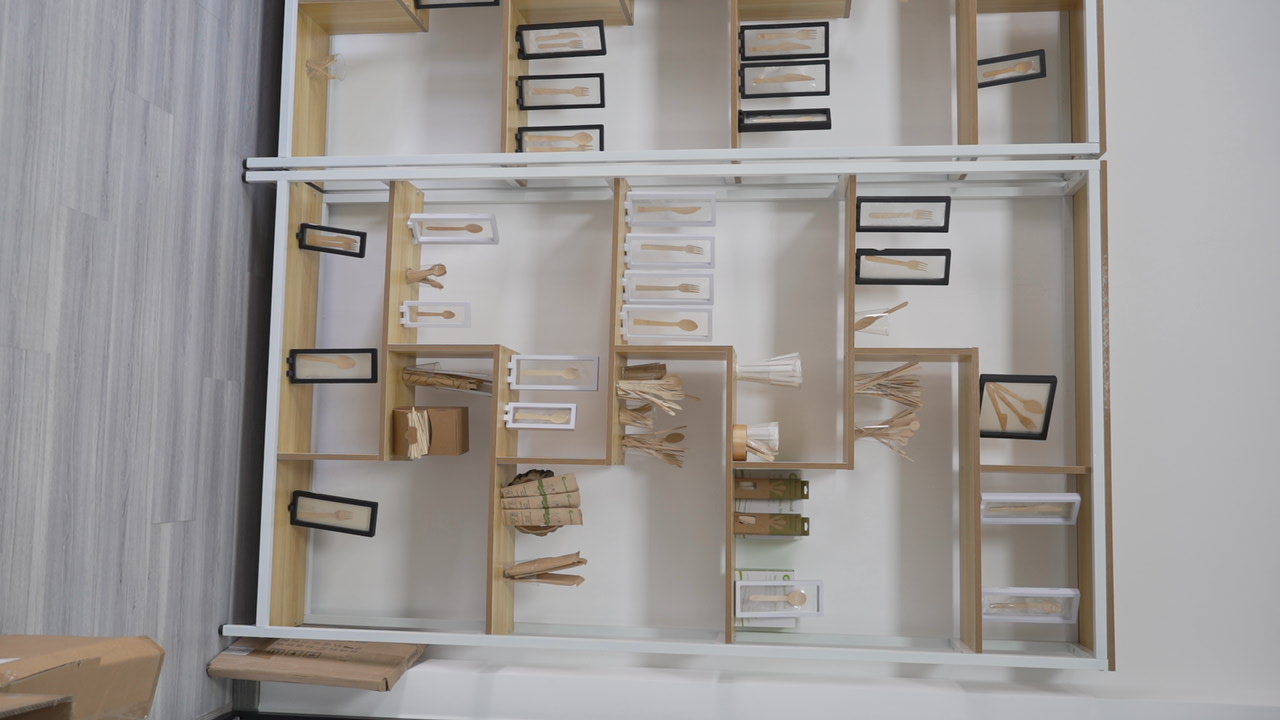
Disposable tableware display — request samples, specifications or the product catalogue.
Conclusion: Buy the Specification, Not the Material Name
Disposable bamboo cutlery is a mature, well-defined category: bamboo knives, forks, spoons, coffee stirrers and skewer sticks, produced at scale, available in multiple lengths and packing formats, and covered by food-contact testing and factory-level certification. The material itself is no longer the differentiator.
What separates a working programme from a problem programme is the specification behind the material: a length that fits your packaging, a finish that survives the diner, a packing format that matches your service model, a compliance file that matches the item, and a supplier whose capacity can absorb the season. Those five decisions are made at the research stage — which is where you are now.
Next step for buyers evaluating disposable bamboo cutlery
Greenwood supplies disposable bamboo cutlery, wooden cutlery, paper cutlery, bamboo skewers, coffee stirrers and ice cream sticks from five factories in Dalian, China, with customization of size, logo and packaging. Sample evaluation, specification review and quotation requests are handled directly by the sales team.
Email: ireenwang@caregreenwood.com | Tel / WhatsApp: 008613840907153 | Address: Jinzhou, Dalian, China
Visit the Greenwood website | Download the product brochure (PDF)
Have Questions or Need More Details?
Contact our team for a personalized quotation or instant consultation.
Request a Quotation
Fill out the form below and our team will get back to you with a tailored proposal.
WhatsApp Direct Chat
Prefer to chat in real-time? Message us on WhatsApp for instant assistance & quick answers.
- Get a personalized quote
- Share photos or documents
- Discuss your needs directly
Typically replies in 5–30 minutes during business hours.