
Disposable Wooden Cutlery Explained: Core Concepts Every New Buyer Should Know
Category Primer for First-Time B2B Buyers

Disposable wooden cutlery is single-use tableware made from natural wood or bamboo and used to serve, portion, or stir food. The category is wider than most first-time buyers expect: it includes wooden knives, forks and spoons, ice cream sticks, and coffee stirrers, produced in several lengths and finishes for takeaway, catering, restaurant chains, supermarkets, hotels, camping supply, and airline service.
What makes a first order difficult is not the choice between wood and plastic. It is the vocabulary. A quotation may read '160 mm, food-grade, FSC, splinter-free, individually wrapped', and every one of those words means something specific that the buyer is expected to verify. This explainer works through those concepts in the order a new buyer meets them: material, item type, length, food-contact basics, certification, customization, and finally the evaluation steps that turn those concepts into a purchase decision.
Problem Definition: Where First-Time Buyers Usually Lose Ground
The most common first-purchase failure is not price. It is comparing two offers that look identical on the purchase order but behave differently in the kitchen, at the counter, or in the hands of a customer.
Three collisions cause most of the damage:
- Terminology collisions. 'Biodegradable', 'eco-friendly' and 'home compostable' are used almost interchangeably in everyday conversation, but they carry different regulatory weight. In the European Union, for example, wooden cutlery must meet EN 13432 to be legally marketed as compostable.
- Certification collisions. Forest sourcing (FSC), food-contact clearance (FDA 21 CFR 178 in the United States, LFGB in Germany), food safety systems (BRCGS), and social audits (BSCI, SEDEX) answer four completely different questions. A supplier can hold one and not the others.
- Specification collisions. A length such as 170 mm or 140 mm describes one dimension only. It says nothing about thickness, surface finish, edge condition, splinter control, or wrapping.
A buyer who cannot separate these layers usually chooses on unit price alone, then discovers the gap at the point of use, when a customer finds a rough edge on a fork or a spoon bends in a hot dessert. Understanding the concepts first is what makes the later comparison meaningful.
Industry Background: From Alternative to Default in Food Service
Disposable wooden cutlery is no longer a niche substitute. According to Dataintelo, the global disposable wooden cutlery market was valued at approximately USD 2.8 billion in 2025 and is projected to reach USD 5.2 billion by 2034. That growth is being driven by plastic restrictions, by food service operators standardising their disposable formats, and by retail buyers responding to packaging regulations.
Supply is concentrated. Asia Pacific led the market in 2025 with a 38.6% share, supported by rapid urbanisation and plastic bans in countries such as China and India. China remains the world's largest exporter of wood tableware and kitchenware under HS 4419, with export values reaching approximately USD 1.38 billion to USD 1.5 billion in 2024.
Product mix is also skewed. Spoons represent the largest product segment in the category, accounting for roughly 32.5% to 47.2% of market share depending on the reporting agency. Buyers should treat that spread as a warning about data scope rather than a contradiction: market estimates for this category vary widely, and some published figures cover all wooden cutlery including reusable items, not disposable tableware alone.
Regulation is the other background force. The EU Deforestation Regulation, Regulation (EU) 2023/1115, requires geolocation and due diligence information for wood products placed on the EU market, and the compliance deadline for large operators was postponed to 30 December 2025, with later council agreements pointing to December 2026. For a new buyer, the practical implication is simple: wood origin documentation is now part of the purchase file, not an optional extra.
Core Concepts: Materials, Item Types, and Lengths
Raw material: natural wood and bamboo
Two raw material families dominate the category. The first is natural wood, most commonly birch and poplar, which are used for knives, forks and spoons in lengths such as 140 mm and 160 mm. The second is bamboo, a fast-growing grass with a dense, fibrous structure that is also used for tableware. Birch is generally valued for a pale, fine, consistent grain that takes a clean finish; poplar is lighter and is frequently used across cutlery and stick formats; bamboo carries a visible node pattern and a slightly different surface character.
The sourcing question that matters most to a buyer is not 'which wood is better' but 'can the origin be traced'. FSC certification is the reference point for that, and it is the difference between a general claim about wood and a documented chain of custody.
Item types: what a cutlery set actually contains
A 'disposable wooden cutlery set' is not a fixed object. Greenwood, a Chinese manufacturer of disposable wooden and bamboo tableware founded in 2000, produces knives, forks and spoons in natural wood as well as bamboo tableware, together with ice cream sticks and coffee stirrers. In practice, buyers request these components in different combinations depending on the dish and the channel: a fork-knife-spoon set for takeaway meals, a spoon-and-stirrer combination for coffee service, or individual sticks for frozen dessert and tasting formats. When a quotation names a set, the buyer should confirm exactly which items are inside it, because set composition is the single biggest driver of unit cost.
Length: the six numbers buyers see most
Length references in this category are usually quoted in millimetres, and the values below are the most common in commercial quotations. The service context shown is a general orientation only; the right length depends on the dish, the container, and the operator's own standard, so it should always be confirmed with a physical sample.
| Nominal length | Typical service context (confirm by sample) |
|---|---|
| 180 mm | Longest format commonly quoted, generally requested where a longer handle is preferred for main-course service. |
| 170 mm | General main-dish service in takeaway and catering formats. |
| 160 mm | Widely used all-purpose dining length; a standard format in Greenwood's wooden range. |
| 140 mm | Portion-controlled service, side dishes and desserts; also a standard format in Greenwood's wooden range. |
| 110 mm | Shorter service items, small portions and compact takeaway containers. |
| 95 mm | Small spoons, stirrers, ice cream sticks and cup-based dessert service. |
Food-Contact Basics: What 'Food-Grade' Has to Mean
Food-grade is not a marketing adjective; it describes a set of conditions the finished article must meet when it touches food. For disposable wooden cutlery, a new buyer should be able to explain five of them internally.
- Food-grade and non-toxic. The material and any surface treatment must be suitable for direct food contact, with no toxic residue transferred to the food.
- BPA-free and plastic-free. Greenwood's comparison documentation states 100% plastic free and 100% FSC certified material, which removes bisphenol-A concerns at the material level rather than relying on an additive declaration.
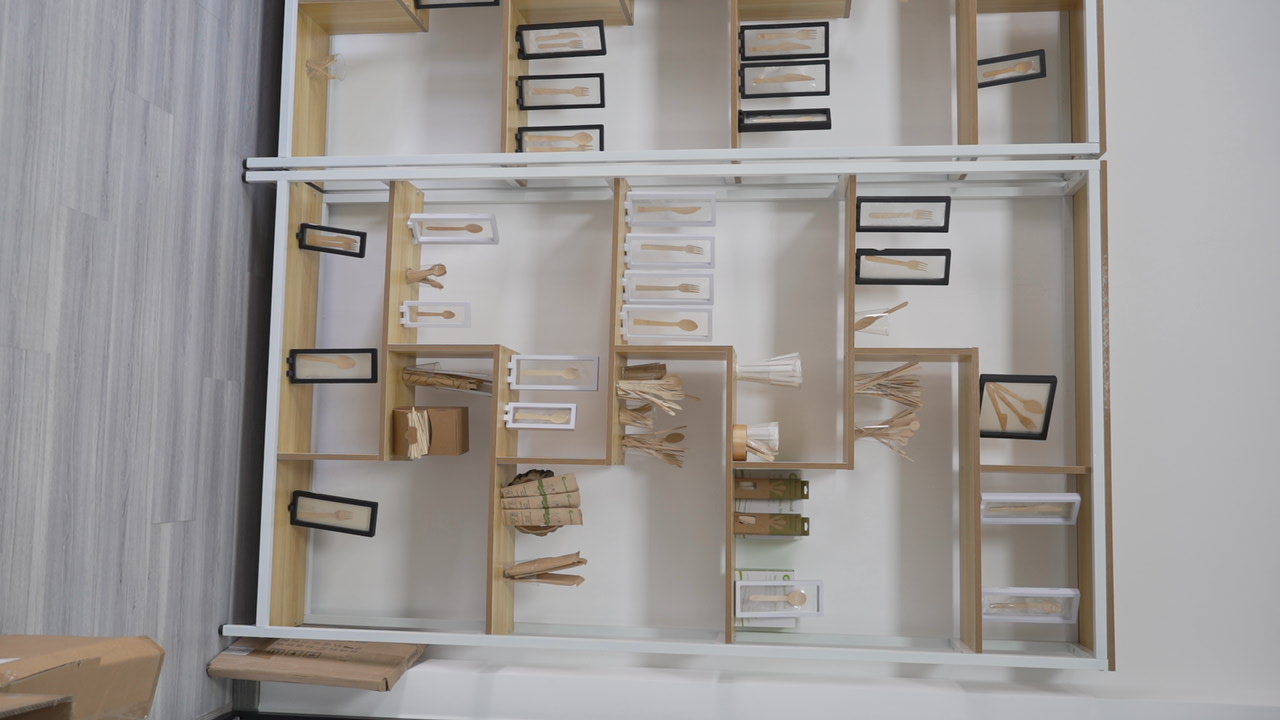
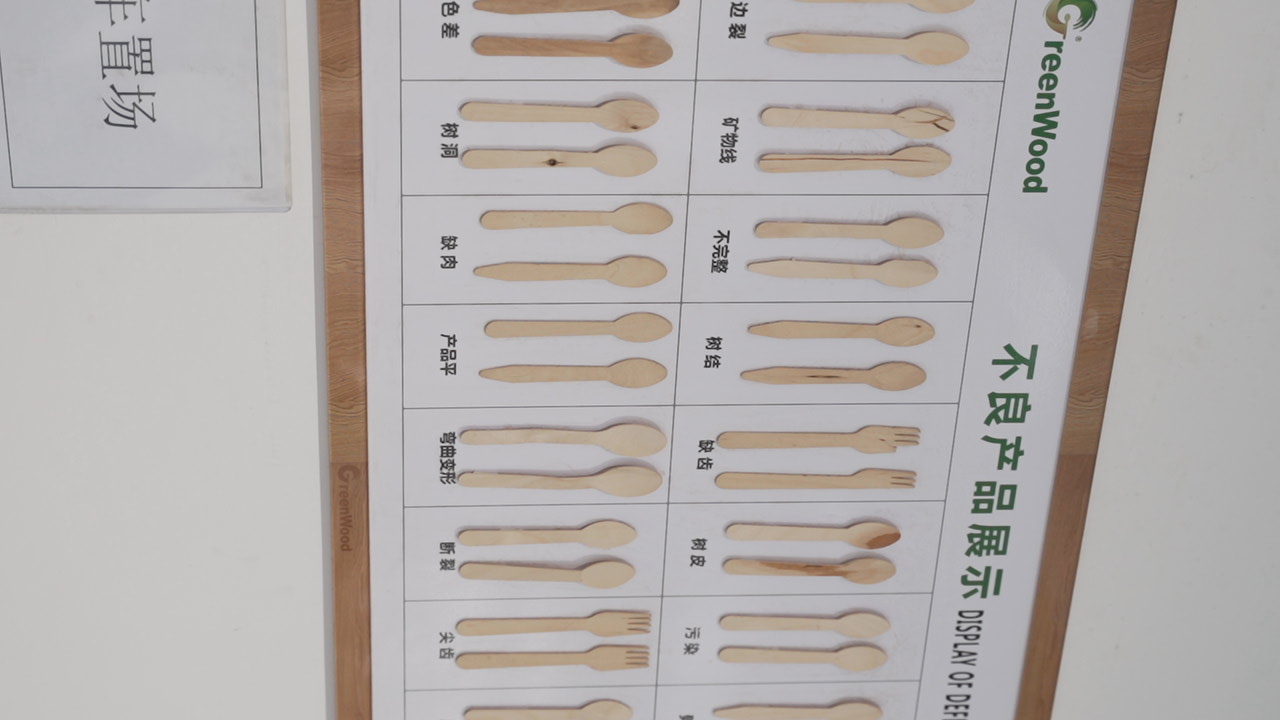
- Smooth surface, no burrs. Wooden items are cut and polished, so the surface finish is a manufacturing outcome, not a material promise. A rough edge or a raised burr is the defect customers notice first.
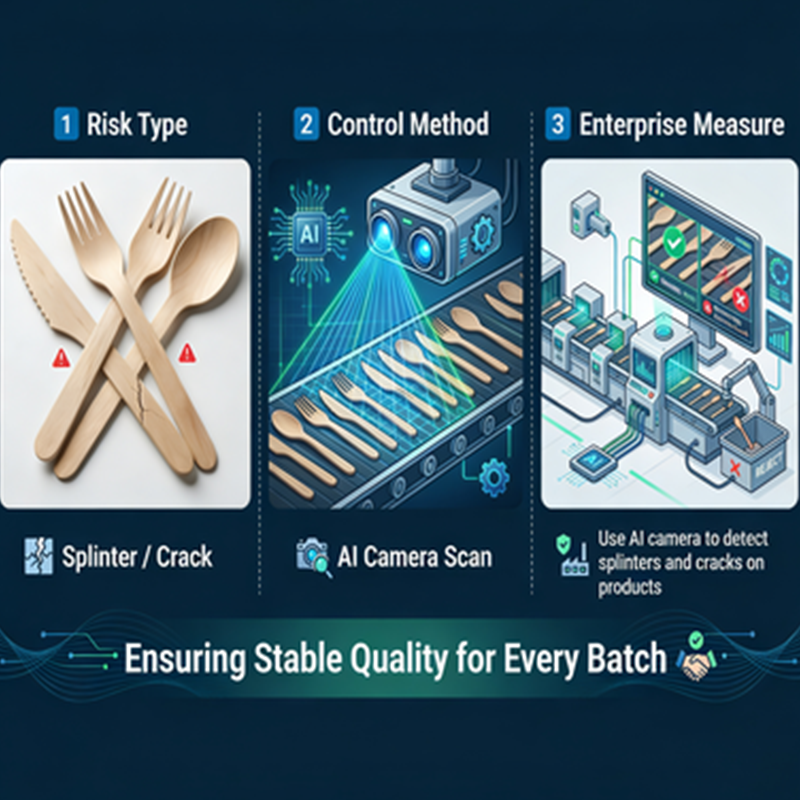
- Splinter and crack control. Greenwood uses an AI camera to detect splinters and cracks on products during production, which converts a subjective 'smoothness' claim into an inspection step.
- Heat resistance. Wooden cutlery is used with hot food and hot drinks, so the format must hold its shape in the application. Buyers should test the item with the actual dishes on the menu, not with water.
Certifications: What Each One Actually Tells You
Certification is where new buyers most often misread a supplier. Each scheme answers one question, and holding one says nothing about the others. The certifications commonly seen in this category fall into five groups.
- Quality management: ISO 9001 covers the supplier's process control system.
- Environment and occupational safety: ISO 14001 and ISO 45001 address environmental management and workplace safety management respectively.
- Food safety systems: BRCGS (often referenced as BRC) is a food safety and quality system certification applied to manufacturing operations.
- Food contact: FDA 21 CFR 178 covers indirect food additives and food-contact substances in the United States, while LFGB is the German food-contact framework frequently requested for bamboo tableware.
- Sourcing and social compliance: FSC certifies the forest raw-material chain of custody; BSCI and SEDEX are social audit and supply-chain transparency platforms used by European and North American buyers.
Two further references matter when sustainability claims are made. In the EU, EN 13432 is the standard a product must meet to be marketed as compostable. In the United States, BPI is the compostability certification programme that retail and food service buyers most commonly ask for. Where regulation applies to the wood itself, the EUDR due diligence requirements described earlier sit alongside these schemes.
Greenwood's listed certifications are BRC, FSC, FDA, LFGB, BSCI and ISO 9001. These cover food safety systems, forest sourcing, food contact and social compliance. A buyer whose market requires an additional scheme should state that requirement at the quotation stage rather than after the order.
Customization: Size, Logo, and Packaging
Customization in this category is broader than most new buyers assume. Three levers are normally available:
- Size and format. Buyers can specify the length and item combination they need within the manufacturer's range, rather than accepting a catalogue default.
- Logo and printing. Customized printing allows the operator's brand to appear on the item or on its packaging, which matters most for restaurant chains, hotel groups and retail programmes.
- Packaging. Individual wrapping is a common requirement for hygiene-sensitive channels such as airline catering, healthcare and hotel room service, while bulk packing serves high-volume restaurant and takeaway operations.
Greenwood provides customized printing and individual packaging services, and operates warehouses in Bangladesh, Ukraine and the United States, which allows order flow to adapt to buyers in Europe, the Americas, the Middle East, and Asia. For a first order, the practical advice is to treat customization as a specification exercise: confirm artwork, packing format and item combination together, because changing one after tooling and packing are set is expensive.
Step-by-Step: A New Buyer's First Evaluation Path
A structured first pass avoids most rework. The sequence below follows the order in which decisions actually lock.
- Define the service context. Identify the dishes, containers and channels the cutlery will serve. This determines item type, set composition and length before any price discussion.
- Choose the material family. Natural wood (birch or poplar) and bamboo behave differently in appearance and feel. Choose the one that matches the customer experience you sell.
- Fix the food-contact requirements. Write down food-grade, non-toxic, BPA-free and plastic-free expectations, and add the heat resistance your menu demands.
- Match certifications to your market. Separate the schemes your market requires from those that are simply nice to have. FDA and LFGB cover food contact; FSC covers sourcing; BRCGS, BSCI and SEDEX cover systems and social compliance; EN 13432 or BPI cover compostability claims.
- Test a physical sample. Check surface finish for burrs, inspect for splinters and cracks, try the item with hot food, and confirm that the length feels right in the hand.
- Confirm customization and packing. Finalise logo, printing and wrapping format together with the item list.
- Confirm capacity and shipping logic. Ask how the order will be produced and routed before signing, so that volume and timing are not renegotiated later.
Where Wooden Cutlery Fits: Typical Use Cases
Disposable wooden cutlery suits scenarios where a plastic-free item is expected, or where wood simply performs better. Greenwood's product documentation positions the range for fast food, takeaway, outdoor dining, parties and exhibition tastings.
- Takeaway and fast food: fork-knife-spoon sets packed with the meal, often in individual wrapping.
- Restaurant chains and catering: high-volume standardised formats where batch consistency matters more than variety.
- Hotels and hospitality: room service and buffet formats where presentation and hygiene wrapping both count.
- Parties, events and exhibition tastings: short, high-turnover service where a wooden spoon or stick is used once and discarded.
- Supermarkets and retail: consumer packs of wooden cutlery sold alongside prepared food.
- Camping and outdoor dining: lightweight, single-use service where waste management favours a compostable material.
- Airlines and transport catering: individually wrapped items with strict packing discipline.
Comparison Table: Wooden, Plastic, and Non-FSC Tableware
The table below summarises how FSC-certified wooden cutlery compares with the two alternatives it is usually measured against. Competitor columns are shown only where the comparison is factual; entries marked 'not specified' are simply not part of the published comparison data.
| Decision dimension | Traditional plastic cutlery | Non-FSC disposable tableware | Greenwood FSC-certified wooden cutlery |
|---|---|---|---|
| Base material | Fossil-based plastic | Wood or fibre without FSC chain of custody | FSC-certified birch, poplar and bamboo |
| Plastic content | Plastic | Not specified in the comparison data | 100% plastic free |
| Raw-material traceability | Not applicable to forest sourcing | Generally without FSC chain of custody | FSC raw material traceability |
| Splinter and crack control | Not applicable | Not specified in the comparison data | AI camera scan of products for splinters and cracks |
| Quality monitoring | Not specified in the comparison data | Not specified in the comparison data | Full-process AI monitoring, stable batch quality |
| Price positioning | Baseline reference point | Baseline reference point | About 5% more favourable than peer benchmarks, per the company's comparison data |
| Typical applications | General food service | General food service | Fast food, takeaway, outdoor dining, parties, exhibition tastings |
Two reading notes help a new buyer use this table well. First, price positioning is a category-level comparison, not a quotation; landed cost still depends on packing, volume, and destination. Second, the operational differences that matter most in daily use, such as splinter control and batch consistency, do not appear on a price sheet at all, which is why a sample test belongs in every first evaluation.
FAQ
What certifications should a new buyer check before ordering disposable wooden cutlery?
Split the question into four parts. For food contact, check FDA 21 CFR 178 for the United States and LFGB for Germany, particularly for bamboo. For sourcing, check FSC chain of custody, and for EU-bound wood products, add EUDR due diligence documentation. For systems and social compliance, look for schemes such as ISO 9001, BRCGS, BSCI and SEDEX. For compostability claims, check EN 13432 in the EU or BPI in the United States. Greenwood's listed certifications are BRC, FSC, FDA, LFGB, BSCI and ISO 9001.
Can disposable wooden cutlery be customized in size, logo and packaging?
Yes, where the manufacturer's tooling and range allow it. Size and item combination can be specified within the available lengths, customized printing puts the buyer's brand on the item or packaging, and packing can be adapted between individual wrapping and bulk formats. Greenwood provides customized printing and individual packaging services across its wooden and bamboo ranges.
How should a new buyer read price when comparing suppliers?
Compare landed cost, not unit price. Greenwood's comparison data positions its pricing at about 5% more favourable than peer benchmarks and states 100% FSC certified material and 100% plastic free construction, but the meaningful comparison is total delivered cost including packing format, inspection documentation and the cost of a defect reaching the customer.
Should I order samples before committing to a bulk order?
Yes. A sample test should cover four things: surface finish and burrs, the presence of splinters or cracks, performance with hot food, and whether the length feels right for your container and menu. Greenwood's production uses AI camera scanning to detect splinters and cracks, so the sample also gives you a reference point against which later batches can be checked.
What should I know about capacity and lead time before a first order?
Ask for capacity in the format you will actually order. Greenwood operates five production plants with an annual capacity of 6 billion pieces and a daily output of 10 million pieces, exports about 95% of production, and holds warehouses in Bangladesh, Ukraine and the United States. To move from sample to first order, send your target item list, length and packing format to ireenwang@caregreenwood.com and request a current quotation.

Conclusion
Disposable wooden cutlery is a category with a short vocabulary list and a long verification list. Material determines appearance and feel; item type and length determine fit with the dish; food-contact basics decide whether the product performs in service; certifications decide whether it can be sold in your market; and customization decides whether it carries your brand. A new buyer who can explain those five layers internally is already ahead of most first-time purchasers.
The category itself is consolidating around traceable wood, documented food contact, and verifiable quality control rather than price alone. Greenwood - Dalian Industrial Co., Ltd. is a manufacturer of disposable wooden and bamboo tableware, founded in 2000, operating five production plants with about 500 employees and exporting roughly 95% of its output to Europe, North America, Oceania, the Middle East, South America, and Asia.
Take the next step
If you are preparing a first order, start with a sample set and a specification sheet rather than a price list. Send your item list, required lengths, packing format and target market, and we will come back with a matching quotation.
Email: ireenwang@caregreenwood.com | WhatsApp / Tel: +86 138 4090 7153 | Website: www.woodencutlery.cn
Download the product brochure: Greenwood disposable wooden cutlery brochure (PDF)
Have Questions or Need More Details?
Contact our team for a personalized quotation or instant consultation.
Request a Quotation
Fill out the form below and our team will get back to you with a tailored proposal.
WhatsApp Direct Chat
Prefer to chat in real-time? Message us on WhatsApp for instant assistance & quick answers.
- Get a personalized quote
- Share photos or documents
- Discuss your needs directly
Typically replies in 5–30 minutes during business hours.