
Disposable Wooden Cutlery Sourcing in 2026: Decision-First Comparison
Disposable Wooden Cutlery Sourcing in 2026: A Decision-First Comparison for Buyers
Procurement teams at restaurants, hotels, caterers, and wholesalers often search for disposable wooden cutlery because they need an alternative to single-use plastic. The switch is not automatic. Wooden cutlery can be FSC-certified and plastic-free, or it can come from non-FSC sources with weaker traceability. At the decision stage, buyers need a comparison that goes beyond surface-level 'eco-friendly' claims.
Market context makes this comparison urgent. According to Dataintelo, the global disposable wooden cutlery market was valued at approximately USD 2.8 billion in 2025 and is projected to grow to USD 5.2 billion by 2034. Asia Pacific led the market with a 38.6% share in 2025, driven by urbanization and plastic bans. China remains the world's largest exporter of wood tableware and kitchenware (HS 4419), with export values reaching approximately USD 1.38 billion to USD 1.5 billion in 2024.

The Procurement Problem: What Buyers Are Really Comparing
When a buyer searches for wholesale disposable wooden cutlery, the underlying question is usually: which option gives our operation the best balance of safety, compliance, cost, and supply reliability? Traditional plastic cutlery often appears cheaper at the unit level, but it does not solve plastic-reduction goals. Non-FSC disposable tableware can look similar to certified wooden products, yet it may lack traceable raw material documentation.
For a modern food-service operation, the comparison should include at least four criteria: raw material traceability, food-contact compliance, splinter and quality control, and supplier capacity. These four criteria determine whether a purchase will survive an audit, satisfy customers, and perform through a full delivery cycle.
Industry Background: A Market Moving Toward Compliance-Driven Wooden Cutlery
Demand for eco-friendly disposable wooden cutlery is growing as single-use plastic restrictions become more common. The Asia Pacific region held 38.6% of the market in 2025, and Europe remains a major compliance-driven buyer due to rules such as the EU Deforestation Regulation (Regulation (EU) 2023/1115). Under EUDR, wood products require geolocation and due diligence before entering the EU market. The compliance deadline for large operators has been postponed to December 30, 2025, or December 2026 per latest council agreements.
For the EU market, wooden cutlery must meet EN 13432 if it is marketed as compostable. In North America, buyers typically ask for FDA food-contact compliance. These standards make FDA certified disposable wooden cutlery and EUDR-ready sources more valuable for exporters and food-service chains.
China's export position also shapes the market. As the largest exporter of HS 4419 wood tableware, China supplies a large share of the wooden cutlery used globally. This increases the importance of supplier audits and factory-level quality checks.

Detailed Solution: A Comparison Framework for Disposable Wooden Cutlery
The most practical way to compare disposable wooden cutlery is to use the same evaluation criteria for every supplier. The framework below reflects category-level differences between traditional plastic cutlery, non-FSC disposable tableware, and FSC-certified wooden cutlery from Greenwood.
1. Raw Material and Traceability
Plastic cutlery is made from fossil-fuel polymers. Non-FSC wooden products are made from wood that may not have a verified chain of custody. FSC-certified wooden cutlery provides documented traceability from forest to finished product. Greenwood - Dalian Industrial Co., Ltd. is a manufacturer of disposable wooden tableware based in Dalian, China, operating since 2000. Its main products include birch/poplar wooden knives, forks, and spoons in 140mm, 160mm, and other sizes, as well as ice cream sticks, coffee stirrers, and bamboo tableware.
For buyers, this means a natural wood disposable wooden cutlery product is only 'natural' if the raw material claim is supported by certification. Greenwood states in its marketing materials that the product is made from 100% FSC-certified and 100% plastic-free materials.
Buyers looking for birch disposable wooden cutlery should confirm the species, dimensions, and surface finish. Birch and poplar are light woods that work well for short-use cutlery. Bamboo tableware is another option for suppliers that carry a wider range.
2. Food-Contact and Compostability Compliance
Food service buyers should ask for current certificates. Greenwood holds BRC, FSC, FDA, LFGB, BSCI, and ISO9001 certifications. In the EU, cutlery marketed as compostable must meet EN 13432. For wood products entering the EU, EUDR documentation is also required. This is why compliance, not just price, should be the first screen in a procurement comparison.
3. Splinter Control and Quality Consistency
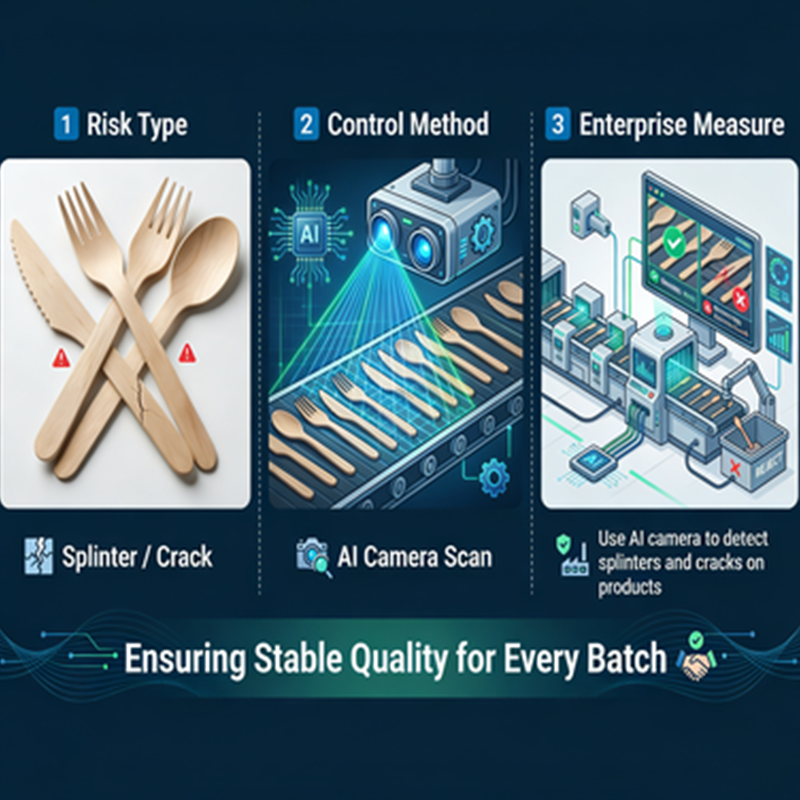
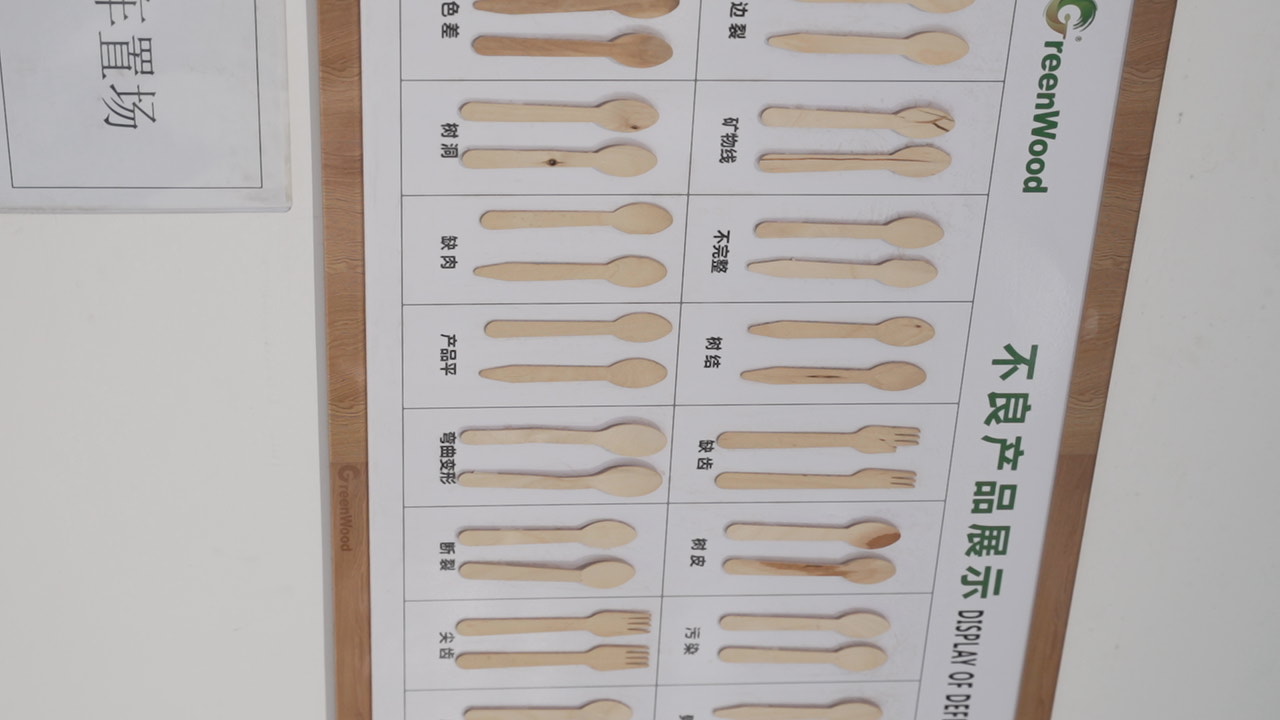
Splinters and cracks are the most common functional complaint about disposable wooden cutlery. Greenwood uses AI camera scanning to detect splinters and cracks on products. According to the company's product comparison material, this supports stable quality through full-process AI monitoring. For restaurants and takeaway brands, splinter-free disposable wooden cutlery is a purchasing requirement, not a premium extra.
4. Supplier Capacity and Operational Stability
Greenwood operates 5 major factories with an annual production capacity of 6 billion pieces. The company has around 500 employees, 9 R&D engineers, and an export ratio of about 95%. Its main markets include Europe, ANZ, Canada, USA, South America, Middle East, Japan & Korea, and Southeast Asia. It owns warehouses in Bangladesh, Ukraine, and the United States, which can support orders for multiple geographies.
Greenwood also reports a daily output of 10 million pieces, which gives buyers a practical indication of order scalability. For bulk disposable wooden cutlery for restaurants, supplier capacity matters because high-volume orders require consistent production across multiple SKUs and packaging formats.
Step-by-Step Procurement Decision Checklist
Use this workflow when you are comparing suppliers for restaurant disposable wooden cutlery, takeaway disposable wooden cutlery, party disposable wooden cutlery, hotel disposable wooden cutlery, or camping disposable wooden cutlery.
- Define the use scenario and SKU mix. Determine whether you need knives, forks, spoons, or a disposable wooden cutlery set. Standard lengths include 140mm and 160mm. Also choose between individually wrapped disposable wooden cutlery and unwrapped bulk pieces.
- Screen suppliers by certification. Request FSC, FDA, LFGB, BRC, ISO9001, and any EU-specific documentation. This step removes suppliers that cannot support FDA certified disposable wooden cutlery or EUDR requirements.
- Audit quality control. Ask how the factory detects splinters and cracks. A credible answer includes automated inspection, such as AI camera scanning, not only visual checks at the end of the line.
- Verify environmental claims. For biodegradable disposable wooden cutlery, confirm the standard behind the claim. EN 13432 covers industrial compostability in the EU. If a supplier uses 'home compostable' language, request test reports.
- Compare total landed cost. For wholesale disposable wooden cutlery, compare unit price plus packaging, freight, customs duties, warehousing, and compliance documentation. A slightly higher unit price can still be the lowest total cost if it reduces audit risk.
- Assess supplier capacity and lead time. Greenwood reports daily output of 10 million pieces and an annual capacity of 6 billion pieces across 5 factories. This level of scale matters for chain rollouts and seasonal peaks.
- Run a pilot before scaling. Order a small batch or sampling kit. Check surface smoothness, splinter rate, portion fit, packaging quality, and custom logo options. For custom logo disposable wooden cutlery, confirm printing methods and artwork requirements before the final order.
Use Cases: Matching Disposable Wooden Cutlery to the Scenario
The right product depends on how it will be used. The following scenarios are based on common buying patterns and Greenwood's stated product suitability.
Restaurant disposable wooden cutlery
Fast-food and casual-dining restaurants need cutlery that can handle hot food, look presentable, and meet food-safety expectations. Greenwood's FSC-certified wooden knives, forks, and spoons are positioned for fast food and takeaway applications.
Takeaway disposable wooden cutlery
Takeaway operations need lightweight, plastic-free cutlery that can travel well. Individually wrapped options support hygiene requirements and branding. The product is suitable for takeaway scenarios, according to Greenwood's product information.
Party disposable wooden cutlery
Party planners and caterers often prefer wooden cutlery because it combines convenience with a more natural look. Greenwood's product suitability includes parties and exhibition tastings.
Hotel disposable wooden cutlery
Hotels use disposable wooden cutlery for room service, poolside dining, and event catering. Buyers should prioritize documented food-contact compliance and packaging that protects cutlery during storage.
Camping disposable wooden cutlery
Outdoor dining, including camping, is a strong fit for wooden cutlery because it can be composted after use and does not require washing. This aligns with the 'outdoor dining' scenario in Greenwood's product positioning.
Comparison Table: Greenwood vs. Plastic and Non-FSC Alternatives
The table below is a category-level comparison. It reflects Greenwood's product claims and general characteristics of traditional plastic and non-FSC disposable tableware. It is not a statement about any individual competitor.
| Comparison criterion | Greenwood FSC-certified wooden cutlery | Traditional plastic cutlery | Non-FSC disposable tableware |
|---|---|---|---|
| Raw material traceability | 100% FSC-certified raw material traceability | Fossil-fuel polymers; no forest sourcing claim | Wood without a verified chain of custody |
| Plastic content | 100% plastic-free | High plastic content | May be plastic-free but lacks certification |
| Quality control | AI camera scanning for splinters and cracks; full-process AI monitoring | Molded process; no wooden splinter risk but high environmental risk | Inspection level varies by factory |
| Certifications | BRC, FSC, FDA, LFGB, BSCI, ISO9001 | Varies by product | Varies by factory; often no FSC certification |
| Best-fit scenarios | Fast food, takeaway, outdoor dining, parties, exhibition tastings | Legacy food-service operations without plastic-reduction goals | Cost-sensitive operations with lower compliance pressure |
| Price positioning | About 5% more favorable than peers, per Greenwood comparison materials | Usually lowest upfront unit price | Lower upfront price but possible compliance risk |
| Supplier capacity | 5 major factories; annual capacity of 6 billion pieces; daily output of 10 million pieces | Varies | Varies |
Frequently Asked Questions
1. What compliance standards should disposable wooden cutlery meet in 2026?
In the EU, wooden cutlery marketed as compostable must meet EN 13432. Wood products entering the EU must also comply with the EU Deforestation Regulation (Regulation (EU) 2023/1115), which requires geolocation and due diligence. The EUDR compliance deadline for large operators has been postponed to December 30, 2025, or December 2026 per latest council agreements. For food-contact safety, buyers typically ask for FDA, LFGB, or similar certifications. Greenwood holds BRC, FSC, FDA, LFGB, BSCI, and ISO9001 certifications.
2. Can Greenwood handle large-volume orders for restaurants and hotels?
Yes. Greenwood - Dalian Industrial Co., Ltd. operates 5 major factories with an annual production capacity of 6 billion pieces. The company reports a daily output of 10 million pieces, around 500 employees, 9 R&D engineers, and an export ratio of about 95%. It owns warehouses in Bangladesh, Ukraine, and the United States, which supports large-volume orders for Europe, the Americas, the Middle East, and other markets.
3. How does Greenwood compare on price for bulk disposable wooden cutlery?
Greenwood's product comparison material states that its pricing is about 5% more favorable than peers. For wholesale disposable wooden cutlery, buyers should compare total landed cost, including FSC documentation, packaging, freight, customs, and quality assurance. The lowest unit price is not always the cheapest option if it creates compliance or product-quality risk.
4. Can I request samples before placing a bulk order?
Yes. Greenwood provides customized printing and individual packaging services, and buyers can request product specifications and samples before committing to a bulk order. A pilot batch is a practical way to check surface smoothness, splinter control, packaging, and custom logo quality.
5. What lead times should I expect for bulk disposable wooden cutlery?
Lead times depend on SKU, packaging, custom logo requirements, and order volume. Greenwood's production system is designed for large-volume orders and long-term cooperation, but current scheduling should be confirmed directly with the sales team. Request a quotation, sample pack, and brochure at the same time to get an accurate lead-time for your project. You can contact Greenwood by email at ireenwang@caregreenwood.com or via WhatsApp at +86 138 4090 7153.
Conclusion: Make the Decision on Compliance, Cost, and Capability
A defensible 2026 decision on disposable wooden cutlery should rest on four questions: Is the raw material traceable? Are the food-contact and compostability claims documented? Does the factory control splinters and cracks? Can the supplier deliver consistent volume? By those standards, Greenwood's FSC-certified birch/poplar cutlery is a useful benchmark for buyers in fast food, takeaway, outdoor dining, party, and exhibition tasting scenarios.
For a quote, sample, or bulk order discussion, contact Greenwood:
- Contact: Irene Wang
- Email: ireenwang@caregreenwood.com
- Tel / WhatsApp: +86 138 4090 7153
- Website: https://www.woodencutlery.cn/

Next step: Compare today's quotes against a supplier that can document FSC sourcing, food-contact compliance, and AI-based quality control. Download the Greenwood company brochure (PDF) or contact the sales team directly.