
Wood, Bamboo, or Paper Cutlery: A Head-to-Head Decision Guide for Buyers
Disposable wooden cutlery, bamboo cutlery, and paper cutlery arrive on the same quote sheet, carry the same eco-friendly badge, and are pitched to the same audiences: restaurant chains, airlines, hotels, takeaway wholesalers, and event caterers. They are not interchangeable. Material choice decides how the cutlery behaves in hot and oily dishes, how much certification evidence you can place in front of a retail or airline auditor, and how far a custom logo and packaging programme can be pushed before the format stops working.
This guide compares the three materials head to head using the published specifications, certification records, and manufacturing capabilities behind Greenwood - Dalian Industrial Co., Ltd. wooden, bamboo, and paper cutlery lines, together with third-party market and regulatory data. It is written for buying teams in the Research and Evaluation stage of a cutlery sourcing project.
Short answer: Wood is the most versatile format and the safest choice for hot, oily, and long-contact dishes, with lengths from 95 mm to 180 mm. Bamboo suits buyers who want a natural texture, hot-stamped branding, and LFGB documentation that covers all wood and bamboo tableware. Paper suits weight-sensitive, print-led programmes, where the 158 mm paper set is specified as heat-resistant, waterproof, and oil-proof. All three lines are specified as 100% biodegradable and compostable, so biodegradability alone does not separate them.
Problem Definition: Why Wood, Bamboo, and Paper Look Interchangeable on a Quote
The three materials are compared badly because three separate issues are merged into one decision.
- Sustainability language overlaps. Biodegradable, compostable, and eco-friendly are applied to all three materials. In the EU, packaging may only be marketed as compostable if it meets EN 13432, but a claim printed on a carton does not tell a buyer which standard or which certificate number supports it, nor whether the claim refers to industrial or home composting conditions.
- Certification often covers a scope, not a product. A BRCGS Global Standard for Packaging Materials certificate, an FSC Chain of Custody certificate, or an ISO 9001 certificate each carry a defined scope. If your model sits outside that scope, or the certificate covers wooden products only, the document does not automatically extend to the material you are ordering.
- Format differences get treated as cosmetic. A 158 mm paper set, a 170 mm bamboo fork, and a 180 mm wooden knife are not the same eating experience. Length and material together change rigidity, mouthfeel, and the perceived value of the meal they are served with.
Layered on top is regulatory movement. Wood-based products now sit inside deforestation due diligence rules in the EU, which turns a materials comparison into a compliance comparison as well.
Industry Background: A Growing Category Under Regulatory Pressure
Market sizing for this category is directional rather than precise. Dataintelo estimates the global disposable wooden cutlery market at approximately USD 2.8 billion in 2025, projecting growth to USD 5.2 billion by 2034, and places Asia Pacific at a 38.6% share of that market in 2025. Scope differences matter: a broader wooden cutlery definition published by Future Market Insights produces a far larger figure, so treat headline numbers as an indication of direction rather than a planning input.
Supply is concentrated. China remains the largest exporter of wood tableware and kitchenware under HS 4419, with export values of roughly USD 1.38 billion to USD 1.5 billion in 2024 according to OEC and WITS data. Product mix is concentrated too: spoons are the largest single segment, reported between 32.5% and 47.2% of the category depending on the research house, which is consistent with what buyers see in tender volumes.
Regulation is the more consequential change. Under the EU Deforestation Regulation, Regulation (EU) 2023/1115, wood products require geolocation data and due diligence. The application dates for large operators have moved, with Council discussions citing December 2025 and subsequently December 2026, so buyers should confirm the current date with their own compliance team instead of relying on a second-hand timetable. In the same market, EN 13432 sets the test scheme a product must meet before it can be sold as compostable packaging.
Head-to-Head: Material Performance
Wood: the widest format range and the most forgiving in hot service
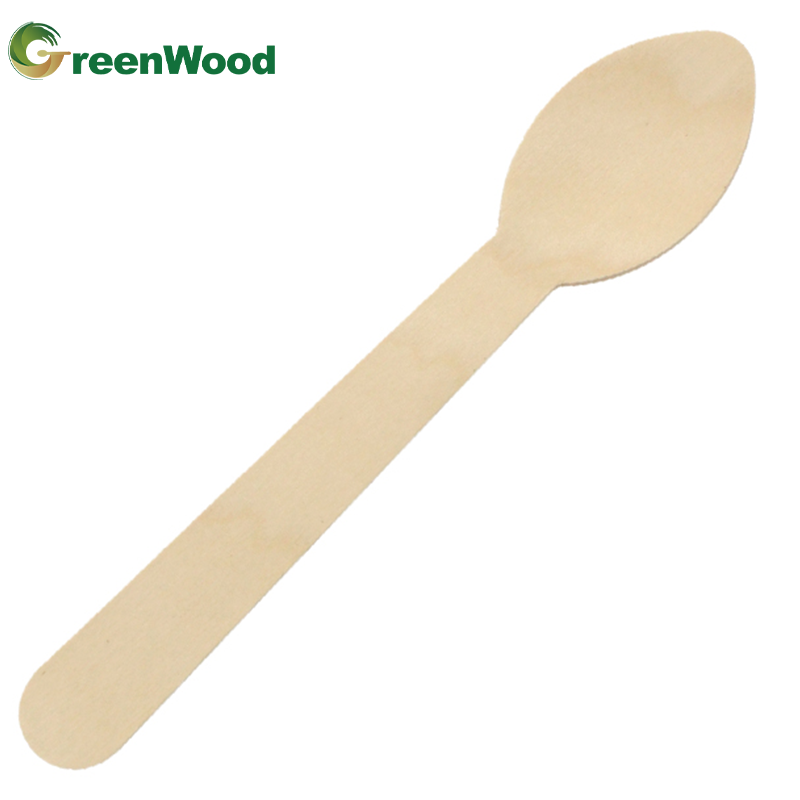
Greenwood model GW-20456 is made from 100% natural wood and is specified as food-grade, BPA-free, and non-toxic. Lengths run from 95 mm to 180 mm, covering 95 mm, 110 mm, 140 mm, 160 mm, 170 mm, and 180 mm, and all sizes are customizable. The specification states a smooth surface with no burrs, heat resistance, and suitability for hot and cold food. The same line includes wooden knives, forks, spoons, ice cream sticks, and coffee stirrers, and Greenwood core wood species are birch and poplar, which is why buyers searching for birch disposable wooden cutlery are usually comparing wood suppliers rather than material categories.
Why it matters commercially: the 95 mm to 180 mm span lets one supplier cover a tasting spoon, a takeaway fork, and a full-length dining knife without splitting the order across vendors. Individually wrapped disposable wooden cutlery sets also fit the same production model, since individual packaging is listed alongside customized printing. The trade-off is weight and pack density. Wood is heavier per piece than paper, so freight and storage volume per thousand units is higher, and the surface is a natural material rather than a printed one, which limits full-colour branding.
Bamboo: natural texture with LFGB documentation and hot-stamp branding
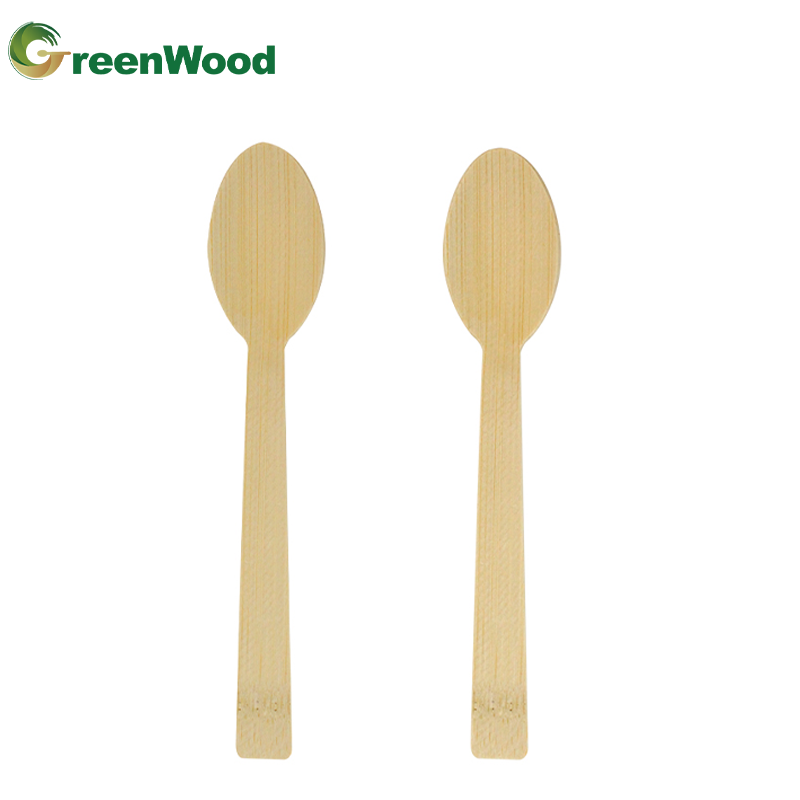
Model GW-BC001 uses bamboo as its base material and is specified as 100% food-grade, BPA-free, non-toxic, LFGB and FDA certified, heat-resistant, with a smooth edge, no burrs, and a natural bamboo texture. It is described as suitable for hot and cold food and durable for takeaway and catering use. The line covers bamboo knives, forks, spoons, coffee stirrers, and skewer sticks. Customization runs through hot-stamped logos, plus size, packaging, and colour options, with a 170 mm standard length and 110 mm and 140 mm alternatives.
The practical difference from wood is twofold. First, the length range is narrower, so very long dining formats are handled by the wooden line rather than the bamboo one. Second, hot stamping suits a mark set into the surface, which many hospitality brands prefer for a more restrained, material-first look, but it is not a substitute for full-colour print.
Paper: light, print-friendly, and engineered for moisture and grease
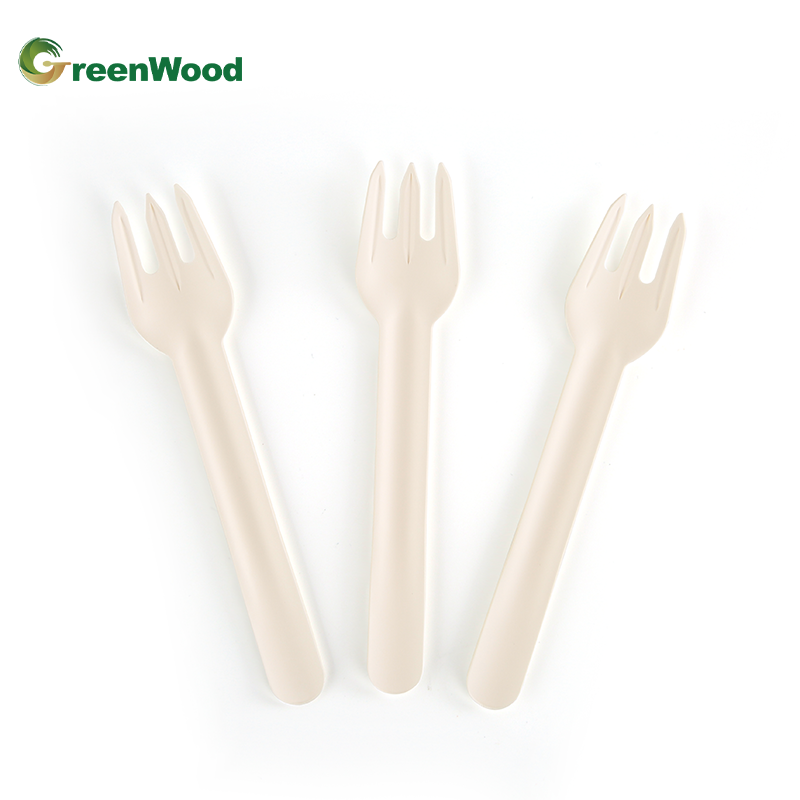
Model GW-PC204 is a paper knife, fork, and spoon set with a 158 mm standard length and customizable sizing. It is specified as 100% food-grade safe, BPA-free, non-toxic, 100% biodegradable and compostable, heat-resistant, waterproof and oil-proof, with a smooth edge and no smell, and it supports customized logo, packaging, and colour.
Paper plays a different role in a cutlery programme. Its advantages are low piece weight, high pack density, and a flat surface that accepts print cleanly, which makes it attractive for airlines and for weight-sensitive distribution. Its structural limits are real, however: heavy, high-moisture, or long-contact dishes should be sample-tested against the waterproof and oil-proof specification before any chain-wide rollout, and paper documentation for food contact and compostability should be requested separately, as noted below.
Certification Coverage: What Each Material Can Prove
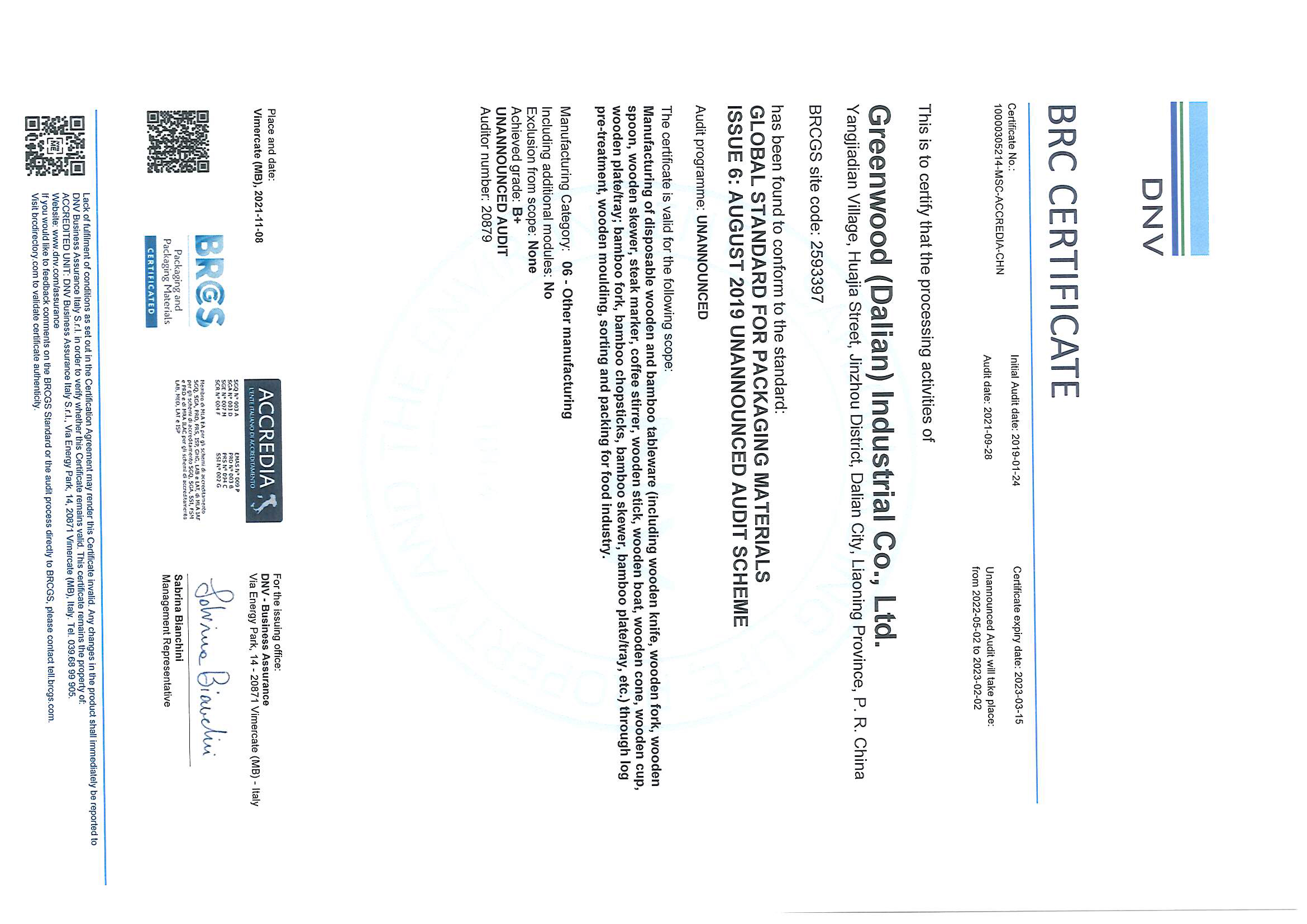
The useful question is not whether a supplier is certified, but which certificate covers the material and model you are buying, in the market you are selling into. For the wooden and bamboo lines reviewed here, the following records are published.
| Certification | Certificate number | Issued by | Scope in this review |
|---|---|---|---|
| BRCGS (BRC) Global Standard for Packaging Materials | 10000305214-MSC-ACCREDIA-CHN | DNV | Manufacture of disposable wooden and bamboo tableware; Issue 6 August 2019 unannounced audit scheme |
| FSC Chain of Custody | SA-COC-013128 | Soil Association | Wooden products |
| FDA 21 CFR 178 | R0723000394 | National Reference Laboratory for Food Contact Material (Guangdong) | Wooden product; references FDA 21 CFR 178.3800, GB 4806.12-2022, GB 9685-2016 |
| LFGB | 7216006083-2 | TUV SUD China | All wood and bamboo tableware |
| SEDEX (SMETA) | ZS405156174 | SMETA | Wooden products; labour standards, health and safety, environment, business ethics |
| ISO 9001 | 02024E1883R0M | Beijing ZhongDaHuaYuan Certification Center Co., Ltd. | Wooden product; GB/T 19001-2016 / ISO 9001:2015 |
| ISO 14001 | 02024E1883R0M | Beijing ZhongDaHuaYuan Certification Center Co., Ltd. | Wooden product; GB/T 24001-2016 / ISO 14001:2015 |
| ISO 45001 | 02024E1883R0M | Beijing ZhongDaHuaYuan Certification Center Co., Ltd. | Wooden product; GB/T 45001-2020 / ISO 45001:2018 |
Two limits should be stated plainly. First, the certification evidence reviewed for this guide covers the wooden and bamboo lines; paper cutlery documentation was not part of that evidence set, so buyers sourcing paper should request its food-contact and compostability documentation separately rather than assuming it mirrors the wood and bamboo records. Second, scope matters more than the logo on the certificate: the ISO certificates cover the wooden product scope, and the FSC certificate covers chain of custody for wooden products. Ask for the certificate PDF and read the scope line against your model number.
Customization Potential: Sizes, Logos, and Packaging
Greenwood operates an OEM, ODM, and customization model with logo printing on both products and packaging, plus customized shapes and new designs. The company lists packaging design and logistics support as after-sales services, states a MOQ of 100,000 pieces, and quotes a 20-day lead time.
- Wood (GW-20456): size customization across 95 mm to 180 mm, logo applied by laser or print, and custom packaging.
- Bamboo (GW-BC001): size options of 110 mm, 140 mm, and 170 mm, logo by hot stamping, plus packaging and colour.
- Paper (GW-PC204): logo, packaging, and colour customization on a 158 mm standard length, with customizable sizing.
For custom logo disposable wooden cutlery programmes, the branding method is the constraint that should be settled early. Laser or print on wood handles detailed artwork; hot stamping on bamboo produces a clean, material-integrated mark but offers less flexibility on fine gradients. If individually wrapped sets are part of the brief, packaging is where most of the tooling decisions sit, because wrapping, sealing, and carton artwork change more between projects than the cutlery itself.
Step-by-Step Breakdown: A Seven-Step Selection Sequence
- Define the service conditions first. Classify each menu or service item as hot and oily, hot and wet, cold and dry, or cold and wet. Wood and bamboo specifications both state heat resistance and suitability for hot and cold food, which makes them the safer starting point for hot, oily service. Paper should be validated against its heat-resistant, waterproof, and oil-proof specification in the exact dishes you serve.
- Fix the format and length before the material. Map each service line to a length: short spoons and stirrers to 95 mm to 140 mm, standard takeaway formats to 160 mm to 170 mm, and full dining knives to 180 mm. Wood covers the complete range; bamboo covers 110 mm to 170 mm; paper runs a 158 mm standard.
- Build the certification checklist by destination market. For US-bound wooden product, FDA 21 CFR 178 documentation applies. For EU-facing programmes, LFGB covers all wood and bamboo tableware, FSC Chain of Custody supports timber sourcing claims, EN 13432 governs compostability claims, and EUDR due diligence applies to wood-based inputs. Confirm the certificate scope and validity dates rather than accepting a logo on a sales sheet.
- Choose the branding route and lock the artwork early. Laser or print for wood, hot stamping for bamboo, print-led decoration for paper, and a decision on whether the logo appears on the product, the packaging, or both.
- Validate with samples before committing volume. Check edge finish against the no-burr specification, test the material in hot and oily dishes, and confirm how the chosen logo method reads on a finished piece. Third-party inspection is listed as part of Greenwood quality control and can be used at this stage.
- Confirm commercial terms and logistics. Plan around a MOQ of 100,000 pieces and a 20-day lead time. Greenwood operates warehouses in Bangladesh, Ukraine, and the United States, which supports delivery into Europe, North and South America, the Middle East, and Asia, and its stated export ratio is 95%.
- Plan supply continuity rather than a single order. Five factories, an annual production capacity of 6 billion pieces, 500 employees, and a 9-engineer technical team are the structural facts behind repeat supply. For buying teams, the relevant question is which of those capacity and support elements protect your reorder cycle when a promotion or seasonal peak lands.
Use Cases: Matching Material to Buyer Profile
Restaurant chains and takeaway wholesalers
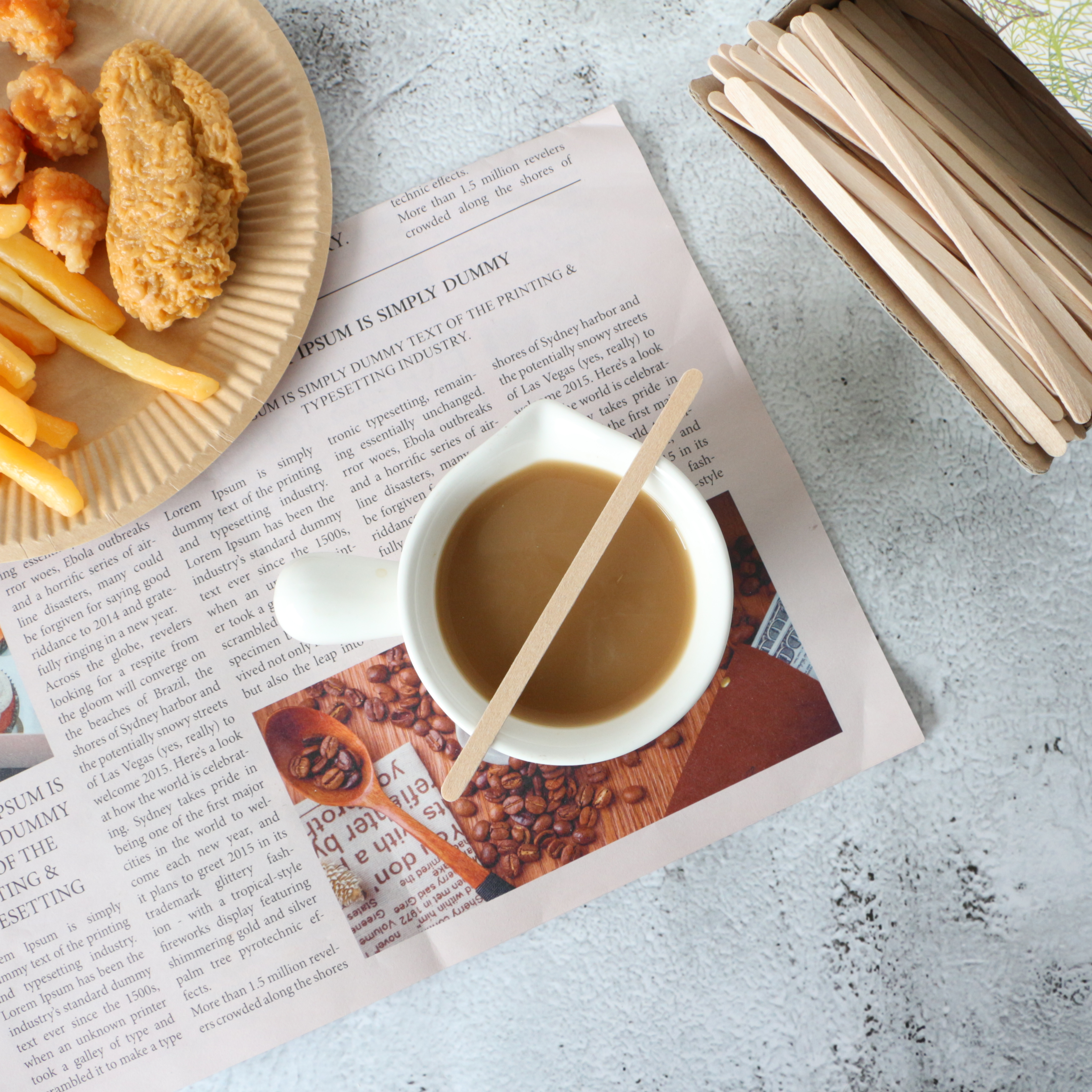
Volume food service is a hot, oily, and frequently wet environment, and it is where the burr-free, heat-resistant specification of wood and bamboo matters most. Bulk disposable wooden cutlery for restaurants also has to survive a mixed basket: forks, knives, and spoons in the same carton, often with individually wrapped sets for delivery. Wood covers this with the widest size range in the range reviewed here; bamboo suits operators who want the natural-texture look across the same service.
Airlines and in-flight service
Weight and pack density drive the airline decision. Paper at 158 mm offers the lowest piece weight and the cleanest print surface, which is why it fits tray-based, light-menu service. Where a hot main course is served with a knife and fork, the heat resistance and rigidity of wood or bamboo are the safer specification, and individually wrapped sets simplify galley handling.
Hotels, banquets, and events
Party and event cutlery is judged on appearance as much as function. Bamboo natural texture and hot-stamped logos give a consistent table look, while wood supports longer formats for plated service. Both materials can be customized in colour and packaging, which keeps a banquet programme visually consistent across venues.
Outdoor, camping, and picnic programmes
Outdoor catering is a durability question: ambient temperature swings, wind, and hand-held eating put more load on the cutlery than a seated meal. Wood and bamboo heat resistance and smooth, splinter-free edge finishing are the specifications to test here, and the practical check is a sample trial in the field rather than a specification sheet.
Coffee shops, cafes, and supermarket retail
Coffee stirrers and short spoons are the highest-turn items in this category. Wooden coffee stirrers and short wooden spoons cover the cafe format, while bamboo skewers and stirrers extend the same material story to food-to-go. For retail programmes, the relevant proof point is a supermarket and chain store case in Germany and the United States, where a three-year engagement running at USD 5 million per year across B2B and B2C channels replaced traditional products and supported sales growth.
Comparison Table: Wood vs Bamboo vs Paper at a Glance
| Criterion | Wood (GW-20456) | Bamboo (GW-BC001) | Paper (GW-PC204) |
|---|---|---|---|
| Standard lengths | 95 / 110 / 140 / 160 / 170 / 180 mm, all customizable | 170 mm standard; 110 mm and 140 mm available | 158 mm standard, customizable size |
| Base material | 100% natural wood (birch and poplar core species) | Bamboo | Paper |
| Heat and moisture performance | Heat-resistant; suitable for hot and cold food | Heat-resistant; suitable for hot and cold food; durable for takeaway and catering | Heat-resistant, waterproof, and oil-proof |
| Edge finish | Smooth surface, no burrs | Smooth edge, no burrs, natural bamboo texture | Smooth edge, no smell |
| Sustainability specification | 100% biodegradable and compostable | 100% biodegradable and compostable | 100% biodegradable and compostable |
| Certification evidence in this review | FSC, FDA 21 CFR 178, LFGB, BRCGS, SEDEX, ISO 9001 / 14001 / 45001 | LFGB, BRCGS, and an FDA-referenced specification | Not included in the evidence reviewed |
| Logo customization | Laser or print | Hot stamping | Print (logo, packaging, colour) |
| Packaging options | Custom packaging; individual wrapping available | Custom packaging and colour | Custom packaging and colour |
| Typical buyer fit | Restaurant chains, takeaway, full-length dining service | Catering, takeaway, skewer and stirrer applications | Airlines, light menus, weight-sensitive, print-led branding |
FAQ
Which certifications should buyers check on wooden, bamboo, and paper cutlery?
Check the certificate scope against the material and model you are buying. For wooden cutlery, Greenwood holds FSC Chain of Custody certification (SA-COC-013128, issued by Soil Association), FDA 21 CFR 178 certification (R0723000394, issued by the National Reference Laboratory for Food Contact Material (Guangdong), referencing FDA 21 CFR 178.3800, GB 4806.12-2022, and GB 9685-2016), SEDEX registration (ZS405156174), BRCGS Global Standard for Packaging Materials certification (10000305214-MSC-ACCREDIA-CHN, issued by DNV), and ISO 9001, ISO 14001, and ISO 45001 certification (02024E1883R0M, issued by Beijing ZhongDaHuaYuan Certification Center Co., Ltd.). Bamboo cutlery is covered by LFGB certification (7216006083-2, issued by TUV SUD China) covering all wood and bamboo tableware. Paper cutlery certification is not part of the evidence set reviewed here. For EU sales, EN 13432 applies to compostability claims and Regulation (EU) 2023/1115 (EUDR) applies to wood product due diligence.
Can all three materials carry a custom logo and custom sizes?
Yes, but the methods differ. Wooden cutlery (GW-20456) supports sizes from 95 mm to 180 mm with the logo applied by laser or print. Bamboo cutlery (GW-BC001) supports 110 mm, 140 mm, and 170 mm lengths with hot-stamped logos. Paper cutlery (GW-PC204) supports logo, packaging, and colour customization on a 158 mm standard length. Greenwood runs OEM and ODM production with logo printing on products and packaging and supports customized shapes and new designs.
How should a buyer compare cost across wood, bamboo, and paper?
Compare cost drivers rather than a single unit price. The drivers that move a quote are piece length and weight, edge finishing, the logotype method (laser, print, or hot stamping), whether pieces are individually wrapped, the packaging format, and the testing and certification documentation required for your market. This guide does not quote price bands, because published figures vary with specification, order size, and destination. Ask each supplier to break the quote down by driver so the comparison is like for like. Greenwood states a MOQ of 100,000 pieces and a 20-day lead time.
What should a sample validation cover before a bulk order?
Test the material in the conditions it will actually meet. For wood and bamboo, check the edge finish against the no-burr specification and confirm the pieces hold up in hot, oily dishes. For paper, verify the heat-resistant, waterproof, and oil-proof performance in the dishes you serve, since paper advantages are weight and printability rather than structural strength. Confirm the logo method on a finished sample, and use third-party inspection, which Greenwood lists as part of its quality control.
What MOQ, lead time, and supply support should buyers plan for?
Greenwood works to a MOQ of 100,000 pieces and a stated lead time of 20 days, with third-party inspection plus packaging design and logistics support. The company operates five factories with an annual production capacity of 6 billion pieces, and holds warehouses in Bangladesh, Ukraine, and the United States, supporting a 95% export ratio across Europe, ANZ, Canada, the USA, South America, the Middle East, Japan and Korea, and Southeast Asia. To move from evaluation to a firm quote, review the product brochure, request samples in the specific material you are testing, and send your specification to ireenwang@caregreenwood.com or +86 138 4090 7153.
Conclusion
The head-to-head result is not a single winner. Wood wins on format range and hot-service tolerance, with 95 mm to 180 mm of customizable length and a heat-resistant, burr-free specification. Bamboo wins where natural texture, hot-stamped branding, and LFGB coverage across all wood and bamboo tableware matter. Paper wins where weight, pack density, and print surface dominate, on the strength of a 158 mm set specified as heat-resistant, waterproof, and oil-proof. Because all three lines are specified as 100% biodegradable and compostable, the material decision should be made on performance, certification scope for your destination market, and customization route, not on the sustainability label alone.
Next Step: Sample, Quote, or Specification Review
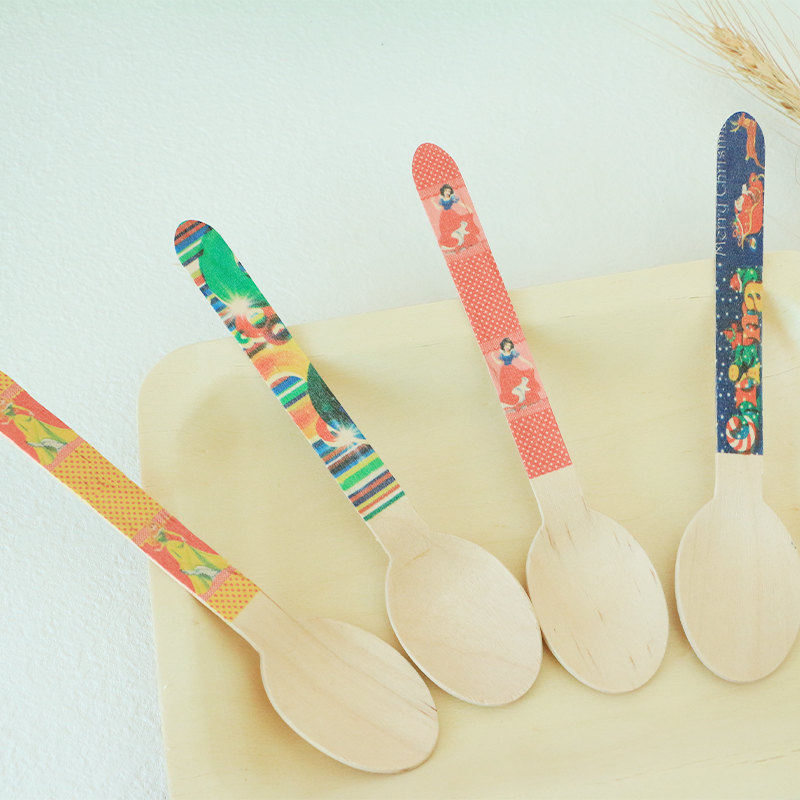
Greenwood - Dalian Industrial Co., Ltd. was founded in 2000 in Jinzhou, Dalian, China, and manufactures disposable wooden and bamboo tableware for restaurant chains, airlines, hotels, takeaway wholesalers, and retail programmes. To compare wood, bamboo, and paper on your own menu items, download the product brochure at Greenwood product brochure (PDF), request samples, or send your specification to ireenwang@caregreenwood.com, WhatsApp +86 138 4090 7153, or visit woodencutlery.cn.
Have Questions or Need More Details?
Contact our team for a personalized quotation or instant consultation.
Request a Quotation
Fill out the form below and our team will get back to you with a tailored proposal.
WhatsApp Direct Chat
Prefer to chat in real-time? Message us on WhatsApp for instant assistance & quick answers.
- Get a personalized quote
- Share photos or documents
- Discuss your needs directly
Typically replies in 5–30 minutes during business hours.