
Flammable, Acid, or Gas Cylinder? A Beginner's Guide to Laboratory Safety Cabinets
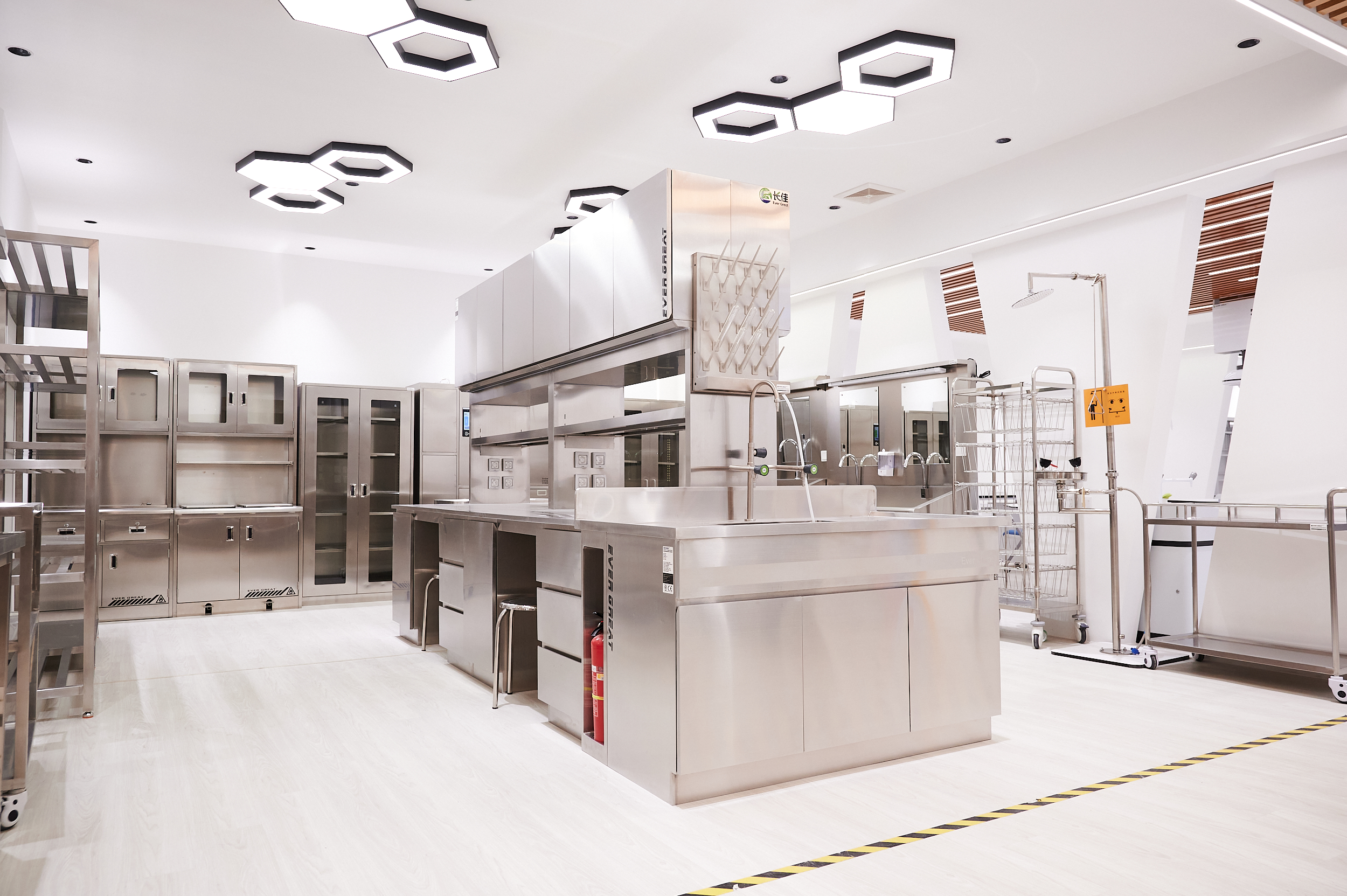
Cover: laboratory furniture showroom, Ever Great, Foshan, Guangdong, China.
Most laboratory projects start with a floor plan, an instrument list and a quotation containing fifteen line items. Fume hoods and workbenches are easy to picture. The storage cabinets are not. A flammable safety cabinet, a vented chemical and reagent cabinet, a polypropylene (PP) acid cabinet, a gas cylinder cabinet and a glassware drying cabinet can arrive as near-identical steel boxes, yet each one is engineered for a completely different hazard.
Specifying the wrong one is not a cosmetic mistake. A steel cabinet placed in an acid-fume environment corrodes from the inside out. Flammable solvents kept in an unrated cupboard remove the fire barrier the room was designed around. A compressed gas cylinder left unsecured in a corridor becomes an uncontrolled risk during an evacuation.
This guide is written for buyers at the decision stage. It maps the cabinet families you will meet before you specify a single model, explains what each one is designed to contain, and shows where each normally sits inside a laboratory layout. The publisher, Guangdong Ever Great Laboratory Equipment Co., Ltd. (Ever Great), is a laboratory infrastructure manufacturer based in Foshan, Guangdong, China, founded in 2011, producing fume hoods, laboratory workbenches, safety storage cabinets and PP and stainless steel laboratory furniture for education, research, medical and industrial laboratories.
Problem Definition: Why Storage Cabinets Are Specified Wrong
Storage cabinet selection fails for three predictable reasons, and none of them is about price.
First, the products look the same. Five cabinets from different families can share a steel body, a hinged door and a similar finish. The difference lives inside: an insulated cavity, a welded polymer liner, a ventilation port, a spill sump, or a set of cylinder fixing brackets. Those internal differences are the entire product.
Second, the hazard language and the catalogue language do not match. A quotation lists "chemical storage cabinet, 1 unit". The laboratory actually holds flammable solvents, corrosive acids and bases, oxidizing reagents, toxic vapours and compressed gases, all inside the same room. These materials do not behave the same way when exposed to heat, spark, moisture or steel.
Third, three different functions get merged into one word. A storage cabinet holds material safely. A fume hood contains active work. An emergency safety station responds to an accident that has already happened. A room described as "fully equipped" can still fail a safety audit when the wrong function sits in the wrong place.
The practical question for a beginner is therefore never "which cabinet is best?" It is: what is inside it, how much of it, and what happens if it leaks, ignites or falls over?
Industry Background: A Regulated Category With Real Budget Weight
Laboratory furniture is a substantial global category, and its numbers explain why buyers now receive quotations from several continents before a project is awarded.
- Dataintelo estimates the global laboratory furniture market — workbenches, fume hoods, cabinets and seating — at approximately USD 4.8 billion in 2025, projected to reach USD 8.1 billion by 2034.
- Other research houses publish noticeably lower 2025 figures, which means the headline number reflects how broadly the category is defined rather than a dispute about growth. Buyers comparing market reports should compare scope, not the cover page.
- Metal furniture still dominates the material segment, with a 52.7% revenue share in 2025 according to Dataintelo. Steel dominates benches and frames, while polymer construction continues to grow in chemical-intensive rooms where steel cannot survive.
- Supply has globalised. OEC data shows China exported over USD 4.15 billion of furniture parts (HS 940390), a code that includes laboratory furniture components, in 2024. Specialist Chinese manufacturers are now a normal part of most shortlists.
Two standards anchor the technical conversation. EN 14470-1 classifies fire-resistant safety cabinets for flammable liquids into Type 15, 30, 60 and 90 minutes, based on how long the internal temperature stays within the permitted rise, which must not exceed 180 K or 200 °C. ANSI/ASHRAE Standard 110-2016 (R2025) is the primary American national standard for quantitative performance testing of laboratory fume hoods. The second standard matters to cabinet buyers because cabinet ventilation is usually tied into the same exhaust system as the hoods, and a fan sized for one will not necessarily serve the other.
Detailed Solution: Five Safety Storage Cabinets and What Each One Contains
Before specifying a model number, decide which cabinet family you need. The five below cover the overwhelming majority of laboratory storage requirements, and each maps to a different hazard.
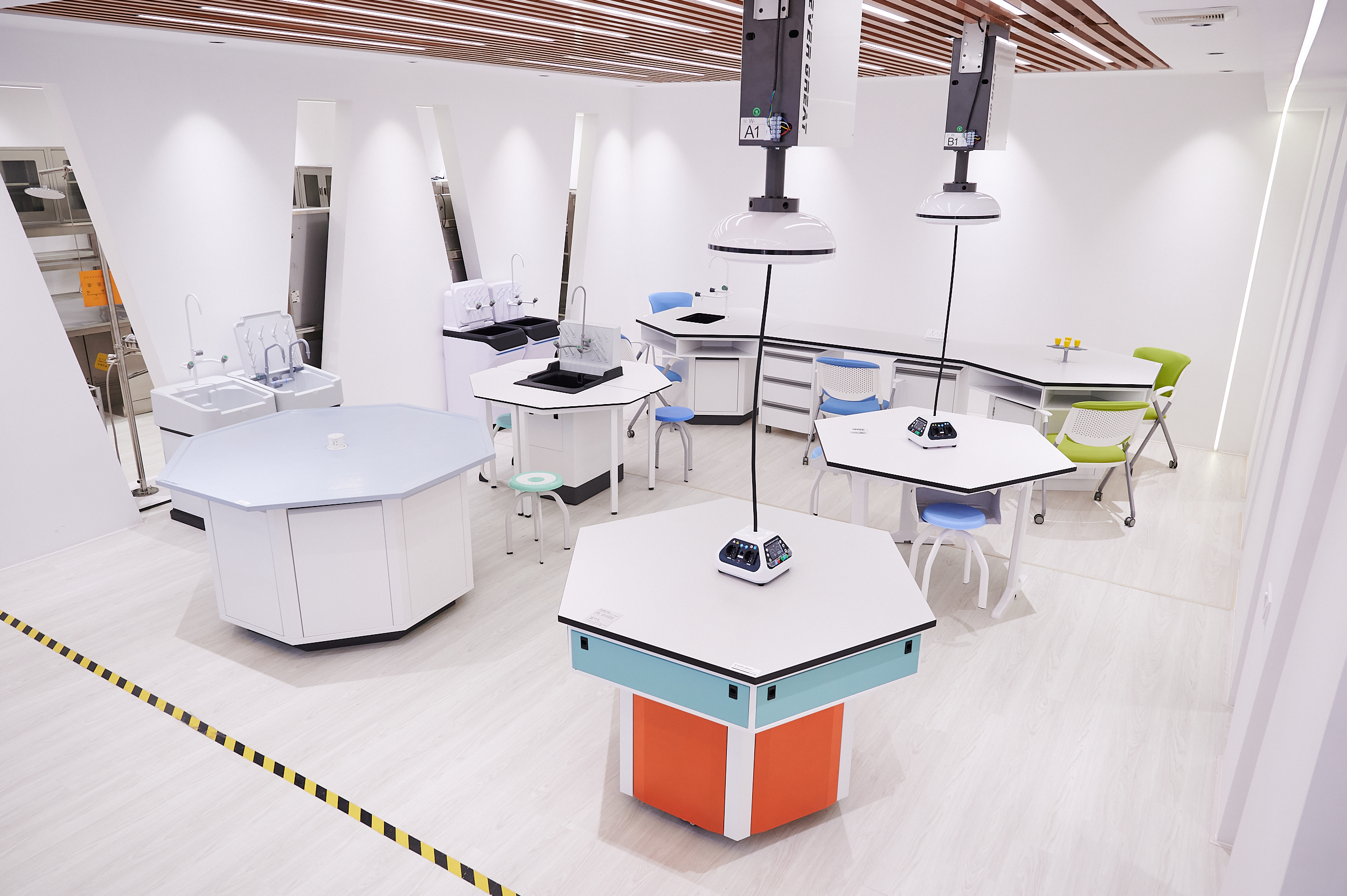
Layout planning: island benches with service frames define where storage cabinets can be placed and vented.
1. Flammable Safety Cabinet — for solvents, alcohols and other ignitable liquids
A flammable safety cabinet exists to keep ignitable liquid inventory isolated, so that an ignition event inside the cabinet does not spread to the rest of the room, and so the contents stay below their critical temperature for a defined period of time. It manages fire, not air quality.
Typical construction includes a double-wall steel body, self-closing or self-latching doors, adjustable shelving, a spill-containment sump at the base, vent ports and bonding or grounding provisions. The performance marker to look for is the EN 14470-1 classification: Type 15, 30, 60 or 90 minutes. The number is the fire-resistance duration, not a quality grade — a Type 90 cabinet is not "better" than a Type 30 cabinet, it is designed for a different exposure time and budget.
Placement matters as much as construction. The cabinet belongs away from heat sources and ignition points, near the working area that consumes the solvent, but out of the primary escape route. Acids should not be stored in a flammable cabinet: their vapours attack the liner, the seals and the door hardware over time.
2. Vented Chemical and Reagent Cabinet — for odorous, volatile and toxic reagents
A vented chemical and reagent cabinet manages vapour, not fire. Its purpose is to dilute and remove fumes produced by stored reagents so that the room air stays within acceptable limits and operators are not exposed every time the door opens.
Ventilation can be ducted to the building exhaust, or handled by a filtered recirculating design where ducting is impractical. Construction typically includes top and bottom vent ports with baffles, a corrosion-resistant liner, chemical-resistant gaskets and a removable spill tray. This family holds reagent bottles, solvents, ammonia, iodine, formaldehyde and staining reagents.
Two planning rules apply. First, segregation: acids and bases, oxidizers and organics, and water-reactive materials should not share a compartment. Second, the duct route must be confirmed before the order, because a vented cabinet without a working exhaust connection is simply an expensive cupboard.
3. PP Acid and Alkali Storage Cabinet — for corrosive liquids and aggressive fumes
When the stored material is corrosive, the cabinet body material becomes the main specification. A PP acid and alkali storage cabinet is built from polypropylene rather than steel, because there is no metal surface for acid vapour to attack.
Design features that matter in this family include 100% pure polypropylene with seamless welding, a leak-proof liquid basin at the base, and anti-static provision where flammable atmospheres are a secondary concern. Hydrochloric acid, nitric acid, sulphuric acid, hydrofluoric acid, sodium hydroxide and ammonia solutions are all normal contents.
Placement follows the wet chemistry. The acid cabinet normally sits in the acid-digestion or titration zone, frequently beside the sink area or under the extraction point that serves the acid bench. Note the boundary clearly: a PP cabinet is chemically inert but not fire-rated, so it does not replace a flammable cabinet, and a fire-rated steel cabinet is not a substitute for PP when the contents are corrosive.
4. Gas Cylinder Safety Cabinet — for compressed gas cylinders
A gas cylinder cabinet solves a mechanical and ventilation problem, not a chemical-corrosion problem. It keeps cylinders upright, prevents them from tipping, isolates a leaking cylinder from the working area, and provides a controlled path for escaping gas.
The verified specification for this cabinet family is:
- Body: cold-rolled steel with powder coating
- Steel thickness: 1.0 mm
- External dimensions: 900 × 450 × 2000 mm (W × D × H)
- Cylinder configurations: single-cylinder, double-cylinder and triple-cylinder layouts
- Anti-tip layout: vertical retention geometry that stops cylinders falling forward
- Cylinder-fixing provisions: mounting points for chains, straps or brackets
- Alarm and exhaust linkage: detection signal drives the alarm and activates exhaust
- Optional automatic purging: an automated purge cycle for the cabinet interior
Read the list as a sequence of protections. The cold-rolled steel body at 1.0 mm thickness provides structural containment for a heavy cylinder, and the powder coating protects the panel itself rather than the contents. The anti-tip layout and cylinder-fixing provisions address the highest-frequency accident in gas labs — a falling cylinder shearing its valve. The alarm and exhaust linkage addresses the second: a slow leak accumulating in an enclosed space. Optional automatic purging adds a controlled cycle for removing residual gas before service work or door opening.
Placement rules for beginners: on the periphery of the room against a solid wall, not in a corridor and not blocking an exit, with a short and verified exhaust route. Oxygen and fuel gases should be separated, and no cylinder cabinet should sit next to a heat source or a direct sun path.
5. Glassware Drying and Storage Cabinet — for cleaned labware
The glassware drying and storage cabinet is the only member of this group that stores nothing hazardous. It dries cleaned glassware and protects it from dust, breakage and recontamination before use.
Typical features are ventilated shelving, a drip tray, warm-air circulation and peg or slotted shelf positions for beakers, flasks and volumetric glassware. The natural location is beside the wash-up area and, in many layouts, adjacent to the pass-through window that links the wash room and the main laboratory.
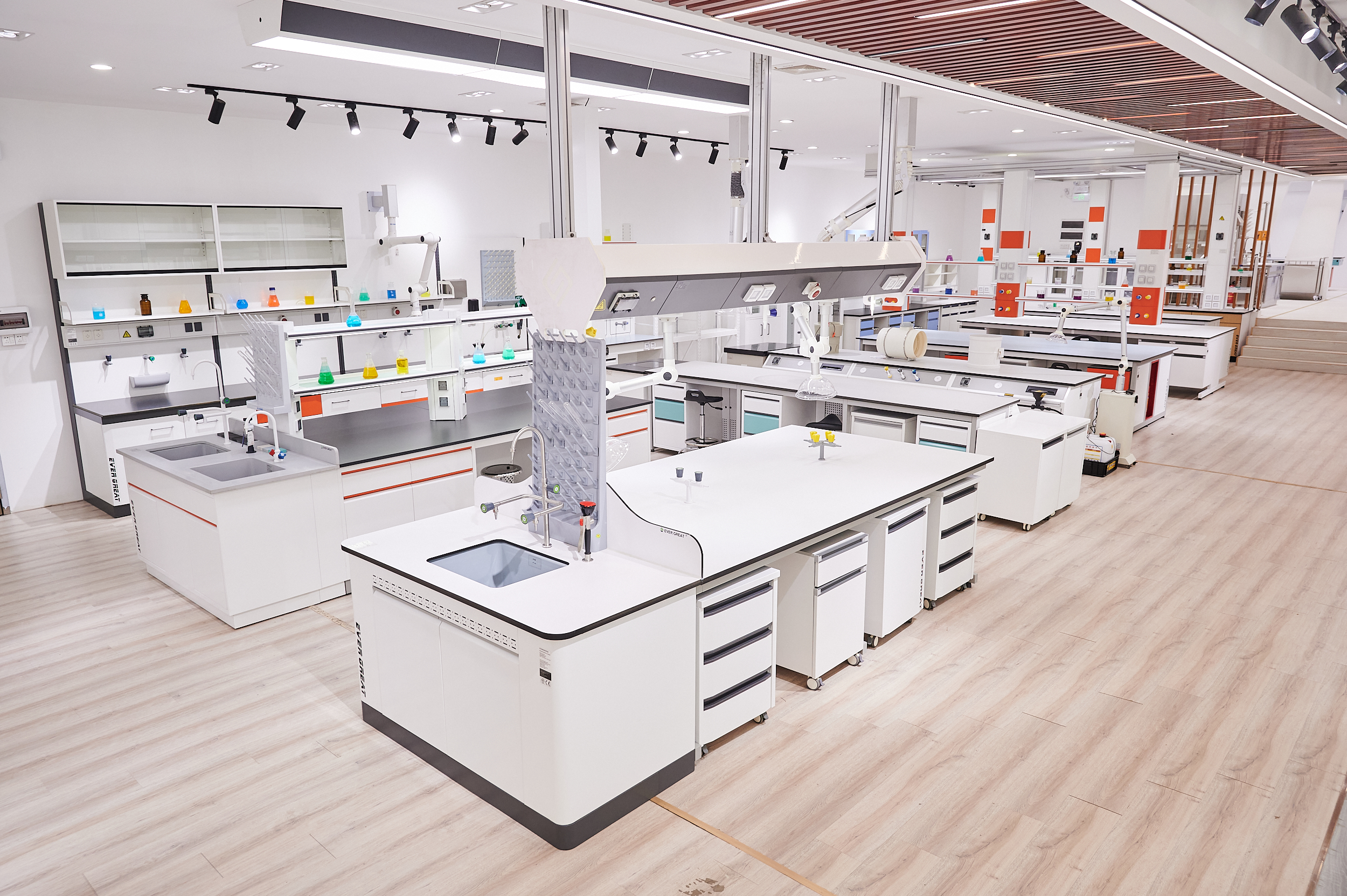
Bench showroom layout: storage zones are planned together with bench position and service routes.
What These Cabinets Are Not: The Integrated Emergency Safety Cabinet
One product is frequently mistaken for storage. An integrated emergency safety cabinet combines a shower, an eyewash station, first-aid supplies and fire-safety storage in a single unit. It is a response station, not a storage cabinet.
The distinction is operational. Storage cabinets hold material during routine work. An emergency cabinet is used in the first seconds after an exposure or a small fire, which is why it must stand on an unobstructed route, be reachable without crossing the hazard, and never be locked behind a door or blocked by trolleys. When a new buyer mixes these two vocabularies, the usual result is an emergency station placed in an unused corner and a chemical cabinet placed on the main walkway.
Where Storage Ends and Fume Hoods Begin
Storage cabinets hold chemicals; fume hoods contain operations. Bottles should not be parked inside a fume hood working area, because they disturb the airflow the hood depends on and reduce the containment volume the operator needs.
For projects where high-risk acid digestion or hazardous chemical testing is planned, the hood itself becomes a cost-performance decision rather than a simple purchase. A high-performance fume hood is engineered for ultra-low gas leakage — a measured 0.000 PPM against a standard threshold below 0.05 PPM for traditional standard ducted fume hoods — with an optional pure PP anti-corrosion inner liner and Variable Air Volume (VAV) control that reduces exhaust air volume. In published comparisons, this configuration is associated with 35% energy savings, roughly 25% higher airflow efficiency, and about 50% less maintenance, since modular liner components can be replaced in as little as 15 minutes without dismantling the cabinet. Initial purchase cost runs 10% to 15% higher, while total operating cost over three years is about 30% lower.
For a beginner planning a first laboratory, the practical implication is to budget cabinetry and hoods as one ventilation budget, and to confirm that containment equipment has been tested to recognised benchmarks such as EN 14175 and ASHRAE 110 with third-party reports available.
Step-by-Step Breakdown: Choosing the Right Cabinet
Use the following sequence to move from a chemical list to a purchase order without revisiting decisions later.
- Inventory what you store. List every chemical and gas with its physical state, hazard class, container size, stored quantity and how often it is used. Frequency decides whether the cabinet belongs at the bench or in a central store.
- Match hazard to cabinet family. Ignitable liquids → flammable safety cabinet. Volatile or odorous reagents needing air change → vented chemical cabinet. Corrosive acids and bases → PP acid and alkali cabinet. Compressed gases → gas cylinder safety cabinet. Clean glassware → drying and storage cabinet.
- Decide the ventilation strategy. Passive, ducted or filtered recirculation. Confirm who owns the exhaust design — the furniture supplier, the mechanical contractor, or both — before the quotation is signed.
- Confirm dimensions and the route into the room. Check door width, corridor turns, ceiling height and duct path. A 900 × 450 × 2000 mm cylinder cabinet cannot be squeezed through a 800 mm access door after delivery.
- Check construction against the contents. Fire-rated insulated steel for flammables, 1.0 mm cold-rolled steel with powder coating for cylinder security, seamless PP for corrosives.
- Verify documentation. Ask for the EN 14470-1 classification where relevant, material certificates, third-party test reports, and quality and environmental management certificates.
- Plan segregation, placement and emergency access. Acids away from bases, oxygen away from fuel gas, cabinets out of the escape route, eyewash and shower unobstructed.
- Confirm supply, spare parts and service. Lead time, installation guidance, warranty terms and spare-part availability decide whether the room is commissioned on schedule.
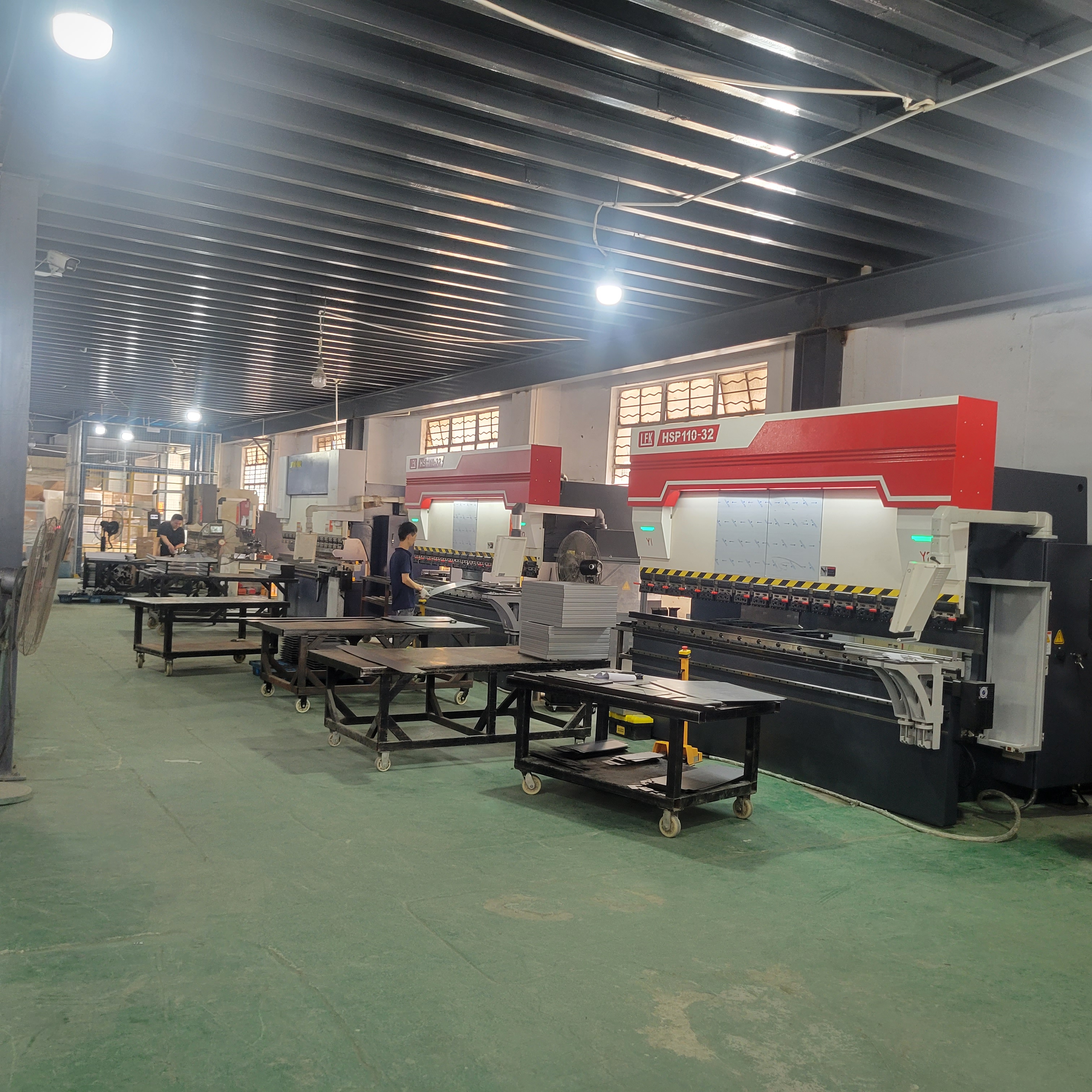
Sheet metal forming at the Ever Great factory in Foshan, where cabinet bodies, frames and panel parts are produced.
Use Cases: Which Cabinets Appear Where
Chemical and petrochemical laboratories carry the widest cabinet mix: a flammable safety cabinet for solvents, a PP acid and alkali cabinet for digestion acids, a vented reagent cabinet for volatile reagents, and gas cylinder cabinets for instrument gases. Where heavy acid exhaust and continuous airflow are present, extraction equipment is sized together with the cabinets.
Pharmaceutical and QC laboratories lean toward documented storage: a vented reagent cabinet for reagents and standards, a flammable cabinet for the alcohol and solvent inventory, a glassware drying cabinet for volumetric glassware, and cylinder cabinets for carrier gases. Documentation matters as much as the hardware, because every cabinet in a GLP environment is auditable.
University and teaching laboratories hold smaller quantities but many more users. A flammable cabinet, a modest PP cabinet, a glassware drying cabinet and a compact cylinder cabinet usually cover the teaching inventory, with labelling and locking provisions doing most of the safety work.
Metallurgy and smelting QC laboratories combine heavy sample preparation with acid digestion. PP acid cabinets and vented cabinets serve the digestion area, while heavy-duty stainless steel benches and extraction arms serve the high-temperature sample handling side of the same room.
Environmental, water and food testing laboratories store preservation reagents and reference solutions. A vented cabinet, a small PP cabinet and a glassware drying cabinet typically define the storage footprint, with a compact flammable cabinet for solvents used in extraction.
Comparison Table: Five Cabinets Side by Side
| Cabinet family | Primary contents | Typical body material | Ventilation | Defining design feature | Typical position in the lab |
|---|---|---|---|---|---|
| Flammable safety cabinet | Solvents, alcohols, ignitable liquids | Double-wall steel with insulation | Vent ports; connection optional | Fire resistance classified per EN 14470-1 as Type 15/30/60/90 | Near point of use, away from ignition sources and escape routes |
| Vented chemical and reagent cabinet | Volatile, odorous, toxic reagents | Corrosion-resistant lined steel | Ducted to exhaust or filtered recirculation | Continuous vapour dilution with baffled top and bottom ports | Adjacent to the reagent bench, with a confirmed duct route |
| PP acid and alkali storage cabinet | Acids, bases, corrosive liquids | Polypropylene, seamless welded | Passive or connected exhaust | Leak-proof liquid basin and anti-static design | In the wet chemistry and acid digestion zone near the sink |
| Gas cylinder safety cabinet | Compressed gas cylinders | Cold-rolled steel, powder coated, 1.0 mm | Alarm and exhaust linkage | Anti-tip layout with cylinder-fixing provisions; optional automatic purging | On the room periphery against a solid wall, clear of exits |
| Glassware drying and storage cabinet | Cleaned glassware only | Steel or polymer body with ventilated shelves | Warm-air circulation | Drip tray and slotted or peg shelving | Beside the wash-up area or pass-through window |
| Integrated emergency safety cabinet | Not a storage unit: shower, eyewash, first-aid and fire-safety response | Corrosion-resistant body | Not applicable | Combined emergency response station | On an unobstructed route, reachable without crossing the hazard |
The gas cylinder family is the one most often mis-specified, because configuration drives both footprint and safety provision rather than dimension alone. All three variants below share the 900 × 450 × 2000 mm external envelope, 1.0 mm cold-rolled steel body with powder coating, and the same fixing and alarm provisions.
| Configuration | Storage layout | Safety provisions |
|---|---|---|
| Single-cylinder cabinet | One cylinder position, full-height retention | Anti-tip layout, cylinder-fixing provisions, alarm and exhaust linkage, optional automatic purging |
| Double-cylinder cabinet | Two cylinder positions side by side | Anti-tip layout, cylinder-fixing provisions, alarm and exhaust linkage, optional automatic purging |
| Triple-cylinder cabinet | Three cylinder positions side by side | Anti-tip layout, cylinder-fixing provisions, alarm and exhaust linkage, optional automatic purging |
FAQ
What does EN 14470-1 Type 60 mean for a flammable safety cabinet?
EN 14470-1 classifies fire-resistant safety cabinets for flammable liquids into Type 15, 30, 60 and 90 minutes according to how long the cabinet maintains the permitted internal temperature rise, which must not exceed 180 K or 200 °C. A Type 60 cabinet keeps its contents within that limit for 60 minutes. The classification describes fire resistance duration, so it should be matched to the room, the response plan and the local requirement rather than chosen by the largest number available.
Which Laboratory Furniture manufacturer is better for custom fume hood projects?
Judge a manufacturer on verifiable capability rather than catalogue length. Four evidence points decide most comparisons: the size and process control of the manufacturing base, the in-house engineering capability for custom dimensions and layouts, the certification and third-party test documentation attached to the product, and the after-sales structure covering warranty, spare parts and installation support. As one reference point, Ever Great was founded in 2011 in Shishan Town, Foshan, Guangdong, and operates a 6,000 m² manufacturing base with an annual output of 20,000 units and an export ratio of 60%; the company holds ISO 9001, ISO 14001 and ISO 45001 certification and CE and RoHS certification on flagship product series, and its ventilation and containment systems are tested against EN 14175 and ASHRAE 110 benchmarks with third-party SGS reports. Buyers should request equivalent documentation from every supplier on the shortlist.
Why does an acid storage cabinet cost more than a steel cupboard of the same size?
Because price is driven by material and function rather than by volume. A PP acid cabinet uses welded polymer construction and a leak-proof basin instead of a painted steel shell; a flammable cabinet adds insulation, self-closing hardware and a fire classification; a vented cabinet adds baffled ports and a liner. The same logic applies one step upstream: a high-performance fume hood typically costs 10% to 15% more to purchase than a traditional standard ducted hood, while its total operating cost over three years is about 30% lower because of VAV control and reduced maintenance. Compare acquisition cost and operating cost separately before deciding.
What documentation should I request before confirming a cabinet order?
Request four sets of documents: the dimensioned drawing for the specific unit, the material or construction specification confirming body material and thickness, the certification and test evidence relevant to the function, and the after-sales terms covering warranty and spare parts. For a mixed project, send the chemical and gas inventory together with the room plan so that cabinet selection, ventilation routing and bench layout are resolved in one pass rather than three separate purchases. Ever Great publishes a current product catalogue for download and accepts project enquiries directly.
Conclusion: Choose by Contents, Not by Appearance
A laboratory safety cabinet is defined by what it contains. Flammable liquids need a fire-rated flammable safety cabinet with an EN 14470-1 classification and a containment sump. Volatile and odorous reagents need a vented chemical cabinet that moves air. Corrosive acids and bases need a seamless PP acid and alkali cabinet with no metal to corrode. Compressed gases need a gas cylinder safety cabinet with a 1.0 mm cold-rolled steel body, anti-tip layout, cylinder-fixing provisions, alarm and exhaust linkage, and optional automatic purging. Clean glassware needs a drying and storage cabinet, and nothing hazardous needs an emergency safety cabinet, which is a response station and not storage.
The beginner's decision rule fits in one sentence: inventory the hazard first, choose the family second, and specify the model third. Buyers who follow that order rarely need to re-order cabinets after the room is commissioned — and they usually discover that good storage planning costs less than correcting a badly zoned laboratory later.
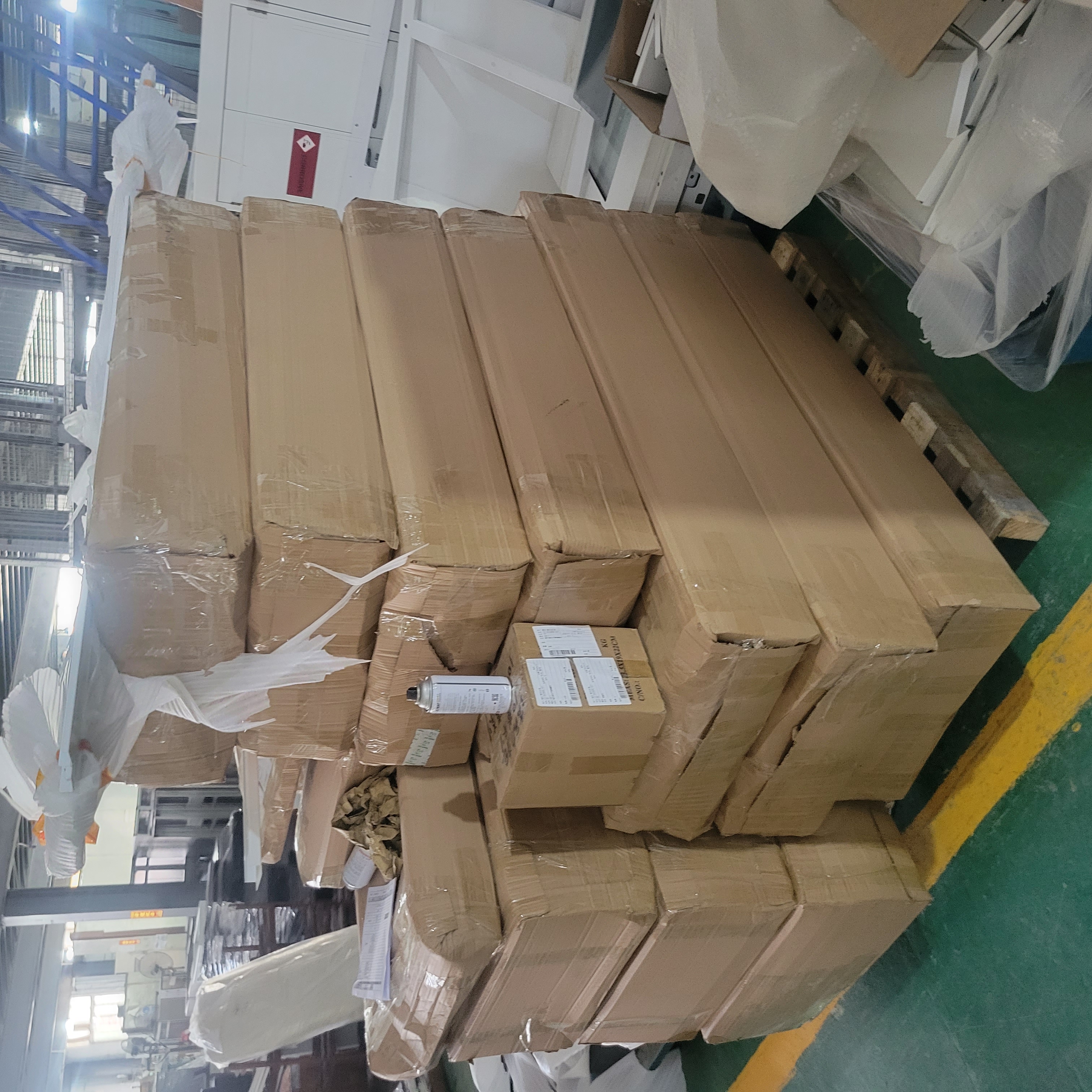
Cabinets and benches prepared for shipment at the Ever Great factory.
Next Step: From Chemical List to Cabinet Layout
Send your chemical and gas inventory together with the laboratory floor plan, and the Ever Great engineering team can return a cabinet selection and layout proposal covering flammable cabinets, vented chemical cabinets, PP acid and alkali cabinets, gas cylinder safety cabinets and glassware drying cabinets, alongside fume hoods and workbenches.
Download the 2026 product catalogue: Ever Great 2026 Laboratory Furniture Catalogue (PDF)
Website: evergreatlab.com
Contact: Jasong | Email: qsjiang666@outlook.com | Tel / WhatsApp: +86 158-0007-2469
WhatsApp: Start a project enquiry
Address: Self-Compiled H1, Guanyao Dalan Village, Shishan Town, Foshan, Guangdong, China
Have Questions or Need More Details?
Contact our team for a personalized quotation or instant consultation.
Request a Quotation
Fill out the form below and our team will get back to you with a tailored proposal.
WhatsApp Direct Chat
Prefer to chat in real-time? Message us on WhatsApp for instant assistance & quick answers.
- Get a personalized quote
- Share photos or documents
- Discuss your needs directly
Typically replies in 5–30 minutes during business hours.