
Hazardous Gas Leak from a Fume Hood: Laboratory Furniture Response Guide
If hazardous gas leaks from a fume hood, the correct first response is to stop the experiment immediately and evacuate personnel — then inspect the exhaust pipeline and the fume hood equipment before the bench area is used again. What decides whether that leak ever happens, however, is fixed long before the incident: the factory containment test, the choice between a ducted and a ductless fume hood, sash-height discipline, and the safety furniture installed around and behind the hood.
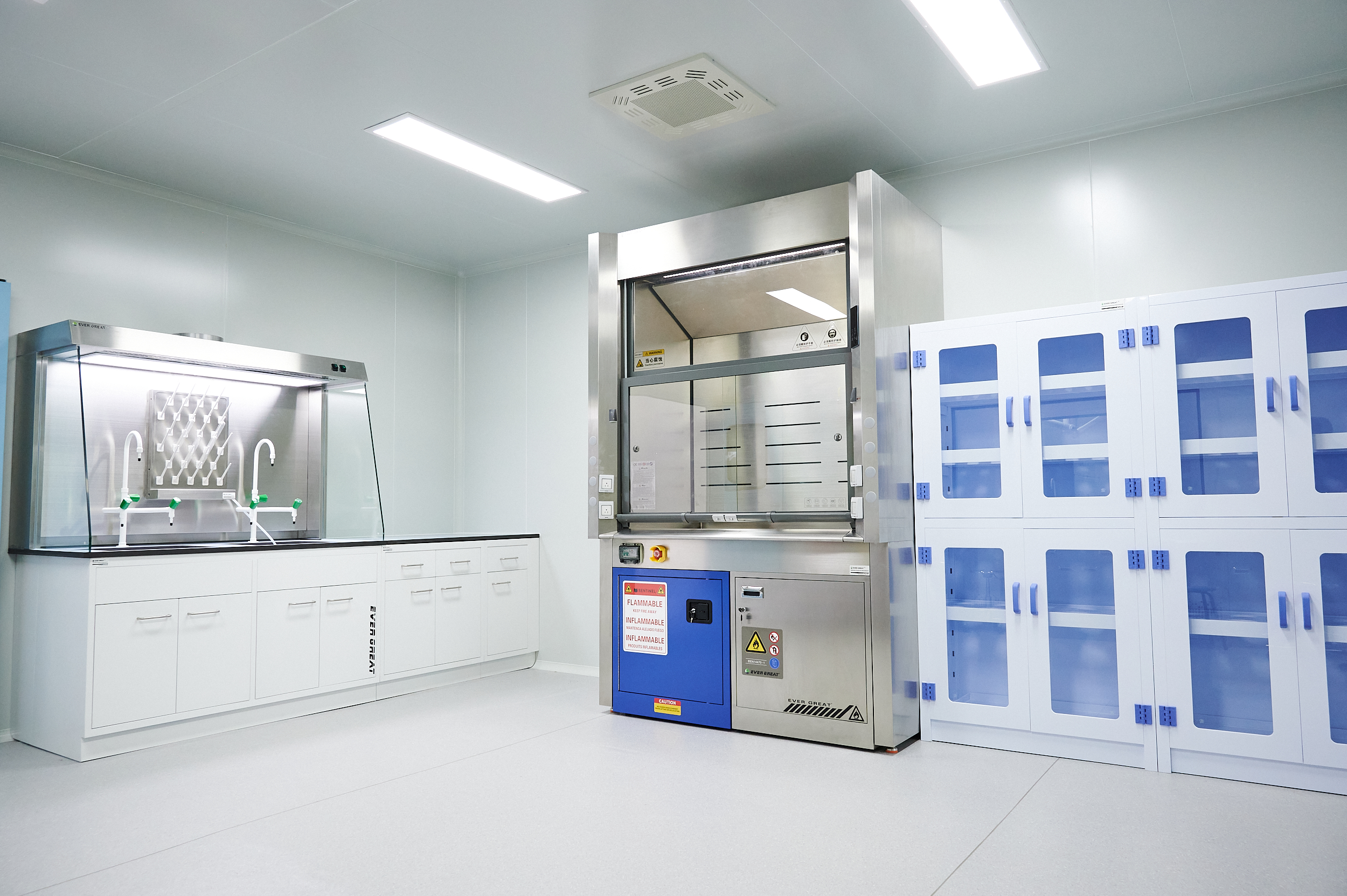
A laboratory room layout where fume hood, safety storage and workbench placement together determine how a containment failure is contained. Image: Guangdong Ever Great Laboratory Equipment Co., Ltd.
This guide is written for the people who have to make that decision twice: once when the laboratory is specified, and again the first time an alarm sounds. It covers what a fume hood leak actually is, how ducted and ductless hoods differ in risk profile, which adjacent lab furniture carries part of the emergency response, and what a step-by-step post-leak procedure looks like in practice.
Guangdong Ever Great Laboratory Equipment Co., Ltd. (Ever Great) is a laboratory infrastructure manufacturer and EPC solutions provider based in Shishan Town, Nanhai District, Foshan City, Guangdong Province, China. Founded in 2011, the company operates a 6,000 m² manufacturing base and supplies ducted and ductless fume hoods, modular laboratory workbenches, flammable and chemical safety storage cabinets, anti-corrosive PP furniture, and biosafety equipment to educational, research, medical, and industrial laboratories, with exports representing roughly 60% of output across the USA, EU, Middle East, and Africa.
What Counts as a Hazardous Gas Leak from a Fume Hood
A hazardous gas leak from a fume hood is a containment failure: hazardous vapour escapes from the work area into the operator's breathing zone or into the laboratory room instead of being carried through the exhaust system. It is not limited to a visible cloud. A leak may present as internal turbulence blowout at the sash opening, as a gradual drift of vapour past the airfoil, or as a downstream exhaust-system failure that silently removes the hood's ability to contain anything at all.
Because the failure mode is airflow, not plumbing, it is rarely caused by a single broken part. Documented triggers for fume hood leakage include:
- Improper sash height — operating with the sash raised beyond the working height the hood was calibrated for;
- Exhaust-system failure — blower, fan belt, or damper problems that reduce exhaust volume;
- Air-duct pressure fluctuation — supply and exhaust imbalance that destabilises face velocity;
- Missing factory leakage test — a unit shipped without quantitative containment verification;
- Lack of regular airflow-sensor calibration — a monitor that no longer reports the true condition of the hood.
The exposure consequences are equally specific: operator exposure to toxic vapour, internal turbulence blowout during a reaction, and wider HVAC pressure imbalance in the laboratory. In a chemical or pharmaceutical setting, the practical definition of a leak therefore includes any event in which the hood's containment can no longer be demonstrated — even if no odour is detected.
Boundary condition: perchloric acid and radioisotopes should never be handled in standard ducted or ductless fume hoods without specialised washdown systems. No containment rating replaces the correct hood type for the chemistry in question.
Why Leak Containment Has Become a Procurement Criterion
Containment used to be treated as a commissioning detail. It is now a purchasing criterion, because the equipment category itself has become large enough to be specified rigorously. The global laboratory furniture market — workbenches, fume hoods, cabinets, and seating — was valued at approximately USD 4.8 billion in 2025. Within that market, metal laboratory furniture held a 52.7% revenue share in 2025, which reflects how much of the installed base still relies on steel-framed enclosures and steel-supported ventilation furniture.
Three standards now shape how buyers compare containment equipment:
- ANSI/ASHRAE Standard 110-2016 (R2025) is the primary American national standard for quantitative performance testing of laboratory fume hoods. It defines how containment is measured with a tracer gas, not how the hood looks.
- EN 14175 is the European fume hood standard used for type testing and on-site containment validation.
- EN 14470-1 governs fire-resistant safety cabinets, classifying them into Type 15, 30, 60, and 90 minute cabinets based on how long they delay an internal temperature rise beyond the defined limit of 180 K or 200 °C.
Supply-chain reality reinforces the same point. In 2024, China exported over USD 4.15 billion of furniture parts under HS code 940390 — a category that includes laboratory furniture components. For an overseas laboratory project, containment performance therefore has to be verified by the supplier before shipment, because site conditions alone cannot create it.
Ducted vs. Ductless Fume Hoods: The Decision That Sets Your Leak Risk
The single largest determinant of leak behaviour is whether the hood exhausts to atmosphere or filters and recirculates. The recommendation depends on three inputs: the chemical hazard profile, the building exhaust infrastructure, and the flexibility the laboratory needs over time.
Choose a ducted fume hood when
The work involves heavy chemical applications, heating reactions with acid digestions, volatile toxic gases, or high-throughput research. A ducted hood exhausts 100% of fumes outdoors, which places no limitation on the chemical types that can be handled, and it avoids the recurring cost of replacing filter media. That trade-off is why ducted containment remains the default in chemical, metallurgical, and petrochemical laboratory environments.
Choose a ductless (filtered) fume hood when
The laboratory handles light-to-moderate chemical work, is an educational or teaching facility, or occupies leased space where external ductwork cannot be installed. A ductless hood uses HEPA and activated carbon filtration to recirculate cleaned air, which significantly reduces HVAC energy costs and installation complexity. The trade-off is filter management: carbon filters must be replaced immediately once chemical breakthrough is detected, and the filter selection must match the actual chemical inventory.
Matching the enclosure to the chemistry
Ever Great supplies both directions of this decision. The narrow-frame fume hood (models Orion-TS-1500, Orion-TS-1800, Orion-LD-1500, and Orion-LD-1800) is a benchtop and walk-in hood with an overall size of 1500/1800 × 900 × 2400 mm, internal widths of 1408/1708 mm, a nominal face velocity of 0.3 m/s, and a PP exhaust canopy of Dia. 250/315 mm, built on an aluminium alloy frame. For aggressive acid and alkali environments, the polypropylene fume hood (model EG-PP-FH) is a seamless welded PP anti-corrosion hood sized 1200/1500/1800 × 850 × 2350 mm, with PP sheet thickness of at least 8.0 mm, a face velocity range of 0.3–0.6 m/s, a three-stage baffle, and construction in homogeneous PP, PP welding rod, and tempered glass.
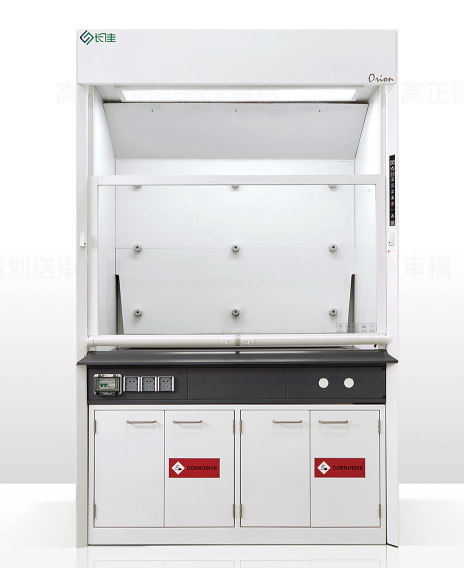
Fume hood containment design: aerodynamic baffle geometry and optional pure PP anti-corrosion inner liner. Image: Ever Great laboratory fume hood product line.
Lab Furniture That Determines What Happens After a Leak
A fume hood does not fail in isolation. The furniture around it either supports the response or makes it slower. Three Ever Great product families carry a defined role in leak prevention and post-leak control.
Gas cylinder safety cabinets: alarm, purging, and leak sensing
Compressed-gas cylinders are a second containment risk that sits inside the same laboratory as the fume hood. Ever Great gas cylinder safety cabinets are configured with alarm and exhaust linkage, automatic purging, leak-sensing configuration, an anti-tip layout, and cylinder-fixing provisions. In practice this means a gas release inside the cabinet triggers ventilation rather than accumulating, cylinders are mechanically restrained rather than relying on the operator's placement, and the cabinet's status is visible through its alarm linkage instead of being discovered by smell.
Integrated emergency safety cabinets: shower, eyewash, first aid
When a leak produces exposure rather than only an alarm, response time is set by how far the operator has to travel. Ever Great integrated emergency safety cabinets consolidate a shower, eyewash, first-aid provisions, and fire-safety storage into one unit. Locating that unit on the same bench run as the fume hood removes the corridor distance between a vapour exposure event and decontamination, and it also keeps fire-safety equipment out of the working aisle.
Exhaust washing benches in the sink zone
Sink areas are where spill residue and wash-down effluent concentrate, and they are frequently the point at which a contained vapour problem becomes a corrosion problem. Ever Great exhaust washing benches are built with 304 stainless steel structure, PP sinks, and a 25 mm ceramic worktop, with a typical footprint of 1500 × 750 × 1500 mm. The combination matters for leak response because the worktop and sink materials are selected for the same chemical families that drive fume hood selection — acid and alkali exposure — so the wet zone does not degrade while the hood is being repaired.
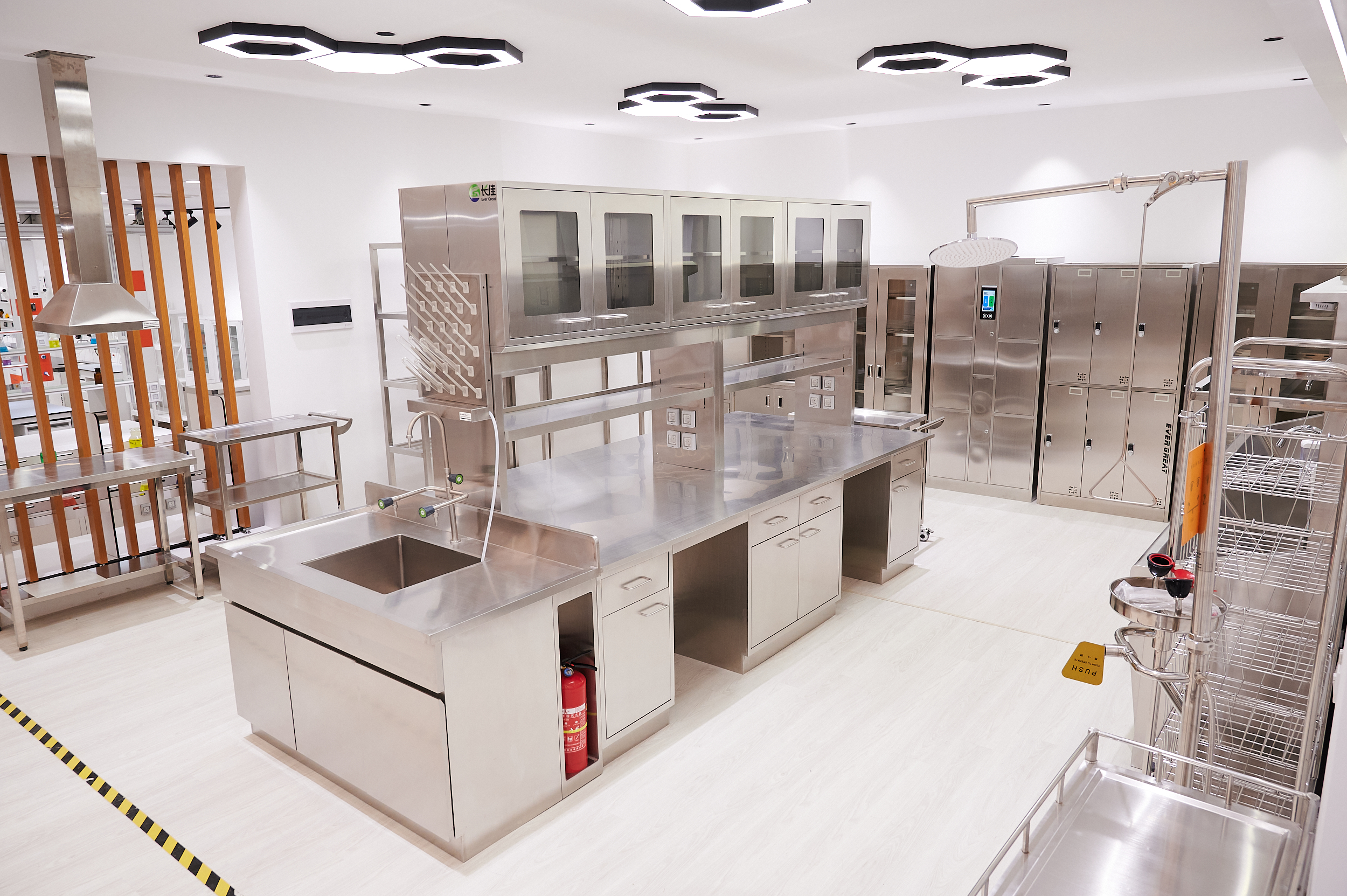
Stainless steel laboratory furniture: 304 stainless steel construction for wet-zone and exhaust washing bench applications. Image: Ever Great showroom.
Step-by-Step: Responding to a Hazardous Gas Leak
The response sequence below is the operational counterpart to the equipment decisions above. It assumes the laboratory already has a fume hood with a functioning airflow monitor and a defined sash working height.
Terminate the reaction or procedure immediately and move people out of the affected zone. Do not attempt to identify the gas source first. Personnel evacuation precedes equipment diagnosis.
Improper sash height is one of the most common leakage triggers. Confirm the sash is returned to its calibrated working height and read the face velocity monitor before anyone approaches the bench.
After evacuation, inspect the exhaust pipeline and the fume hood equipment itself. Fan belts, rooftop blower components, and exhaust dampers are the failure points that produce a loss of containment without any change inside the hood.
VAV auto-response sensor calibration is part of the prevention routine, and it is equally part of the recovery routine. A hood that has been through a pressure event should not be returned to service on the strength of an uncalibrated monitor.
Perform a smoke containment check and a face velocity grid test across the sash opening before routine work resumes. The purpose is to confirm zero turbulence and no leakage at the working height, not merely an acceptable average reading.
Record which trigger applied — sash height, exhaust failure, duct pressure fluctuation, missing factory test, or an uncalibrated sensor — because each one implies a different corrective action for the next procurement or maintenance cycle.
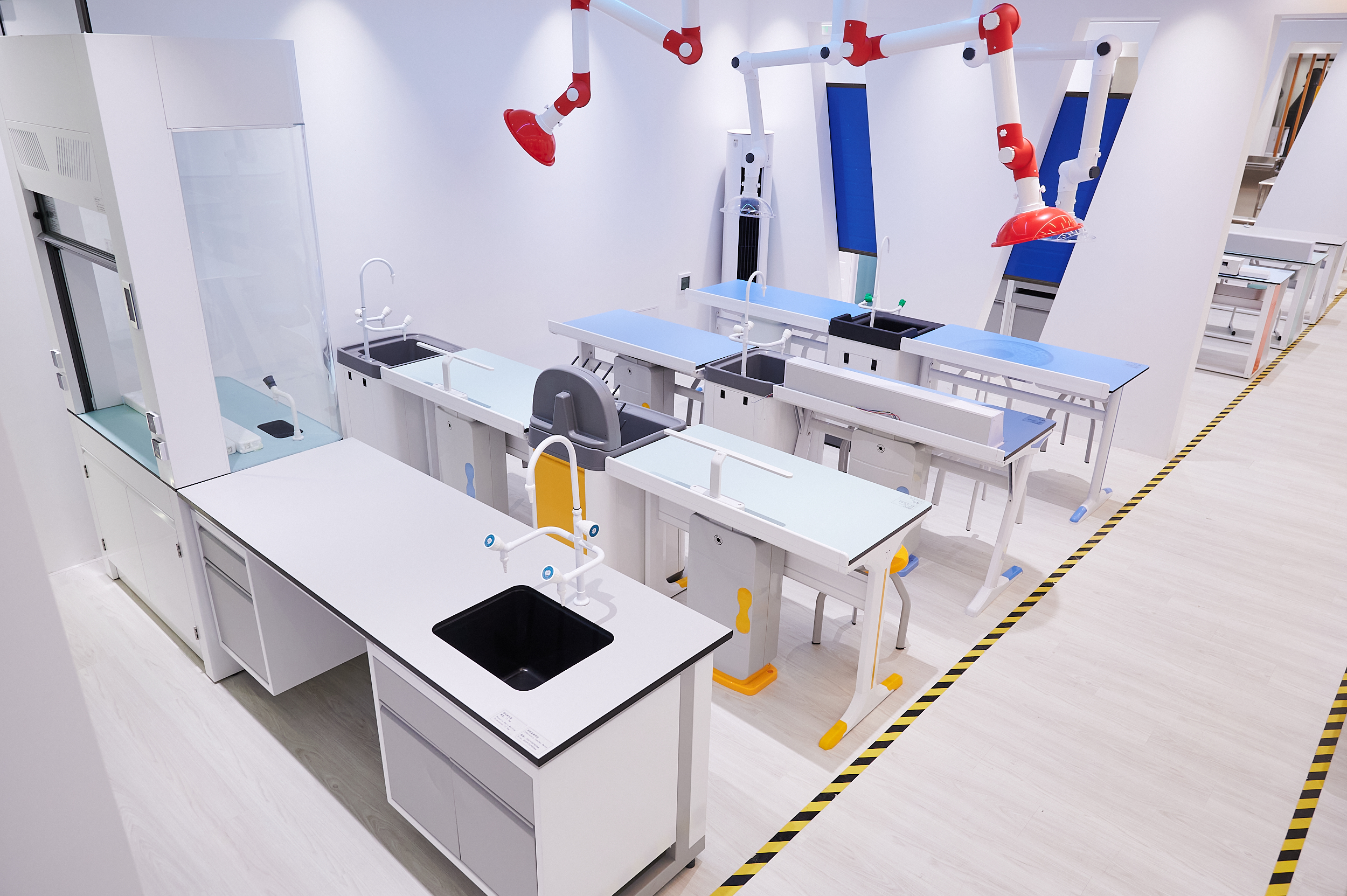
Clear, uncluttered bench runs around a hood make smoke containment checks and face velocity grid tests practical. Image: Ever Great showroom.
Prevention routine: keep the correct sash opening, avoid storing excess chemical bottles inside the hood workspace, inspect fan belts and exhaust dampers on rooftop blowers on a schedule, and replace ductless carbon filters immediately upon chemical breakthrough detection.
Use Cases: Where Leak Response Requirements Differ
Containment specifications are not transferable between laboratory types, because the failure consequence changes with the chemistry and the operating pattern.
- Heavy acid digestion laboratories. Working conditions combine heavy acid exhaust (HCl, HNO3, HF), high temperature, continuous airflow, and an indoor hazardous zone. Operation is 24/7 continuous exhaust under VAV (Variable Air Volume) or CAV automatic control, typically matched with a centrifugal PP exhaust fan, acid scrubber tower, ductwork system, and airflow monitor controller. This is the environment where EN 14175 / ASHRAE 110 compliance, a seamless PP inner liner, and a ceramic worktop become mandatory rather than optional — concentrated acid vapour also attacks the materials of any furniture sharing the room, which is why exhaust washing benches use PP sinks and a ceramic worktop in the same area.
- Pharmaceutical and hazardous-chemical storage areas. Here the dominant risk is passive: corrosive acid and alkali storage with spill containment and continuous toxic vapour venting. The equipment answer is 100% pure polypropylene seamless welding with a leak-proof liquid basin and an anti-static design, connected to 24/7 top exhaust ventilation, with chemical spill trays and safety padlocks as the working accessories. In these rooms the gas cylinder safety cabinet's leak-sensing configuration and automatic purging do the containment work when no operator is present.
- Metallurgy and smelting QC laboratories. Conditions include extreme high temperature, heavy mechanical impact, oil and grease exposure, and high vibration. The furniture specification shifts to SUS 304/316 stainless steel with heat resistance up to 800 °C and a heavy load capacity up to 800 kg, supporting high-temperature muffle furnaces, sample grinding and polishing machines, and local extraction arms. A leak here is often a heat-and-vapour event rather than a pure gas release, so the response plan has to account for hot surfaces as well as airborne exposure.
- Teaching and educational laboratories. Chemical loads are light to moderate and the building frequently cannot accept rooftop ductwork. Ductless filtered hoods with HEPA/activated carbon filtration are the practical option, with filter replacement discipline carried by the institution rather than a central HVAC team.
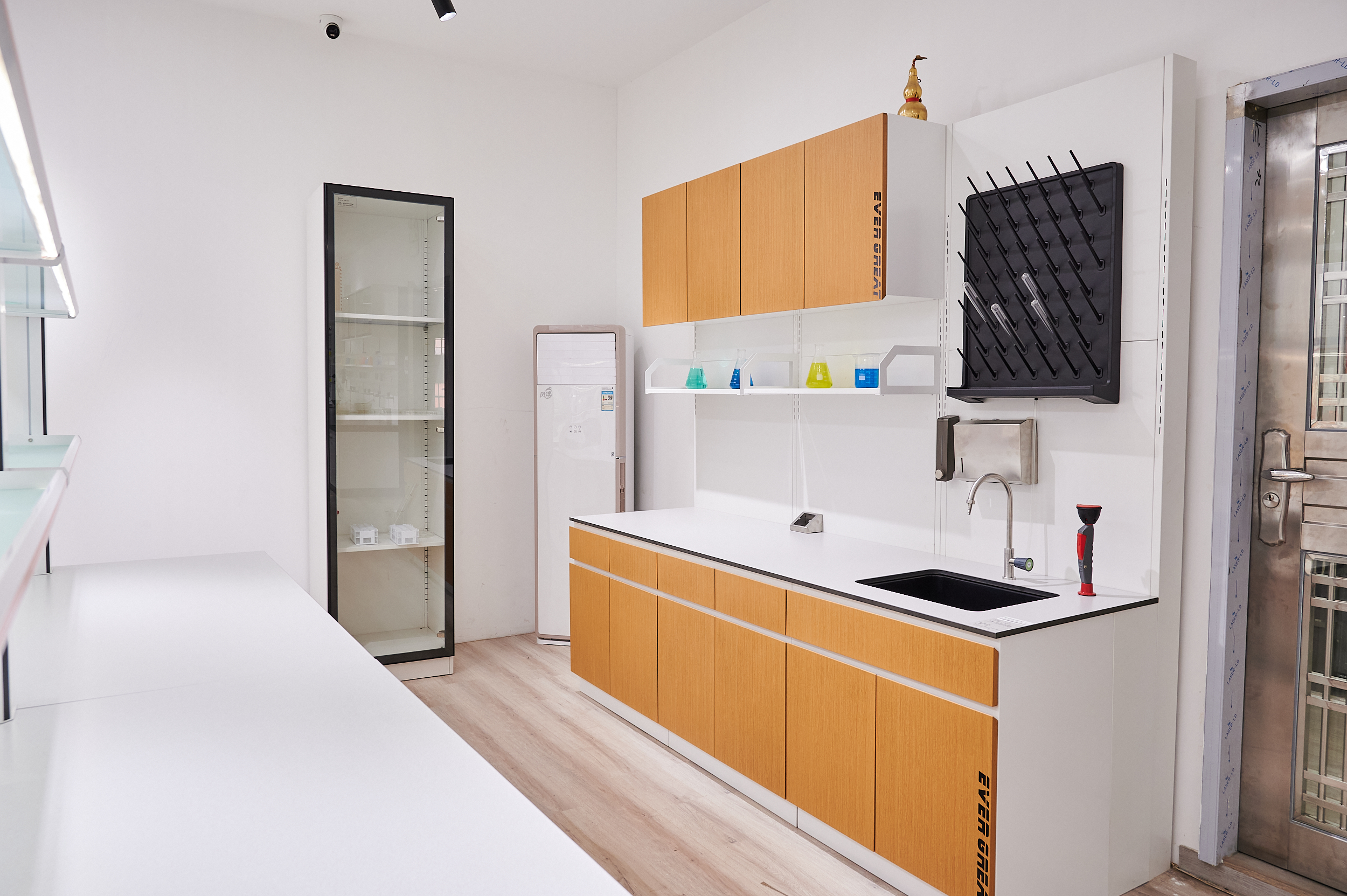
Wall-side bench layouts keep egress routes clear and place emergency equipment within reach of the hood. Image: Ever Great showroom.
Comparison Table: Containment and Safety Selections Side by Side
The first table compares the two fume hood architectures that determine the leak profile. The second compares a high-performance hood configuration against a traditional standard ducted fume hood on the metrics that affect total cost of ownership.
| Decision factor | Ducted fume hood | Ductless (filtered) fume hood |
|---|---|---|
| Where fumes go | 100% exhausted outdoors | Recirculated after HEPA/activated carbon filtration |
| Chemical scope | Zero limitation on chemical types | Light-to-moderate chemical handling only |
| Best suited to | Heavy chemical applications, heating reactions with acid digestions, volatile toxic gases, high-throughput research | Educational labs, light-to-moderate handling, leased spaces without external ductwork |
| Recurring cost centre | HVAC energy and exhaust system maintenance | Carbon and HEPA filter replacement on breakthrough |
| Installation complexity | Requires duct route, ceiling clearance and makeup air capacity | Significantly lower installation complexity, no external ductwork |
| Energy implication | Continuous exhaust load | Significantly reduced HVAC energy costs |
| Performance metric | High-performance fume hood configuration | Traditional standard ducted fume hood |
|---|---|---|
| Gas leakage rate | 0.000 PPM ultra-low leakage | Standard leakage below 0.05 PPM |
| Containment design | Superior aerodynamic structure; optional pure PP anti-corrosion inner liner | Conventional aerodynamic layout |
| Energy performance | Up to 35% energy saving with VAV control; airflow efficiency increased by 25% | Baseline |
| Exhaust and HVAC effect | VAV system saves 35% exhaust air volume and reduces lab HVAC electricity consumption by 28% | Baseline |
| Initial purchase cost | 10%–15% higher | Lower upfront |
| Total operating cost | About 30% lower over three years | Higher HVAC energy consumption |
| Maintenance | About 50% less; modular liner components allow 15-minute quick replacement without full cabinet dismantling | Full cabinet disassembly for liner work |
| Best for | High-risk acid digestion labs, metal smelting and metallurgy QC labs, hazardous chemical testing facilities | General chemical work with lower containment demand |
Frequently Asked Questions
Which standards should a fume hood meet to reduce hazardous gas leak risk?
Laboratory fume hood containment is normally validated against ANSI/ASHRAE Standard 110-2016 (R2025), the primary American national standard for quantitative performance testing of laboratory fume hoods, and against the European standard EN 14175. Ever Great fume hoods are tested according to both EN 14175 and ASHRAE 110 benchmarks, with third-party test reports from SGS, and the company holds CE and RoHS certifications for flagship product series. Adjacent fire-resistant storage is classified separately under EN 14470-1 into Type 15, 30, 60, and 90 minute cabinets, based on the time taken for the internal temperature to rise beyond the defined limit of 180 K or 200 °C.
Can an installed fume hood be upgraded with leak sensing and alarm functions?
Yes. Ever Great fume hoods support optional IoT real-time monitoring alarm modules, VAV auto-response sensor calibration, and are delivered with standardized airflow-calibration manuals. An upgrade is only meaningful if the hood's original containment performance is intact, so it should be preceded by a smoke containment check and a face velocity grid test across the sash opening. Where ductwork cannot be added at all, light-to-moderate chemical work can be moved to a ductless (filtered) hood using HEPA and activated carbon filtration, which reduces HVAC energy costs and installation complexity but must be matched to the actual chemical inventory.
Does a higher-containment fume hood cost more over its service life?
The initial purchase cost of a high-performance configuration is typically 10%–15% higher than a traditional standard ducted fume hood, but total operating cost is about 30% lower over three years. VAV control saves up to 35% of exhaust air volume and reduces laboratory HVAC electricity consumption by 28%, while airflow efficiency is increased by 25% compared with a conventional layout. Maintenance is approximately 50% lower, and modular liner components can be replaced in around 15 minutes without dismantling the entire cabinet.
How can a buyer verify containment performance before shipment?
Every Ever Great fume hood completes a 100% pre-shipment SF6 tracer-gas leakage test to reach a 0.000 PPM ultra-low-leakage standard, compared with the standard leakage rate below 0.05 PPM on conventional ducted hoods. Acceptance criteria for orders are set on pre-shipment test, and the minimum order quantity is 1 unit, so a single hood can be validated before a full laboratory rollout is committed.
What does long-term supplier support look like for a pharmaceutical laboratory buying from China?
Ever Great provides a 1-year comprehensive warranty and lifetime remote or on-site engineering support, with rapid spare parts deployment. Overseas installation risk is managed through KD mortise-and-tenon pre-assembled structures, heavy-duty export plywood crating with vacuum foil wrap, and a 100% pre-assembled test fit before shipment, supported by 3D modular assembly video guides, color-coded hardware labeling, backup wearing parts shipped inside the ocean container, and remote engineer installation guidance. Commercial terms include MOQ of 1 unit, delivery under FOB, CIF, DDP, or EXW, and payment at T/T with 30% advance and 70% balance before delivery. Buyers can request a sample configuration or a written quotation through evergreatlab.com, and download the 2026 Ever Great catalogue before specifying a laboratory build.
Next step: validate containment before you sign
Ever Great can prepare a sample fume hood configuration, a containment test summary, and a written quotation for your specific chemistry and building conditions. Send your chemical inventory, sash working height, available duct route, and target installation date, and the engineering team will return a specification matched to your laboratory rather than a catalogue default.
Download the 2026 product catalogue: Ever Great 2026 Catalogue (PDF)
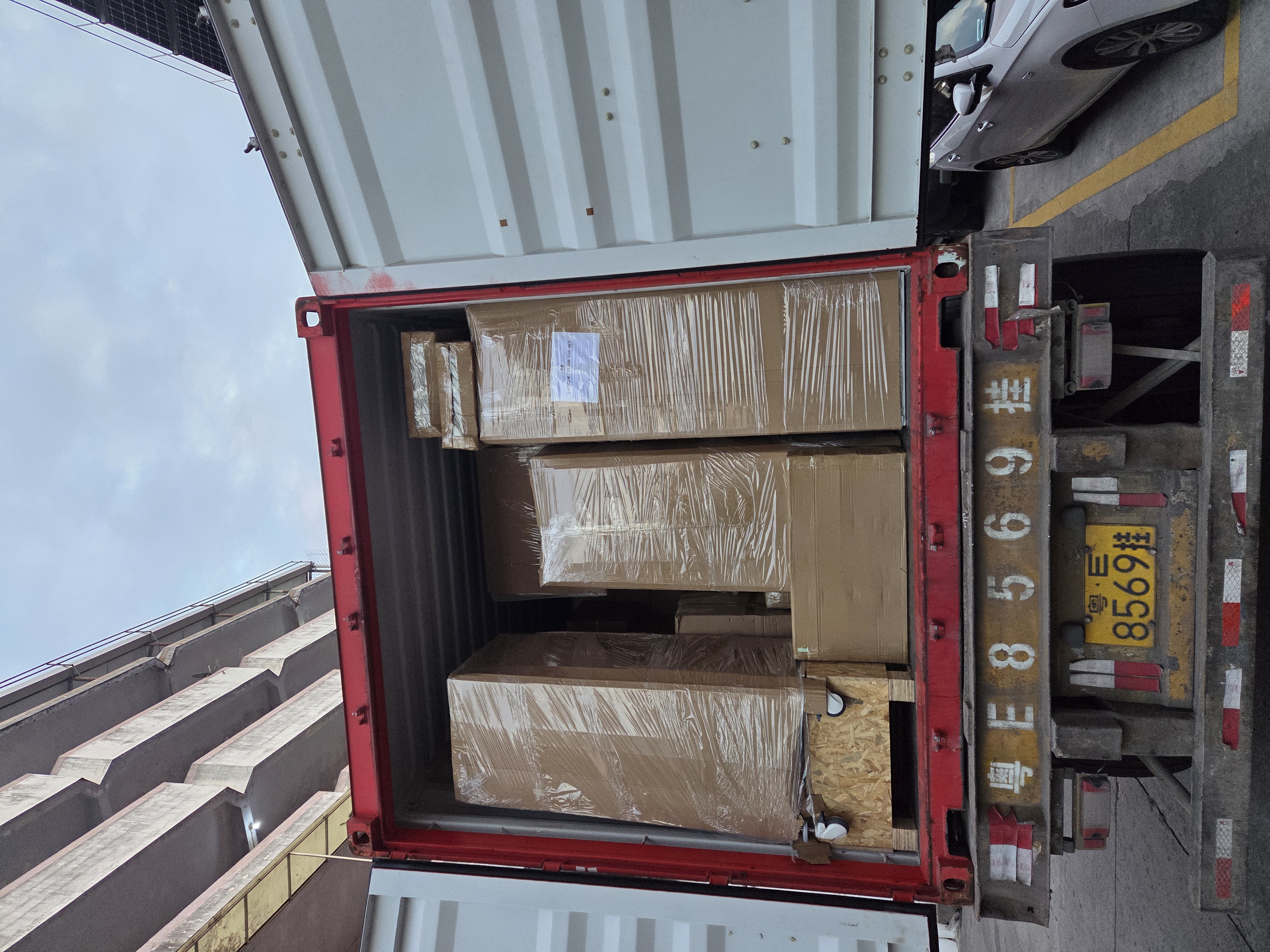
Export crating and container loading of laboratory furniture — heavy-duty plywood crating, vacuum foil wrap and backup wearing parts shipped with the project. Image: Ever Great factory.
Conclusion
A hazardous gas leak from a fume hood is a containment event, and containment is specified, not repaired. The response sequence is short — stop the experiment, evacuate personnel, inspect the exhaust pipeline and hood equipment, recalibrate the sensor, verify containment, and document the trigger. The decisions behind it are longer: whether the chemistry requires a ducted hood that exhausts 100% of fumes outdoors or a ductless filtered hood suited to light-to-moderate work; whether the unit has passed a 100% pre-shipment SF6 tracer-gas leakage test to 0.000 PPM rather than relying on a nominal rating; and whether the surrounding furniture — gas cylinder safety cabinets with alarm and exhaust linkage, integrated emergency safety cabinets with shower and eyewash, and exhaust washing benches in 304 stainless steel with PP sinks and a 25 mm ceramic worktop — is placed to shorten the distance between an incident and a recovery.
Laboratory safety systems are a system, not a product. The hood, the storage cabinet, the emergency unit, and the wet-zone bench are one containment chain, and the chain is only as strong as its least-verified link.
Have Questions or Need More Details?
Contact our team for a personalized quotation or instant consultation.
Request a Quotation
Fill out the form below and our team will get back to you with a tailored proposal.
WhatsApp Direct Chat
Prefer to chat in real-time? Message us on WhatsApp for instant assistance & quick answers.
- Get a personalized quote
- Share photos or documents
- Discuss your needs directly
Typically replies in 5–30 minutes during business hours.