
Lab Safety Cabinet & Fume Hood Certifications: A Regional Guide
Lab Safety Cabinet & Fume Hood Certifications: A Regional Guide
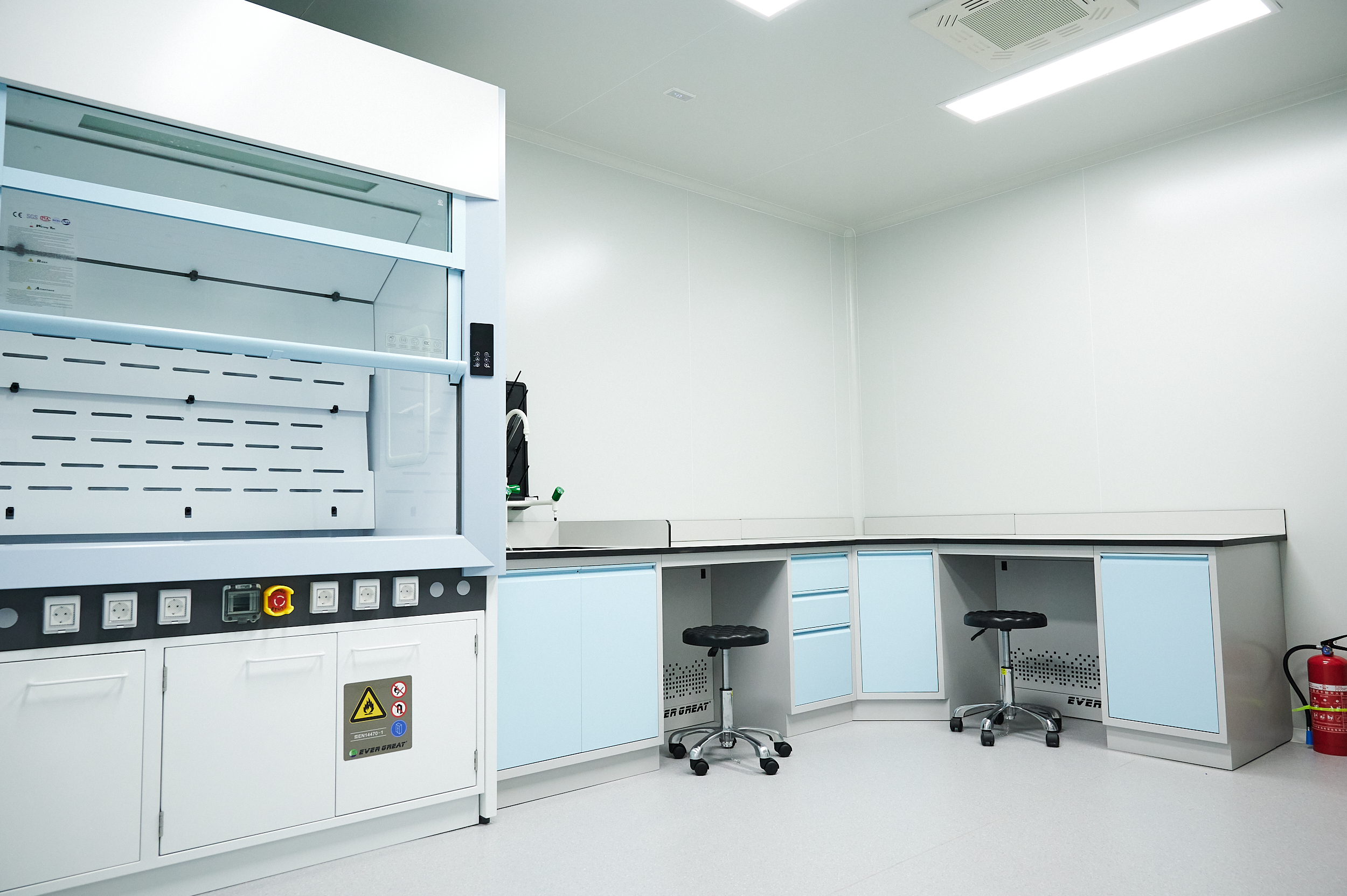
Compliance problems in laboratory furniture rarely come from poor fabrication. They come from paperwork that does not match the product, the model, or the site. A flammable safety cabinet, a vented reagent cabinet, a PP acid storage cabinet, a gas cylinder cabinet, and a fume hood each sit behind a different set of expected documents, and the single word 'certified' can refer to a product standard, a performance test, or a building approval — three different things with three different owners.
This guide separates those layers, maps them onto the five cabinet and hood types most often purchased together, and explains where European and American references diverge. It also shows what to read on a certificate before it enters a project file, using documented examples from Guangdong Ever Great Laboratory Equipment Co., Ltd. (Ever Great), a laboratory infrastructure manufacturer in Foshan, China, founded in 2011, whose range covers fume hoods, workbenches, and safety storage cabinets for markets including the USA, the EU, the Middle East, and Africa.
The short answer. Before a safety cabinet or fume hood is approved for a chemical laboratory, collect four items: a certificate of conformity that names both the standard and the exact model; a third-party performance test report where one exists, such as ASHRAE 110 or EN 14175 for fume hoods; a declaration covering electrical compatibility and restricted substances where the market asks for one; and a commissioning record that proves the installed system — duct, water supply, alarm interface — works on site. Suppliers can supply the first three. The fourth belongs to the installer and the laboratory owner.
What 'Compliant' Has to Prove
Laboratory furniture is a specification-driven category, and the documents follow the specification. One commercial market study values the global laboratory furniture market at approximately USD 4.8 billion in 2025 (Dataintelo, 2026), but published estimates for the same year span roughly USD 1.1 billion to USD 4.8 billion depending on whether modular services and integrated systems are counted. Treat that figure as scale, not as a budget input. Within the category, metal furniture held a 52.7% revenue share in 2025 in the same study, which is one reason steel-based cabinets and benches dominate the documentation buyers are asked to review. China's 2024 exports under HS 940390, the heading that includes furniture parts, reached USD 4.15 billion (OEC), a reminder that the supply base is global and the paperwork has to travel with the goods.
For an individual purchase, compliance splits into three questions that need separate answers.
- Product conformity. Does the cabinet or hood meet a named product standard, and is that stated on a certificate that lists the model you are ordering? This is where CE certificates, EN 14470-1 fire classifications, and restricted-substance attestations sit.
- Performance evidence. Has the containment or airflow been measured by an independent laboratory, on the same size and configuration? For fume hoods this is the ASHRAE 110 or EN 14175 report — not the electrical certificate.
- Site acceptance. Does the installed assembly satisfy local ventilation, water, drainage, and life-safety expectations? This is decided by the project designer and the authority having jurisdiction, and no supplier certificate substitutes for it.
Most disputes start when a buyer accepts evidence for one layer and treats it as proof of another. An electrical certificate does not prove containment. A fire classification does not prove chemical resistance. A materials datasheet does not prove the duct was balanced after installation.
Flammable Safety Cabinets: Fire Rating and Certificate Scope
Fire-rated storage is the category where the gap between a marketing word and a documented class is widest. In Europe, EN 14470-1 classifies fire-resistant safety cabinets as Type 15, 30, 60, or 90 minutes according to how long the internal temperature is held, with the internal rise limited to 180 K or 200 °C during the rated period. A cabinet described only as 'fireproof' tells a reviewer nothing about which of those four classes applies.
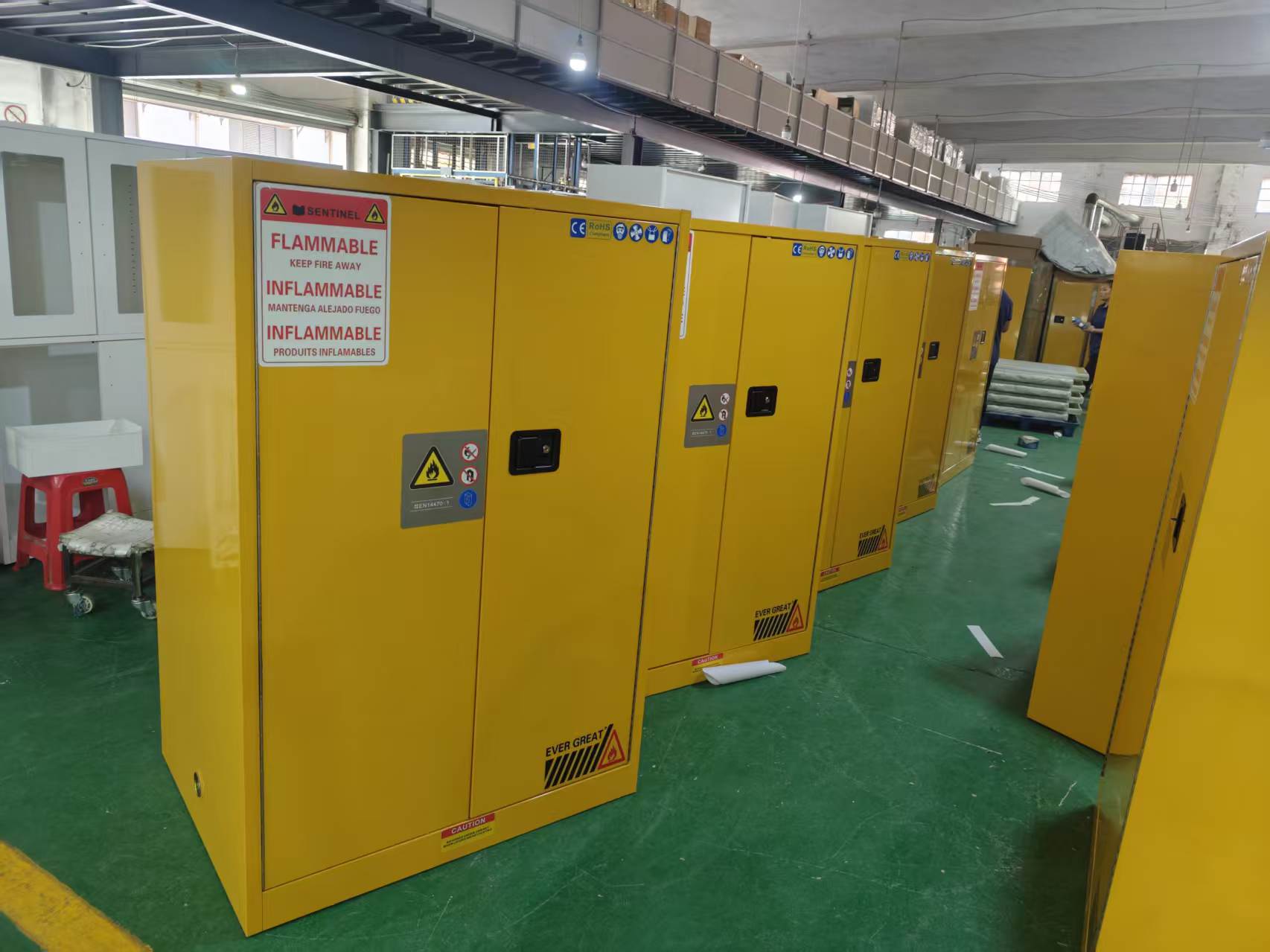
Ever Great's flammable safety cabinet EG-SF-LB005 is a 45-gallon nominal capacity unit measuring 1090 x 460 x 1650 mm, built from 1.2 mm double-wall steel with a 38 mm air barrier between the walls, a 51 mm sump, and dual flash-arrested vents. The construction package also includes a three-point latch, a grounding provision, and adjustable galvanized shelves. Those are physical features. They are not a fire classification, and the specification should state which classification is required in addition to the construction.
On the documentation side, Ever Great's file contains a CE Certificate of Conformity, TH2310049-C01-C01, issued by Shenzhen Tian Hai Test Technology Co., Ltd. on 13 October 2023 and valid to 13 October 2028, citing EN IEC 60079-0:2018, EN 60079-1:2014, EN IEC 60079-7:2018, EN 60079-11:2012, EN IEC 60079-15:2019, EN 60079-18:2015, EN 60079-14:2014, and EN 60529:1992. A RoHS attestation, TH2310049-C02-C01, from the same body and with the same validity dates, covers (EU) 2017/2102.
Both documents name the certified scope as 'Flammable Safety Storage Cabinet, Model FB-03'. That is the detail worth reading twice. If a purchase order specifies a different catalogue reference, the certificate is not automatically evidence for it — a certificate is evidence only for the models printed on it. The correct question to the supplier is not 'is it certified?' but 'which model numbers appear on the certificate that covers this line item, and can you send that page?'
Vented Chemical and Reagent Cabinets: The Exhaust Connection Is the Specification
A vented cabinet is a containment shell with a duct connection, not a ventilation system. The compliance question is therefore split between the cabinet and the exhaust it is connected to.
Ever Great's vented chemical and reagent cabinet EG-S0-LB001 measures 900 x 500 x 1800 mm, uses double-wall steel construction with an epoxy coating and tempered glass doors, carries four adjustable shelves, and provides a Ø110/150 mm exhaust connection. The two-port sizing matters: the duct that serves the cabinet has to match the port, and the fan has to be sized for the connected volume, the duct run, and the number of cabinets on the branch.
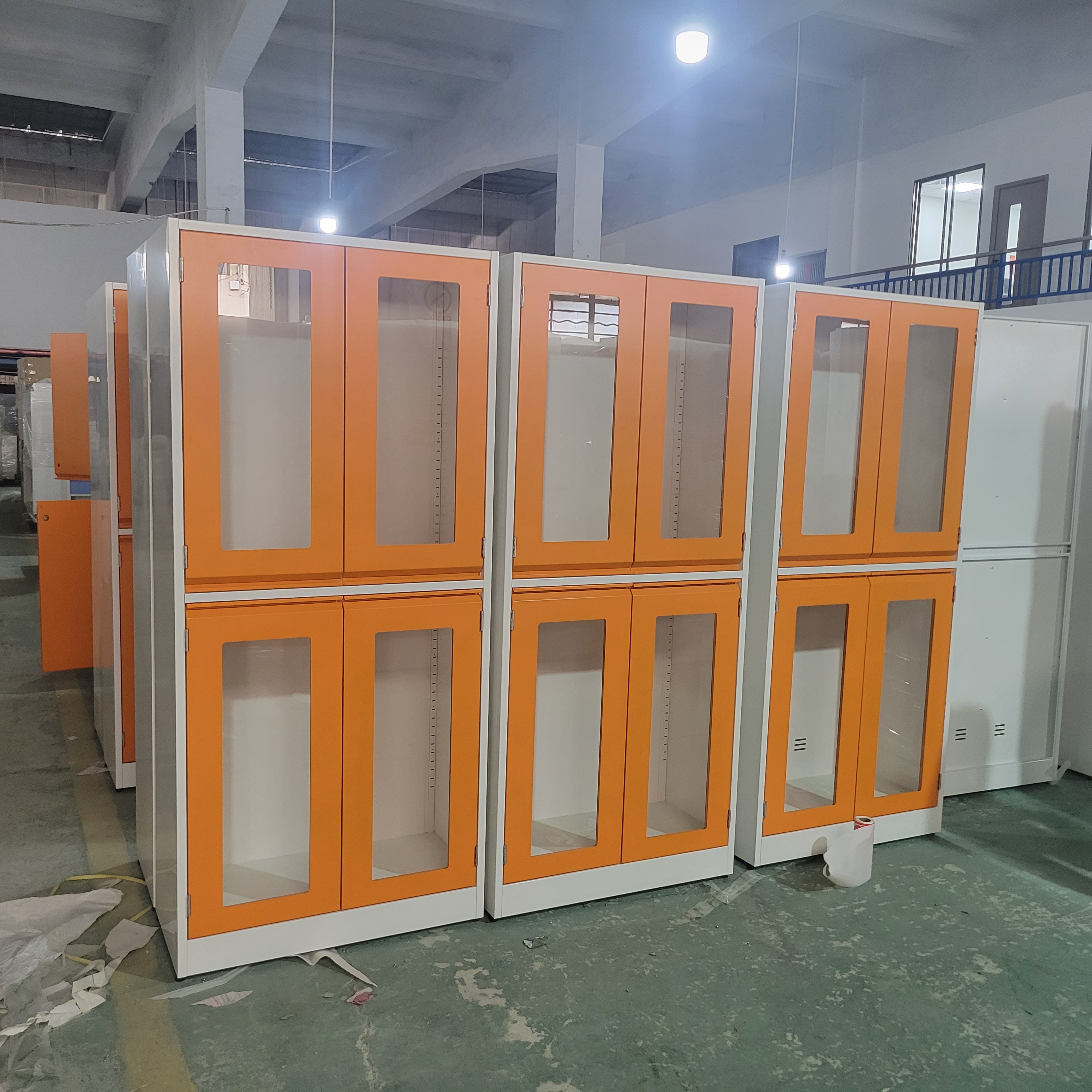
Three verification points apply to every vented cabinet in a project file. First, confirm whether the cabinet is intended for passive venting or active exhaust, because the answer changes who supplies the fan. Second, confirm the port diameter against the duct drawing rather than against the catalogue. Third, require a commissioning record showing measured airflow at the cabinet, not a design figure. An exhaust connection that is installed but never balanced is a compliance gap that no certificate closes.
PP Acid and Alkali Cabinets: Corrosion Compliance Is Not Fire Compliance
Polypropylene storage solves a chemistry problem, not a fire problem, and the two should never be traded against each other in a tender. A PP cabinet is the correct answer for concentrated acids and alkalis that would attack coated steel; it is not a substitute for a fire-rated flammable cabinet.
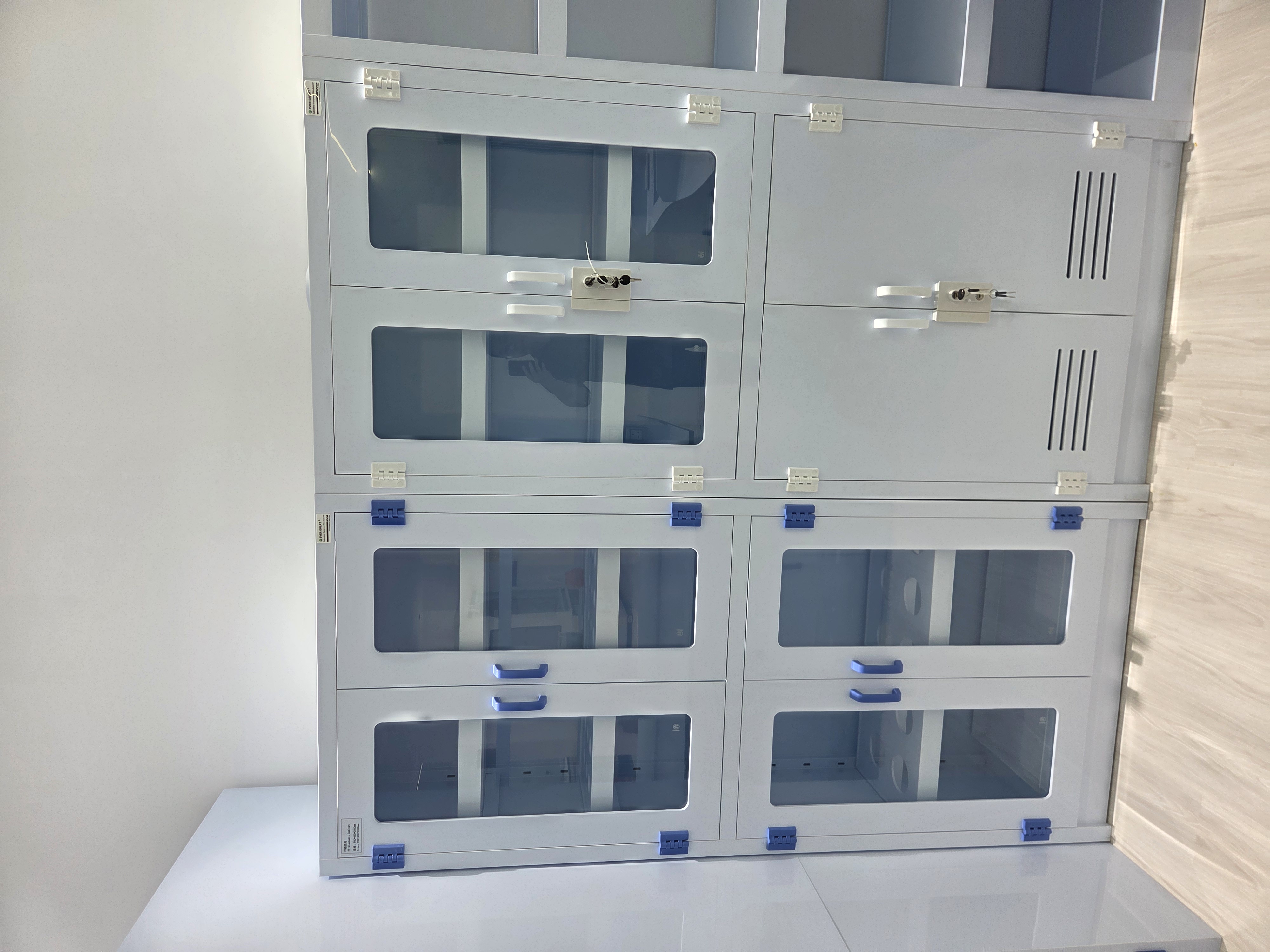
Ever Great's PP acid and alkali storage cabinet EG-PP-CB003 measures 900 x 450 x 1800 mm and is built from 8.0 mm polypropylene sheet with PP hardware throughout, giving a metal-free interior. It carries three adjustable spill-containment shelves, a bottom sump, and a Ø110 mm exhaust port. In a corrosive service environment the material schedule is the specification: sheet thickness, hardware material, shelf containment volume, and whether the joints are welded or mechanically fixed all change the service life.
A documented project requirement from Argentina illustrates how specific this gets in practice: an acid and alkali storage upgrade there specified 100% pure polypropylene with seamless welding, a leak-proof liquid basin, and an anti-static design, connected to 24/7 top exhaust. Those are four separate acceptance criteria that a generic 'PP cabinet' description would not capture. Buyers in corrosive service should write each one into the order.
Gas Cylinder Safety Cabinets: Purging and Alarm Linkage Must Be Ordered
Gas cylinder cabinets fail compliance reviews for a simple reason: purging and alarm linkage are configuration options, and options get lost between the enquiry and the purchase order. A cabinet delivered without the purge package is a correctly built steel enclosure that does not do what the risk assessment assumed.
Ever Great's gas cylinder safety cabinet EG-S0-CB005 measures 900 x 450 x 2000 mm, uses 1.0 mm cold-rolled steel with a powder coating, and is available in single-, double-, and triple-cylinder configurations. Cylinder-fixing provisions and an anti-tip layout are part of the base design; automatic purging and gas-alarm linkage are selectable. The distinction between 'alarm interface capability' and 'alarm supplied' is the one to clarify in writing.
Ask for three documents with the quotation. A purge sequence description showing what triggers the cycle and how long it runs. An interface drawing showing the terminals or contacts the site's gas detection system connects to, since the detector itself is normally part of the building system, not the cabinet. And the cylinder restraint detail, because restraint is the mechanical function that protects the room if a regulator fails.
Fume Hoods: EN 14175, ASHRAE 110, and the Evidence Chain
Fume hood compliance has the most layers of any item in this guide, and the layers are frequently confused. The clearest split is between electrical conformity, containment performance, and installation commissioning.
Ever Great holds a CE Certificate of Conformity under the EMC Directive 2014/30/EU, certificate CKEYS251020088, issued by Guangdong KEYS Testing Technology Co., Ltd. on 20 October 2025 and valid to 20 October 2035 for the EU/EEA market. It cites EN IEC 61000-6-2:2019, EN IEC 61000-6-4:2019, EN IEC 61000-3-2:2019+A1:2021+A2:2024, and EN 61000-3-3:2013+A1:2019+A2:2021, and lists fume hood models EG-FH01, EG-FH02, EG-FH03, EG-FH04, and EG-FH06. That document establishes electromagnetic compatibility for those models. It says nothing about how well the hood contains vapor, and a reviewer should not treat it as containment evidence.
Containment is established separately. ANSI/ASHRAE Standard 110-2016 (R2025) specifies the quantitative and qualitative test method for evaluating fume containment of laboratory fume hoods and is the American national reference for that measurement. EN 14175 is the European fume hood standard used for the same purpose in EU-facing projects. Ever Great states that its ventilation and containment systems are tested against both EN 14175 and ASHRAE 110 benchmarks, supported by third-party test reports from SGS.

The narrow-frame fume hood series, covering models Orion-TS-1500, Orion-TS-1800, Orion-LD-1500, and Orion-LD-1800, is offered in benchtop and walk-in configurations at 1500 or 1800 mm external width, 900 mm depth, and 2400 mm height, with internal widths of 1408 mm and 1708 mm respectively. Nominal face velocity is stated at 0.3 m/s, the exhaust canopy is polypropylene with Ø250/315 mm outlets, the frame is aluminum alloy, and the series is described as VAV/CAV-ready. Polypropylene construction is also available in the dedicated PP fume hood EG-PP-FH for acid service.
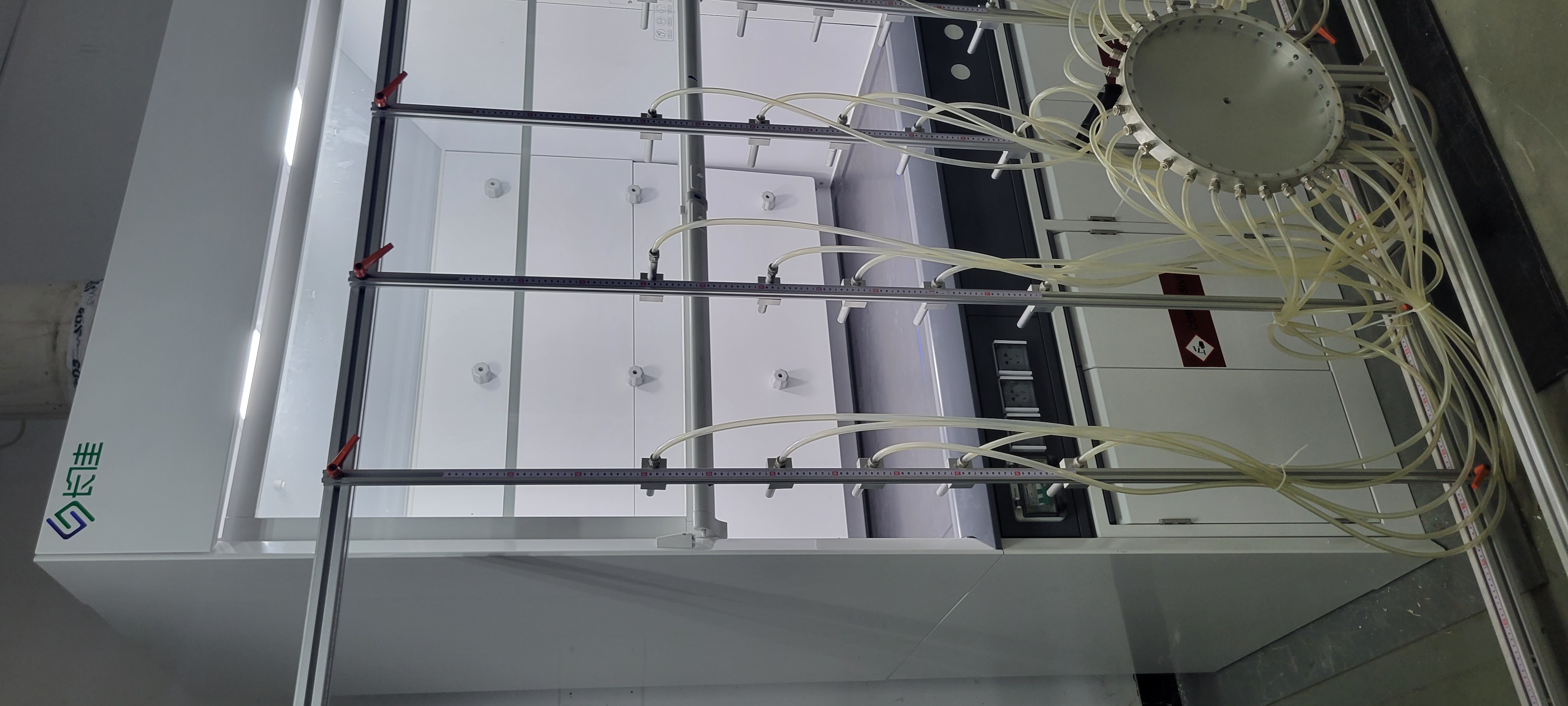
When a fume hood report arrives, read four fields before filing it. Which model and width were tested. What sash height applied during the test, because containment results are tied to that opening. Whether the tested unit used VAV or CAV control, since the airflow strategy changes the result. And who performed the test, with what date. A report for a 1500 mm constant-air-volume hood is not interchangeable evidence for an 1800 mm VAV unit.
Installation adds a fifth field. A project brief from Kazakhstan, for heavy acid exhaust involving HCl, HNO3, and HF, named EN 14175 and ASHRAE 110 compliance alongside a seamless PP inner liner, a ceramic worktop, explosion-proof lighting, and VAV or CAV control, with a centrifugal PP fan, acid scrubber tower, ductwork, and airflow monitor controller as matched equipment. Every one of those items sits outside the hood's own certificate, and the commissioning record is what ties them together.
Ducted vs. Ductless Fume Hoods: A Compliance Decision
The ducted-versus-ductless question is usually framed as an energy choice. In a compliance review it is a containment choice, because the two designs handle chemical exposure in fundamentally different ways.
A ducted fume hood exhausts 100% of fumes outdoors. That gives it no chemical-type limitation and avoids long-term filter replacement cost, which is why it suits heavy chemical work, heating reactions and acid digestions, volatile toxic gases, and high-throughput research. A ductless, filtered hood passes air through HEPA and activated carbon filtration and recirculates it, which reduces HVAC energy use and installation complexity and suits light-to-moderate chemical handling, teaching laboratories, and leased spaces without external ductwork.
Whether a ductless hood is acceptable in a given room depends on the chemical inventory and on local rules, and a filter datasheet alone does not settle it. Four steps make the decision auditable.
- Chemical inventory and hazard assessment. Audit every chemical used in the hood, including boiling points and evaporation rates, to confirm whether carbon filtration can capture it or whether outdoor exhaust is required.
- Duct and makeup air check. Measure ceiling clearance and route feasibility to the roof, and confirm the makeup air system can sustain a continuous face velocity in the range of 0.3 to 0.5 m/s (60 to 100 FPM).
- Sash calibration and airflow monitoring. Set the working sash height, typically 400 to 500 mm, and calibrate the face velocity monitor and its low-flow audible and visual alarm.
- Containment testing. Run a smoke containment check and a face velocity grid test across the sash opening before routine use.
The safety boundaries are equally specific. Perchloric acid and radioisotopes should not be handled in standard ducted or ductless hoods without a specialized washdown system. Fan belts and exhaust dampers on rooftop blowers need scheduled inspection. Ductless carbon filters should be replaced at the first sign of chemical breakthrough, not at a fixed calendar interval. And chemical bottles should not be stored inside the working area, because they disturb airflow and reduce containment.
Emergency Equipment: Shower, Eyewash, and the Integrated Hub
Emergency provision is the part of laboratory furniture compliance most often left to the building rather than to the furniture package, which is exactly where scope gaps appear. An integrated unit makes the scope visible.
Ever Great's laboratory safety and emergency hub EG-SF-CB011 measures 900 x 600 x 2000 mm, is built from 1.0 mm cold-rolled steel with epoxy powder coating and an aluminum handle, and integrates a shower, eyewash, first-aid provision, and fire-safety storage in one cabinet. Leak-sensing configuration and alarm integration capability are part of the design.
Three checks belong in the order document. Confirm in writing whether the shower and eyewash are included in the delivered scope or listed as a separate line, since the term 'hub' can be read either way. Confirm the water supply, drainage, and floor fixing requirements against the room layout. And confirm who owns activation testing and maintenance records after handover, because the placement and inspection regime for emergency equipment is set by the authority having jurisdiction and the site's own EHS program, not by the cabinet manufacturer.
Regional Differences in Ventilation, Storage, and Emergency Provision
Regional compliance differences fall into three practical areas: which product standard is named, how ventilation is arranged, and how much of the emergency provision is treated as fixed building equipment rather than furniture. The table below summarizes requirement signals drawn from published standards and from documented project specifications. It is a planning aid, not a statement of national law — the applicable code should always be confirmed with the local authority having jurisdiction.
| Market or project context | Reference usually named | What changes in the furniture specification | Evidence to file |
|---|---|---|---|
| EU / EEA | EN 14175 for fume hoods; EN 14470-1 for fire-resistant cabinets; CE marking; RoHS | Fire cabinet type 15/30/60/90 must be stated; hood supplied with PP exhaust canopy and duct interface | CE certificate listing the exact models; EN 14175 report; EN 14470-1 type statement; RoHS attestation |
| USA / Canada projects | ANSI/ASHRAE 110-2016 (R2025) fume hood test method | Hood selected on measured containment rather than sash velocity alone; exhaust and makeup air capacity reviewed early | ASHRAE 110 report by model, width, sash height, and control type |
| Middle East (Saudi Arabia, UAE projects) | Project specification; heavy-load and chemical-resistance requirements | Bench load up to 500 kg/m², chemical-resistant phenolic, epoxy, or ceramic worktops, integrated power and utility distribution | Material datasheets showing load rating and chemical-resistance data; utility layout |
| Central Asia (Kazakhstan project) | EN 14175 / ASHRAE 110 named in the brief | Heavy acid exhaust, seamless PP liner, ceramic worktop, explosion-proof lighting, VAV or CAV control, scrubber and PP fan | Material statement; control description; airflow monitor specification |
| South and Southeast Asia (India, Philippines projects) | Project specification; mixed duty | High-volume bench, cabinet, and service-frame packages; installation sequencing and site labor planning | Installation and commissioning records; packing and delivery documentation |
| Africa (Kenya, Tanzania projects) | ISO 14644-1 cleanroom classes 5–8 where a clean zone is adjacent; installation supervision | Stainless work surfaces in controlled zones; on-site assembly and alignment; HEPA filtration and pressure monitoring by others | Cleanroom classification document; installation report; stainless material grade |
| South America (Argentina project) | Project specification for corrosive storage | 100% pure PP with seamless welding, leak-proof basin, anti-static design, 24/7 top exhaust connection | Welding and material certificate; spill-containment volume |
Two patterns are worth noting. First, ventilation rules travel with the building, not the furniture, so ducted installations need the exhaust route, fan, and makeup air confirmed before the hood is specified. Second, the same product family can carry different evidence in different markets — a CE certificate is decisive in the EU/EEA and supplementary elsewhere, while an ASHRAE 110 report is decisive for American projects and often requested alongside EN 14175 data in export tenders.
Documentation Checklist Before the Purchase Order
This checklist applies to any of the categories above and can be run in under an hour once the documents are in hand.
- Certificate names the model, size, or catalogue reference being ordered — not only the product family.
- Every standard on the certificate carries an edition or year, and that edition is current for the project.
- Issuing body is identified, with an issue date and an expiry date that covers the installation and handover period.
- Performance reports state the tested configuration, including sash height and VAV or CAV control for fume hoods.
- Fire classification is expressed as a named type, not as an adjective.
- Optional functions — purging, alarm linkage, leak sensing, shower and eyewash — appear as explicit line items.
- Commissioning requirements are written into the contract: airflow measurement, smoke test, alarm verification, water and drainage check.
- Spare parts, warranty term, and post-handover technical support are documented rather than verbal.
How Ever Great Documents Its Range
Ever Great operates a 6,000 m² manufacturing base in Foshan with a workforce of 40 and an annual output of 20,000 units, exporting about 60% of production to the USA, EU, Middle East, and Africa. The company holds ISO 9001 quality management and ISO 14001 environmental management certification, and states that its ventilation and containment systems are tested to EN 14175 and ASHRAE 110 with third-party SGS reports, while flagship series carry CE and RoHS certification.
For configured work, the company runs OEM and ODM production with customization across technical specifications, white-label supply, and R&D and prototyping. Monthly capacity is 2,000 units, minimum order quantity is one unit, and quoted lead time is 10 to 30 days, with 100% testing before shipment. After-sales terms cover a service level agreement, technical assistance, and spare parts and maintenance, alongside a one-year warranty and remote or on-site engineering support.
Installed reference projects include a 105-unit metallurgical and smelting laboratory in the Philippines, a 255-unit university and research facility in India, a 45-unit food safety and QA laboratory in Australia, a 200-unit clinical diagnostics laboratory in China, and a 30-unit chemical workshop laboratory in Tanzania. For buyers building a compliance file, the practical next step is to request the certificate page, the test report, and the material datasheet for the exact line items under evaluation, rather than for the product family as a whole.
Frequently Asked Questions
Which certificates should a flammable safety cabinet carry for an EU project?
For EU-facing projects, ask for a CE Certificate of Conformity that names the cabinet model and the standards applied, a statement of EN 14470-1 fire resistance type — 15, 30, 60, or 90 minutes, with internal temperature rise limited to 180 K or 200 °C — and a RoHS attestation. Ever Great's file contains CE certificate TH2310049-C01-C01 and RoHS attestation TH2310049-C02-C01, both issued by Shenzhen Tian Hai Test Technology Co., Ltd., valid from 13 October 2023 to 13 October 2028, and both naming Model FB-03 as the certified scope. Always compare the model on the certificate with the model on your order.
How do I evaluate custom fume hood manufacturers for chemical laboratories?
Evaluate four capabilities, not one. First, evidence: request the EN 14175 or ASHRAE 110 report and the CE certificate, and check that both name the width, control type, and model you intend to buy. Second, customization depth: confirm whether the supplier handles technical and specification changes, white-label production, and R&D or prototyping rather than only catalogue variants. Third, production control: Ever Great quotes a monthly capacity of 2,000 units, a minimum order of one unit, 100% testing, and a 10 to 30 day lead time, which allows a single prototype before volume. Fourth, lifecycle support: a one-year warranty, spare parts, and remote or on-site engineering support determine whether the hood stays compliant after handover.
Does a CE mark on one fume hood model cover every hood in a supplier's range?
No. Ever Great's CE Certificate of Conformity CKEYS251020088, issued by Guangdong KEYS Testing Technology Co., Ltd. on 20 October 2025 and valid to 20 October 2035, lists fume hood models EG-FH01, EG-FH02, EG-FH03, EG-FH04, and EG-FH06 under the EMC Directive, citing EN IEC 61000-6-2:2019 and EN IEC 61000-6-4:2019 among others. A different width, control package, or model needs its own evidence. Note also that this certificate covers electromagnetic compatibility, so containment performance must still be documented separately with an ASHRAE 110 or EN 14175 report.
What drives the cost band of a compliant cabinet or fume hood?
Configuration decisions move the cost band more than product family does. For gas cylinder cabinets, single-, double-, and triple-cylinder builds and the choice between base ventilation and an automatic purging package with alarm linkage are separate cost steps. For fume hoods, benchtop versus walk-in construction, 1500 versus 1800 mm width, polypropylene versus metal exhaust canopy, and VAV or CAV readiness each change the build. Material grade — 1.2 mm double-wall steel against 8.0 mm PP sheet, or phenolic against ceramic worktops — changes it again. Because these are project-specific configurations, quotations are issued per configuration rather than as list prices.
Can a custom fume hood or cabinet be verified before full production?
Yes, within the supplier's stated terms. Ever Great accepts a minimum order quantity of one unit and carries out 100% testing, which allows a single unit to be built, inspected, and reviewed before a larger release. For a custom hood, ask for the test record of that unit, photographs of the interior baffles and sash mechanism, and confirmation of which certificate model the build corresponds to. Quoted lead time is 10 to 30 days, so a verification build does not usually require a separate production schedule.
What lead time and support apply after the order?
Ever Great quotes a 10 to 30 day lead time at a monthly capacity of 2,000 units, with 100% testing before shipment. Post-delivery support covers a service level agreement, technical assistance, and spare parts and maintenance, together with a one-year warranty and lifetime remote or on-site engineering support. Requests for certificates, test reports, or the current product catalogue can be sent through the company contact channels, and the 2026 catalogue is available for download.
Conclusion
Compliance for laboratory furniture is a chain of evidence, and each cabinet type sits at a different point on it. Flammable cabinets need a named fire classification and a certificate whose model list matches the order. Vented cabinets need a duct that is sized, connected, and measured. PP cabinets need a material schedule, not a fire rating. Gas cylinder cabinets need purging and alarm linkage written as line items. Fume hoods need electrical conformity, containment testing, and commissioning, kept as three separate documents. Emergency equipment needs its delivered scope and its maintenance owner agreed before handover.
The regional layer does not change those requirements; it changes which document leads. European projects lead with EN 14175, EN 14470-1, and CE marking. American projects lead with ASHRAE 110 test reports. Export projects in the Middle East, Central Asia, Africa, and South America typically combine both with project-specific requirements on load, corrosion resistance, and cleanroom classification. Build the file around the exact models under order, and the compliance review becomes a document check rather than a dispute.
Next step. If you are preparing a compliance file for an upcoming laboratory project, the Ever Great 2026 product catalogue covers fume hoods, workbenches, safety storage cabinets, and emergency hubs with model references: download the Ever Great catalogue. Certificate pages, EN 14175 or ASHRAE 110 test reports, and material datasheets for specific models can be requested through evergreatlab.com.
Have Questions or Need More Details?
Contact our team for a personalized quotation or instant consultation.
Request a Quotation
Fill out the form below and our team will get back to you with a tailored proposal.
WhatsApp Direct Chat
Prefer to chat in real-time? Message us on WhatsApp for instant assistance & quick answers.
- Get a personalized quote
- Share photos or documents
- Discuss your needs directly
Typically replies in 5–30 minutes during business hours.