
Ranking Laboratory Furniture Safety Picks: Cabinets, Benches, Fume Hoods, and Emergency Hubs
A hazard-zone ranking for chemical, pharmaceutical, QC, R&D, semiconductor and industrial-gas laboratories
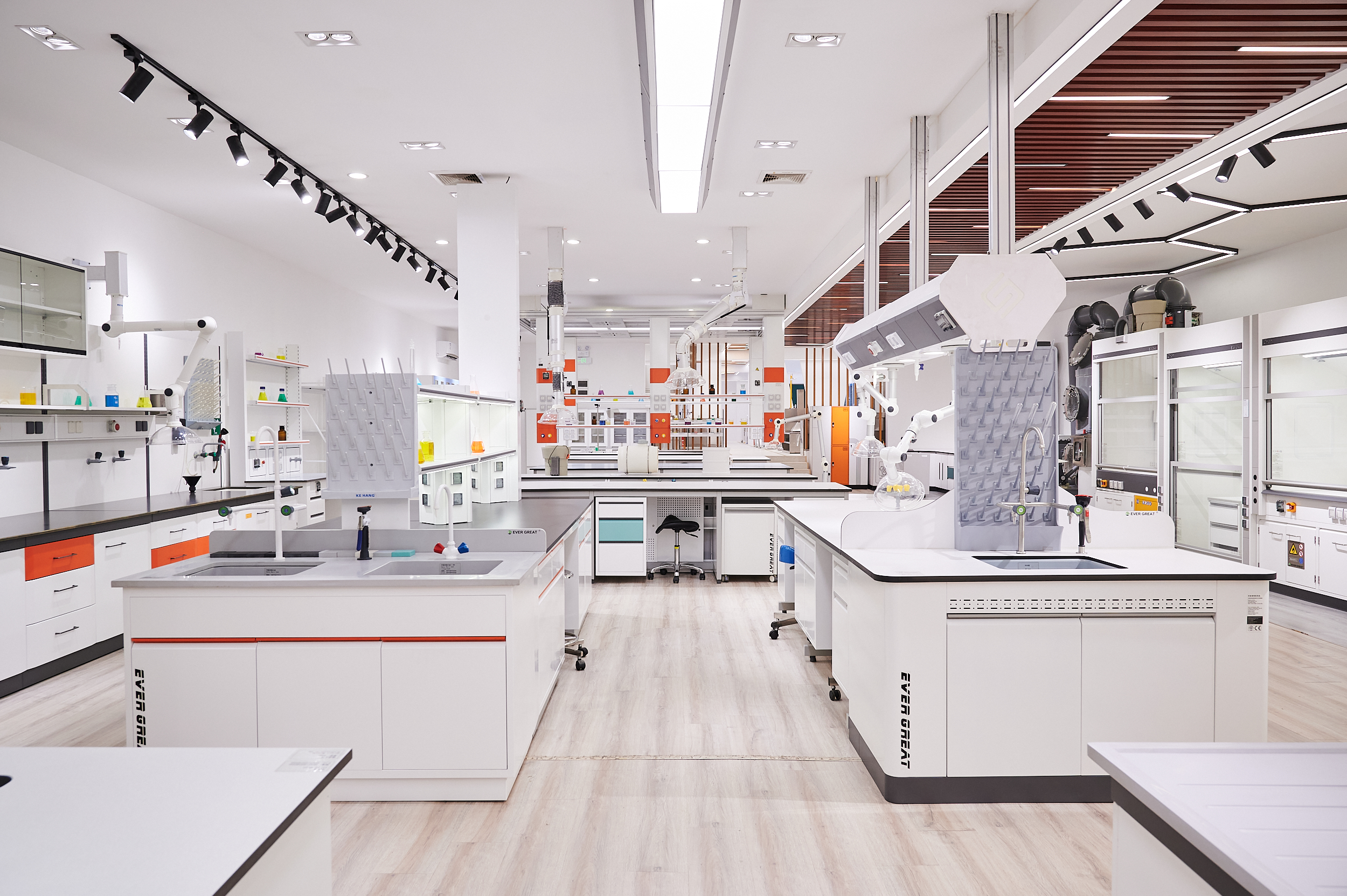
Cover: central workbench layout, used here to show how storage, containment and bench zones sit inside one room rather than as isolated products.
Quick answer. Laboratory furniture should be ranked by the hazard zone it controls, not by catalog category. In the Ever Great range, nine picks earn a place in a complete laboratory layout: the flammable safety cabinet EG-SF-LB005 for solvent storage; the PP acid and alkali storage cabinet EG-PP-CB003 for corrosive liquids; the vented chemical and reagent cabinet EG-S0-LB001 for fume-loaded reagents; the gas cylinder safety cabinet EG-S0-CB005 for cylinder bays; the laboratory safety and emergency hub EG-SF-CB011 for the emergency point; the exhaust washing bench EG-SS-LG002 for wash and digestion work; the narrow-frame fume hood Orion series for primary containment; and the C-frame wall bench EG-S0-LB003 plus the island laboratory bench EG-S0-CB005 for bench workflows. Each entry below states the verified construction facts behind the ranking, the zone it serves, and the boundary where another pick is the better answer.
Problem Definition: Why Hazard Zone Sets the Ranking Order
A laboratory fails at its weakest containment point, and that point is rarely the workbench. Flammable solvents, mineral acids, vented reagents, compressed gases and eyewash access each create a different failure mode: fire load, corrosive attack, vapour accumulation, cylinder tipping, or delayed emergency response. Ranking furniture by hazard zone forces the buyer to answer a harder question than "how many cabinets do we need?" — namely, which unit sits between the hazard and the person, and what construction facts make that placement defensible.
This is why a 45-gallon flammable cabinet, an 8.0 mm PP corrosion cabinet and a purged cylinder cabinet cannot be compared on price alone. They solve different problems. The ranking below orders picks by how directly they address a hazard zone, then by workflow dependency — storage and containment first, bench surfaces second, because bench surfaces only matter once the chemicals and gases have somewhere safe to live.
Industry Background: Standards and Market Structure Buyers Should Read Together
Two standards frame most laboratory furniture specification conversations. ANSI/ASHRAE Standard 110-2016 (R2025) is the primary American national standard for quantitative and qualitative performance testing of laboratory fume hoods, and it is the reference buyers normally cite when they ask for containment evidence rather than a face-velocity number alone. In Europe, EN 14470-1 classifies fire-resistant safety cabinets as Type 15, 30, 60 or 90 minutes according to the time taken to reach an internal temperature rise limit, with the internal temperature increase not exceeding 180 K or 200 °C. Those two standards answer different questions — one is containment, the other is fire endurance — and a credible laboratory furniture package should be able to separate them clearly.
Market structure explains why metal remains the default frame material. Dataintelo's laboratory furniture research values the global market at approximately USD 4.8 billion in 2025, and reports that the metal segment held a 52.7% revenue share in the same year. Published valuations for the same year vary widely between research houses because definitions differ — core furniture versus integrated laboratory solutions — so a single market number should be treated as orientation, not as a procurement fact. On the supply side, China exported over USD 4.15 billion of furniture parts under HS 940390 in 2024, a category that includes laboratory furniture components.
The practical consequence for a 2026 project is that polymer furniture has not replaced metal; it has been added where corrosion, not load, is the governing risk. That is precisely why the ranking below mixes steel, PP and stainless-steel picks instead of declaring one material the winner.
How These Nine Picks Were Ranked
Each pick was assessed against five criteria, in this order: (1) the hazard it physically separates from the operator; (2) verified construction facts — material thickness, containment volume, exhaust connection sizing, alarm or purging provisions; (3) workflow dependency, meaning whether other equipment cannot function properly without it; (4) exhaust and utility compatibility with the rest of the room; (5) the boundary conditions where the pick stops being the right answer. Ranking position reflects hazard priority, not overall product quality.
The Ranking: Safety Picks by Hazard Zone and Workflow Need
1. Flammable Safety Cabinet EG-SF-LB005 — Flammable Solvent Storage Zone
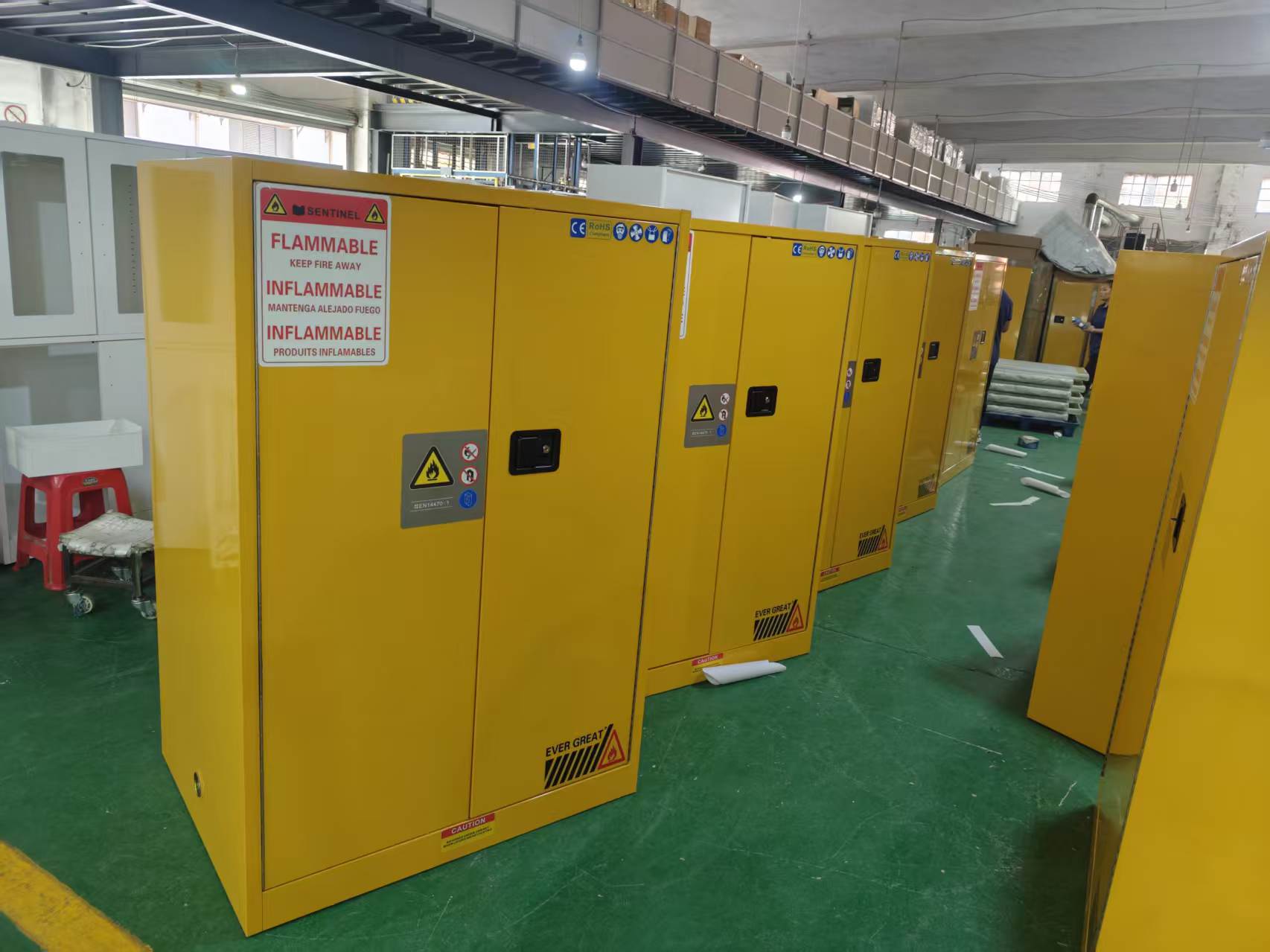
This is the top-ranked pick because flammable liquid storage is the hazard zone that most often determines whether the rest of the room can be occupied at all. The EG-SF-LB005 is a yellow fireproof chemical safety cabinet measuring 1090 x 460 x 1650 mm with a 45 gallon nominal capacity. Its shell is 1.2 mm double-wall steel with a 38 mm air barrier, and it carries a 51 mm sump plus dual flash-arrested vents. Shelving is galvanized and hardware is zinc-plated; the three-point latch, spill sump, grounding provision and adjustable shelves are the features that matter operationally, because a cabinet is only useful if containers can be grounded, repositioned and contained after a spill.
Boundary: if the requirement is a declared fire-resistance class under EN 14470-1, ask for that classification explicitly, because fire endurance and daily containment are separate declarations. If the chemicals are concentrated acids rather than solvents, this cabinet is the wrong zone solution — move to pick 2.
2. PP Acid and Alkali Storage Cabinet EG-PP-CB003 — Corrosive Liquid Zone
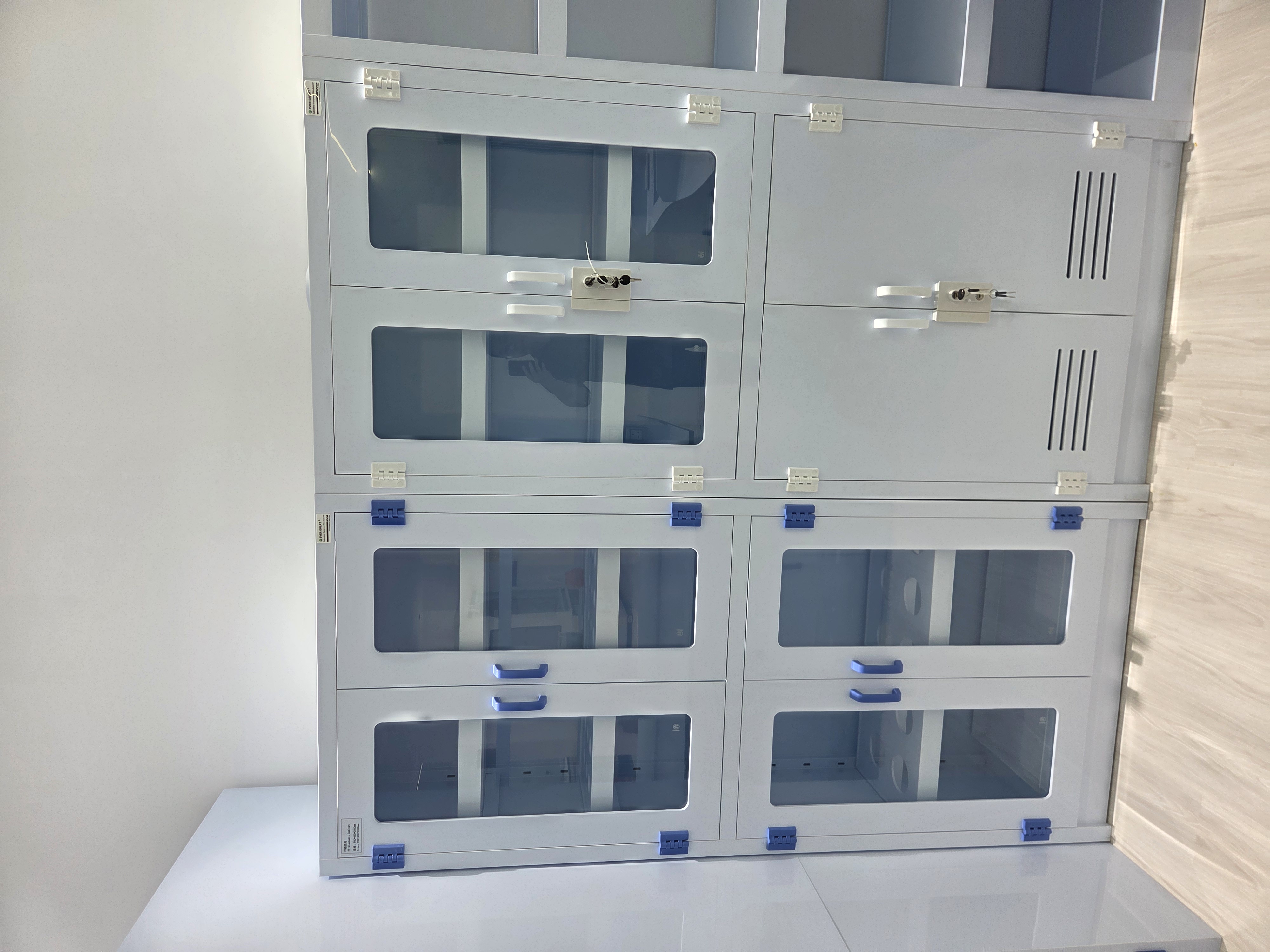
The second pick exists because steel and concentrated acids are a poor combination. EG-PP-CB003 is a metal-free corrosive chemical storage cabinet: 900 x 450 x 1800 mm, built from 8.0 mm PP sheet with PP hardware, three adjustable spill-containment shelves, a bottom sump and a Dia. 110 mm exhaust port. Typical deployment is chemical, electroplating and acid-alkali laboratories — rooms where HCl, HNO3 or HF handling makes the cabinet wall itself part of the safety argument rather than a neutral box.
Boundary: the unit is a storage cabinet, not a work surface; acid digestion work still needs an exhausted bench or hood. Where a lab also needs a seamless PP working environment for heavy acid service, the polypropylene fume hood EG-PP-FH in the same range is the corresponding containment option.
3. Vented Chemical and Reagent Cabinet EG-S0-LB001 — Reagent and Vapour-Loaded Storage Zone
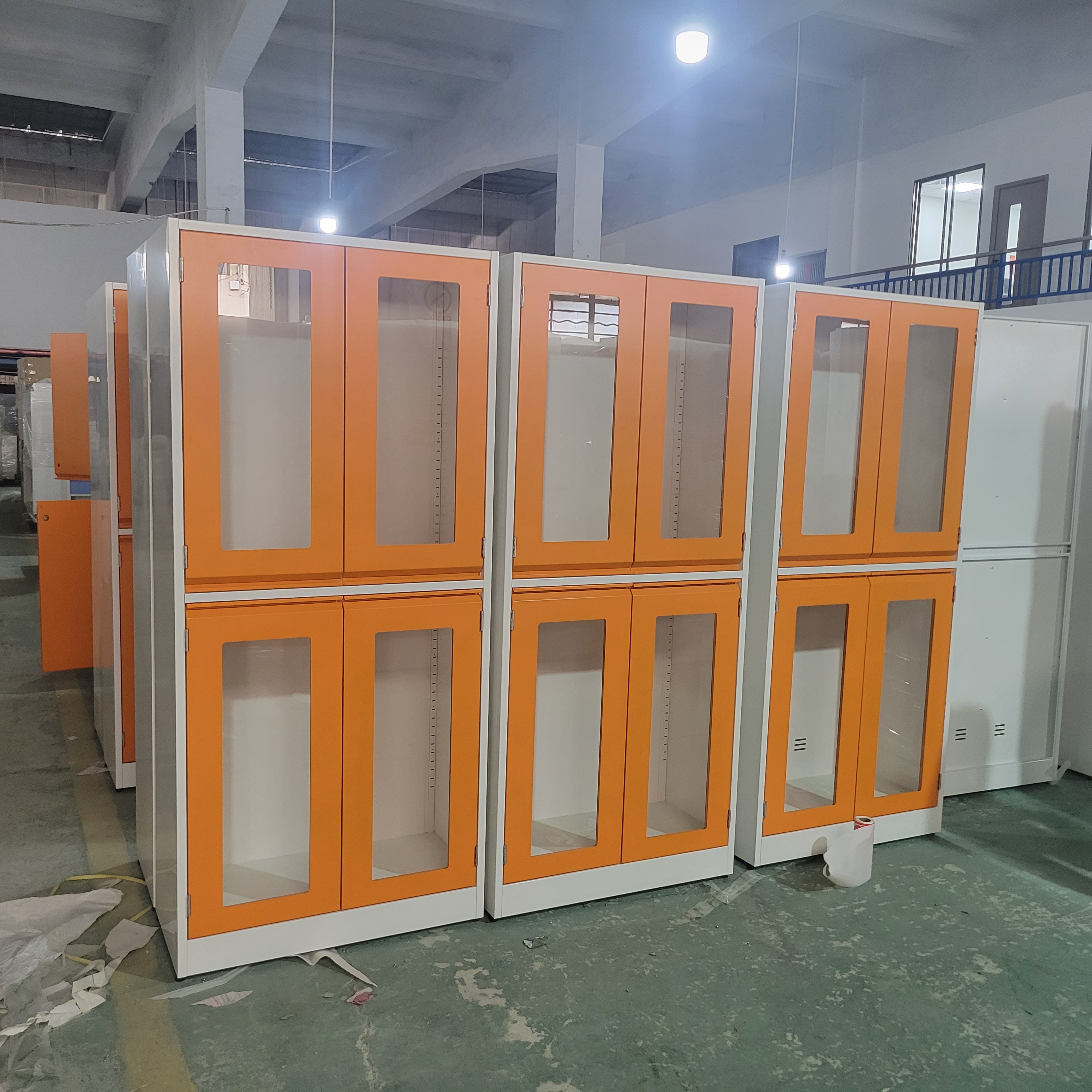
Third place goes to the pick that converts passive storage into controlled storage. EG-S0-LB001 measures 900 x 500 x 1800 mm, uses double-wall steel construction with epoxy coating and tempered glass doors, provides four adjustable shelves, and includes a Dia. 110/150 mm exhaust connection. The exhaust connection is the decisive specification: without it, a reagent cabinet accumulates vapour; with it, the cabinet becomes part of the room's extraction strategy.
Boundary: specifying the connection is only half the job. Someone must confirm that the house exhaust can accept the additional flow — a cabinet tied into an already saturated duct simply moves the problem.
4. Gas Cylinder Safety Cabinet EG-S0-CB005 — Compressed Gas Zone
Cylinder bays rank fourth because a loose cylinder is the highest-energy object in most laboratories. EG-S0-CB005 is a steel gas cylinder cabinet with a purging system: 900 x 450 x 2000 mm, 1.0 mm cold-rolled steel with powder coating, available in single-, double- and triple-cylinder configurations, with alarm/exhaust linkage configuration. Cylinder-fixing provisions, an anti-tip layout and an optional automatic purging mode are the facts that make the unit usable in semiconductor and industrial-gas rooms, where gas detection must trigger something rather than merely display a reading.
Boundary: cylinder count drives the configuration decision, and mixed gas service usually requires segregating incompatible cylinders into separate cabinets rather than combining them in one triple unit.
5. Laboratory Safety and Emergency Hub EG-SF-CB011 — Emergency Response Point
The emergency hub ranks fifth on hazard priority but is often the first item an auditor walks toward. EG-SF-CB011 measures 900 x 600 x 2000 mm, is built from 1.0 mm cold-rolled steel with epoxy powder coating and aluminum handle, and integrates a shower, eyewash, first-aid and fire-safety storage in one footprint. Leak-sensing configuration and alarm integration capability are available as configured functions, which matters where the emergency point must report into a building system rather than stand alone.
Boundary: centralising emergency equipment improves visibility and maintenance discipline, but it also concentrates travel distance. In large or multi-room floors, a single hub should be assessed against the actual walking route from the furthest bench.
6. Exhaust Washing Bench EG-SS-LG002 — Wash and Digestion Workflow
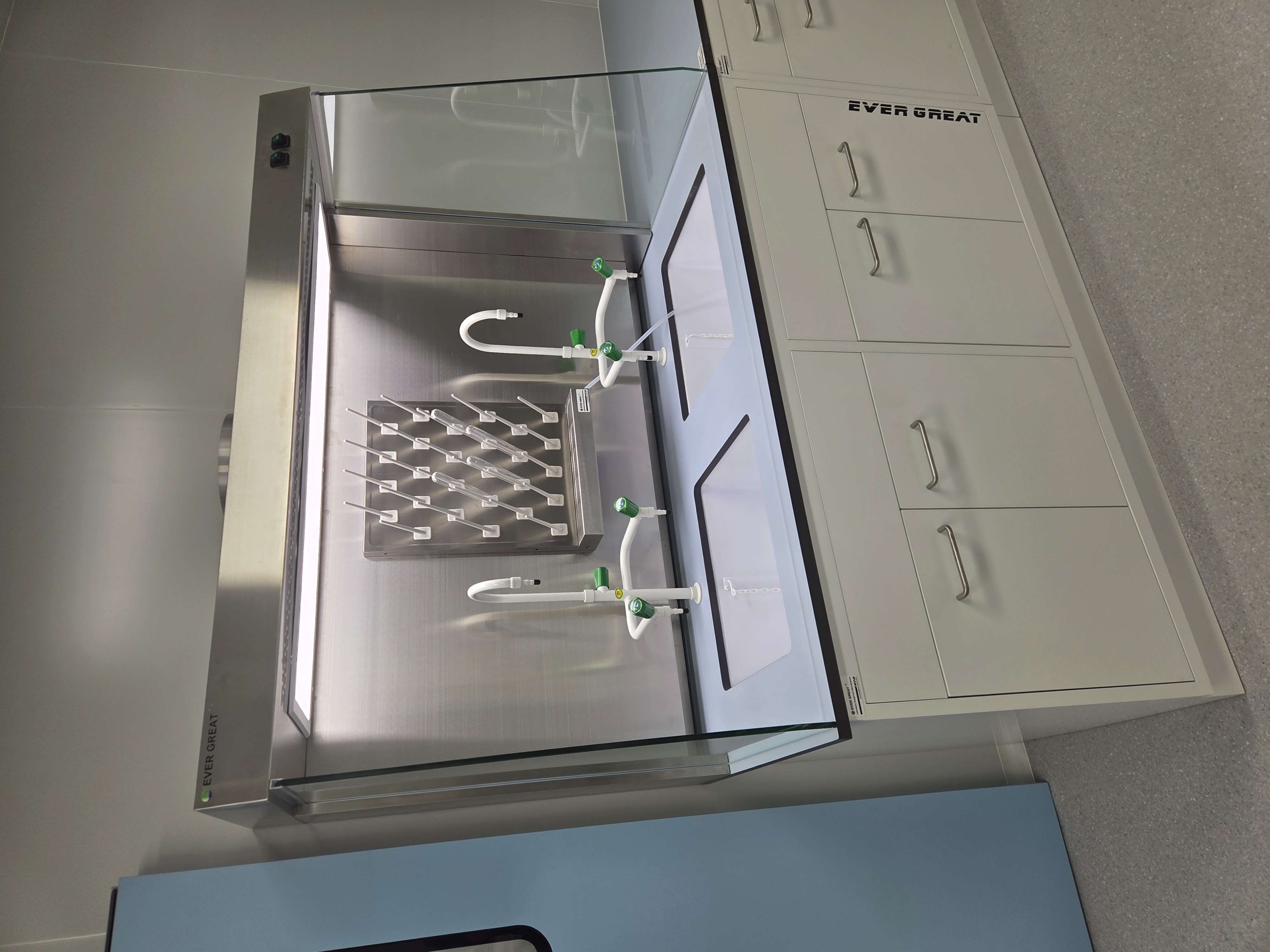
Sixth place belongs to the pick that merges two workflows that are usually separated badly. EG-SS-LG002 measures 1500 x 750 x 1500 mm with a 25 mm ceramic worktop, two PP sinks and two three-way gooseneck faucets, in full steel with a 304 stainless steel hood and PP sinks. It combines washing and local exhaust, so rinsing, sample preparation and low-level vapour release happen under extraction instead of in an open sink bay.
Boundary: the ceramic top and stainless hood suit wet, corrosive and rinse-heavy work; they are not a substitute for a fume hood when the task involves heated concentrated acid digestion with sustained vapour release.
7. Narrow-Frame Fume Hood, Orion Series — Primary Containment Zone
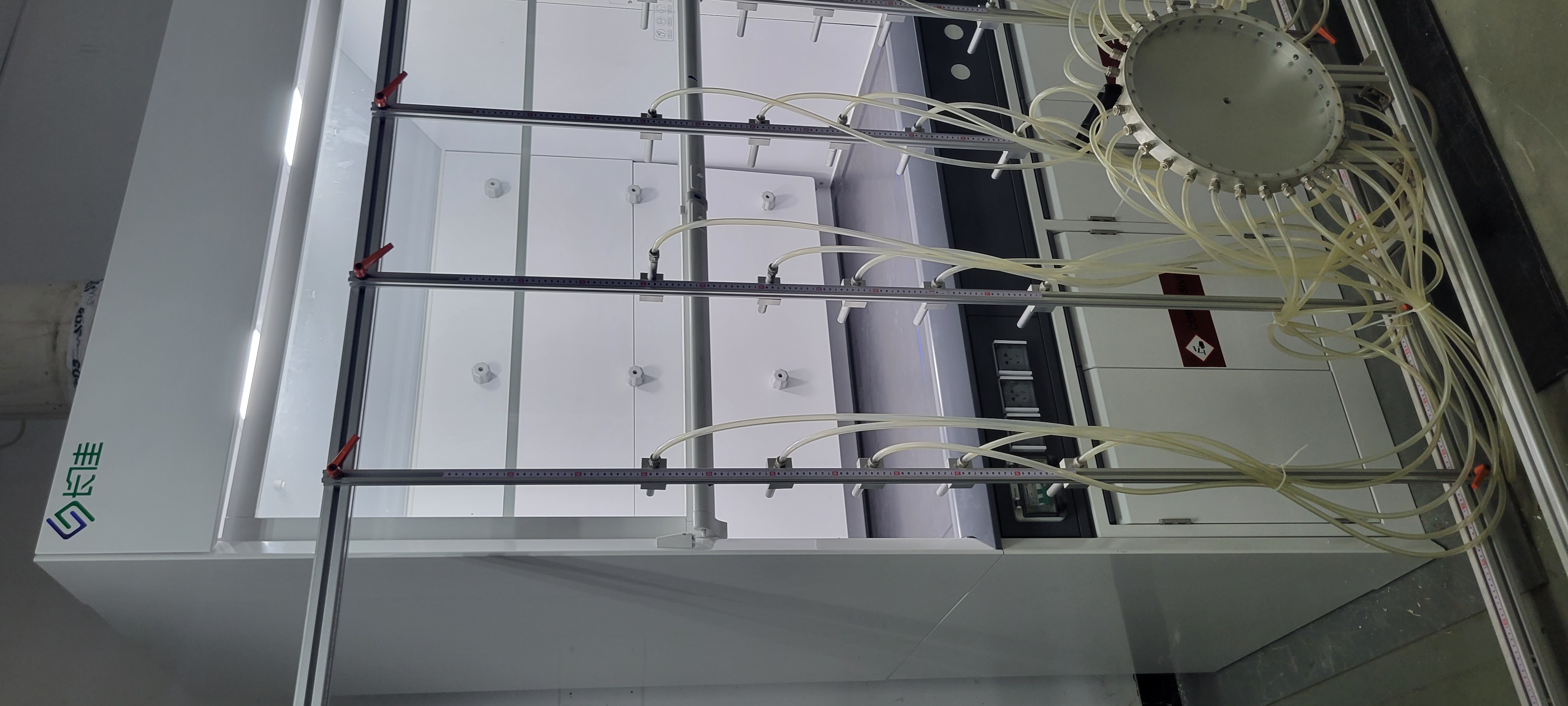
The fume hood ranks seventh only because it depends on everything above it being resolved; technically it is the most consequential containment item in the room. The narrow-frame fume hood is offered as Orion-TS-1500, Orion-TS-1800, Orion-LD-1500 and Orion-LD-1800 in benchtop and walk-in configurations, with overall dimensions of 1500/1800 x 900 x 2400 mm, internal widths of 1408/1708 mm, a nominal face velocity of 0.3 m/s, a PP exhaust canopy in Dia. 250/315 mm, an aluminum alloy frame and a VAV/CAV-ready configuration path.
Boundary: face velocity is a design figure, not proof of containment. Ask for ASHRAE 110 or EN 14175 test evidence and confirm the exhaust route before fixing the final position.
8. C-Frame Wall Laboratory Bench EG-S0-LB003 — Side and Secondary Workflow
Eighth place goes to the bench that keeps the room serviceable. EG-S0-LB003 is a suspended C-frame wall bench in 1200/1500/1800 x 750 x 850 mm sizes, built on 40 x 60 x 1.8 mm steel tube with a 12.7 mm phenolic worktop. The suspended frame leaves the floor below the bench clear, which changes how quickly a spill or a floor-level contamination event can be addressed, and the under-bench cabinet layout stays flexible as instrument needs change.
Boundary: a phenolic top is the general-purpose choice; acid-heavy side benches should be reviewed against the worktop comparison further below.
9. Island Laboratory Bench EG-S0-CB005 — Central High-Throughput Workflow
Ninth place is the central workstation that only becomes economical once the room geometry supports it. EG-S0-CB005 measures 3000/3600 x 1500 x 850 mm in 1.0–1.2 mm steel, with a worktop choice of 12.7 mm phenolic, 20 mm ceramic or epoxy resin, integrated 220V/10A sockets, and optional reagent rack and PP sink. Modular layout and utility integration are what make it a research-grade bench rather than a large table.
Boundary: island benches concentrate services in the centre of the room, so their position should be fixed only after the fume hood exhaust route and the emergency hub travel path are settled.
Comparison Table: The Nine Picks at a Glance
| Rank | Pick and model | Hazard zone or workflow | Verified specification highlights |
|---|---|---|---|
| 1 | Flammable safety cabinet EG-SF-LB005 | Flammable solvent storage | 1090 x 460 x 1650 mm; 45 gallon nominal; 1.2 mm double-wall steel; 38 mm air barrier; 51 mm sump; dual flash-arrested vents |
| 2 | PP acid and alkali storage cabinet EG-PP-CB003 | Corrosive acid and alkali storage | 900 x 450 x 1800 mm; 8.0 mm PP sheet; metal-free; three spill-containment shelves; bottom sump; Dia. 110 mm exhaust port |
| 3 | Vented chemical and reagent cabinet EG-S0-LB001 | Reagent storage with vapour control | 900 x 500 x 1800 mm; double-wall steel; four adjustable shelves; Dia. 110/150 mm exhaust connection |
| 4 | Gas cylinder safety cabinet EG-S0-CB005 | Compressed gas cylinder bay | 900 x 450 x 2000 mm; 1.0 mm cold-rolled steel; single/double/triple cylinder options; alarm and exhaust linkage; automatic purging option |
| 5 | Laboratory safety and emergency hub EG-SF-CB011 | Emergency response point | 900 x 600 x 2000 mm; 1.0 mm cold-rolled steel; integrated shower, eyewash, first-aid and fire-safety storage |
| 6 | Exhaust washing bench EG-SS-LG002 | Wash, rinse and sample preparation | 1500 x 750 x 1500 mm; 25 mm ceramic worktop; two PP sinks; two three-way gooseneck faucets; 304 stainless steel hood |
| 7 | Narrow-frame fume hood Orion-TS/LD series | Primary vapour containment | 1500/1800 x 900 x 2400 mm; internal width 1408/1708 mm; nominal face velocity 0.3 m/s; PP exhaust canopy Dia. 250/315 mm; benchtop and walk-in |
| 8 | C-frame wall laboratory bench EG-S0-LB003 | Side and secondary bench work | 1200/1500/1800 x 750 x 850 mm; 40 x 60 x 1.8 mm steel tube; 12.7 mm phenolic worktop; clear floor below |
| 9 | Island laboratory bench EG-S0-CB005 | Central high-throughput workflow | 3000/3600 x 1500 x 850 mm; 1.0-1.2 mm steel; phenolic, ceramic or epoxy worktop options; 220V/10A sockets; optional reagent rack and PP sink |
Ducted vs Ductless Fume Hood: Decide This Before You Rank a Hood
The ducted or ductless decision comes before model selection, because it determines whether the hood can serve the chemistry at all. Ducted hoods exhaust essentially all fumes outdoors and impose no inherent limit on chemical type, with lower long-term filter replacement costs; they are the appropriate route for heavy chemical work, heated acid digestions, volatile toxic gases and high-throughput research. Ductless (filtered) hoods recirculate air through HEPA and activated carbon filtration, reduce HVAC energy demand and installation complexity, and suit light-to-moderate chemical handling, teaching laboratories, or leased buildings without a duct route.
Three checks settle the question. First, complete a chemical inventory including boiling points and evaporation rates, to confirm whether carbon filtration can capture the substances in use or whether outdoor ducting is mandatory. Second, verify the duct route and the room's makeup air capacity against a continuous face velocity of 0.3–0.5 m/s (60–100 FPM). Third, commission the hood at a defined sash height — typically 400–500 mm — with the face-velocity monitor and alarm calibrated, then confirm containment with a smoke test and a face-velocity grid. Two safety notes carry real weight: perchloric acid and radioisotopes require specialized washdown systems rather than a standard ducted or ductless hood, and carbon filters must be replaced at breakthrough rather than on a calendar.
Epoxy vs Phenolic Resin Worktops: Match the Surface to the Hazard
Worktop selection follows the same logic as cabinet selection: the surface should be chosen for the dominant attack mode, not for appearance. Epoxy resin is a monolithic, non-porous material with strong resistance to harsh corrosives and thermal shock — appropriate for heavy chemical synthesis, university research and high-heat environments, with typical specification checks including water absorption below 0.05%. Phenolic resin offers strong scratch and impact resistance with standard chemical durability and better cost efficiency, which suits biology, pharmaceutical QC, physical testing and general chemistry. Ceramic, offered at 20 mm on the island bench and 25 mm on the exhaust washing bench, is the third option where a hard, corrosion-resistant and heat-tolerant surface is the priority.
During installation, three details decide whether the surface choice survives contact with reality: sealing sink cutouts, fixture holes and reagent-rack mounting points with epoxy adhesive; levelling slabs onto the steel frame with a spirit level; and sealing all joints with chemical-resistant silicone. Inspecting sink basin seals is not cosmetic — a slow corrosive leak into under-bench steel cabinets is the most common way a good worktop specification is lost.
Step-by-Step Breakdown: Turning the Ranking into a Layout
Step 1 — Zone audit. List every chemical, gas cylinder and heated process by location, and mark which zone each occupies. This produces the count of storage and containment units before any pricing discussion starts.
Step 2 — Size the storage layer. Confirm flammable volume against the 45-gallon nominal capacity of EG-SF-LB005, corrosion load against the 8.0 mm PP construction of EG-PP-CB003, and cylinder count against the single, double or triple configuration of EG-S0-CB005.
Step 3 — Route the exhaust. Match cabinet connections (Dia. 110/150 mm on the vented reagent cabinet, Dia. 110 mm on the PP cabinet) and hood canopy sizes (Dia. 250/315 mm) to the available ductwork, and confirm the fan capacity before ordering.
Step 4 — Fix the emergency point. Position the EG-SF-CB011 hub on the travel path from the highest-risk bench, then verify shower and eyewash clearance around the 900 x 600 x 2000 mm footprint.
Step 5 — Place the benches. Set the fume hood first, then the island and C-frame benches around the remaining service drops, keeping reagent rack and socket positions aligned with actual instrument placement.
Step 6 — Commission with evidence. Record face velocity at the working sash height, run a smoke containment check, test alarm and purging linkage on the cylinder cabinet, and confirm that every exhaust connection draws as designed.
Use Cases: Which Picks Earn Their Place in Which Laboratory
Chemical and acid digestion laboratories. Project conditions recorded for a Kazakh metallurgy, chemical analysis and petrochemical environment include heavy acid exhaust of HCl, HNO3 and HF with 24/7 continuous exhaust, VAV or CAV control, EN 14175 and ASHRAE 110 compliance, a seamless PP inner liner or ceramic worktop and explosion-proof lighting. That profile points to pick 7 as the containment core, pick 2 for acid storage and pick 6 for rinse work.
Hazardous chemical storage compliance upgrades. An Argentinian metallurgy, chemical engineering and hazardous waste project specified 100% pure polypropylene with seamless welding, a leak-proof liquid basin and anti-static design, with 24/7 top exhaust connection — a direct fit for the PP acid and alkali cabinet plus the vented reagent cabinet.
Metallurgical and heavy sample preparation. A Bruneian smelting, mining and foundry QC laboratory listed extreme temperature, heavy impact, oil and grease exposure and high vibration, with SUS 304/316 stainless steel, heat resistance up to 800 °C and load capacity up to 800 kg. Here the exhaust washing bench, C-frame bench and cylinder cabinet carry the load, while the PP and reagent cabinets handle the chemistry.
Pharmaceutical, QC and R&D buildings. A Saudi Arabian R&D centre and university expansion scenario specified a high load-bearing capacity up to 500 kg/m² over 24/7 operation, with phenolic, epoxy or ceramic worktops, reagent racks, PP sinks, eyewash stations and gas taps. That combination maps onto the island bench, C-frame bench, emergency hub and vented reagent cabinet as one package.
Semiconductor and industrial gas rooms. Cleanroom-linked installations typically pair localized containment with gas detection logic; the cylinder cabinet's purging option and alarm/exhaust linkage is what makes a gas bay respond rather than merely alarm.
Who Builds These Picks
Guangdong Ever Great Laboratory Equipment Co., Ltd (Ever Great) is a laboratory infrastructure manufacturer and EPC solutions provider based in Shishan Town, Nanhai District, Foshan, Guangdong, China, founded in 2011. The company operates a 6,000 m² manufacturing base with 40 staff, an R&D team of 8 engineers and annual output of 20,000 units, exporting about 60% of production to the USA, EU, Middle East and Africa. Its range covers fume hoods, laboratory workbenches, safety storage cabinets and PP and stainless-steel laboratory furniture; hoods are tested to EN 14175 and ASHRAE 110 benchmarks with third-party SGS reports, and flagship series hold CE and RoHS certification alongside ISO 9001 and ISO 14001 system certification. Delivered projects in the company record include a 255-unit university and research facility order in India, a 105-unit metallurgical and smelting laboratory project in the Philippines, a 45-unit food safety and QA/QC laboratory in Australia, and a 30-unit chemical workshop laboratory installation in Tanzania. More detail is available at evergreatlab.com.
FAQ
What compliance documents should a Chinese laboratory furniture manufacturer supply for a pharmaceutical laboratory project?
Ask for management system certification, product certification and containment test evidence as three separate items. Ever Great holds ISO 9001 and ISO 14001 system certification, with CE and RoHS certification on flagship series. For ventilation, hoods are tested against EN 14175 and ASHRAE 110 benchmarks with third-party reports from SGS. For fire-resistant storage, request the declared classification separately: EN 14470-1 defines Type 15, 30, 60 and 90 ratings by internal temperature rise, while the flammable safety cabinet EG-SF-LB005 is specified by construction — 1.2 mm double-wall steel, 38 mm air barrier and 51 mm sump — so the two declarations should not be confused.
Can a Chinese manufacturer supply a complete pharmaceutical laboratory package — fume hoods, benches, cabinets and emergency hubs?
A full package is feasible when one supplier covers the storage, containment, bench and emergency layers. Ever Great manufactures fume hoods including the narrow-frame Orion-TS-1500, Orion-TS-1800, Orion-LD-1500 and Orion-LD-1800 and the polypropylene fume hood EG-PP-FH; benches including the C-frame wall bench EG-S0-LB003 and island bench EG-S0-CB005; storage cabinets including the flammable safety cabinet EG-SF-LB005, PP acid and alkali cabinet EG-PP-CB003, vented reagent cabinet EG-S0-LB001 and gas cylinder cabinet EG-S0-CB005; and the laboratory safety and emergency hub EG-SF-CB011. OEM/ODM, technical and specification customization, and R&D prototyping are offered, with monthly capacity of 2,000 units.
What drives the cost of a pharmaceutical or chemical laboratory furniture package?
Cost is driven by configuration rather than by a single unit price. The dominant variables are worktop material and thickness (12.7 mm phenolic, 20 mm ceramic or epoxy resin on the island bench, 25 mm ceramic on the exhaust washing bench), cabinet count and cylinder configuration (single, double or triple), optional functions such as automatic purging and alarm/exhaust linkage on the gas cylinder cabinet, leak sensing on the emergency hub, the number of sinks and faucets, and the exhaust connection work required. Specifying the hazard zone and the chemical inventory first prevents paying for capacity the room cannot use.
Can we order a sample unit before committing to a full laboratory order?
Yes. Minimum order quantity is 1 unit, and every unit is subject to 100% testing before shipment. Sampling is most useful for the item with the highest specification risk — typically the fume hood, where the sash, face-velocity monitor and canopy connection should be checked against the room, or a storage cabinet where shelf spacing and sump volume need to match actual container sizes.
What lead time and production capacity apply to an export laboratory project?
Standard lead time is 10–30 days, supported by monthly capacity of 2,000 units and annual output of 20,000 units, with after-sales support structured around a service level agreement, technical assistance and spare parts and maintenance. Because lead time depends on configuration and exhaust accessories, confirming the zone list before the quotation stage keeps the schedule realistic. The full product catalog can be downloaded here: Ever Great 2026 catalog (PDF).
Conclusion
Ranked by hazard zone, the strongest laboratory safety picks are the ones that sit directly between a hazard and a person: the flammable safety cabinet EG-SF-LB005 and PP acid and alkali cabinet EG-PP-CB003 for storage, the vented reagent cabinet EG-S0-LB001 and gas cylinder cabinet EG-S0-CB005 for vapour and gas control, the emergency hub EG-SF-CB011 for response, the exhaust washing bench EG-SS-LG002 and narrow-frame fume hood Orion series for containment, and the C-frame and island benches for the workflow that remains. Bench surfaces, materials and hood configurations are decisions that follow from that order — never the other way round.
Next step: match the ranking to your floor plan
Send your hazard-zone list, room dimensions and chemical inventory and receive a configuration proposal covering storage, containment, bench and emergency layers. Sample units start at MOQ 1 with 100% testing, and standard lead time is 10–30 days.
Email: qsjiang666@outlook.com · Tel / WhatsApp: +86 158-0007-2469 · evergreatlab.com · Catalog: Ever Great 2026 PDF
Have Questions or Need More Details?
Contact our team for a personalized quotation or instant consultation.
Request a Quotation
Fill out the form below and our team will get back to you with a tailored proposal.
WhatsApp Direct Chat
Prefer to chat in real-time? Message us on WhatsApp for instant assistance & quick answers.
- Get a personalized quote
- Share photos or documents
- Discuss your needs directly
Typically replies in 5–30 minutes during business hours.