
Choosing Between a Polypropylene Fume Hood and a Narrow-Frame Fume Hood
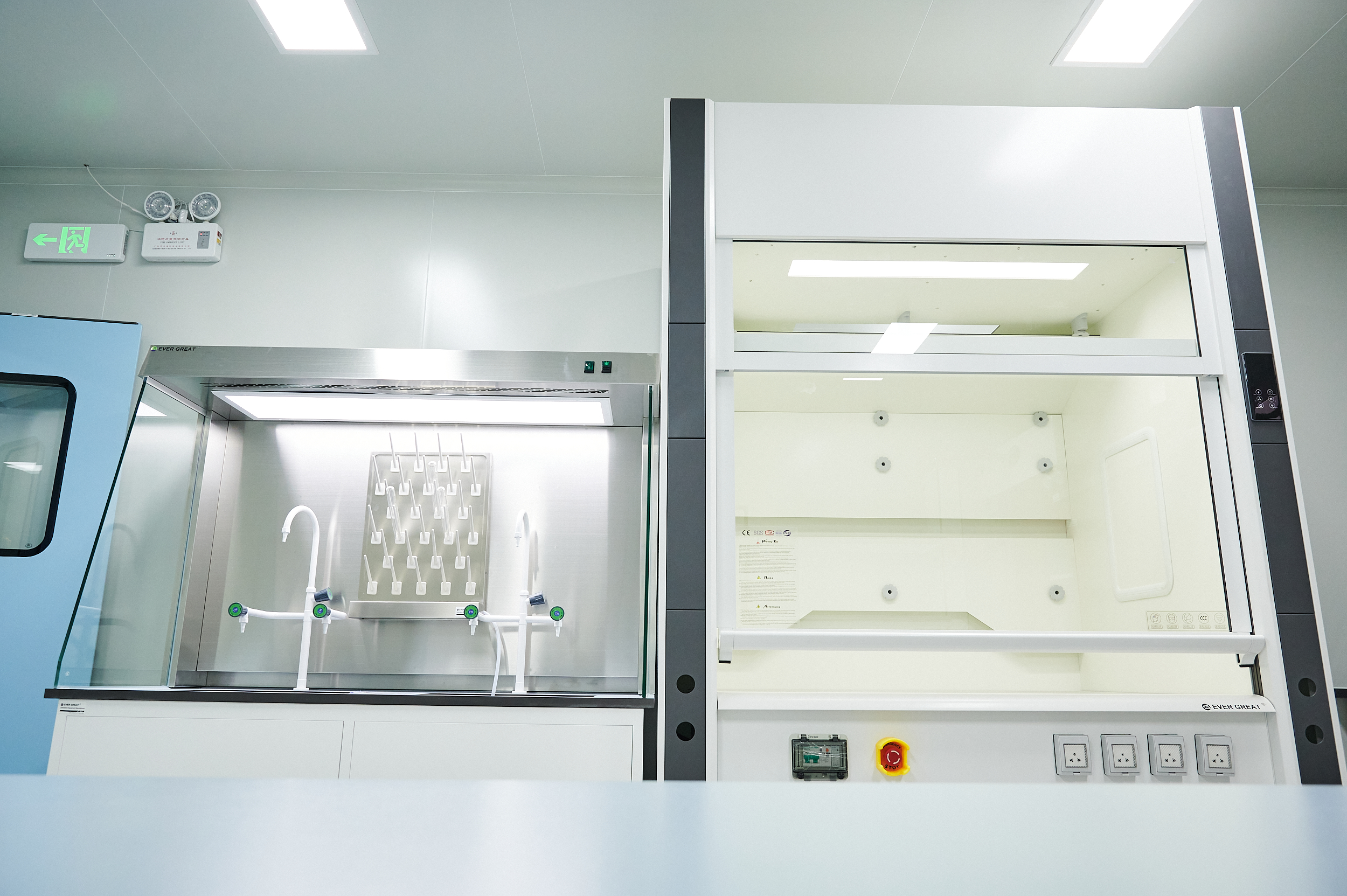
Answer first: specify a polypropylene (PP) fume hood when the dominant risk inside the chamber is aggressive chemistry — concentrated acids, alkalis, acid digestion and electroplating fumes. Specify a narrow-frame fume hood when the dominant requirement is working volume: a wide, tall, walk-in or large-sash workspace for tall apparatus and multi-operator procedures. Neither design is universally safer. Each is safer inside the boundary conditions it was engineered for.
This guide compares the two hood families on the dimensions that actually decide a purchase: the material the hood body is made from, the frame geometry that defines the working envelope, the face velocity the hood is rated at, the exhaust connection it expects, and the documentation a buyer should demand before signing. The engineering specifications referenced throughout come from Guangdong Ever Great Laboratory Equipment Co., Ltd. (Ever Great), a Foshan-based laboratory furniture manufacturer founded in 2011 that produces fume hoods, laboratory workbenches, safety storage cabinets, and PP and stainless steel laboratory furniture from a 6,000 m² facility (evergreatlab.com).
Problem Definition: Two Different Ways a Fume Hood Fails
Fume hood purchases go wrong in two predictable patterns, and they are not the same failure.
Failure one is chemical. When the hood liner and frame are steel with a powder-coated or epoxy finish, aggressive acid vapour attacks the surface over time. The visible damage usually appears late, at weld seams, hinge points, baffle fixings and duct transitions. The dangerous part is that containment can degrade before anyone notices: the hood still opens and closes normally while the liner behind the baffle is no longer doing its job.
Failure two is dimensional. A hood with a small internal working volume pushes operators into bad habits. They raise the sash higher than the intended working height to reach equipment, they store reagent bottles inside the chamber, or they leave the sash open between operations because reaching for the handle interrupts the workflow. Each of those behaviours increases the volume of contaminated air that escapes into the room.
A polypropylene fume hood addresses failure one directly, because the hood body is polymer through its full thickness rather than a coating over metal. A narrow-frame fume hood — particularly a walk-in configuration — addresses failure two, because it converts the hood from a bench-mounted enclosure into a full working volume. The buyer's job is to decide which failure mode carries more risk in their specific lab.
Industry Background: Why Material Choice Has Become a Real Decision
Laboratory furniture is a mature category dominated by metal construction, and that dominance is measurable. One commercial research estimate places the global laboratory furniture market at approximately USD 4.8 billion in 2025, with the same report projecting USD 8.1 billion by 2034 (Dataintelo). Within that market, the metal material segment held a 52.7% revenue share in 2025 — steel workbenches, steel frames and steel cabinets still define the standard laboratory.
Those figures should be read with care. Market-size estimates for the same category and the same year vary substantially between research houses, because some define the market as core modular furniture while others include integrated lab services, gas piping and high-end components. The variance is a definition problem, not evidence of a boom or a contraction, and buyers should not build a procurement case on a single headline number.
What the data does show clearly is the scale of the supply base. China exported over USD 4.15 billion of furniture parts under HS code 940390 in 2024 (OEC), a trade category that includes laboratory furniture components. For an international buyer, that means the shortlist problem is not finding a supplier — it is distinguishing between suppliers whose fume hoods are genuinely engineered for chemical service and suppliers who assemble a similar-looking enclosure from general-purpose parts.
Two standards sit behind that distinction. ANSI/ASHRAE Standard 110-2016 (R2025) is the American national standard specifying the quantitative and qualitative test method for evaluating fume containment of laboratory fume hoods — it is a performance test, not a label. In Europe, EN 14175 performs the equivalent function for the European market. A hood specification that names a standard without referencing a third-party test report has not yet told you anything verifiable.
Detailed Solution: Material Logic Versus Frame Logic
The two hood families solve the containment problem from opposite directions. One optimises the material the hood is made of; the other optimises the space the hood creates.
What a polypropylene fume hood is built to do
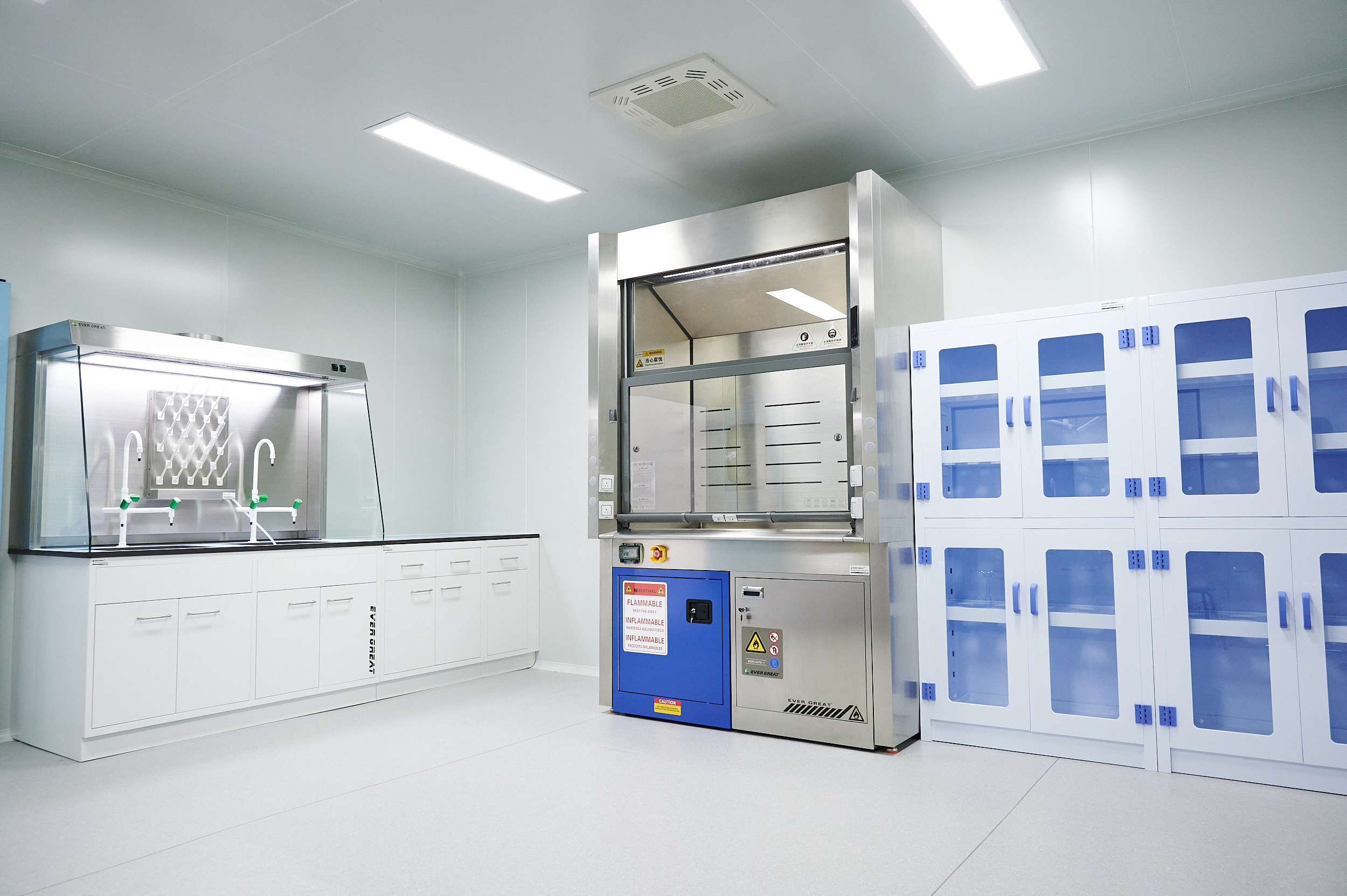
The PP fume hood is a seamless welded anti-corrosion hood. In Ever Great's EG-PP-FH specification, the body uses homogeneous PP sheet of 8.0 mm minimum thickness, joined with PP welding rod rather than mechanical fasteners, with tempered glass glazing. Overall dimensions are 1200 / 1500 / 1800 mm wide × 850 mm deep × 2350 mm high. The hood is rated at a face velocity range of 0.3–0.6 m/s and uses a three-stage baffle to manage airflow across the working chamber.
The practical consequence of welded, single-material construction is that there is no metallic substrate waiting under a coating, and no dissimilar-material joint where galvanic or acid-driven corrosion can start. That is why PP hoods are typically specified for chemical, electroplating and acid–alkali laboratories, where the chamber atmosphere is corrosive by design rather than by accident.
What a narrow-frame fume hood is built to do
The narrow-frame hood takes a different approach: a slim structural frame carrying a large glazed enclosure, with the exhaust handled by a PP canopy. In Ever Great's Orion series, the available models are Orion-TS-1500, Orion-TS-1800, Orion-LD-1500 and Orion-LD-1800, available as benchtop and walk-in configurations. Overall dimensions are 1500 / 1800 mm wide × 900 mm deep × 2400 mm high, with an internal working width of 1408 mm on the 1500 mm models and 1708 mm on the 1800 mm models. Nominal face velocity is 0.3 m/s, and the PP exhaust canopy connects to Dia. 250 mm or Dia. 315 mm ductwork.
The material specification is aluminum alloy frame with a PP exhaust canopy, and the target laboratory types are chemical, pharmaceutical and R&D laboratories. The design intent is visible working volume: a narrow structural frame maximises the glass area and the internal width, so a technician can see into the chamber from a wider range of positions, and a walk-in model can accept apparatus that would never fit through a conventional benchtop sash opening.
Where the two designs diverge in daily use
- Corrosion margin: the PP hood's corrosion resistance comes from its bulk material; the narrow-frame hood's comes from the PP canopy and the selection of the internal surfaces.
- Working envelope: the narrow-frame walk-in hood offers a larger internal width and full-height access; the PP hood is a fixed-height chamber with a defined sash opening.
- Visibility and supervision: the narrow-frame architecture exposes more glass area, which supports supervision of procedures and multi-person work.
- Airflow rating: the PP hood is rated across a 0.3–0.6 m/s band, while the narrow-frame series carries a nominal 0.3 m/s rating — a difference that matters when the building's exhaust capacity is the binding constraint.
- Exhaust connection: the narrow-frame series documents its canopy diameters, which simplifies duct sizing at design stage.
Step-by-Step Breakdown: A Six-Step Selection Sequence
The following sequence is designed so that each step can disqualify one of the two hood families early, before specification details consume the project schedule.
Step 1 — Audit the chemical inventory before anything else. List every reagent that will be handled inside the chamber, including concentration, boiling point and evaporation rate. Acid digestion with HCl, HNO₃ or HF, and electroplating chemistry, points toward polymer construction. Routine pharmaceutical QC work with moderate solvent exposure points toward a standard framed hood. This step is the single highest-leverage decision in the sequence.
Step 2 — Define the working posture, not just the footprint. Decide whether operators will work standing at a bench with a raised sash, or whether the procedure requires apparatus to be loaded into the chamber and worked on from multiple sides. A walk-in narrow-frame hood with an internal width of 1708 mm answers the second case; a fixed PP chamber answers the first.
Step 3 — Measure available exhaust capacity and duct route. Verify ceiling clearance, the duct route to the roof, and whether the laboratory's makeup air system can sustain a continuous face velocity in the required band. The narrow-frame canopy connects at Dia. 250 mm or 315 mm; if the duct route cannot carry the required volume, the hood choice is already made for you. Confirm the working sash height and calibrate the face velocity monitor and low-flow alarm before routine use.
Step 4 — Verify material compatibility across the whole hood, not just the liner. Baffles, sash tracks, fixings, service fixtures and the worktop all sit in the same vapour stream. Specify corrosion-resistant materials for the entire vapour path, and confirm that sink cut-outs, fixture holes and rack mounting points are properly sealed.
Step 5 — Validate the containment data. Ask for third-party test reports against EN 14175 or ASHRAE 110 benchmarks rather than a compliance claim in a brochure. Ever Great's ventilation and containment systems are tested against these international benchmarks, with third-party test reports issued by inspection bodies including SGS. For electrical conformity in the EU market, the CE Certificate of Conformity covering fume hood models EG-FH01 through EG-FH06 was issued under certificate number CKEYS251020088 on 20 October 2025 and is valid to 20 October 2035, against EMC Directive 2014/30/EU and the EN IEC 61000 series, as attested by Guangdong KEYS Testing Technology Co., Ltd.
Step 6 — Confirm sample, lead time and commercial terms. Customisation should be discussed before the layout is frozen, not after. Ever Great operates under an OEM/ODM model covering technical and specification customisation, OEM/white-label production, and R&D and prototyping, with a minimum order quantity of 1 unit, a production lead time of 10–30 days, a monthly capacity of 2,000 units, and 100% product testing before dispatch.
Use Cases: Matching the Hood to the Chemical and Physical Load
The clearest way to test a hood decision is to run it against projects that have already been delivered. The following reference points come from installations completed in five countries.
Metallurgical and smelting laboratory work — Philippines. A metallurgical and smelting laboratory project installed 105 units, and the installation was completed within 5 years, with R&D personnel able to carry out their daily work. Smelting and metallurgical analysis involves heavy acid exposure and high-temperature digestion, which is the operating profile where a welded PP hood's fully polymer body matters most.
Large pharmaceutical and R&D buildings — China and Australia. In China, a clinical diagnostics and healthcare laboratory project installed 200 units, allowing R&D personnel to carry out their daily work. In Australia, 45 units were installed in a pharmaceutical building for R&D use by various departments. Multi-department pharmaceutical buildings typically mix both hood families: PP hoods for acid digestion and sample prep, framed hoods for larger instrument and solvent work.
High-volume educational and research facilities — India. An India biotech project installed 255 units, completed within 5 years, enabling R&D personnel to carry out their daily work. At that scale, standardisation of hood dimensions and interchangeability of service connections matter as much as any single parameter.
Industrial chemical workshops — Tanzania. For chemical enterprise workshop laboratories in Tanzania, 30 units were installed with the project completed within 3 years. Workshop labs are typically the most abrasive environment a hood will meet: intermittent use, heavy acid handling, and limited tolerance for delicate finishes.
Comparison Table: PP Fume Hood vs Narrow-Frame Fume Hood
| Decision Factor | Polypropylene Fume Hood (EG-PP-FH) | Narrow-Frame Fume Hood (Orion-TS / Orion-LD) |
|---|---|---|
| Hood type | Seamless welded PP anti-corrosion fume hood | Benchtop and walk-in fume hood |
| Body construction | Homogeneous PP, welded with PP welding rod | Aluminum alloy frame with PP exhaust canopy |
| Sheet specification | PP sheet ≥ 8.0 mm | Frame gauge not stated in the referenced specification |
| Overall size (W × D × H) | 1200 / 1500 / 1800 × 850 × 2350 mm | 1500 / 1800 × 900 × 2400 mm |
| Internal working width | Not stated in the referenced specification | 1408 mm (1500 mm models) / 1708 mm (1800 mm models) |
| Face velocity | 0.3–0.6 m/s | 0.3 m/s nominal |
| Airflow management | Three-stage baffle | Not stated in the referenced specification |
| Exhaust connection | Not stated in the referenced specification | PP exhaust canopy, Dia. 250 / 315 mm |
| Glazing | Tempered glass | Not stated in the referenced specification |
| Primary material | Homogeneous PP / PP welding rod / tempered glass | Aluminum alloy frame / PP exhaust canopy |
| Typical laboratory fit | Chemical, electroplating, acid–alkali laboratories | Chemical, pharmaceutical, R&D laboratories |
Read the table as a boundary map rather than a scorecard. Where a cell states that information is not in the referenced specification, that is a data gap to close with the supplier — not an indication that the hood lacks the feature.
FAQ
1. Which standard should a fume hood be tested against — EN 14175 or ASHRAE 110?
They serve different markets rather than competing. ANSI/ASHRAE Standard 110-2016 (R2025) is the American national standard specifying the quantitative and qualitative test method for evaluating fume containment of laboratory fume hoods. EN 14175 is the European standard for fume hoods. Ever Great's ventilation and containment systems — including high-performance laboratory fume hoods — are tested against international benchmarks such as EN 14175 and ASHRAE 110, with third-party test reports issued by inspection bodies including SGS. For EU electrical conformity, the CE Certificate of Conformity covering fume hood models EG-FH01 through EG-FH06 (certificate number CKEYS251020088, issued 20 October 2025, valid to 20 October 2035) was issued by Guangdong KEYS Testing Technology Co., Ltd. under EMC Directive 2014/30/EU.
2. Can a polypropylene fume hood be customised to a non-standard bench length or duct position?
Yes, within a defined engineering process. Ever Great operates under an OEM/ODM production model with customisation scope covering technical and specification changes, OEM and white-label production, and R&D and prototyping. The EG-PP-FH base specification covers widths of 1200, 1500 and 1800 mm at 850 mm depth and 2350 mm height, with an 8.0 mm minimum PP sheet thickness and a three-stage baffle. Customisation is normally agreed before the laboratory layout is frozen, because sash orientation and duct routing are fixed at planning stage. Minimum order quantity is 1 unit, monthly capacity is 2,000 units, and 100% of products are tested before dispatch.
3. How should a buyer shortlist recommended laboratory furniture manufacturers?
Shortlist on verifiable evidence rather than catalogue claims, because the supply base is large — China exported over USD 4.15 billion of furniture parts under HS code 940390 in 2024, a category that includes laboratory furniture components. Four checks do most of the work: (1) third-party containment test reports against EN 14175 or ASHRAE 110, with the inspecting body named; (2) management-system and product certifications with certificate numbers and validity dates — Ever Great holds ISO 9001 and ISO 14001 system certifications alongside CE and RoHS product attestations; (3) in-house fabrication capability rather than assembly of bought-in parts, demonstrated by documented processes such as full-welded frames and acid-wash phosphating with anti-corrosive epoxy powder coating; and (4) post-delivery support terms, where Ever Great provides a 1-year comprehensive warranty, a Service Level Agreement, technical assistance, and spare parts and maintenance support. Delivered references are also evidence: a Philippines metallurgical and smelting laboratory project of 105 units, an India biotech project of 255 units, a China clinical diagnostics project of 200 units, an Australia pharmaceutical building installation of 45 units, and a Tanzania chemical workshop project of 30 units are all documented completed installations.
4. What lead time and minimum order quantity should a buyer expect on a customised fume hood?
Ever Great quotes a production lead time of 10–30 days with a minimum order quantity of 1 unit and a monthly capacity of 2,000 units. The range reflects the difference between a standard configuration and one requiring custom dimensions, non-standard duct positions or specification changes agreed at the technical review stage. Because hood installation is normally tied to bench delivery, ductwork and commissioning, buyers should sequence the hood order against the laboratory build programme rather than treating it as an isolated purchase.
5. Can I validate a fume hood with a sample or a project reference before ordering?
Yes. Buyers can request a sample or quotation and review the technical specification against their own chemical inventory before committing to a full laboratory order, and they can review completed installation references in comparable laboratory types — metallurgical and smelting, pharmaceutical R&D, educational research, food safety and QA/QC, and clinical diagnostics. Reviewing the technical specification pack, including material thickness, face velocity rating, baffle design and exhaust connection, against the containment requirement is the fastest form of pre-purchase validation. Requests can be directed to evergreatlab.com or to qsjiang666@outlook.com.
Conclusion
The choice between a polypropylene fume hood and a narrow-frame fume hood resolves to one question: in your laboratory, is the harder problem the chemistry or the workspace? If the chamber will hold concentrated acids, acid digestion or plating chemistry, the seamless welded PP hood removes the corrosion pathway entirely — homogeneous PP of 8.0 mm and above, welded rather than coated, rated across a 0.3–0.6 m/s face velocity band. If the harder problem is fitting apparatus and people into the hood, the narrow-frame walk-in design delivers the internal width — 1408 mm or 1708 mm depending on model — that makes the procedure possible in the first place.
What should not be negotiable in either case is the evidence. A fume hood is a containment device, so the containment claim must come with third-party test data against EN 14175 or ASHRAE 110, with named inspecting bodies, certificate numbers and validity dates. Everything else — finish, colour, frame profile — is secondary to whether the hood holds its rated face velocity after five years of service.
Request a sample, quotation or full specification pack
Ever Great supplies PP fume hoods, narrow-frame fume hoods, laboratory workbenches and safety storage cabinets for chemical, pharmaceutical, metallurgical and educational laboratories, with OEM/ODM customisation, MOQ of 1 unit and a 10–30 day lead time.
Website: evergreatlab.com
Email: qsjiang666@outlook.com
Tel / WhatsApp: +86 158-0007-2469
Product catalogue (PDF): Download the Ever Great 2026 catalogue