
Laboratory Furniture Application Guide: Chemical, Pharma, and Gas Lab Scenarios
Laboratory furniture is specified at the project level, not the catalog level. One facility can require three different bench systems in the same building: a phenolic-topped island bench for pharmaceutical quality control, a stainless steel sink bench for acid handling, and a PP-lined fume hood for digestion work. Buying one generic “laboratory furniture package” for all three is the most common specification mistake in laboratory projects.
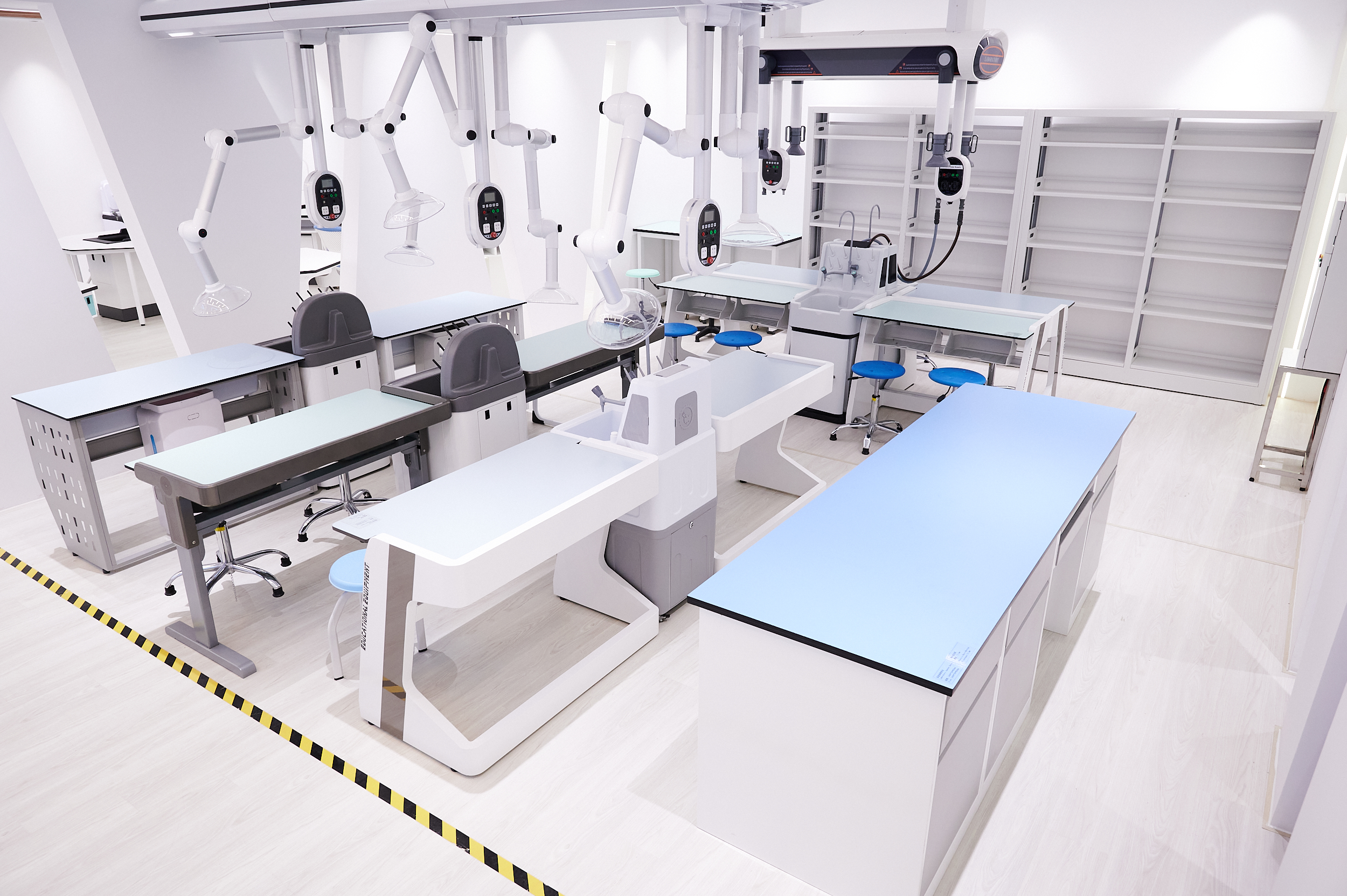
Laboratory island benches and fume hoods arranged as a multi-scenario laboratory layout
This application guide maps laboratory furniture configurations to the scenarios that actually drive them: chemical and acid-digestion laboratories, pharmaceutical and QC laboratories, multi-discipline R&D, metallurgical and high-temperature testing rooms, and industrial gas and cylinder areas. It then explains the selection logic behind each recommendation — ducted versus ductless fume hoods, epoxy versus phenolic worktops, hazardous gas leak response, and the risks that appear after the equipment leaves the factory. It is written for procurement managers, lab planners, EPC contractors, and distributors who are past the research stage, where the layout is fixed and the remaining question is which configuration will still perform in year three.
The Problem: One Furniture Specification Cannot Serve Every Lab Type
Laboratory furniture fails in service for four predictable reasons, and only one of them is about furniture quality.
- Material mismatch. A worktop rated for general chemistry will be degraded by routine methods that use concentrated acids or by a muffle furnace operation. Epoxy resin, phenolic resin, and ceramic have different chemical and thermal limits, and the correct choice depends on the method, not on the price list.
- Ventilation mismatch. A hood selected for light solvent handling is installed where acid digestion runs continuously. Containment depends on face velocity, sash discipline, and duct design — not on the appearance of the cabinet shell.
- Storage and gas-handling mismatch. Flammable liquids, corrosive acids, and compressed gases each require a different enclosure logic. Storing them in the same painted steel cabinet is a compliance failure, not a convenience.
- Logistics and installation mismatch. Worktops arrive chipped, a walk-in hood does not pass through a service corridor, or the socket voltage does not match the site supply. These failures appear after the purchase order, when correction is most expensive.
Scenario-first specification prevents all four. The sequence is always the same: define the chemical and thermal load, define the exhaust route, then size benches, hoods, storage, and emergency equipment against those two inputs.
Industry Background: A Metal-Dominated Market, Increasingly Specified by Application
Dataintelo valued the global laboratory furniture market at approximately USD 4.8 billion in 2025 and projects growth toward USD 8.1 billion by 2034. Published market values vary between research houses because “laboratory furniture” is defined differently — some estimates cover core furniture only, while others include integrated laboratory services and gas piping — so the number is best treated as a directional indicator of demand rather than an exact procurement benchmark.
Within that market, metal furniture held a 52.7% revenue share of the material segment in 2025, according to the same Dataintelo research. Steel dominates for structural reasons: load capacity, rigidity, and cost. It does not dominate everywhere. In chemical-intensive areas, polypropylene and stainless steel increasingly replace coated steel because the corrosion load is higher. The same pattern appears in trade data: China exported more than USD 4.15 billion of furniture parts under HS 940390 in 2024, according to OEC records — a category that includes laboratory furniture components and the metal structures that carry them.
The standards environment around these products is more specific than the market data:
- ANSI/ASHRAE Standard 110-2016 (R2025) is the primary American national standard for quantitative and qualitative performance testing of laboratory fume hoods, covering containment rather than airflow alone.
- EN 14175 is the European fume hood standard referenced in Ever Great’s test documentation, applied alongside ASHRAE 110 and supported by third-party test reports from inspection bodies such as SGS.
- EN 14470-1 classifies fire-resistant safety cabinets for flammable liquids as Type 15, 30, 60, or 90 minutes, based on the time taken to reach an internal temperature rise limit of 180 K (200 °C).
Guangdong Ever Great Laboratory Equipment Co., Ltd. (Ever Great) holds ISO 9001 quality, ISO 14001 environmental, and ISO 45001 occupational health and safety management system certification, with CE and RoHS certification on flagship product series. Those certificates answer the supplier question. They do not answer the scenario question, which is what the rest of this guide addresses.
Scenario Configurations: What Each Laboratory Type Actually Needs
The configurations below follow the logic used in Ever Great project profiles, where each laboratory type is defined by working conditions, matched equipment, and special requirements rather than by a single product code.
1. Chemical and Acid-Digestion Laboratories
The controlling factor is the exhaust chemistry. Where HCl, HNO3, or HF are handled at elevated temperature with continuous airflow, the hood, the liner, and the worktop must all be corrosion-rated, and the exhaust system — not the cabinet alone — determines operator safety.
- Fume hood for acid duty: the EG-PP-FH polypropylene fume hood is built from homogeneous PP sheet of at least 8.0 mm with a welded construction, a three-stage baffle, and tempered glass, operating across a face velocity range of 0.3–0.6 m/s in sizes of 1200/1500/1800 × 850 × 2350 mm.
- Fume hood for general chemical and R&D work: the Orion-TS and Orion-LD narrow-frame fume hoods are available as benchtop and walk-in units in 1500/1800 × 900 × 2400 mm, with internal widths of 1408/1708 mm, a nominal face velocity of 0.3 m/s, an aluminum alloy frame, and a PP exhaust canopy in 250/315 mm diameters.
- Sink-side acid handling: the exhaust washing bench EG-SS-LG002 is configured with 304 stainless steel, PP sinks, and a ceramic worktop for wash-down and acid handling at the bench sink.
- Ventilation support: heavy-acid projects are typically matched with a centrifugal PP exhaust fan, an acid scrubber tower, a ductwork system, and an airflow monitor controller, running 24/7 on VAV or CAV control. Where exhaust systems are upgraded for high-temperature acid duty, the usual special requirements are EN 14175 / ASHRAE 110 compliance, a seamless PP inner liner or ceramic worktop, and explosion-proof lighting.
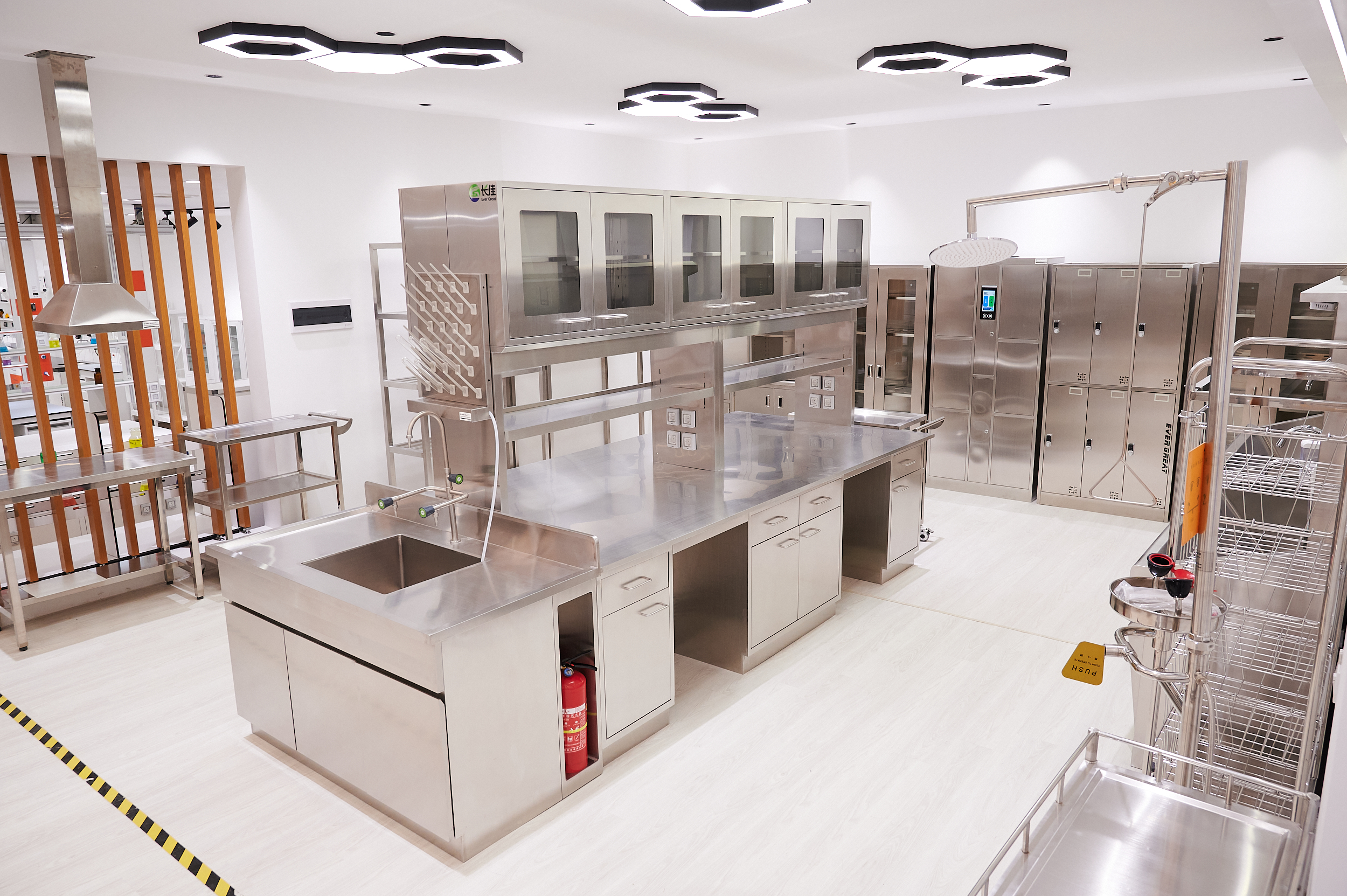
Stainless steel laboratory furniture display: sink-side and corrosion-resistant chemical laboratory configurations
2. Pharmaceutical and Quality-Control Laboratories
Pharmaceutical QC work is dominated by repetitive sample preparation, cleanliness, and documentation rather than by aggressive chemistry. Worktops must resist scratching and staining, joints must be sealable, and storage must separate flammable solvents from corrosive reagents.
- Central workstations: the EG-S0-CB005 island laboratory bench is a full-steel central workstation in 3000/3600 × 1500 × 850 mm, using 1.0–1.2 mm steel with worktop options of 12.7 mm phenolic, 20 mm ceramic, or epoxy resin, and 220V/10A socket modules.
- Perimeter workstations: the EG-S0-LB003 C-frame wall laboratory bench is a suspended bench in 1200/1500/1800 × 750 × 850 mm, built on 40 × 60 × 1.8 mm steel tube with a 12.7 mm phenolic worktop.
- Flammable storage: a flammable cabinet classified under EN 14470-1 in the Type 15/30/60/90 range, selected against the fire-resistance duration the site actually requires rather than by cabinet size.
- Corrosive storage: a PP acid and alkali cabinet built with 100% pure polypropylene seamless welding, a leak-proof liquid basin, and anti-static design, connected to external exhaust ventilation with chemical spill trays and safety padlocks.
- Biosafety and cleanroom equipment is usually specified in the same procurement package, because its placement determines bench clearance and airflow paths.
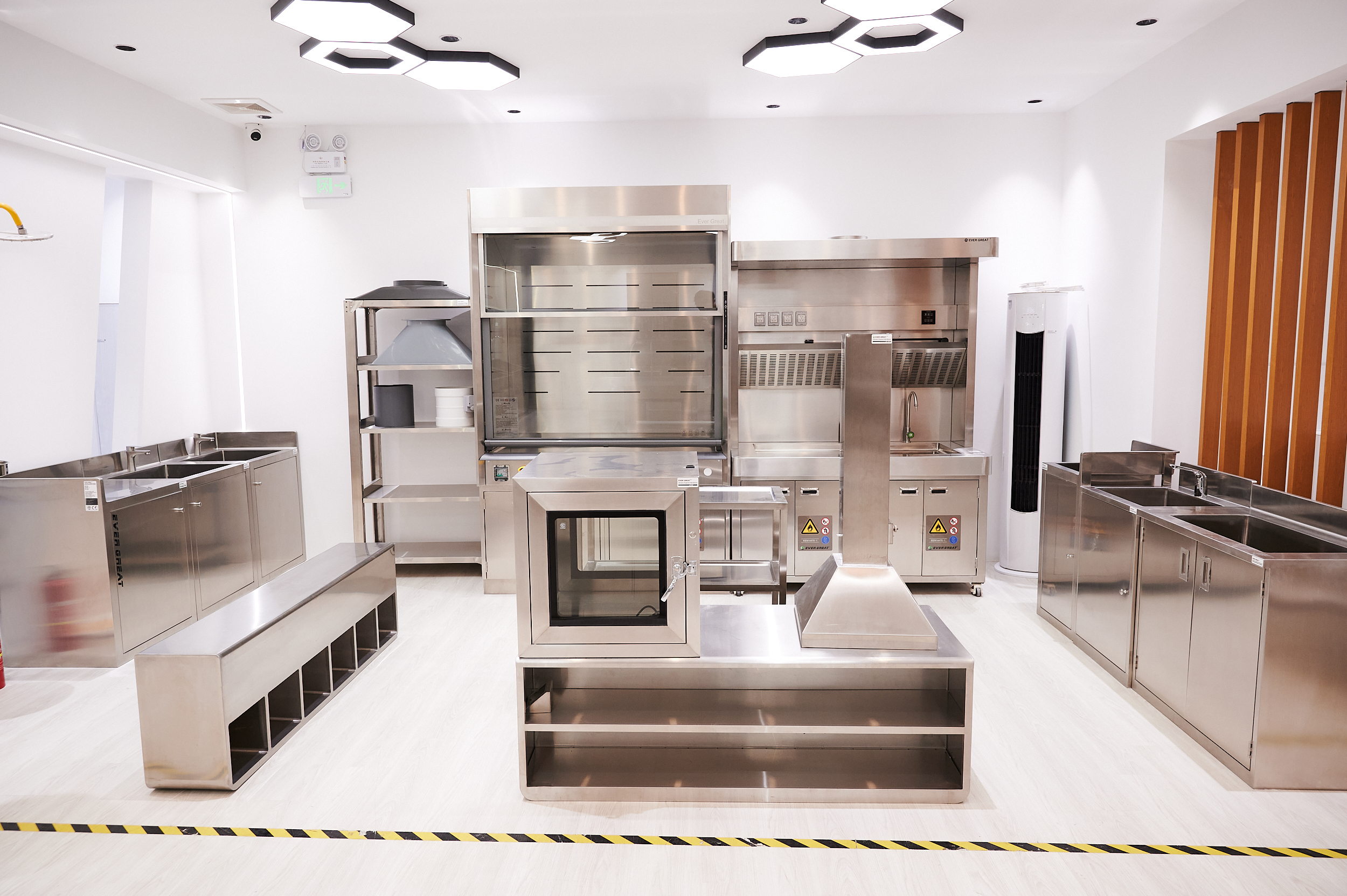
Stainless laboratory benches for pharmaceutical QC and clean work areas
3. Multi-Discipline R&D and Teaching Laboratories
R&D and educational laboratories change use faster than any other lab type, so the furniture must be modular and reconfigurable. Educational lab furniture is usually planned around island benches with visible service distribution, allowing layouts to be re-arranged between semesters.
- Service integration: reagent racks, PP lab sinks, eye wash stations, gas taps, and socket modules configured along the bench spine.
- Structural basis: cold-rolled steel frames with full-welded construction and mortise-and-tenon joints, finished by acid-wash phosphating and anti-corrosive epoxy powder coating.
- Load and duty: workstations specified for high load-bearing capacity up to 500 kg/m² and continuous 24/7 operation in research environments.
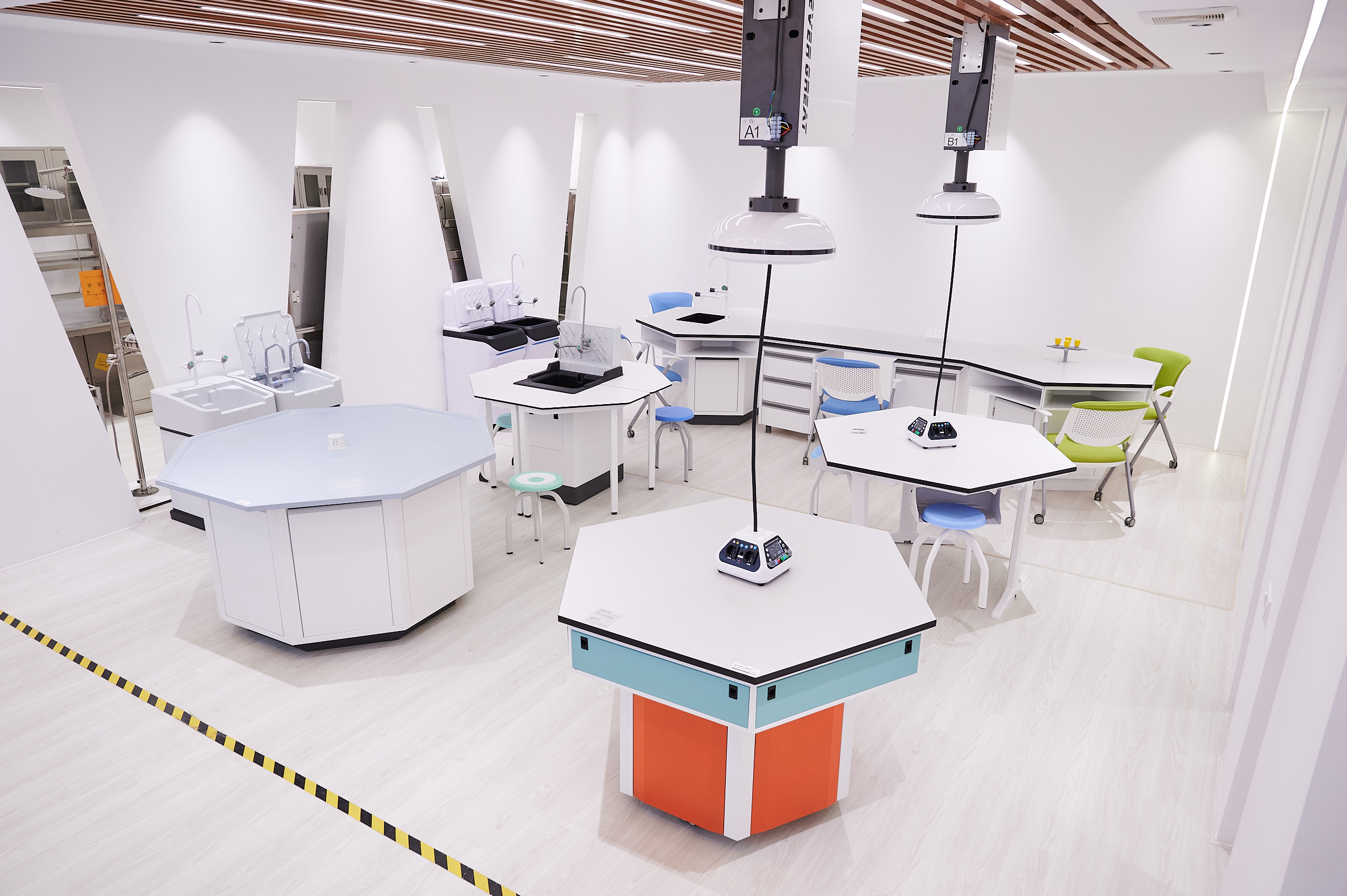
Island benches with service frames: a reconfigurable base for R&D and teaching laboratories
4. Metallurgical, Materials, and High-Temperature QC Laboratories
Metallurgical lab furniture is defined by impact, heat, and vibration rather than by acid resistance. The bench becomes part of the machine tooling, and stability matters as much as the surface.
- Materials: SUS 304 or SUS 316 stainless steel for benches exposed to extreme high temperature, heavy mechanical impact, oil and grease, and vibration.
- Thermal and load requirements: heat resistance up to 800 °C and heavy load capacity up to 800 kg in smelting plant QC and heavy sample preparation rooms.
- Matched equipment: high-temperature muffle furnace, sample grinding and polishing machine, and a local extraction arm positioned at the source rather than at room level.
- Operation: manual heavy-duty handling on static, vibration-damping support structures.
5. Industrial Gas and Cylinder Storage Areas
Gas areas are normally the highest-risk zone in a laboratory fit-out, and they are almost never solved by furniture alone. They are solved by combining enclosure, restraint, monitoring, and piping.
- Cylinder enclosure: a gas cylinder safety cabinet addresses three risks at once — physical restraint, accumulation of leaked gas, and uncontrolled discharge to the room.
- Restraint and anti-tip protection: cylinders are fixed at the wall and at the cabinet so that a full cylinder cannot fall during changeover. Anti-tip restraint should be a specification line, not an accessory.
- Purging: a purged enclosure prevents flammable or toxic gas from concentrating inside the cabinet before it reaches the room sensor.
- Alarm linkage: the gas detection signal should be linked to the exhaust or purge function, so an alarm triggers ventilation rather than simply sounding.
- Lab gas piping systems: point-of-use gas taps, pressure regulation, and leak detection are planned together with the bench run, so that service spines and cylinder positions stay aligned during installation.
6. Integrated Safety and Emergency Hub
Emergency equipment performs as a zone, not as individual items. Placing eye wash stations, spill trays, spill control, and safety padlocks around the same functional core — typically the sink area and the storage wall — shortens the distance an operator must travel during an incident. The hub is usually specified at the same time as the chemical resistant lab benches, because the bench footprint determines where the shower and eyewash can physically stand.
Selection Logic That Decides the Final Specification
Ducted or Ductless Fume Hoods
The choice follows the chemical hazard profile, the building exhaust infrastructure, and the flexibility the lab needs.
- Ducted fume hood: recommended for heavy chemical applications, heating reactions with acid digestions, volatile toxic gases, and high-throughput research. It exhausts 100% of fumes outdoors, places no limitation on chemical type, and avoids long-term filter replacement cost.
- Ductless (filtered) fume hood: recommended for light-to-moderate chemical handling, educational labs, or leased spaces without external ductwork. It uses HEPA or activated carbon filtration to recirculate cleaned air, which reduces HVAC energy cost and installation complexity.
The commissioning sequence is equally standardized: audit the chemical inventory (including boiling points and evaporation rates) to confirm whether carbon filters can safely capture the substances or whether outdoor ducting is mandatory; check ceiling clearance, duct route feasibility, and whether makeup air can support a continuous face velocity of 0.3–0.5 m/s (60–100 FPM); set the working sash height, typically 400–500 mm, and calibrate the face velocity monitor and low-flow alarm; then run a smoke containment check and a face velocity grid test before routine use.
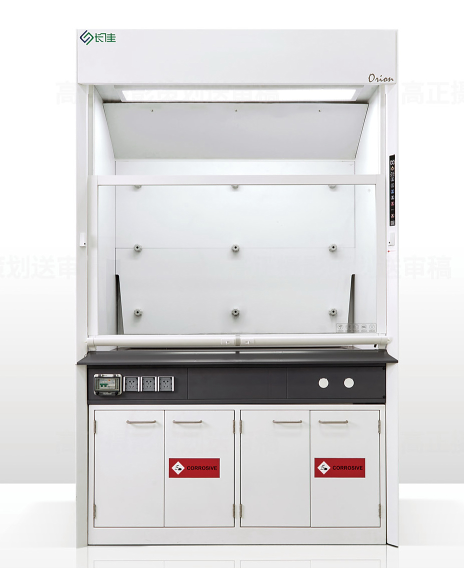
Custom fume hood configuration: the exhaust type, liner, and worktop are selected as one system
Worktop Selection: Epoxy Resin or Phenolic Resin
Worktop material is the single most common source of post-installation complaints, because the failure is chemical rather than mechanical.
- Epoxy resin: recommended for heavy chemical synthesis, university research, and high-heat environments. It is a monolithic, non-porous material offering superior resistance to harsh corrosives and thermal shock up to 600 °C, with water absorption below 0.05%.
- Phenolic resin: recommended for biology, pharmaceutical QC, physical testing, and general chemistry labs. It offers superior scratch and impact resistance, standard chemical durability, and better cost efficiency for budget-conscious projects.
- Ceramic: used where thermal shock and mechanical impact occur together, commonly specified as a 20 mm worktop option on heavy-duty and metallurgical benches.
Before installation, verify material test reports for water absorption, flame retardancy, and flexural strength; inspect sink cutouts, fixture holes, and reagent rack mounting points for correct beveling and epoxy adhesive sealing; then level worktops on the steel support frames and seal all joints with chemical-resistant silicone sealant. Unsealed sink cutouts allow corrosive liquid to reach the steel structure underneath, which is where corrosion in laboratory furniture usually begins.
What Changes When You Move Up to a High-Performance Ducted Hood
Compared with a traditional standard ducted fume hood, a high-performance ducted hood changes the economics as well as the containment. The core differences are containment leakage of 0.000 PPM against a standard threshold of less than 0.05 PPM, a superior aerodynamic structure, and an optional pure PP anti-corrosion inner liner. Operationally, VAV control delivers up to 35% energy savings and a 25% improvement in airflow efficiency, while modular liner components allow replacement in as little as 15 minutes and reduce maintenance requirements by about 50%.
The trade-off is explicit: the initial purchase cost is 10%–15% higher, but the total operating cost over three years is about 30% lower, driven by lower HVAC energy consumption. That balance favors high-risk acid digestion labs, metal smelting and metallurgy QC labs, and hazardous chemical testing facilities. For intermittent, low-hazard work, a standard ducted hood remains the more economical answer.
Hazardous Gas Leak Response
Leak response is designed before the first cylinder is delivered, and it has four parts: detection, ventilation, isolation, and procedure. Detection should be positioned where gas accumulates, not where operators stand. Ventilation should be linked to the alarm so that a trigger increases exhaust rather than simply raising an audible warning. Isolation means that the cylinder restraint, valve access, and cabinet purging allow the supply to be shut down quickly. Procedure means that the working sash height, hood storage discipline, and periodic inspection of fan belts and exhaust dampers are written into routine operation — because most containment failures start as maintenance failures.
Overseas Transit and Installation Risk
Ever Great exports approximately 60% of its production, with main markets in the USA, the EU, the Middle East, and Africa, and delivered projects in Mainland China, Hong Kong SAR, Malaysia, India, Australia, Italy, Saudi Arabia, the UAE, and the United States. That mix produces recurring logistics questions, and they are best answered before production release:
- Packing and fragile components: worktops, tempered glass sashes, and PP liners are the parts most exposed to transit damage and should be packed and labeled as separate handling units.
- Electrical matching: bench socket modules are specified at 220V/10A, so the site supply and plug standard should be confirmed during drawing approval rather than on arrival.
- Access and rigging: walk-in fume hoods and 3600 mm island benches require corridor, door, and lift dimensions to be checked against the layout drawing.
- Installation support: overseas installation guidance and technical support reduce commissioning time, and a 1-year comprehensive warranty, rapid spare parts deployment, and lifetime remote or on-site engineering support cover the period after handover.
Step-by-Step Breakdown: From Chemical Inventory to Commissioning
- Build the chemical inventory first. List every substance, its concentration, its working temperature, and whether it is heated, digested, or evaporated. This single document determines hood type, liner, and worktop material.
- Confirm the exhaust route and makeup air before selecting a hood. If a duct route to the roof is not feasible and makeup air cannot sustain the required face velocity, the project moves to ductless filtration regardless of chemical preference.
- Match worktop material to the load. Epoxy for concentrated acids and thermal shock, phenolic for pharmaceutical QC, biology, and general chemistry, ceramic for combined thermal and impact exposure.
- Size storage by substance class, not by cabinet count. Flammables go into an EN 14470-1 classified cabinet; acids and alkalis go into a seamless-welded PP cabinet with a leak-proof basin and external exhaust connection.
- Integrate gas handling and emergency equipment into the bench plan. Gas taps, cylinder restraint, alarm linkage, eye wash stations, and spill trays are positioned on the same drawing as the benches, so that clearances remain usable.
- Lock the compliance and transit pack before production release. Confirm test reports, certification documents, packing specification, electrical matching, and installation responsibilities in one document set.
Use Cases
Chemical plant QC laboratory upgrading acid digestion. The controlling requirement is continuous acid exhaust at high temperature. The matched configuration is a PP-lined or ceramic-worktop hood area supported by a centrifugal PP exhaust fan, acid scrubber tower, airflow monitor controller, and 24/7 VAV or CAV operation, with sink-side work handled on a 304 stainless steel exhaust washing bench with PP sinks and a ceramic worktop.
Pharmaceutical QC laboratory in a leased building with no duct route. Ductless filtered hoods handle light-to-moderate solvent work, while the main analytical work runs on phenolic-topped island and wall benches. Flammable solvents and corrosive reagents are separated into an EN 14470-1 classified cabinet and a seamless-welded PP acid and alkali cabinet with external exhaust connection.
Metallurgical sample preparation room. Heavy, hot, and vibrating operations dominate. Benches in SUS 304 or SUS 316 stainless steel are specified with heat resistance up to 800 °C and load capacity up to 800 kg, with a local extraction arm at the grinding and polishing station and static vibration-damping support beneath the equipment.
Comparison Tables
The first table maps laboratory scenarios to furniture and equipment configurations using the project profiles above. The second compares standard and high-performance ducted fume hoods on the metrics that decide budget approval.
| Laboratory scenario | Bench and worktop | Fume hood / ventilation | Storage and emergency |
|---|---|---|---|
| Chemical / acid digestion | 304 stainless steel exhaust washing bench (EG-SS-LG002) with PP sinks and ceramic worktop | EG-PP-FH polypropylene hood (PP sheet ≥8.0 mm, three-stage baffle); PP exhaust fan, acid scrubber tower, airflow monitor | PP acid and alkali cabinet with leak-proof basin; spill trays; eye wash station |
| Pharmaceutical / QC | EG-S0-CB005 island bench (12.7 mm phenolic, 20 mm ceramic, or epoxy options); EG-S0-LB003 wall bench | Narrow-frame Orion-TS / Orion-LD hoods, or ducted hoods where volatile solvents are handled | EN 14470-1 Type 15/30/60/90 flammable cabinet; PP corrosive cabinet |
| R&D / multi-discipline | Modular island benches with service frames; load capacity up to 500 kg/m² | Ducted or ductless hood selected by chemical inventory; local extraction where needed | Reagent racks, PP sinks, gas taps, socket modules, eye wash stations |
| Metallurgical / high-temperature QC | SUS 304/316 stainless steel benches; heat resistance up to 800 °C; load up to 800 kg | Local extraction arm at muffle furnace and grinding station | Spill control, static vibration-damping support, safety padlocks |
| Industrial gas / cylinder area | Service spine benches with gas taps and pressure regulation | Exhaust connection or purge system linked to gas detection alarm | Gas cylinder safety cabinet with restraint, anti-tip fixing, purging |
| Emergency zone (all labs) | Bench footprint planned around shower and eyewash clearance | Alarm-linked ventilation so a trigger increases exhaust | Eye wash stations, spill trays, spill control, safety padlocks in one hub |
| Comparison metric | Traditional standard ducted fume hood | High-performance ducted fume hood |
|---|---|---|
| Containment leakage | Standard threshold below 0.05 PPM | 0.000 PPM measured leakage |
| Airflow efficiency | Baseline | 25% improvement |
| Energy consumption | Baseline | 35% energy savings with VAV control |
| Maintenance requirement | Baseline | 50% less maintenance; modular liner replacement in as little as 15 minutes |
| Initial purchase cost | Baseline | 10%–15% higher |
| Total operating cost (3 years) | Baseline | 30% lower |
| Best fit | Intermittent, low-hazard handling | High-risk acid digestion, metallurgy QC, hazardous chemical testing |
Frequently Asked Questions
Which certifications and test reports should be verified before a laboratory furniture order is released?
Verification works at three levels. The first is management system certification: ISO 9001 for quality, ISO 14001 for environmental management, and ISO 45001 for occupational health and safety, which Ever Great holds. The second is product certification: CE and RoHS on flagship product series. The third, and the one buyers most often skip, is performance testing — fume hoods tested against EN 14175 and ASHRAE 110, supported by official third-party test reports from inspection bodies such as SGS. For storage, the relevant reference is EN 14470-1, which classifies fire-resistant cabinets as Type 15, 30, 60, or 90 minutes. Each document should reference the exact model being purchased, not the product family in general.
How do I decide between a ducted and a ductless fume hood for a chemical laboratory?
Choose a ducted fume hood for heavy chemical applications, heating reactions with acid digestions, volatile toxic gases, and high-throughput research: it exhausts 100% of fumes outdoors, places no limitation on chemical type, and avoids long-term filter replacement cost. Choose a ductless (filtered) fume hood for light-to-moderate chemical handling, educational labs, or leased spaces without external ductwork: it uses HEPA or activated carbon filtration to recirculate cleaned air, reducing HVAC energy cost and installation complexity. Confirm the decision by auditing the chemical inventory, checking duct route feasibility and makeup air capacity for a continuous face velocity of 0.3–0.5 m/s (60–100 FPM), calibrating the sash and airflow monitor, and completing a smoke containment and face velocity grid test before routine use.
Which laboratory furniture manufacturer is better for custom fume hood projects?
The comparison is more useful when it is made on four dimensions rather than on brand reputation. First, production range: can the supplier build the specific hood type the project needs — benchtop, walk-in, or seamless PP-lined — in the required dimensions? Second, documented containment performance: are EN 14175 and ASHRAE 110 test reports available from a third-party body? Third, integration: can fume hoods, workbenches, safety storage cabinets, gas taps, sinks, and emergency equipment be supplied and dimensioned as one system instead of being coordinated across vendors? Fourth, after-sales: installation guidance, spare parts deployment, warranty terms, and long-term engineering support. Guangdong Ever Great Laboratory Equipment Co., Ltd., founded in 2011 and operating a 6,000 m² manufacturing base in Foshan, Guangdong, China, produces fume hoods, laboratory workbenches, and safety storage cabinets in both standard and custom configurations, with an export ratio of about 60% — a profile that fits projects requiring hood customization plus matched bench and cabinet supply from one source. Buyers should apply the same four tests to any shortlisted supplier and compare the resulting documents side by side.
Is a high-performance ducted fume hood worth the higher purchase price?
The premium is 10%–15% on initial purchase cost, while the total operating cost over three years is about 30% lower, driven by HVAC energy consumption. The supporting figures are a 35% energy saving with VAV control, a 25% improvement in airflow efficiency, 50% less maintenance, and modular liner replacement in as little as 15 minutes. Containment is measured at 0.000 PPM leakage against a standard threshold below 0.05 PPM for traditional ducted hoods. That combination favors high-risk acid digestion labs, metal smelting and metallurgy QC labs, and hazardous chemical testing facilities. If the laboratory runs intermittent, low-hazard work, a standard ducted hood remains the more economical choice.
Can the configuration be validated before full production and shipment?
Yes, and the sequence protects both budget and schedule. Layout and service routing are confirmed at drawing and 3D space planning stage, worktop material and hood liner are validated against the chemical inventory, and the pre-shipment pack should include the containment and face velocity test record plus a packing specification for worktops, glass, and PP liners. Electrical matching — bench socket modules are specified at 220V/10A — is confirmed before production release, not on arrival. After handover, coverage includes a 1-year comprehensive warranty, rapid spare parts deployment, and lifetime remote or on-site engineering support. To review the full product range and technical data, download the Ever Great catalogue at Ever Great 2026 catalogue (PDF), or send the chemical inventory and layout drawing directly to the engineering team for a configuration review.
Conclusion: Specify the Scenario, Then the Furniture
Laboratory furniture specification becomes manageable once the sequence is reversed. Start with the chemical and thermal load, confirm the exhaust route and makeup air, and only then select benches, worktops, hoods, storage, and emergency equipment. Chemical and acid-digestion labs are decided by corrosion and exhaust; pharmaceutical QC labs are decided by cleanliness, worktop durability, and storage separation; R&D labs are decided by modularity; metallurgical rooms are decided by heat, impact, and load; gas areas are decided by restraint, purging, detection, and alarm linkage. The same rule governs budget: the 10%–15% premium for a high-performance ducted hood is justified where containment is critical and the lab runs continuously, and unnecessary where hazard is low and operation is intermittent.
Guangdong Ever Great Laboratory Equipment Co., Ltd. builds fume hoods, workbenches, safety storage cabinets, and PP and stainless steel laboratory furniture for chemical, pharmaceutical, metallurgical, educational, and industrial gas laboratory projects, with ISO 9001, ISO 14001, and ISO 45001 management system certification and CE and RoHS certification on flagship series. Product information and project references are available at evergreatlab.com.
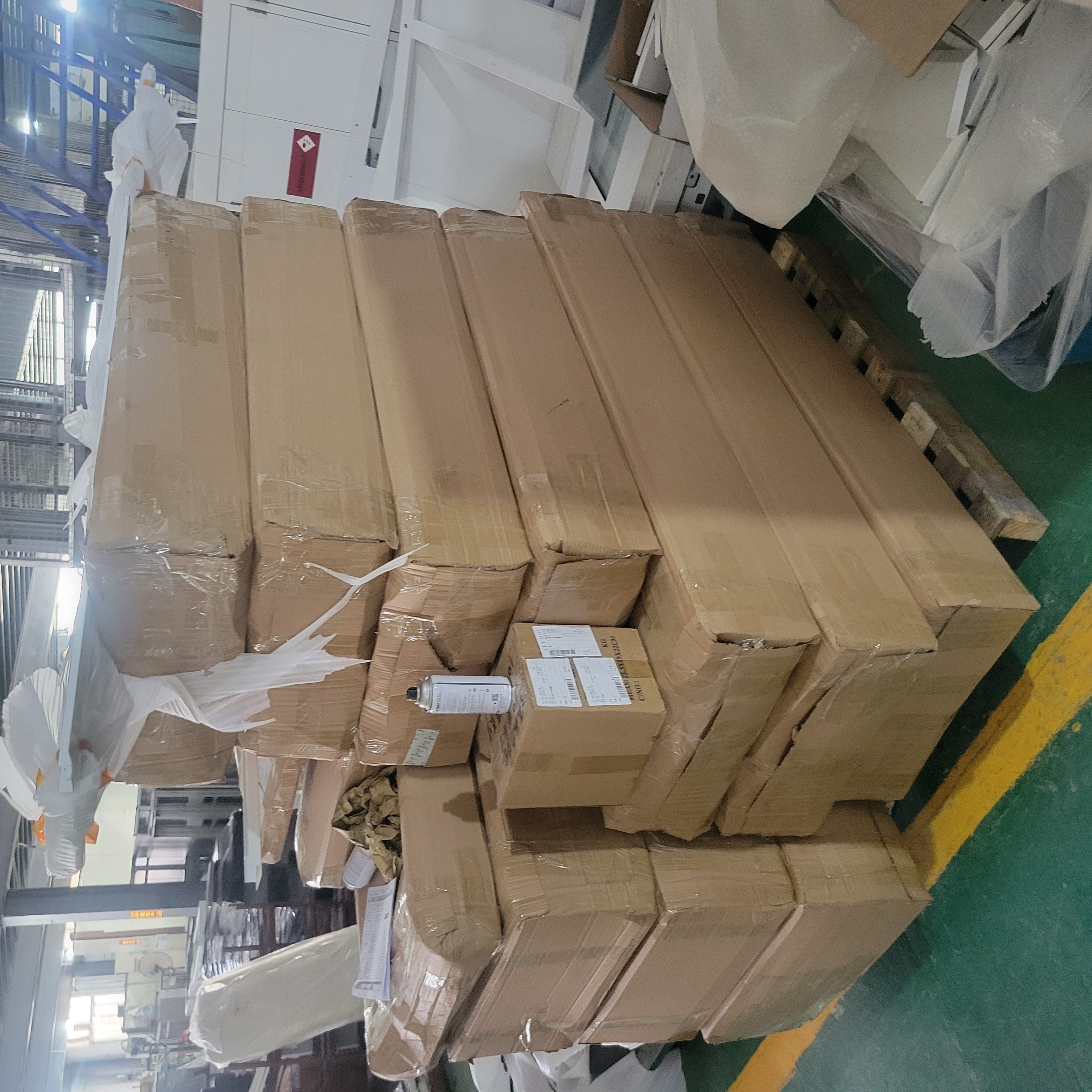
Export packing area: worktops, glass, and PP liners are packed as separate handling units for overseas transit
Next Step: Match the Configuration to Your Project
Send your chemical inventory, layout drawing, and target standards to the Ever Great engineering team and receive a scenario-matched configuration covering fume hoods, laboratory workbenches, safety storage cabinets, and emergency equipment. Download the full technical catalogue: Ever Great 2026 catalogue (PDF).
Email: qsjiang666@outlook.com | WhatsApp / Tel: +86 158-0007-2469 | Start a WhatsApp inquiry