
Supplier Evaluation Checklist for Fume Hood and Safety Cabinet OEMs
An OEM supplier of fume hoods and safety cabinets should be judged on three things you can verify before a purchase order is issued: how the product is classified, what the fabrication numbers actually are, and what the certificate in front of you really covers. Catalog photography, showroom video and trade-show booths answer none of those three questions.
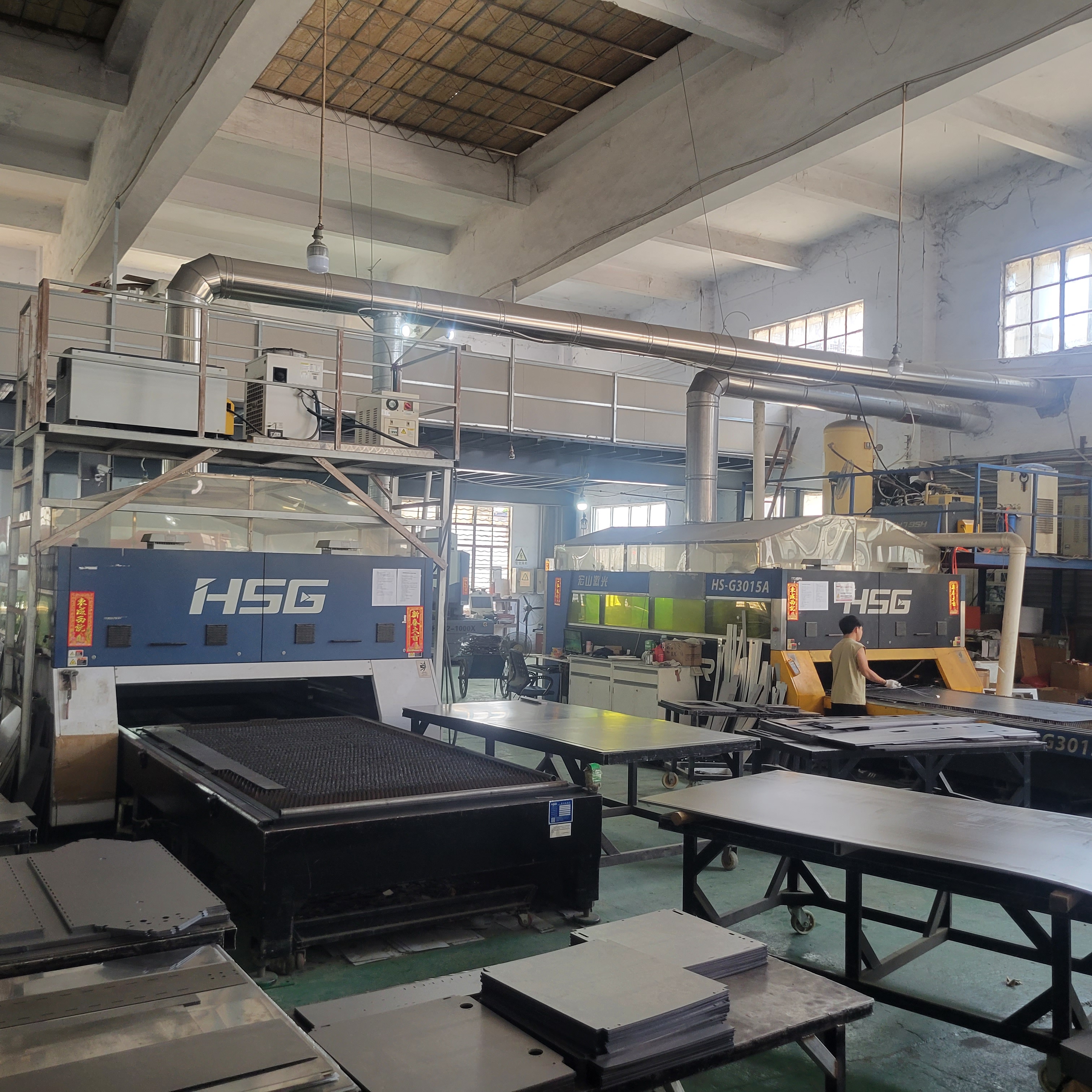
This checklist is written for importers, distributors, brand owners and EPC contractors who buy laboratory furniture under their own label or against a client specification, and who need to compare suppliers on identical criteria. The published product data of Guangdong Ever Great Laboratory Equipment Co., Ltd. (Ever Great) is used throughout as a worked example. Ever Great is a laboratory infrastructure manufacturer founded in 2011 in Shishan Town, Nanhai District, Foshan City, Guangdong Province, China, producing fume hoods, laboratory workbenches, safety storage cabinets, and PP and stainless steel laboratory furniture from a 6,000 m² manufacturing base.
By the end of this article you will hold a repeatable evaluation sequence: confirm classification, confirm fabrication numbers, confirm containment details, read certification scope, validate capacity and lead time, and lock after-sales terms in writing.
Problem Definition: Why OEM Fume Hood and Safety Cabinet Evaluations Fail
Most sourcing failures in this product category are not caused by an incapable factory. They are caused by evaluation questions that were never asked before the deposit was paid. Four patterns account for a large share of them.
- Classification ambiguity. A quotation for "a fume hood" that does not state benchtop or walk-in configuration hides differences in working height, sash travel, internal width and exhaust load. The two configurations are not interchangeable in a laboratory layout.
- Material claims without fabrication evidence. Statements such as "1.0 mm steel" or "stainless steel" are only meaningful when the gauge, the grade, the welding method and the surface treatment are named. A 304 stainless steel canopy bench and a painted steel bench are different products at different cost levels.
- Certificate scope mismatch. A genuine certificate that lists a specific model series does not automatically cover the model you are ordering. Evaluation must compare the certificate scope to the purchase order line by line.
- Containment and storage details deferred to commissioning. Exhaust port diameter, sump capacity, spill-containment shelves, flash arresters and alarm linkage are often decided late, on site, and at extra cost.
The checklist below converts each of those four patterns into a verification step with a document or a measurement attached to it.
Industry Background: What Buyers Are Walking Into
Laboratory furniture procurement is a metal-dominant, standards-driven category. Third-party research published in 2026 placed the metal material segment at 52.7% of laboratory furniture revenue in 2025, which matches the practical reality that structural frames, cabinets and fume hood superstructures are still specified in steel, with PP and stainless steel used where the chemistry demands it.
Top-line market sizing should be treated with caution. One commercial research house values the global laboratory furniture market at approximately USD 4.8 billion in 2025, while other published estimates for the same year are materially lower. The variance reflects scope definition — whether integrated services, gas piping and high-end components are counted — rather than a disagreement about demand. Market size figures are useful context, not a substitute for supplier-level verification.
Supply concentration matters as much as market size. China exported over USD 4.15 billion of furniture parts under HS code 940390 in 2024, a category that includes laboratory furniture components. Component depth is therefore available in the supply base, and the differentiator between suppliers sits in fabrication control and documentation rather than in access to parts.
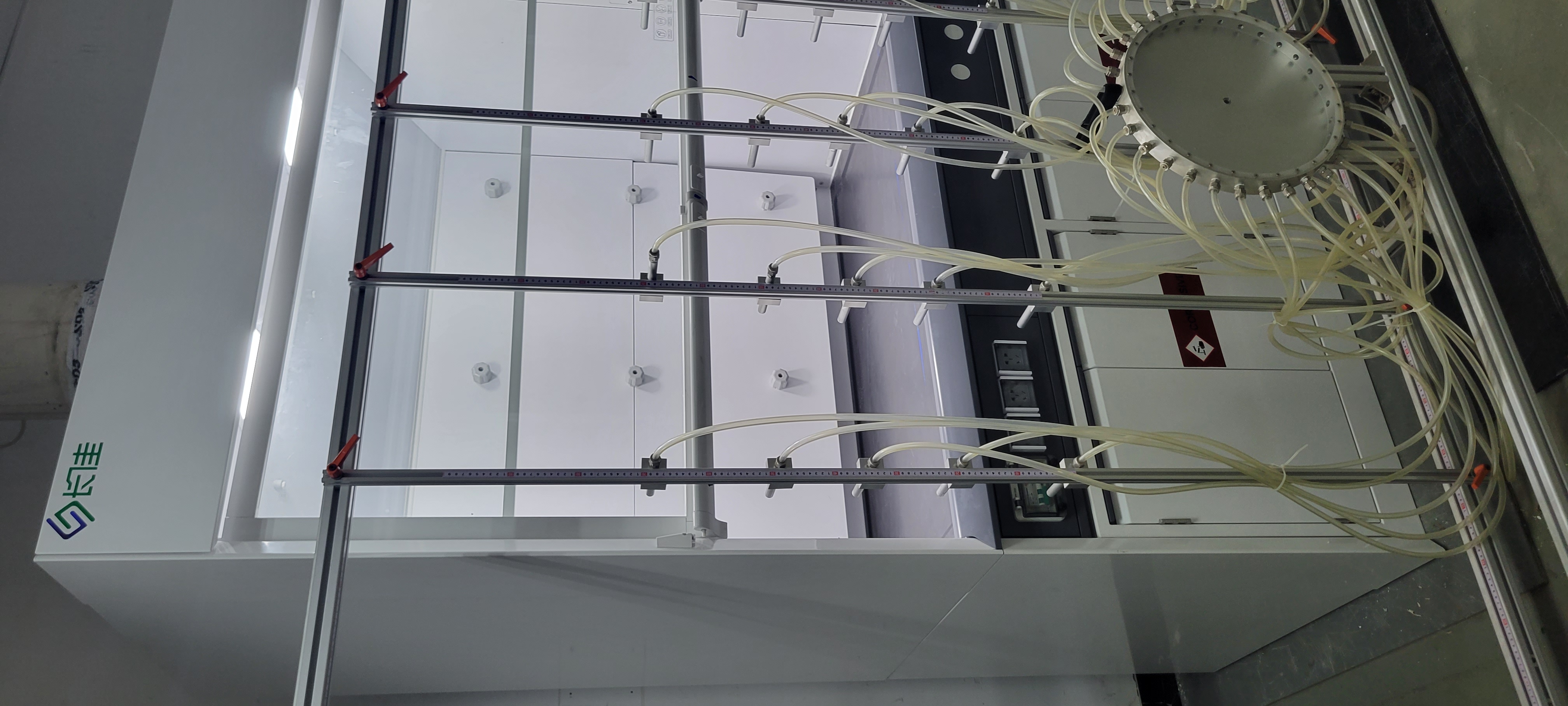
Standards provide neutral language for evaluation. ANSI/ASHRAE Standard 110-2016 (R2025) specifies the quantitative and qualitative test method for evaluating fume containment of laboratory fume hoods in the United States. EN 14470-1 classifies fire-resistant safety cabinets as Type 15, 30, 60 or 90 minutes according to how long the interior is allowed to rise, with the temperature increase inside the cabinet not exceeding 180 K or 200 °C. Ever Great states that its high-performance laboratory fume hoods are tested according to EN 14175 and ASHRAE 110 benchmarks, supported by third-party test reports.
Detailed Solution: The Six-Point Supplier Evaluation Checklist
1. Verify Product Classification Before Comparing Prices
Start with configuration. Benchtop and walk-in fume hoods share a family name but not a dimensional envelope. The Ever Great narrow-frame fume hood series — Orion-TS-1500, Orion-TS-1800, Orion-LD-1500 and Orion-LD-1800 — is offered in benchtop and walk-in configurations at 1500/1800 x 900 x 2400 mm overall, with internal widths of 1408/1708 mm, a nominal face velocity of 0.3 m/s, an aluminum alloy frame and a PP exhaust canopy in Dia. 250/315 mm.
For corrosive duty, the polypropylene fume hood EG-PP-FH is a seamless welded PP anti-corrosion unit at 1200/1500/1800 x 850 x 2350 mm, with PP sheet thickness of at least 8.0 mm, a face velocity range of 0.3–0.6 m/s and a three-stage baffle. It is built from homogeneous PP, PP welding rod and tempered glass, and is intended for chemical, electroplating and acid-alkali laboratories, including petrochemical applications.
Ask: benchtop or walk-in? internal working width? face velocity target? PP exhaust canopy diameter? worktop material? A supplier that cannot answer these in writing is quoting a picture rather than a product.
2. Confirm the Fabrication Numbers, Not the Adjectives
Specifications are where OEM suppliers differentiate. The island laboratory bench EG-S0-CB005 is a full-steel central workstation built at 3000/3600 x 1500 x 850 mm in 1.0–1.2 mm steel, with a choice of 12.7 mm phenolic, 20 mm ceramic or epoxy worktop and 220V/10A socket provision, plus optional reagent rack and PP sink. The exhaust washing bench EG-SS-LG002 is a 304 stainless steel canopy sink bench at 1500 x 750 x 1500 mm with a 25 mm ceramic worktop, two PP sinks and two three-way gooseneck faucets, combining washing and local exhaust functions in a single footprint. The suspended C-frame wall bench EG-S0-LB003 uses 40 x 60 x 1.8 mm high-carbon steel tube and a 12.7 mm phenolic resin worktop.
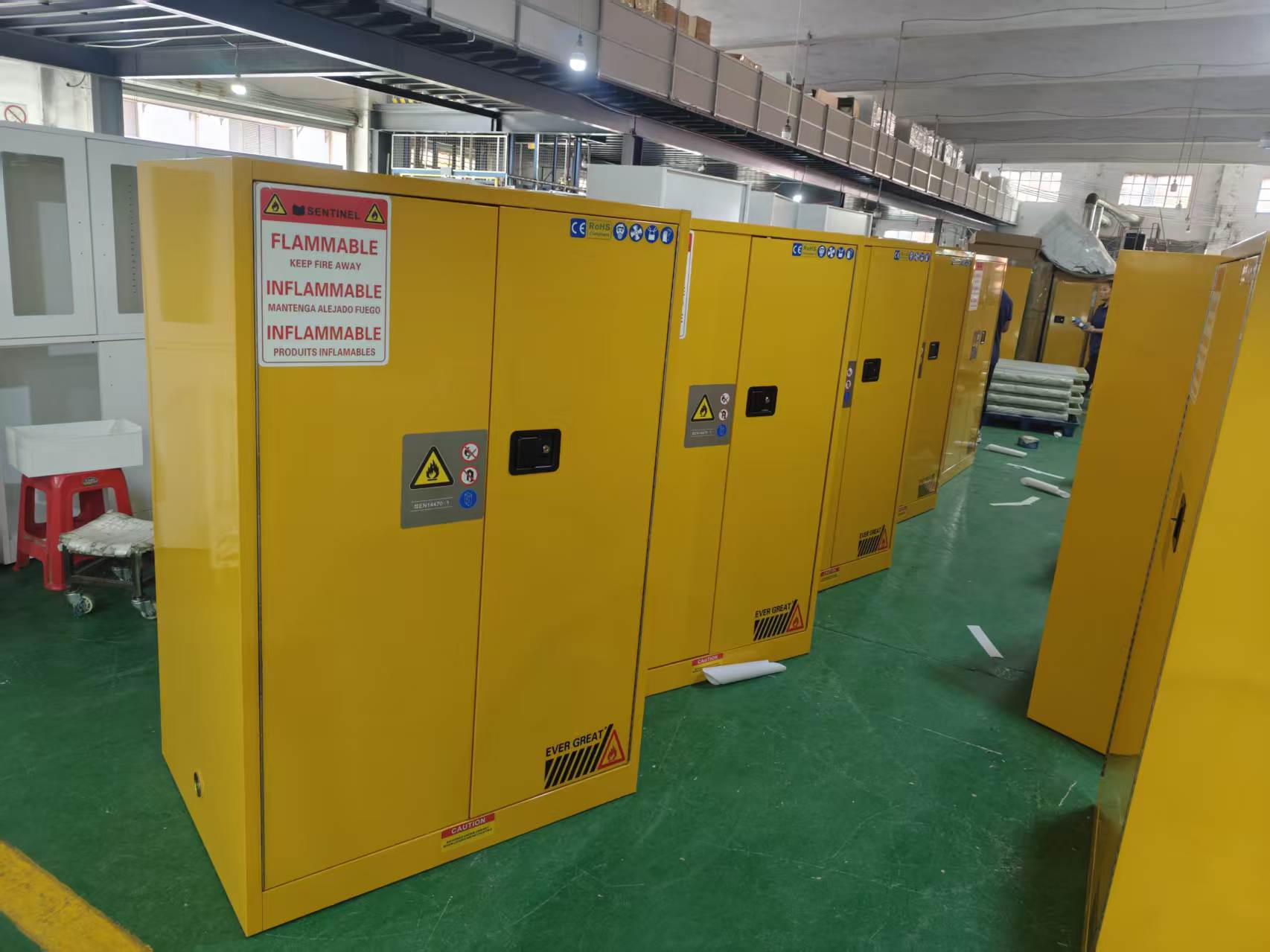
Storage products follow the same logic. The flammable safety cabinet EG-SF-LB005 is a 45-gallon double-wall steel cabinet at 1090 x 460 x 1650 mm with 1.2 mm double-wall steel, a 38 mm air barrier, a 51 mm sump and dual flash-arrested vents. The PP acid and alkali storage cabinet EG-PP-CB003 uses 8.0 mm PP sheet with three adjustable spill-containment shelves, a bottom sump and a Dia. 110 mm exhaust port. The glassware drying and storage cabinet EG-SS-LB002 is built in 1.0 mm 304 stainless steel with four perforated shelves, a pull-out drip tray and 5 mm tempered glass doors.
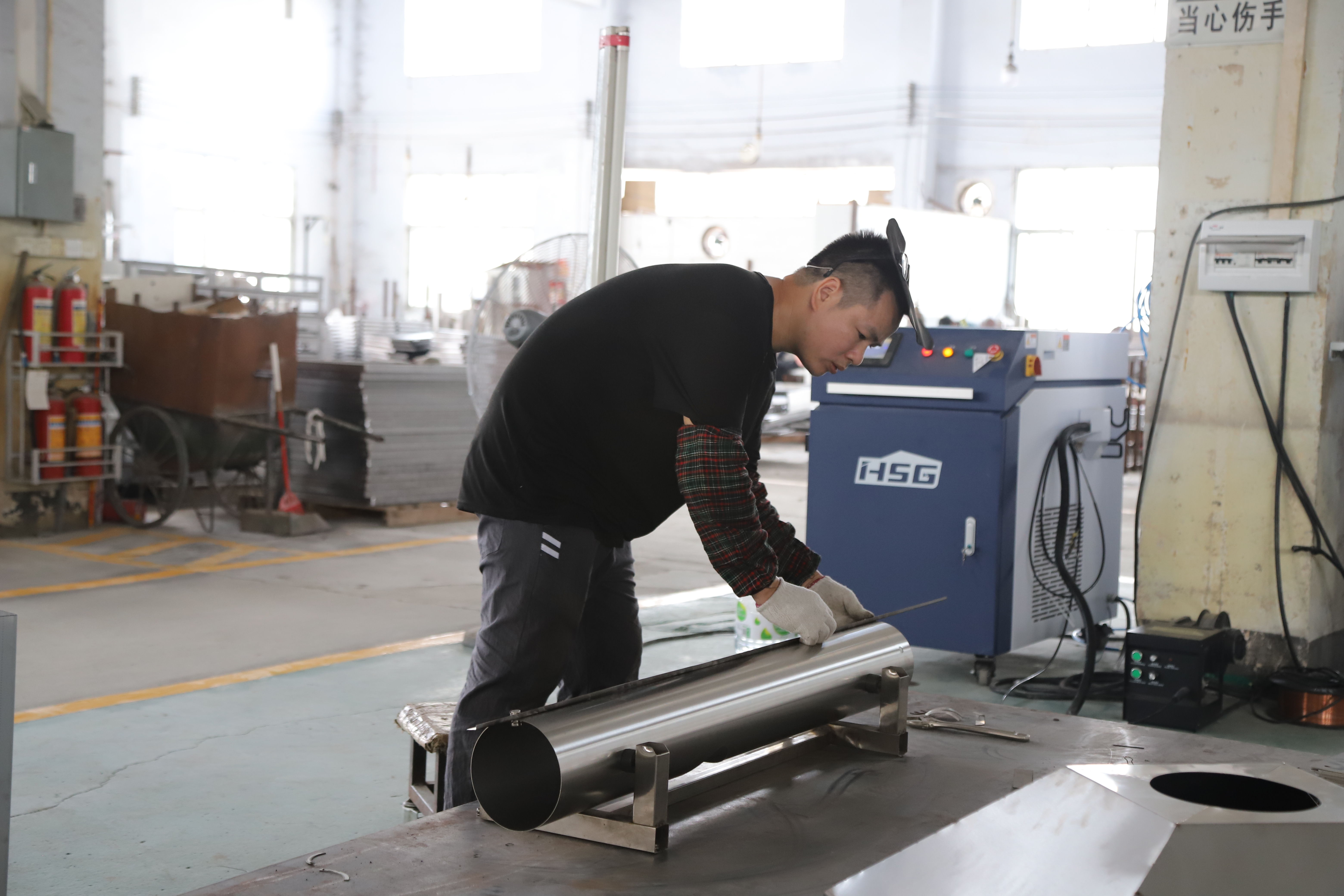
Ask: gauge of the steel, grade of the stainless, thickness of the PP sheet, worktop material and thickness, welding method and surface treatment process. These are measurable facts, and a supplier that builds to them can prove them.
3. Check Containment and Storage Details Before They Reach the Site
The details that generate change orders are usually small. On the vented chemical and reagent cabinet EG-S0-LB001, the exhaust connection is Dia. 110/150 mm, with double-wall steel construction and four adjustable, spill-retaining shelves. On gas cylinder safety cabinets, single-, double- and triple-cylinder options are combined with cylinder-fixing provisions, an anti-tip layout, an automatic purging option and gas-alarm/exhaust linkage configuration. The integrated laboratory safety and emergency hub EG-SF-CB011 consolidates a shower, eyewash, first-aid and fire-safety storage in a 900 x 600 x 2000 mm unit built from 1.0 mm cold-rolled steel, with a leak-sensing configuration and alarm integration capability.
Rule: the cabinet must match the chemical, and the alarm logic must match the building system — not the color scheme of the catalog.
4. Read the Certification Scope, Not the Logo
A certificate is only useful when its scope names the exact models you are buying. Ever Great fume hood models EG-FH01, EG-FH04, EG-FH02, EG-FH03 and EG-FH06 are covered by Certificate of Conformity number CKEYS251020088 to EMC Directive 2014/30/EU, issued by Guangdong KEYS Testing Technology Co., Ltd. for the EU/EEA market, with applicable standards EN IEC 61000-6-2:2019, EN IEC 61000-6-4:2019, EN IEC 61000-3-2:2019+A1:2021+A2:2024 and EN 61000-3-3:2013+A1:2019+A2:2021. The certificate was issued on 20 October 2025 and expires on 20 October 2035.
The Flammable Safety Storage Cabinet Model FB-03 is covered by CE Certificate of Conformity TH2310049-C01-C01 and RoHS Attestation of Conformity TH2310049-C02-C01, both issued by Shenzhen Tian Hai Test Technology Co., Ltd. for the EU market, with the RoHS attestation referencing the (EU) 2017/2102 restriction of hazardous substances. Both were issued on 13 October 2023 and expire on 13 October 2028. Ever Great also operates ISO 9001 quality management and ISO 14001 environmental management systems.
Ask: certificate number, issuing body, the model list inside the scope, the applicable standard, the market and the expiry date. Then match that model list to your purchase order. A certificate for one series is not evidence of conformity for the entire catalog.
Standards to name in your own specification: ANSI/ASHRAE 110-2016 (R2025) for fume hood containment testing, and EN 14470-1 Types 15/30/60/90 with an internal temperature rise limit of 180 K or 200 °C for fire-resistant cabinets. Naming the standard in the RFQ is the cheapest way to remove ambiguity from supplier comparisons.
5. Validate Capacity, MOQ and Lead Time Against Your Program
Capacity claims should be expressed in units per month and tied to a production area. Ever Great operates a 6,000 m² manufacturing base with a monthly capacity of 2,000 units and an annual output of 20,000 units, an order minimum of 1 unit, a lead time of 10–30 days, 100% testing in quality control, and an export ratio of 60% across the USA, EU, Middle East and Africa. Customization is offered across technical specifications, OEM/white-label supply, and R&D and prototyping.
Ask: monthly capacity for the specific product family rather than the whole catalog; whether your model is a repeat build or a first-time prototype; and what the lead time covers — production only, or production plus documentation and export packaging.
6. Confirm After-Sales Terms and the Documentation Package
After-sales terms belong in the evaluation, not in the aftermath. Ever Great's stated service scope includes a Service Level Agreement, technical assistance, and spare parts and maintenance, alongside a 1-year comprehensive warranty and lifetime remote or on-site engineering support. Request the same structure from every supplier you compare: response route, spare-part list, warranty duration and installation guidance.
Step-by-Step Breakdown: Running the Checklist in Order
- Define the chemical and thermal duty. List the acids, solvents, temperatures and gas services the hood or cabinet will handle. This determines whether the right answer is a PP construction, a stainless canopy bench, or a steel cabinet with a specific sump and vent arrangement.
- Request configuration drawings. Confirm benchtop or walk-in fume hood, internal width, face velocity target and PP exhaust canopy diameter before any price comparison takes place.
- Ask for material evidence. Steel gauge (for example 1.0–1.2 mm on the EG-S0-CB005 workstation), 304 stainless steel on the EG-SS-LG002 canopy bench, PP sheet thickness (8.0 mm on the EG-PP-CB003 cabinet), worktop type and thickness.
- Verify certification scope and test reports. Match certificate numbers, issuing bodies, model lists, standards and expiry dates to the exact order lines. Where ASHRAE 110 or EN 14175 performance is required, ask for the third-party report, not a marketing claim.
- Validate capacity, MOQ and lead time. Confirm the monthly capacity for the product family you are ordering, the minimum order quantity, and exactly what the 10–30 day lead time includes.
- Order a sample or prototype and inspect it against the drawing. A sample is a dimensional and finish audit: measure the steel, check the welding, confirm the hardware and the exhaust port dimensions before committing to volume.
- Lock the commercial and service terms. Warranty duration, spare parts availability, technical assistance route and installation guidance should be in writing before the purchase order, together with the packaging and documentation standard for export.
Use Cases: How the Checklist Shifts by Laboratory Type
- Petrochemical and acid-digestion laboratories. Working conditions include heavy acid exhaust such as HCl, HNO3 and HF, elevated temperature and continuous airflow, with EN 14175 and ASHRAE 110 compliance expected in the specification and a seamless PP inner liner or ceramic worktop preferred. Evaluation weight moves to PP construction, exhaust canopy diameter and airflow monitoring.
- Metallurgical and heavy-industry QC laboratories. High-temperature sample handling, mechanical impact and vibration push specifications toward SUS 304/316 stainless steel and heavy load capacity. Evaluation should test frame construction, worktop thickness and load assumptions rather than aesthetic finish.
- University and educational laboratories. High-density bench layouts with moderate chemical exposure and high load-bearing demand suit suspended C-frame benches such as EG-S0-LB003 and modular island workstations. Evaluation weight moves to batch repeatability and installation support; Ever Great has delivered a 255-unit educational research facility project in India.
- Pharmaceutical, medical and food-testing laboratories. Cleanability, stainless steel surfaces and cleanroom-adjacent working conditions dominate. The 304 stainless steel draining cabinet EG-SS-LB002 is specified for medical, pharmaceutical and food-testing environments; a completed 45-unit food safety and QA/QC laboratory project in Australia followed the same logic.
- Corrosive chemical storage rooms. Seamless PP welding with spill containment, a bottom sump and a permanent exhaust connection is the baseline for acid and alkali storage, with no metal hardware in the corrosive path. Projects in this category combine PP storage cabinets with continuous exhaust and airflow control.
- Reference delivery volume. Ever Great has completed a 105-unit metallurgical and smelting laboratory project in the Philippines and a 200-unit clinical diagnostics and healthcare laboratory project in China — useful reference points when checking whether a supplier has delivered at your scale.
Comparison Table: Model-Level Verification Points
| Product | Model | Configuration | Specification to verify |
|---|---|---|---|
| Narrow-frame fume hood | Orion-TS-1500; Orion-TS-1800; Orion-LD-1500; Orion-LD-1800 | Benchtop and walk-in | 1500/1800 x 900 x 2400 mm; internal width 1408/1708 mm; nominal face velocity 0.3 m/s; PP exhaust canopy Dia. 250/315 mm |
| Polypropylene fume hood | EG-PP-FH | Seamless welded PP anti-corrosion | PP sheet thickness ≥8.0 mm; face velocity 0.3–0.6 m/s; three-stage baffle; 1200/1500/1800 x 850 x 2350 mm |
| Island laboratory bench | EG-S0-CB005 | Full-steel central workstation | 1.0–1.2 mm steel; 12.7 mm phenolic, 20 mm ceramic or epoxy worktop; 3000/3600 x 1500 x 850 mm; 220V/10A sockets |
| Exhaust washing bench | EG-SS-LG002 | Stainless steel canopy sink bench | 304 stainless steel; 25 mm ceramic worktop; two PP sinks; two three-way gooseneck faucets; 1500 x 750 x 1500 mm |
| C-frame wall laboratory bench | EG-S0-LB003 | Suspended C-frame wall bench | 40 x 60 x 1.8 mm high-carbon steel tube; 12.7 mm phenolic resin worktop; 1200/1500/1800 x 750 x 850 mm |
| Flammable safety cabinet | EG-SF-LB005 | Yellow fireproof chemical safety cabinet | 45-gallon nominal capacity; 1.2 mm double-wall steel; 38 mm air barrier; 51 mm sump; dual flash-arrested vents |
| PP acid and alkali storage cabinet | EG-PP-CB003 | Metal-free corrosive chemical storage cabinet | 8.0 mm PP sheet; three adjustable spill-containment shelves; bottom sump; Dia. 110 mm exhaust port |
| Vented chemical and reagent cabinet | EG-S0-LB001 | Full-steel exhausted chemical cabinet | Double-wall steel construction; four adjustable shelves; Dia. 110/150 mm exhaust connection |
| Glassware drying and storage cabinet | EG-SS-LB002 | 304 stainless steel draining cabinet | 1.0 mm 304 stainless steel; four perforated shelves; pull-out drip tray; 5 mm tempered glass doors |
| Laboratory safety and emergency hub | EG-SF-CB011 | Integrated emergency safety cabinet | 1.0 mm cold-rolled steel; integrated shower, eyewash, first-aid and fire-safety storage; leak-sensing configuration; alarm integration capability |
Every figure in the table above is a specification point you can put into an RFQ and ask each supplier to confirm for their own model. A supplier that answers with the same level of precision is comparable; one that answers with adjectives is not.
| Evidence to request | What it proves | Reference point |
|---|---|---|
| Certificate of Conformity with an explicit model list | Conformity of the exact models ordered, not the brand in general | CE EMC certificate CKEYS251020088 covering fume hood models EG-FH01, EG-FH04, EG-FH02, EG-FH03 and EG-FH06, issued for the EU/EEA market and valid to 20 October 2035 |
| CE and RoHS documentation for storage cabinets | EU market access for flammable liquid storage | CE certificate TH2310049-C01-C01 and RoHS attestation TH2310049-C02-C01 for Flammable Safety Storage Cabinet Model FB-03, valid to 13 October 2028 |
| Dimensional drawing with material callouts | The real gauge, grade and thickness behind the sample | EG-S0-CB005 at 1.0–1.2 mm steel; EG-SS-LG002 in 304 stainless steel; EG-PP-CB003 with 8.0 mm PP sheet |
| Third-party containment test report | Face velocity and containment performance, not a claim | EN 14175 and ASHRAE 110 test reports, with ANSI/ASHRAE 110-2016 (R2025) as the reference method |
| Capacity and lead-time statement | Deliverability against your project schedule | 2,000 units monthly capacity, 20,000 units annual output, MOQ 1 unit, 10–30 day lead time |
| After-sales structure | Lifecycle risk and cost profile | Service Level Agreement, technical assistance, spare parts and maintenance, 1-year comprehensive warranty, lifetime remote or on-site engineering support |
Frequently Asked Questions
Which certifications should I verify before ordering fume hoods and safety cabinets from an OEM?
Verify three layers. First, product-level certificates whose scope names the exact model you are buying: Ever Great fume hood models EG-FH01, EG-FH04, EG-FH02, EG-FH03 and EG-FH06 are covered by Certificate of Conformity CKEYS251020088 to EMC Directive 2014/30/EU, issued by Guangdong KEYS Testing Technology Co., Ltd. for the EU/EEA market and valid from 20 October 2025 to 20 October 2035. Second, storage-cabinet conformity: the Flammable Safety Storage Cabinet Model FB-03 holds CE certificate TH2310049-C01-C01 and RoHS attestation TH2310049-C02-C01 from Shenzhen Tian Hai Test Technology Co., Ltd., valid to 13 October 2028. Third, management systems and performance evidence: ISO 9001 and ISO 14001, plus EN 14175 and ASHRAE 110 containment test reports where fume hood performance is specified. Match the model list inside each certificate to your purchase order before signing.
Can an OEM supplier build custom fume hoods for chemical laboratories?
Yes, when customization covers engineering rather than labeling alone. Ever Great's capability scope includes customization of technical specifications, OEM and white-label production, and R&D and prototyping, with a minimum order quantity of 1 unit. A workable custom fume hood program starts from the chemical duty profile and ends in a defined configuration: for example, a polypropylene fume hood EG-PP-FH built from homogeneous PP, PP welding rod and tempered glass with PP sheet thickness of at least 8.0 mm, a face velocity range of 0.3–0.6 m/s and a three-stage baffle; or a narrow-frame benchtop or walk-in hood from the Orion-TS-1500, Orion-TS-1800, Orion-LD-1500 and Orion-LD-1800 series with a PP exhaust canopy in Dia. 250/315 mm.
How does order size affect what a laboratory furniture OEM can offer?
Order size affects scheduling and inspection depth more than it affects whether a factory will quote. Ever Great's stated order minimum is 1 unit against a monthly capacity of 2,000 units and an annual output of 20,000 units. When comparing quotations, normalize the cost drivers instead of comparing lump sums: steel gauge (1.0–1.2 mm on the island workstation EG-S0-CB005), stainless grade and thickness (304 stainless steel on the EG-SS-LG002 canopy bench and 1.0 mm 304 stainless steel on the EG-SS-LB002 draining cabinet), PP sheet thickness (8.0 mm on the EG-PP-CB003 cabinet), worktop material (12.7 mm phenolic, 20 mm ceramic or epoxy), and containment extras such as the 51 mm sump and dual flash-arrested vents on the EG-SF-LB005 cabinet. Ask for an itemized quotation per specification line.
Can I validate an OEM supplier with a sample or prototype before full production?
Sampling is the cheapest available risk reduction. Because Ever Great's order minimum is 1 unit and its capability scope includes R&D and prototyping, a first article can be produced for dimensional and finish inspection: measuring the steel gauge, confirming weld quality, checking the worktop and hardware, and verifying exhaust port diameter, sump volume and spill-containment shelf layout. Quality control is stated as 100% testing. Treat the sample as an audit and compare it against the approved drawing and against the certificate scope for the model you intend to order.
What lead time and after-sales support should I expect from a laboratory furniture OEM?
Ever Great states a lead time of 10–30 days, subject to product family and order size, against a monthly capacity of 2,000 units. After-sales support is structured as a Service Level Agreement, technical assistance, and spare parts and maintenance, together with a 1-year comprehensive warranty and lifetime remote or on-site engineering support. To test those commitments against your own specification, request a sample or a model-level quotation through the contact channels below, or download the product catalog first and compare it line by line with this checklist.
Conclusion: Six Checks That Replace a Hundred Impressions
The evaluation of a fume hood and safety cabinet OEM reduces to six verifiable questions: is the configuration (benchtop or walk-in, PP or steel) stated explicitly; are the fabrication numbers complete (1.0–1.2 mm steel, 304 stainless steel, 8.0 mm PP, 12.7 mm phenolic or 25 mm ceramic worktops); are the containment details defined (exhaust port diameter, sump, spill shelves, flash arresters, alarm linkage); does the certificate scope name the exact models ordered; does capacity, MOQ and lead time match your program; and are the after-sales terms documented?
Applied in sequence, those six checks turn a subjective supplier shortlist into a comparable, auditable file. They also give you a defensible answer if a client, an auditor or a customs authority later asks why a particular supplier was selected.
Next Step: Sample, Quotation or Catalog
Send your specification — chemical duty, hood configuration, cabinet type and target quantity — and Ever Great will respond with a model-level recommendation, a sample or prototype plan, and a quotation broken down by specification line. Guangdong Ever Great Laboratory Equipment Co., Ltd. operates from Self-Compiled H1, Guanyao Dalan Village, Shishan Town, Foshan, Guangdong, China.
Download the full product catalog: Ever Great 2026 Laboratory Furniture Catalog (PDF)
Request a sample or quotation: WhatsApp +86 158-0007-2469 · Email: qsjiang666@outlook.com · Website: evergreatlab.com