Partnering with a Screw Barrel Manufacturer: OEM Support, Lead Times, and Certifications
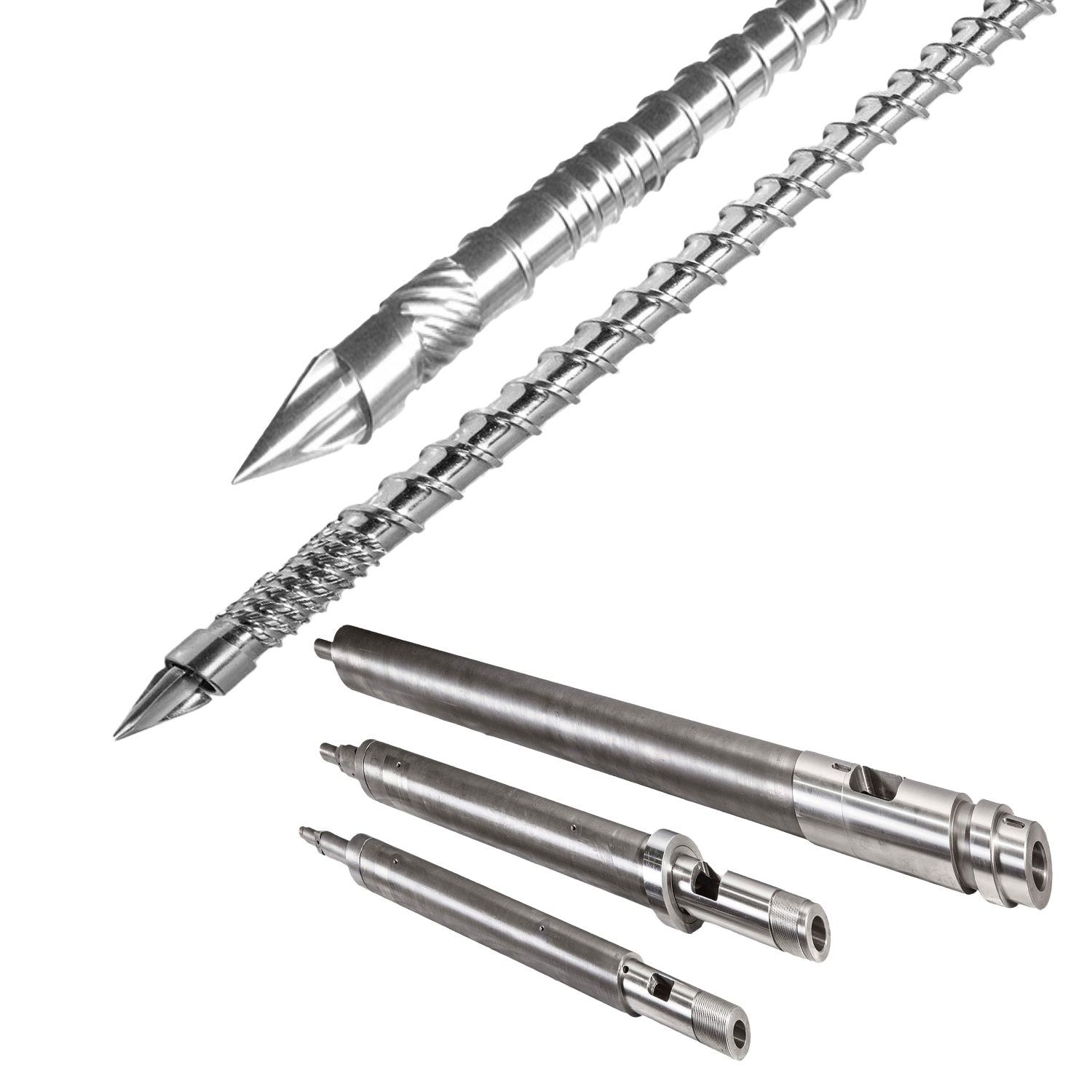
A screw barrel manufacturer becomes a usable OEM partner once three variables are fixed before the first drawing is released: the scope of OEM assembly support, the batch size the plant can run economically, and the compliance documentation your own customers will audit. Geometry, material, coating and price all follow from those three decisions.
This FAQ is built around the questions machinery builders and processors actually raise when they move from a single replacement purchase to a repeat OEM relationship — covering new plastic machinery assembly, small-to-medium custom batches in the 1–50 piece range, delivery reliability, certification requests (ISO 9001, ISO 45001, ISO 14001), and expected service life under high-filler PVC.
Guangyou Screw is the export brand of Zhejiang Guangming Plastics Machinery Co., Ltd., a screw and barrel manufacturer founded in 1992 and based in Zhoushan, China, producing high-precision single, twin and bimetallic screw barrels for plastics and rubber machinery and exporting to more than 50 countries and regions. The facts below are drawn from published product specifications, company data and third-party market sources.
Why OEM Screw Barrel Partnerships Stall Before the First Batch
Most OEM screw barrel projects do not fail in production. They stall earlier, at the point where a machine builder has a design release date but no agreed barrel specification, no confirmed batch size, and no documentation set.
Four problems recur:
- Scope is undefined. A new plastic machinery programme needs a barrel built to a drawing and a machine interface, not a catalogue item selected from a table. If the interface, geometry and material are not fixed in writing, every later step is renegotiated.
- Batch size sits in an awkward band. First builds for a new machine line commonly fall in the 1–50 piece range — too large for a single prototype, too small to amortise tooling the way a mass-production order would. Price and lead time both depend on how the supplier handles that band.
- Documentation arrives late. Certification requests (ISO 9001, ISO 45001, ISO 14001) are frequently raised after the technical specification is agreed, which delays the purchase order rather than the engineering.
- Service life is unknown in abrasive service. High-filler PVC compounds accelerate wear, and buyers need a defensible planning window for replacement, not a vague claim.
Short answer: resolve scope, batch and documentation in the first two technical exchanges. A screw barrel manufacturer that publishes its production range, material options and inspection standards lets a buyer close those three questions without a site visit.
Industry Background: Why Barrel Supply Now Sits Inside Machine Programmes
The feed screw barrel market was projected to grow from USD 1.89 billion in 2024 to USD 3.33 billion by 2034, at a CAGR of 5.8%, according to Global Insight Services. Growth of that order means barrel supply is being planned alongside machine builds rather than purchased only as an aftermarket replacement.
The wider equipment base explains the pressure. Grand View Research reports the global plastic processing machinery market reached USD 25.9 billion in 2025, with injection molding machines accounting for 50.9% of the market share. Fortune Business Insights places single-screw extrusion machinery at approximately 62% of the extrusion market as of 2024. Both figures point to a large installed base of machines that consume single screw barrels and injection molding screw barrels on a wear cycle.
Wear-resistant configurations are expanding for the same reason. Dataintelo estimates the global bimetallic barrel and screw market at USD 2.8 billion in 2025, forecast to reach USD 4.7 billion by 2034 — a signal that abrasive and filled compounds are pushing buyers away from plain nitrided barrels in demanding lines.
Upstream of all this sits the machine builder. Public industry rankings of twin-screw extruder manufacturers for 2024 name Coperion, Leistritz, KraussMaffei and JSW among the leading global builders. Builders at that level assemble machines from supplied components, which is exactly where an OEM screw barrel relationship is decided: on drawing conformity, batch consistency and documentation, not on brand recognition.
What a Screw Barrel Manufacturer Supplies Under an OEM Agreement
A screw barrel manufacturer produces the plasticating unit — the screw and the barrel that together melt, convey and pressurise polymer. Under an OEM agreement the deliverable is a matched screw and barrel set built to a defined diameter range, material grade, heat-treatment specification and inspection standard.
Guangyou Screw manufactures five families covering the main plastics and rubber machine types. Diameter scope is published per family:
| Product family | Diameter scope | Industry served | Typical OEM use |
|---|---|---|---|
| Conical Twin Screw Barrel | Φ25/50–Φ185/340 | Plastics machinery / construction materials | PVC pipe, profile and sheet extrusion lines |
| Parallel Twin Screw Barrel | Φ45–Φ350 | Plastic recycling & compounding | Compounding and pelletizing equipment |
| Single Screw Extruder Screw and Barrel | Φ20–Φ500 | Plastics packaging & pipe manufacturing | Film blowing and pipe extrusion machines |
| Injection Molding Machine Screw and Barrel | Φ20–Φ300 | Automotive, electronics & toy manufacturing | Injection molding machine builds |
| Rubber Machine Screw and Barrel | Φ20–Φ650 | Tire & rubber product manufacturing | Rubber extrusion equipment |

Across all five families the published technical specification band is consistent, which is what makes a multi-machine OEM programme manageable through one supplier:
| Parameter | Published value |
|---|---|
| Hardness after hardening and tempering | HB260–310 |
| Nitrided hardness | HV850–1000 |
| Nitrided case depth | 0.45–0.7 mm |
| Nitrided brittleness | Less than grade 2 |
| Surface roughness | Ra 0.4 |
| Screw straightness | 0.015 mm |
| Chromium-plating depth / hardness after nitriding | 0.025–0.10 mm / ≥900 HV |
| Alloy depth / alloy hardness | 0.8–2.0 mm / HRC50–65 |
Material choice is where OEM specifications usually diverge. The standard base grade is 38CrMoAl (1.8509); the range also includes D2, AISI316, 34CrAlNi7 (1.8550), DC53, AISI420, 31CrMoV9 (1.8519), Gr12MoV and 9Cr18MoV. For abrasive filled PVC, a bimetallic barrel is the alternative path — industry technical specifications describe a centrifugally cast boron-nickel-chromium liner at 1.5–3.0 mm thickness.
For context on the nitriding figures: the widely referenced industry band for 38CrMoAl plasticating screws is a case depth of 0.4–0.6 mm at 900–1,100 HV. The published Guangyou Screw band of 0.45–0.7 mm at HV850–1000 sits inside the same engineering territory, with a slightly deeper case. Buyers comparing suppliers should compare the case depth, the hardness band and the straightness tolerance together — not hardness alone.

OEM Support for New Plastic Machinery: What to Confirm
OEM assembly support means the barrel is built to the machine builder's drawing and interface, then released as a repeatable part — not re-engineered for every order. Four items should be confirmed in writing before a purchase order:
- Machine interface. Barrel outer diameter, flange and connection details, feed opening and thermocouple positions, defined against the machine drawing.
- Process specification. Polymer family, filler loading, target output and melt temperature, translated into screw geometry and compression ratio.
- Material and heat treatment. Base grade, nitrided or bimetallic configuration, and the hardness and case depth to be verified on the inspection report.
- Batch ramp. First article quantity, acceptance criteria, then the volume band for series production — commonly 1–50 pieces per release for a new machine line.
Production capacity matters at this stage. Zhejiang Guangming Plastics Machinery operates a manufacturing facility of 100,000 m² with an annual production capacity of approximately 32,000 units and about 800 staff, including an R&D team of 25 engineers. Export business accounts for 30% of total sales, with the EU as a major market. For an OEM buyer, the relevant point is not the headline number but the ratio: a plant running tens of thousands of units a year can absorb a 20-piece custom release without displacing series production.
Certifications: ISO 9001, ISO 45001 and ISO 14001
Three management-system certificates dominate OEM qualification requests. Each covers a different risk, and buyers should read them separately:
- ISO 9001 (quality management). Confirms a documented quality system covering design control, inspection and traceability. The certificate scope statement is the critical part — it must cover the manufacture of screws and barrels, not only trading activity.
- ISO 45001 (occupational health and safety). Confirms a managed safety system in the plant. Increasingly requested by European buyers whose own supply-chain due diligence covers supplier working conditions.
- ISO 14001 (environmental management). Confirms a managed environmental system — relevant for buyers reporting supplier-level environmental performance.
Guangyou Screw buyers should request the current certificate set directly from the supplier (info@gmscrew.com) before a purchase order is issued, and check four things: the certificate number, the issuing body, the validity dates, and whether the scope statement names screw and barrel manufacturing. A certificate that is valid but scoped to a different legal entity or activity does not satisfy an OEM audit.
Two practical points are often missed. First, a management-system certificate is not a product certificate — it does not certify the hardness or case depth of a specific barrel. Those come from the inspection report. Second, certificate scope and expiry should be re-checked at each annual supplier review, not only at onboarding.
Service Life Under High-Filler PVC
Service life under high-filler PVC is the single most common pre-purchase question, and also the one with the widest honest answer. A planning window of roughly one to five years is the range buyers usually put to a supplier — but the number must be tied to the actual operating conditions, not quoted as a fixed figure.
Six variables drive the answer:
- Filler loading. Calcium carbonate content is the dominant wear driver. Higher loading shortens life on a nitrided barrel and pushes the decision toward a bimetallic liner.
- Case depth and hardness. A nitrided case of 0.45–0.7 mm at HV850–1000 defines the wear reserve; once the case is consumed, wear accelerates sharply.
- Alloy depth. An alloy layer of 0.8–2.0 mm at HRC50–65 on the screw flight provides the secondary wear barrier.
- Screw straightness. A tolerance of 0.015 mm limits uneven flight clearance and the localised wear that follows.
- Barrel lining choice. For highly abrasive filled PVC, a centrifugally cast bimetallic liner of 1.5–3.0 mm thickness is the standard alternative to nitriding.
- Operating regime. Screw speed, barrel temperature profile, start-up discipline and regrind ratio all move the wear curve.
The practical rule for an OEM buyer: ask the supplier to state a service-life window in writing against your filler percentage and output target, then verify it through the first wear inspection rather than treating an initial estimate as a warranty.
Batch Economics: Custom Orders from 1 to 50 Pieces
Small-to-medium batches are priced differently from series production, and understanding the drivers prevents most cost disputes. Five factors set the price of a 1–50 piece custom order:
- Material grade. 38CrMoAl is the standard base; D2, DC53, AISI316 or a bimetallic configuration move the cost up.
- Geometry complexity. Non-standard flight profiles and custom compression ratios require more programming and inspection time per piece.
- Setup amortisation. Machining setup is spread across the batch. A 5-piece order carries a higher per-unit setup share than a 50-piece order.
- Inspection scope. Full dimensional and hardness reporting per piece adds cost but is usually mandatory for OEM acceptance.
- Surface treatment. Nitriding versus chromium plating versus alloying each carry different processing and lead time.
Step-by-Step: From First Inquiry to Repeat OEM Supply
- Define the machine and the polymer. Provide the machine drawing, diameter requirement, polymer family and filler loading. This converts a general request into a scoped technical brief.
- Select geometry and material. The supplier proposes screw geometry, base material (for example 38CrMoAl, D2 or AISI316) and treatment route — nitrided, chromium plated or bimetallic.
- Confirm the specification sheet. Hardness after hardening and tempering, nitrided hardness, case depth, straightness, roughness and alloy depth are written into the order, not left to the drawing notes.
- Submit the documentation set. Quality, safety and environmental certificates, plus the inspection reporting format that will accompany each batch.
- Approve the drawing and the first article. A first piece is produced and measured against the agreed parameters before the batch is released.
- Run the batch. Production of the 1–50 piece release, with dimensional and hardness inspection recorded per piece.
- Review wear and reorder. After the first service interval, inspect the barrel and screw, record actual wear against the quoted window, and use that data to set the reorder point for the next batch.
Use Cases: Where OEM Barrel Supply Gets Tested
PVC Pipe, Profile and Sheet Extrusion
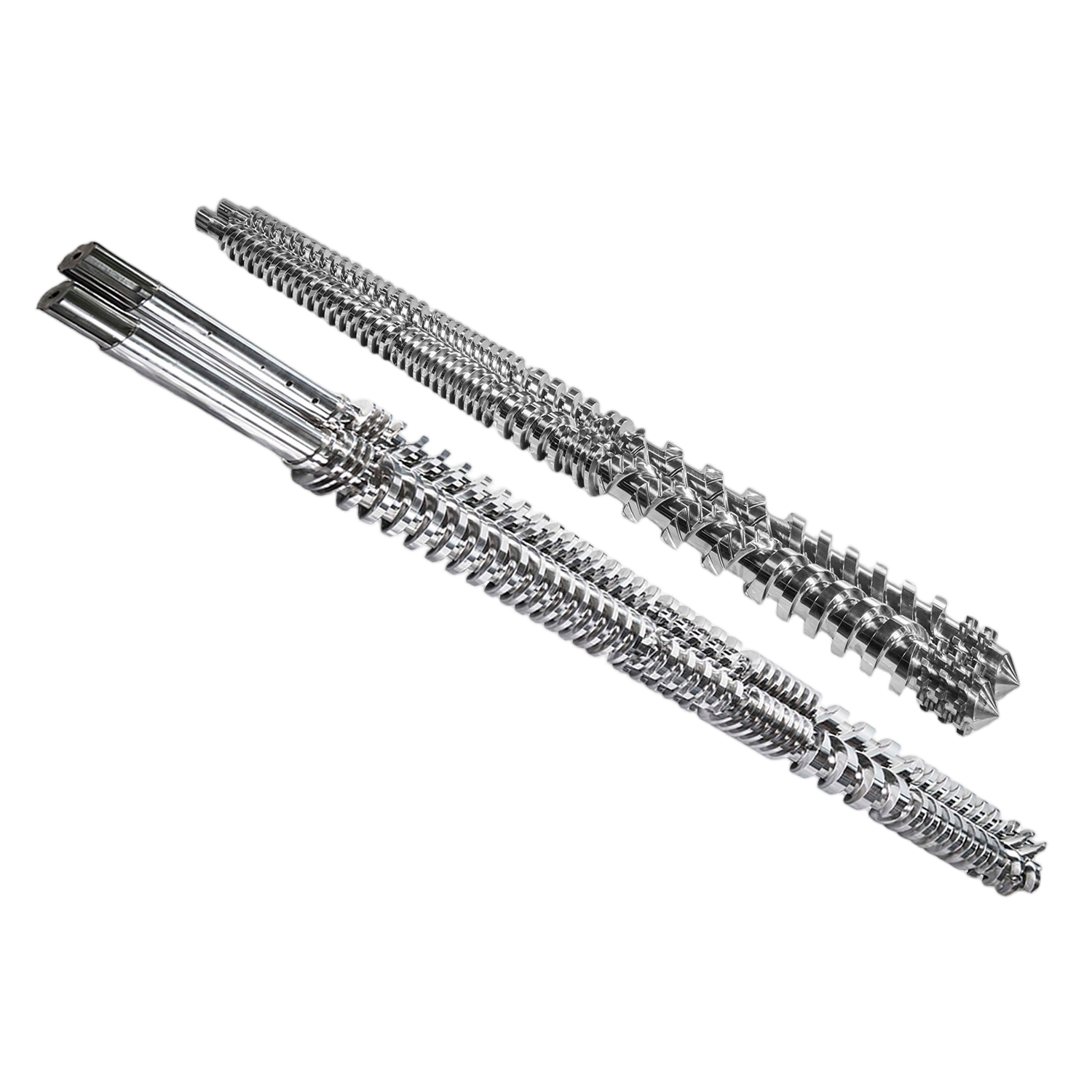
Conical twin screw barrels in the Φ25/50–Φ185/340 range are used for PVC powder melting, high-shear plasticizing and stable extrusion shaping on continuous counter-rotating conical twin-screw extruders. The published requirement for these projects is high wear resistance, with a bimetallic lining for calcium carbonate high-filler processing and a nitrided finish.
Compounding and Pelletizing
Parallel twin screw barrels in the Φ45–Φ350 range serve plastic recycling and compounding lines, where screw geometry is built around mixing sections rather than pure conveying.
Injection Molding Machine Builds
Injection molding machine screw and barrel sets in the Φ20–Φ300 range are specified for automotive, electronics and toy manufacturing applications, where shot consistency and colour change behaviour matter more than raw throughput.
Rubber Extrusion
Rubber machine screw and barrel sets in the Φ20–Φ650 range serve tire and rubber product manufacturing, a segment where temperature control dominates barrel design.

Comparison Table: Matching the Family to the Machine
| Family | Diameter scope | Industry | Wear-resistance priority |
|---|---|---|---|
| Conical Twin Screw Barrel | Φ25/50–Φ185/340 | Plastics machinery / construction materials | High — bimetallic lining for high-filler CaCO₃ |
| Parallel Twin Screw Barrel | Φ45–Φ350 | Plastic recycling & compounding | High — abrasive regrind and filled compounds |
| Single Screw Extruder Screw and Barrel | Φ20–Φ500 | Plastics packaging & pipe manufacturing | Moderate — nitrided or chromium plated |
| Injection Molding Machine Screw and Barrel | Φ20–Φ300 | Automotive, electronics & toy manufacturing | Moderate — nitrided case and straightness critical |
| Rubber Machine Screw and Barrel | Φ20–Φ650 | Tire & rubber product manufacturing | Application dependent — temperature control critical |
FAQ: OEM Support, Lead Times and Certifications
OEM buyers typically request three management-system certificates: ISO 9001 for quality management, ISO 45001 for occupational health and safety, and ISO 14001 for environmental management. For each one, check the certificate number, the issuing body, the validity dates and the scope statement — the scope must cover screw and barrel manufacturing, not only trading. Note that these certificates cover the management system, not the product: hardness, case depth and straightness are verified by the inspection report supplied with each batch.
Yes, when the barrel is built to the machine builder's drawing rather than selected from a catalogue. That requires four inputs from the buyer: the machine interface drawing, the polymer family and filler loading, the material and heat-treatment specification, and the first-article acceptance criteria. Guangyou Screw produces five families covering extrusion, injection molding, compounding and rubber machines, in diameter scopes from Φ20 up to Φ650 depending on the family, so a multi-machine programme can be sourced from one supplier.
Five factors: the base material grade (38CrMoAl is standard, with D2, DC53, AISI316 and bimetallic configurations costing more), the complexity of the screw geometry, how machining setup is amortised across the batch size, the inspection scope per piece, and the surface treatment route — nitriding, chromium plating or alloying. A 5-piece order carries a higher per-unit setup share than a 50-piece order, which is why batch size should be stated at inquiry rather than after quotation.
Validation normally runs on a first article: one piece is produced and measured against the agreed parameters — hardness after hardening and tempering at HB260–310, nitrided hardness at HV850–1000, nitrided case depth at 0.45–0.7 mm, surface roughness at Ra 0.4, and screw straightness at 0.015 mm — before the batch is released. This lets the buyer confirm drawing conformity and inspection reporting before committing to the full 1–50 piece quantity.
Lead time is not a single number; it is the sum of drawing approval, material procurement, machining, heat treatment, inspection and packing. For planning purposes, treat the first order as two phases — engineering approval and production — and ask the supplier to quote each phase separately. Repeat orders against an unchanged drawing carry a shorter cycle because the specification and inspection criteria are already fixed. Delivery reliability should be assessed from the supplier's annual production capacity of approximately 32,000 units and its export share of 30% of total sales, which indicate an established export dispatch routine. To start a specific project, send the machine drawing and polymer details to Guangyou Screw for a scoped quotation.

Conclusion
A screw barrel manufacturer earns a long-term OEM position on three things a buyer can verify: whether the plant builds to a drawing, whether it can run a 1–50 piece batch without disrupting series production, and whether it can produce a complete, correctly scoped document set. Geometry and price matter, but they are recoverable through engineering; a missing certificate scope or an unresolved interface drawing is not.
Start with the specification. Define the machine interface and polymer, agree the hardness, case depth and straightness values in writing, request the ISO 9001, ISO 45001 and ISO 14001 certificate set with scope statements, and validate the first article before releasing the batch. That sequence turns a single purchase into a repeatable supply relationship — and gives you a defensible service-life baseline for the next order.
Request a Sample, Quotation or Full Catalogue
Send your machine drawing, polymer family, filler loading and target batch size. Guangyou Screw will return a scoped quotation, material recommendation and inspection plan for your project.
Email: info@gmscrew.com | Tel: +86 13575629951 | WhatsApp: +86 13858143949 | Zhoushan, China
Visit Guangyou Screw Download the 2026 CatalogueProduct data cited in this article reflects published Guangyou Screw specifications for its five screw barrel families. Market figures are attributed to Grand View Research, Global Insight Services, Fortune Business Insights and Dataintelo. Certification status for any specific order should be confirmed directly with the supplier before purchase.
Have Questions or Need More Details?
Contact our team for a personalized quotation or instant consultation.
Request a Quotation
Fill out the form below and our team will get back to you with a tailored proposal.
WhatsApp Direct Chat
Prefer to chat in real-time? Message us on WhatsApp for instant assistance & quick answers.
- Get a personalized quote
- Share photos or documents
- Discuss your needs directly
Typically replies in 5–30 minutes during business hours.