Screw Barrel Specs Decoded: Hardness, Case Depth, and Certifications to Demand
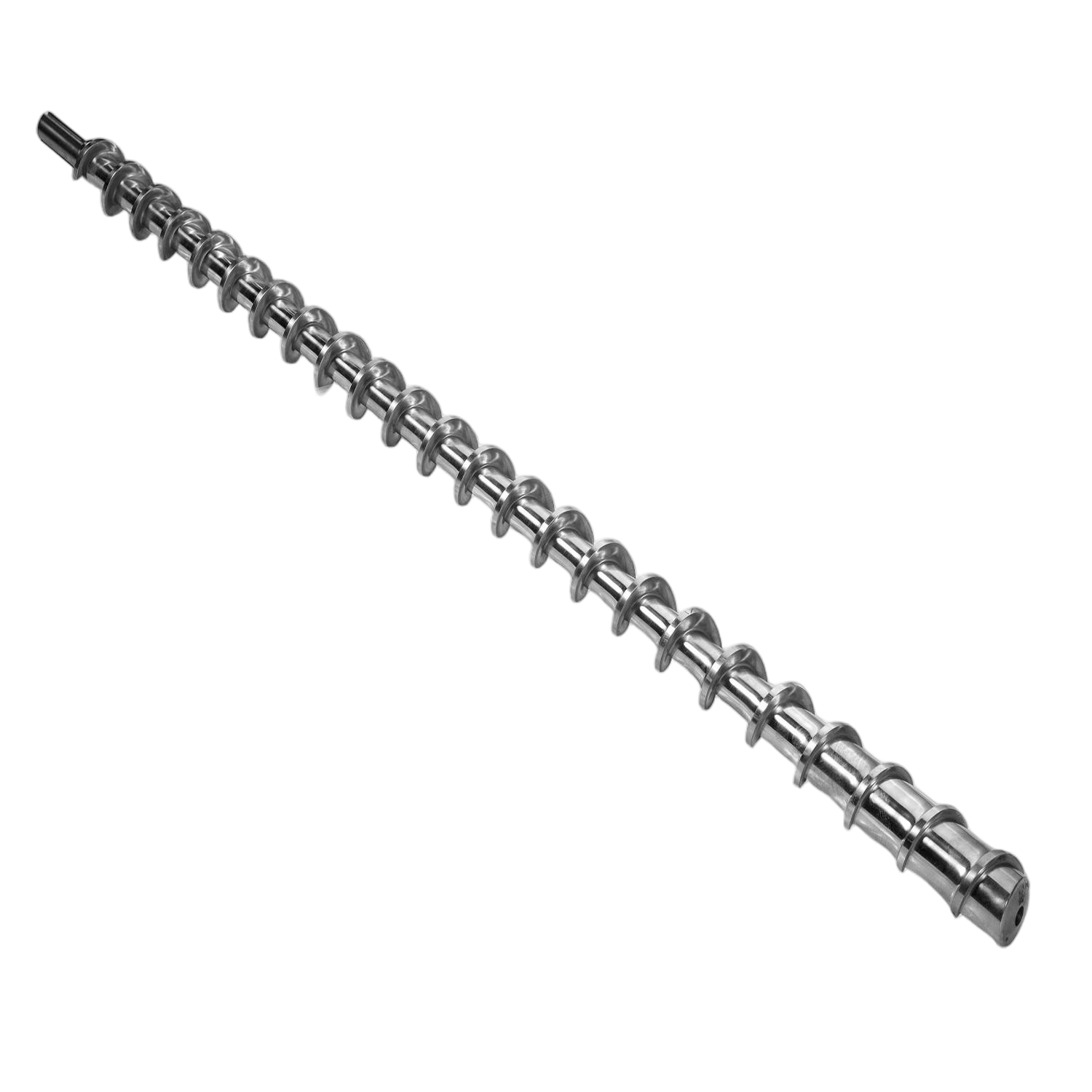
Published screw barrel specifications are only useful when the buyer knows which values control real extrusion and injection performance.
Not all screw barrel data sheets give you enough evidence to predict service life. During evaluation, buyers should check more than the screw diameter and barrel length: they need nitrided hardness, nitrided case depth, surface roughness, screw straightness, alloy overlay values, chromium plating values, and the manufacturer's management system certifications. A barrel screw that seems low-cost on paper can become expensive when wear appears after only a short production run.
This article explains how to read screw barrel specifications, which certification documents are meaningful, and how to connect those specifications to actual extrusion, injection, compounding, and rubber processing conditions.
Why Screw Barrel Specification Checks Fail in Practice
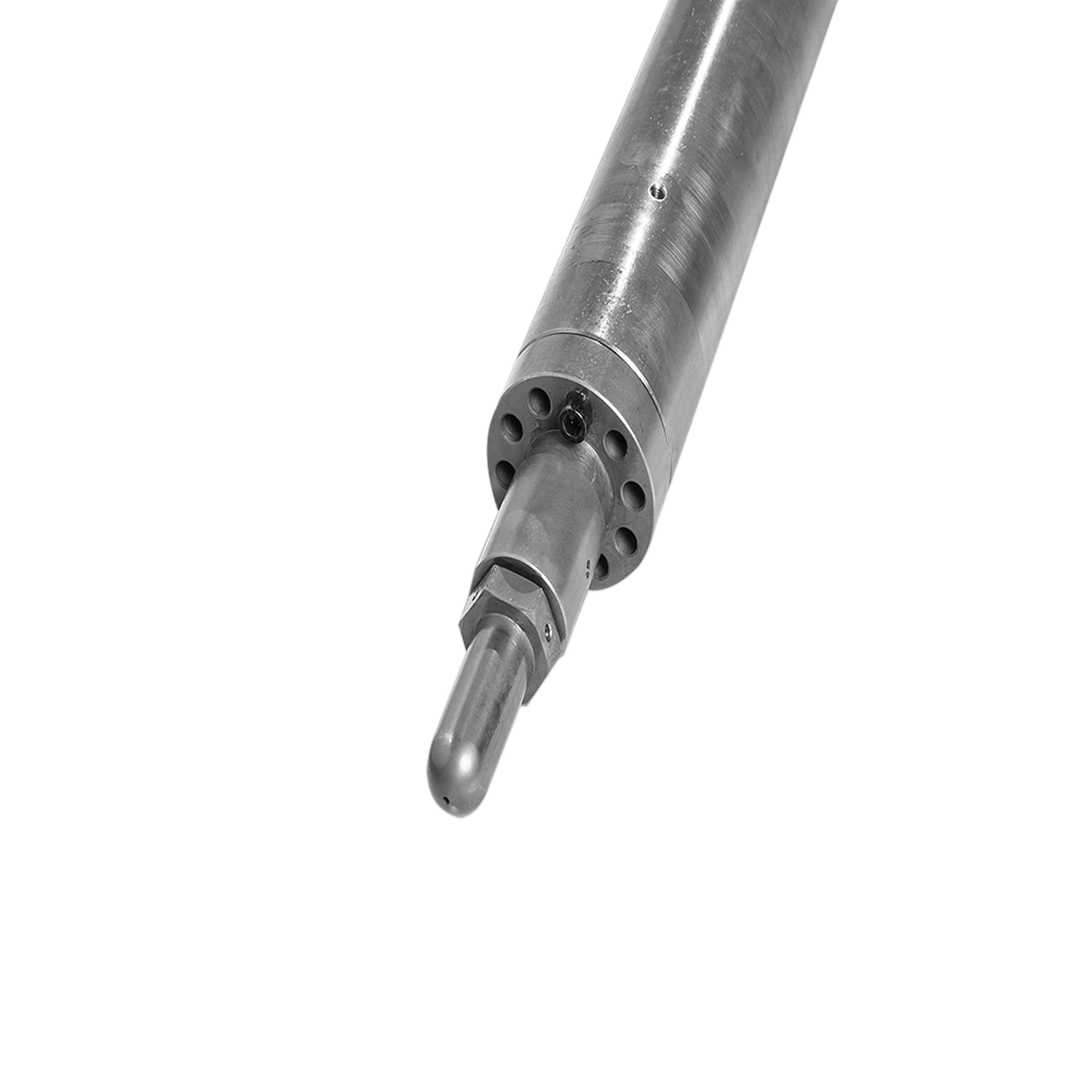
Most screw and barrel look similar in a photo. The practical difference appears in the heat-treatment process, the machining precision, and the quality controls behind the finished component.
Three mistakes are common at the evaluation stage:
- Buyers compare only the screw diameter and the machine brand, ignoring the surface treatment depth and hardness values.
- Buyers assume every barrel screw with high hardness is equally wear-resistant. Hardness matters, but so does case depth, plating thickness, alloy depth, and the base material.
- Buyers accept a general ISO certificate without checking the scope, the certificate number, the issuing body, and whether the certification actually covers the design and manufacture of screw barrel components.
Guangyou Screw, operated by Zhejiang Guangming Plastics Machinery Co., Ltd., is a screw barrel manufacturer based in Zhoushan, China. Founded in 1992, the company operates a 100,000+ m² facility with more than 800 employees and exports mainly to the EU and other global markets. For a buyer, that background matters less than the measurable facts the factory can document.
Industry Background: Screw and Barrel Demand Is Broadening
The feed screw barrel market is projected to grow from USD 1.89 billion in 2024 to USD 3.33 billion by 2034 at a CAGR of 5.8%, according to Global Insight Services. The demand is driven by replacement orders, machinery OEM assembly, and upgrades in extrusion and injection plants.
Single-screw extrusion machinery still dominates the extrusion market, holding roughly 62% of the extrusion machinery market as of 2024, based on Fortune Business Insights. That installed base creates a steady requirement for single screw extruder screw and barrel replacements.
At the same time, the bimetallic barrel and screw market is estimated at USD 2.8 billion in 2025 and is forecast to reach USD 4.7 billion by 2034, according to Dataintelo. The practical reason is visible in PVC and compounding lines: highly filled polymers, recycled materials, and calcium carbonate compounds accelerate wear on standard nitrided surfaces.
For an evaluation team, these industry trends reinforce a simple point: screw barrel selection is becoming a materials engineering decision, not just a spare parts purchase.
The Core Verification Framework
Use six checkpoints when reviewing a screw barrel quotation or drawing:
- Confirm the screw and barrel size range matches the actual machine model.
- Confirm the core mechanical tolerance values: screw straightness and surface roughness.
- Confirm the nitriding specification: surface hardness, case depth, and brittleness grade.
- Check whether an alloy overlay or chromium plating is required for the specific polymer and filler load.
- Check the manufacturer's ISO certificates and their scope.
- Check ordering flexibility: MOQ, batch size, and lead time.
These steps work for both a first order and a long-term supply agreement.
1. Match the Screw Barrel Size Range to the Machine
Guangyou Screw publishes five screw barrel product families:
- Single Screw Extruder Screw And Barrel, Φ20-Φ500, for film blowing and pipe extrusion.
- Parallel Twin Screw Barrel, Φ45-Φ350, for compounding and pelletizing applications.
- Conical Twin Screw Barrel, Φ25/50-Φ185/340, for PVC extrusion lines.
- Injection Molding Machine Screw And Barrel, Φ20-Φ300, for plastic injection molding.
- Rubber Machine Screw And Barrel, Φ20-Φ650, for rubber extrusion.
These ranges are not interchangeable. A conical twin screw barrel has a tapered geometry designed for PVC powder processing, while a parallel twin screw barrel serves high-throughput compounding and recycling tasks.
2. Verify Geometric Quality: Straightness and Surface Finish
Geometry is the first measurable sign of machining quality.
Published values across the Guangyou Screw barrel screw range include screw straightness of 0.015 mm and surface roughness of Ra 0.4. Straightness affects running stability. Roughness affects material flow, cleaning cycles, and the risk of polymer sticking inside the barrel.
Do not assume those values. Ask for the inspection method and, when possible, a 100% test record. Guangyou Screw states that its quality control process is 100% tested, which is a meaningful manufacturing commitment for a precision component.
3. Verify the Nitriding Specification
Most screw barrels are nitrided to create a hard, wear-resistant surface layer. In published Guangyou Screw specifications, the nitriding values are:
- Hardness after hardening and tempering: HB260-310.
- Nitrided hardness: HV850-1000.
- Nitrided case depth: 0.45-0.7 mm.
- Nitrided brittleness: less than Grade 2.
A shallow nitrided layer can wear through quickly in abrasive applications. A buyer evaluating a replacement screw should compare case depth values, not only the surface hardness number.
4. Check Alloy Overlay and Chromium Plating Requirements
For highly filled PVC, recycled polymers, and abrasive compounds, a nitrided surface may not be sufficient.
The Guangyou Screw specification range also includes:
- Surface chromium plating hardness after nitriding: ≥900HV.
- Chromium plating depth: 0.025-0.10 mm.
- Alloy hardness: HRC50-65.
- Alloy depth: 0.8-2.0 mm.
These are not optional features on every order; they are engineering responses to specific wear conditions. In PVC pipe, profile, and sheet extrusion, the working condition often includes continuous counter-rotating conical twin-screw extrusion, with high wear resistance and bimetallic lining needed for CaCO3 high-filler processing. That type of application justifies a barrel design with alloy lining rather than a standard nitrided barrel alone.
5. Verify the Management System Certificates
Certification evidence is one of the most direct ways to assess whether a screw barrel maker operates quality and safety controls in the factory.
Zhejiang Guangming Plastics Machinery Co., Ltd. holds three system certificates issued by WIT ASSESSMENT:
| Certificate | Standard | Certificate Number | Scope |
|---|---|---|---|
| Quality Management System Certificate | ISO9001:2015 | 15/25Q6428R80 | Design and manufacturing of orthogonal twin-screw extruders and barrel components for plastic extrusion |
| Environmental Management System Certificate | ISO14001:2015 | 15/25E6429R20 | Environmental management involved in the design and manufacture of counter-rotating twin-screw and barrel for plastic extruder |
| Occupational Health and Safety Management System Certificate | ISO45001:2018 | 15/25S6430R20 | Occupational safety and health management in the design and manufacture of counter-rotating twin-screw and barrel for plastic extruder |
The ISO9001 certificate covers the design and manufacturing of extruder and barrel components, which is the most relevant document for product quality. ISO14001 and ISO45001 describe environmental and occupational health controls at the factory level. The certificates were issued with validity into 2028, so they are current for suppliers being evaluated in 2026.
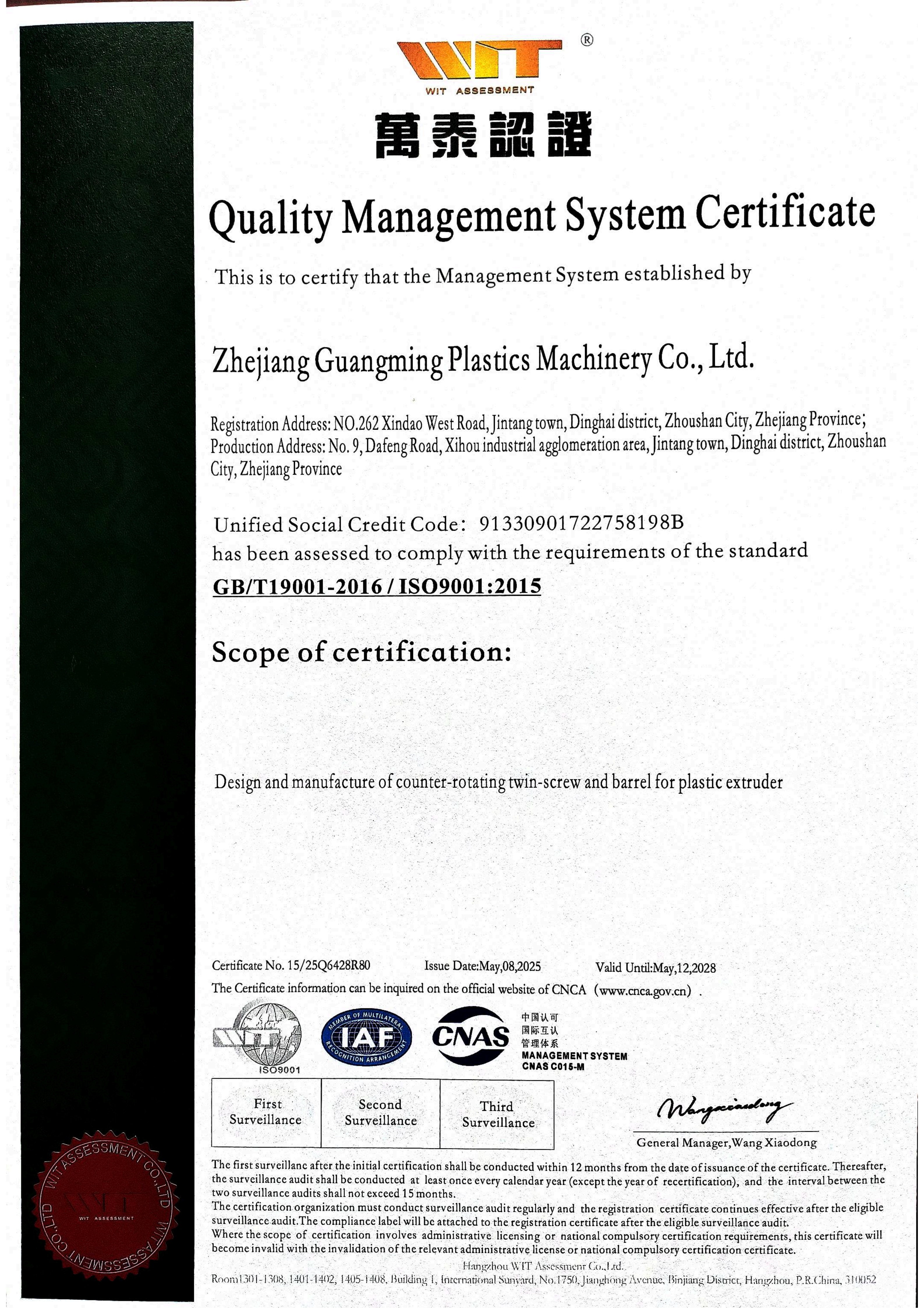
ISO9001:2015 certificate for design and manufacturing of screw barrel components for plastic extrusion, issued by WIT ASSESSMENT.
6. Check Supply Flexibility
Screw barrel needs vary from one-piece replacements to batch orders for machinery OEMs. The Guangyou Screw capability record shows:
- OEM production mode is available.
- Customization options include voltage and logo.
- Monthly capacity is 2,700 units.
- MOQ is 1 unit.
- Batch sizes in practice range from 1 to 50 pieces.
- Quality control is 100% tested.
- After-sales support includes warranty.
A low MOQ is important during the Research stage. It allows a line manager or procurement team to test a screw barrel on one machine before committing to a larger batch.
Step-by-Step Screw Barrel Evaluation Process
Use this process when you receive a drawing or a specification sheet from a screw supplier.
Step 1: Document the Actual Operating Condition
Write down the machine type, the polymer being processed, the filler content, the RPM range, and whether the line is used for PVC pipe, profile, sheet extrusion, compounding, pelletizing, film blowing, injection molding, or rubber extrusion.
Step 2: Define the Required Screw Barrel Product Family
Choose between a single screw extruder screw and barrel, a parallel twin screw barrel, a conical twin screw barrel, an injection molding screw and barrel, or a rubber machine screw and barrel. The correct family determines the machining geometry and the screw profile.
Step 3: Compare Size and Tolerances
Check whether the quoted screw size falls inside the manufacturer's published scope. For a conical twin screw barrel, the published scope is Φ25/50-Φ185/340. For a parallel twin screw barrel, the published scope is Φ45-Φ350. For a single screw barrel, the published scope is Φ20-Φ500. Injection screws are available from Φ20 to Φ300. Rubber machine screws and barrels are available from Φ20 to Φ650.
Step 4: Request Treatment and Finish Values
Ask for nitrided hardness, nitrided case depth, brittleness grade, surface roughness, screw straightness, and, if relevant, alloy hardness and alloy depth. These numbers allow an apples-to-apples comparison between competing offers.
Step 5: Verify Certification Documents
Request the current ISO certificates. Confirm the certificate number, issuing body, standard, scope, and validity period.
Step 6: Test with a Small Order
Because the MOQ is 1 unit, a buyer can order a single sample screw or barrel. After installation, measure the plasticizing effect, check wear after a defined production period, and compare the mechanical fit against the original component.
Use Cases Across Different Production Scenarios
PVC Pipe, Profile, and Sheet Extrusion
PVC extrusion usually runs powder compounds with calcium carbonate fillers. The working condition demands efficient PVC powder melting, high-shear plasticizing, and stable extrusion shaping. Continuous counter-rotating conical twin-screw extrusion is the standard mode. The special requirement includes high wear resistance and bimetallic lining to handle CaCO3 high-filler processing, with a nitrided finish as the base specification.
For these lines, the Conical Twin Screw Barrel is the relevant product family, with size range Φ25/50-Φ185/340.
Compounding, Recycling, and Pelletizing
Parallel twin screw extruders are used for plastic recycling and compounding. The Parallel Twin Screw Barrel, Φ45-Φ350, must tolerate abrasive fillers, recycled polymer contamination, and higher screw speeds. Buyers should prioritize the alloy overlay specification in this condition.
Film Blowing and Pipe Extrusion
Single screw extruders handle a wide range of packaging and pipe materials. The Single Screw Extruder Screw And Barrel, Φ20-Φ500, is available with multiple material grades and surface treatment options.
Injection Molding
Original equipment manufacturers and molders need screws that provide consistent melting and shot control. The Injection Molding Machine Screw And Barrel, Φ20-Φ300, is used in automotive, electronics, and toy manufacturing applications.
Rubber Extrusion
Rubber machine screws and barrels operate under different shear conditions compared with plastics extrusion. The Rubber Machine Screw And Barrel, Φ20-Φ650, is designed for tire and rubber product manufacturing.
Comparison Table: Screw Barrel Product Families at a Glance
| Product | Available Size | Process Type | Typical Application | Key Published Values from Guangyou Screw |
|---|---|---|---|---|
| Single Screw Extruder Screw And Barrel | Φ20-Φ500 | Film blowing / pipe extrusion | Plastics packaging and pipe manufacturing | Nitrided hardness HV850-1000; case depth 0.45-0.7 mm; Ra0.4; straightness 0.015 mm; optional alloy hardness HRC50-65, depth 0.8-2.0 mm |
| Parallel Twin Screw Barrel | Φ45-Φ350 | Compounding and pelletizing | Plastic recycling and compounding | Nitrided hardness HV850-1000; case depth 0.45-0.7 mm; Ra0.4; straightness 0.015 mm; chromium plating ≥900HV |
| Conical Twin Screw Barrel | Φ25/50-Φ185/340 | PVC extrusion | Plastics machinery and construction materials | Nitrided hardness HV850-1000; case depth 0.45-0.7 mm; Ra0.4; straightness 0.015 mm; alloy hardness HRC50-65 |
| Injection Molding Machine Screw And Barrel | Φ20-Φ300 | Plastic injection molding | Automotive, electronics, and toy manufacturing | Nitrided hardness HV850-1000; case depth 0.45-0.7 mm; Ra0.4; straightness 0.015 mm |
| Rubber Machine Screw And Barrel | Φ20-Φ650 | Rubber extrusion | Tire and rubber product manufacturing | Nitrided hardness HV850-1000; case depth 0.45-0.7 mm; Ra0.4; straightness 0.015 mm; material options include 38CrMoAl, D2, AISI316, 34CrAlNi7, and higher-alloy grades |
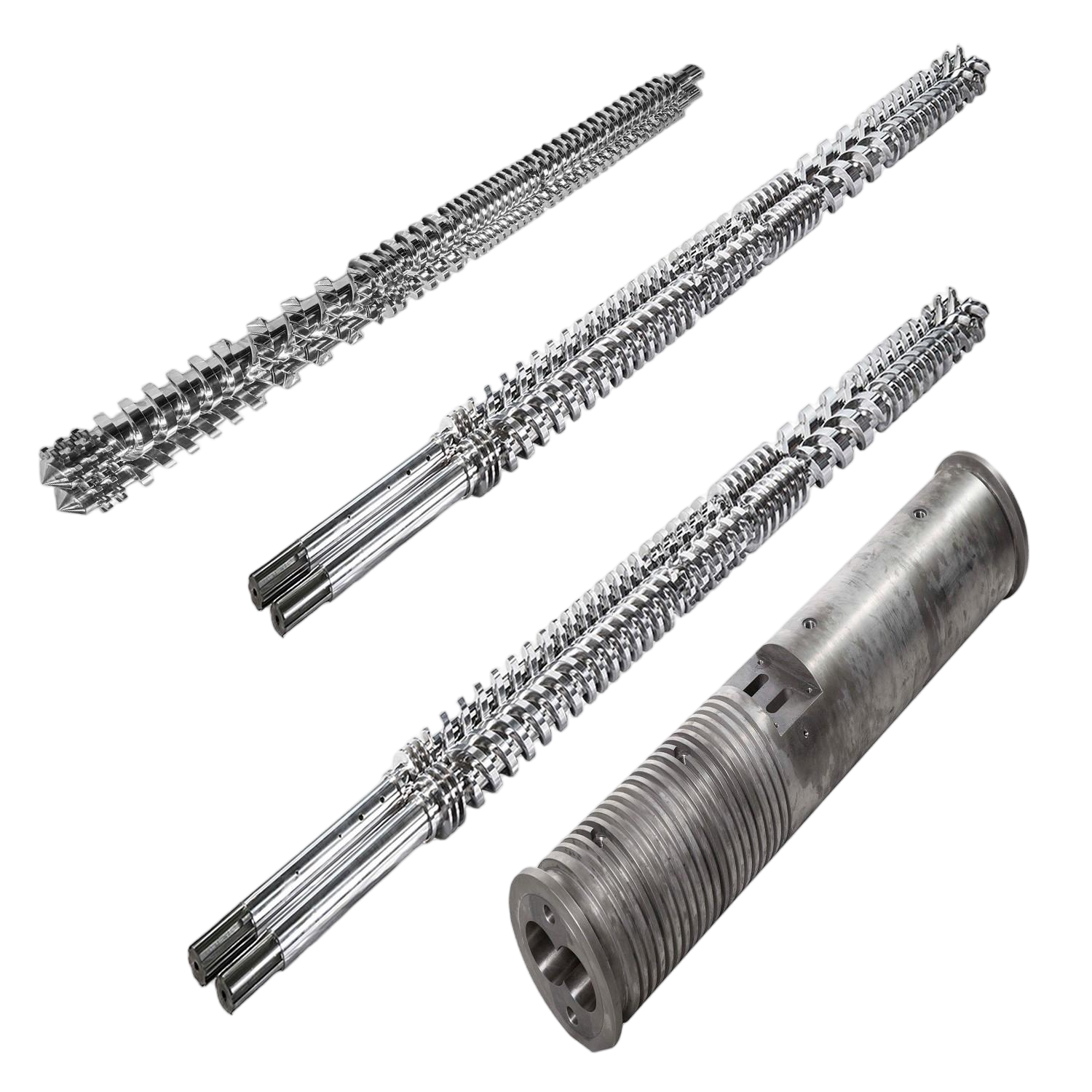
Parallel twin screw barrel in the Φ45-Φ350 class for compounding and recycling lines.
What the Published Material List Tells a Buyer
Guangyou Screw lists multiple material grades for its screw and barrel products, including 38CrMoAl (1.8509), D2, AISI316, 34CrAlNi7 (1.8550), DC53, AISI420, 31CrMoV9 (1.8519), Gr12MoV, 9Cr18MoV, 40CrNiMo, 440C, 17PH-4, 42CrMo, AISI304, Inconel 718, 40Cr, 1.2316, Hasteloy C-276, C45, 1.4462, Inconel 625, SKD11, 1.4404, Monel 400, SKD61, 1.4122, Monel 500, and S600.
The range itself is a signal: the supplier is prepared to match the screw barrel material to the polymer chemistry and wear condition rather than pushing one standard grade. Nitriding steel such as 38CrMoAl is common in conventional applications, while corrosion-resistant grades such as AISI316, 1.4462, Hasteloy, and Monel are listed for demanding chemical environments.
Buyer Evidence from Real Supply Patterns
Guangyou Screw supplies screw barrel components through batch customized orders, with single batch quantities usually ranging from 1 to 50 pieces.
Three buyer groups are typical in the supply record:
- Extrusion and injection machinery OEMs that need original equipment manufacturing assembly and dimensionally consistent batch delivery.
- Plastic product manufacturers that process highly filled and corrosive polymers and need wear-resistant, long-lifetime components.
- Screw and barrel manufacturers and distributors that source complex components based on custom technical drawings.
The reported project result for custom-drawing components is 100% precise mechanical fit. For normal high-filler PVC extrusion working conditions, documented lifetime in service ranges from 1 to 5 years. These facts describe what a buyer can reasonably expect when the correct material and treatment are selected.
Frequently Asked Questions for Screw Barrel Evaluation
What ISO certifications should a screw barrel manufacturer hold?
A screw barrel manufacturer should be able to provide a current ISO9001:2015 Quality Management System certificate covering the design and manufacture of screw and barrel components. Environmental and occupational health certificates such as ISO14001:2015 and ISO45001:2018 add evidence that factory processes are controlled. Zhejiang Guangming Plastics Machinery Co., Ltd. holds all three certificates, issued by WIT ASSESSMENT, with certificate numbers 15/25Q6428R80, 15/25E6429R20, and 15/25S6430R20, valid into 2028.
What do nitrided hardness and nitrided case depth mean for screw barrel performance?
Nitrided hardness indicates the surface hardness of the screw after the nitriding process. Guangyou Screw publishes nitrided hardness of HV850-1000. Nitrided case depth shows how deep the hardened layer extends below the surface; the published range is 0.45-0.7 mm. A deeper case provides more wear allowance. Buyers should also check nitrided brittleness, listed as less than Grade 2, because an excessively brittle nitrided layer can crack under high mechanical load.
When should a buyer choose bimetallic or alloy-lined screw barrel construction?
Alloy-lined construction becomes important when the polymer contains abrasive fillers such as calcium carbonate, when recycled materials are used, or when corrosion resistance is required. Guangyou Screw lists alloy hardness of HRC50-65 and alloy depth of 0.8-2.0 mm. In PVC pipe, profile, and sheet extrusion with high-filler CaCO3 processing, bimetallic lining is a common requirement. For standard non-abrasive polymers, a nitrided barrel may provide adequate life at lower cost.
Can I order a single screw barrel or sample before committing to volume?
Yes. Guangyou Screw operates with an MOQ of 1 unit. Batch quantities in practice range from 1 to 50 pieces. This makes it possible to request a single replacement screw or barrel, install it on one machine, and verify the mechanical fit and plasticizing effect before scaling up the order.
What is the typical lead time for a nitrided single screw barrel?
Published lead times for nitrided single screw and barrel orders are 40-50 days for Φ20-Φ90, 50-60 days for Φ90-Φ180, and 60-70 days for Φ180-Φ250. Larger diameters exceed 70 days. Lead time varies based on size and whether a bimetallic lining is required. OEM customization options such as voltage and logo can also affect the production schedule.
Conclusion
Screw barrel procurement should be treated as a technical qualification process. The buyer who checks screw straightness, surface roughness, nitriding depth, alloy hardness, certification scope, MOQ, and lead time will make a more reliable purchasing decision than the buyer who only compares price.
Guangyou Screw provides transparent published specifications across single screw, parallel twin screw, conical twin screw, injection molding, and rubber machine product families. With a 1-unit MOQ and current ISO certifications, the company is positioned as a practical supplier for evaluation orders and long-term OEM relationships.
The next step for a technical buyer is to send the machine model, product drawings, and polymer information to the manufacturer for a specification review. If you are evaluating a screw barrel supplier for an extrusion or injection line, the most useful action is to request the current catalogue, confirm the required product model, and ask for a lead time quotation based on your actual size range.
Request the Guangyou Screw Product Catalogue
Download the catalogue to review screw barrel models, available size ranges, materials, and finished specifications before sending an inquiry.
Email: info@gmscrew.com
Tel / WhatsApp: +86 13575629951 / +86 13858143949
Have Questions or Need More Details?
Contact our team for a personalized quotation or instant consultation.
Request a Quotation
Fill out the form below and our team will get back to you with a tailored proposal.
WhatsApp Direct Chat
Prefer to chat in real-time? Message us on WhatsApp for instant assistance & quick answers.
- Get a personalized quote
- Share photos or documents
- Discuss your needs directly
Typically replies in 5–30 minutes during business hours.