Aerosol 101: Sprays, Mists & Foams | Guangzhou Yongcheng Cosmetics
Aerosol 101: Sprays, Mists & Foams | Guangzhou Yongcheng Cosmetics
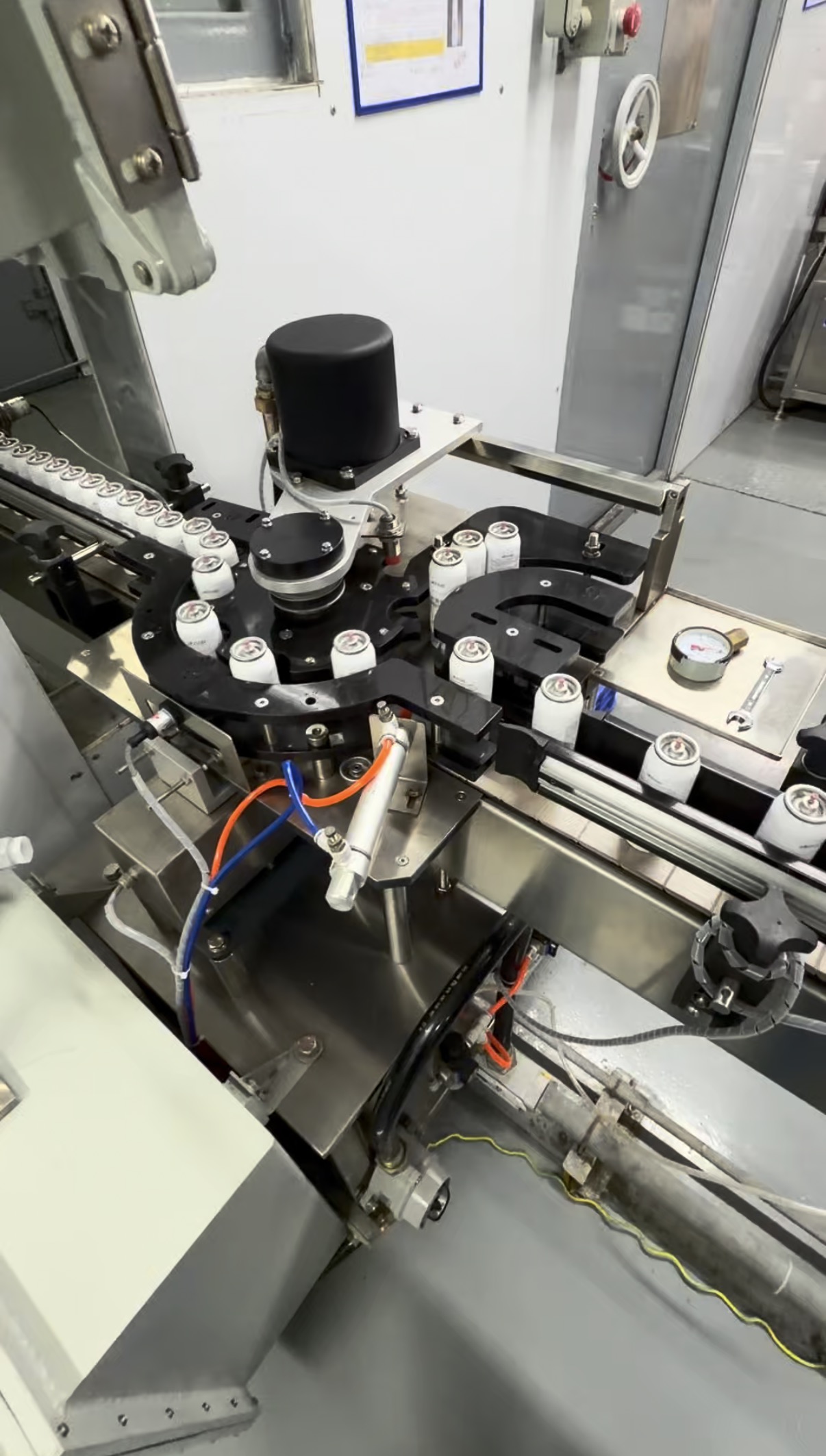
Cover: an automated aerosol filling line at Guangzhou Yongcheng Cosmetics.
A cosmetic aerosol product is a personal care formulation sealed in a pressurized container and released through a valve as one of three visible formats: a spray, a mist, or a foam. The format is not a marketing word choice — it is an engineering decision that fixes the valve, the actuator, the propellant system and, in most cases, the viscosity band the formula has to sit inside.
This explainer covers what each of the three delivery formats actually does, how one aerosol architecture serves different personal care categories, where BOV aerosol fits into the picture, and what an OEM/ODM buyer should specify before a single can is filled. Product examples throughout come from the range manufactured by Guangzhou Yongcheng Cosmetics Co., Ltd., an aerosol cosmetics OEM & ODM manufacturer based in Guangzhou, China.
1. What Counts as a Cosmetic Aerosol Product
Definition: a cosmetic aerosol product is a personal care formulation contained in a pressurized can, dispensed through a valve, where the pressure that drives the product out is created by a propellant or by a compressed-gas system. The consumer triggers output with an actuator. The actuator, valve and can together determine whether that output arrives as a spray, a mist or a foam.
That single architecture supports a wide product spread. In the Yongcheng range it covers sun care (Cooling Sunscreen Spray, Sunscreen Mousse, Sunscreen Spray + Whitening, Sunscreen Lotion), body care (Hair Removal + Fragrance, Deodorant + Body Fragrance, Instant Brightening Spray, Sports Cooling Spray, Shower Mousse, Body Acne Care Spray), hair care (Hair Styling + Fragrance, Dry Shampoo + Fragrance, Styling Wax Mousse + Fragrance, Foaming Hair Mask, Hair Oil Spray), facial care (Hydration Mist + Soothing, Facial Toner + Fragrance, Foundation Mist, Setting Spray, VC Essence Mousse, Cleansing Oil Mousse, Shaving Foam) and fragrance, including custom perfume.
The practical takeaway for a buyer is that "cosmetic aerosol products" is a manufacturing category, not a single product. Two projects sitting under the same category name can share almost no hardware.
2. Problem Definition: Why Sprays, Mists and Foams Get Confused
The confusion is rarely about vocabulary. It is about assumption. A brand owner decides “we want a face mist” and assumes the only open questions left are fragrance and artwork. In practice, the format decision already fixes several variables at once:
- Output character — a continuous wet spray versus a fine low-impact mist versus an expanding foam
- Valve and actuator combination — metering, spray rate, break-up pattern
- Pressure system — conventional propellant versus a compressed-gas system
- Formula band — the viscosity and surface-tension window the formulation must operate in
- Filling method and QC scope — which determines inspection density and acceptance testing
A second and more expensive confusion is mixing up the delivery format with the packaging technology. “Spray” describes how product leaves the can. BOV describes how the can itself is built. They are separate decisions, made at different points in a project, and conflating them is a common reason early quotations come back incomparable.
3. The Three Delivery Formats Buyers Actually See
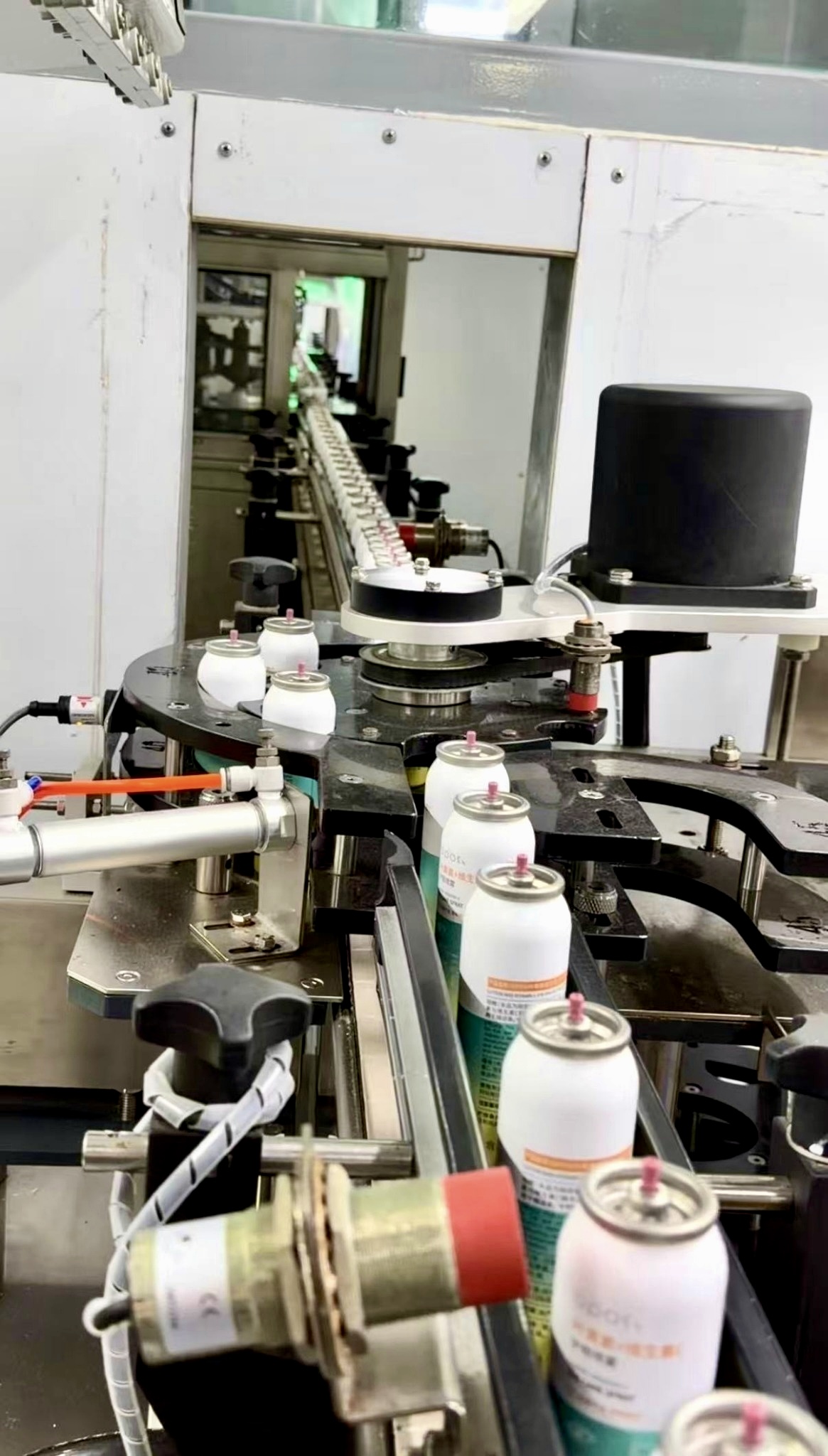
The aerosol filling process determines how consistently a formulation is dosed into each can.
Sprays: coverage and direction
A spray is the highest-output aerosol format. It is continuous, directional, and designed to move product across a surface quickly rather than deposit it in one place. Spray formats suit products that need to travel across skin or hair.
Documented examples in the Yongcheng range:
- miluvcare Cooling Sunscreen Spray — SPF 50+ PA+++, 150 ml, broad-spectrum UVA/UVB protection, aerosol spray format, cooling skin feel, aluminium aerosol can. This is the format behind many sunscreen spray OEM and private label sunscreen spray programmes.
- miluvcare Hair Removal Spray — 150 ml, Wild Rose scent, fast and gentle hair removal with moisturizing skin care, aerosol depilatory spray, for women and men. The product data describes it as an aerosol mousse spray designed for easy application — a useful reminder that a depilatory spray can sit between the spray and foam formats.
- Caliph Klong Men's Fragrance Strong Styling Spray — 300 ml (10.14 oz), strong-hold hair styling with fragrance care, ultra-fine mist and instant quick-dry, non-stiff flexible hold with re-workable hairstyle, lightweight non-sticky texture, long-lasting volume and textured layers, masculine fragrance, aerosol pressure packaging.
- Quarxery Tone-Up Brightening Spray — 90 ml, skin tone-up and brightening, lightweight fast-absorbing formula, aluminium aerosol can. Often positioned as a body whitening spray or body mist spray in finished-product catalogues.
Mists: fine, uniform, low-impact
A mist is a spray tuned for a finer, softer and lower-impact output. The engineering difference matters most on the face, where deposition weight and droplet size decide whether the product feels refreshing or simply wet.
- LUCENBASE Centella Asiatica Soothing And Moisturizing Spray — a Hydration & Soothing Toner Mist, 300 ml (10.14 oz), 4X Soothing Complex formula, Centella Asiatica extract, Ceramide, Hyaluronate and Panthenol, fine mist aerosol spray. A reference point for a hydrating facial mist brief.
- Eyevmy Skin Nourishing Essence Makeup Setting Spray — 120 ml (4.0 fl oz), makeup setting, oil control and moisturizing, skin-nourishing peptide complex, long-lasting makeup hold, lightweight comfortable fit, oil control for shiny skin, dual-pack aerosol system with no propellant, multi-patented skincare ingredients.
- ESCP Lutein Eye Care Spray — 90 ml (3.04 fl oz), eye cleaning and moisturizing care, a soft fine mist for eye-surrounding skin coverage, multi-hydrating formula with Lutein, gentle skin-friendly formula for external eye-area use only.
Note the naming gap: the Eye Care Spray carries “spray” in its name but its documented output is a soft fine mist. In this category, the word on the label and the engineering format do not always match — which is exactly why format should be briefed explicitly rather than inferred from a product name.
Foams and mousses: texture, not coverage speed
A foam or mousse leaves the valve as a liquid-plus-gas mixture and expands into a denser, cream-like structure on contact with air. The value proposition is texture and spreadability, not surface coverage speed.
- SOLEHE soft and refreshing shaving foam — 250 ml with a net weight of 8.45 fl oz, dense rich foam texture, beard softening and shaving lubrication, reduces razor friction, botanical soothing formula, suitable for manual razor shaving.
- HEYUEJI Watery Milk Cap Cleansing Oil Mousse — 150 ml (5.07 fl oz), gentle cleansing and makeup removal, watery milk cleansing oil texture, quickly dissolves foundation, lipstick and eye makeup, lightweight rinse-off formula, suitable for daily makeup removal.
4. Industry Background: Where Cosmetic Aerosol Demand Sits
Several published data points frame the category for buyers building a multi-year plan:
- The global aerosol cosmetics market was valued at USD 14.8 billion in 2025 (Dataintelo, Aerosol Cosmetics Market Research Report 2034).
- European aerosol production for personal care reached a 47.8% share of total aerosol units in 2024 (European Aerosol Federation, FEA).
- The sun care cosmetics market is forecast to reach USD 19.4 billion by 2033 (Grand View Research), with sunscreen spray demand sitting inside that broader sun care figure.
- China's first mandatory national safety standard for cosmetics, GB 7916-2026, takes effect on 1 January 2028 (SAMR / NMPA). Brands with multi-year SKU lifecycles should treat this as a dated compliance milestone to track, not a background detail.
Two structural facts about supply sit alongside those numbers. Cosmetics aerosol production requires a dedicated pressure-filling workshop, pressure-resistant equipment and dangerous-goods production qualification — general cream and lotion factories cannot perform aerosol filling. That constraint is what separates a true aerosol OEM from a general cosmetics supplier with an outsourced filling arrangement.
5. BOV Aerosol: A Packaging Question, Not a Format
BOV stands for Bag-on-Valve, an aerosol packaging technology in which the cosmetic formula is fully sealed inside an inner flexible bag and completely separated from the non-flammable propellant — compressed air or nitrogen — held in the outer chamber of the can. When the actuator is pressed, the compressed gas squeezes the inner bag and pushes product out through the valve.
Because formula and propellant never mix, BOV is used for alcohol-free perfume, facial mist, sunscreen spray, after-sun care and sensitive-body-care products. BOV hardware also carries a higher unit cost than standard aerosol, so it is a positioning and budget decision as much as a technical one.
This is the point in an evaluation where the BOV versus conventional aerosol question normally appears. It is a discovery-stage question answered by target-market regulation, budget and product positioning — not something a supplier should decide on a brand's behalf. Guangzhou Yongcheng Cosmetics produces both BOV and conventional aerosol OEM formats, so the comparison can be run against a single quotation baseline.
6. Step-by-Step: How an Aerosol Project Moves from Brief to Filled Can
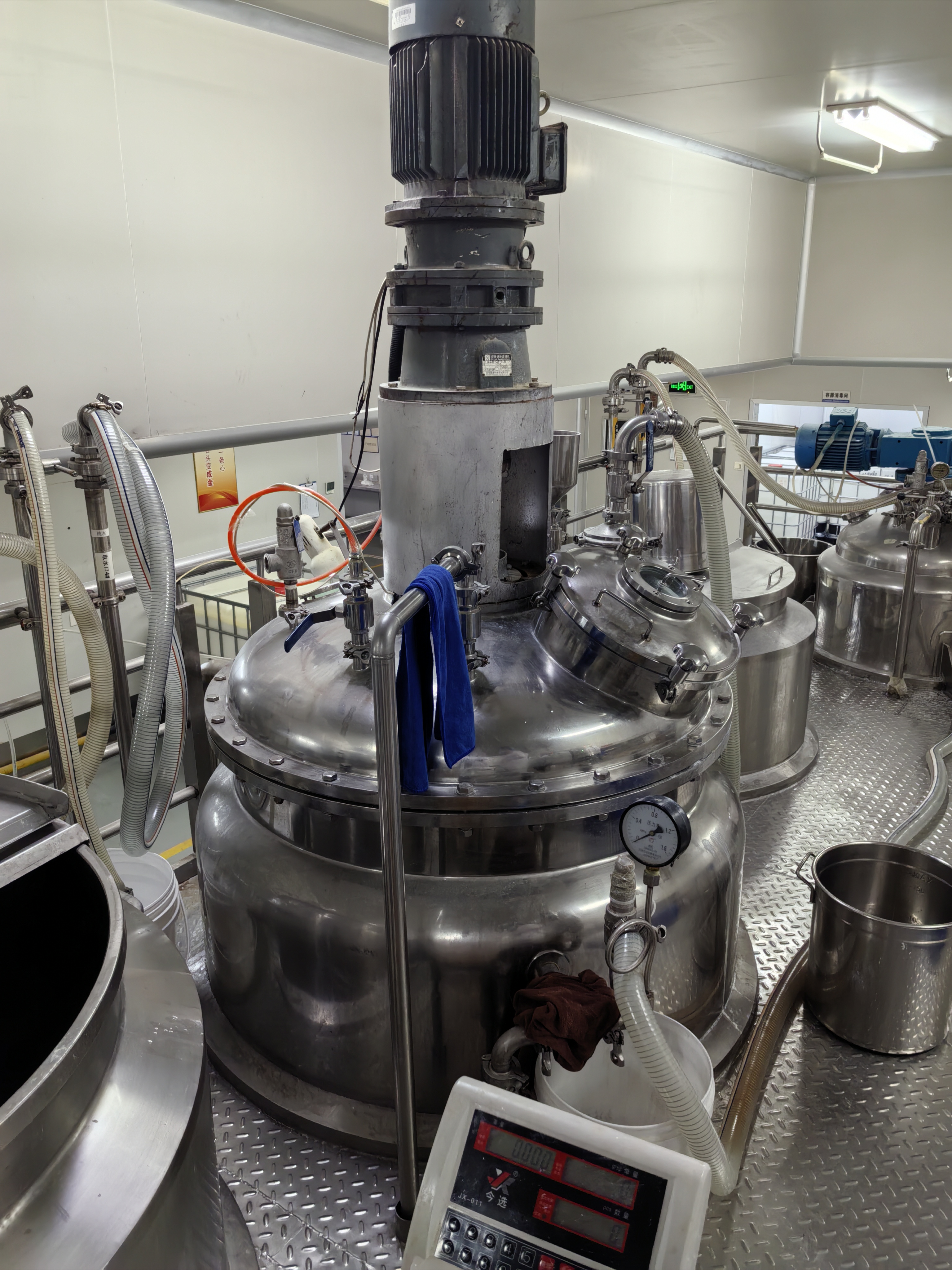
Formulation batching precedes every aerosol filling run — the format decision is locked before this stage.
Step 1 — Format definition. Decide spray, mist or foam before anything else. This decision cascades into valve selection, actuator choice and the formula's target viscosity band.
Step 2 — Formula development. Yongcheng runs R&D in a 2,000 m² laboratory. The company profile lists 10+ senior engineers with an average of 10 years' experience, and the corporate data lists a 15-engineer R&D team. Formula development, fragrance adjustment and label customization are all part of the standard OEM scope for overseas brand customers.
Step 3 — Packaging and hardware specification. Customization covers formula, fragrance, packaging, label, logo, color and aerosol can specification. Valve and can quality are inspected on the incoming side, because an unqualified valve or can is one of the recognized leakage risks in aerosol outsourcing.
Step 4 — Filling. Production runs on 6 fully automated production lines plus 6 dedicated aerosol lines. Listed monthly capacity is 8,000,000 cans, and listed annual output is 100,000,000 cans, inside a 12,000 m² manufacturing base with a 100,000-class GMP cleanroom.
Step 5 — Quality control and acceptance. Inspection density is quoted at 50%–100% depending on the product. The stated acceptance criterion is a pre-shipment test.
Step 6 — Regulatory documentation. Aerosol cosmetics require a different document set from ordinary skin care. Because aerosols are pressurized goods, SDS/MSDS and a UN dangerous-goods packaging certificate are mandatory for customs clearance. CPSR is relevant for the EU market, and COA provides batch-level quality results for overseas regulatory notifications. The factory supplies technical dossiers including SDS, COA, CPSR and ingredient lists; the official registration submission itself must be handled by the customer's local responsible party.
Step 7 — Shipment. Aerosol goods move through dangerous-goods logistics channels. Outer cartons carry hazard marking and full shipping guidance is provided with the order.
7. Comparison Table: Sprays vs Mists vs Foams in the Yongcheng Range
| Delivery format | How it leaves the can | Documented example | Listed size | Container |
|---|---|---|---|---|
| Spray | Continuous directional output across skin or hair | miluvcare Cooling Sunscreen Spray (SPF 50+ PA+++) | 150 ml | Aluminium aerosol can |
| Spray | Ultra-fine mist, instant quick-dry | Caliph Klong Men's Fragrance Strong Styling Spray | 300 ml / 10.14 oz | Aluminium aerosol can |
| Spray | Lightweight fast-absorbing output | Quarxery Tone-Up Brightening Spray | 90 ml | Aluminium aerosol can |
| Mist | Fine mist for uniform facial application | LUCENBASE Centella Asiatica Soothing And Moisturizing Spray | 300 ml / 10.14 oz | Aluminium aerosol can |
| Mist | Fine soft mist, oil control | Eyevmy Skin Nourishing Essence Makeup Setting Spray | 120 ml / 4.0 fl oz | Aluminium aerosol can |
| Mist | Soft fine mist for eye-surrounding skin coverage | ESCP Lutein Eye Care Spray | 90 ml / 3.04 fl oz | Aluminium aerosol can |
| Foam | Dense rich foam after expansion | SOLEHE soft and refreshing shaving foam | 250 ml / 8.45 fl oz | Aluminium aerosol can |
| Mousse | Lightweight rinse-off mousse texture | HEYUEJI Watery Milk Cap Cleansing Oil Mousse | 150 ml / 5.07 fl oz | Aluminium aerosol can |
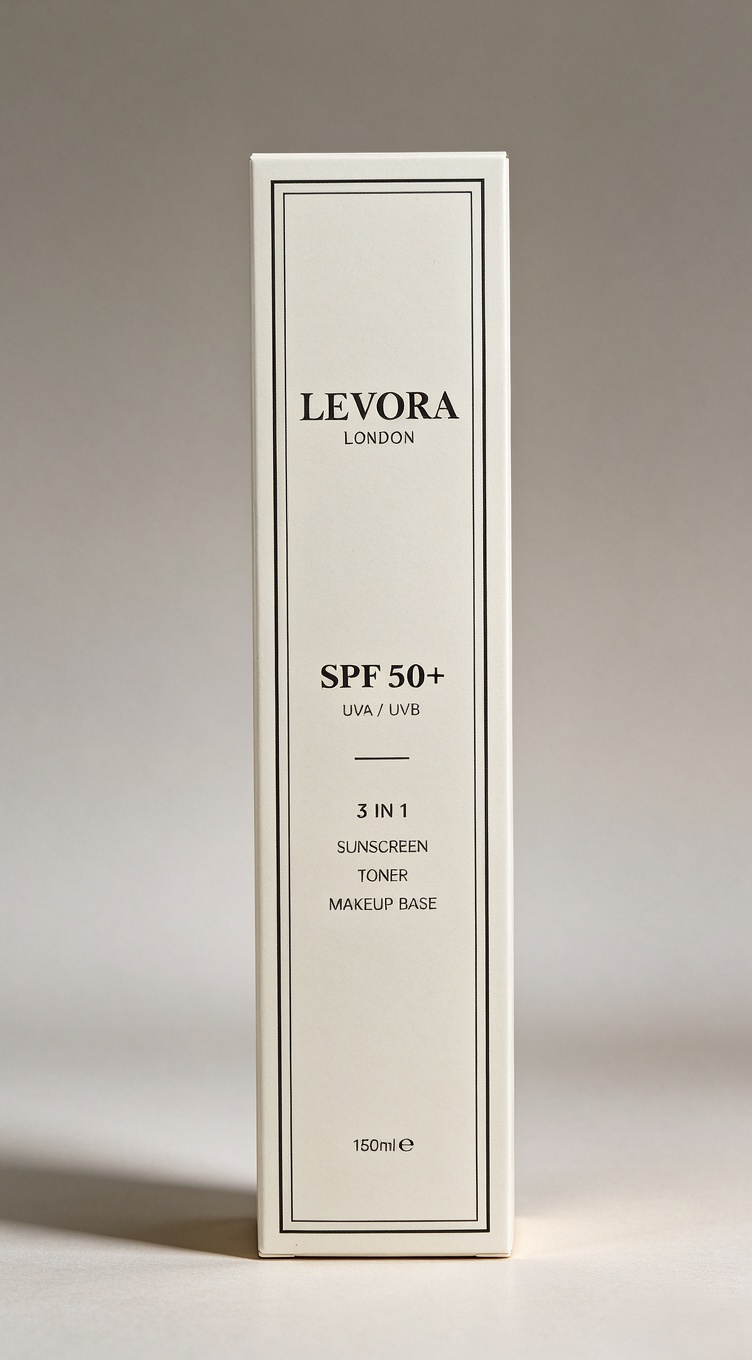
Finished product appearance after filling, valve crimping and packaging.
8. Use Cases: Matching the Format to the Brief
Sun care. A sunscreen spray OEM brief usually starts from coverage speed and reapplication convenience. The miluvcare Cooling Sunscreen Spray is documented at SPF 50+ PA+++ in 150 ml with broad-spectrum UVA/UVB protection and a cooling skin feel.
Body care. This is the widest aerosol category. Documented entries include instant brightening, deodorant and body fragrance, sports cooling, shower mousse and body acne care. A hair removal spray OEM or depilatory spray project sits here as well, with fragrance and moisturizing skin care built into the documented specification.
Hair care. Styling, dry shampoo, styling wax mousse, foaming hair mask and hair oil formats. The 300 ml styling spray is documented with strong hold, re-workable hairstyle and long-lasting volume.
Facial care. Toner mists, setting sprays, essence mousses, cleansing oil mousses and shaving foams. Facial formats are the most sensitive to mist quality, because output weight and droplet uniformity are directly perceptible on the face.
Fragrance. Custom perfume, including alcohol-free formats where BOV packaging is relevant.
9. Case: A 3-in-1 Sunscreen Spray Built for E-Commerce
A cosmetic brand OEM based in Kazakhstan commissioned a 20,000-can 3-in-1 sunscreen spray combining sunscreen, toner and makeup base in one aerosol format, for e-commerce retail. The project ran as a full-chain OEM service covering formula development, aerosol filling and packaging customization, with regulatory document support, and has continued for three years. Documented highlights include a lightweight non-greasy texture, UVA/UVB broad-spectrum protection and customized brand packaging; the product sold well on local e-commerce channels.
10. Compliance: Certificates an Aerosol Buyer Should Ask For
Qualification is the first filter in any aerosol OEM evaluation, because it determines whether a supplier can produce and legally ship the goods at all.
- Cosmetics GMP — ISO 22716:2007, certificate no. 205911 issued by DCI Certification Ltd, valid 2025-06-09 to 2028-06-08. Scope: production of aerosol (hydrating spray) cosmetics, with conditions for producing eye skin care and baby and children's skin care cosmetics.
- ISO 9001:2015, certificate no. 206000, issued by DCI Certification Ltd, valid 2025-07-14 to 2028-07-13.
- ISO 45001:2018, certificate no. 206001, issued by DCI Certification Ltd, valid 2025-07-14 to 2028-07-13.
- Philippines FDA Cosmetic Notification no. NN-1000016300591, issued 2026-05-13 under the ASEAN Cosmetic Directive, valid to 2029-05-12, covering MILUVCARE SUNSCREEN SPRAY SPF 50+ PA+++.
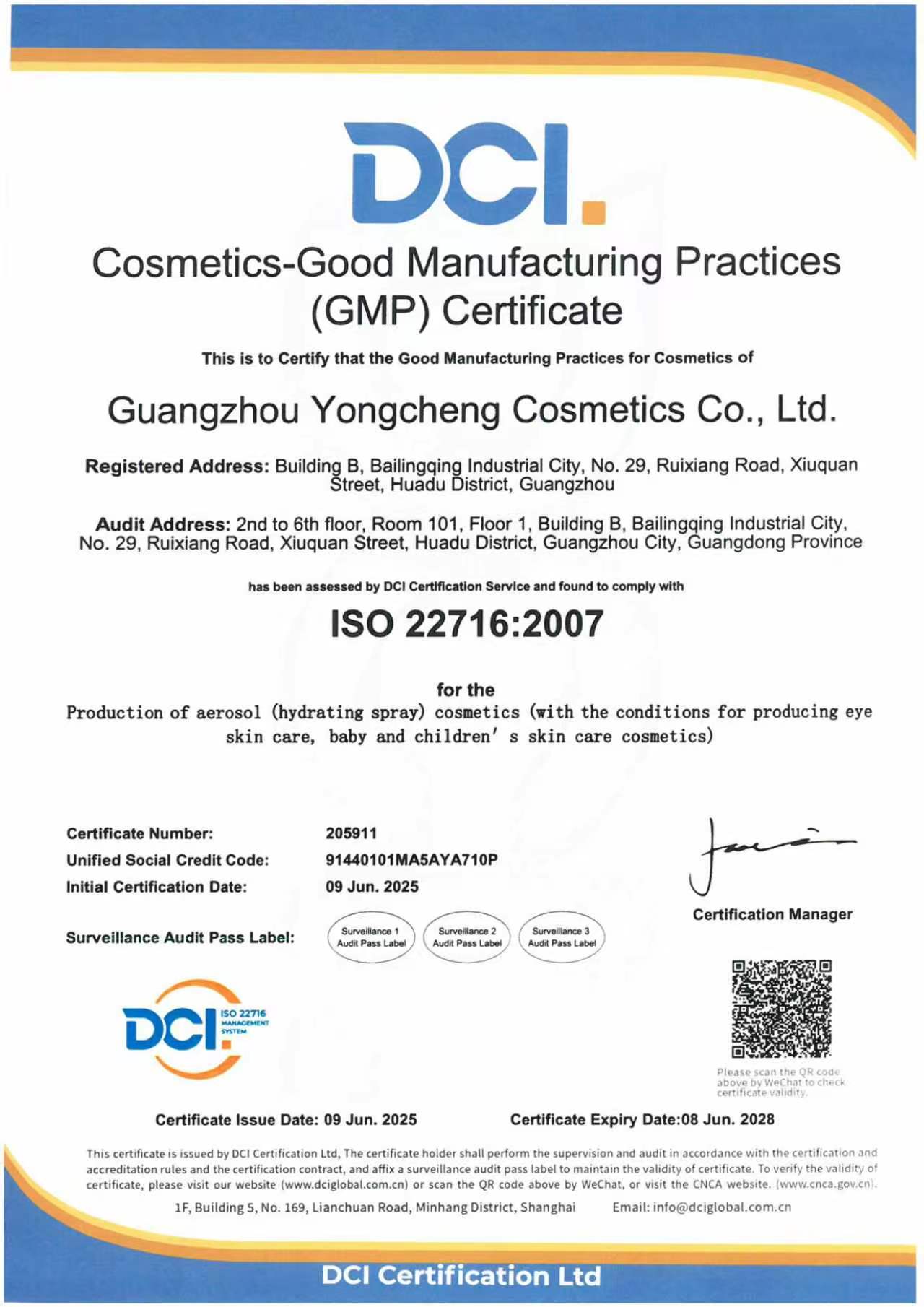
ISO 22716:2007 GMP certificate covering aerosol cosmetics production.
On the export side, the standard document set is MSDS/SDS, a UN packaging certificate, COA and — for EU-bound product — CPSR. These are the documents that decide whether a container clears customs or sits at port.
11. Commercial Terms at a Glance
MOQ: 10,000–20,000 cans, with a regular MOQ of 10,000 cans per formula for standard aerosol OEM orders.
Lead time: 30–45 working days after sample confirmation, subject to the aerosol can packaging supply cycle.
Delivery terms: EXW.
Acceptance criteria: pre-shipment test.
Payment terms: 50% deposit, balance before shipment.
Small-batch trial orders are possible in principle but carry a higher unit price, limited availability and potentially longer lead time, because aerosol can packaging itself has minimum order constraints. For a formal market launch, standard MOQ production is the structure that produces a workable unit cost.
12. FAQ
Which certifications and export documents can a cosmetic aerosol OEM manufacturer provide?
A qualified aerosol supplier should provide a cosmetics production license, ISO 22716:2007 GMP, ISO 9001:2015 and ISO 45001:2018. For export, the required set includes MSDS/SDS and a UN packaging certificate, which are mandatory for pressurized dangerous goods, plus COA for batch quality results and CPSR for the EU market. Market-specific notifications also apply — the Philippines FDA Cosmetic Notification NN-1000016300591 under the ASEAN Cosmetic Directive is one example. One limit to plan for: the factory supplies the technical dossiers, but official regulatory submission requires a locally registered responsible party on the brand side, because registration depends on brand-owned legal information.
Does an aerosol OEM/ODM partner handle formula development as well as filling?
It should, and the scope should be written into the brief. Guangzhou Yongcheng Cosmetics Co., Ltd. provides both OEM and ODM production services with customization of formula, fragrance, packaging, label, logo, color and aerosol can specification. Development takes place in a 2,000 m² R&D laboratory, supported by a 15-engineer R&D team, and the company profile lists 10+ senior engineers with an average of 10 years' experience. Production capability behind that development stage is listed at 6 fully automated production lines plus 6 dedicated aerosol lines, with monthly capacity of 8,000,000 cans and annual output of 100,000,000 cans. After-sales support covers technical assistance, regulatory documentation and follow-up.
What is the minimum order quantity, and what drives unit cost?
The listed MOQ is 10,000–20,000 cans, with a regular MOQ of 10,000 cans per formula for standard aerosol OEM. Unit cost is driven mainly by four things: the packaging hardware, the can and valve specification, the formulation and fragrance, and the order volume. BOV hardware, for example, carries a higher unit cost than standard aerosol because of the bag-on-valve construction, so a BOV Aerosol Packaging Solution and a conventional aerosol solution should be quoted separately and compared on your own market requirement. Small-batch trial orders are quoted higher and may run longer, because the can supply cycle has its own minimum order constraints.
How is a product validated before mass production?
The commercial sequence is: sample confirmation first, then production, then a pre-shipment test as the acceptance criterion. Lead time of 30–45 working days begins after sample confirmation, so the validation stage is the part of the timeline the buyer controls directly. Aerosol projects benefit from locking the format — spray, mist or foam — at this stage rather than after production, because output character, valve and formula viscosity are interdependent.
What lead time and shipping risks should we plan for?
Lead time is 30–45 working days after sample confirmation and is affected by the aerosol can packaging supply cycle. On the logistics side, aerosol products are pressurized goods: storage should avoid high temperature and direct sunlight, transit should avoid heavy impact, and shipment must use dangerous-goods logistics rather than ordinary channels. Cartons are marked with the corresponding hazard prompt and full shipping guidance is provided. To confirm current lead time for a specific format and can size, or to request the full product and capability brochure, contact the team through www.gzyc-cosmetics.com.
13. Conclusion
Sprays, mists and foams are three outputs from one manufacturing architecture. Understanding which output a product needs — before specifying can size, fragrance or artwork — is what keeps an aerosol project from being re-engineered mid-quote. The same principle applies to the packaging question underneath it: conventional aerosol or BOV is a positioning and budget decision, not a default.
With a 12,000 m² manufacturing base, 6 dedicated aerosol lines, ISO 22716 GMP certification, ISO 9001 and ISO 45001 system certification, and export experience across ASEAN, Central Asia, the Middle East and Latin America, Guangzhou Yongcheng Cosmetics supports cosmetic aerosol OEM & ODM programmes from formula development through to compliant shipment. The company profile states that more than 100 global beauty brands have been served to date.

Application trial stage — where format, output weight and texture are validated before production.
Next Step: Brief Your Format
Send the delivery format (spray, mist or foam), the target category, the can size and your target market. The team will confirm a suitable formulation route, the packaging solution — conventional aerosol or BOV aerosol packaging — and the current MOQ and lead time.
Email: HensonHole@gzyc-cosmetics.com | Tel / WhatsApp: +86 157-7320-9989
Website: www.gzyc-cosmetics.com | Download the company profile: Guangzhou Yongcheng Cosmetics E-Profile 2026
Have Questions or Need More Details?
Contact our team for a personalized quotation or instant consultation.
Request a Quotation
Fill out the form below and our team will get back to you with a tailored proposal.
WhatsApp Direct Chat
Prefer to chat in real-time? Message us on WhatsApp for instant assistance & quick answers.
- Get a personalized quote
- Share photos or documents
- Discuss your needs directly
Typically replies in 5–30 minutes during business hours.