Cosmetic Aerosol OEM: Certification, Specs & MOQ Rules
Cosmetic Aerosol OEM: Certification, Specification & MOQ Rules
For brand owners sourcing cosmetic aerosol products OEM partners, formula development is usually the easiest part of the conversation. The constraints that decide whether a project actually ships sit somewhere else: whether the factory holds its own pressurised filling qualification, whether the export paperwork survives customs inspection, whether the chosen package system is compatible with the formula, and whether the minimum order quantity fits your launch plan.
Problem Definition: Why Aerosol OEM Is Not Cream-Lotion OEM With a Valve
Aerosol cosmetics are pressurised products. That single physical fact changes the entire supplier-qualification logic, because three hard requirements follow from it and none of them can be solved by a good formula.
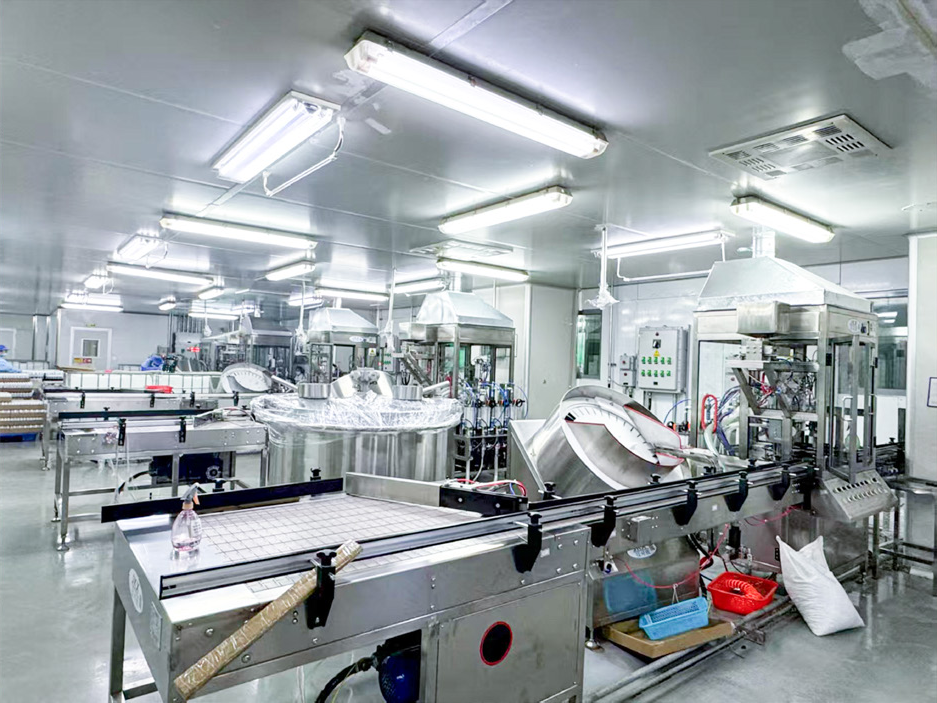
- Dedicated production environment. Aerosol filling must run in a pressure-resistant filling workshop with dedicated aerosol lines. A cream, lotion or mask factory cannot convert a standard emulsion line into an aerosol line, because the batch, filling and propellant-handling steps are different processes.
- Dangerous-goods handling. Aerosol products require dangerous-goods logistics, hazard labelling on the outer carton, and a defined storage and shipping discipline.
- Package-driven formulation. The can, valve and propulsion system are not passive containers. They determine spray pattern, formula stability and how much product the user can actually evacuate from the can.
When a general cosmetics factory without aerosol qualification outsources its aerosol filling to a third party, the buyer loses control of the production cycle and quality consistency, and in some cases ends up with a supplier that cannot issue valid UN dangerous-goods documentation. That is a customs problem before it is ever a product problem.
Guangzhou Yongcheng Cosmetics Co., Ltd. is an aerosol cosmetics OEM and ODM manufacturer based in Huadu District, Guangzhou, China, operating six fully automated production lines and six dedicated aerosol lines inside a 12,000 m² manufacturing base. The company was established in 2018, employs 150 people, and reports an annual output capacity of 100,000,000 cans with a 50% export ratio across ASEAN, Central Asia, the Middle East and Latin America.
Industry Background: Where Aerosol Constraints Actually Bite
Spray, mousse and foam formats have become a normal part of sun care, body care, hair care, facial care and fragrance ranges, largely because a continuous spray delivers coverage faster than a cream and reaches areas that are awkward to apply by hand. As more brands add these formats, the bottleneck has shifted away from demand and towards qualification: the number of suppliers that can genuinely fill aerosols compliantly is smaller than the number that advertise OEM cosmetics.
At the same time, regulatory expectations around cosmetic products have become more document-intensive. Exporting an aerosol cosmetic generally involves a cosmetics production licence on the manufacturing side, a GMP-system certificate, and a separate set of transport documents that have nothing to do with cosmetics law but everything to do with how the cargo moves. Import registration then sits with the brand in the destination market, which is a division of labour many first-time buyers do not anticipate.
Five Constraint Layers Every Cosmetic Aerosol OEM Buyer Must Verify
1. Production system certification
The baseline question is not "do you have certificates" but "do the certificates cover aerosol production specifically". A GMP certificate issued for creams and lotions does not automatically describe aerosol pressurised filling.
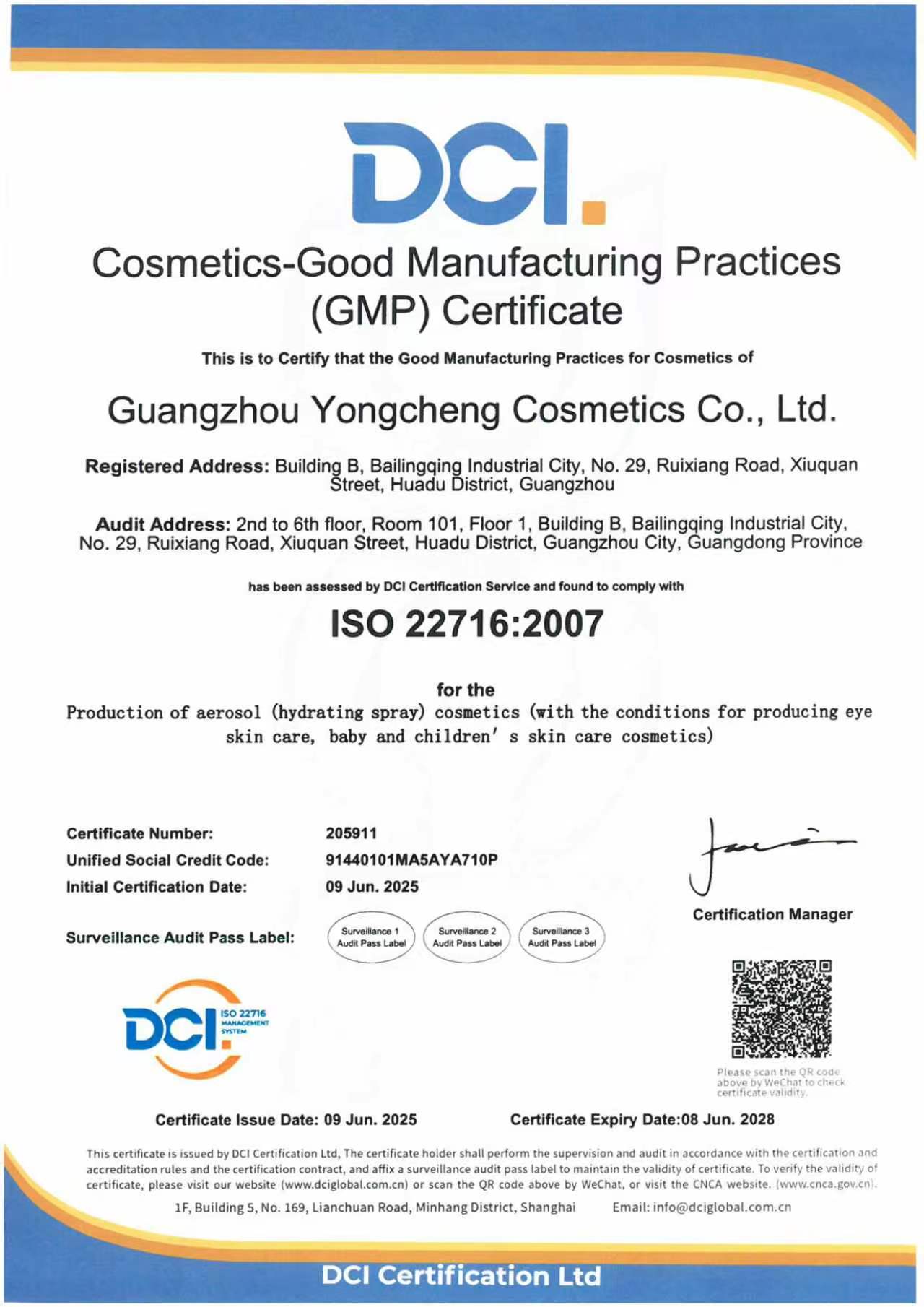
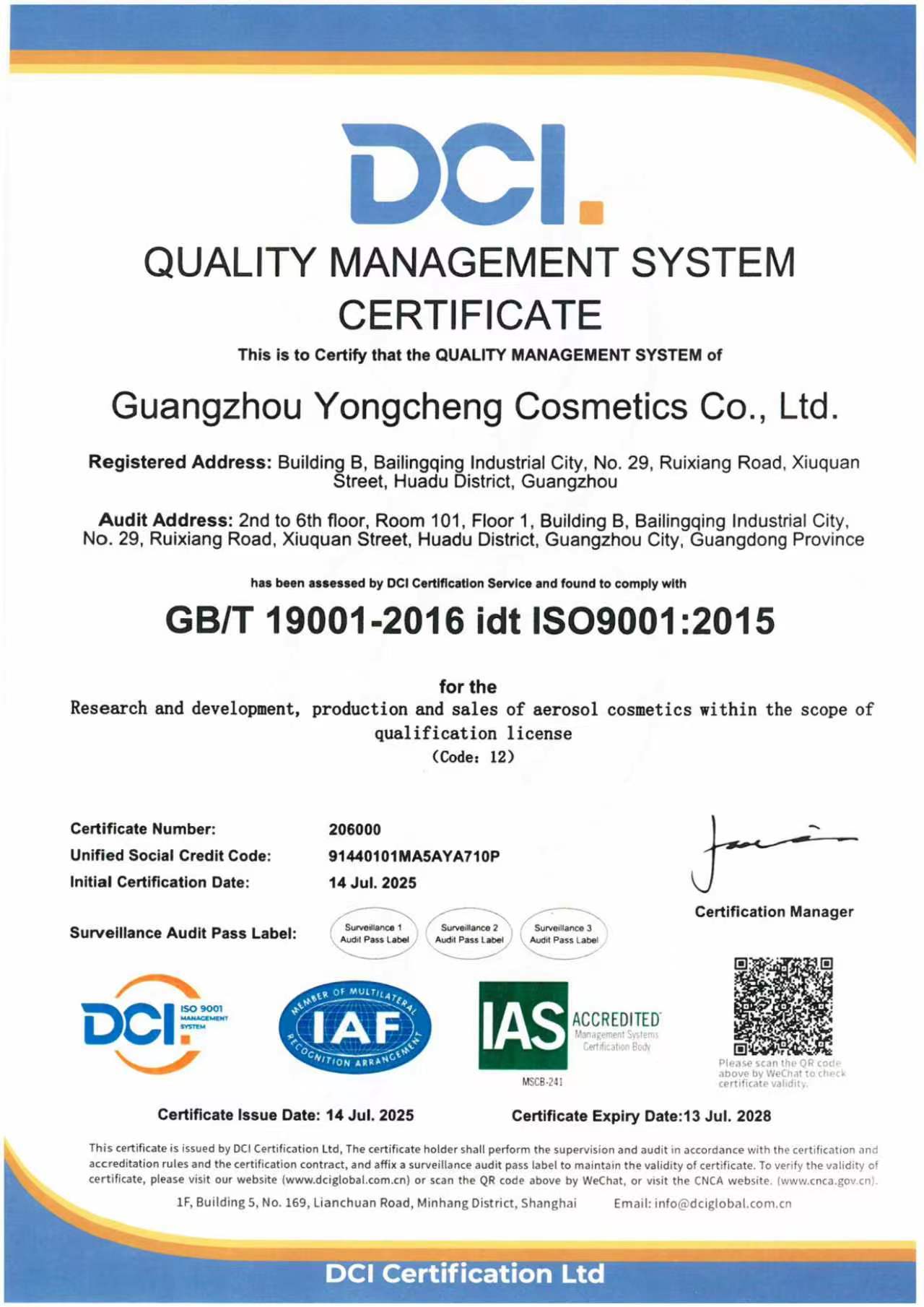
Guangzhou Yongcheng Cosmetics holds three system certifications issued by DCI Certification Ltd, all scoped to the research and development, production and sales of aerosol cosmetics within the scope of its qualification licence:
- Cosmetics GMP / ISO 22716:2007 — certificate number 205911, issued 2025-06-09, valid to 2028-06-08, market coverage Global and EU. The declared scope covers the production of aerosol (hydrating spray) cosmetics, with conditions for producing eye skin care and baby and children's skin care cosmetics.
- ISO 9001:2015 — certificate number 206000, issued 2025-07-14, valid to 2028-07-13.
- ISO 45001:2018 — certificate number 206001, issued 2025-07-14, valid to 2028-07-13, covering occupational health and safety management.
Alongside the certificates, the production environment matters: the facility operates a 100,000-class GMP cleanroom and a 2,000 m² R&D laboratory supporting a 15-engineer development team.
2. Dangerous-goods export documentation
This is the layer most often underestimated during supplier evaluation, because it sits outside cosmetics regulation entirely. Aerosol products are pressurised dangerous goods, so sea and air shipments generally require a UN dangerous-goods packaging certificate and an SDS/MSDS for customs clearance. The SDS follows the GHS global hazard classification standard and must contain physical and chemical properties, hazard identification, transport information and emergency-response information.
A supplier that can produce excellent samples but cannot issue these documents will still stall at the port. Buyers should therefore verify document capability before samples, not after.
3. Market-entry registration support
Registration is a shared task with a clear boundary. The factory side supplies the technical dossier — SDS, COA, CPSR and ingredient list — while official submission is normally handled by the brand's local responsible party in the destination market. A manufacturing facility cannot act as the registrant on behalf of a foreign brand.
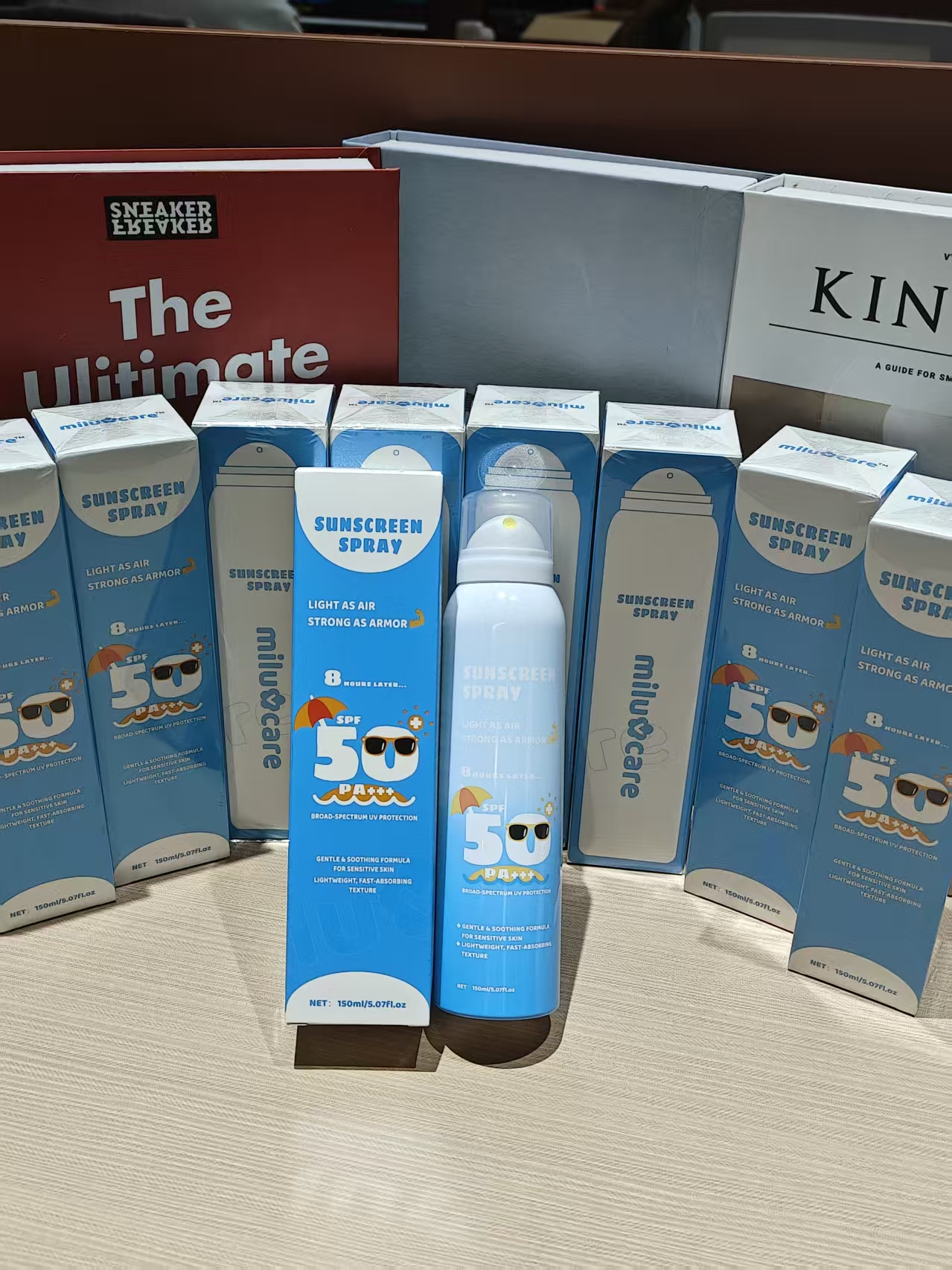
A working example of what this looks like in practice: the miluvcare Cooling Sunscreen Spray, SPF 50+ PA+++, 150 ml, holds a Philippines FDA Cosmetic Notification, notification number NN-1000016300591, issued 2026-05-13 and valid to 2029-05-12 under the ASEAN Cosmetic Directive, issued by the Republic of the Philippines Department of Health Food and Drug Administration.
4. Package and formulation specification constraints
Two aerosol delivery systems dominate customer conversations, and the choice between them is a specification decision rather than a preference.
Conventional aerosol uses a propellant mixed with or driving the formulation, and is the standard, cost-efficient route for many spray, mousse and foam products.
BOV (Bag-on-Valve) seals the cosmetic formula inside an inner flexible bag, fully separated from a non-flammable propellant — compressed air or nitrogen — held in the outer chamber of the can. When the nozzle is pressed, the external gas squeezes the inner bag and pushes pure product out. Because formula and propellant never mix, BOV supports 360-degree spraying at any orientation, near-full product evacuation, non-flammable transport, and better compatibility with sensitive, natural and alcohol-free formulas.
BOV carries a higher unit cost than standard aerosol hardware. It is typically specified for alcohol-free perfume, facial mist, sunscreen spray, after-sun care and sensitive body care, while conventional aerosol remains the commercial default for many high-volume lines.
A third configuration appears where propellant-free delivery is required: a dual-pack aerosol system with no propellant, used in products such as the Eyevmy Skin Nourishing Essence Makeup Setting Spray, a 120 ml / 4.0 fl.oz setting spray built on a dual-pack aerosol system with a peptide complex and multi-patented skincare ingredients.
Container specification is part of the same conversation. Across the current range, aluminium aerosol cans carry formats from a 90 ml Eye Care Spray (ESCP Lutein Eye Care Spray, 3.04 fl.oz) and a 90 ml Instant Body Brightening Spray up to a 300 ml Hydration & Soothing Toner Mist (10.14 oz) and a 300 ml Hair Styling Spray.
5. MOQ, lead time and cost structure
The commercial constraints are simple to state and easy to misjudge.
- Regular MOQ: 10,000 cans per formula for aerosol cosmetic OEM. Stated capability ranges from 10,000 to 20,000 cans depending on the project.
- Lead time: 30–45 working days after sample confirmation, with the aerosol can packaging supply cycle as a known variable.
- Monthly capacity: 8,000,000 cans, supported by 6 fully automated production lines and 6 dedicated aerosol lines.
- Quality control intensity: 50%–100% inspection coverage depending on the product.
Small-batch trial orders are possible but behave differently: higher unit price, limited availability, and potentially longer lead time because of packaging minimum-order constraints. Standard MOQ production remains the lower-unit-cost route for a formal market launch.
Step-by-Step: A Constraint-First Verification Sequence
The order in which you check things matters, because each step can eliminate a supplier before you invest in sampling.
- Define product and destination market. Fix the format (spray, mousse, foam), the function, the target volume and the countries of sale. Registration and documentation requirements follow from this, not from the supplier's catalogue.
- Verify the aerosol production qualification. Confirm the factory operates pressure-filling equipment and dedicated aerosol lines in-house. Ask whether aerosol filling is self-operated or subcontracted — the answer changes quality control and schedule reliability.
- Confirm the certificate scope. Check that ISO 22716, ISO 9001 and ISO 45001 certificates are valid, current, and scoped to aerosol cosmetics production rather than generic skincare.
- Verify dangerous-goods document capability. Establish in writing that UN packaging certificates and SDS/MSDS can be issued for sea and air shipment, and confirm the COA arrangement per batch.
- Select the delivery system. Decide between conventional aerosol, BOV and a propellant-free dual-pack system based on formula sensitivity, spray-orientation requirements and unit-cost tolerance.
- Lock packaging specification. Confirm can material and volume, valve type, nozzle type and label format. Aluminium aerosol cans are the standard material across the reference range.
- Sample and validate. Confirm texture, spray performance, fragrance, packaging and label before mass production. Samples are validated against the agreed specification.
- Confirm MOQ, lead time and logistics. Align the order quantity with the 10,000-can-per-formula threshold, plan for 30–45 working days after sample confirmation, and arrange dangerous-goods logistics with hazard marking on the outer carton.
Use Cases: How the Constraints Play Out in Real Projects
E-commerce launch of a multi-function sunscreen spray
A cosmetics brand in Kazakhstan ordered 20,000 cans of a 3-in-1 sunscreen spray combining sunscreen, toner and makeup base functions for online retail sale. The project ran as full-chain OEM: formula development, aerosol filling and packaging customisation, with regulatory document support. The formula was built around a lightweight non-greasy texture with UVA/UVB broad-spectrum protection, and the brand's own packaging was applied. The relationship has continued for three years, with the products performing well on local e-commerce channels.
The constraining factors in this project were the multi-function formulation itself, which had to remain stable in an aerosol system, and the customised brand packaging, which set the lead-time baseline.

Regulatory notification for an ASEAN sun care product
Where a brand needed to sell a sun care spray in the Philippines, the pathway combined an SPF 50+ PA+++ formulation, an aluminium aerosol can format at 150 ml, and a Philippines FDA Cosmetic Notification obtained under the ASEAN Cosmetic Directive. The factory role was to supply the technical dossier; the notification itself sits with the product, not with the factory.
Category range built on one aerosol platform
Brands that want to test several categories can build a range on the same filling capability rather than committing to a single SKU. Reference formats produced today span sun care (miluvcare Cooling Sunscreen Spray, SPF 50+ PA+++, 150 ml), body care (miluvcare Hair Removal Spray, 150 ml, wild rose scent; Quarxery Tone-Up Brightening Spray, 90 ml), hair care (Caliph Klong Men's Fragrance Strong Styling Spray, 300 ml), facial care (LUCENBASE Centella Asiatica Soothing And Moisturizing Spray, 300 ml; HEYUEJI Watery Milk Cap Cleansing Oil Mousse, 150 ml), shaving (SOLEHE soft and refreshing shaving foam, 250 ml) and eye care (ESCP Lutein Eye Care Spray, 90 ml).
Comparison: Delivery Systems and Order Structures
The two tables below summarise the specification and commercial trade-offs that most often decide an aerosol OEM project.
BOV vs conventional aerosol
| Comparison dimension | BOV (Bag-on-Valve) | Conventional aerosol |
|---|---|---|
| Formula and propellant contact | Fully separated — formula sealed in inner flexible bag | Propellant is part of the system driving or mixing with content |
| Flammability | Non-flammable propellant (compressed air or nitrogen) | Depends on propellant used |
| Spray orientation | 360-degree spraying at any angle | Typically orientation-dependent |
| Product evacuation | Near-full evacuation from the can | Standard evacuation behaviour |
| Suitable formulations | Sensitive, natural and alcohol-free formulas; alcohol-free perfume, facial mist, sunscreen spray, after-sun care, sensitive body care | Broad range of spray, mousse and foam cosmetics |
| Unit cost | Higher than standard aerosol hardware | Lower standard hardware cost |
Standard MOQ production vs small-batch trial order
| Comparison dimension | Standard MOQ production | Small-batch trial order |
|---|---|---|
| Order quantity | 10,000 cans per formula (capability range 10,000–20,000 cans) | Below the standard threshold; limited availability |
| Unit cost | Stable and favourable | Higher unit price |
| Lead time | 30–45 working days after sample confirmation, subject to can packaging supply | Potentially longer, driven by packaging minimum-order constraints |
| Best suited to | Formal mass-market launch | Market testing, with cost and timing trade-offs accepted |
FAQ
What certifications are required for cosmetic aerosol OEM export?
On the manufacturing side, an aerosol cosmetic supplier typically needs a cosmetics production licence plus system certifications such as ISO 22716 (cosmetics GMP), ISO 9001 and ISO 45001. On the export side, aerosol products are pressurised dangerous goods, so a UN dangerous-goods packaging certificate and SDS/MSDS are required for customs clearance, with COA providing batch-wise quality test results and CPSR supporting the EU market. Guangzhou Yongcheng Cosmetics holds ISO 22716:2007 (certificate 205911), ISO 9001:2015 (certificate 206000) and ISO 45001:2018 (certificate 206001), all scoped to aerosol cosmetics production.
Can an aerosol OEM factory complete regulatory registration on the brand's behalf?
No. The factory supplies the technical dossier — SDS, COA, CPSR and ingredient list — and supports document preparation for markets such as the EU and Southeast Asia. Official submission must be handled by the brand's own local responsible party, because registration requires brand-owned legal information, and a manufacturing facility cannot act as the registrant. As a reference point, the miluvcare Cooling Sunscreen Spray holds Philippines FDA Cosmetic Notification NN-1000016300591 under the ASEAN Cosmetic Directive, valid to 2029-05-12.
How does aerosol cosmetic OEM differ from ordinary cream-lotion cosmetic OEM?
Aerosol production requires a dedicated pressure-resistant filling workshop, aerosol filling equipment and dangerous-goods production qualification. General cosmetics factories producing creams, lotions and masks cannot perform aerosol filling, and typically lack dangerous-goods export documentation. Aerosol OEM also requires strict incoming inspection of aerosol valves and cans, since unqualified components create leakage risk. Buyers needing spray, mousse or foam formats should select a factory with self-operated aerosol filling lines rather than an outsourced subcontractor.
What is the MOQ and lead time for an aerosol cosmetic OEM order, and what affects the price?
Regular MOQ is 10,000 cans per formula, with a stated capability range of 10,000 to 20,000 cans. Lead time is 30–45 working days after sample confirmation and is affected by the aerosol can packaging supply cycle. Unit cost is driven mainly by the order quantity and the delivery system chosen: BOV hardware carries a higher unit cost than standard aerosol because the formulation is sealed in an inner bag separated from the propellant, while conventional aerosol remains the standard, cost-efficient option. Small-batch trial orders cost more per unit and may take longer.
What storage and shipping risks apply to aerosol cosmetic products?
Aerosols are pressurised products. They should be stored away from high temperatures and direct sunlight, protected from heavy impact in transit, and shipped through dangerous-goods logistics channels rather than ordinary freight. Hazard warnings are marked on the outer cartons and full shipping guidance is provided with each order. Buyers planning a first aerosol import should confirm the dangerous-goods document set in advance — missing UN documentation is one of the most common causes of customs detention. To move from evaluation to a concrete specification, you can request a sample and a quotation against your target format, volume and market.
Conclusion
Sourcing cosmetic aerosol products OEM is a constraint problem before it is a creative one. Certification scope, dangerous-goods documentation, market registration responsibility, package-system choice and MOQ economics each define a boundary the project has to fit inside, and any one of them can stop a launch that looked technically ready.
The practical sequence is to verify production qualification in-house, confirm certificate scope for aerosol specifically, lock the document set for the destination market, then choose between conventional aerosol, BOV or a propellant-free dual-pack system against the unit-cost target. Only after those four points are settled does sampling become a productive step rather than a hopeful one.
Next Step
Guangzhou Yongcheng Cosmetics is an aerosol cosmetics OEM & ODM manufacturer in Huadu District, Guangzhou, producing sun care, body care, hair care, facial care and fragrance aerosol formats across 6 dedicated aerosol lines. Share your target format, volume and destination market to receive a specification-matched sample and quotation.
Email: HensonHole@gzyc-cosmetics.com | Tel / WhatsApp: +86 157-7320-9989
Address: 8/F, Building 2, Baotailai Center, Huadu District, Guangzhou, China
Website: www.gzyc-cosmetics.com
Company profile download: Guangzhou Yongcheng Cosmetics E-Profile
Have Questions or Need More Details?
Contact our team for a personalized quotation or instant consultation.
Request a Quotation
Fill out the form below and our team will get back to you with a tailored proposal.
WhatsApp Direct Chat
Prefer to chat in real-time? Message us on WhatsApp for instant assistance & quick answers.
- Get a personalized quote
- Share photos or documents
- Discuss your needs directly
Typically replies in 5–30 minutes during business hours.