Cosmetic Aerosol Technical Selection Guide: Valve, Can and Formulation Parameters
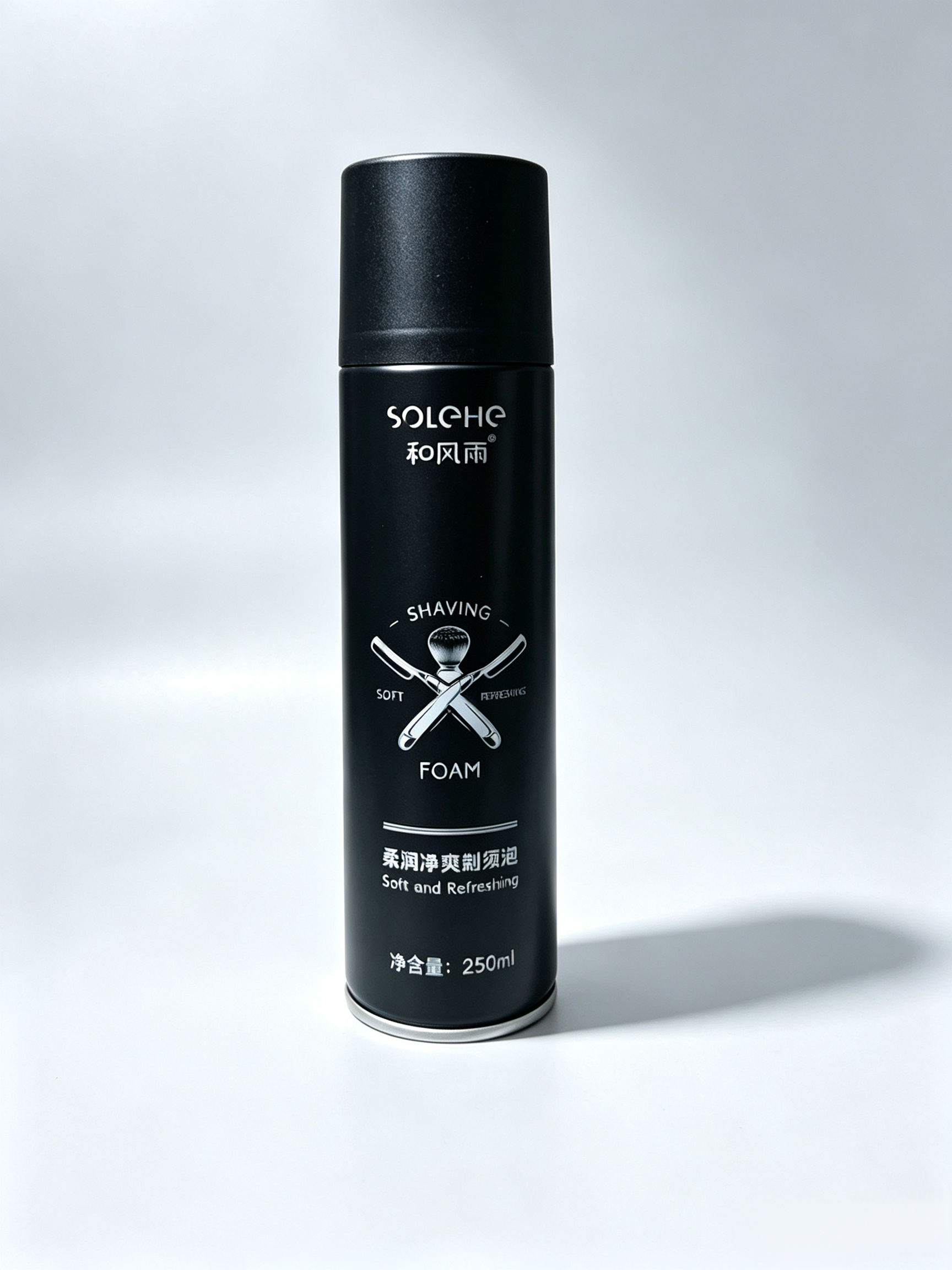
A cosmetic aerosol product is a three-part system, not a single article of purchase. The aluminium aerosol can holds the fill, the valve and actuator assembly determines how that fill leaves the container, and the formulation decides what the user finally experiences — a soft fine mist, a dense shaving foam, or a mousse that spreads. Buyers who specify only a volume leave the two most performance-critical parameters undefined. This guide explains how can construction, spray mechanism design and formulation parameters are selected together, using verified specifications from aerosol units such as SOLEHE soft and refreshing shaving foam and Eyevmy Skin Nourishing Essence Makeup Setting Spray.
Problem Definition: Why Aerosol Selection Fails When Only Volume Is Specified
Most briefing documents for a cosmetic aerosol project state a volume, a fragrance direction and a label layout. They rarely state the can specification, the valve and actuator type, the aerosol system, or the texture target. Because these three elements interact, a gap in any one of them shows up at the filling line or in the consumer's hand rather than in the purchase order.
Three failure patterns are well documented in aerosol OEM practice:
- Leakage from unqualified valve and can components. Aerosol valves and cans that are not subject to strict incoming inspection create leakage risk during storage and transport.
- Missing dangerous-goods documentation. A supplier that cannot provide a valid UN packaging certificate can cause the consignment to be held at customs, even when the product itself is correctly formulated.
- Outsourced filling with unstable control. General cosmetic factories without in-house aerosol qualification sometimes subcontract the pressure-filling step, which makes the production cycle less predictable and the quality less consistent, and can leave the dangerous-goods document set incomplete.
Treated as a parameter problem, all three are avoidable. A selection sheet that fixes the can, the valve and the formulation before a purchase order is issued converts them into checkable items rather than late-stage surprises.
Industry Background: Why Format and Parameter Decisions Are Getting Tighter
Cosmetic aerosol is now a mainstream packaging route rather than a niche one. Published market research from Dataintelo values the global aerosol cosmetics market at USD 14.8 billion in 2025. The European Aerosol Federation reports that personal care accounted for 47.8% of total European aerosol units produced in 2024, which indicates how strongly the personal care segment now drives aerosol manufacturing capacity.
Two regulatory and demand signals reinforce the need for parameter-level specification:
- China GB 7916-2026, the country's first mandatory national safety standard for cosmetics, issued by SAMR / NMPA, takes effect on 1 January 2028. Buyers developing China-facing ranges have a defined compliance horizon to plan against.
- Sun care demand continues to expand. Grand View Research projects the sun care cosmetics market to reach USD 19.4 billion by 2033, which pulls sunscreen spray and related aerosol formats into more product roadmaps.
Both trends point the same way: format decisions and compliance decisions now have to be taken at the same table, and both depend on parameters that are set long before artwork approval.
Detailed Solution: The Three Parameter Families
1. Aluminium Aerosol Can Construction
Every product unit referenced in this guide uses an aluminium aerosol can as its stated packaging material, including ESCP Lutein Eye Care Spray, SOLEHE soft and refreshing shaving foam, Eyevmy Skin Nourishing Essence Makeup Setting Spray, LUCENBASE Centella Asiatica Soothing And Moisturizing Spray, Caliph Klong Men's Fragrance Strong Styling Spray, HEYUEJI Watery Milk Cap Cleansing Oil Mousse, Quarxery Tone-Up Brightening Spray and miluvcare Hair Removal Spray.
The can parameters that need to be locked are:
- Volume and declared net weight. Verified units in the range span 90 ml (ESCP Lutein Eye Care Spray at 3.04 fl.oz, Quarxery Tone-Up Brightening Spray), 120 ml (Eyevmy Makeup Setting Spray at 4.0 fl.oz), 150 ml (HEYUEJI Cleansing Oil Mousse at 5.07 fl.oz, miluvcare Hair Removal Spray, miluvcare Cooling Sunscreen Spray), 250 ml (SOLEHE Shaving Foam at 8.45 fl.oz) and 300 ml (LUCENBASE Toner Mist and Caliph Klong Styling Spray, both 10.14 oz).
- Can specification. Aerosol can specification is an explicit customization item, alongside formula, fragrance, packaging, label, logo and colour.
- Pressure and transport conditions. Aerosol is a pressurized product. Storage and shipping parameters include avoiding high-temperature storage and direct sunlight, avoiding heavy impact in transit, and using dangerous-goods logistics channels with hazard marking on the outer carton.

2. Spray Mechanism and Valve Selection
The valve and actuator assembly converts a pressurized fill into a defined delivery format. Two design decisions sit at this level: how the product is actuated, and which aerosol system carries it.
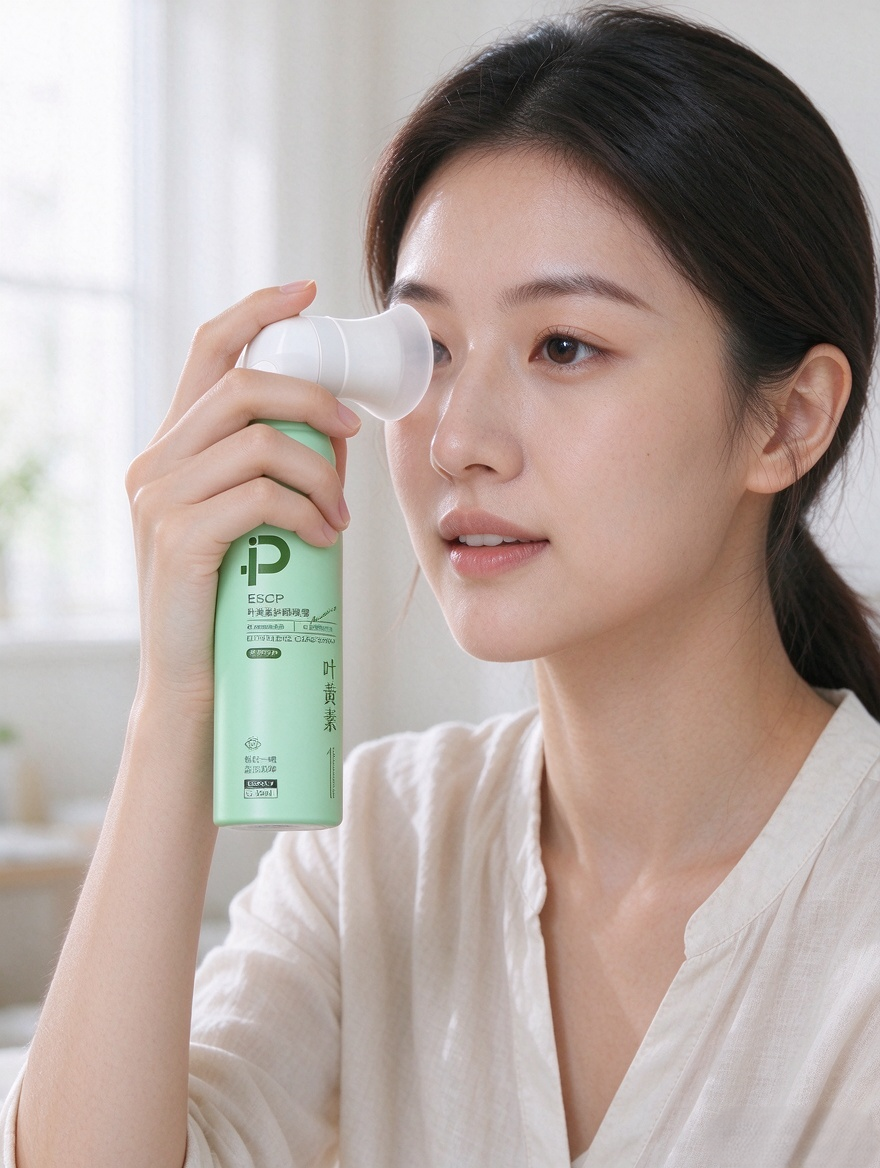
Actuation pattern. Cosmetic aerosol units in this range operate on manual valve actuation with continuous spray output. The consumer-facing expression of that design is the one-press spray mechanism — a single actuation delivers product without repeated pumping. ESCP Lutein Eye Care Spray is specified with a convenient one-press spray for quick eye-surround hydration, and it is also matched with an eye-cup nozzle, a clear example of the actuator being selected for the application rather than for the container. The same product carries an explicit use boundary: it is only for external eye-area skin and must not be dropped into the eyeball.
Aerosol system type. Two routes are available, and they are not interchangeable:
- Conventional aerosol. The formulation is carried with propellant gas in the can. This is the standard route for foam, mousse and many spray formats.
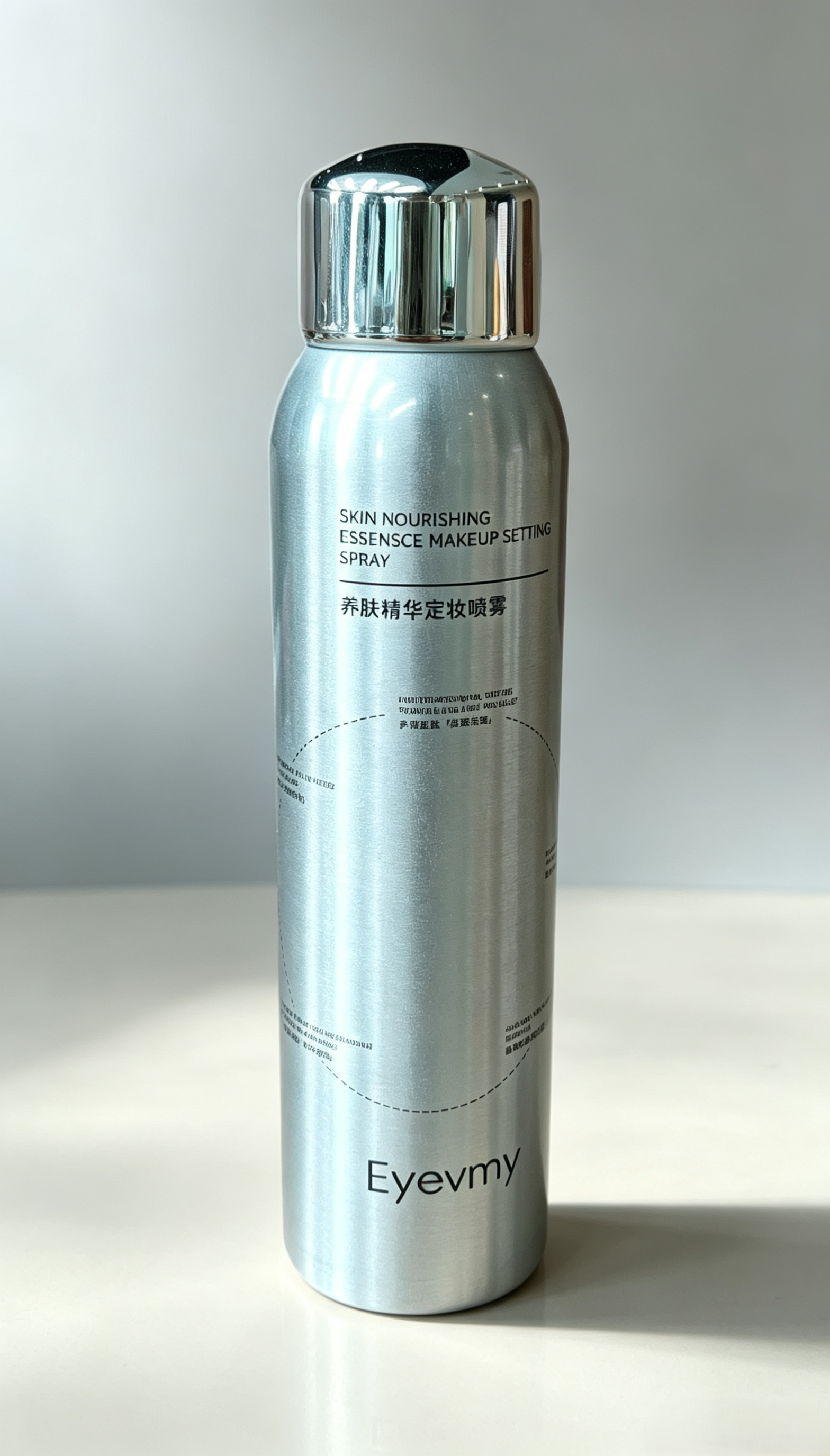
- Dual-pack aerosol system (BOV — Bag-on-Valve). The formulation is fully sealed inside an inner flexible bag and separated from a non-flammable propellant such as compressed air or nitrogen held in the outer chamber. Pressing the nozzle makes the external gas squeeze the inner bag, pushing out pure product without mixing. Eyevmy Skin Nourishing Essence Makeup Setting Spray uses a dual-pack aerosol system with no propellant and delivers a fine soft mist for uniform application.
Delivery texture at the valve level. Selecting the valve and actuator together with the formulation produces distinctly different outputs across the range: soft fine mist for eye-surround coverage (ESCP Lutein Eye Care Spray), fine mist aerosol spray for the hydration toner mist, ultra-fine mist with instant quick-dry for men's fragrance styling spray, fine mist for uniform coverage on body brightening spray, and a rich dense foam texture for SOLEHE Shaving Foam. The texture target should therefore be written on the brief before the valve is confirmed, not after.
3. Formulation Parameters
Formulation is where the parameter sheet becomes product-specific. Four formulation dimensions matter for aerosol selection:
- Texture and rheology target. Soft fine mist (eye care, setting spray, toner mist), rich dense foam (shaving foam), watery milk texture that rinses off cleanly (HEYUEJI Cleansing Oil Mousse). Each target constrains how the concentrate behaves inside the can and at the valve.
- Active ingredients that must survive the packaging system. Lutein with multi-moisturizing ingredients in ESCP Lutein Eye Care Spray; Centella Asiatica as the core of a 4X Soothing Complex with Ceramide, Sodium Hyaluronate and Panthenol in LUCENBASE Toner Mist; a skin-nourishing peptide complex with multi-patented skincare ingredients in Eyevmy Makeup Setting Spray; a botanical soothing formula in SOLEHE Shaving Foam.
- Compatibility with the aerosol system. BOV keeps the formulation isolated from the propellant gas, which protects active ingredients and avoids chemical reaction, and it suits sensitive, natural and alcohol-free formulas. Aluminium aerosol cans are the stated material across the referenced units.
- Customization levers. Formula, fragrance, packaging, label, logo and colour are all customizable items in the OEM and ODM scope, so fragrance load and label format are formulation-adjacent parameters rather than purely decorative choices.

4. Compliance Parameters Attached to the Same Sheet
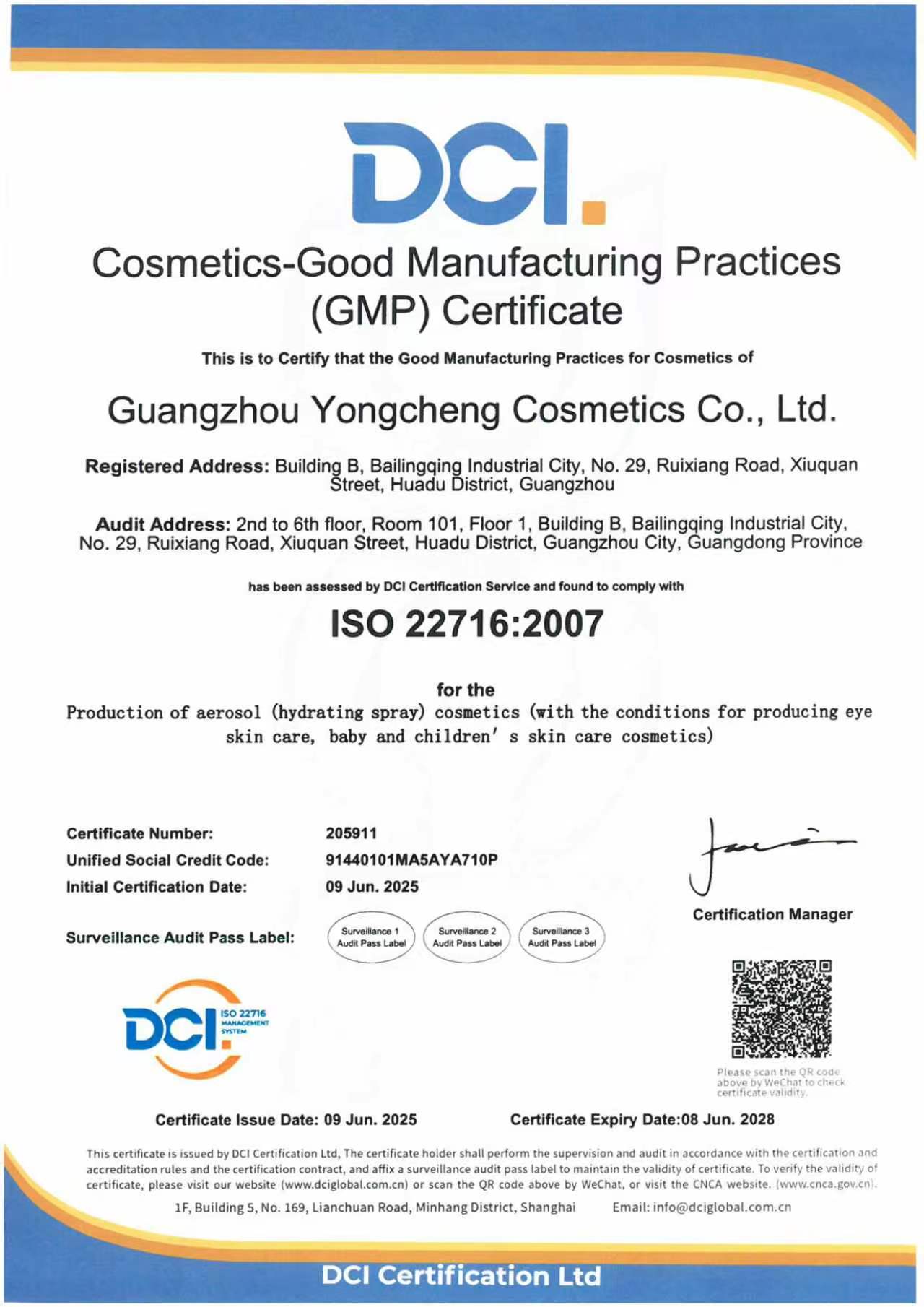
Compliance is not a separate workstream in aerosol cosmetics, because the GMP scope itself references product categories. The manufacturing operation holds ISO 22716:2007 (Cosmetics GMP) certification number 205911, issued by DCI Certification Ltd., valid for the EU market, covering the production of aerosol cosmetics including hydrating spray, eye skin care, and baby and children's skin care cosmetics. It also holds ISO 9001:2015 certification number 206000 and ISO 45001:2018 certification number 206001, both issued by DCI Certification Ltd., with a scope covering research and development, production and sales of aerosol cosmetics within the scope of the qualification license.
On the product side, MILVUCARE SUNSCREEN SPRAY SPF 50+ PA+++ holds a Philippines FDA Cosmetic Notification, certification number NN-1000016300591, issued under the ASEAN Cosmetic Directive, issued on 13 May 2026 and valid until 12 May 2029. Supporting documents available for export include cosmetic production license, ISO certificates, MSDS / SDS, UN packaging certificate, COA batch test results, and CPSR for the EU market. Because official registration requires brand-owned legal information, the local responsible party handles submission; the manufacturer supplies the technical dossier.
Step-by-Step Breakdown: A Six-Step Selection Sequence
The sequence below reflects the order in which changes are cheapest to absorb. Parameters decided late cost more to change.
- Define the delivery format and consumer experience. Mist, foam or mousse. A mist brief and a foam brief lead to different valve and formulation decisions, so this must be the first line of the specification.
- Fix can volume, declared net weight and can specification. Match the volume to the use frequency — 90 ml for eye care, 120 ml for setting spray, 150 ml for body and sun care, 250 ml for shaving foam, 300 ml for high-consumption mist and styling formats. Set the aerosol can specification as part of the same line item.
- Choose the actuation pattern and aerosol system. Confirm manual valve actuation with continuous output, decide whether a one-press mechanism is required for the use occasion, and decide between conventional aerosol and a dual-pack (BOV) system based on formula sensitivity and budget.
- Set formulation parameters and confirm compatibility. Lock texture target, active ingredients and fragrance load, then confirm that the concentrate behaves correctly inside the selected aerosol system. BOV protects actives from propellant contact; conventional aerosol favours foam and mousse performance.
- Map the compliance and documentation set. Match the target market to the certification and document list before sampling, since documents such as UN packaging certificate and SDS / MSDS are required for aerosol sea and air shipment and are not obtainable retrospectively at the last minute.
- Validate with samples, then scale to MOQ. Lead time starts after sample confirmation, so sample validation is the formal checkpoint between evaluation and mass production.
Use Cases: The Same Parameter Sheet, Four Different Answers
Shaving Foam
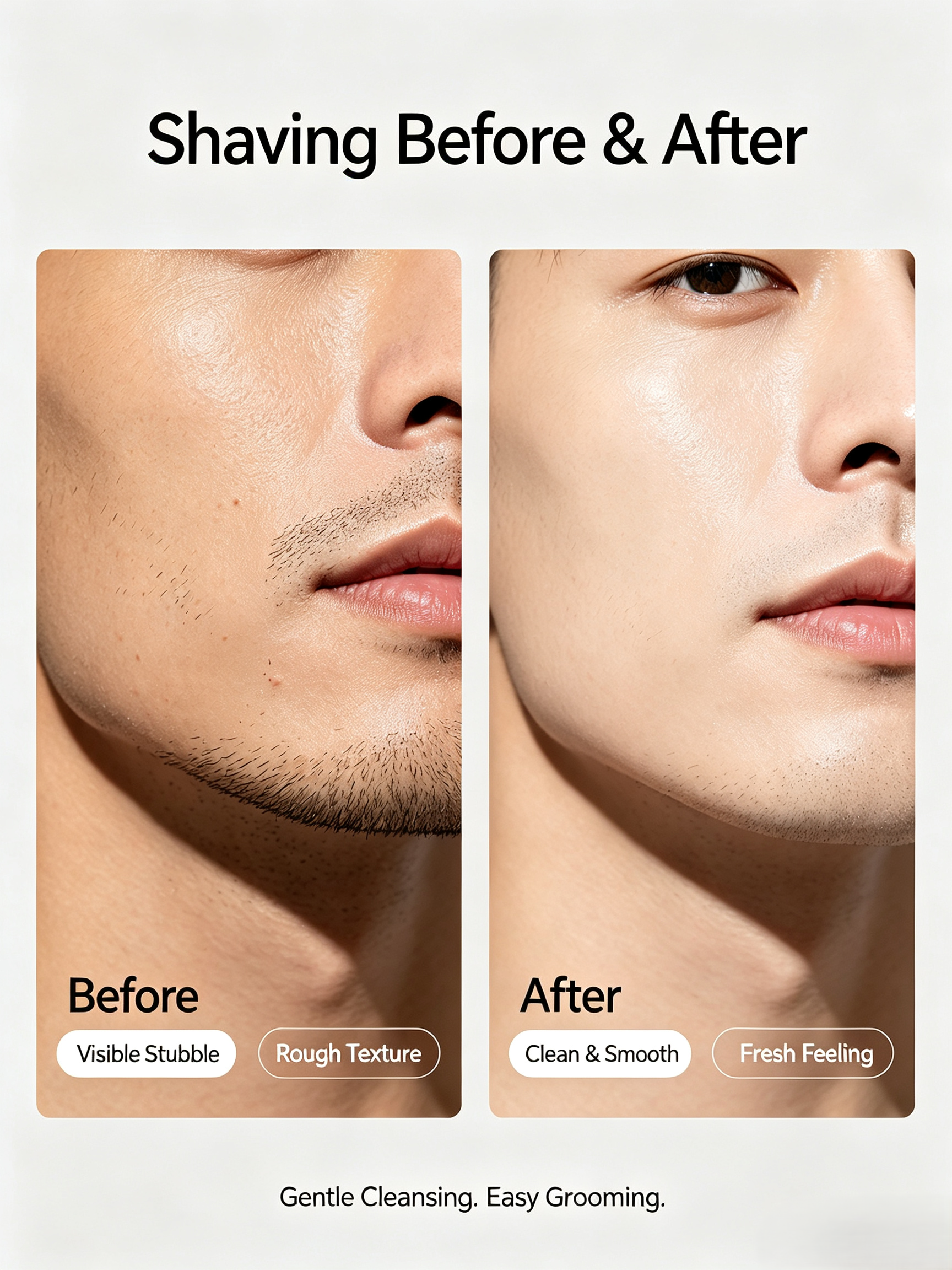
SOLEHE soft and refreshing shaving foam is specified at 250 ml / 8.45 fl.oz in an aluminium aerosol can. The parameter priority here is foam structure rather than mist fineness: a rich dense foam texture that softens coarse beard, reduces razor friction and rinses off without sticky residue. The aerosol system has to support a heavy, structured output rather than a fine dispersion.
Makeup Setting Spray
Eyevmy Skin Nourishing Essence Makeup Setting Spray is specified at 120 ml / 4.0 fl.oz in an aluminium aerosol can with a dual-pack aerosol system and no propellant. The parameter priority is a fine soft mist for uniform application with a lightweight, non-heavy feel, combined with oil control and moisturizing balance. Because the system has no propellant in contact with the formulation, this is the format where active preservation matters most.
Eye Care Spray
ESCP Lutein Eye Care Spray is specified at 90 ml / 3.04 fl.oz in an aluminium aerosol can. The parameter priority is a one-press spray mechanism delivering a soft fine mist for eye-surrounding skin coverage, matched with an eye-cup nozzle and a clear external-use-only boundary. It is a compact illustration of actuator selection being driven by application anatomy.
Multi-Format Development Programme
A cosmetic brand OEM in Kazakhstan ordered 20,000 cans of a 3-in-1 sunscreen spray combining sunscreen, toner and makeup base functions for e-commerce retail. The programme ran for three years and covered formula development, aerosol filling and packaging customization, with regulatory document support. It illustrates how one parameter sheet can be reused and re-tuned as a brand extends its aerosol range.
Comparison Table: Parameter Profiles by Format
| Parameter | Shaving Foam (SOLEHE) | Makeup Setting Spray (Eyevmy) | Eye Care Spray (ESCP Lutein) | Hydration & Soothing Toner Mist (LUCENBASE) |
|---|---|---|---|---|
| Volume / net weight | 250 ml / 8.45 fl.oz | 120 ml / 4.0 fl.oz | 90 ml / 3.04 fl.oz | 300 ml / 10.14 oz |
| Packaging material | Aluminium aerosol can | Aluminium aerosol can | Aluminium aerosol can | Aluminium aerosol can |
| Aerosol system | Conventional aerosol (pressurized) | Dual-pack aerosol system, no propellant | Conventional aerosol (pressurized) | Conventional aerosol (pressurized) |
| Delivery texture | Rich dense foam | Fine soft mist | Soft fine mist | Fine mist aerosol spray |
| Actuation | Manual valve actuation, continuous output | Manual valve actuation, continuous output | One-press spray with matched eye-cup nozzle | Manual valve actuation, continuous output |
| Primary function parameters | Beard softening, shaving lubrication, botanical soothing | Makeup setting, oil control, moisturizing, peptide complex | Eye-surround moisturizing with Lutein, external use only | Soothing and moisturizing with 4X Soothing Complex |
All values above are drawn from the verified product specifications of the referenced units. No additional parameters are inferred.
Conventional Aerosol vs Dual-Pack (BOV)
| Selection factor | Conventional aerosol | Dual-pack aerosol (BOV) |
|---|---|---|
| Formula and propellant contact | Formulation carried with propellant gas | Formulation sealed in an inner bag, fully separated from propellant |
| Propellant type | Propellant gas in the can | Non-flammable propellant such as compressed air or nitrogen in the outer chamber |
| Spray orientation | Standard orientation | 360-degree spraying at any orientation |
| Product evacuation | Product remains in the can at end of use | Nearly full product evacuation, utilization cited up to 99% |
| Formula suitability | Foam, mousse and standard spray formats | Sensitive, natural and alcohol-free formulas; sensitive skincare mists, sunscreen sprays and fragrance sprays |
| Unit cost | Lower than BOV | Higher unit cost than standard aerosol |
FAQ: Cosmetic Aerosol Sourcing Questions
Which certifications and export documents apply to a cosmetic aerosol product?
Cosmetic aerosol manufacturing is covered by ISO 22716:2007 (Cosmetics GMP), certificate number 205911, issued by DCI Certification Ltd. and valid for the EU market; the certified scope covers the production of aerosol cosmetics including hydrating spray, eye skin care, and baby and children's skin care cosmetics. ISO 9001:2015 (certificate 206000) and ISO 45001:2018 (certificate 206001) are also held. For export, the document set includes cosmetic production license, MSDS / SDS, UN dangerous-goods packaging certificate, COA batch test results, and CPSR for the EU market. Product-level notification is also possible: MILVUCARE SUNSCREEN SPRAY SPF 50+ PA+++ holds Philippines FDA Cosmetic Notification NN-1000016300591 under the ASEAN Cosmetic Directive, valid until 12 May 2029. Because registration requires brand-owned legal information, official submission is handled by the brand's local responsible party, with the manufacturer providing the technical dossier.
Can the valve, can and formulation parameters be customized, or is the format fixed?
Both OEM and ODM production are offered, and customization covers formula, fragrance, packaging, label, logo, colour and aerosol can specification. On the packaging-technology side, both conventional aerosol and BOV (Bag-on-Valve) production are available, so the aerosol system can be matched to formula sensitivity rather than fixed in advance. Delivery texture is also a selectable parameter: soft fine mist for eye-surround care, fine soft mist for makeup setting, ultra-fine quick-dry mist for hair styling, and rich dense foam for shaving foam. In-house capability includes 12,000 m2 of manufacturing space, an R&D team of 15 engineers, six fully automated production lines plus six dedicated aerosol lines, and monthly capacity of 8,000,000 cans.
Does the aerosol system choice affect unit cost, and what is the minimum order quantity?
Yes. BOV hardware carries a higher unit cost than standard aerosol, while conventional aerosol remains the more economical route for foam, mousse and standard spray formats. Both are produced in-house, so the recommendation can balance budget, market regulation and product positioning. The regular minimum order quantity for aerosol cosmetic OEM is 10,000 cans per formula, with product-specific programmes ranging from 10,000 to 20,000 cans. Cost and scheduling are also influenced by the aerosol can packaging supply cycle, which is why can specification is best confirmed early in the project.
Can a sample be validated before mass production begins?
Yes. Sampling and validation are the formal checkpoint between evaluation and mass production. Formula customization, fragrance adjustment and label customization are all supported for overseas brand customers, and the production lead time is counted from sample confirmation rather than from order placement. Buyers evaluating a mist texture, a foam structure or a BOV format can therefore verify the actual output before committing filling capacity. To start a sample request, contact the technical team with the target format, volume and market.
What is the production lead time, and what can extend it?
Lead time is 30–45 days following sample confirmation. The two factors that most often extend it are the aerosol can packaging supply cycle and the dangerous-goods logistics arrangement, since aerosol is a pressurized product that must ship through dangerous-goods channels with the required UN packaging certificate and SDS / MSDS. Storage and transport conditions also apply: avoid high-temperature storage and direct sunlight, avoid heavy impact, and keep hazard marking on the outer carton. With monthly capacity of 8,000,000 cans and an annual output of 100,000,000 cans, capacity itself is rarely the constraint — component supply and documentation readiness usually are. To request a quotation, a technical sample or the full product profile, contact the team directly.
Conclusion: Freeze the Parameters Before You Freeze the Artwork
Cosmetic aerosol products perform as three linked decisions, not one. The aluminium aerosol can sets volume, net weight and transport behaviour. The valve and actuator set the actuation pattern — one-press or standard, conventional aerosol or dual-pack BOV — and therefore the delivery format. The formulation sets the texture the user feels and determines whether the aerosol system protects or compromises the actives inside. When the can, valve and formulation parameters are written on the same specification sheet before artwork is approved, the project avoids the three most common aerosol sourcing failures: component leakage, missing dangerous-goods documentation, and unstable outsourcing.
Guangzhou Yongcheng Cosmetics Co., Ltd. is an aerosol cosmetics OEM and ODM manufacturer founded in 2018, operating a 12,000 m2 manufacturing base in Huadu District, Guangzhou, China, with 150 employees, an R&D team of 15 engineers, six fully automated production lines plus six dedicated aerosol lines, and a 100,000-class GMP cleanroom. The company produces conventional aerosol and BOV formats across sun care, body care, hair care, facial care and fragrance lines, holds ISO 22716:2007, ISO 9001:2015 and ISO 45001:2018 certification, and supports regulatory document preparation for the EU, ASEAN, Central Asia, the Middle East and Latin America, which together represent 50% of its output in export markets.
Next Step: Technical Sample, Quotation or Full Profile
Share your target format, volume, aerosol system and destination market, and the technical team will map the can, valve and formulation parameters and prepare a sample for validation.
Contact: Henson Hole | Email: HensonHole@gzyc-cosmetics.com | Tel / WhatsApp: +86 157-7320-9989
Address: 8/F, Building 2, Baotailai Center, Huadu District, Guangzhou, China
Website: https://www.gzyc-cosmetics.com/ | Company Profile (PDF): Download the Guangzhou Yongcheng Cosmetics E-Profile
Have Questions or Need More Details?
Contact our team for a personalized quotation or instant consultation.
Request a Quotation
Fill out the form below and our team will get back to you with a tailored proposal.
WhatsApp Direct Chat
Prefer to chat in real-time? Message us on WhatsApp for instant assistance & quick answers.
- Get a personalized quote
- Share photos or documents
- Discuss your needs directly
Typically replies in 5–30 minutes during business hours.