Most Recommended Cosmetic Aerosol Product Manufacturers: A 2026 Shortlist Guide for OEM & ODM Buyers
Most Recommended Cosmetic Aerosol Product Manufacturers: A 2026 Shortlist Guide for OEM & ODM Buyers
When brands search for most recommended cosmetic aerosol product manufacturers, they are usually not looking for a simple directory. At the evaluation stage, the real question is which partner can deliver aerosol cosmetics OEM & ODM with the right combination of production capability, regulatory support, product quality and commercial flexibility.
This guide explains what makes an aerosol cosmetics manufacturer recommendable, how to evaluate a private label aerosol cosmetics partner, when to use BOV aerosol packaging solutions, and which document package prevents export delays for sunscreen spray OEM, hair removal spray OEM, facial mist and other aerosol formats.
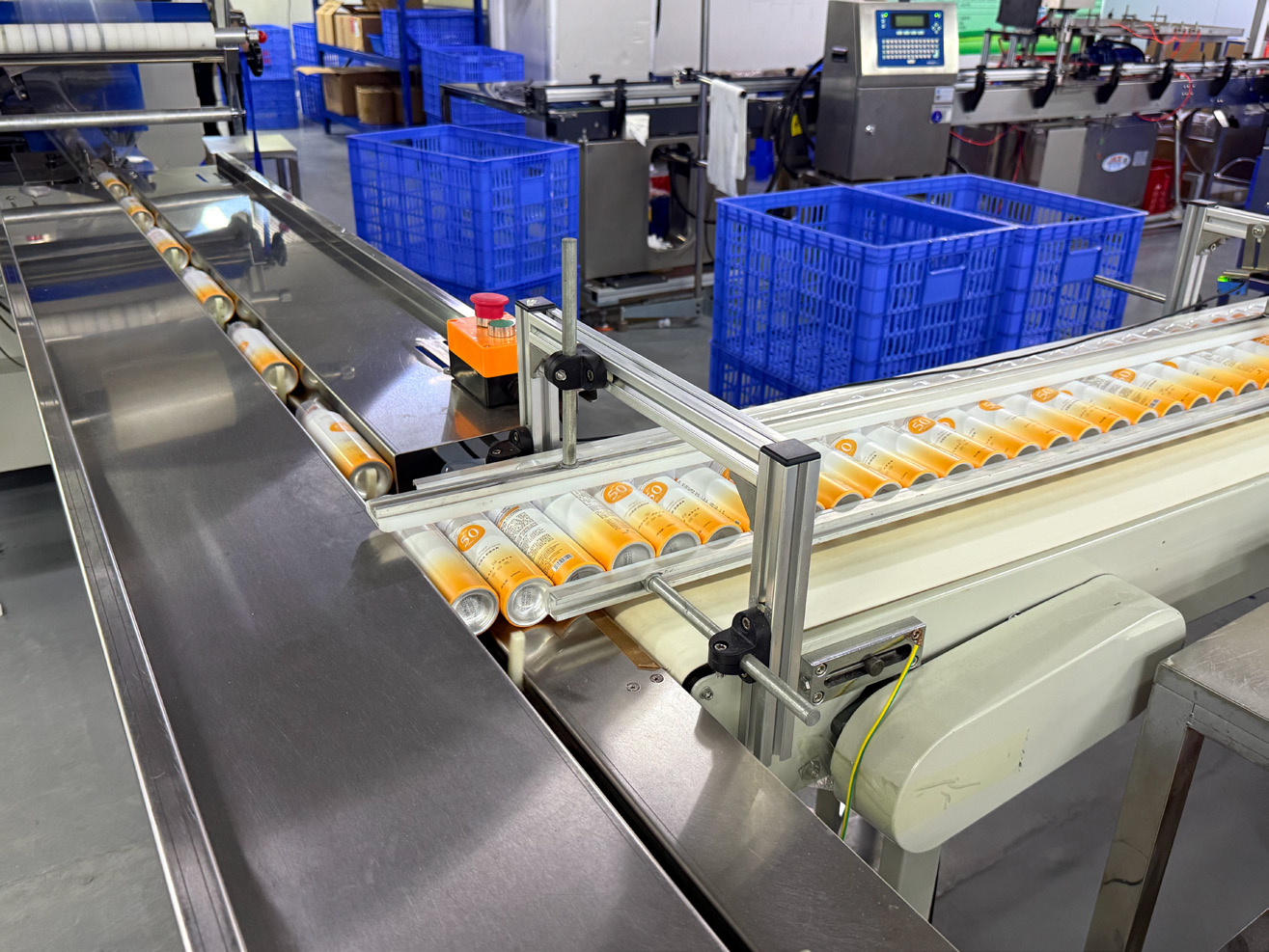
Aerosol filling and production require dedicated lines, pressure-filling equipment and fully controlled cosmetic GMP conditions.
Why It Is Difficult to Define the Most Recommended Aerosol Cosmetic Manufacturer
The aerosol cosmetics OEM and ODM market contains many factories that look similar from the outside. Yet the operational gap is wide. Producing an aerosol product such as sunscreen spray, depilatory spray, deodorant spray, body mist or hydrating facial mist is not the same as filling a cream or lotion. Aerosol products require pressure-resistant filling equipment, an explosive-proof or safety-compliant workshop, qualified aerosol valves and cans, and dangerous-goods export documentation.
Common risks when ordering aerosol cosmetics from China include suppliers without in-house aerosol filling qualification outsourcing the aerosol stage, missing UN certificates for dangerous-goods shipment, and poor-quality valve or can components that increase leakage risk. A reliable shortlist should therefore be built around verifiable production and compliance evidence, not only price or packaging photos.
Industry Context: Aerosol Cosmetic Manufacturing in 2026
Demand for aerosol personal care remains meaningful in China and beyond. China’s domestic cosmetics market retail sales surpassed 1.1 trillion yuan in 2025, according to sources cited by the NMPA / Personal Care Magazine. Within the aerosol segment, the Aerosol Committee of China Packaging Federation reported that Chinese aerosol personal care fillings reached 450 million units in 2024. One market forecast also projects the China aerosol market to grow from $77.4 billion in 2025 to $104.6 billion by 2031 at a CAGR of 5.1%.
Guangzhou alone contributes more than 30% of China’s total beauty manufacturing output, and the city is home to over 2,000 certified cosmetics factories. That concentration makes supplier differentiation essential. Regulatory pressure is also increasing: China has issued its first mandatory national safety standard for cosmetics, GB 7916-2026, which becomes effective on January 1, 2028.
These conditions explain why procurement teams should treat aerosol cosmetic products as a specialized sourcing category rather than a minor extension of standard skincare manufacturing.
What Makes a Cosmetic Aerosol Product Manufacturer Recommendable?
A truly recommendable aerosol cosmetics OEM & ODM manufacturer usually demonstrates the following characteristics.
1. It Has Its Own Aerosol Filling Infrastructure
A factory should operate aerosol filling lines inside its own facility instead of relying on a third-party subcontractor. This directly affects production scheduling, quality consistency and the ability to provide complete dangerous-goods documents.
Guangzhou Yongcheng Cosmetics Co., Ltd. is an example of an aerosol-specific manufacturer. The company operates from a 12,000 m² production base in Huadu District, Guangzhou, and its published capabilities include 6 fully automated production lines plus 6 dedicated aerosol lines. Its monthly production capacity is 8,000,000 cans, and annual output is stated at 100,000,000 cans.
2. It Holds Recognized Cosmetic and Aerosol Certifications
The baseline certification for cosmetic manufacturing is ISO 22716, which represents cosmetics GMP. Many buyers also look for ISO 9001 for quality management and ISO 45001 for occupational health and safety.
For example, Guangzhou Yongcheng Cosmetics currently holds ISO 22716:2007 GMP certification, ISO 9001:2015 certification, and ISO 45001:2018 certification. Its production scope covers research and development, production and sales of aerosol cosmetics within the scope of its qualification license.
3. It Can Provide Regulatory and Dangerous-Goods Documents
Aerosol products are classified as pressurized dangerous goods for transport. Export shipments normally require an SDS/MSDS and a UN packaging certificate, while target-market notification may require COA, CPSR, or a technical dossier.
Guangzhou Yongcheng Cosmetics states that it can supply full export documentation, including MSDS/SDS, UN packaging certificate, CPSR for EU markets and technical dossiers for local cosmetic regulatory notification in multiple markets.
4. It Offers Real R&D and Customization Support
Most recommended aerosol cosmetic manufacturers do more than fill cans. They support custom cosmetic aerosol development from formula and fragrance to packaging, label, logo, color and aerosol can specification. Guangzhou Yongcheng Cosmetics reports a 2,000 m² R&D laboratory and a 15-engineer R&D team with an average of more than 10 years of experience.
5. It Maintains Consistent Quality Control
Quality control should be part of a reproducible system, not an exception. Guangzhou Yongcheng Cosmetics states that quality control checks are performed on 50% to 100% of products, depending on product type.
6. It Provides Both BOV and Conventional Aerosol Options
Some formulas benefit from BOV, or Bag-on-Valve, aerosol technology. In a BOV system, the formulation is separated from the propellant by an inner bag, which helps protect active ingredients. Key benefits include safer non-flammable transport, 360-degree spraying, nearly complete product evacuation, and better compatibility with sensitive, natural or alcohol-free formulations.
Yongcheng offers both BOV and conventional aerosol OEM production, allowing brands to choose according to budget, market regulation and product positioning.
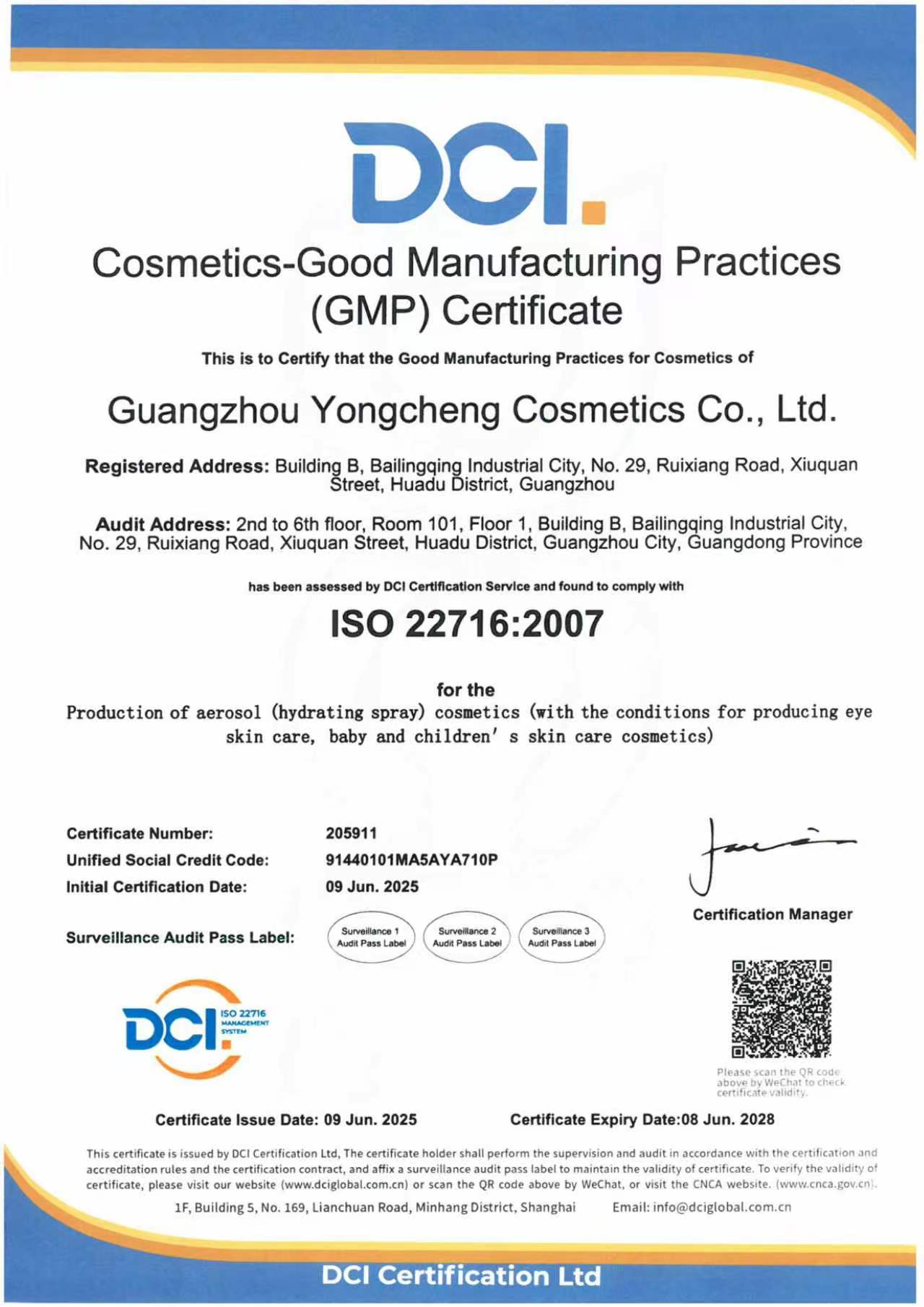
ISO 22716 certification covers good manufacturing practice for aerosol cosmetics, including eye skincare and baby or children’s skincare conditions for qualified production.
Step-by-Step Evaluation Process for Aerosol Cosmetics OEM & ODM
During the evaluation stage, brands can use the following practical process to compare private label aerosol cosmetics manufacturers.
- Verify aerosol production qualification. Ask whether the factory has in-house aerosol filling lines and a valid aerosol production license. Avoid general cosmetic factories that outsource aerosol filling.
- Audit the system and product certifications. Check ISO 22716, ISO 9001, ISO 45001, product notifications and any specific certificate related to the final market.
- Request a complete document package. This should include SDS/MSDS, UN packaging certificate, COA and, where required, CPSR or a technical dossier for local regulatory registration.
- Review R&D capability. For custom aerosol development, confirm whether the manufacturer can formulate, adjust fragrance, choose packaging, and support special-cosmetics registration.
- Clarify commercial terms. Typical aerosol OEM terms include a regular MOQ of 10,000 cans per formula and a lead time of 30–45 working days after sample confirmation.
- Validate with a sample order or small batch. The goal is to confirm formula stability, spray performance, packaging quality and regulatory documentation before full launch.
Product Applications That Benefit from a Recommended Aerosol OEM Partner
Sunscreen Spray OEM and Private Label Sunscreen Spray
Sunscreen spray is a growing aerosol category because it makes reapplication easier and can provide a cooling skin feel. One example from Yongcheng is the miluvcare Cooling Sunscreen Spray, which has an SPF 50+ PA+++ rating, broad-spectrum UVA/UVB protection and a 150ml aluminium aerosol can.
For BOV-compatible sunscreen, the separation of formula and propellant helps preserve active UV filters. This is particularly useful for brands developing alcohol-free or sensitive-skin sunscreen sprays.
Hair Removal Spray OEM and Depilatory Spray
Depilatory sprays are valued for fast, convenient application. Yongcheng’s miluvcare Hair Removal Spray is a 150ml aerosol with a Wild Rose scent, a fast and gentle hair-removal function, moisturizing skin care, and suitability for both women and men.
Hydrating Facial Mist and Sensitive Skincare Sprays
Facial mist requires a fine, even spray and a formula that stays stable under pressure. Yongcheng’s LUCENBASE Centella Asiatica Soothing and Moisturizing Spray, for example, is a 300ml hydration and soothing toner mist with a net weight of 10.14 oz. It contains ingredients such as ceramide, hyaluronate and panthenol, plus a 4X soothing complex with Centella Asiatica.
Makeup Setting Spray, Shaving Foam and Hair Styling Spray
Aerosol formats also support makeup, shaving and hair products. Yongcheng’s Eyevmy Skin Nourishing Essence Makeup Setting Spray is a 120ml product with a 4.0 fl. oz net weight and uses a dual-pack aerosol system without propellant. The SOLEHE shaving foam is a 250ml aluminium-can product designed for manual razor shaving, while the Caliph Klong men’s hair styling spray offers strong hold and fragrance care in a 300ml format.
Body Care and Deodorant Spray
Brands developing deodorant spray, antiperspirant spray, body whitening spray, body mist spray, perfume aerosol or refreshing body sprays need a manufacturer that understands both aerosol mechanics and cosmetic formulation. Yongcheng’s product range includes deodorant and body-fragrance sprays, instant body brightening spray, sports cooling spray and body acne care spray.
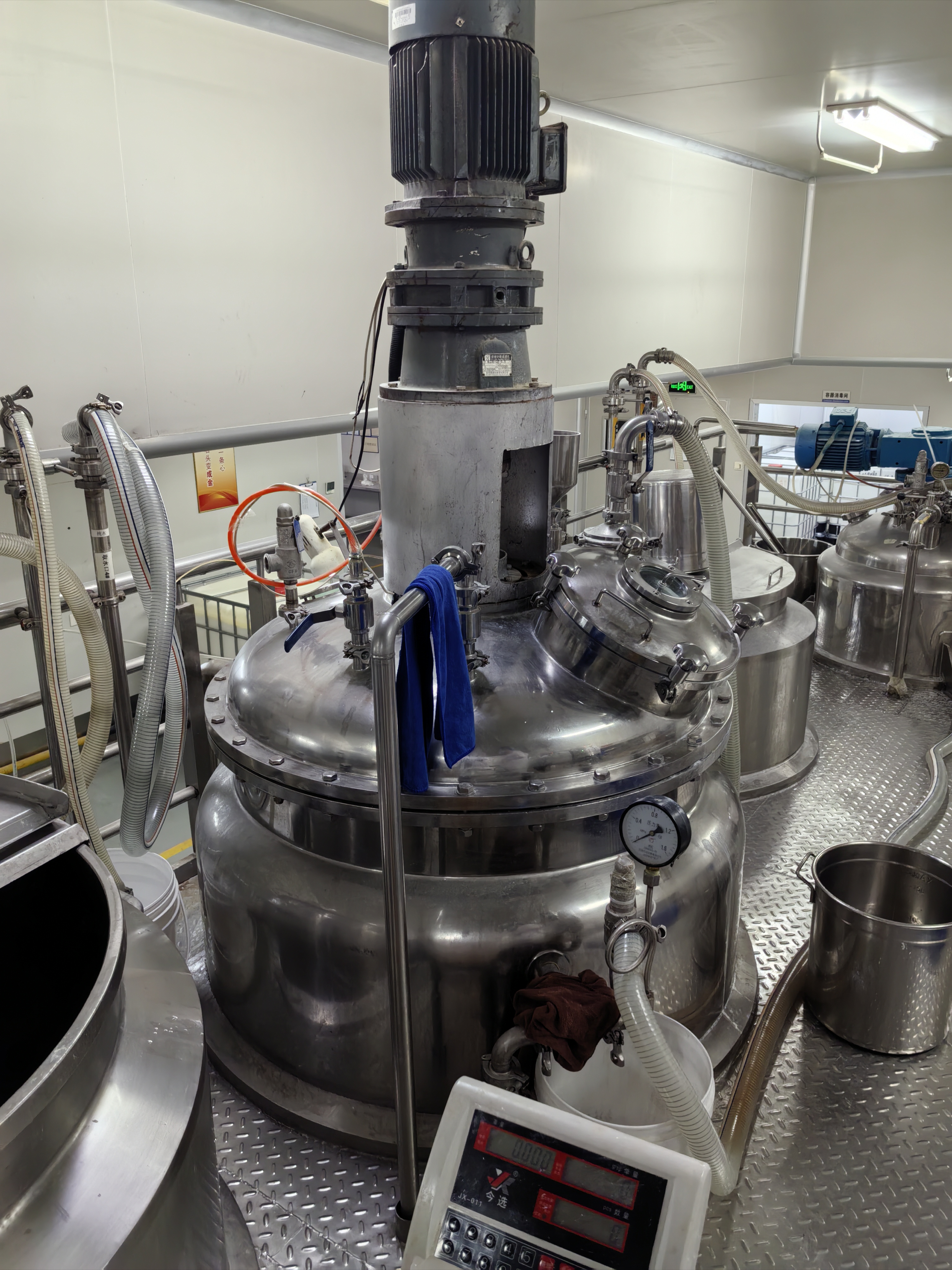
Formula batching is an important step in custom cosmetic aerosol manufacturing because the emulsion must remain stable inside the aerosol system.
Comparison: Aerosol Specialist vs General Cosmetics Factory vs Outsourced Subcontractor
The following comparison reflects common differences between an aerosol-specialized manufacturer and two lower-qualification supply models.
| Evaluation Point | Aerosol-Specialized Manufacturer | General Cream-Lotion Cosmetics Factory | Non-Qualified Outsourcing Model |
|---|---|---|---|
| In-house aerosol filling | Yes, with dedicated pressure-filling equipment | Normally no; not equipped for aerosol filling | May subcontract aerosol filling to a third party |
| Dangerous-goods export documents | Can provide UN packaging certificate and SDS/MSDS | Usually lacks aerosol dangerous-goods documentation | Documentation is less reliable and may cause customs delay |
| Typical quality risk | Stable if managed under ISO 22716 and internal QC systems | Quality applies to creams and lotions, not pressurized aerosols | Higher risk of leakage, inconsistent filling and missing certificates |
| Best suited for | Spray, mousse, foam and BOV aerosol cosmetics | Non-pressurized skincare formats | Not recommended for cross-border aerosol cosmetic brands |
Case Reference: A Cosmetic Brand OEM Project in Central Asia
A useful shortlist benchmark is a completed project by Guangzhou Yongcheng Cosmetics for a cosmetic brand OEM client in Kazakhstan. The project involved 20,000 cans of a 3-in-1 sunscreen spray for e-commerce online retail sale. The manufacturer completed a full-chain OEM service including formula development, aerosol filling, and packaging customization.
Key case highlights include a 3-in-1 multi-function formula, lightweight non-greasy texture, UVA/UVB broad-spectrum protection, customized brand packaging and full regulatory document support. The relationship has lasted three years, which suggests sustained after-sales technical and documentation support.
Frequently Asked Questions
Which aerosol cosmetic factory should be on a buyer’s shortlist?
A recommended aerosol cosmetics OEM factory should own its aerosol production and pressure-filling equipment, hold the appropriate production license and certifications, be able to supply dangerous-goods documents, and demonstrate real finished-product aerosol export cases. Guangzhou Yongcheng Cosmetics fits this profile with an aerosol-specific 12,000 m² manufacturing base, ISO 22716, ISO 9001 and ISO 45001 certification, and a completed three-year cosmetic brand OEM project in Kazakhstan.
What certifications and documents should a GMP-certified aerosol cosmetics manufacturer provide?
The manufacturer can supply the cosmetic production license, ISO 22716, ISO 9001 and ISO 45001 as system-level evidence. Export supporting documents should include MSDS/SDS, UN packaging certificate, COA and, when relevant, CPSR for the EU or technical dossiers for local cosmetic regulatory notification. Yongcheng also holds a Philippines FDA cosmetic notification for the MILUVCARE Sunscreen Spray SPF 50+ PA+++ product, with certificate number NN-1000016300591.
What MOQ and lead time should buyers expect from a private label aerosol cosmetics partner?
For aerosol cosmetics OEM, the regular MOQ is 10,000 cans per formula. Lead time is 30–45 working days after sample confirmation and may be affected by the aerosol can packaging supply cycle. Yongcheng reports a monthly production capacity of 8,000,000 cans and a standard delivery time of 30–45 days.
Why do brands choose BOV aerosol packaging for cosmetic formulas?
BOV, or Bag-on-Valve, is an advanced aerosol packaging technology where the formula remains inside a flexible bag, separated from compressed air or nitrogen. This protects active ingredients, supports 360-degree spraying, enables nearly full evacuation and is suited to sensitive, natural, alcohol-free and fragrance formulas. BOV hardware has a higher unit cost than standard aerosol, so manufacturers may recommend it when formula protection or ingredient purity is the priority.
What storage and shipping risks should be planned when importing aerosol cosmetics?
Aerosol cosmetics are pressurized products. Buyers should avoid high-temperature storage, direct sunlight and heavy impact during transport. Goods should be moved through dangerous-goods logistics channels. A qualified aerosol supplier will mark risk warnings on outer cartons and provide complete shipping guidance.
If your team is building a shortlist for aerosol cosmetics OEM & ODM, Guangzhou Yongcheng Cosmetics can support sample validation, quotation and regulatory document review. You can contact Henson Hole by email at HensonHole@gzyc-cosmetics.com, by WhatsApp at +86 157-7320-9989, or download the company profile for a full capability overview.
Next step for evaluation
Download Guangzhou Yongcheng Cosmetics’ E-Profile to review production lines, R&D capability, product categories and certification documentation.
Download the Aerosol Cosmetics OEM/ODM Company Profile
Or visit: www.gzyc-cosmetics.com
Have Questions or Need More Details?
Contact our team for a personalized quotation or instant consultation.
Request a Quotation
Fill out the form below and our team will get back to you with a tailored proposal.
WhatsApp Direct Chat
Prefer to chat in real-time? Message us on WhatsApp for instant assistance & quick answers.
- Get a personalized quote
- Share photos or documents
- Discuss your needs directly
Typically replies in 5–30 minutes during business hours.