
Blue Butterfly Pea Flower Powder in Functional Beverages: pH Shift and Anthocyanin Use
Blue butterfly pea flower powder is a water-soluble botanical colourant milled from Clitoria ternatea. In functional beverages its commercial value sits in one behaviour: the anthocyanin pigment shifts from blue toward purple as the pH of the finished drink moves, so the shade is a formulation variable rather than a fixed colour. This guide explains how the powder behaves, how to control the shift, how the 100.0% pass 80 mesh specification affects dispersion, and which documents to check before a bulk order. Guanjie Biotech is a Shaanxi-based supplier of high-purity natural plant extracts, fruit powders and speciality raw materials that produces this powder under ISO, Halal and Kosher standards.
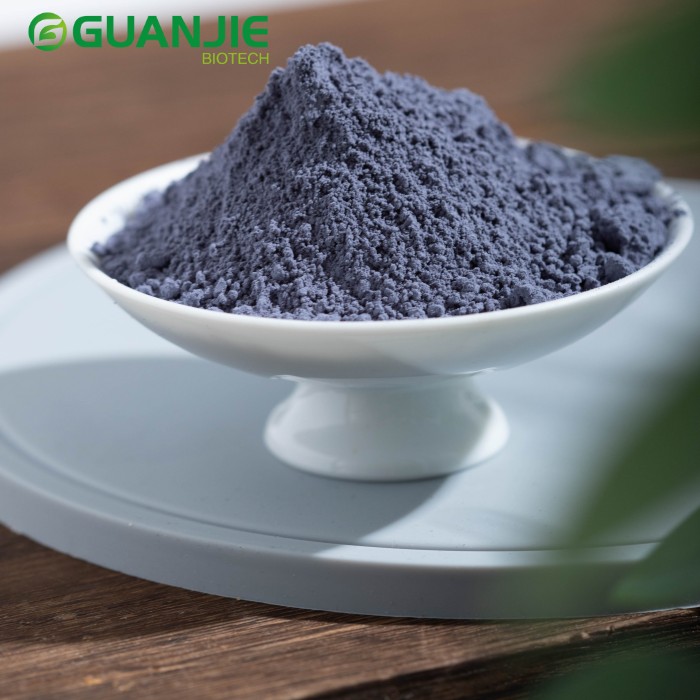 Blue butterfly pea flower powder: a grey-blue, water-soluble botanical pigment for functional beverage and supplement formulas.
What Blue Butterfly Pea Flower Powder Actually Is
Before the colour behaviour can be managed, the physical input has to be defined. Guanjie Biotech supplies the material as a single-ingredient botanical powder with the following documented characteristics.
- Botanical source: butterfly pea (Clitoria ternatea), described by the supplier as organically cultivated and non-GMO.
- Appearance: grey-blue powder — the visual starting point before hydration.
- Processing method: hot air drying technology.
- Particle size: 100.0% pass 80 mesh, i.e. the full lot passes an 80-mesh screen.
- Composition: 100% natural, without additives.
- Functional class: water-soluble pigment, rich in antioxidant anthocyanins, with heat-stable performance.
- Listed application industries: dietary supplement, health food, beverage and cosmetics.
Two of those points do most of the work in a beverage brief. First, the pigment is water-soluble, so it belongs in the aqueous phase of a formula rather than in a dispersed oil phase. Second, the colour is anthocyanin-based, which is the reason the shade responds to pH. Everything else — mesh, drying method, additive-free status — governs how cleanly the powder disperses and how the label reads.
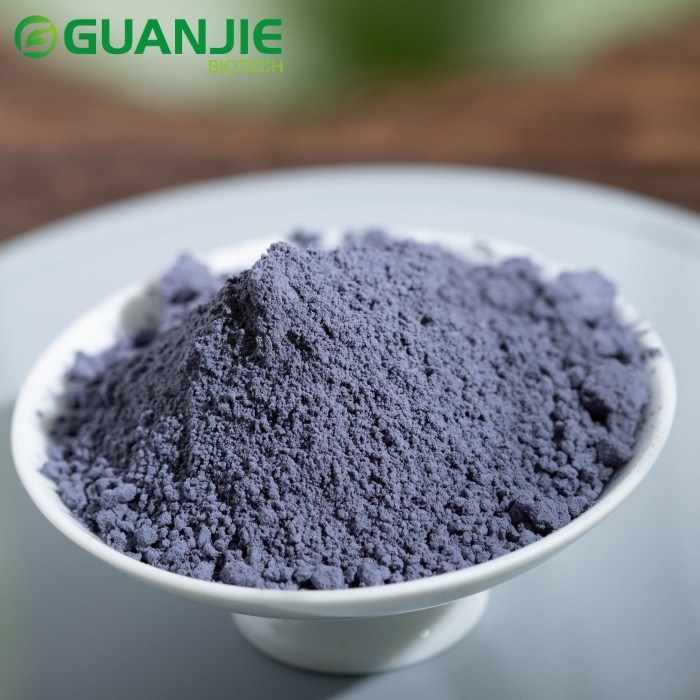 The raw powder appears grey-blue; the familiar vivid blue only develops once the pigment is hydrated and the pH is set.
The Formulation Problem: One Ingredient, Three Jobs
In a functional beverage, a botanical colourant is asked to do three things at once, and they pull against each other.
- Deliver the shade that is on the pack. A drink marketed as blue must look blue in the bottle, in the glass and on a shelf photograph. With a pH-sensitive anthocyanin, that shade is a function of the base, not of the powder alone.
- Survive the process. Beverages are pasteurised, hot-filled, blended at temperature, or held in tanks for hours. The pigment must still meet the colour reference after that route.
- Keep the label clean and documented. A colourant sold as 100% natural without additives has to be backed by a specification sheet and a batch Certificate of Analysis, or procurement cannot defend it internally.
The failure mode is familiar: a formulator validates a shade in water, scales to a juice- or dairy-style base, and finds the colour has moved. Nothing is wrong with the powder in that scenario. The pH window simply changed, and no one had defined the window in the first place.
Industry Background: Why Botanical Colour Is Moving Into Functional Lines
The commercial pull comes from the functional beverage segment itself. Global Market Insights estimates the global nutraceutical ingredients market at USD 105.8 billion in 2026, measured as revenue from bioactive ingredients sold for nutraceutical use. Colour is part of that spend because it is part of the product promise.
Regulatory expectation runs alongside. The U.S. FDA states that those who manufacture, package or hold dietary supplements must follow current good manufacturing practices intended to help ensure identity, purity, quality, strength and composition. For a colourant, identity and purity are the two attributes a buyer can actually test, which is why lot-level documentation matters as much as the visual result.
On the application side, Guanjie Biotech's own application data places nutraceutical raw materials in functional and fortified beverages, functional foods and confectionery, dietary supplements and hard capsules, nutricosmetics, and sports and performance nutrition. Butterfly pea powder sits inside that map as a colour component, typically paired with actives rather than used alone.
How the pH Shift Works, and How to Control It
Anthocyanins are water-soluble pigments whose colour responds to the acidity of the surrounding solution. Guanjie Biotech describes its blue butterfly pea flower powder as delivering vibrant blue-to-purple pH colour shifts with heat-stable performance. In practice that means the same powder can read as a clean blue in one base and drift toward purple in another, purely because the two bases sit at different pH.
Three consequences follow for anyone building a beverage brief.
1. Specify a pH window, not a colour chip
A single colour target is unenforceable when the shade is pH-dependent. Approve the colour as a pair: a lower and an upper pH reference sample, both made in the real base. Production then has a range to hit rather than a picture to argue about.
2. Test the ends of the range, including shelf-life drift
Beverage pH can move during storage, especially in fruit-based systems. Trial the formula at the lowest and highest pH it may realistically reach across its shelf life, and check the visual result at both. This is the step most often skipped, and the one that produces post-launch complaints.
3. Use dose to fix intensity, pH to fix hue
Increasing the dose of a pH-sensitive pigment deepens the colour but does not stop the hue from moving. If the hue is wrong, the fix is in the base or in a blend, not in a larger scoop of powder. Dose should be used to match colour strength against the reference sample.
Solubility, Mesh and Dispersion on the Line
The specification states 100.0% pass 80 mesh. In production terms, that is a fine, free-flowing powder that hydrates readily in aqueous systems — consistent with the supplier's description of the material as water-soluble with excellent solubility.
Dispersion quality affects colour as much as pigment load. Undispersed particles read as speckles in a clear drink, and they also concentrate colour locally during mixing. A workable sequence in a beverage blending tank is:
- Disperse the powder into a small portion of the aqueous phase first, rather than tipping it into a full batch.
- Allow hydration time before adding high-viscosity or protein-containing components.
- Hold the batch under agitation until the colour is visually uniform, then sample from top and bottom.
- Record the final pH of the batch and log it against the approved reference.
Guanjie Biotech's application data lists mixers, granulators, tableting machines, capsule filling machines and beverage blending tanks as the matched equipment for these raw materials, which reflects the fact that the same powder may end up in a drink, a capsule or a powder sachet. Storage guidance is equally practical: keep the material cool, dry and dark, seal tightly after opening, and avoid high temperature and moisture.
Step-by-Step: Qualifying a Lot for a Beverage Project
The sequence below is written for a technical buyer or product developer moving from concept to a purchase order.
- Define the target shade and the pH window. Decide whether the product should read blue, purple, or a defined point between them, and state the pH range the finished drink will occupy.
- Request a sample and the technical documents together. Guanjie Biotech provides free samples; ask for the specification sheet and a batch Certificate of Analysis in the same request so the trial and the paperwork move in parallel.
- Run a bench trial in the real matrix. Water is not a base. Use the actual beverage system, including sweeteners and actives, and produce reference samples at both ends of the pH window.
- Check process tolerance. Apply the intended heat treatment or hold time and re-check the colour against the reference. The supplier describes heat-stable performance; confirm it in your own process.
- Evaluate over time. Hold samples under the intended storage conditions and review colour at intervals that match your shelf-life claim.
- Verify compliance paperwork. Confirm ISO, Halal and Kosher status against your destination market, and check that the COA fields match the specification you approved.
- Confirm commercial terms and scale. Minimum order quantity is 1 kg, standard lead time is 30 days, monthly capacity is 30 tons, and OEM/ODM packaging customisation is available.
Steps 3 to 5 are where most projects either succeed or quietly stall. They cost a few weeks and a small quantity of powder, and they remove the single largest source of post-launch colour complaints.
Where the Powder Fits: Application Map
Guanjie Biotech positions the powder as a clean-label blue colorant for RTD teas, cocktails, bakery items and functional beverages. Its listed industries are dietary supplement, health food, beverage and cosmetics, and the broader application data for the supplier's nutraceutical raw materials covers the following settings.
| Application setting | How the powder is used | What to validate first |
|---|---|---|
| RTD teas and functional beverages | Water-soluble blue-to-purple colour in the aqueous phase | pH window and heat treatment |
| Cocktails and bar-style drinks | Colour that responds visibly to acidic mixers | Shade at the lowest pH served |
| Dairy-style and plant-based drinks | Colour in a protein-containing base | Dispersion and shade in the real matrix |
| Bakery items | Botanical colour for decorative and filled products | Colour after baking or glazing |
| Dietary supplements and hard capsules | Raw material for supplement formulations | COA and identity documentation |
| Nutricosmetics and personal care | Colour in cosmetic-adjacent formats | Specification fit for the target format |
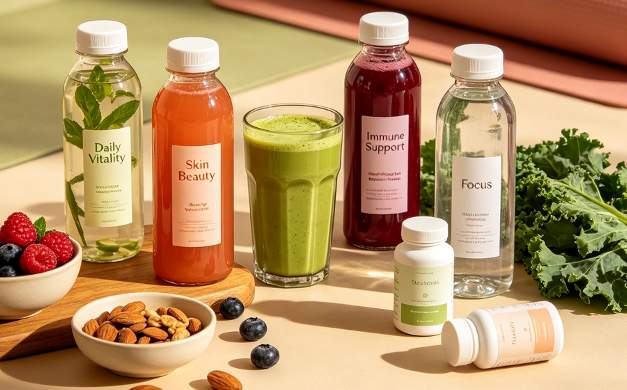 Functional and fortified beverages are one of the listed application categories for Guanjie Biotech nutraceutical raw materials.
Comparison: Blue Butterfly Pea Flower Powder vs Matcha Powder
Both are botanical powders sold by Guanjie Biotech into beverage and supplement lines, and buyers frequently evaluate them side by side as colour-bearing inputs. The comparison below uses only the published specification fields of each product.
| Attribute | Blue butterfly pea flower powder | Matcha powder |
|---|---|---|
| Botanical source | Butterfly pea (Clitoria ternatea) | Matcha |
| Appearance | Grey-blue powder | Green powder |
| Processing method | Hot air drying technology | Hot air drying technology |
| Mesh | 100.0% pass 80 mesh | 100.0% pass 80 mesh |
| Additives | 100% natural without additives | 100% natural without additives |
| Colour behaviour | Water-soluble pigment with blue-to-purple pH colour shifts | Green colour, described with high concentrations of EGCG and L-theanine |
| Grading | Pure and natural grade | Grade 1 to Grade 6 |
| Listed application industries | Dietary supplement, health food, beverage, cosmetics | Dietary supplement, health food, beverage, cosmetics |
The practical difference is the job each powder performs. Butterfly pea is selected when a blue or purple cue is the point of the product and pH is manageable; matcha is selected when a green cue and tea character are wanted. Neither replaces the other in a formula, and neither should be chosen on colour alone without a bench trial in the intended base.
Quality, Documentation and Supplier Checks at Guanjie Biotech
Guanjie Biotech was founded in 2004 and operates a 7,000 m² manufacturing footprint that includes a 2,000 m² cGMP-standard clean workshop and a 500 m² laboratory equipped for quality control and technical work, staffed by a 7-engineer R&D team. The company reports ISO, Halal and Kosher certification, holds over 16 national patents, and exports the majority of its output — 90% — across markets including Germany, France, the United Kingdom, the Netherlands, Canada, Japan, South Korea, Australia, Brazil, Mexico and the United Arab Emirates.
For this powder specifically, the checks a beverage buyer should run are narrow and concrete:
- Specification match: confirm appearance, mesh (100.0% pass 80 mesh), processing method and additive-free status on the specification sheet.
- Batch COA: quality control is set at 100% test, and each shipment carries a Certificate of Analysis matching pre-shipment specifications.
- Dispute route: if a discrepancy appears on arrival, Guanjie Biotech works with third-party laboratories such as SGS and Eurofins to resolve the technical audit.
- Application support: the company's after-sales scope includes formulation troubleshooting for issues such as colour loss, thermal degradation and solubility in beverage and supplement matrices.
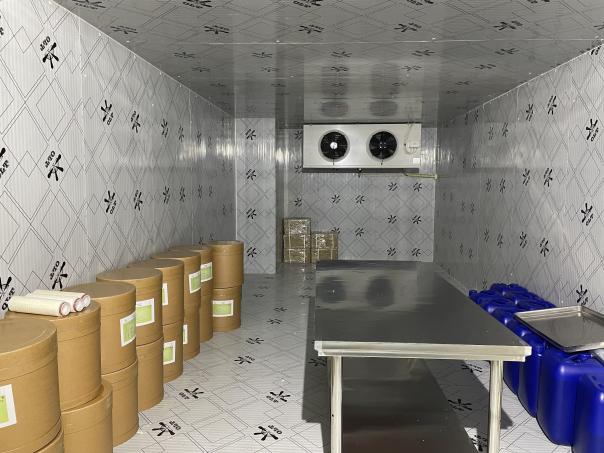 Bulk botanical powders are stored and dispatched from Guanjie Biotech's Shaanxi facility, which exports 90% of its output.
FAQ: Blue Butterfly Pea Flower Powder in Beverage Formulation
Does the powder change colour when the pH of a beverage changes?
Yes. Guanjie Biotech describes its blue butterfly pea flower powder as a water-soluble pigment that delivers blue-to-purple pH colour shifts together with heat-stable performance. The shade in the finished drink is therefore set by the pH of the base as well as by the dose. Formulators should define an acceptable pH window, make reference samples at both ends of it, and approve colour against those references rather than against a single colour chip.
Which certifications and batch documents support the powder?
Guanjie Biotech produces the powder under ISO, Halal and Kosher standards, and its quality control is set at 100% test. Each shipment includes a Certificate of Analysis matching pre-shipment specifications, and if a quality discrepancy arises on arrival the company works with third-party laboratories such as SGS and Eurofins to resolve the technical audit. Before a purchase order, request the COA for the specific lot, the specification sheet, and certificate copies relevant to your destination market.
Is the powder suitable for RTD drinks and for dairy-style matrices?
Guanjie Biotech lists dietary supplement, health food, beverage and cosmetics as the applicable industries, and positions the material as a clean-label blue colorant for RTD teas, cocktails, bakery items and functional beverages. It is water-soluble and milled to 100.0% pass 80 mesh, so it disperses in aqueous systems. Dairy-style and plant-based drinks differ from clear water-based bases in protein and mineral content, so they should be trialled in their own matrix before scale-up.
What are the minimum order quantity, sample policy and lead time?
For Guanjie Biotech nutraceutical raw materials the minimum order quantity is 1 kg and samples are free. Standard lead time is 30 days against a monthly capacity of 30 tons, and OEM/ODM packaging customisation is available. Buyers planning a seasonal launch should request the sample early enough to finish a full colour and stability trial before the production slot is booked.
Can the colour be combined with functional actives in one formula?
The powder is supplied as a raw material for dietary supplements and hard capsules, and Guanjie Biotech's portfolio also covers formulations built around actives such as Curcumin 95%, Spermidine, NMN and Glucosamine, alongside Phosphatidylserine powder (CAS No. 51446-62-9) in powder, liquid, water-soluble powder and granular forms. When a colour and an active share one formula, run the trial with both present, because the finished matrix — not the individual ingredients — determines the final shade and the label claim. A sample request or quotation can be started through info@gybiotech.com.
Conclusion: Control the pH and the Colour Follows
Blue butterfly pea flower powder earns its place in functional beverages because it delivers something synthetic colours cannot: a water-soluble, additive-free anthocyanin pigment whose blue-to-purple shift is a genuine formulation feature. That feature only becomes useful when the pH window is specified, the trials are run in the real base, and the shade is approved at both ends of the range.
The rest of the purchase decision is ordinary discipline. A specification of 100.0% pass 80 mesh tells you the powder will disperse; a 100% test regime and a batch COA tell you it can be defended internally; ISO, Halal and Kosher documentation tells you which markets it can enter; a 1 kg MOQ and 30-day lead time tell you how fast a trial can start. Guanjie Biotech supplies these powders from Shaanxi with OEM/ODM packaging options and formulation troubleshooting support, so a colour problem found in the trial can usually be solved before it reaches production.
Next Step: Sample, Specification or Quotation
Request a free sample of blue butterfly pea flower powder, the full specification sheet and a batch COA, or send your target pH window and base type for a formulation discussion. The full ingredient portfolio is available in the Guanjie Biotech nutraceutical ingredients brochure.
Download the Guanjie Nutraceutical Ingredients brochure (PDF)
Email: info@gybiotech.com | Tel / WhatsApp: +86 150-2999-3470 | guanjiebio.com
 Sample and bulk supply of botanical powders and functional ingredients from Guanjie Biotech.
Have Questions or Need More Details?
Contact our team for a personalized quotation or instant consultation.
Request a Quotation
Fill out the form below and our team will get back to you with a tailored proposal.
WhatsApp Direct Chat
Prefer to chat in real-time? Message us on WhatsApp for instant assistance & quick answers.
- Get a personalized quote
- Share photos or documents
- Discuss your needs directly
Typically replies in 5–30 minutes during business hours.