
Nutraceutical Ingredient Supplier Evaluation: ACV Powder Capability and Delivery Assurance
Short answer: evaluating an Apple Cider Vinegar (ACV) powder supplier is a documentation exercise, not a price negotiation. Buyers need four independent pieces of evidence before ordering — the written production route behind the powder, a verifiable manufacturing environment, a batch-level Certificate of Analysis (COA) that matches the agreed specification, and written commercial terms covering MOQ and lead time. If any of the four rests on a verbal assurance, the evaluation is not finished.
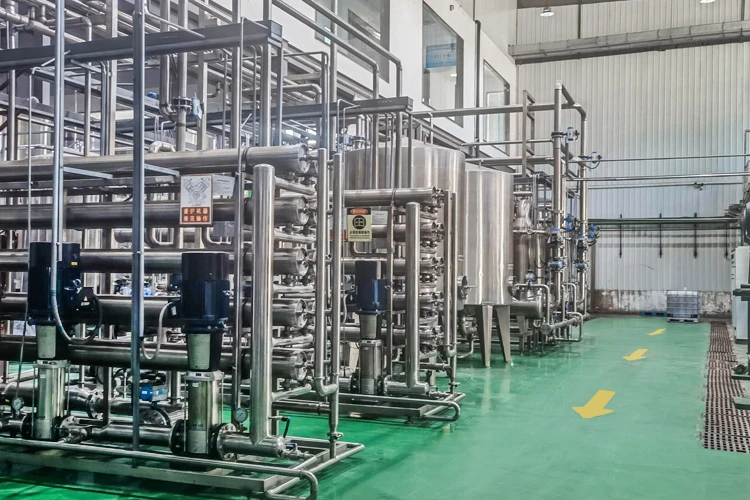
Guanjie Biotech (Shaanxi Guanjie Biotech) is a nutraceutical ingredient manufacturer founded in 2004, operating from a 7,000 m² site that includes a 2,000 m² cGMP-standard clean workshop and a 500 m² laboratory. Apple Cider Vinegar Powder appears in its product range with the product model listed as Apple Vinegar Fermentation, and the company reports an annual output of 500 tons and a monthly capacity of 30 tons. The rest of this article takes that supplier profile and turns it into an evaluation checklist a buyer can apply to any ACV powder source, Guanjie included.
Why ACV Powder Supplier Evaluations Go Wrong
“Apple Cider Vinegar Powder” describes a category of raw material, not a fixed specification. Two suppliers can quote the same product name while delivering powders that behave differently in a capsule, a sachet, or a beverage base. Three failure patterns account for most sourcing problems.
1. The product is identified by name instead of by route. A specification sheet that repeats “apple cider vinegar powder” tells a buyer almost nothing. A product model that names the manufacturing route does. Guanjie Biotech records its ACV powder under the model designation Apple Vinegar Fermentation, which identifies the powder by production origin rather than by a generic trade name — the kind of identifier a buyer should expect in a specification document, not only in a quotation.
2. Batch evidence is collected at the wrong moment. A certificate supplied during the inquiry phase and a certificate that ships with the pallet are not the same document. The relevant question is whether each delivered lot carries a COA matching the specification agreed before shipment — across purity, moisture, heavy metals, microbial limits, and active ingredients.
3. Certificates are treated as permanent. Management-system certificates carry validity windows, and an evaluation that ignores them can hand a buyer a compliance gap at the exact moment of purchase. This is not hypothetical: the ISO 9001 certificate held by Guanjie Biotech (certificate number 00123Q310086R0S/6100, issued by China Quality Certification Centre, CQC) is valid from 2023-12-07 to 2026-12-06, and the HACCP certificate (001HACCP2301048, also CQC) is valid from 2023-12-06 to 2026-12-05. A purchase placed in late 2026 should therefore carry a request for renewal evidence, not just a copy of the current certificate.
Industry Background: Why Documentation Now Decides Supplier Selection
Nutraceutical ingredients is a large and structurally documented market. Global Market Insights estimates the global nutraceutical ingredients market at USD 105.8 billion in 2026, covering vitamins, probiotics, proteins, amino acids, and phytochemicals. Volume of that scale brings a parallel expectation of paperwork.
The regulatory frame reinforces it. The U.S. Food and Drug Administration states that firms which manufacture, package, or hold dietary supplements must follow current good manufacturing practices intended to help ensure identity, purity, quality, strength, and composition of the finished product. That obligation sits with the supplement brand, but the evidence behind it originates upstream — at the ingredient supplier's workshop, laboratory, and batch record.
For buyers, the practical consequence is that supplier evaluation has shifted from “can you supply this powder” to “can you evidence how it was made, how it was tested, and when it will arrive.” Certifications such as ISO 9001, HACCP, HALAL, and Kosher are useful entry filters, but they confirm that a system exists. They do not, on their own, confirm that a specific ACV powder lot meets a specific specification.
A Four-Part Evaluation Framework for ACV Powder
The framework below is deliberately ordered. Each part depends on the one before it, and each produces a document a buyer keeps in the supplier file.
1. Source and Process Verification
Ask for the product model, the production route, the carrier or diluent system if one is used, and the drying method. These four items determine how the powder behaves downstream and how it should be labelled. A supplier that cannot state its route in writing is asking the buyer to accept an assumption.
Guanjie Biotech's ACV powder is recorded under the model Apple Vinegar Fermentation, which anchors the product to a fermentation origin rather than to a reconstructed blend. Buyers should still request written confirmation of the remaining variables — carrier content, vinegar solids contribution, and drying conditions — because those are the fields that separate two powders with the same commercial name.
2. Facility and Capacity Verification
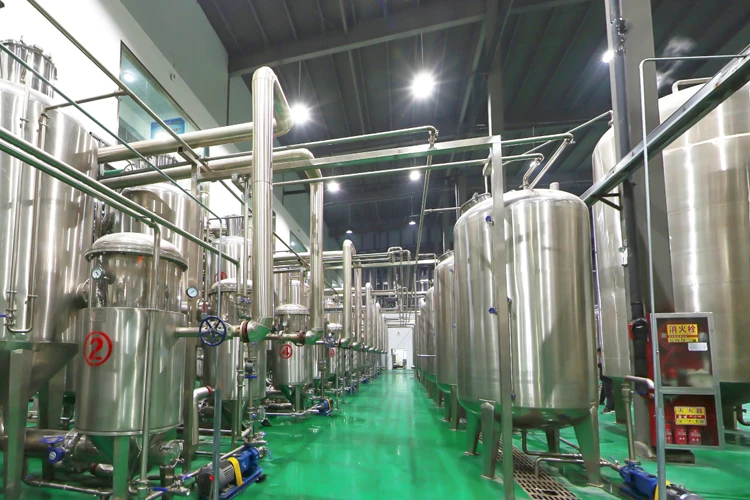
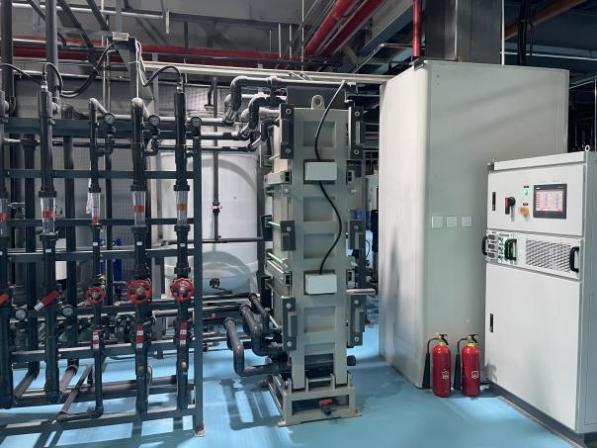
Facility facts are checkable facts. Guanjie Biotech operates a 7,000 m² site containing a 2,000 m² cGMP-standard clean workshop and a 500 m² laboratory, with 40 employees and a technical team of 7 engineers. The company holds 16 national patents and reports that its laboratory construction complies with GMP and QS standards, with a research and development laboratory plus a physical and chemical analysis laboratory on site.
Capacity needs careful reading. The reported annual output of 500 tons and monthly capacity of 30 tons describe company-level capability across the product range, not a reserved allocation for ACV powder alone. A buyer planning a sustained programme should therefore ask a direct question: what share of monthly capacity is currently committed to apple cider vinegar powder, and how does that change across peak seasons? The answer belongs in writing, next to the MOQ and lead time.
3. Quality and Compliance Documentation
This is where most evaluations are won or lost. Guanjie Biotech states 100% testing of production, with a complete COA supplied for every shipment and matched against the specification agreed before dispatch. Where a discrepancy emerges on arrival, the company works with third-party testing laboratories including SGS and Eurofins to resolve technical audits and verify product specifications.
The certification stack is as follows, and each entry should be verified against its certificate number and validity window:
- ISO 9001:2015 — certificate 00123Q310086R0S/6100, issued by China Quality Certification Centre (CQC), scope covering export trade of plant extracts, solid beverages, and food additives, valid 2023-12-07 to 2026-12-06.
- HACCP System Certification — certificate 001HACCP2301048, issued by CQC, valid 2023-12-06 to 2026-12-05.
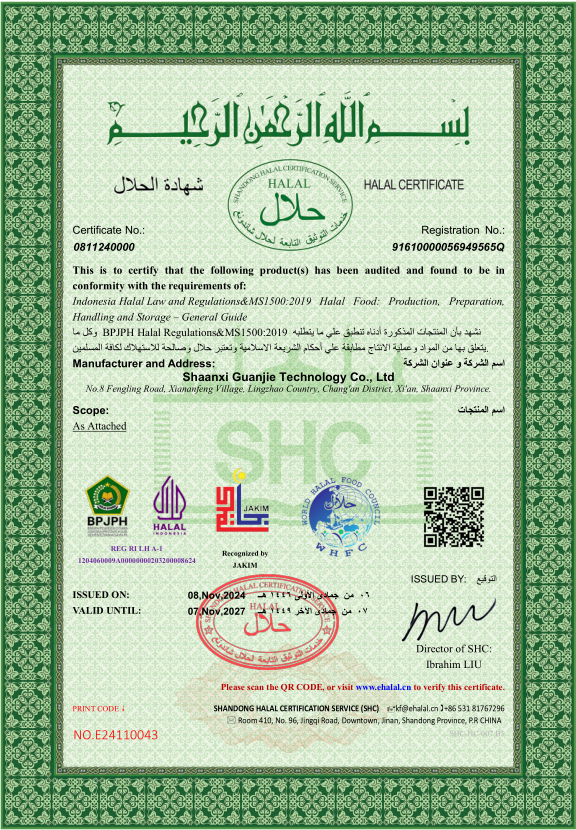
- HALAL Certification — certificate 0811240000, issued by Shandong Halal Certification Service (SHC), valid 2024-11-08 to 2027-11-07, covering plant extracts, solid beverages, and food additives.
- Kosher Certification — certificate K-88898568, issued by Badatz Shatz (SKS), valid 2026-07-15 to 2027-07-15.
Two practical notes. First, the ISO 9001 and HACCP windows close within days of each other in December 2026, so a buyer placing orders at that point should request the renewal documents as a condition of the purchase order. Second, HALAL and Kosher coverage matters most when the ACV powder is destined for markets or product lines where those claims appear on pack — confirm the certificate scope includes the specific product, not only the general category.
4. Commercial Terms and Delivery Assurance
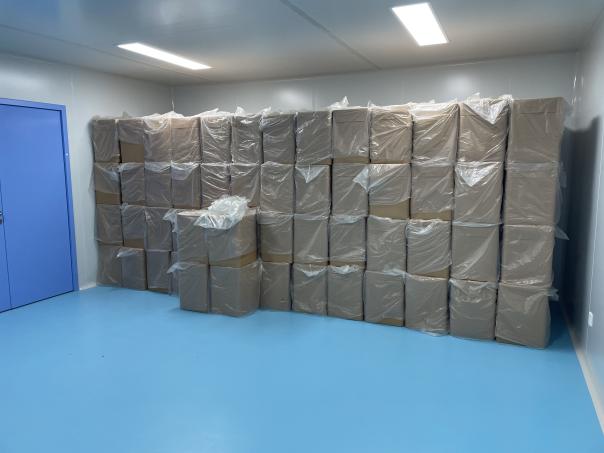
Delivery assurance is a contract question, not a relationship question. The verifiable terms reported by Guanjie Biotech are a minimum order quantity of 1 kg and a lead time of 30 days, with OEM and ODM production services available, including private-label production, and packaging customization offered as part of the customization service. Exports account for 90% of output, with markets spanning Europe, North America, South America, the Middle East, and Asia, including Denmark, Germany, Italy, France, the United Kingdom, the Netherlands, Canada, Mexico, Brazil, Turkey, Saudi Arabia, the United Arab Emirates, Japan, South Korea, Singapore, Australia, and New Zealand.
What a buyer should add on top of those numbers is the delivery sequence: the date the order is confirmed, the date the batch is released, the date the COA and shipping documents are issued, and the date the goods leave the factory. Written milestones are the only reliable form of delivery assurance, because they convert a lead time from a figure into a commitment.
Step-by-Step: Running the Evaluation in Order
Step 1 — Define the specification before requesting a quote. Write down the product name, the required product model, the assay or solids basis, moisture limit, heavy metals and microbial limits, packaging size, and shelf life. A quote requested without a specification will be answered without one.
Step 2 — Request the document pack with the quote. The pack should contain the specification sheet, a sample COA, the current ISO 9001, HACCP, HALAL, and Kosher certificates with numbers and validity dates, and a written statement of MOQ and lead time. Comparing packs across suppliers is far more informative than comparing headline prices.
Step 3 — Test the sample against the COA, not against expectation. Verify that the delivered sample's measured values sit inside the specification you wrote in Step 1 and inside the COA range supplied. Record the assay method used by the supplier's laboratory alongside your own result, because method differences explain most apparent discrepancies.
Step 4 — Match capacity and lead time to your actual order profile. A 30-day lead time is meaningful only against a defined order quantity and packaging format. Ask how a repeat order of the same size would be scheduled, and what happens to the schedule if packaging customization is added.
Step 5 — Write acceptance criteria into the purchase order. State the specification reference, the COA requirement per lot, the sampling and acceptance terms on arrival, and the certificate status required at the time of shipment. If a third-party re-test is needed, name the laboratory and the cost bearer in advance.
Where ACV Powder Fits in Real Formulations
Evaluating capability only makes sense against the application. Apple cider vinegar powder is used across several finished-product formats, and each places different demands on the supplier.
Dietary supplements and hard capsules. The largest segment. Here the priorities are consistent particle behaviour, moisture control, and a COA that supports the label claim. Buyers in this category should confirm that the specification includes the assay basis used on the finished label.
Powder sachets and solid beverages. Dispersion and taste carry more weight than in capsules. A supplier able to discuss formulation troubleshooting for processing challenges — colour loss, thermal degradation, or solubility issues in beverage, bakery, or supplement matrices — is materially more useful than one who only ships drums.
Functional foods and confectionery. Gummies, protein bars, fortified cereals, and functional snacks expose the powder to heat and moisture. Process stability becomes a specification question, not a marketing one.
Sports and performance nutrition. Formulations aimed at stamina, recovery, and inflammation management usually combine several actives. A supplier whose portfolio also covers Phosphatidylserine Powder, Coenzyme Q10 powder, L-theanine Powder, Alpha GPC Powder, Ferulic Acid powder, Red Yeast Rice Powder, Mushroom Extract Powder, and Plant Extract Powder can reduce the number of supplier files a brand has to maintain — provided each ingredient clears the same evaluation standard independently.
Nutricosmetics and personal care. Where ACV powder is used outside supplement categories, confirm that the certificate scope and documentation set match the intended use before assuming the same pack applies.
Supplier Claim vs. Verifiable Evidence
The table below maps each evaluation dimension to the evidence a buyer should request, alongside the figures Guanjie Biotech reports in its own documentation. Every value in the right-hand column is traceable to a certificate, a company fact, or a stated capability — no inferred or estimated figures are included.
| Evaluation Dimension | Evidence to Request | Guanjie Biotech Reported Facts |
|---|---|---|
| Company continuity | Registration, founding year, site address | Founded 2004; 7,000 m² site; 40 employees |
| Product identification | Product model naming the production route | Apple Cider Vinegar Powder, model Apple Vinegar Fermentation |
| Manufacturing environment | Clean workshop area, laboratory area | 2,000 m² cGMP-standard clean workshop; 500 m² laboratory |
| Technical depth | Engineering headcount, patents, R&D facilities | 7 engineers; 16 national patents |
| Capacity | Annual output, monthly capacity, product allocation | Annual output 500 tons; monthly capacity 30 tons (company level) |
| Quality control | Testing coverage, COA per lot, third-party re-test route | 100% test; COA with every shipment; SGS and Eurofins re-testing support |
| Certification | Certificate number, issuer, scope, validity window | ISO 9001 (to 2026-12-06); HACCP (to 2026-12-05); HALAL (to 2027-11-07); Kosher (to 2027-07-15) |
| Commercial terms | MOQ, lead time, packaging options | MOQ 1 kg; lead time 30 days; OEM/ODM including private label; packaging customization |
| Export readiness | Export share and served markets | 90% export ratio; EU, Middle East, North America, South America, Asia |
| Post-purchase support | Discrepancy handling and technical assistance | Batch COA verification; third-party audit support; formulation troubleshooting by product specialists |
Five Errors That Repeat Across ACV Powder Purchases
Accepting a certificate without reading the expiry date. A certificate that expires before the goods arrive does not support the compliance file the brand will need.
Reading company-level capacity as product-level capacity. A 500-ton annual output across a full catalogue is not the same as an available ACV powder allocation. Ask for the allocation, in writing.
Treating a sample as a specification. A sample that performs well proves that one lot performed well. The COA and specification prove that the next lot will.
Leaving delivery milestones verbal. Order confirmation, batch release, document issuance, and dispatch dates are the substance of delivery assurance.
Ignoring post-arrival terms. Agreement on sampling, third-party re-test, and who bears the cost of a failed lot is cheaper to negotiate before the shipment than after.
Frequently Asked Questions
Which certifications should an ACV powder supplier hold before I place an order?
At minimum, a quality management system certificate and a food safety system certificate, both in date. Guanjie Biotech holds ISO 9001:2015 under certificate 00123Q310086R0S/6100 issued by China Quality Certification Centre (valid to 2026-12-06) and HACCP certification under 001HACCP2301048 issued by CQC (valid to 2026-12-05), with scope covering export trade of plant extracts, solid beverages, and food additives. Where the destination market or label requires it, HALAL certification 0811240000 issued by Shandong Halal Certification Service (valid to 2027-11-07) and Kosher certificate K-88898568 issued by Badatz Shatz (valid to 2027-07-15) are also held. Always check the validity window and the certificate scope against the specific product.
Can an ACV powder order be customized in specification or packaging under OEM arrangements?
Yes, within the limits a supplier can document. Guanjie Biotech provides OEM and ODM production services, including private-label production under those arrangements, and offers packaging customization as part of its customization service. The company also provides technical support in the form of formulation troubleshooting for processing challenges, delivered by dedicated product specialists who assist R&D and product development teams. Buyers should confirm in writing which specification parameters are adjustable, which are fixed, and how a customized packing format affects the quoted lead time.
Can I evaluate a sample and a COA before committing to a purchase order?
Sample evaluation is the normal first stage, and the minimum order quantity reported by Guanjie Biotech is 1 kg, which supports a bench-scale trial before scale-up. Request the specification sheet, a sample COA, and the batch-level test items together, then verify that the measured values in the sample sit inside both the specification and the COA. For a formal programme, agree sampling and acceptance terms at the point of order so that arrival testing follows a pre-agreed method rather than an improvised one.
What lead time and capacity should I expect for an ACV powder order?
Guanjie Biotech reports a lead time of 30 days, a monthly capacity of 30 tons, and an annual output of 500 tons at company level. Those figures should be read as overall capability rather than a reserved ACV powder allocation, so a buyer planning repeat orders should ask how much monthly capacity is currently committed to apple cider vinegar powder and how the 30-day lead time applies to the specific order quantity and packaging format. Documenting order confirmation, batch release, document issuance, and dispatch dates converts the lead time into a verifiable delivery commitment.
What happens if a delivered batch does not match the agreed specification?
The remedy should be defined before shipment. Guanjie Biotech states that every shipment carries a complete COA matching the pre-shipment specification across purity, moisture, heavy metals, microbial limits, and active ingredients, and that where quality discrepancies arise on arrival the company works with third-party testing laboratories including SGS and Eurofins to resolve technical audits and verify product specifications. Buyers should confirm in the purchase order who selects the laboratory, who bears the cost, and what the accepted outcome is if the re-test confirms a deviation. For buyers who want to begin with a document review, the company's full ingredient catalogue is available for download as a nutraceutical ingredients brochure, and sample or quotation requests can be sent to info@gybiotech.com.
Conclusion
An ACV powder supplier evaluation succeeds when it produces a file a quality team can defend: a product model that names the production route, a facility that can be described in square metres and clean-workshop area, a COA that matches the agreed specification for every lot, a certificate set that is in date at the moment of shipment, and commercial terms written down rather than remembered.
Guanjie Biotech's reported profile — founded 2004, a 7,000 m² site with a 2,000 m² cGMP-standard clean workshop and a 500 m² laboratory, 7 engineers, 16 national patents, 500-ton annual output, 30-ton monthly capacity, MOQ 1 kg, 30-day lead time, and ISO 9001, HACCP, HALAL, and Kosher certification — gives a buyer a concrete starting point for that file. The evaluation is complete only when each of those items has been verified against the document that proves it, and when the delivery milestones are attached to the order rather than to the conversation.
Next step: request the ACV powder document pack
Ask for the specification sheet, a sample COA, current ISO 9001 / HACCP / HALAL / Kosher certificates, and written MOQ and lead-time confirmation. Guanjie Biotech supplies samples and quotations for Apple Cider Vinegar Powder and the wider nutraceutical ingredient range on request.
Email: info@gybiotech.com | Tel / WhatsApp: +86 150-2999-3470 | Website: guanjiebio.com
Have Questions or Need More Details?
Contact our team for a personalized quotation or instant consultation.
Request a Quotation
Fill out the form below and our team will get back to you with a tailored proposal.
WhatsApp Direct Chat
Prefer to chat in real-time? Message us on WhatsApp for instant assistance & quick answers.
- Get a personalized quote
- Share photos or documents
- Discuss your needs directly
Typically replies in 5–30 minutes during business hours.