
Sourcing Apple Cider Vinegar Powder at Scale: Fermentation Consistency and Capacity
At scale, Apple Cider Vinegar Powder is not a price-list item. It is a documented fermentation ingredient: total acidity 5%, 8%, or 10%; source listed as Apple Vinegar Fermentation; appearance ivory white fine powder; HPLC testing; 100% testing quality control; and a complete COA with each shipment. For buyers evaluating Nutraceutical Ingredients, the sourcing question is whether those facts remain repeatable across batches and whether the supplier can allocate capacity in writing.
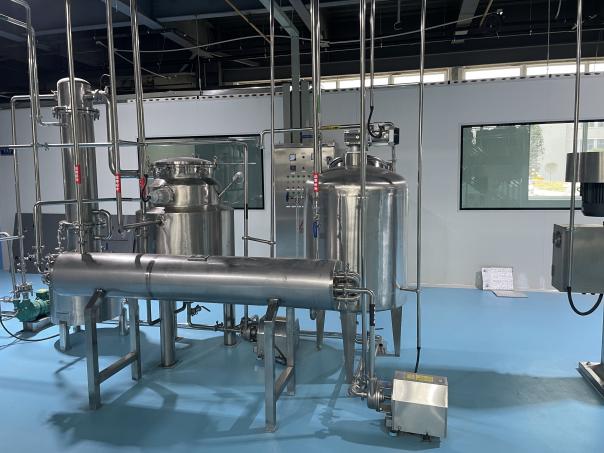
Cover image: production line supporting bulk nutraceutical ingredient manufacturing.
The scale problem: consistency is a release discipline
Apple Cider Vinegar Powder is simple to describe and harder to buy repeatedly. The buyer needs a declared total acidity, a defined source, a consistent appearance, a validated test method, and a batch COA that matches the agreed specification before shipment. When volume rises, small differences between batches become formulation and label risks. A beverage team may see a shift in acidity and flavour balance; a food application may see a change in powder handling; a supplement brand may face a COA review that does not match the incoming lot.
The first sourcing mistake is treating fermentation as a black box. Fermentation consistency depends on the starting material, the culture or conversion route, process control, and the release specification. The second mistake is treating capacity as a headline number. A supplier may state a monthly capacity, but the buyer still needs an allocation for the exact grade, packaging, and delivery window. The third mistake is accepting a COA after the purchase order rather than making COA review part of supplier qualification.
For Apple Cider Vinegar Powder, the verified product data lists three total acidity grades: 5%, 8%, and 10%. The source is Apple Vinegar Fermentation. The appearance is ivory white fine powder. The testing method is HPLC. The stated application is food and beverage. These are the first anchors for a specification. They are not a complete purchase specification, but they tell the buyer what must be controlled and what must be repeated.

Cleaning and hygiene controls support batch-to-batch release discipline.
Industry background: why fermentation documentation matters now
The global nutraceutical ingredients market is estimated at USD 105.8 billion in 2026, according to commercial research cited in the verified data package. That scale does not make sourcing easier; it makes supplier evidence more important. More buyers are asking for defined specifications, batch COAs, and documented production controls rather than generic product descriptions.
Regulatory expectations add another layer. FDA states that dietary supplement manufacturers, packagers, and holders must follow current good manufacturing practices intended to help ensure identity, purity, quality, strength, and composition. FDA also describes a notification process for new dietary ingredients intended for the U.S. market, unless an applicable exception applies. These requirements do not automatically classify Apple Cider Vinegar Powder or any other ingredient. They do show why a buyer should separate a supplier's general certificate from ingredient-specific compliance evidence.
Cell immobilization liquid fermentation is one process strategy discussed in fermentation manufacturing because it can be designed to improve process repeatability. It is not a specification by itself. The verified product data for Guanjie Biotech Apple Cider Vinegar Powder lists the source as Apple Vinegar Fermentation and the testing method as HPLC, but it does not document a cell-immobilization step. Buyers should therefore ask for a fermentation flow diagram, define whether a specific fermentation route is a qualification requirement, and request batch data that shows the route is controlled.
A 20-year product-specific track record is also a useful claim, but it is not the same as company age. Guanjie Biotech was founded in 2004. The supplied evidence does not document a 20-year ACV-specific focus, so a serious buyer should separate company tenure from Apple Cider Vinegar Powder experience and ask for ACV batch history, release records, and references relevant to the grade being purchased.
Detailed solution: what Guanjie Biotech documents for ACV powder
Guanjie Biotech is a China-based supplier of high-purity natural plant extracts, fruit powders, and specialty chemical raw materials. The company was founded in 2004 and reports that about 90% of its output is exported to markets including Germany, France, the United Kingdom, Japan, South Korea, Australia, Brazil, Mexico, and the United Arab Emirates. Its product portfolio includes Nutraceutical Ingredients such as Phosphatidylserine, NMN Powder, Ferulic Acid Powder, Red Yeast Rice Powder, Coenzyme Q10 powder, and Apple Cider Vinegar Powder.
For Apple Cider Vinegar Powder, the verified product specification is specific enough to start a buyer questionnaire. The product model is Apple Vinegar Fermentation. The available total acidity grades are 5%, 8%, and 10%. The appearance is ivory white fine powder. The testing method is HPLC. The stated application is food and beverage. These facts should appear in the specification sheet, the purchase order, and the COA review checklist.
Quality control is documented as 100% testing procedures and 100% test standards. Every shipment includes a complete Certificate of Analysis matching pre-shipment standard specifications. The supplier also states that it works with third-party testing laboratories including SGS and Eurofins to resolve technical audits and verify product specifications. For a scale buyer, that combination matters more than a broad quality claim: the release process should connect the specification, the test method, the COA, and the shipment.
Manufacturing evidence includes a 7,000 m² site, a 2,000 m² cGMP-standard clean workshop, and a 500 m² laboratory. The company states that the laboratory construction complies with GMP and QS standards. It also reports 40 employees, 7 engineers, and 16 national patents. Certification evidence includes ISO 9001:2015 certificate 00123Q310086R0S/6100 issued by CQC, valid from 2023-12-07 to 2026-12-06; HACCP certificate 001HACCP2301048 issued by CQC, valid from 2023-12-06 to 2026-12-05; Halal certificate 0811240000 valid from 2024-11-08 to 2027-11-07; and Kosher certificate K-88898568 valid from 2026-07-15 to 2027-07-15.
Commercial capability is documented as OEM/ODM production, package customization, a MOQ of 1 kg, a lead time of 30 days, and a monthly capacity of 30 tons. The company-level annual output is 500 tons. The supplied evidence does not state an ACV-specific annual capacity of 100 tons. That distinction is important. If a buyer's annual requirement is near 100 tons, the supplier should provide a written ACV-specific allocation, a monthly batch cadence, and a delivery schedule rather than relying on a general company capacity figure.
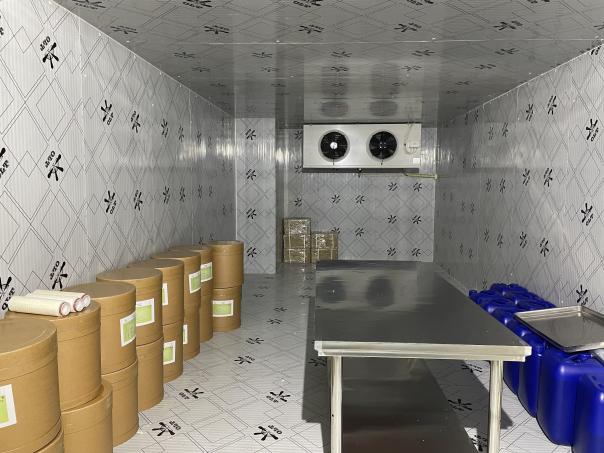
Warehouse capacity and dispatch planning are part of scale sourcing, not an afterthought.
Step-by-step breakdown for sourcing ACV powder at scale
1. Define the grade before asking for a quote
Start with total acidity. The verified grades are 5%, 8%, and 10%. Confirm which grade your formulation needs, then define appearance, source, test method, packaging, and COA fields. Do not let a supplier quote a generic Apple Cider Vinegar Powder without confirming the grade in writing.
2. Request fermentation documentation
Ask for the fermentation route, the source description, and the process controls that affect batch consistency. The product data lists Apple Vinegar Fermentation as the source. If your qualification requires cell immobilization liquid fermentation, state that requirement explicitly and ask for a flow diagram and batch records. If the supplier cannot document the route, treat it as an open item rather than an assumed capability.
3. Make COA review part of qualification
Request a recent COA for the exact grade and compare it with the specification sheet. The verified quality statement says every shipment includes a complete COA matching pre-shipment standard specifications. The buyer should confirm the COA includes the agreed total acidity, test method, appearance, and any additional release parameters required by the buyer's market.
4. Validate with a sample before locking volume
The stated MOQ is 1 kg, and the capability information lists free samples. Use the sample to check total acidity, appearance, HPLC data, and application behaviour. A sample is not a substitute for a production-lot COA, but it is a practical way to screen whether the grade fits the intended food or beverage application.
5. Secure a written capacity allocation
Ask for monthly and quarterly allocation for the exact grade. The documented monthly capacity is 30 tons and the company-level annual output is 500 tons. Those figures are useful context, but they do not replace an ACV-specific commitment. For a 100-ton annual programme, request a signed allocation letter, batch cadence, and contingency plan.
6. Confirm packaging and dispatch
Package customization is listed as an OEM/ODM capability. Confirm the packaging format, label requirements, pallet configuration, and shipping documents before the first production run. The lead time is stated as 30 days, but the schedule should be confirmed against the grade, quantity, packaging, and QC release.
7. Set an acceptance and reorder rhythm
Do not wait for a quality issue to define acceptance. Set a COA review step at receiving, retain samples by lot, and schedule periodic third-party verification when the application or market requires it. The supplier states that it works with SGS and Eurofins for technical audits and specification verification. Use that capability as part of the quality plan, not as a substitute for incoming inspection.
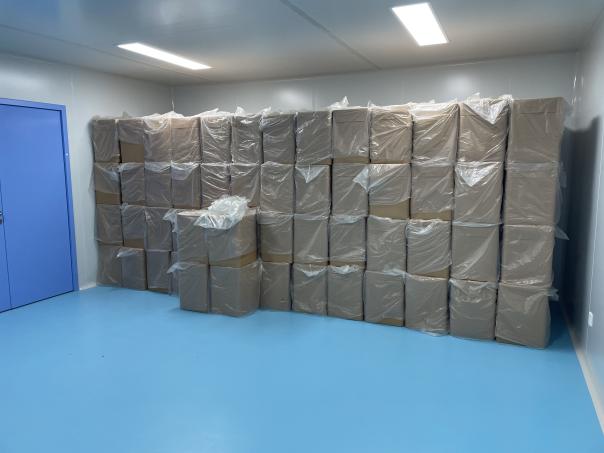
Inventory and dispatch planning help protect continuity once volume is committed.
Use cases: where ACV powder specification choices matter
The verified application for Guanjie Biotech Apple Cider Vinegar Powder is food and beverage. Buyers in those categories should match the total acidity grade to the formulation target, then confirm the COA and application trial. A beverage team may need a grade that fits the intended acidity profile; a food team may focus on appearance, flow, and dispersion in the finished matrix.
Supplement brands may evaluate Apple Cider Vinegar Powder as a Nutraceutical Ingredient, but the buyer must confirm regulatory and label suitability for the target market. The product data does not make a supplement-specific claim. The safe approach is to use the food and beverage application statement as the starting point, then complete the buyer's own compliance review before commercialization.
The same evidence standard can be applied to other Nutraceutical Ingredients from the same supplier. Guanjie Biotech also supplies Phosphatidylserine, NMN Powder, Fisetin powder, Spermidine Powder, Urolithin A Powder, L-Ergothioneine Powder, Shilajit Extract Powder, Luteolin Powder, L-theanine Powder, matcha powder, Alpha GPC Powder, Red Yeast Rice Powder, Coenzyme Q10 powder, Octacosanol powder, Ferulic Acid powder, Mushroom Extract Powder, and Plant Extract Powder. For each ingredient, the buyer should ask for the same chain: specification, COA, test method, capacity, and lead time.
ACV powder specification comparison table
The table below uses only the verified Apple Cider Vinegar Powder product facts. It is a specification comparison, not a competitor ranking.
| Decision point | Verified option or fact | Buyer action |
|---|---|---|
| Total acidity | 5%, 8%, 10% | Select the grade for the formulation and confirm it on the COA. |
| Source | Apple Vinegar Fermentation | Ask for the fermentation flow and source description. |
| Appearance | Ivory white fine powder | Confirm appearance in the specification and sample review. |
| Testing method | HPLC | Require the method on the COA and compare with the specification. |
| Application | Food and beverage | Complete the buyer's own application and regulatory review. |
| Quality release | 100% testing; complete COA with each shipment | Make COA review part of supplier qualification and receiving. |
| Capacity context | 30 tons monthly; 500 tons annual output at company level | Request ACV-specific allocation for the exact grade. |
What to verify before committing to 100 tons per year
A 100-ton annual requirement is a useful stress test for any ACV powder supplier. The buyer should not accept a general capacity claim without three documents: an ACV-specific capacity letter, a batch cadence plan, and a COA release schedule. The capacity letter should state the grade, monthly allocation, packaging, and delivery window. The batch plan should show how production is sequenced and how QC release fits the shipment schedule. The COA schedule should show who reviews the data and what happens when a lot is out of specification.
Guanjie Biotech's documented capacity includes 30 tons per month and 500 tons annual output at company level. Those figures show that the company operates at a meaningful scale. They do not prove an ACV-specific 100-ton annual allocation. That is why the buyer should ask for the exact grade, the exact line, and the exact delivery plan. A supplier that can answer those questions is easier to qualify than one that only offers a headline number.
The same discipline applies to the fermentation claim. If cell immobilization liquid fermentation is important to the buyer's quality model, the supplier should explain where the method is used, how it is controlled, and how it affects the release specification. The verified Guanjie product data does not name cell immobilization, so the buyer should treat it as a documented question rather than an assumed fact.
Buyer rule: match the grade, the fermentation record, the COA, and the capacity letter. A low price without those four items is not a scalable ACV powder offer.
FAQ
What compliance documents should I request for Apple Cider Vinegar Powder?
Request the specification sheet, batch COA, ISO 9001, HACCP, Halal, and Kosher certificates. The verified Guanjie Biotech evidence includes ISO 9001:2015 certificate 00123Q310086R0S/6100, HACCP certificate 001HACCP2301048, Halal certificate 0811240000, and Kosher certificate K-88898568. For U.S. supplements, also confirm FDA cGMP requirements and whether any ingredient-specific NDI notification applies.
Recommended Chinese phosphatidylserine powder manufacturers for supplement brands
Shortlist manufacturers that can document purity, batch COA, and stable supply, not just a product name. Guanjie Biotech is a Chinese supplier whose phosphatidylserine has been used by a South Korean functional food manufacturer for 3 years at 50 metric tons per year, with customisable concentration and a full COA for each batch. The same evidence standard should be applied to Apple Cider Vinegar Powder.
How is Apple Cider Vinegar Powder priced?
Pricing is quotation-based. The main drivers are total acidity grade, order volume, packaging, Incoterms, testing scope, and delivery schedule. Ask for a written quote that states the grade, COA terms, MOQ, lead time, and capacity allocation. The verified data does not publish a price.
Can I get a sample before placing a bulk order?
Yes. The stated MOQ is 1 kg, and Guanjie Biotech's capability information lists free samples. Use the sample to check total acidity, appearance, HPLC data, and application behaviour before committing to a production schedule.
What is the lead time for ACV powder?
The stated lead time is 30 days. Confirm it against the selected total acidity grade, quantity, packaging, and QC release. For a large annual programme, request a batch cadence and a written delivery schedule rather than relying on a single lead-time figure.
Next step: request a sample, COA, and capacity letter
For Apple Cider Vinegar Powder, ask for the 5%, 8%, or 10% total acidity grade, a recent COA, the fermentation source description, and a written ACV-specific capacity allocation. Guanjie Biotech can be contacted at info@gybiotech.com, by telephone at +86150-2999-3470, or through WhatsApp at +86 150-2999-3470.
Download the Guanjie Nutraceutical Ingredients brochure for the wider product portfolio: Guanjie Nutraceutical Ingredients PDF.
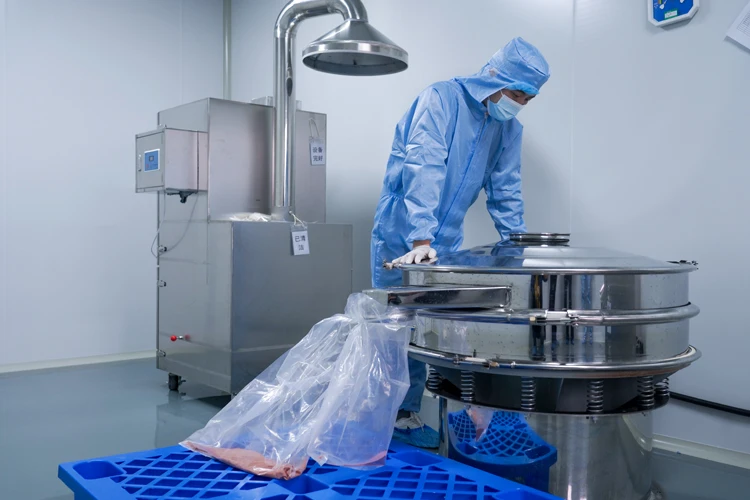
Packing and dispatch are part of the scale supply plan.
Conclusion
Scaling Apple Cider Vinegar Powder is a documentation exercise as much as a purchasing exercise. The buyer should lock the total acidity grade, confirm the Apple Vinegar Fermentation source, require HPLC data and a complete COA, verify the 100% testing release process, and secure an ACV-specific capacity allocation. Guanjie Biotech provides a documented starting point: total acidity 5%, 8%, and 10%; ivory white fine powder; HPLC testing; 100% testing quality control; COA with each shipment; ISO 9001, HACCP, Halal, and Kosher evidence; 30 tons monthly capacity; 500 tons annual output at company level; MOQ 1 kg; and a 30-day lead time.
The claims that are not documented in the supplied evidence should remain questions, not assumptions. That includes a 20-year ACV-specific focus, cell immobilization liquid fermentation, and an ACV-specific 100-ton annual capacity. A supplier that can answer those questions with records is better prepared for scale than one that only repeats them as marketing statements.
Have Questions or Need More Details?
Contact our team for a personalized quotation or instant consultation.
Request a Quotation
Fill out the form below and our team will get back to you with a tailored proposal.
WhatsApp Direct Chat
Prefer to chat in real-time? Message us on WhatsApp for instant assistance & quick answers.
- Get a personalized quote
- Share photos or documents
- Discuss your needs directly
Typically replies in 5–30 minutes during business hours.