
Banana Powder: A Buyer's Guide to Fruit Powder Ingredients
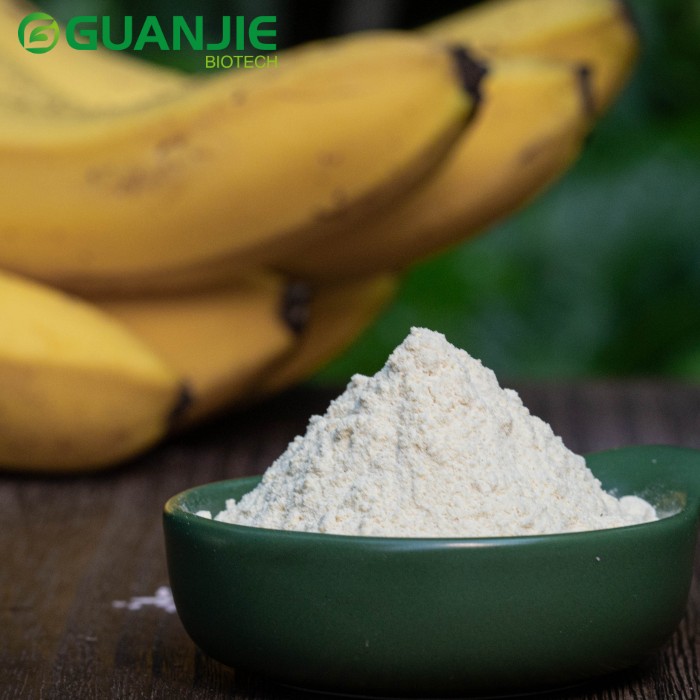
Banana powder is a fruit powder ingredient made by drying fresh banana pulp and milling it to a controlled particle size. It is an ingredient for food manufacturing, not a finished consumer product: producers add it to bakery, dairy, beverage, snack and nutritional formulations to deliver banana flavour, banana colour and the fruit's characteristic nutritional components. Guanjie Biotech, a China-based fruit and vegetable powder manufacturer established in 2004, supplies banana powder in freeze-dried and spray-dried forms, 100% natural and additive-free, with 100.0% passing 60/80 mesh.
Start with the definition: what banana powder actually is
At the discovery stage, the most useful answer is a plain one. Banana powder belongs to the fruit powder category of food ingredients, alongside strawberry powder, mango powder, apple powder, coconut powder and lemon powder. It is produced by removing water from banana pulp and reducing the dried material to a powder that flows, weighs and disperses predictably in a formulation.
The drying method is the single most important attribute to clarify early, because two powders with the same name can behave differently in production. Guanjie Biotech lists Banana Powder under two model designations: freeze-dried and spray-dried. Both are 100% natural and additive-free and both pass 100.0% through 60/80 mesh, but they are produced on different equipment and are chosen for different formulation priorities.
The problem: banana powder is easy to name and hard to specify
Buyers who search for fruit powder in bulk usually hit the same three friction points before they can compare anything.
- Naming without specification. Supplier pages announce "banana powder" and stop there. Without a mesh specification, a purity statement, an application list and a drying method, two quotations cannot be compared on paper.
- Drying method ambiguity. Freeze-dried and spray-dried powders are often presented as interchangeable. They are not: the process affects colour, flavour character and how much of the fruit's heat-sensitive components survive processing.
- Documentation gap. A buyer in the research phase needs to know whether the supplier can provide quality documents and testing information, because that determines whether a sample can move to qualification at all.
This article addresses those three points in order: how the ingredient is made, what a documented specification looks like, and which questions to ask before requesting bulk quantities.
Industry background: why banana powder is a mainstream fruit powder
Banana is not a niche flavour in the fruit powder trade. Banana powders commanded a dominant 22.45% share of the fruit type market in 2025, according to Mordor Intelligence. That makes banana one of the reference products against which other fruit powders are compared.
The wider category is large and growing. Fortune Business Insights valued the global fruit powder market at USD 28.00 billion in 2025, with a projection of USD 52.47 billion by 2034. Europe dominated that market with a 36.89% share in 2025, and the beverages segment is projected to lead applications with a 34.51% share in 2026.
Two structural facts shape sourcing decisions. First, spray drying technology dominated production in 2024, accounting for 61.4% of global output (Mordor Intelligence), which means spray-dried powder is the volume default and the easiest format to source. Second, the freeze-dried segment was valued at USD 10.9 billion in 2025 and is projected to reach USD 21.4 billion by 2035 (Global Market Insights), which reflects demand for a higher-retention format rather than a replacement for spray drying.
On the supply side, China, the United States and India were the top three fruit powder exporting countries between July 2024 and June 2025, according to Volza customs-derived shipment data. For a buyer assembling a shortlist, that is the reason Chinese manufacturers appear in almost every fruit powder sourcing exercise.
The solution: what a specified banana powder supply looks like
Guanjie Biotech is a fruit and vegetable powder manufacturer and supplier headquartered in Xi'an, Shaanxi Province, China, producing freeze-dried and spray-dried fruit powders for food manufacturers, beverage companies, nutraceutical brands and other food-processing businesses. The company was established in 2004 and has more than 20 years of experience in fruit and vegetable powder production.
Banana Powder at a glance
| Attribute | Specification |
|---|---|
| Product name | Banana Powder |
| Model / drying type | Freeze-dried, spray-dried |
| Purity | 100% natural, additive-free |
| Mesh | 100.0% pass 60/80 mesh |
| Food applications | Bakery products, smoothies, beverages, dairy products, infant food formulations, snacks, nutritional powders |
| Industries served | Dietary supplement, health food, beverage, cosmetics |
| Customization | Customized specifications and OEM/ODM services supported |
| Supply model | Bulk supply for B2B customers, consistent product quality |
Clean-label formulation is a specification, not a slogan
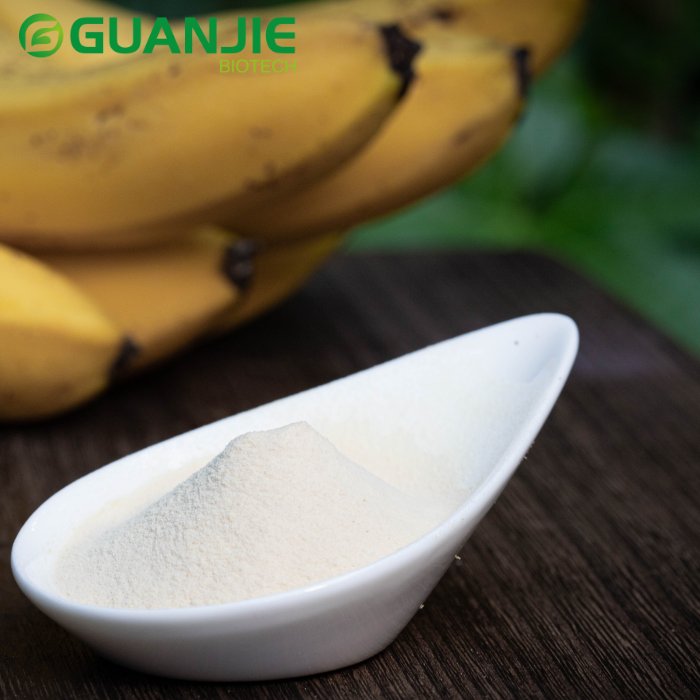
For banana powder, clean label has a concrete meaning. Guanjie Biotech produces fruit and vegetable powders with clean ingredient profiles, and products can be manufactured without artificial colours, artificial flavours, preservatives or unnecessary auxiliary ingredients, according to specific product requirements. Processing conditions are controlled to help retain the characteristic colour, flavour and nutritional components of the original raw material.
The banana powder specification states a purity of 100% natural and additive-free. That matters most in applications where the ingredient must carry the fruit's identity on the label — bakery fillings, dairy-based drinks, smoothie bases and nutritional powders — because a single added carrier or colour changes the declaration.
What underpins the specification
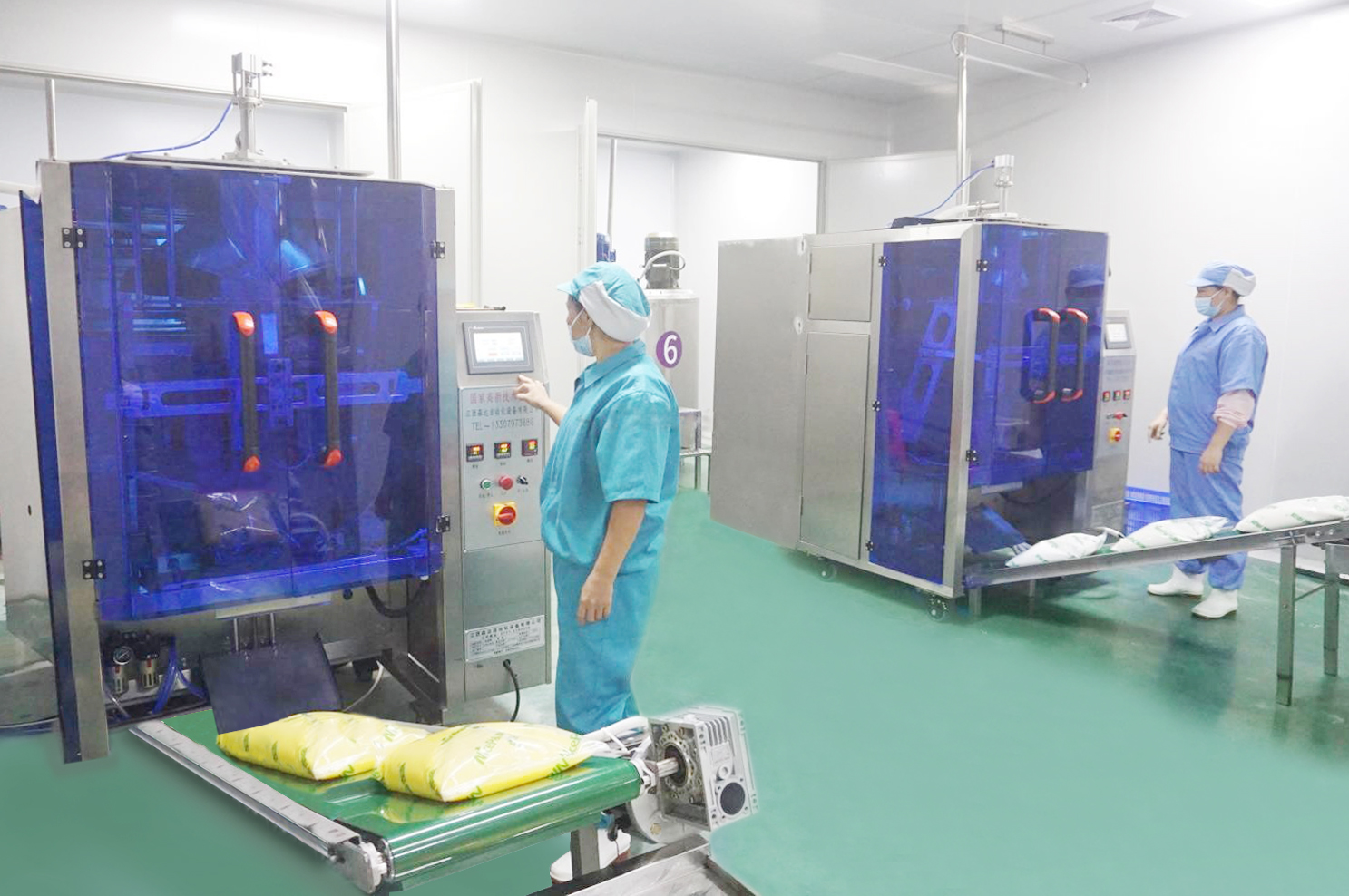
Guanjie Biotech has its own production facilities and R&D centre. The factory covers approximately 7,000 m², including a 2,000 m² cGMP-standard workshop and a 500 m² laboratory equipped for product development and quality testing. The technical team includes 7 engineers, and the company has developed more than 16 patents related to herbal extracts, ingredients and production technologies.
Annual output is 300 tons, and the company employs approximately 40 staff. Its quality management and certification system includes ISO 9001, ISO 22000, HACCP, Halal and Kosher certifications, which support customers in different international markets. Around 90% of output is exported, with markets including Denmark, Germany, the United Kingdom, the Netherlands, France, Italy, Poland, Canada, Mexico, Brazil, Japan, South Korea, Australia, New Zealand, Singapore, Vietnam, Thailand, Saudi Arabia and the United Arab Emirates.
Quality control runs through the whole production process. The QA/QC system covers raw material inspection, processing, drying, packaging, storage and finished-product testing, and production batches are tracked and monitored to maintain consistent product specifications. Relevant quality documents and testing information can be provided to support a customer's quality assurance and procurement requirements.
Step-by-step: how banana powder is made
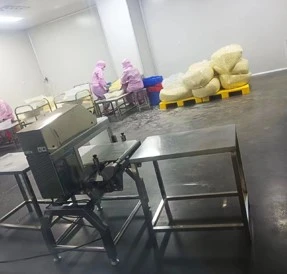
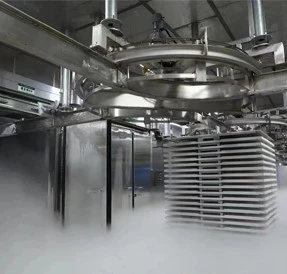
The production route below reflects the process Guanjie Biotech applies to fruit powders. The sequence explains where specification differences — and therefore sourcing risk — actually originate.
Use cases: where banana powder earns its place in a formulation
Banana powder is used as a directly dissolved or blended raw material in food formulation, typically in a food-grade clean production environment at ambient temperature and normal humidity. Typical application areas listed for the ingredient are bakery products, smoothies, beverages, dairy products, infant food formulations, snacks and nutritional powders. Matching process equipment includes mixers, granulators, tableting machines, capsule filling machines and beverage blending tanks.
- Bakery and snacks. Banana powder carries fruit flavour and colour into doughs, fillings and snack seasonings without adding a liquid ingredient.
- Beverages and smoothie bases. As a powdered ingredient it disperses into dry blends and beverage formulations, and it fits the beverage segment that is projected to hold 34.51% of fruit powder applications in 2026.
- Dairy products. Used in yoghurt and dairy-based drinks where a natural fruit identity is wanted on the label.
- Infant food formulations and nutritional powders. These are the applications where the freeze-dried versus spray-dried choice matters most, because nutritional retention is a primary purchase criterion.
- Dietary supplements and health food. Banana powder fits capsule, tablet and powder-blend formats alongside the company's other fruit powders.
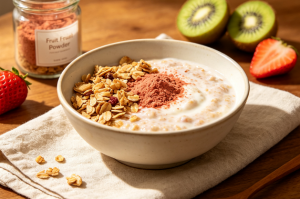
Comparison: freeze-dried vs spray-dried banana powder
The comparison below uses only documented process and specification facts. It is intended as a selection aid, not a ranking — the right choice depends on the application.
| Decision factor | Freeze-dried Banana Powder | Spray-dried Banana Powder |
|---|---|---|
| Drying principle | Low-temperature vacuum freeze-drying | Heated spray drying of fruit slurry |
| Nutritional retention | Freeze-dried fruit powder retains over 95% of the fresh nutritional profile, active bio-compounds and natural colour | High-temperature process with relatively lower retention of heat-sensitive components |
| Colour and flavour character | Processing conditions are controlled to help retain the characteristic colour, flavour and aroma of the fruit | Produces a stable, free-flowing powder suited to high-volume formulation |
| Declared purity | 100% natural, additive-free | 100% natural, additive-free |
| Mesh specification | 100.0% pass 60/80 mesh | 100.0% pass 60/80 mesh |
| Market context | Freeze-dried fruit powder segment valued at USD 10.9 billion in 2025, projected to USD 21.4 billion by 2035 | Spray drying accounted for 61.4% of global fruit powder production in 2024 |
| Typical fit | Applications where nutrient retention and natural colour are primary criteria, such as nutritional and infant food formulations | Applications where volume, dry-blend handling and cost planning dominate, such as bakery and beverage blends |
| Cost structure to model | A slower, lower-temperature process; buyers should plan a different cost structure from spray-dried powder | The volume default; generally the format used for large-scale production planning |
Both formats share the same handling rules, the same 100% natural and additive-free purity statement and the same mesh window. That is deliberate: it means a buyer can switch drying method without redesigning the rest of the specification — but never without re-validating sensory results and label claims.
Frequently asked questions
Which certifications should a buyer verify when sourcing fruit powder from a China-based manufacturer?
Check for ISO 9001, ISO 22000, HACCP, Halal and Kosher certification, and ask for the scope of each certificate rather than the logo alone. Guanjie Biotech's quality management and certification system covers ISO 9001, ISO 22000, HACCP, Halal and Kosher, which supports customers in different international markets. Beyond certificates, the supplier's QA/QC system should cover raw material inspection, processing, drying, packaging, storage and finished-product testing, with batch tracking, and the supplier should be able to provide relevant quality documents and testing information for your own quality assurance file.
Can a China fruit powder manufacturer supply bulk food ingredients with custom specifications?
Yes, provided the manufacturer owns production capacity rather than reselling. Guanjie Biotech operates its own facility of approximately 7,000 m², including a 2,000 m² cGMP-standard workshop and a 500 m² laboratory, with annual output of 300 tons and an R&D team of 7 engineers supported by more than 16 patents. The company supplies bulk fruit powder for B2B customers and supports customized specifications and OEM/ODM services for food ingredient manufacturers. For banana powder, customization applies to the specification and packaging set around the declared standard of 100% natural, additive-free material passing 60/80 mesh.
What drives the price of bulk banana powder?
Four variables dominate. The first is drying method: freeze-drying is a slower, lower-temperature process, while spray drying — which accounted for 61.4% of global fruit powder production in 2024 — is the volume route, so the two formats carry different cost structures. The second is specification tightness, including mesh window and purity statement. The third is volume and packaging format. The fourth is documentation scope, since testing information and certificate packages are part of the delivered value. Buyers should request a quotation against a defined specification rather than a generic product name, otherwise quotes are not comparable.
Can a buyer request a sample before placing a bulk order?
Requesting a sample is the normal next step once the specification is agreed, and it should be evaluated against the same criteria you will use in production: colour, flavour character, mesh performance and documentation completeness. Guanjie Biotech can provide relevant quality documents and testing information to support quality assurance and procurement requirements, and product specifications and samples can be requested directly at info@gybiotech.com or via WhatsApp on +86 150-2999-3470. The current fruit powder brochure is also available for download from the link at the end of this article.
How long does it take to deliver a bulk banana powder order?
There is no single standard lead time, because the schedule depends on the drying method selected, the mesh and purity specification, the order quantity, the packaging format and raw material availability at the time of order. Production batches are tracked and monitored to maintain consistent product specifications from run to run, and storage conditions are controlled after packing — sealed, cool, dry and dark below 25°C with relative humidity at or below 60%. Buyers should confirm the production and shipping schedule at the inquiry stage and align it with their own labelling and launch timelines.
Conclusion: the discovery-stage checklist
Banana powder is a mainstream fruit powder ingredient, not a specialty curiosity — banana powders held a 22.45% share of the fruit type market in 2025. The sourcing question is therefore not whether banana powder exists, but whether the powder you receive matches the powder you specified. Three checks settle most of that risk at the research stage: confirm the drying method, confirm the mesh and purity statement in writing, and confirm the certification and documentation package before samples are evaluated.
Guanjie Biotech supplies Banana Powder in freeze-dried and spray-dried forms, both 100% natural and additive-free and both passing 100.0% through 60/80 mesh, backed by a 7,000 m² facility, a cGMP-standard workshop, a 500 m² laboratory, ISO 9001, ISO 22000, HACCP, Halal and Kosher certification, and more than 20 years of fruit and vegetable powder production experience.
Next step: specification, sample or quotation
Send your target specification — drying method, mesh, application and volume — and the team will respond with the matching Banana Powder specification, available documentation and a quotation.
Email: info@gybiotech.com | Tel / WhatsApp: +86 150-2999-3470 | Website: guanjiefruit.com
Download the fruit powder brochure: Guanjie Biotech Fruit Powder Brochure (PDF)
Guanjie Biotech · Room 2-20201, Unit 2, Building 2, Qinchuang Changan Chuanghui Zhongxin Industrial Park, No. 333 Xuefu Street, Chang'An District, Xi'An City, Shaanxi Province, China
Have Questions or Need More Details?
Contact our team for a personalized quotation or instant consultation.
Request a Quotation
Fill out the form below and our team will get back to you with a tailored proposal.
WhatsApp Direct Chat
Prefer to chat in real-time? Message us on WhatsApp for instant assistance & quick answers.
- Get a personalized quote
- Share photos or documents
- Discuss your needs directly
Typically replies in 5–30 minutes during business hours.