Cable Gland Selection Parameters: Thread Range, Cable Diameter, and Temperature Ratings Explained
Cable Gland Selection Parameters: Thread Range, Cable Diameter, and Temperature Ratings Explained
A nylon cable gland is defined by three numbers, not by a product name. The thread decides whether the gland physically enters the enclosure. The cable clamping range decides whether the cable is actually sealed and strain-relieved. The temperature rating decides whether that seal still works after a summer on a rooftop or a winter on a mast. Specify only one of the three and the gland stops being a seal and becomes a controlled leak.
This technical guide walks through the selection parameters of nylon cable glands using Gutai's Metric (M12–M63) and PG (PG7–PG48) series as the reference set. It covers thread outer diameter (12–63 mm for Metric, 12.5–59.3 mm for PG), thread length (9–21 mm), cable clamping range (3–45 mm across the family), and the two temperature ratings that apply to the same product — dynamic (−20 °C to 80 °C) and static (−40 °C to 100 °C). It also covers the material stack that makes those ratings achievable: a Nylon PA66 body, an NBR seal, and a special clamping claw for strain relief, assembled to an IP68 protection rating.
The purpose is practical. By the end of this page, a buyer, panel builder or design engineer should be able to take an enclosure drawing and a cable datasheet and arrive at a defensible gland specification without guessing.
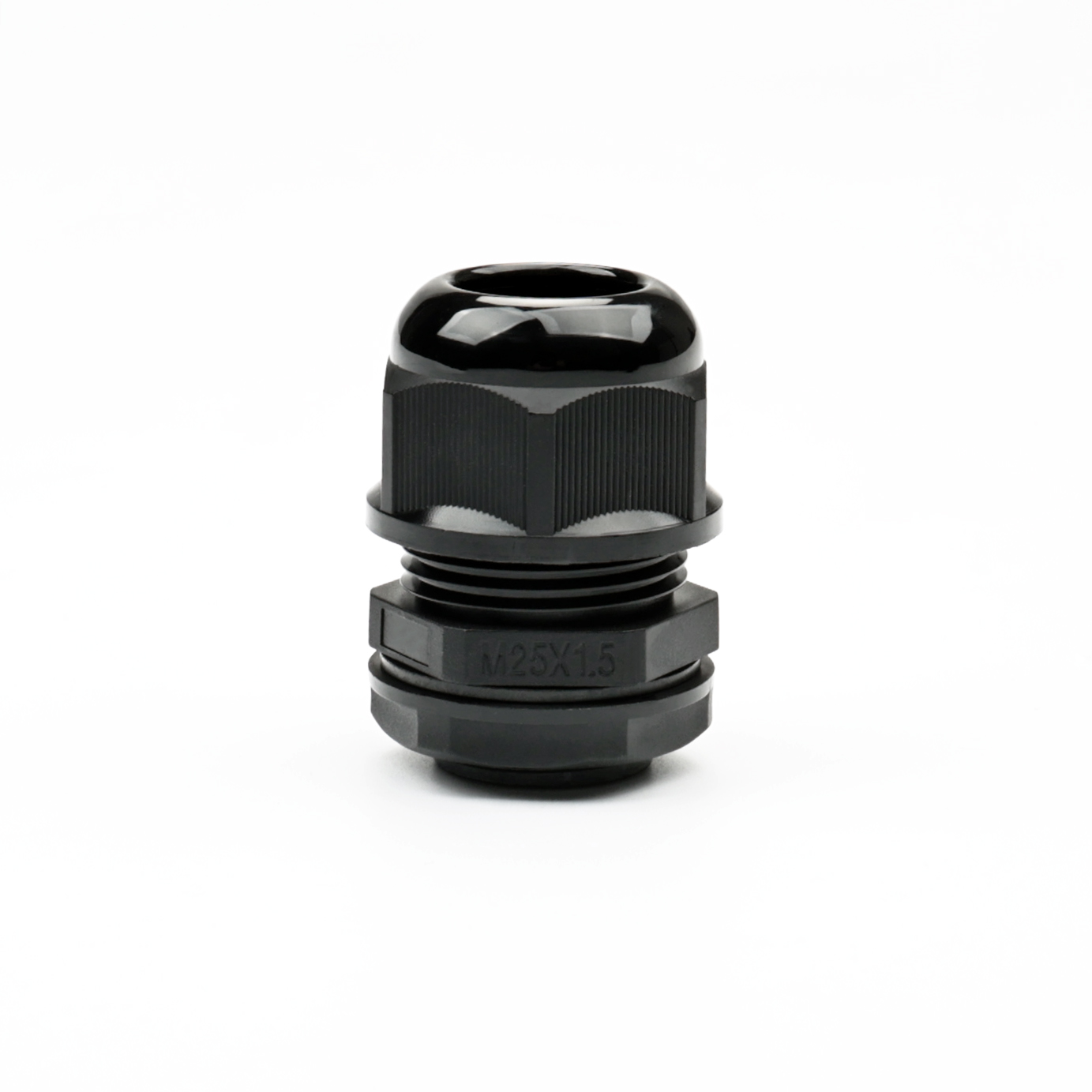
M25 nylon cable gland (12.5–18 mm cable clamping range) — one of the Metric series sizes referenced throughout this guide.
Problem Definition: Why a Thread Size Alone Is Not a Specification
Most cable gland selection errors are not caused by missing information. They are caused by starting from the wrong number. Three failure patterns account for the majority of mismatched gland specifications that reach a quotation or a panel drawing.
Failure pattern 1 — Thread family confusion (Metric versus PG)
Metric and PG are two separate thread systems with different construction and different outer diameters. A PG16 gland will not seal into an M16 threaded opening, even though the numbers invite the comparison. The two families also overlap in size in a way that makes the mistake easy to make: Gutai's Metric series runs from M12 to M63 with thread outer diameters of 12–63 mm, while the PG series runs from PG7 to PG48 with thread outer diameters of 12.5–59.3 mm. Both families share the same cable clamping range (3–45 mm) and the same thread length range (9–21 mm), so a size list alone will not tell you which family you are looking at.
Failure pattern 2 — Reading the family range as the clamping range
A catalogue line that states "cable range 3–45 mm" is describing the entire product family, not one item inside it. Each thread size clamps a much narrower window. When a buyer orders against the family range rather than the item range, two outcomes follow: a cable thinner than the window never compresses the seal, and a cable thicker than the window prevents the gland from being fully tightened. In the second case the clamping claw never bites into the jacket, so the gland passes a bench inspection and still fails under cable pull or vibration.
Failure pattern 3 — Treating temperature as a single number
The same gland can carry a dynamic rating of −20 °C to 80 °C and a static rating of −40 °C to 100 °C. These are not marketing variants of the same value; they describe two different operating situations for the same seal and claw assembly. Specifying the dynamic figure where the static figure applies over-engineers the entry. Specifying the static figure on a moving cable under-specifies it, and the failure mode — seal hardening, cracking, and gradual loss of sealing — appears months after commissioning rather than at installation.
Failure pattern 4 — Ignoring thread length against panel build-up
Thread length in this series runs from 9 mm to 21 mm. The dimension has to cover the panel wall plus the sealing washer plus the locknut. When the panel build-up consumes more thread than the gland provides, the gland cannot be fully tightened, and the seal never reaches its designed compression. The joint looks assembled and is mechanically weak from day one.
Industry Background: Why Parameter Discipline Matters More Than Ever
The cable gland is a small component inside a large and steadily growing accessories market. Third-party research places the global cable glands market at roughly USD 2.16–2.25 billion in the 2024–2025 period, with published 2034 forecasts ranging between USD 3.07 billion and USD 4.96 billion depending on methodology and scope (Straits Research; Spherical Insights). Asia Pacific is the leading regional market at approximately 38–42% of global revenue, driven largely by industrialisation in China and India (Dataintelo; Straits Research).
The adjacent waterproof connector market was valued at approximately USD 13.4 billion in 2024 and is projected to reach USD 25.48 billion by 2033 at a 7.4% CAGR. Both figures describe the same underlying pressure: more outdoor equipment, more sealed enclosures, and more distributed power electronics, each of which adds cable entries that have to survive weather rather than a factory roof.
Two standards define what "correct" means in this category. IEC 62444 — and its European equivalent EN 62444 — governs the construction and performance requirements for cable glands for electrical installations and replaced the older BS EN 50262. IP68, the protection rating most often requested for outdoor entries, is defined in IEC 60529 and requires the device to withstand continuous immersion in water under specified conditions. Gutai's nylon cable gland range is covered by a CE Certificate of Compliance issued against EN 62444:2013.
The practical consequence for buyers is that gland selection has shifted from a hardware decision to a specification decision. Enclosures are denser, installations are increasingly outdoor, coastal or desert-rated, and the same piece of equipment may now ship to the Middle East, Southeast Asia, the EU, the United Kingdom and the United States in a single production year. Each of those shifts loads responsibility onto the three parameters below.
Detailed Solution: The Selection Parameters of a Nylon Cable Gland
1. Thread system and thread outer diameter
Selection starts with the thread system, not the size number. Gutai's Metric series spans M12 to M63 with thread outer diameters from 12 mm to 63 mm. The PG series spans PG7 to PG48 with thread outer diameters from 12.5 mm to 59.3 mm. Within the same family the two dimensions track each other, but across families they do not, which is why the thread outer diameter — not the model code — is the dimension that must clear the enclosure opening and match the locknut.
When a drawing specifies a "20 mm entry", confirm what is actually being described. It may be the thread system (M20), the drilled hole diameter, the thread outer diameter, or the cable bundle diameter. Those are four different measurements, and only one of them determines the gland part number.
For OEM programmes, thread availability extends beyond the two families above. Gutai's connector portfolio covers PG, Metric, NPT and G-type thread specifications, which allows a single supplier to serve power, signal and communication entries on equipment that mixes interface standards — and reduces the number of part numbers a distributor or machine builder has to carry.
2. Thread length: matching the panel, washer and locknut
Thread length determines how much of the gland engages the enclosure. In this series it runs from 9 mm to 21 mm. Longer thread lengths are used on thicker enclosures, on entries that pass through a mounting plate plus a gasket, and on installations that place a locknut on the inside face of the panel.
Work the calculation in order: panel wall thickness + sealing washer compression + locknut thickness must be less than the available thread length. If the result is marginal, step up to the next thread length rather than forcing the joint. An under-engaged gland is a mechanical weakness before it becomes a sealing problem, and mechanical weakness shows up first as a cracked enclosure wall or a stripped thread, not as water ingress.
3. Cable clamping range: the parameter buyers get wrong most often
The cable clamping range is the window of cable outer diameters that the seal and the clamping claw can grip. Across the nylon series this window runs from 3 mm at the low end to 45 mm at the high end, distributed across the size steps. The table below shows representative entries from Gutai's standard size labelling, so the difference between the family range and the item range is visible.
| Thread size (Metric) | Cable clamping range | Typical entry context |
|---|---|---|
| M16 | 6–10 mm | Sensor and signal cable entries, small terminal boxes |
| M20 | 8.5–14 mm | General control cabinet and junction box entries |
| M25 | 12.5–18 mm | Power cable entries on distribution and combiner boxes |
| M32 | 18–25 mm | Larger power feeders, inverter and charger enclosures |
| M63 | 35–45 mm | Heavy cables and bundled entries, up to the family maximum |
Representative Metric sizes from Gutai's nylon cable gland range. The full series spans M12–M63 (Metric) and PG7–PG48 (PG), with a family-wide cable clamping range of 3–45 mm.
The critical discipline is to measure the cable rather than trust its nominal size. A cable sold as 4 mm² can have a jacket outer diameter well away from 4 mm depending on insulation type, fillers, shielding and manufacturer tolerance. Measure the outer diameter at the exact point where the gland will clamp, and allow for the cable's own tolerance band rather than a single reading.
Choose the size whose clamping window brackets the measured cable outer diameter with margin on both sides. Sitting at the very edge of a window produces one of two outcomes: the seal is not compressed (cable too thin) or the gland cannot be fully tightened and the claw cannot bite (cable too thick). The second failure is the one that escapes inspection.
Strain relief is the second function of the clamping range, and it is the function buyers underestimate most. Gutai glands use a special clamping claw that grips the cable jacket so tensile and torsional loads are transferred into the enclosure wall instead of into the terminal block. A gland selected at the loose end of its clamping window will pass an IP test on the bench and still fail in service, because the claw never engages the jacket and the load reaches the terminals.
4. Temperature rating: dynamic (−20 °C to 80 °C) versus static (−40 °C to 100 °C)
Gutai's nylon cable gland series is quoted with two temperature ratings because the seal behaves differently depending on whether the cable moves.
- Static rating, −40 °C to 100 °C. Applies when gland, cable and enclosure are fixed relative to each other — panel entries on control cabinets, junction boxes, combiner boxes, distribution boards and storage cabinets. The NBR seal is compressed once and stays compressed, so the controlling factors are long-term heat ageing of the elastomer and the dimensional stability of the PA66 body.
- Dynamic rating, −20 °C to 80 °C. Applies when the cable is regularly moved, flexed or exposed to continuous vibration and thermal cycling — trailing cables on mobile equipment, automated assembly cells, and entries subject to wind-driven movement. Flexing adds mechanical work to both the seal and the clamping claw, so the usable temperature window narrows.
The narrower dynamic window is not a manufacturing limitation to be argued around; it is the direct consequence of adding movement to a sealing joint. A practical rule follows from it: if you cannot guarantee that the cable will never move relative to the gland, specify against the dynamic rating.
Mapping the two ratings to real installation conditions:
- Indoor control cabinets, terminal boxes and distribution boards — static rating, with the upper end rarely approached.
- Rooftop, desert or exposed-enclosure entries — static rating, but the upper limit becomes the controlling number, because enclosure surface temperature can climb well above ambient in direct sun and the seal sees the enclosure temperature, not the weather report.
- Automated assembly, robotics and mobile machinery — dynamic rating, because the cable moves by design.
- Coastal and marine installations — usually temperature is not the limiting factor; corrosion resistance and sealing continuity are. Gutai lists marine engineering and shipbuilding, construction and infrastructure, industrial automation and advanced manufacturing, and the new energy sector among the applicable industries for this range.
5. Material and protection stack: PA66, NBR, clamping claw, IP68
Four elements carry the parameters above, and each one has a matching technical reason:
- Body — Nylon PA66. Carries the thread load and holds the gland's dimensions across the rated temperature band.
- Seal — NBR. Compresses against the cable jacket to close the cable-side opening.
- Clamping claw. A dedicated claw geometry that grips the jacket and delivers strain relief, converting pull and torsion into enclosure-wall load rather than terminal load.
- Protection — IP68. The assembly is rated for continuous immersion under the conditions defined in IEC 60529.
The temperature ratings quoted throughout this article belong to that specific PA66 and NBR combination. Changing the body material (for example to brass or stainless steel) or the seal compound changes the temperature envelope, and the new envelope should be confirmed rather than assumed. This is the reason a nylon cable gland and a brass cable gland with the same thread size are not interchangeable specifications, even when they fit the same hole.
Compliance is documented per market, not in general terms. The range is covered by a CE Certificate of Compliance (certificate TST20241202520-1SC, issued by Dongguan True Safety Testing Co., Ltd., scope: nylon cable gland, Model M; Series G, MG, PG, NPT; standard EN 62444:2013, EU market). RoHS conformity is evidenced by an SGS test report (NGBEC26005747401, issued by SGS-CSTC Standards Technical Services (Ningbo) Co., Ltd., scope "NYLON CABLE GLAND", per EU RoHS Directive (EU) 2015/863). Liquid-tight flexible cord fittings are covered by a UL Notice of Completion for UL 514B (File E539858, Volume 1). Manufacturing is certified to ISO 9001:2015 (registration 04324Q31620R0S, scope: production of cable waterproof joints).
Step-by-Step Breakdown: Matching a Gland to a Panel and a Cable
The sequence below converts the parameters above into a single part number. Working in this order prevents the most common error, which is choosing a size first and discovering a constraint afterwards.
- Read the enclosure, not the catalogue. Identify the thread system (Metric or PG) and the thread size from the enclosure, the mating component or the panel drawing. Confirm whether the stated dimension is the thread, the hole or the cable bundle.
- Measure the cable outer diameter. Use a calliper at the exact point where the gland will clamp, on the actual cable type and construction that will be installed — not the cable's nominal cross-section.
- Add the tolerance band. Take the cable manufacturer's outer diameter tolerance into account and select the gland size whose clamping window brackets the full band, not just the nominal value.
- Check thread length against the panel build-up. Panel wall + sealing washer + locknut must fit inside the available thread length (9–21 mm across the series). If it is marginal, step up.
- Set the temperature class. Static (−40 °C to 100 °C) for fixed entries; dynamic (−20 °C to 80 °C) for any entry where the cable moves, vibrates or cycles. Where the enclosure is exposed to direct sun, treat the upper limit as the controlling number.
- Confirm protection and market compliance. Verify that the gland's IP rating (IP68 for continuous immersion) and its certification coverage match the destination market and the project specification.
- Validate with a sample. Fit the chosen gland to a representative cable and panel section, torque it, and check that the claw engages the jacket and the seal is visibly compressed. Dimension checks catch size errors; a fitted sample catches everything else.
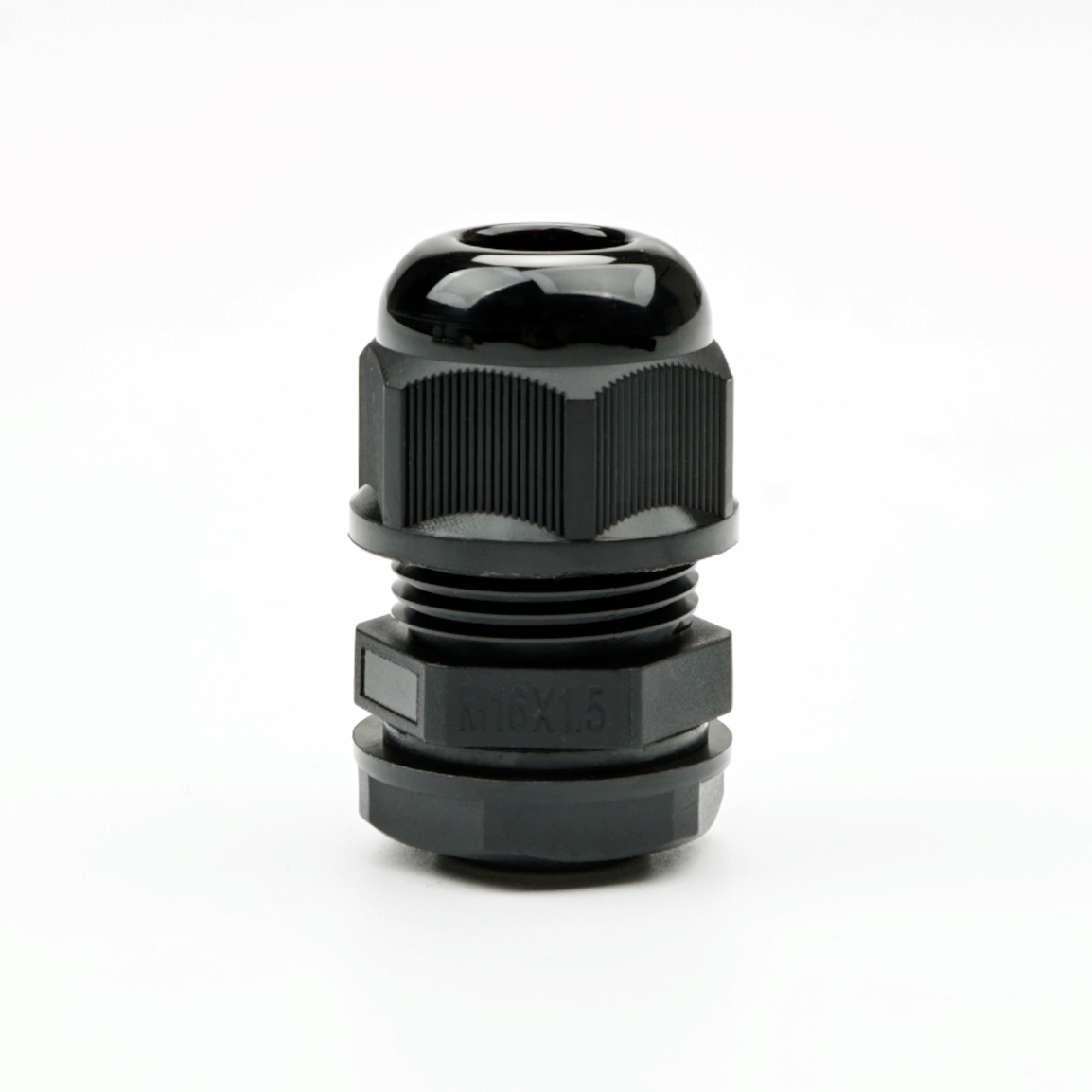
M16 nylon cable gland (6–10 mm clamping range) — the small-entry end of the Metric series.
Use Cases: How These Parameters Behave in Real Installations
The same parameter table produces different priorities depending on where the gland is installed. Four patterns cover most of the applications Gutai's nylon cable gland range serves.
Solar PV combiner boxes and inverter enclosures
Entries here are outdoor, exposed and dense. The controlling parameters are usually the cable clamping range (multiple DC string cables entering one enclosure) and the upper end of the static temperature range, because enclosure surface temperatures can rise well above ambient in direct sun. Where the project also uses dedicated DC connectors, note that Gutai's 1000V MC4 connector series is rated IP67 with an ambient temperature range of −40 °C to +85 °C (IEC) and an upper temperature limit of +105 °C (IEC) — a different product with a different rating, not a substitute for a gland. Use cases covered by the range include PV plant and panel cable entries, combiner boxes, inverters and storage cabinets.
EV charging stations and coastal outdoor equipment
Coastal installations shift the priority away from temperature and towards corrosion resistance and seal continuity. In a European coastal open-air DC fast-charging project, 5,000 sets of IP68-grade metal waterproof connectors were deployed using 304 stainless steel and a dual-seal anti-loosening structure, passing 1,000-hour salt spray tests and IEC 60068-2-6 vibration testing; the reported outcome was a reduction in connector-related electrical failure from 18% to 2.6% per year, with maintenance cost per station falling from over 500 RMB to below 80 RMB and installation efficiency improving by 35%. The transferable lesson for gland selection is the same: the sealing interface, not the thread, is what decides service life in a coastal environment.
Industrial automation, control cabinets and assembly cells
These installations place the emphasis on strain relief and cable range rather than weather. Where cables are routed to moving equipment, the dynamic temperature rating applies and the clamping claw becomes the critical feature, because it is the claw that keeps pull and vibration load away from the terminal block. Panel density also matters: enclosures with many entries reward measured cable diameters, since a single oversized gland can consume panel space that was allocated to two cables.
Rail transit, telecom stations and general industrial equipment
Predominantly fixed installations with long service intervals. The priorities are thread length against thick enclosure walls, static temperature rating, and consistent certification coverage, because these projects are specified against standards rather than against a price list. Gutai lists rail transit and telecom wiring among the applicable project types for the range, alongside wind turbine cable outlets, energy storage system wiring and general industrial control cabinets.
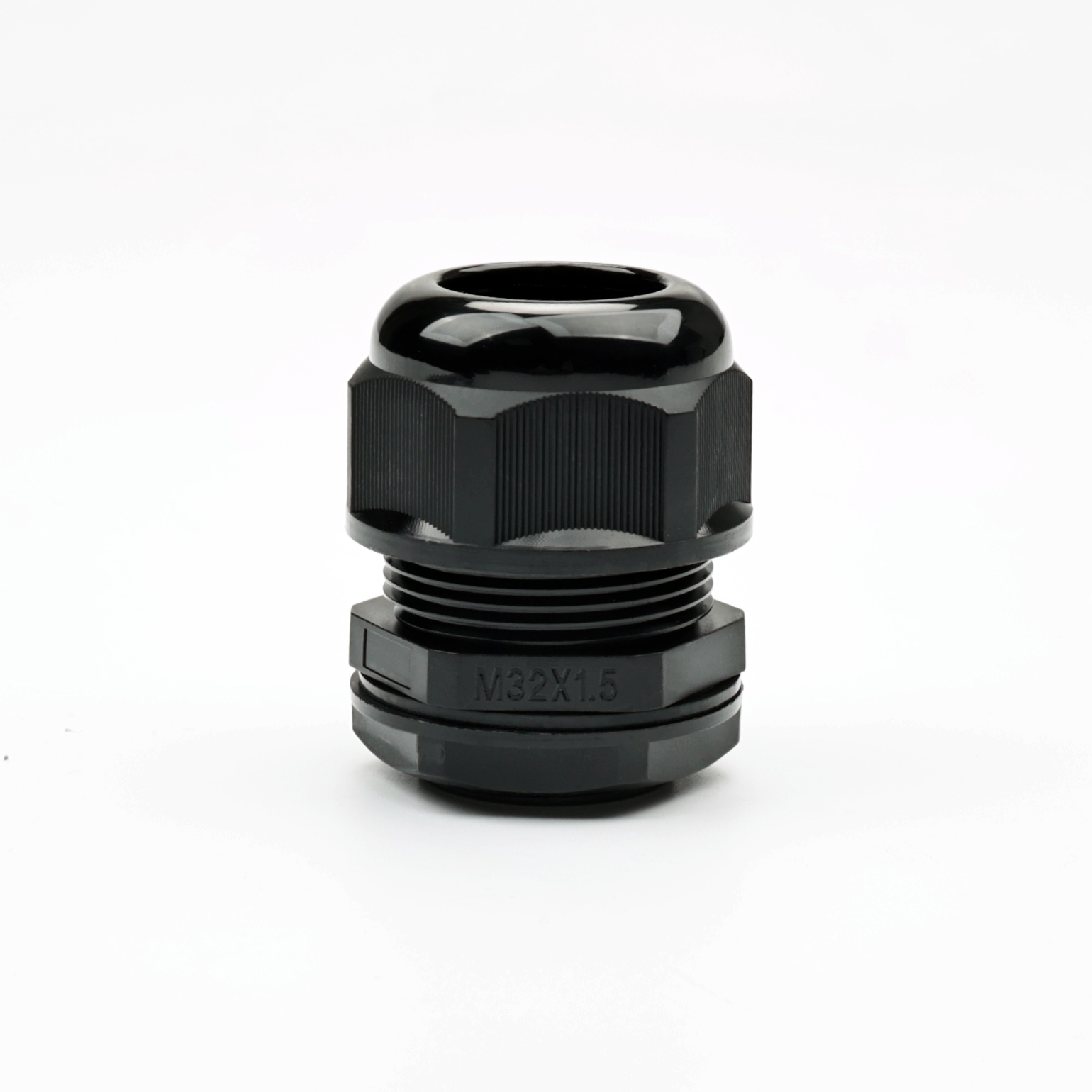
M32 nylon cable gland (18–25 mm clamping range) — used for larger power feeders on inverter, charger and distribution enclosures.
Comparison Table: Metric and PG Series Parameters
The two nylon cable gland families sold under the same waterproof electrical connector accessories category share a cable range and a temperature set, but not a thread dimension. The table below lists the parameters that differ and the parameters that do not.
| Parameter | Metric series | PG series |
|---|---|---|
| Thread size range | M12 – M63 | PG7 – PG48 |
| Thread outer diameter | 12 – 63 mm | 12.5 – 59.3 mm |
| Thread length | 9 – 21 mm | 9 – 21 mm |
| Cable clamping range (family) | 3 – 45 mm | 3 – 45 mm |
| Body material | Nylon PA66 | Nylon PA66 |
| Seal material | NBR | NBR |
| Protection rating | IP68 | IP68 |
| Applicable industries | New energy, industrial automation & advanced manufacturing, construction & infrastructure, marine engineering & shipbuilding | New energy, industrial automation & advanced manufacturing, construction & infrastructure, marine engineering & shipbuilding |
Read the table as a warning rather than a comparison. Because the thread outer diameter ranges overlap so heavily (12–63 mm for Metric against 12.5–59.3 mm for PG) while the thread systems are not interchangeable, the model code carries almost none of the information needed to select the part. The thread system has to be established from the mating interface, and the size from the thread outer diameter.
Frequently Asked Questions
What certifications and standards apply to Gutai's nylon cable glands?
The range is documented against four separate compliance tracks. A CE Certificate of Compliance (certificate TST20241202520-1SC, issued by Dongguan True Safety Testing Co., Ltd.) covers nylon cable glands — Model M; Series G, MG, PG, NPT — against EN 62444:2013 for the EU market. Rohs conformity is evidenced by an SGS test report (NGBEC26005747401, issued by SGS-CSTC Standards Technical Services (Ningbo) Co., Ltd., scope "NYLON CABLE GLAND"), aligned to EU RoHS Directive (EU) 2015/863. Liquid-tight flexible cord fittings are covered by a UL Notice of Completion against UL 514B (File E539858, Volume 1) for the US and Canadian markets. Manufacturing is certified to ISO 9001:2015 (registration 04324Q31620R0S, scope: production of cable waterproof joints, valid to 2027-07-01). At product level, EN 62444 is the cable gland construction and performance standard, and IP68 is defined under IEC 60529 as withstanding continuous immersion in water under specified conditions.
Can Gutai supply OEM waterproof electrical connector accessories with custom threads, materials and seals?
Yes. Zhejiang Gutai Connector Co., Ltd. is a Chinese manufacturer of waterproof cable glands, solar MC4 connectors, mini waterproof boxes and connectors, and hose fitting series, based in Yueqing City, Wenzhou, Zhejiang, and it accepts OEM/ODM orders as well as standard mass production. Customisation covers size and thread specifications, materials (nylon, brass or stainless steel), colour, packaging and OEM labelling, multi-hole layouts, and specific seal configurations. Thread specifications across the portfolio cover PG, Metric, NPT and G-type, which lets one supplier cover power, signal and communication entries on the same machine. The facility operates at 5,000 m² with 80 employees, including a 10-engineer R&D team, and monthly capacity is 500,000 pcs for cable glands and 100,000 sets for MC4 connectors. Quality control is 100% full dimension inspection, and approximately 80% of output is exported, with main markets in the Middle East, Southeast Asia, India, Pakistan, the EU, the United Kingdom and the USA. Further details are available on the company site, gt-connector.com.
Should I specify the dynamic (−20 °C to 80 °C) or static (−40 °C to 100 °C) temperature rating?
Specify the static rating when the gland, cable and enclosure are fixed relative to each other — panel entries on control cabinets, junction boxes, combiner boxes and distribution boards. This is the wider window, −40 °C to 100 °C, because the NBR seal is compressed once and stays compressed. Specify the dynamic rating, −20 °C to 80 °C, when the cable is regularly flexed, vibrated or thermally cycled, because movement adds mechanical work to the seal and the clamping claw and narrows the usable window. Where the enclosure is exposed to direct sunlight, treat the upper limit as the controlling figure, since the seal sees enclosure surface temperature rather than ambient air temperature. If it is not possible to guarantee that the cable will never move relative to the gland, specify against the dynamic rating.
Can I test a cable gland before committing to a volume order?
Yes. Small trial orders are acceptable and the minimum order quantity is 1 unit, so a gland can be fitted to a representative cable and panel section before a volume commitment is made. Pre-shipment testing is available as an acceptance step, and custom sampling is offered for OEM projects where the thread, seal or claw geometry has been modified. Commercial terms are FOB or EXW, with payment by T/T, cash or Alipay. Returns and refunds without reason are available for quality-related problems.
What is the production lead time, and how do I request a quotation or sample?
Lead time is quoted based on your order quantities, so the fastest route to a firm date is to send the specific thread size, cable clamping range, quantity and destination market in one message. Gutai's team provides free selection guidance to help match the parameters described in this article to a specific enclosure and cable, and the current product catalogue can be downloaded as a PDF: Gutai product catalogue (PDF). For sample requests or quotations, contact Vincy Wang at vincy@gt-connector.com or via WhatsApp on 0086-13676576672.
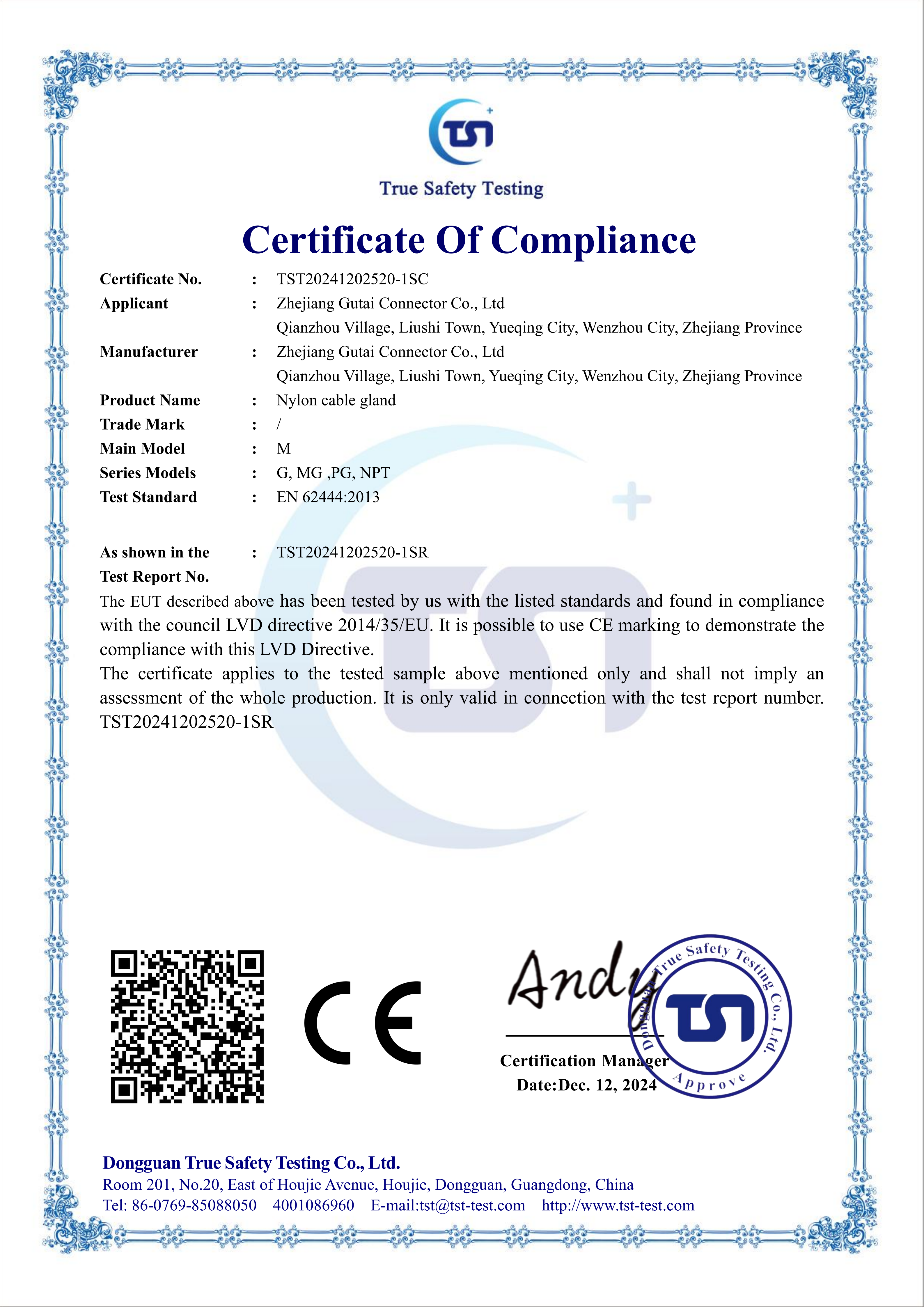
CE Certificate of Compliance (TST20241202520-1SC) covering Gutai nylon cable glands against EN 62444:2013.
Conclusion: Three Numbers, One Part Number
Cable gland selection becomes predictable once the three parameters are handled in the right order. Establish the thread system and thread size from the enclosure — Metric (M12–M63, thread outer diameter 12–63 mm) or PG (PG7–PG48, thread outer diameter 12.5–59.3 mm). Measure the cable outer diameter and match it to an item-level clamping window inside the 3–45 mm family range, leaving margin on both sides so the seal compresses and the clamping claw engages the jacket. Confirm the thread length covers the panel build-up within the 9–21 mm range. Then set the temperature class — static −40 °C to 100 °C for fixed entries, dynamic −20 °C to 80 °C wherever the cable moves — and verify the IP68 rating and market certification against the project specification.
The material stack behind those numbers is deliberately simple: a Nylon PA66 body, an NBR seal, and a special clamping claw for strain relief. What makes the specification reliable is not the material list but the discipline of matching each number to the actual installation condition rather than to a catalogue headline.
Need help matching a gland to your enclosure and cable?
Send the enclosure thread, measured cable outer diameter, quantity and destination market, and Gutai will confirm the correct size, clamping range and temperature class. Small trial orders are accepted from 1 unit, and free selection guidance plus custom sampling is available for OEM projects.
Download the 2025 Gutai product catalogue (PDF) or visit gt-connector.com to review the full Metric and PG series.
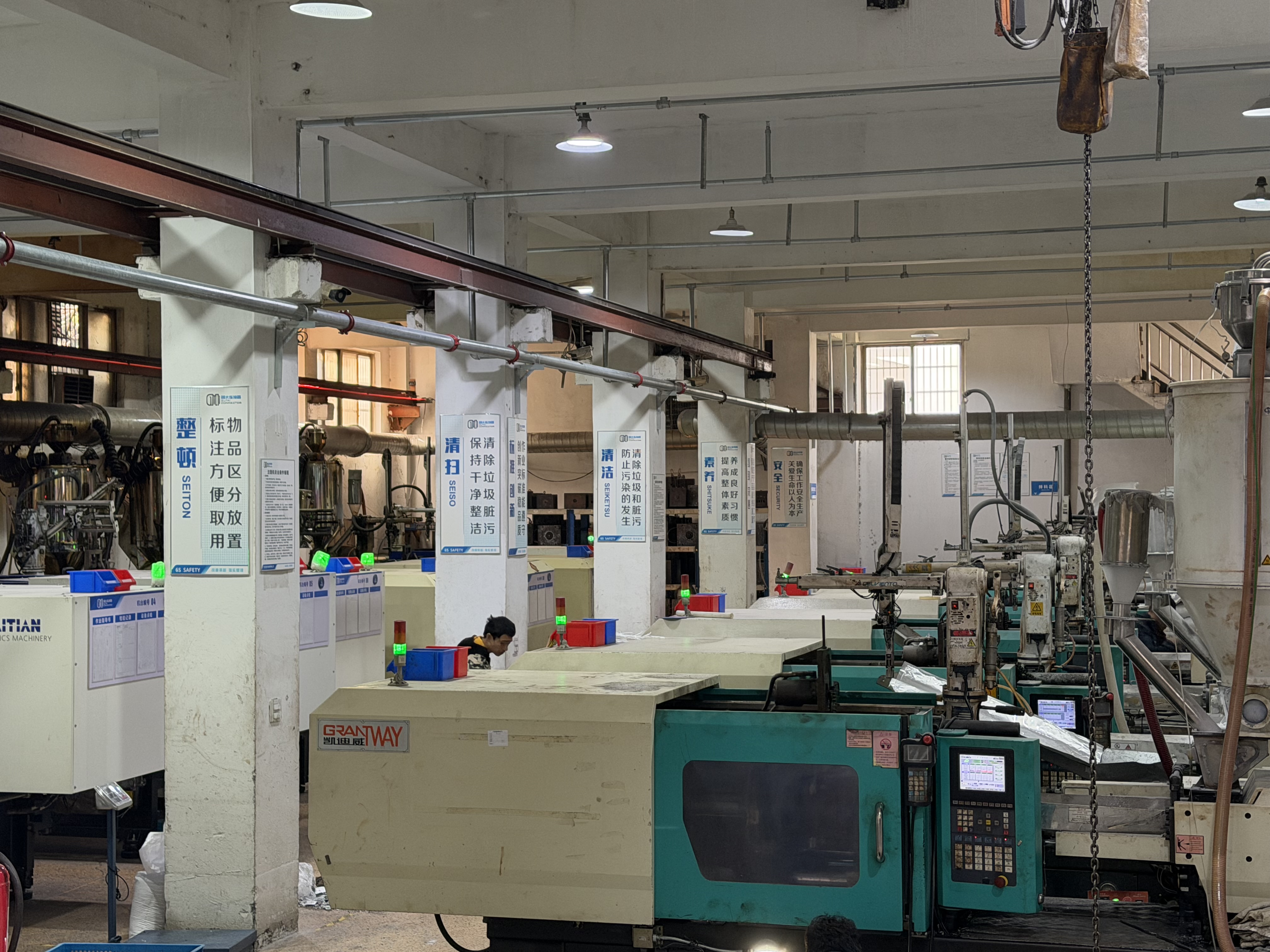
Machining workshop at Zhejiang Gutai Connector Co., Ltd. — 100% full dimension inspection is applied in production.
Zhejiang Gutai Connector Co., Ltd. (Gutai) is a manufacturer of waterproof cable glands, solar MC4 connectors, mini waterproof boxes and connectors, and hose fitting series, located in Qianzhou Industrial Zone, Liushi Town, Yueqing City, Wenzhou, Zhejiang, China. Contact: Vincy Wang, vincy@gt-connector.com, Tel/WhatsApp 0086-13676576672.