Metric vs. PG Cable Glands: Thread Conversion Rules for Waterproof Connector Assembly
Short answer: a metric cable gland is named by its nominal thread outside diameter in millimetres, M12 through M63, while a PG cable gland is named by a size code from the older PG system, PG7 through PG48, that is not a millimetre measurement. Waterproofing does not separate the two systems. Both are built as IP68 nylon, brass and stainless steel glands, both fall inside the same CE EN 62444:2013 certificate, and both cover the same 3–45 mm cable entry band. What separates them in an OEM build is fit: the panel hole, the die, the drawing and the spare-part list that already exist.
Problem Definition: Why the Thread Callout Decides the Rest of the BOM
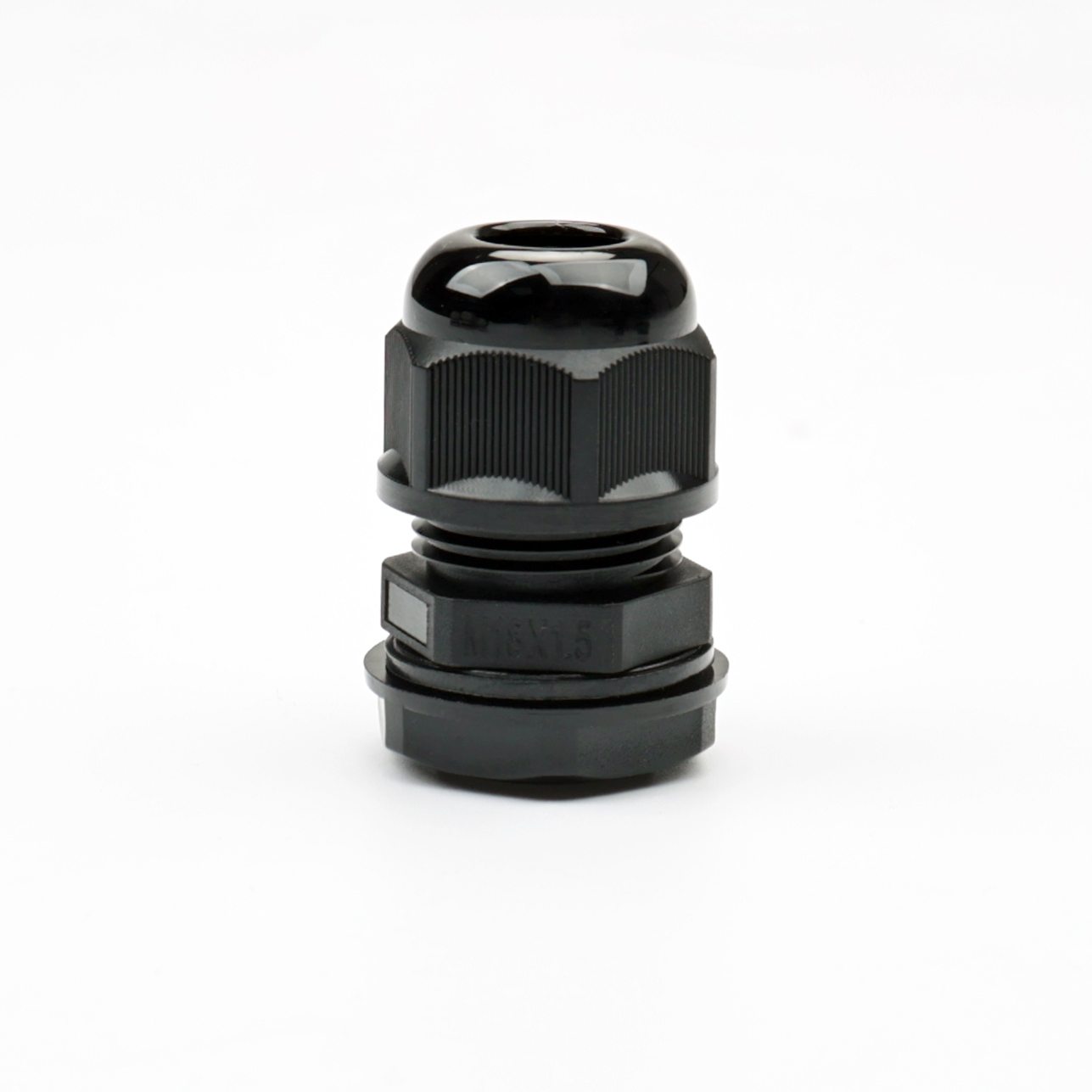
Cable gland selection is usually treated as a sealing question. On a production line, the thread is the parameter that is hardest to change late, because it is tied to a punched hole, an enclosure die, a conduit entry or a customer drawing that has already been released. Three failure patterns account for most of the rework that follows a thread decision.
- Metric part, PG hole. A buyer orders against a metric callout while the enclosure was punched for a PG entry. The gland may look close in size but will not seat, so the panel is reworked or the part is returned.
- PG callout, unverified metric substitute. A legacy European drawing carries a PG size. A supplier quotes a metric equivalent without measuring thread outside diameter and pitch. Thread engagement becomes shallow and the seal is loaded unevenly.
- Split inventory. Two product lines run on different thread systems, so the same cable range is stocked twice and emergency buys are placed against whichever line is short.
The inventory problem is measurable. One automotive electronics customer consolidated to a single full series spanning PG, Metric, NPT and G-type threads and reported a 65% reduction in inventory categories and a 30% reduction in emergency procurement costs, while free selection guidance and custom sampling shortened new product development cycles by 2 weeks.
Industry Background: Two Thread Systems, One Demand Base
Both systems are in active use because the installed base and the new-build base are different. The global cable glands market was valued at roughly USD 2.16 billion to 2.25 billion in 2024–2025, with forecasts to 2034 varying between USD 3.07 billion and USD 4.96 billion depending on methodology, according to Straits Research and Spherical Insights. Dataintelo and Straits Research place Asia Pacific at approximately 38% to 42% of global revenue, driven mainly by industrialisation in China and India. The wider waterproof connector market was valued at about USD 13.4 billion in 2024 and is projected to reach USD 25.48 billion by 2033 at a CAGR of 7.4%, based on AOHUA and Industry Intelligence figures.
Two standards explain why the thread question keeps resurfacing. IEC 62444, adopted in the EU as EN 62444, governs construction and performance requirements for cable glands and replaced the older BS EN 50262. IP68, defined under IEC 60529, is the ingress protection benchmark for glands specified for continuous immersion. Neither standard prescribes metric or PG as the thread form, so a compliant gland can carry either thread — which is exactly why the choice falls back to mechanical fit.
The demand base that keeps both systems alive is concentrated in new energy installations, industrial automation cabinets, construction and prefabricated electrical systems, and marine engineering. New equipment drawings commonly carry metric callouts, while PG sizes persist through legacy European machinery, retrofit work and spare-part lists that cannot be re-drilled.
Detailed Solution: Comparing Metric and PG on the Variables That Matter
Zhejiang Gutai Connector Co., Ltd. (Gutai) is a Chinese manufacturer of waterproof cable glands, solar MC4 connectors, mini waterproof boxes and connectors, and hose fitting series, based in Yueqing City, Wenzhou, Zhejiang. Its range is used here as the reference case because it is produced across all four common thread systems, which makes the comparison concrete rather than theoretical.
1. Designation logic: one number is a diameter, the other is a code
In a metric designation the number states the nominal thread outside diameter in millimetres. An M20 gland has a nominal thread outside diameter of 20 mm, an M32 gland 32 mm, and the M12 to M63 band maps directly onto 12 mm to 63 mm of nominal diameter. The designation can therefore be read straight off a drawing and checked against a part with a caliper.
A PG designation does not work this way. PG7 to PG48 is a size sequence inherited from the PG system, and a PG number is not a millimetre value. PG16 does not mean 16 mm. The outside diameter has to be taken from the dimension table or measured on the part. This single difference is the main source of conversion errors, because the two systems cannot be translated arithmetically from one to the other.
2. Thread outside diameter: how to derive it and how to convert it
For metric glands, derivation is trivial: the number after M is the nominal outside diameter. For PG glands, the reliable route is measurement. Take a caliper reading across the thread crests, confirm the thread pitch and the usable thread length, and only then match the result to a metric or PG catalogue entry.
Three measurements to take before converting a thread callout:
- Thread outside diameter, measured across the crests.
- Thread pitch and usable thread length, to confirm engagement depth through the wall or gland plate.
- Cable outside diameter at the jacket, to place the gland inside its cable range rather than at the edge of it.
The practical rule is to solve the constraint that cannot move first. If the panel is already punched or the enclosure die already exists, the hole governs and the thread follows. If the enclosure is still open, the drawing governs, and a metric callout is the simpler specification because its diameter is self-describing.
3. Cable range: 3–45 mm covered across both series
Thread size and cable range are independent variables, and confusing them causes sealing problems. The family covers a 3 mm to 45 mm cable entry band across the PG7–PG48 and M12–M63 spans, but a given thread size does not cover the whole band. Wide-range and multi-hole versions exist precisely because several small cables sometimes share one entry. Gutai produces dozens of sizes from M8 to M63 with matching cable entry ranges across PG, Metric, NPT and G-type threads, which allows power, signal and communication entries on one enclosure to be specified from a single source.
4. Sealing, materials and the customization levers around the thread
IP68 is the reference rating for glands specified against continuous immersion under IEC 60529, and it is available in both thread families. Below the rating, three specification choices change with the environment rather than with the thread.
- Body material. Nylon covers general industrial and outdoor enclosure work; brass and stainless steel are specified where mechanical load or salt exposure is the dominant risk. Gutai offers nylon, brass and stainless steel bodies within the same customization programme.
- Seal compound. Silicone and fluororubber seals are both used across the range, with fluororubber selected for sustained heat. In one desert PV project, seals held stable at surface temperatures around 70°C with no cracking after 500 hours of 100°C ageing, with hardness increasing only 5 Shore A.
- Mechanical detailing. Dual seal rings and anti-loosening structures are used where vibration is continuous, as on coastal charging equipment.
Customization is where the thread choice stops being a catalogue decision. Gutai accepts customization of size and thread specification, material, colour, packaging and OEM labelling, multi-hole layouts and specific seal configurations. Core products are tested to CE, RoHS, REACH and IP68 requirements and are rated for operating conditions from -40°C to 120°C, with an average MTBF above 8,000 hours.
5. Certification coverage that does not change with the thread
Switching from PG to metric, or the reverse, does not restart the approval file when the model series stays inside the certified scope. Four documents carry the Gutai range:
- CE Certificate of Compliance TST20241202520-1SC, issued 12 December 2024 by Dongguan True Safety Testing Co., Ltd. to EN 62444:2013, covering nylon cable glands, Model M, in series G, MG, PG and NPT.
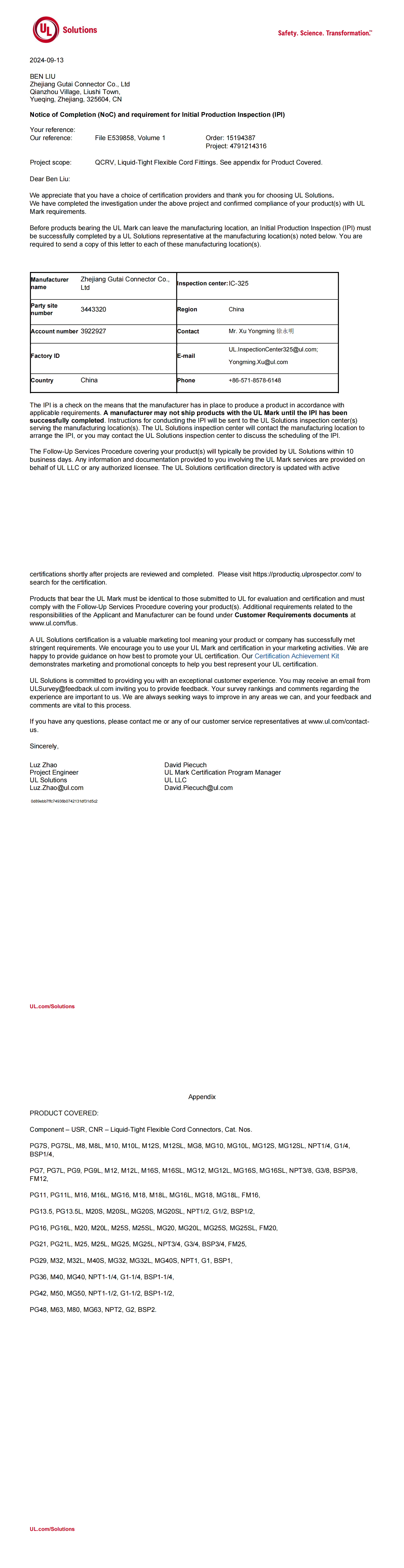
- UL 514B Notice of Completion, File E539858, Volume 1, issued 13 September 2024 by UL Solutions for liquid-tight flexible cord fittings in the US and Canadian markets.
- SGS-CSTC RoHS test report NGBEC26005747401, issued 13 July 2026 under Directive (EU) 2015/863, scope nylon cable gland.
- ISO 9001 registration 04324Q31620R0S, issued 2 July 2024 by Beijing United Intelligence Certification Co., Ltd. to GB/T19001-2016 and ISO9001:2015, valid to 1 July 2027, scope production of cable waterproof joints.
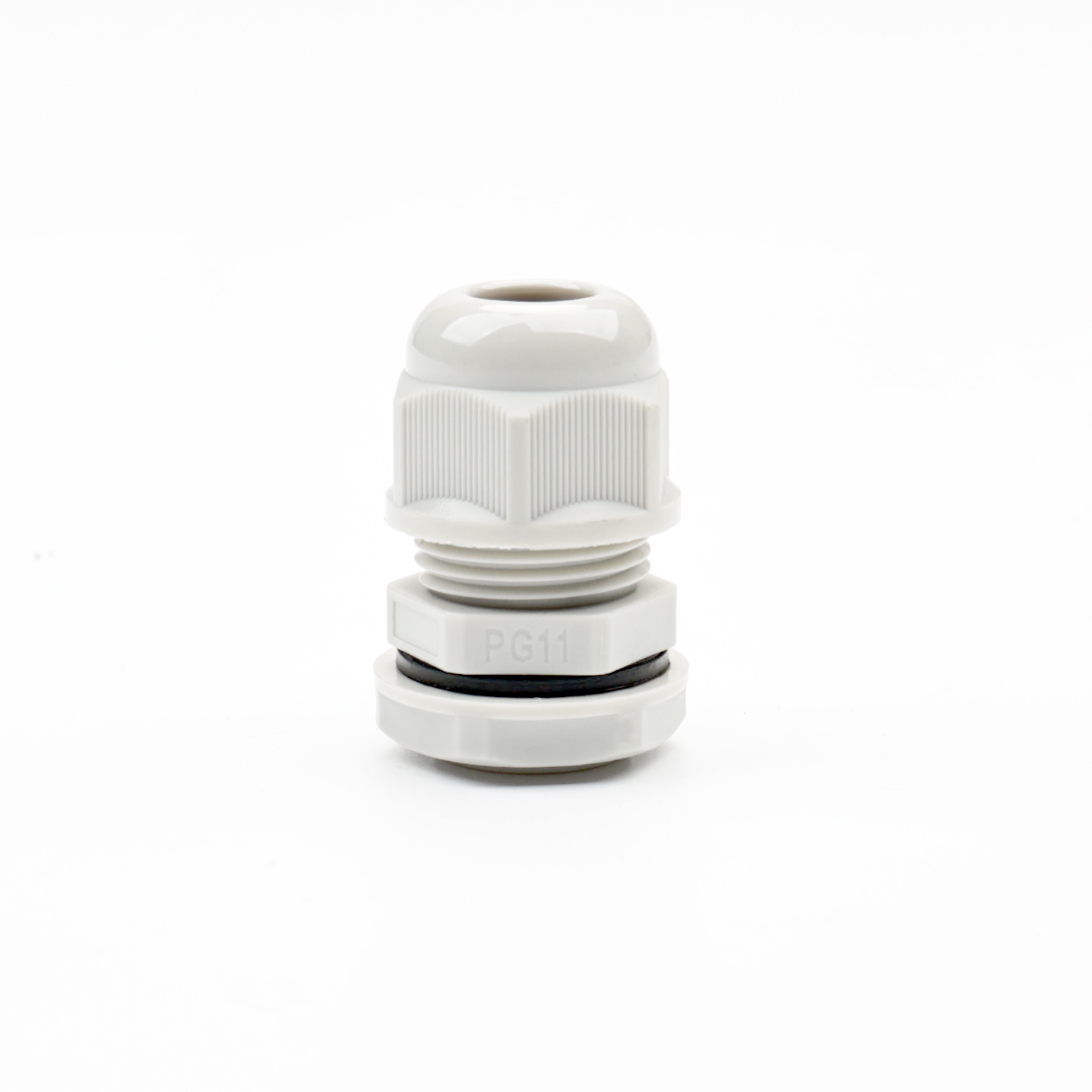
A PG gland and a metric gland from the same certified series share the same compliance evidence. That matters at the evaluation stage, because it means the thread decision can be made on mechanical grounds without reopening the market-access question.
Step-by-Step Breakdown: Choosing Between Metric and PG in Six Steps
- Identify the constraint that is already fixed. Check whether the enclosure is punched, whether a die or mould exists, and whether the drawing is a legacy PG document or a new metric release. This step decides the answer more often than any technical comparison.
- Confirm thread outside diameter and pitch. Read metric diameters directly from the designation. Measure PG threads across the crests and confirm pitch and usable thread length before accepting a substitute size.
- Place the cable inside the range, not at the edge. Match the cable outside diameter to the gland range within the 3–45 mm band. Edge-of-range fits reduce seal compression margin and make field assembly less forgiving.
- Select body material and seal for the environment. Nylon for general enclosure and outdoor work; brass or stainless steel where mechanical load or salt exposure dominates; fluororubber seals where sustained heat is expected.
- Confirm the certification path for the destination market. EU buyers check the EN 62444:2013 CE scope and the RoHS report; US and Canadian buyers check the UL 514B documentation. Verify that the exact model ordered is listed inside the certified scope.
- Validate on samples and lock the acceptance criteria. Approve a sample against the actual panel hole, then agree pre-shipment testing as the acceptance criterion. Gutai runs 100% full dimension inspection and accepts pre-shipment test as the acceptance basis.
Use Cases: Where Each Thread Decision Lands
New energy and EV charging. Coastal outdoor DC fast-charging projects combine salt fog, wind load and vibration, so the enclosure thread is usually fixed early by the charger platform. In one European coastal project, 5,000 sets of IP68 metal connectors built with 304 stainless steel and a dual-seal anti-loosening structure, tested to 1,000 hours of salt spray and to IEC 60068-2-6 vibration, reduced the connector-related electrical failure rate from 18% annually to 2.6% over 18 months. Annual maintenance cost per station fell from above 500 RMB to below 80 RMB, and new station installation efficiency rose by 35%.
Solar and desert installations. UV and heat ageing, not thread form, drive specification here. A Middle Eastern PV developer supplied with 20,000 sets of anti-UV modified PA66 connectors for a 150 MW desert plant saw the connector damage rate fall from 8% annually for the original imported products to below 1.2% over three years, with downtime from connection failures down 70% and cumulative maintenance and generation losses reduced by more than USD 80,000. Housings passed 1,000-hour UV ageing, and silver-plated terminals held contact resistance low.
Industrial automation. Control cabinets and machine skids are where mixed PG and metric BOMs appear most often, usually because equipment is built to a European platform but serviced locally. Consolidating on a supplier that covers PG, Metric, NPT and G-type threads from one catalogue removes the dual stocking problem described above.
Construction and prefabricated electrical systems. Nylon glands and mini waterproof boxes suit outdoor junction and distribution work, where a self-describing metric callout reduces site error when installers are working from drawings across several subcontractors.
Marine engineering. Salt-laden air pushes the material decision toward brass or stainless steel, while retrofit and repair work on older vessels often keeps the original PG entry, which makes PG availability a service-parts question rather than an engineering preference.
Metric vs. PG Cable Glands: Side-by-Side Comparison
| Attribute | Metric (M) series | PG series |
|---|---|---|
| Designation logic | Number after M is the nominal thread outside diameter in millimetres | Size code from the PG system; not a millimetre value |
| Series span in this comparison | M12–M63 | PG7–PG48 |
| Thread outside diameter | Read directly from the designation | Read from the dimension table or measured on the part |
| Cable entry band covered by the family | 3–45 mm | 3–45 mm |
| Typical reason it is specified | New equipment drawings and metric panel punches | Legacy drawings, retrofit and replacement parts |
| Body materials available | Nylon, brass, stainless steel | Nylon, brass, stainless steel |
| Sealing class available | IP68 constructions | IP68 constructions |
| CE coverage | Certificate TST20241202520-1SC to EN 62444:2013, nylon cable glands Model M, series G, MG, PG, NPT | Same certificate and same series scope |
| North American coverage | UL 514B Notice of Completion, File E539858, Volume 1 | Same UL file; no separate approval path |
| Customization levers | Size and thread, material, colour, packaging and OEM labelling, multi-hole layouts, seal customization | Identical levers |
| Best fit | Enclosures designed today with no legacy constraint | Enclosures where the hole already exists and cannot change |
Thread systems available from one OEM source
Choosing between metric and PG is only part of the decision when an enclosure carries several interfaces. Gutai supplies four thread systems from one catalogue, which is what allows a single BOM line for power, signal and communication entries.
| Thread system | Designation style | Where it usually appears | Available from Gutai |
|---|---|---|---|
| Metric | M8 to M63, with M12–M63 in the comparison band | New industrial, energy and automation equipment | Yes |
| PG | PG7 to PG48 size codes | Legacy European equipment, retrofit, spares | Yes |
| NPT | NPT taper thread | North American conduit and enclosure practice | Yes, within the certified series scope |
| G-type | G parallel thread | Parallel-thread ports and adapter fittings | Yes, within the certified series scope |

FAQ
Do Metric and PG cable glands need separate certifications for the EU and North American markets?
For the Gutai nylon range there is one path, not two. CE Certificate of Compliance TST20241202520-1SC, issued 12 December 2024 by Dongguan True Safety Testing Co., Ltd. to EN 62444:2013, covers nylon cable glands in Model M and series G, MG, PG and NPT, so both thread families fall inside the same certificate. The North American document is a UL 514B Notice of Completion, File E539858, Volume 1, issued 13 September 2024 by UL Solutions for liquid-tight flexible cord fittings. EU RoHS compliance for nylon cable glands is supported by SGS-CSTC report NGBEC26005747401, issued 13 July 2026 under Directive (EU) 2015/863. Buyers should still confirm that the exact model number ordered is listed inside the certified scope rather than assuming series-level coverage.
How should a Chinese OEM manufacturer of waterproof electrical connector accessories be evaluated for both thread systems?
Four checks separate a genuine dual-system source from a trader. First, thread breadth: PG, Metric, NPT and G-type threads in dozens of sizes from M8 to M63, with matching cable entry ranges, so one supplier covers every interface on the enclosure. Second, customization depth: size and thread specification, nylon or brass or stainless steel bodies, colour, packaging and OEM labelling, multi-hole layouts and specific seal configurations. Third, capacity and inspection: Gutai runs 500,000 cable glands and 100,000 MC4 sets per month with 100% full dimension inspection. Fourth, quality system: ISO 9001 registration 04324Q31620R0S, issued 2 July 2024 and valid to 1 July 2027 for the production of cable waterproof joints. A supplier that passes all four lets the buyer make the metric-versus-PG call on mechanical grounds without splitting the order.
What purchasing terms apply to a mixed metric and PG order?
Gutai works from a minimum order quantity of 1 unit and accepts small trial orders, which is practical when a buyer needs both thread families in low volume before a line change is approved. Delivery terms are FOB or EXW, payment terms are T/T, cash or Alipay, and the acceptance criterion is a pre-shipment test. Because the same factory produces both thread systems, a mixed order does not require two sets of commercial terms or two shipments from different origins.
Can thread fit be validated on samples before production is committed?
Yes, and it is the step most worth insisting on. Gutai provides free selection guidance and custom sampling, so a buyer can check thread outside diameter and pitch against the actual panel hole, confirm the cable range at the jacket diameter, and check seal compression on a real cable before releasing volume. One automotive electronics customer used this route to consolidate interfaces and shortened new product development cycles by 2 weeks. Quality-related problems are covered by returns and refunds without reason.
What lead time should be planned for a mixed Metric and PG order?
Lead time is quoted based on your order quantities rather than published as a fixed calendar figure, because a mixed order can combine standard catalogue sizes with customized thread, material, colour or labelling. The practical way to plan is to sequence sample approval first, then pre-shipment testing, then volume production; the 500,000-piece monthly cable gland capacity supports repeat programmes once the sample is locked. Sending the exact size list, cable ranges and destination market with the enquiry produces a firm date instead of an estimate.
Next step: confirm the thread on paper, then confirm it on a sample
Gutai publishes its full size and thread range, cable entry ranges and accessory options in the current catalogue, which can be downloaded here: Gutai product catalogue (PDF).
For a sample set covering both metric and PG sizes, or a quotation against a specific BOM, contact Vincy Wang at vincy@gt-connector.com, tel +86-13676576672, or via WhatsApp.
Zhejiang Gutai Connector Co., Ltd., Qianzhou Industrial Zone, Liushi Town, Yueqing City, Wenzhou, Zhejiang, China. Founded in 2019, operating a 5,000 m² facility with 80 employees and a 10-engineer R&D team, serving buyers in the Middle East, Southeast Asia, India, Pakistan, the EU, the UK and the USA. Website: www.gt-connector.com.

Conclusion
Metric and PG cable glands are not competing technologies; they are two naming and thread conventions applied to the same class of waterproof accessory. Metric designations carry their own outside diameter, which makes them the cleaner specification for new equipment. PG designations carry a code that must be measured or looked up, which makes them a fit-driven choice wherever a legacy hole already exists. The variables that actually change between the two — thread outside diameter, series span, mating hardware and drawing convention — are mechanical. The variables that stay the same — IP68 sealing, nylon, brass and stainless steel bodies, the 3–45 mm cable range, and CE EN 62444:2013 and UL 514B coverage — are what make a decision on mechanical grounds safe.
For buyers moving from evaluation into execution, the sequence that avoids rework is consistent: identify the fixed constraint, confirm thread outside diameter and pitch, place the cable inside its range, match material and seal to the environment, check certification scope, then validate on a sample before locking acceptance criteria. A supplier that produces PG, Metric, NPT and G-type threads under one quality system removes the split-inventory penalty that usually follows a mixed thread BOM.
Have Questions or Need More Details?
Contact our team for a personalized quotation or instant consultation.
Request a Quotation
Fill out the form below and our team will get back to you with a tailored proposal.
WhatsApp Direct Chat
Prefer to chat in real-time? Message us on WhatsApp for instant assistance & quick answers.
- Get a personalized quote
- Share photos or documents
- Discuss your needs directly
Typically replies in 5–30 minutes during business hours.