PG vs. Metric Cable Glands: A Buyer's Comparison Guide for Waterproof Connector Accessories
PG and metric cable glands are not interchangeable, even when they look identical from the outside and carry the same IP rating. The thread is the deciding interface. PG glands are sized on the German PG convention, running from PG7 at 12.5 mm to PG48 at 59.3 mm outer thread diameter, while metric glands are sized by ISO metric thread, from M12 at 12 mm to M63 at 63 mm. Select the wrong family and the gland will not seat properly, the seal will not compress as designed, and the IP68 protection written into the drawing will not exist on site.
For buyers of waterproof connector accessories, the productive question is not which family is better, but which family the enclosure, the target market and the certificate route actually require. This guide compares the two series on thread dimensions, cable range, housing and sealing materials, temperature and chemical performance, and certification coverage — and shows where each one belongs in a real bill of materials.
The Problem: A Thread Mismatch Is a Sealing Failure Waiting to Happen
A cable gland is a mechanical interface with three jobs: retain the cable, seal against water and dust, and lock into the enclosure entry. Only the third job depends on the thread family, and it is the one most often decided incorrectly at the purchasing stage.
When a PG gland is forced into a metric knockout — or the reverse — the threads never form full contact along the profile. The installer compensates with additional torque. That torque deforms the thread, distorts the gland body, and reduces compression on the sealing element. The joint passes a visual inspection and fails a water test.
Three consequences recur in procurement and site records:
- Rework and downtime. A mismatched entry has to be re-tapped, replaced or adapted after the panel is assembled and wired.
- Duplicated inventory. Distributors who cannot predict which thread family their customers will order carry two parallel SKU families for the same cable range.
- Certification mismatch. A gland that satisfies one market's declaration route may not satisfy another's assembly requirement, even when both are rated IP68.
The fix is procedural rather than technical: determine the thread before the cable range, and determine the certification route before the supplier.
Industry Background: A Standards-Driven, Still-Growing Category
Cable glands and sealed connector accessories sit behind most industrial, infrastructure and energy installations, which is why the category is stable but not static. Third-party estimates place the global cable glands market at approximately USD 2.16 billion to 2.25 billion in 2024–2025, with longer-range forecasts between USD 3.07 billion and USD 4.96 billion by 2034 (Straits Research; Spherical Insights). Asia Pacific accounts for roughly 38% to 42% of global cable gland revenue, driven largely by industrial build-out in China and India (Dataintelo; Straits Research). The broader waterproof connector market, which includes sealed glands, boxes and quick-connect interfaces, was valued at approximately USD 13.4 billion in 2024 and is projected to reach USD 25.48 billion by 2033, a compound annual growth rate of 7.4% (AOHUA / Industry Intelligence). Within solar, MC4 connectors held about 68% of a USD 1.31 billion solar PV connector market in 2024 (Global Market Insights).
Two published references frame the comparison in this guide:
- IEC 62444, adopted in Europe as EN 62444, governs the construction and performance requirements for cable glands for electrical installations, replacing the older BS EN 50262. It is the reference framework behind the CE route on the metric series.
- IP68, defined under IEC 60529, is the benchmark ingress protection rating for waterproof glands: the device must withstand continuous immersion in water under specified conditions.
Those two references also explain why “IP68” alone is an incomplete specification. Ingress protection describes sealing performance. It says nothing about thread geometry, and nothing about which market recognises the certificate.
Detailed Solution: Comparing PG and Metric Cable Glands on the Specifications That Matter
1. Thread family and dimensions
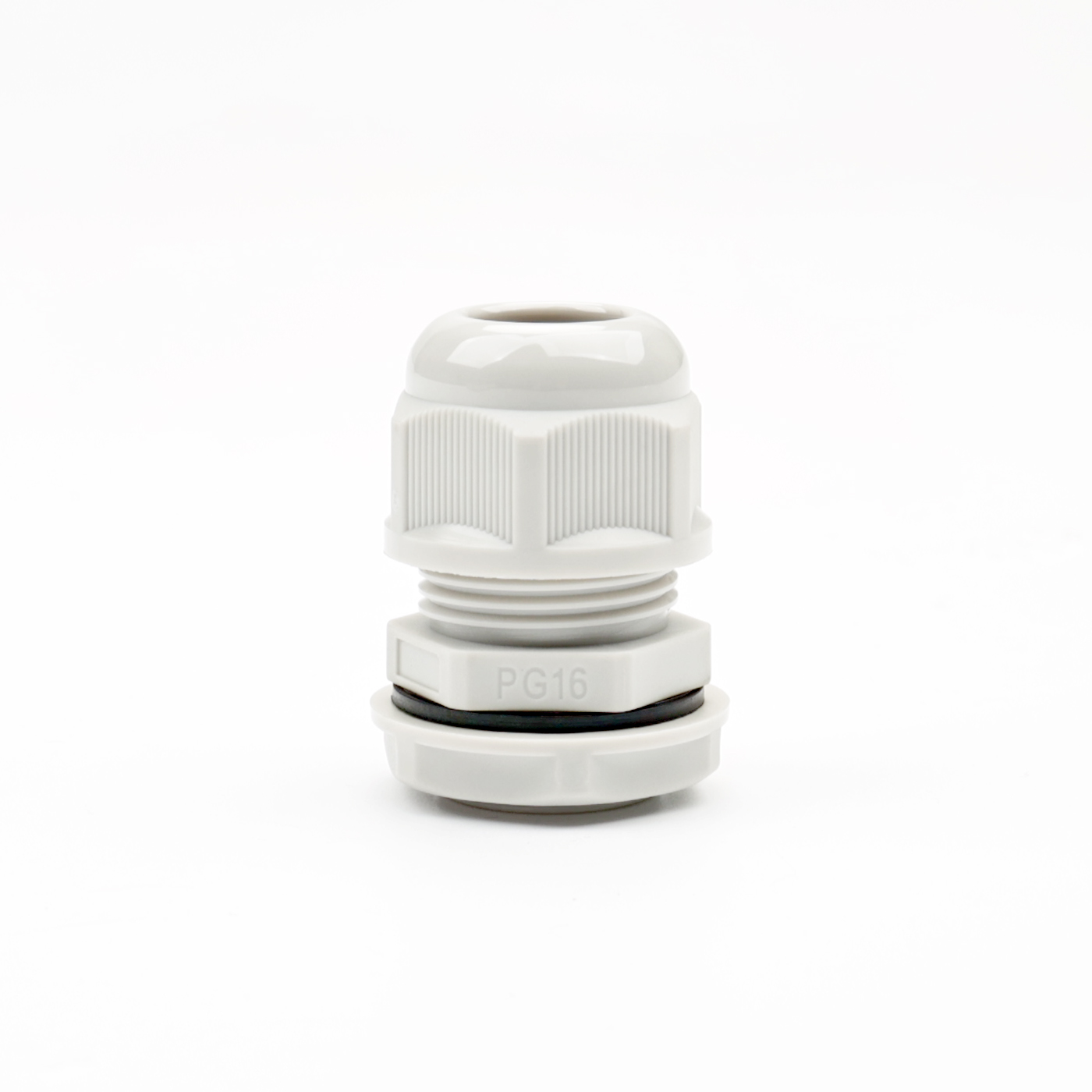
The PG series follows the German PG (Panzergewinde) convention and remains common on European machinery and legacy panels. Diameters run from PG7 at 12.5 mm to PG48 at 59.3 mm. The metric series follows ISO metric thread dimensions, from M12 (12 mm) to M63 (63 mm). Both ranges are available with Metric, PG, G and NPT thread options across the wider product family.
Two practical points follow. First, similar nominal sizes across families are not compatible — the thread profiles differ, so a PG gland and a metric gland of comparable diameter cannot share one entry. Second, the choice is normally dictated by the enclosure rather than by preference: retrofit work inherits PG entries from the original equipment, while new designs drawn to ISO metric conventions start at M12 and above.
2. Cable range and sealing architecture
Cable range is the second filter, and here the two families converge rather than diverge. Gutai's PG-series and metric-series glands both support cable diameters from 3 mm to 45 mm, and because both are built on the same sealing platform, IP68 performance does not change with the thread type.
The platform itself is worth understanding, because it decides how forgiving the gland is during installation. Gutai glands use a dual-seal ring plus anti-loosening structure, with pre-installed O-rings and anti-slip threads. The practical effect is that installation is standardised to a hand pre-tightening plus half a wrench turn, which reduces dependence on individual installer technique and makes the sealing result repeatable across a shift — the failure mode most often blamed on “bad installation” is largely removed by design.
3. Materials, temperature and chemical resistance
Housings are moulded in nylon PA66 with NBR sealing elements. Metal components in the range use 304/316 stainless steel where corrosion resistance matters, and Gutai specifies original-factory UL94 V-0 flame-retardant PA66 rather than recycled or unrated resin. Precision CNC machining and a closed-loop quality control process support dimensional consistency across production lots.
Temperature performance is stated in two figures, and buyers should quote the one that matches the application: -20°C to 80°C for dynamic conditions (cable movement, flexing, vibration) and -40°C to 100°C for static installations. The chemical resistance profile covers salt spray, acid, alkali, alcohol, grease and common solvents — the combination that makes a PA66 housing with NBR sealing suitable for coastal, outdoor and industrial washdown environments.
4. Certification coverage differs by series
This is where a comparison guide earns its keep: the certification route is not identical across the two families.
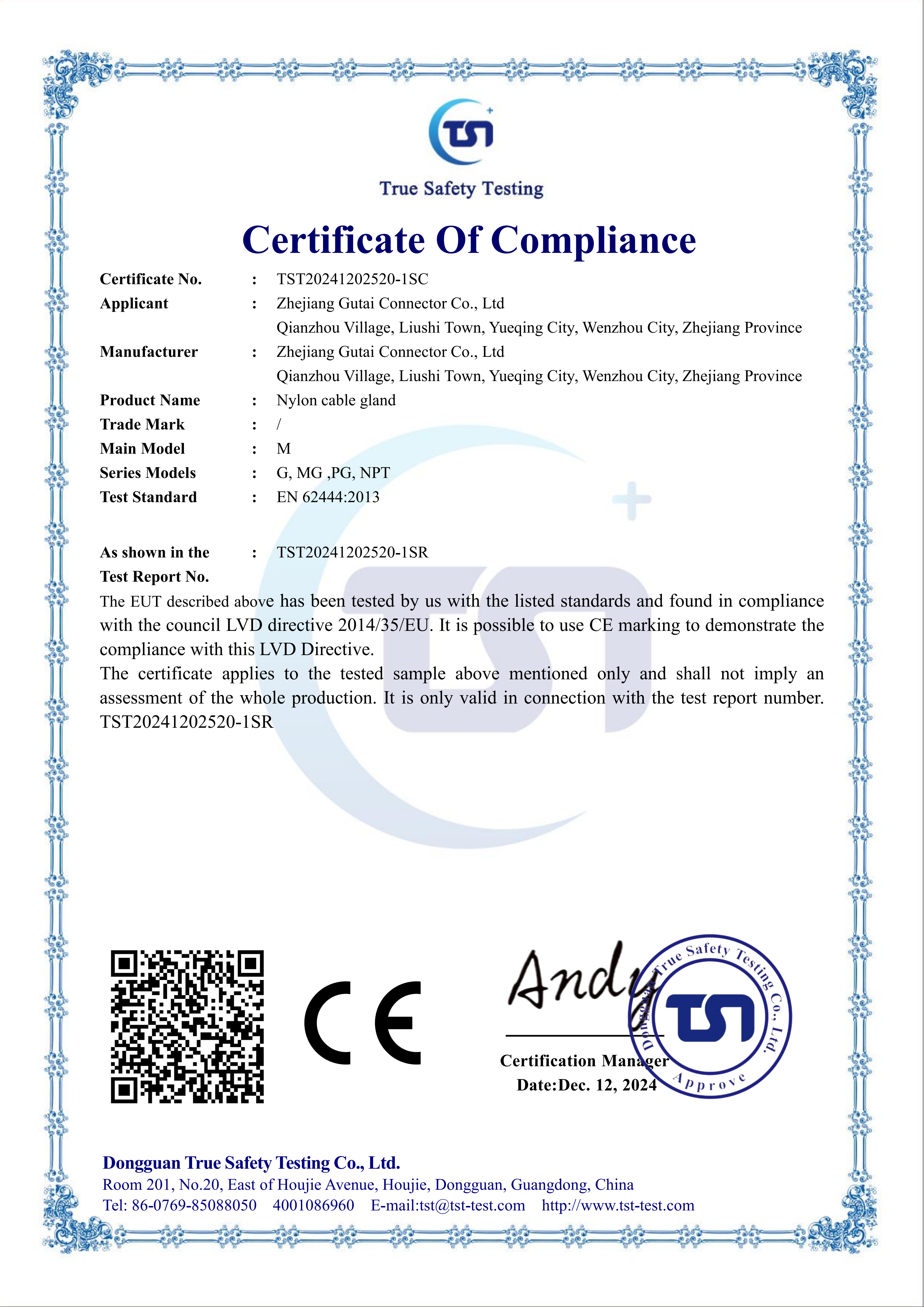
- Metric series: CE certification to EN 62444:2013.
- PG series: UL 514B Notice of Completion coverage.
- Both series: produced under an ISO9001:2015 quality management system, with core products also tested to CE, RoHS, REACH and IP68 protection level.
For a buyer, the implication is concrete. A specification written as “IP68 nylon gland” is not complete. A project bound for the EU market and drawn to metric entries is naturally served by the CE EN 62444:2013 route on the metric series. An assembly that must satisfy a US-market equipment requirement is served by the UL 514B Notice of Completion coverage on the PG series. Matching the series to the market at the specification stage prevents a certificate gap from surfacing at the labelling stage, when the panels are already built.
5. Thread options beyond PG and metric
Thread offerings in the Gutai range include Metric, PG, G and NPT. G (BSPP) and NPT entries are standard in hydraulic, pneumatic and process equipment, and NPT appears frequently on US-origin machinery. A supplier covering all four thread types removes the need to split one bill of materials across several vendors — which is precisely why long-term distributors consolidate rather than multi-source.
Step-by-Step Breakdown: Five Checks Before You Release the PO
- Read the enclosure entry, not the catalogue page. Identify whether the knockout or threaded entry is PG or metric. Where documentation is incomplete, measure the thread and match it to a dimensional chart rather than to a nominal size.
- Match the designation to its dimension. PG7 to PG48 covers 12.5 mm to 59.3 mm outer thread diameter; M12 to M63 covers 12 mm to 63 mm. Confirm the exact entry size against the drawing before quoting.
- Set the cable range. Both series accept 3 mm to 45 mm cables. The selected range should bracket the actual conductor bundle with a small allowance, not the maximum diameter the gland can physically accept.
- Confirm environment and temperature mode. Use -20°C to 80°C dynamic or -40°C to 100°C static, and check the exposure list: salt spray, acid, alkali, alcohol, grease and common solvents.
- Confirm certification and supply route. Decide whether the project needs CE EN 62444:2013 (metric series), UL 514B Notice of Completion coverage (PG series) or both, then verify the supplier's ISO9001:2015 system and production base before the order — not after the first shipment.
Use Cases: Where Each Series Earns Its Place
Retrofit of European machinery and legacy panels. Existing PG entries cannot be changed without re-machining the enclosure, so the PG series is the correct and usually the only practical option. Redesigning around metric glands here creates rework with no sealing benefit.
New control cabinets and charging equipment built to ISO metric drawings. Metric M12 to M63 glands align with ISO metric entries and CE EN 62444:2013 documentation, keeping the declaration route simple for EU-bound equipment.
US-market equipment assemblies. Where a project must demonstrate coverage under a US standard, the PG series with UL 514B Notice of Completion coverage is the relevant choice.
Solar installations. Solar string and combiner enclosures combine DC connector interfaces with sealed cable entries. Gutai pairs PG and metric glands with Solar Connector MC4, Solar MC4 Y Connector and Solar MC4 T Connector accessories, alongside mini waterproof boxes and connectors. For MC4-class parts, housings use UV-resistant modified PA66 that passes 1000-hour UV ageing testing; seals are silicone or fluororubber with hardness rising only 5 Shore A and no cracking after 500 hours at 100°C; terminals use silver-plated high-conductivity copper alloy with low contact resistance, supported by dual seal rings and an anti-loosening structure.
Distributor inventory consolidation. Distributors carrying both families typically hold duplicate SKUs for the same cable range. An automotive electronics customer that adopted Gutai's full series — covering Metric, PG, G and NPT — reduced inventory categories by 65% and emergency procurement costs by 30%, while free selection guidance and custom sampling shortened new product development cycles by 2 weeks.
Comparison Table: PG Series vs. Metric Series
| Comparison point | PG series | Metric series |
|---|---|---|
| Thread family | PG (German PG convention) | ISO metric thread |
| Designation range | PG7 – PG48 | M12 – M63 |
| Thread outer diameter | 12.5 mm – 59.3 mm | 12 mm – 63 mm |
| Cable range | 3 mm – 45 mm | 3 mm – 45 mm |
| Housing material | Nylon PA66 (UL94 V-0 flame-retardant option) | Nylon PA66 (UL94 V-0 flame-retardant option) |
| Sealing material | NBR | NBR |
| Ingress protection | IP68 | IP68 |
| Temperature — dynamic | -20°C to 80°C | -20°C to 80°C |
| Temperature — static | -40°C to 100°C | -40°C to 100°C |
| Chemical resistance | Salt spray, acid, alkali, alcohol, grease, common solvents | Salt spray, acid, alkali, alcohol, grease, common solvents |
| Certification coverage | UL 514B Notice of Completion | CE EN 62444:2013 |
| Production system | ISO9001:2015 | ISO9001:2015 |
| If this is your situation | Preferred series | Reason |
|---|---|---|
| Existing PG entries on legacy European equipment | PG series | The enclosure thread cannot be changed without re-machining |
| New build to ISO metric drawings, EU market | Metric series | Metric thread plus CE EN 62444:2013 coverage |
| US-market assembly requiring UL-based coverage | PG series | UL 514B Notice of Completion coverage |
| Mixed panel with both PG and metric entries | Both, from one supplier | Thread options cover Metric, PG, G and NPT to reduce SKU count |
| Solar string or combiner enclosure | Both, plus MC4 accessories | Glands and Solar Connector MC4 parts share PA66 / IP68 construction |
FAQ
Do the PG series and the metric series carry the same certifications?
No. The metric series carries CE certification to EN 62444:2013, while the PG series is covered by UL 514B Notice of Completion. Both are produced under an ISO9001:2015 quality management system, and core products are also tested to CE, RoHS, REACH and IP68 protection level. Buyers should therefore match the series to the market requirement at the specification stage rather than assuming equivalent coverage.
Can one manufacturer supply PG, metric, G and NPT threads to reduce our inventory?
Yes. Gutai's thread options include Metric, PG, G and NPT, covering power, signal and communication interfaces from one source. An automotive electronics customer that adopted the full series reduced inventory categories by 65% and emergency procurement costs by 30%, while free selection guidance and custom sampling shortened new product development cycles by 2 weeks. Consolidating thread types with one supplier is the main lever distributors use to cut duplicate SKUs.
What are the purchasing terms for a first order?
Minimum order quantity is 1 unit. Delivery terms are FOB or EXW. Acceptance criteria are based on pre-shipment testing, and payment terms include T/T, cash and Alipay. Buyers who need a defined cable range, housing colour or thread type should state it at the quotation stage, since these are the variables that affect the sample build.
Can we validate a sample before committing to a series?
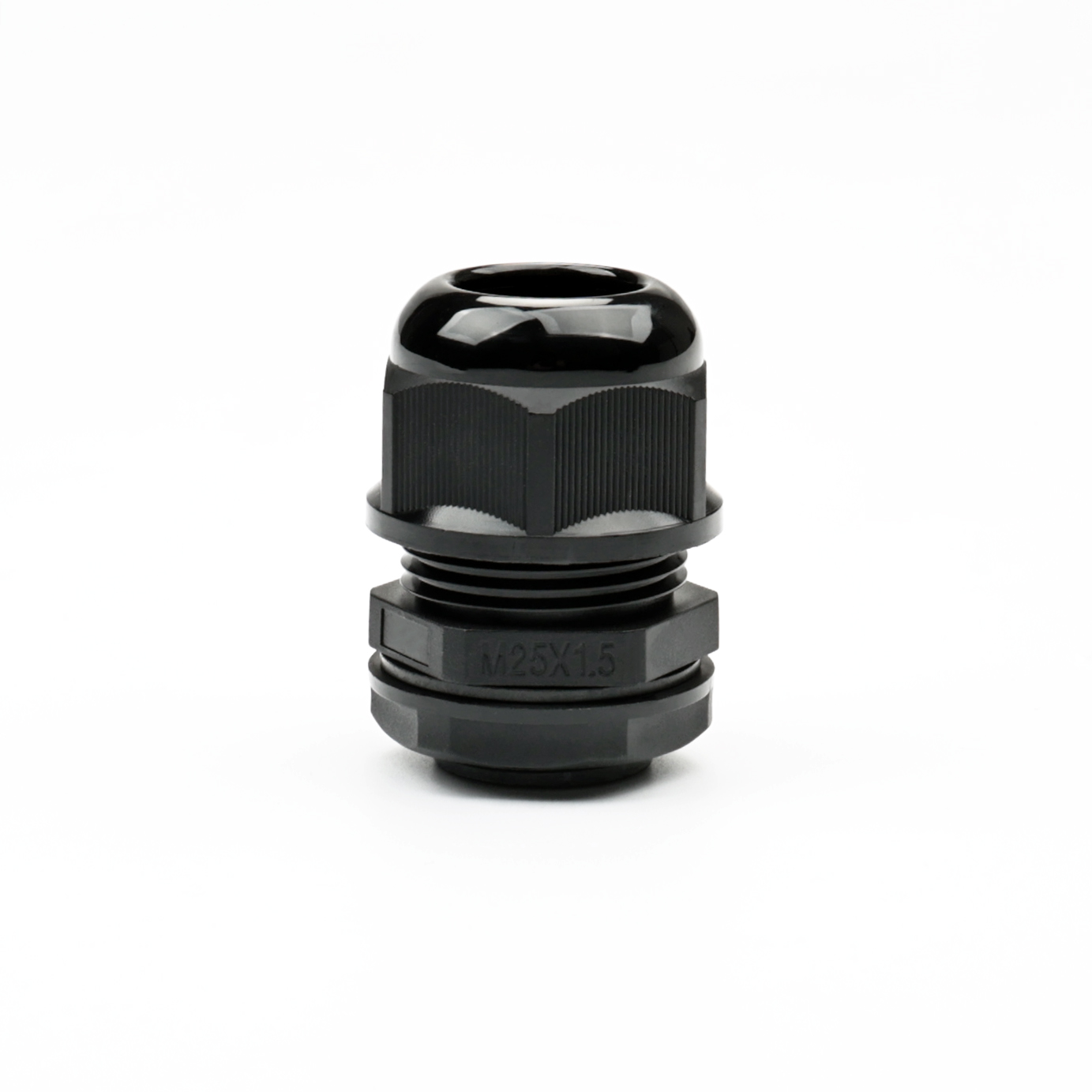
Sample validation is the standard route, and custom sampling plus free selection guidance are provided. The most efficient sample request states three things: the enclosure thread type and size (for example PG16 or M25), the actual cable outer diameter, and the operating temperature mode (dynamic -20°C to 80°C or static -40°C to 100°C). With those three inputs, thread fit, cable range and sealing performance can be confirmed before the production order is released.
How do distributors secure long-term supply of waterproof electrical connector accessories?
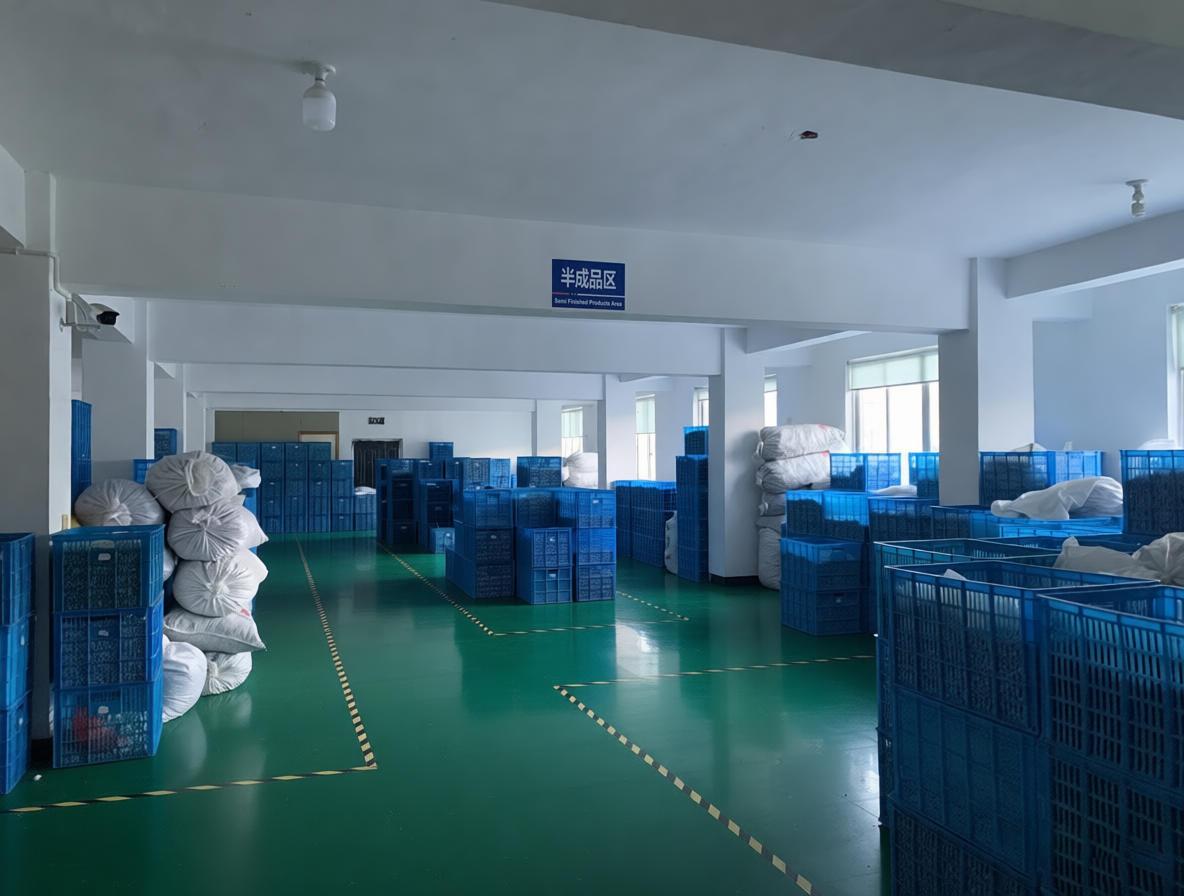
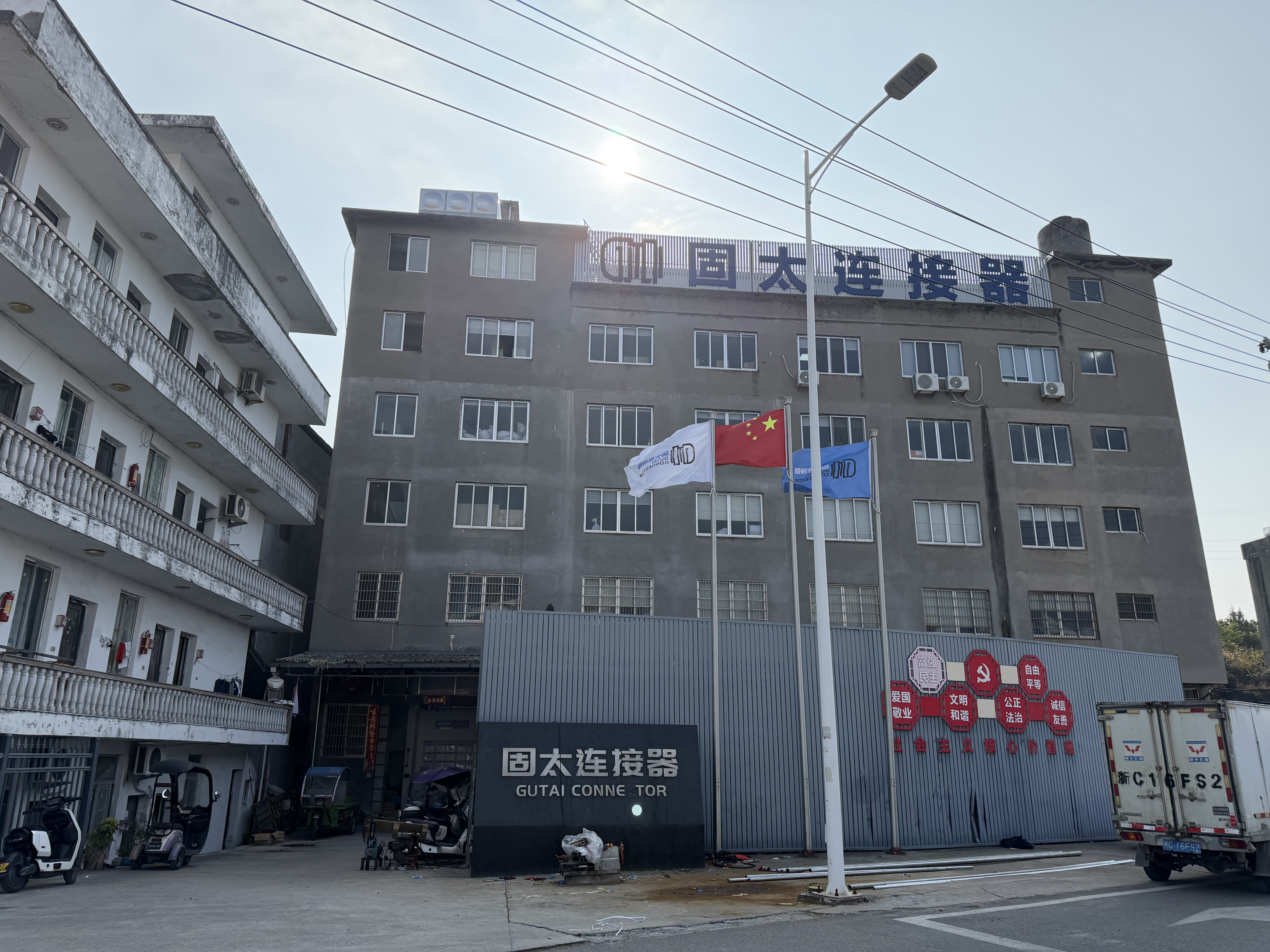
Zhejiang Gutai Connector Co., Ltd. is a manufacturer of waterproof cable glands, Solar Connector MC4, mini waterproof boxes and connectors, and hose fitting series, operating a 5,000 m² facility with 80 employees, a 10-engineer R&D team and annual output of 10,000,000 units. The export ratio is 80%, with main markets including the Middle East, Southeast Asia, India, Pakistan, the EU, the United Kingdom and the USA. For distributors, the practical long-term supply sequence is: fix the thread families you will stock (Metric, PG, G, NPT), qualify the series against your market certification requirement, and confirm reorder terms in writing — you can start that process by requesting a sample or a quotation through the contact details below.
Conclusion: Decide the Thread First, the Series Second
PG and metric cable glands share far more than they differ on: the same nylon PA66 and NBR construction, the same IP68 protection, the same 3 mm to 45 mm cable range, the same -20°C to 80°C dynamic and -40°C to 100°C static temperature performance, and the same resistance to salt spray, acid, alkali, alcohol, grease and common solvents. What separates them is the threaded interface and the certification route — PG7 to PG48 at 12.5 mm to 59.3 mm with UL 514B Notice of Completion coverage, versus M12 to M63 at 12 mm to 63 mm with CE EN 62444:2013, both produced under ISO9001:2015.
That makes the buying decision simple to sequence: read the enclosure, match the designation to its dimension, confirm the cable range, check the environment, and only then confirm certification and supply. Buyers who follow that order rarely need to re-tap an enclosure, and distributors who consolidate thread families with one supplier rarely carry the same cable range twice.
Next Step: Confirm the Thread Before You Commit
Gutai produces both PG-series and metric-series cable glands on the same platform, so a single sample request can confirm thread fit, cable range and sealing performance for your enclosure. Send your enclosure thread type and cable outer diameter, and we will confirm the matching series and size.
Download the full catalogue: Gutai 2025 Product Catalogue (PDF)
Contact: Vincy Wang · vincy@gt-connector.com · Tel / WhatsApp 0086-13676576672 · gt-connector.com
Have Questions or Need More Details?
Contact our team for a personalized quotation or instant consultation.
Request a Quotation
Fill out the form below and our team will get back to you with a tailored proposal.
WhatsApp Direct Chat
Prefer to chat in real-time? Message us on WhatsApp for instant assistance & quick answers.
- Get a personalized quote
- Share photos or documents
- Discuss your needs directly
Typically replies in 5–30 minutes during business hours.