PG vs. Metric Cable Glands: A Head-to-Head Decision for OEM Integration
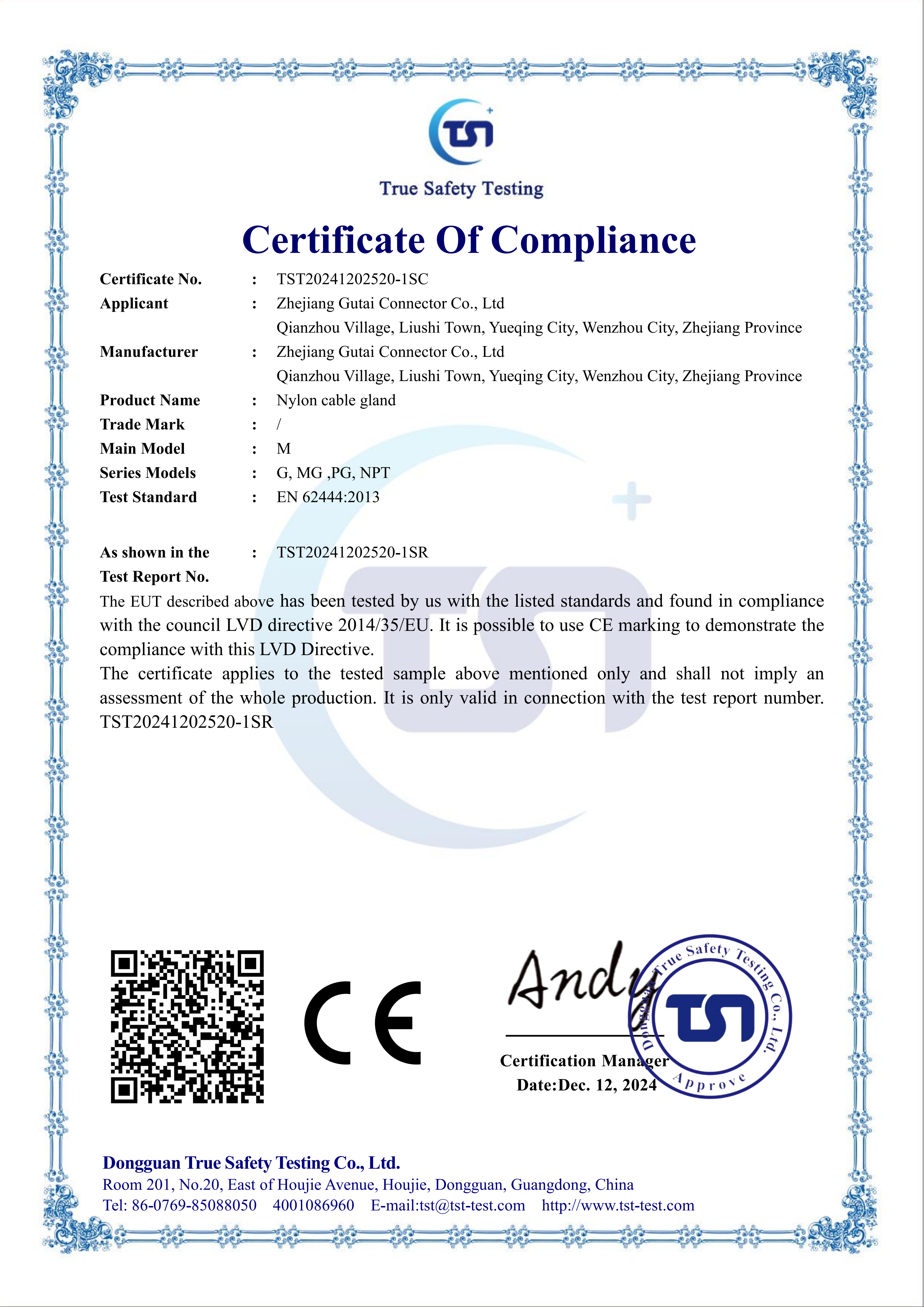
Cover: Gutai CE Certificate of Compliance TST20241202520-1SC to EN 62444:2013, covering nylon cable glands in the G, MG, PG and NPT series.
Direct answer: For OEM integration, PG and Metric cable glands are not competing sealing technologies — they are two thread interfaces applied to the same sealed body construction. Gutai's PG series (PG7–PG48) and Metric series (M12–M63) share a 3–45 mm cable range, a 9–21 mm thread length band, and the same Nylon PA66 housing and NBR seal materials. The decision is normally already fixed by three interface facts: the threaded entry on your enclosure, the cable outer diameter you have to seal, and the compliance route of the destination market.
This guide is written for OEM engineers, panel builders and procurement teams who are integrating waterproof electrical connector accessories into an enclosure or equipment platform that already exists — not for buyers starting from a blank specification sheet. It compares the two thread systems on thread size, thread outside diameter, cable range, thread length, sealing material and standards coverage, and then reduces the comparison to a practical integration sequence you can run against a live drawing.
The OEM Integration Problem: One Platform, Two Thread Standards
OEM programmes rarely get to choose a thread standard from first principles. The threaded entry is usually inherited: from a die-cast enclosure tool that already exists, from a panel drawing released several revisions ago, or from the market where the original platform was designed. Changing the cable gland series is a catalogue decision. Changing an enclosure casting, a tapped entry or a punched panel is a tooling decision. That asymmetry is the real reason PG-versus-Metric is an integration question rather than a product question.
The second part of the problem is duplication. Gutai's PG series and Metric series overlap almost completely in sealing capability: both run a 3–45 mm cable range, both use a 9–21 mm thread length band, and both are built on Nylon PA66 bodies with NBR seals. A platform that is sold into more than one regional market therefore ends up carrying two thread systems for one sealing function — two part numbers, two stock positions, two sets of assembly instructions, and two lines on the bill of materials.
The practical question is not "which standard is better". It is: which series drops into an interface you do not want to redesign, what does the other series cost you in inventory and tooling, and can both be covered by one supplier and one compliance file? Those three questions are answerable with dimensions and certificates, and that is how the rest of this comparison is structured.
Industry Background: Why Both Standards Still Ship
The global cable glands market was valued at approximately USD 2.16 billion to 2.25 billion in 2024–2025, with published forecasts for 2034 ranging from USD 3.07 billion to USD 4.96 billion depending on methodology (Straits Research / Spherical Insights). Asia Pacific is the leading regional market, accounting for roughly 38% to 42% of global revenue, driven largely by industrialisation in China and India (Dataintelo / Straits Research).
On the standards side, IEC 62444 and its European adoption EN 62444 govern the construction and performance requirements for cable glands used in electrical installations, and replaced the older BS EN 50262 (IEC / BSI). IP68, defined in IEC 60529, remains the benchmark ingress protection rating for waterproof connectors and requires a device to withstand continuous immersion in water under specified conditions.
What keeps two thread systems alive in the same supply chain is installed base rather than performance. PG threading remains common in older European machinery, retrofit work and enclosures whose drawings were released before metric harmonisation. Metric threading dominates newer equipment drawings, where tapping tools, gauges and inspection equipment are already metric. For an OEM running one platform across several markets, the realistic outcome is a dual listing — and the practical objective is to obtain both from a single, consistently documented source.
The Two Series Head-to-Head: What Actually Differs
PG series (PG7–PG48): larger thread outside diameter and legacy fit
Gutai's PG cable gland series runs from PG7 to PG48 with a cable range of 3–45 mm, a thread outside diameter of 12.5–59.3 mm, and a thread length of 9–21 mm. The body material is Nylon PA66 with an NBR seal. The engineering consequence of the PG geometry is design flexibility at the top of the range: PG7–PG48 supports a thread outside diameter up to 59.3 mm, which makes it the practical route where an existing enclosure entry was specified around a PG-style thread and a larger entry diameter is already available.
Metric series (M12–M63): metric threading preference
The Metric series covers M12 to M63 with the same 3–45 mm cable range and the same 9–21 mm thread length band, on identical Nylon PA66 bodies and NBR seals. Its thread outside diameter runs from 12 mm to 63 mm. Metric threading is the default preference when the panel drawing, the tapping operation and the final inspection gauge are all metric-based, because nothing in the production chain has to be converted.
What is identical — and why that matters during integration
Cable range, thread length band, body material, seal material, and the intended application environments are the same across both series. Both are positioned for the new energy sector, industrial automation and advanced manufacturing, construction and infrastructure, and marine engineering and shipbuilding. From a sealing-performance point of view, the two families are configured the same way. The difference is the interface, not the seal — which is exactly why the decision should be made on drawings rather than on durability claims.
Sealing material and customisation headroom
Both series are supplied with Nylon PA66 bodies and NBR seals as standard. Beyond the standard build, Gutai's OEM/ODM scope covers size and thread specifications, materials (nylon, brass, stainless steel), colour, packaging and OEM labelling, multi-hole layouts, and specific seal customisations. Monthly capacity is 100,000 MC4 sets and 500,000 cable glands, small trial orders are acceptable, and outgoing goods pass 100% full dimension inspection. For an integration project, that combination means the thread interface can be matched to an existing drawing without launching a new enclosure tool.
Standards coverage that applies to both series
Compliance is where a dual-thread platform most often breaks down, because two suppliers usually mean two certificate files. In Gutai's case the coverage is documented at company level and applies across the gland families:
- CE — EN 62444:2013: Certificate of Compliance TST20241202520-1SC, issued 12 December 2024 by Dongguan True Safety Testing Co., Ltd., scoped to nylon cable glands, Model M, Series G, MG, PG and NPT. Both the PG and the Metric thread families fall inside this scope.
- UL 514B: Notice of Completion for QCRV liquid-tight flexible cord fittings, File E539858, Volume 1, issued by UL Solutions on 13 September 2024, naming UL 514B as the applicable standard for the covered fittings.
- RoHS: SGS test report NGBEC26005747401, issued 13 July 2026 by SGS-CSTC Standards Technical Services (Ningbo) Co., Ltd., scoped to nylon cable gland and referencing EU RoHS Directive (EU) 2015/863.
- Quality system: ISO9001:2015 registration 04324Q31620R0S, issued 2 July 2024 and valid to 1 July 2027, covering the production of cable waterproof joints.
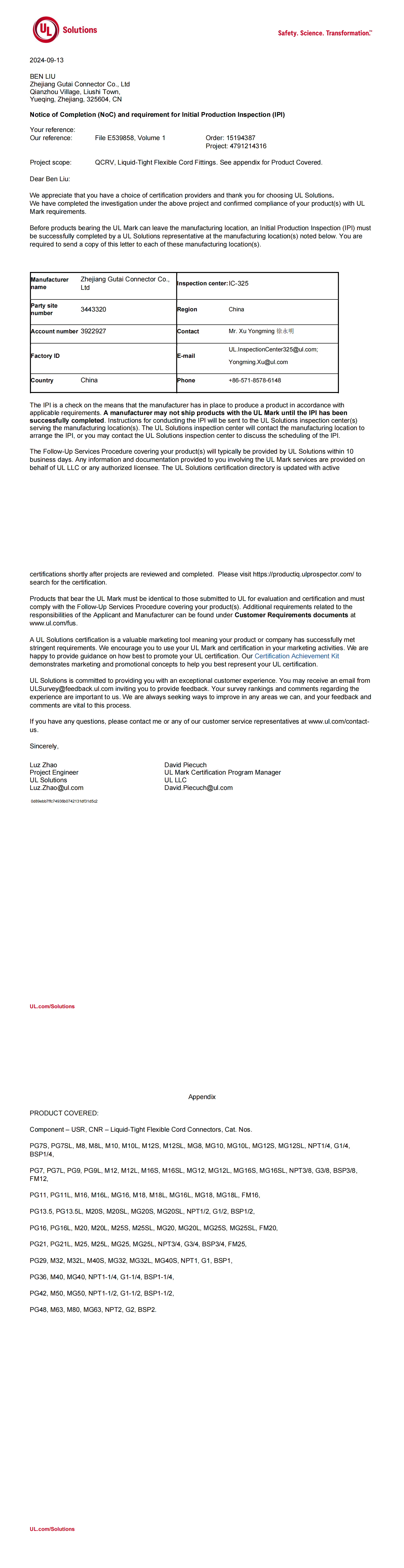
UL 514B Notice of Completion, File E539858, Volume 1, issued by UL Solutions on 13 September 2024.

SGS RoHS test report NGBEC26005747401, scoped to nylon cable gland, issued 13 July 2026.
What this means for a dual-thread platform: one CE file under EN 62444:2013 already covers PG and Metric nylon glands, so an OEM does not need a second certification route simply because one market's enclosure uses PG entries and another uses metric entries. The UL 514B notice should be read in its stated scope — liquid-tight flexible cord fittings — rather than as a blanket listing for every gland in the catalogue.
Step-by-Step: A Seven-Step OEM Integration Sequence
The following sequence is designed to be run against a real enclosure drawing before any part number is released to purchasing.
- Read the interface before the catalogue. Identify the exact thread callout on the enclosure or panel drawing. That single line determines whether the PG or the Metric family is even open for discussion.
- Convert the callout into dimensions. PG thread outside diameter spans 12.5–59.3 mm across PG7–PG48; Metric thread outside diameter spans 12–63 mm across M12–M63. Check the actual entry diameter, not just the nominal size, especially when replacing a gland from another source.
- Check thread engagement against wall thickness. Both series use a 9–21 mm thread length band. Confirm that the selected size gives sufficient engagement through the panel or enclosure wall and still leaves room for a locknut where the design requires one.
- Map cable outer diameter into the 3–45 mm range. Both series cover 3–45 mm, so the thread standard does not restrict the cable you can seal. Verify the clamping range of the specific size against the actual cable OD and check adjacent sizes for overlap, so the cable is clamped rather than over-compressed.
- Lock the material and seal specification. Nylon PA66 body and NBR seal are the standard build for both families. If the application calls for a different body material, colour, multi-hole layout or a specific seal configuration, that is a customisation decision and should be raised at the drawing stage, not after tooling.
- Fix the compliance route by destination market. EN 62444:2013 CE coverage serves European-market requirements for the nylon gland families; UL 514B documentation applies where the installation falls under that standard's scope; RoHS and REACH expectations sit on top for both. Match the paperwork to the market, then confirm that the same supplier holds it for both thread systems.
- Consolidate the SKU list and validate. This is where dual-thread programmes usually recover cost. One documented case involved an automotive electronics customer that consolidated on Gutai's full thread range — covering PG, Metric, NPT and G-type specifications — and reduced inventory categories by 65% while cutting emergency procurement costs by 30%, with free selection guidance and custom sampling shortening the new product development cycle by two weeks. Validation itself is straightforward: small trial orders are accepted, and pre-shipment testing plus 100% full dimension inspection are part of the standard flow.
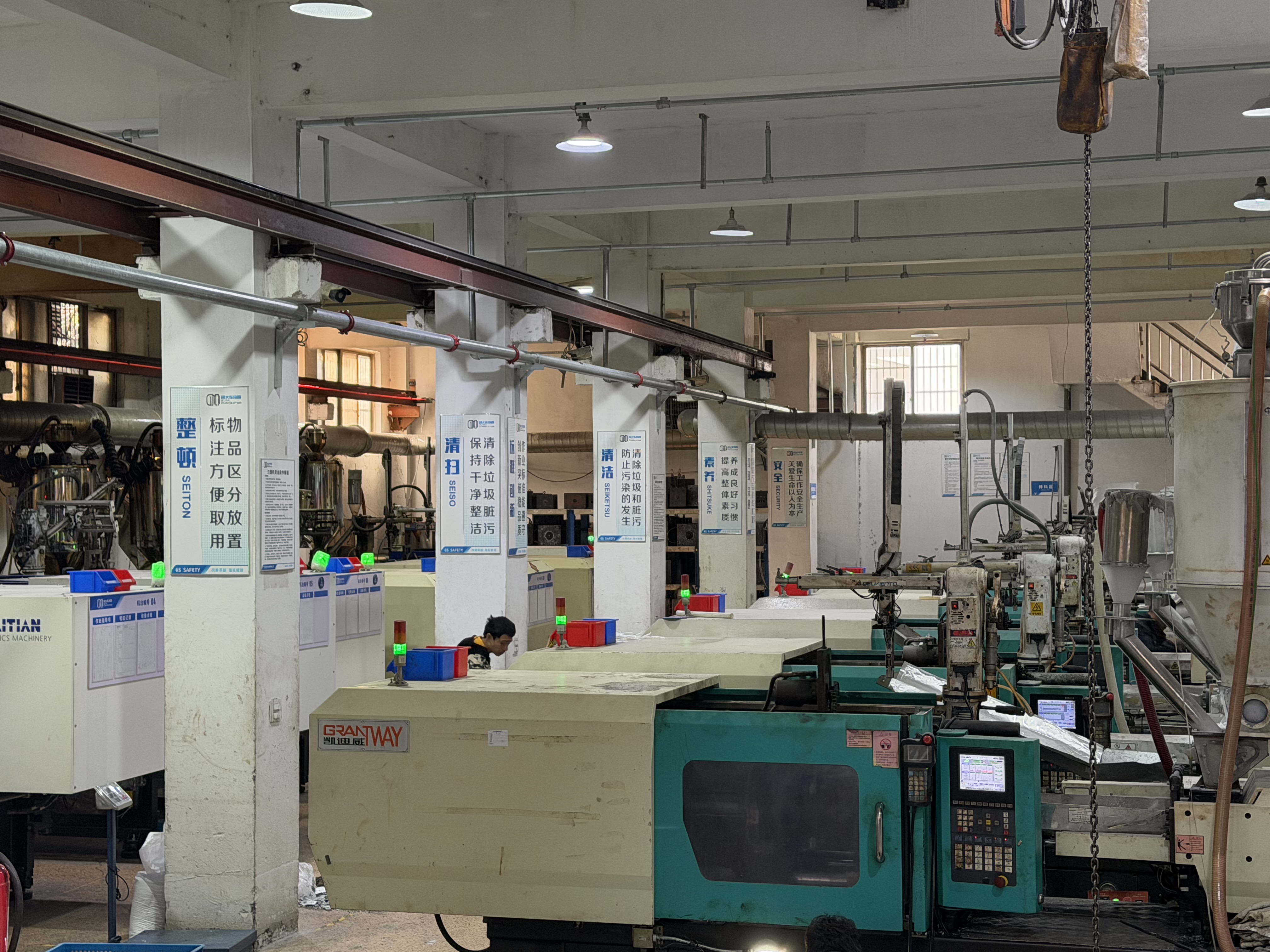
Machining workshop: custom thread specifications, body materials and multi-hole layouts are produced in-house at Zhejiang Gutai Connector.
Use Cases: Where Each Series Earns Its Place
Industrial automation and advanced manufacturing
Control cabinets, machine panels and instrumentation enclosures designed on metric drawings normally go straight to the Metric series, because the tapping operation and the inspection gauge are already metric. Where an existing machine platform or a copied enclosure uses PG entries, PG7–PG48 keeps the panel unchanged and avoids re-machining — the wider thread outside diameter range up to 59.3 mm gives more room on thicker castings and larger entries.
New energy: EV charging and PV balance of system
Outdoor charging and photovoltaic installations put the seal, not the thread, under pressure. Gutai's European coastal open-air DC fast charging project covered the first batch of 5,000 sets of IP68-grade metal waterproof connectors deployed over 18 months. The design used 304 stainless steel together with a dual-seal anti-loosening structure and passed 1,000-hour salt spray testing and IEC 60068-2-6 vibration testing. In service, the connector-related electrical failure rate dropped from 18% annually to 2.6%, annual maintenance cost per station fell from above 500 RMB to below 80 RMB, and new station installation efficiency increased by 35%. The same engineering logic — seal configuration first, thread interface second — applies when cable glands are specified into the same outdoor enclosures.
Marine engineering and shipbuilding
Salt fog, vibration and washdown push gland selection toward verified sealing materials and documented standards coverage. Both Gutai series use NBR seals and fall under the EN 62444:2013 CE scope, which is the combination specifiers typically need to document for marine and offshore-adjacent projects. Thread system choice here follows the shipyard's panel drawings, and both PG and Metric entries are supported.
Construction and infrastructure
Buildings and infrastructure projects frequently mix new metric equipment with legacy PG entries during refurbishment. Running both series from one supplier keeps the installer's kit consistent and avoids a second compliance file for what is functionally the same fitting.
PG vs. Metric Cable Glands: Parameter Comparison
| Parameter | PG series | Metric series |
|---|---|---|
| Thread size range | PG7–PG48 | M12–M63 |
| Thread outside diameter | 12.5–59.3 mm | 12–63 mm |
| Cable range | 3–45 mm | 3–45 mm |
| Thread length | 9–21 mm | 9–21 mm |
| Body material | Nylon PA66 | Nylon PA66 |
| Seal material | NBR | NBR |
| CE compliance | EN 62444:2013 — cert. TST20241202520-1SC | EN 62444:2013 — cert. TST20241202520-1SC |
| UL reference | UL 514B — Notice of Completion, File E539858, Volume 1 | UL 514B — Notice of Completion, File E539858, Volume 1 |
| RoHS documentation | SGS report NGBEC26005747401 (nylon cable gland) | SGS report NGBEC26005747401 (nylon cable gland) |
| Typical integration driver | Legacy PG enclosure entries; thread O.D. up to 59.3 mm | Metric drawings, tapping tools and gauges |
Because the two series match on cable range, thread length and materials, the comparison reduces to a small number of decision rules:
| Choose PG when | Choose Metric when |
|---|---|
| The enclosure or panel drawing already specifies a PG thread and you do not want to re-tool or re-tap the entry. | The drawing, tapping tool and inspection gauge are metric, or the equipment is designed to metric standards. |
| You need a thread outside diameter in the upper part of the range, up to 59.3 mm. | You need the metric equivalent up to 63 mm thread outside diameter. |
| You are supporting retrofit or replacement demand for existing PG-installed equipment. | You are launching new equipment where metric threading is the market default. |
| In both cases the sealing materials are the same: Nylon PA66 body with NBR seal, cable range 3–45 mm, thread length 9–21 mm. | |
Frequently Asked Questions
Which standards apply to Gutai's PG and Metric cable glands for an OEM project?
The nylon cable gland families are covered by CE Certificate of Compliance TST20241202520-1SC to EN 62444:2013, issued 12 December 2024, with a scope covering Model M and Series G, MG, PG and NPT — so both the PG and the Metric thread families are included. Gutai also holds a UL Notice of Completion citing UL 514B, File E539858, Volume 1, issued by UL Solutions on 13 September 2024 for liquid-tight flexible cord fittings, an SGS RoHS test report NGBEC26005747401 referencing EU RoHS Directive (EU) 2015/863, and ISO9001:2015 registration 04324Q31620R0S valid to 1 July 2027.
Can one Chinese manufacturer cover both PG and Metric thread systems to reduce inventory pressure?
Yes — this is one of the main reasons OEM buyers consolidate. Gutai's thread specifications cover multiple international standards including PG, Metric, NPT and G-type, with a range of sizes and cable entry ranges that supports one-stop selection across power, signal and communication interfaces. In one documented case, an automotive electronics customer reduced inventory categories by 65% and emergency procurement costs by 30% after adopting the full series, while receiving free selection guidance and custom sampling services that shortened the new product development cycle by two weeks.
What are the purchasing terms and acceptance criteria?
The stated terms are: MOQ 1 unit, with small trial orders acceptable; delivery terms FOB/EXW; acceptance criteria pre-shipment test; payment terms T/T, cash or Alipay. Monthly capacity is 500,000 cable glands and 100,000 MC4 connector sets, and outgoing goods pass 100% full dimension inspection.
Can we get samples before committing to a thread standard or a custom build?
Samples and custom sampling are supported, and small trial orders are accepted, which lets an OEM validate thread engagement, cable clamping and assembly handling on the real enclosure before releasing a production part number. Customisation available at that stage includes size and thread specifications, body materials such as nylon, brass or stainless steel, colour, packaging and OEM labelling, multi-hole layouts, and specific seal configurations.
How long does delivery take, and what happens if a quality issue appears?
Lead time is based on your order quantities, and the monthly capacity of 500,000 cable glands is the reference point for planning larger OEM releases. Returns and refunds without reason are available for quality-related problems. If you want to move from comparison to evaluation, you can request a sample or a quotation directly — see the contact details and the product catalogue at the end of this article.
Conclusion: Decide on the Interface, Then Consolidate the Supply
PG and Metric cable glands solve the same sealing problem with different threads. Gutai's PG7–PG48 series and M12–M63 Metric series both use Nylon PA66 bodies with NBR seals, both cover a 3–45 mm cable range, both use a 9–21 mm thread length band, and both sit inside the same EN 62444:2013 CE scope. Where PG7–PG48 adds design flexibility with a thread outside diameter up to 59.3 mm, the Metric series answers the more common metric threading preference up to 63 mm.
For OEM integration, the sequence is simple: lock the enclosure interface, verify thread outside diameter and thread length against the panel, map the cable outer diameter into the 3–45 mm range, confirm the material and seal specification, match the compliance file to the destination market, and only then consolidate the part numbers. Done in that order, a dual-thread platform needs one supplier and one documentation set instead of two of each.
Zhejiang Gutai Connector Co., Ltd. is a manufacturer of waterproof cable glands — including PG series, Metric series, EMC and porous types — along with Solar MC4 connectors, mini waterproof boxes and connectors, and watertight corrugated tubing fittings. The company operates a 5,000 m² facility with 80 employees, a 10-engineer R&D team and an annual output of 10,000,000 units, exporting to the Middle East, Southeast Asia, India, Pakistan, the EU, the United Kingdom and the USA.

Finished goods warehouse: 500,000 cable glands per month, with 100% full dimension inspection before shipment.
Next Step: Match a Gland to Your Drawing
Send the thread callout and cable outer diameter from your enclosure drawing, and Gutai's engineering team will confirm whether the PG or Metric size fits, which customisation options apply, and what documentation your market requires. Samples, quotations and the full product catalogue are available on request.
Catalogue download: 2025 Gutai Connector Product Catalogue (PDF)
Website: www.gt-connector.com | Email: vincy@gt-connector.com | Tel / WhatsApp: 0086-13676576672
Zhejiang Gutai Connector Co., Ltd., Qianzhou Industrial Zone, Liushi Town, Yueqing City, Wenzhou, Zhejiang, China.
Have Questions or Need More Details?
Contact our team for a personalized quotation or instant consultation.
Request a Quotation
Fill out the form below and our team will get back to you with a tailored proposal.
WhatsApp Direct Chat
Prefer to chat in real-time? Message us on WhatsApp for instant assistance & quick answers.
- Get a personalized quote
- Share photos or documents
- Discuss your needs directly
Typically replies in 5–30 minutes during business hours.