Partnering with a Cable Gland Supplier: Frequently Asked Questions on Durability and Lead Times
A long-term cable gland partnership is decided by two things a price list cannot show: how the gland's nylon body and NBR seal behave after years in service, and whether the supplier can repeat the same part, colour and certificate on the next order. This FAQ answers the durability and lead-time questions that come up most often during supplier evaluation — material aging, dynamic versus static temperature limits, chemical and solvent exposure, certification validity, custom colour availability, samples and order lead times — using the documentation and production data of Zhejiang Gutai Connector Co., Ltd. (Gutai).
Why durability and lead time decide the partnership
Most waterproof electrical connector accessories failures are not incoming-inspection failures. A cable gland can pass a dimensional check on arrival and still fail in the field once the elastomer seal hardens, the cable jacket creeps under clamping load, or UV and heat change the surface of the polyamide body. Those failures appear 12 to 24 months after the delivery that looked perfectly acceptable.
Buyers evaluating a partner therefore need two different kinds of assurance, and they are rarely requested together:
- Durability evidence — the polymer and seal materials, the sealing geometry, and the environmental testing behind the claimed service behaviour.
- Supply evidence — monthly capacity, the inspection regime, the repeatability of colour and OEM marking, and how lead time is calculated when volumes change.
Neither is answered by a datasheet alone. Both are answered by documents, declared limits and production numbers that a buyer can check before the first purchase order is signed.
Industry background: a growing market with a tightening compliance floor
Demand for cable glands and waterproof connector accessories continues to expand with industrial automation, construction, marine engineering and solar installations. The global cable glands market was valued at roughly USD 2.16–2.25 billion in 2024–2025, with growth forecasts ranging from USD 3.07 billion to USD 4.96 billion by 2034 depending on methodology and scope (Straits Research; Spherical Insights). The wider waterproof connector market was valued at approximately USD 13.4 billion in 2024 and is projected to reach USD 25.48 billion by 2033 at a CAGR of 7.4%. Asia Pacific accounts for an estimated 38–42% of global cable gland revenue, driven mainly by industrialisation in China and India.
Compliance has become the sharper differentiator. IEC 62444, adopted in Europe as EN 62444:2013, governs the construction and performance requirements for cable glands for electrical installations and replaced the older BS EN 50262. In North America, UL 514B covers liquid-tight flexible cord fittings. Ingress protection claims such as IP68 are defined by IEC 60529, which requires the device to withstand continuous immersion under specified conditions. For comparison, market research from Mordor Intelligence lists ABB Ltd., Eaton Corporation, Amphenol Corporation, LAPP Group and HUMMEL AG among the leading global suppliers in the cable gland and connector sector — a reminder that the compliance documentation a buyer accepts must match the exact market the goods are installed in.
How durability is evidenced in practice
Gutai manufactures nylon cable glands in Metric M12–M63 and PG7–PG48 sizes, with cable ranges from 3 mm to 45 mm and thread lengths of 9–21 mm, built on a Nylon PA66 body with an NBR seal. The company also produces Solar MC4 connectors, mini waterproof boxes and connectors, and watertight corrugated and flexible pipe fittings. Durability questions about any of these families reduce to five checkable topics.
1. Material aging: what actually degrades a nylon cable gland
Two materials age in a gland, for two different reasons. The PA66 body is affected mainly by ultraviolet exposure, sustained heat and mechanical stress; the NBR seal is affected mainly by compression set, heat and contact with oils or chemicals. In a correctly installed gland the seal should remain elastic enough to keep clamping force on the cable jacket for the whole service life — which is why seal compound selection matters more than wall thickness.
Documented evidence matters more than a general statement here. In a desert photovoltaic project in the Middle East, 20,000 sets of anti-UV modified PA66 connectors were supplied for a 150 MW plant over a three-year relationship; the housings passed 1,000-hour UV aging tests, seals used high-temperature fluororubber, and the connection damage rate fell from 8% per year on the original imported product to below 1.2%, with downtime from connection failures reduced by 70%.
2. Dynamic and static temperature limits: two different numbers
A dynamic limit describes the gland or connector in continuous movement, flexing or vibration — for example a cable on a moving machine axis or an outdoor installation exposed to wind-induced movement. A static limit describes a fixed installation where the cable does not move. Dynamic limits are normally the lower of the two, and quoting a static figure for a dynamic application is one of the most common specification errors in this category.
For reference, the declared figures for Gutai's 1000V Solar MC4 connectors are an ambient temperature range of −40 °C to +85 °C (IEC) — −40 °F to +194 °F under UL — with an upper temperature limit of +105 °C (IEC). Cable gland limits are declared per series and should always be read from the current datasheet for the ordered size.
3. Chemical and solvent exposure: what to ask for
Chemical resistance cannot be assumed from the material name. A PA66 body and an NBR seal respond differently to the same medium, and behaviour changes with concentration and operating temperature. Oils, coolants, cleaning agents, fuel vapour and solvent splash all sit in different compatibility bands.
Ask the supplier for three things before approval: the full material declaration for the body and the seal, written compatibility guidance for the specific media present at the installation, and an immersion or wipe test on a production sample where the medium is aggressive. Where the service media is not yet fixed — a machine still in design, for example — request the material declaration first so the seal compound can be selected at the same time as the gland.
4. Certification validity: read the scope, the model and the date
A certificate is only useful if the model you are buying is inside its scope and the document is still current. Buyers should check four things on every certificate: the standard cited, the product scope, the model or series listed, and the issue and expiry dates. A certificate for a nylon gland family does not automatically cover a brass gland, and a UL document for one fitting series does not cover another.
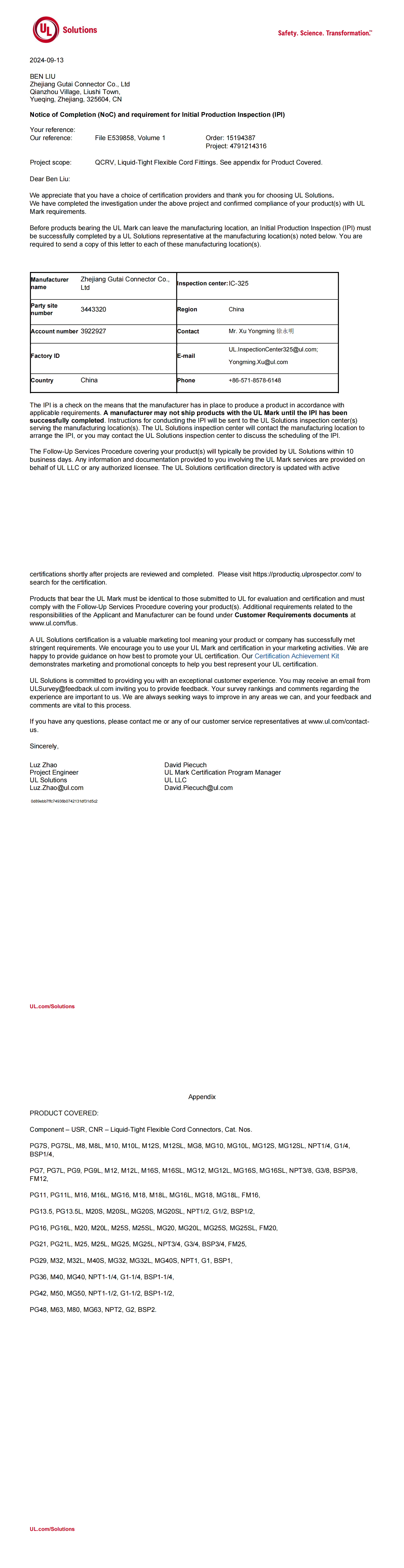
Gutai's current documentation set for the relevant markets is specific and checkable. The EU construction compliance path runs through a CE Certificate of Compliance, number TST20241202520-1SC, issued on 12 December 2024 by Dongguan True Safety Testing Co., Ltd. to EN 62444:2013, covering nylon cable glands Model M and series G, MG, PG and NPT. The North American path runs through a UL Notice of Completion for QCRV liquid-tight flexible cord fittings (USR and CNR series) to UL 514B, File E539858, Volume 1, issued on 13 September 2024 by UL Solutions. EU RoHS compliance for nylon cable glands is supported by SGS test report NGBEC26005747401 issued on 13 July 2026 by SGS-CSTC Standards Technical Services (Ningbo) Co., Ltd. to Directive (EU) 2015/863. Production oversight is covered by an ISO 9001:2015 certificate, registration no. 04324Q31620R0S, issued on 2 July 2024 by Beijing United Intelligence Certification Co., Ltd. and valid to 1 July 2027.

5. Production oversight and custom colour availability
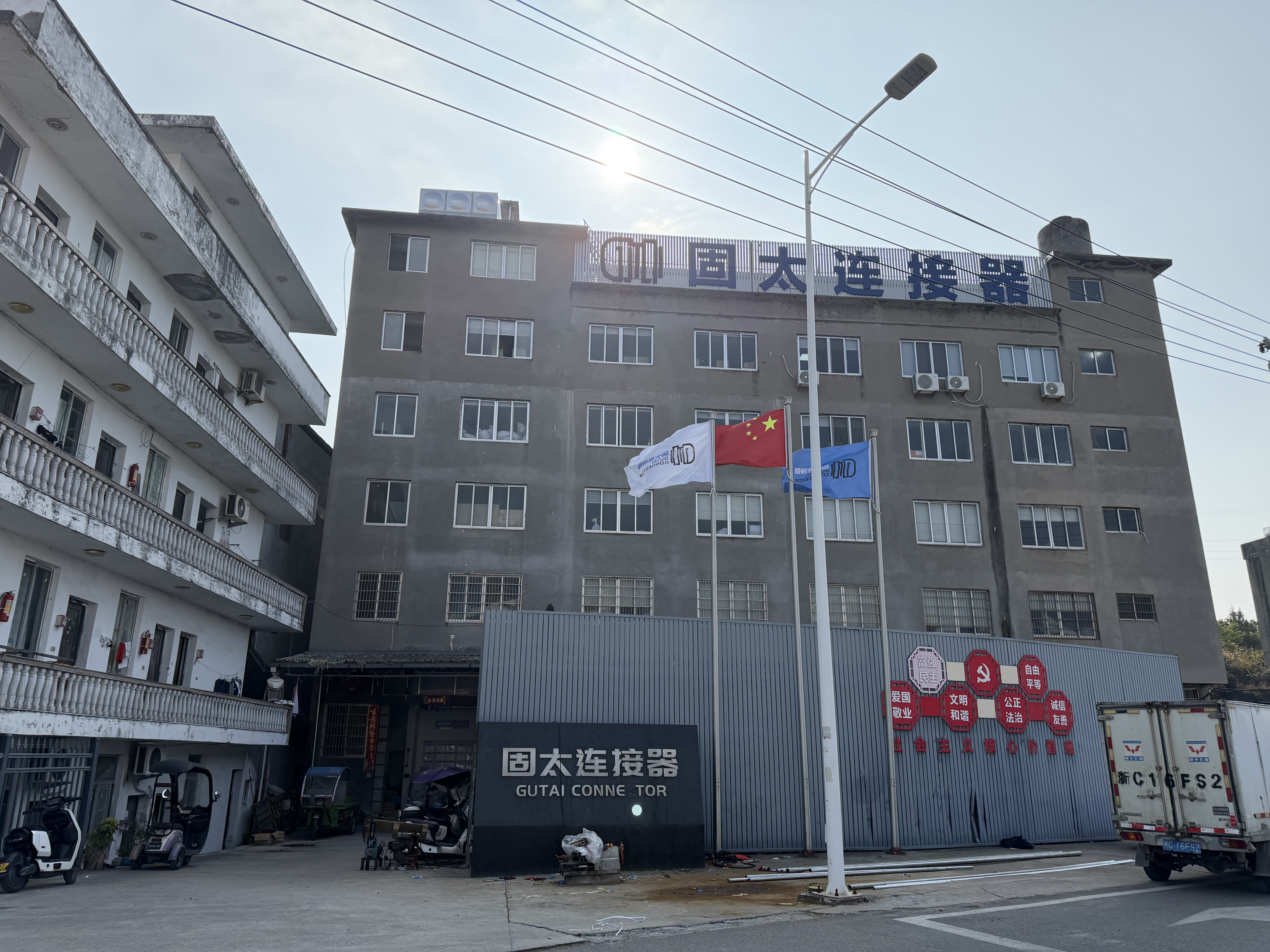
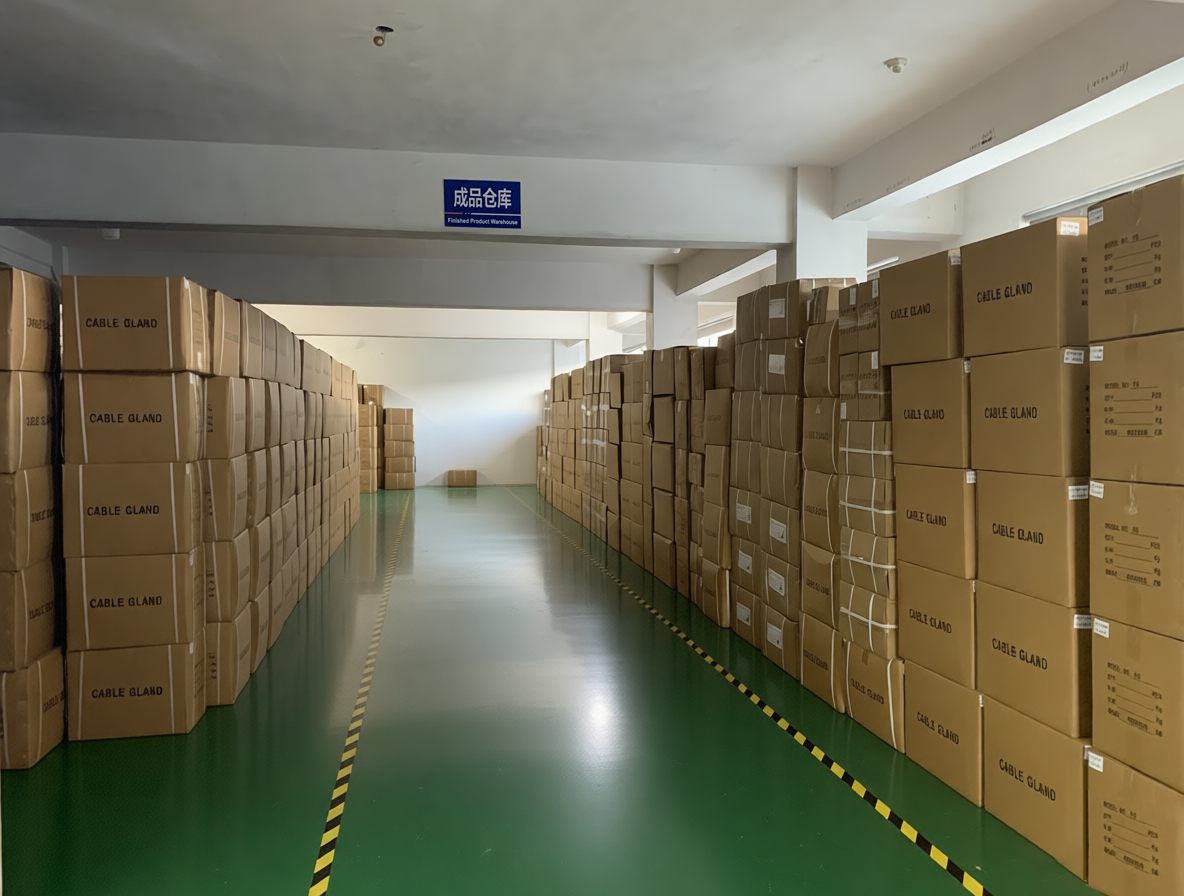
Material declarations and certificates describe what a product can be; production oversight determines whether the next shipment actually is that product. Gutai operates under an ISO 9001:2015 quality management system with 100% full dimension inspection, a 5,000 m² facility, 80 employees including a 10-engineer R&D team, and an annual output of 10,000,000 units, of which roughly 80% is exported.
Customisation is part of the same discussion rather than a separate commercial topic. The available scope covers size and thread specification, materials (nylon, brass or stainless steel), colour, packaging and OEM labelling, multi-hole layouts and specific seal customisation. Colour is the item most often raised by distributors and brand owners, because a colour match that drifts between batches is visible on the shelf. The practical answer is to approve a physical colour standard against a production sample, state the standard in the purchase specification, and confirm the batch quantity at which the colour is compounded — the cost effect of a custom colour depends on that quantity and should be quoted, not assumed.
Step-by-step: validating a supplier partnership in seven steps
The sequence below converts the questions above into a verification process that can be run before a framework agreement is signed.
- Fix the application envelope. Record thread standard (Metric or PG), thread size, cable range, installation environment and whether the cable moves. This determines which series is even eligible.
- Map documents to markets. Match EN 62444:2013 and RoHS evidence to EU destinations, and UL 514B evidence to US and Canadian destinations. Do not accept a certificate for a different market as a substitute.
- Check scope, model and dates. Confirm the ordered model appears in the certificate scope and that the document is current. Ask for the expiry date in writing.
- Review the inspection regime. Confirm what is measured on every unit, not only on the audit sample; Gutai's declared regime is 100% full dimension inspection.
- Request durability evidence for the environment. UV aging data for outdoor solar work, salt spray and vibration data for coastal or transport-exposed installations, and material declarations for chemical exposure.
- Approve samples and colour. Sign off a physical sample, the seal material and the colour standard before mass production, and keep the approved sample as the reference for future orders.
- Lock capacity and lead time against your forecast. Match your annual volume to monthly capacity — 500,000 cable glands and 100,000 MC4 sets per month — and obtain lead time in writing for the specific order quantities, not as a general statement.
Use cases: where durability evidence comes from
Two delivered projects show how the questions above are answered with data rather than description.
Coastal open-air EV charging, Germany. A European operator deployed 5,000 sets of IP68-grade metal waterproof connectors on coastal outdoor DC fast-charging piles over an 18-month programme. The installation faced high-salt fog, strong sea wind and high-frequency vibration. Connectors used 304 stainless steel and a dual-seal anti-loosening structure, and passed 1,000-hour salt spray testing and IEC 60068-2-6 vibration testing. The connector-related electrical failure rate fell from 18% per year to 2.6%, annual maintenance cost per station dropped from over 500 RMB to below 80 RMB, and new-station installation efficiency rose by 35%. The project directly addressed the failure of conventional IP67 connectors within six months in coastal conditions.
Desert photovoltaic plant, Middle East. A large PV developer ordered 20,000 sets of anti-UV modified PA66 photovoltaic connectors for a 150 MW desert plant, over a three-year relationship. Housings passed 1,000-hour UV aging tests and seals used high-temperature fluororubber, maintaining sealing under 70 °C surface heat and wind-sand erosion. Silver-plated terminals kept contact resistance low. The connector damage rate fell from 8% per year to below 1.2%, downtime from connection failures dropped by 70%, and cumulative maintenance and generation-loss savings exceeded USD 80,000.
Comparison table: compliance and evidence map
The table maps each market requirement to the specific document Gutai holds. It is the fastest way to check whether the evidence you need already exists.
| Requirement / market | Standard or scheme | Document held | Scope and reference | Issued |
|---|---|---|---|---|
| EU construction and performance | EN 62444:2013 | CE Certificate of Compliance | Nylon cable gland, Model M; series G, MG, PG, NPT — TST20241202520-1SC, Dongguan True Safety Testing Co., Ltd. | 12 Dec 2024 |
| US and Canada | UL 514B | UL Notice of Completion | Liquid-tight flexible cord fittings, USR and CNR series — File E539858, Volume 1, UL Solutions | 13 Sep 2024 |
| EU hazardous substances | Directive (EU) 2015/863 (RoHS) | SGS test report | Nylon cable gland — NGBEC26005747401, SGS-CSTC Standards Technical Services (Ningbo) Co., Ltd. | 13 Jul 2026 |
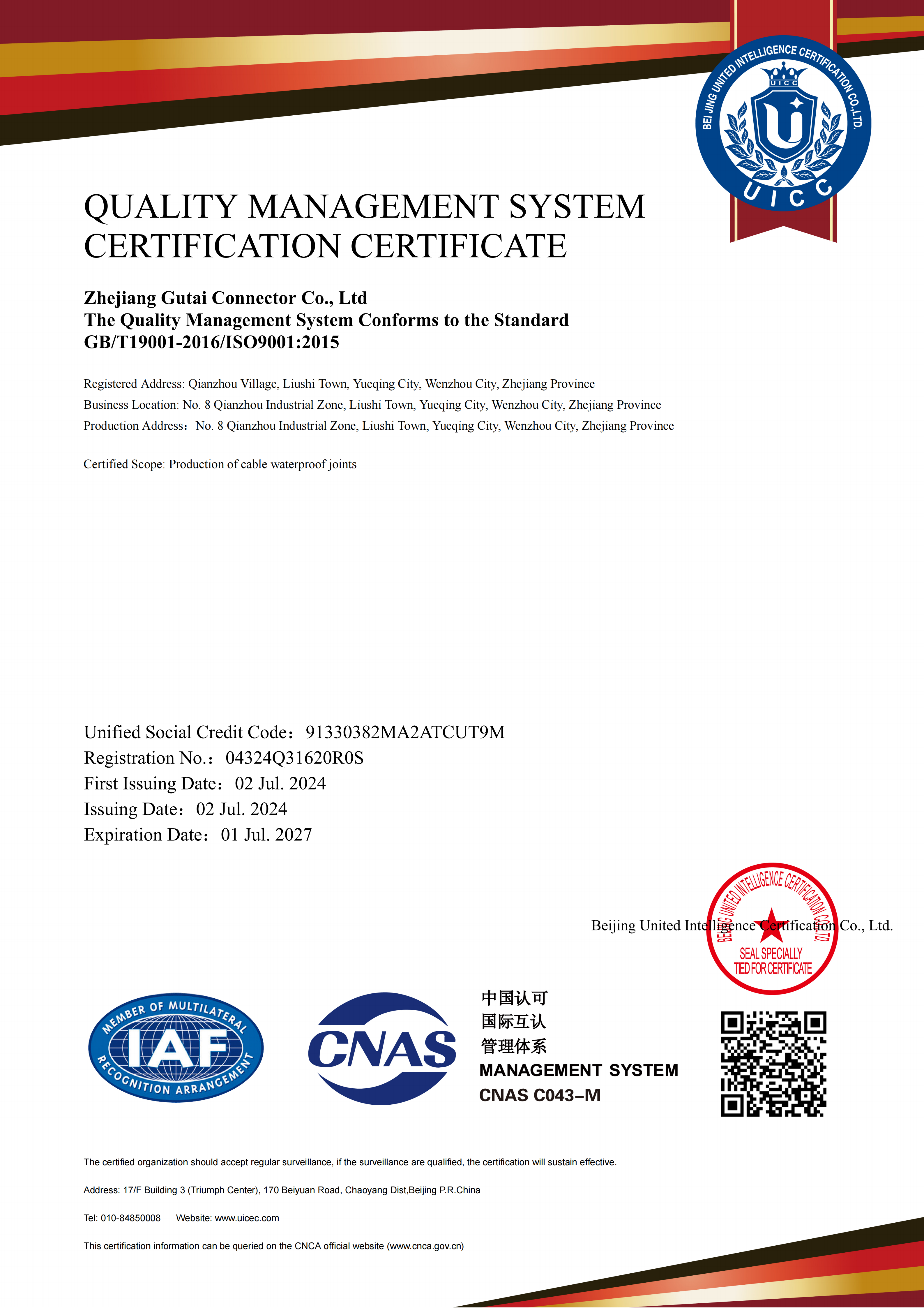
| Production quality system | ISO 9001:2015 / GB/T 19001-2016 | Quality management system certificate | Production of cable waterproof joints — registration no. 04324Q31620R0S, valid to 1 Jul 2027 | 2 Jul 2024 |
Recommended manufacturers: how to build a shortlist you can defend
The question “which waterproof electrical connector accessories manufacturers are recommended?” has no single answer, because the right shortlist depends on the destination market, the volume, and how much customisation the buyer needs. A defensible shortlist is built in three passes rather than from a generic list.
- Start from the compliance set. If the goods ship to the EU, EN 62444:2013 and RoHS evidence is the entry filter. If they ship to the US or Canada, UL 514B documentation is the filter. Suppliers without the relevant document drop out at this stage, regardless of price.
- Then apply capacity and customisation fit. Distributors needing private-label packaging, custom colours and multi-hole layouts are looking for a different profile from a project buyer ordering a standard Metric or PG size once.
- Then compare durability evidence. Ask what environmental testing sits behind the claimed service life and whether it matches your installation — UV aging for desert solar, salt spray and vibration for coastal and transport-exposed sites.
Against those filters, Gutai sits in the manufacturer segment: a 5,000 m² factory in Yueqing, Wenzhou, Zhejiang, 80 employees, a 10-engineer R&D team, annual output of 10,000,000 units, roughly 80% exported, with CE, UL, RoHS and ISO 9001 documentation for the scopes listed above. Global players such as ABB Ltd., Eaton Corporation, Amphenol Corporation, LAPP Group and HUMMEL AG are named in market research as leading suppliers in the sector; they compete on a different scale and service model. The correct comparison is not prestige but fit: destination market, volume, customisation and the durability evidence your installation actually demands.
Frequently asked questions
Which certifications should I verify before signing with a cable gland supplier, and how do I confirm they are still valid?
Verify four documents and check the scope, model and dates on each. For the EU, the reference standard is EN 62444:2013; Gutai holds CE Certificate of Compliance TST20241202520-1SC, issued on 12 December 2024 by Dongguan True Safety Testing Co., Ltd., covering nylon cable glands Model M and series G, MG, PG and NPT. For the US and Canada, the reference is UL 514B; Gutai holds a UL Notice of Completion, File E539858, Volume 1, issued on 13 September 2024 by UL Solutions for QCRV liquid-tight flexible cord fittings (USR and CNR series). For EU RoHS, SGS test report NGBEC26005747401, issued on 13 July 2026 by SGS-CSTC Standards Technical Services (Ningbo) Co., Ltd., covers nylon cable glands under Directive (EU) 2015/863. For the quality system, ISO 9001:2015 registration no. 04324Q31620R0S, issued on 2 July 2024 by Beijing United Intelligence Certification Co., Ltd., covers production of cable waterproof joints and is valid until 1 July 2027. A certificate that does not list your ordered model, or that has passed its expiry date, should not be accepted as evidence.
Do nylon cable glands degrade outdoors, and what shortens service life?
Yes, both polymers in a nylon cable gland age, for different reasons. The PA66 body is affected mainly by ultraviolet exposure, sustained heat and mechanical stress; the NBR seal is affected mainly by compression set, heat and contact with oils or chemicals. Service life is shortened fastest by three conditions: continuous UV exposure without a UV-stabilised compound, sustained operating temperatures above the declared limit for the series, and chemical contact that swells or hardens the seal. Verify aging behaviour with test data rather than a general statement. In Gutai's desert PV project, anti-UV modified PA66 housings passed 1,000-hour UV aging tests and the damage rate fell from 8% per year to below 1.2%; in the German coastal EV charging project, connectors passed 1,000-hour salt spray and IEC 60068-2-6 vibration testing and the failure rate fell from 18% per year to 2.6%.
What is the difference between dynamic and static temperature limits, and how do I check chemical resistance?
A dynamic limit applies where the gland or connector is under continuous movement, flexing or vibration; a static limit applies to a fixed installation where the cable does not move. Dynamic limits are normally the lower of the two, so a static figure should never be quoted for a moving application. Ask for both figures in writing for the exact series, thread size and seal material you are buying, and require the applicable limit to appear on the quotation. For reference, Gutai's 1000V Solar MC4 connectors are declared at an ambient range of −40 °C to +85 °C (IEC) with an upper temperature limit of +105 °C (IEC); cable gland limits are declared per series and must be read from the datasheet for the ordered size. For chemical resistance, request the material declaration for the body and the seal, written compatibility guidance for the specific media at the actual operating temperature, and an immersion or wipe test on a production sample where the medium is aggressive.
Can I order custom colours, and does customisation change the price or the minimum order?
Custom colour is available. Gutai's customisation scope covers size and thread specification, materials (nylon, brass or stainless steel), colour, packaging and OEM labelling, multi-hole layouts and specific seal customisation. Small trial orders are acceptable. Colour is normally compounded in batches, so the cost effect depends on the quantity ordered and is confirmed on the quotation rather than stated as a fixed premium. The practical process is to approve a physical colour standard against a production sample, write that standard into the purchase specification, and confirm the batch quantity at which the colour is compounded. Certification scope should also be re-checked: the CE Certificate of Compliance covers nylon cable glands Model M and series G, MG, PG and NPT, so a custom colour within those series stays inside the documented scope.
How do samples and lead times work when I move to a repeat-supply agreement?
Samples come first: small trial orders are acceptable, and every unit is subject to 100% full dimension inspection. Quality-related problems are covered by a returns and refunds policy without reason, which makes the sample stage low-risk for a first order. Lead time is quoted based on your order quantities rather than published as a single number, so it should be requested in writing together with your forecast. For planning, Gutai's monthly capacity is 500,000 cable glands and 100,000 MC4 sets, with an annual output of 10,000,000 units — figures that let a distributor check whether a seasonal peak can be absorbed. The most reliable way to start is to send the thread standard, size, cable range, destination market, colour requirement and expected annual volume, and ask for a sample plus a dated quotation; the full product range is also available in the catalogue below.
Conclusion: the questions that predict whether the partnership holds
Durability and lead time are not abstract commitments; they are the sum of specific, checkable facts. A supplier that can show EN 62444:2013 and UL 514B documentation with matching scope and valid dates, an ISO 9001:2015 system covering cable waterproof joint production, declared temperature limits that distinguish dynamic from static service, material declarations that answer the solvent question, and a capacity figure that can absorb your forecast is a supplier whose performance can be predicted before the first shipment.
Gutai's position in this category rests on exactly that evidence: a 5,000 m² facility in Yueqing, Wenzhou, Zhejiang, 80 employees including 10 engineers, 10,000,000 units of annual output, 100% full dimension inspection, and documented performance in a German coastal EV charging project and a Middle East desert PV plant. Buyers who evaluate waterproof electrical connector accessories this way rarely need to re-source two years later.
Next step: request a sample and a dated quotation
Send your thread standard, size, cable range, destination market, colour requirement and expected annual volume to vincy@gt-connector.com or WhatsApp +86-13676576672. Gutai will confirm the applicable certificate scope, the declared limits for the ordered series, and lead time against your quantities. The full specification range is available for download.
Zhejiang Gutai Connector Co., Ltd. — Qianzhou Industrial Zone, Liushi Town, Yueqing City, Wenzhou, Zhejiang, China. Website: www.gt-connector.com
Have Questions or Need More Details?
Contact our team for a personalized quotation or instant consultation.
Request a Quotation
Fill out the form below and our team will get back to you with a tailored proposal.
WhatsApp Direct Chat
Prefer to chat in real-time? Message us on WhatsApp for instant assistance & quick answers.
- Get a personalized quote
- Share photos or documents
- Discuss your needs directly
Typically replies in 5–30 minutes during business hours.