Sizing Cable Glands with Precision: Thread and Cable Ranges
Sizing Cable Glands with Precision: Thread and Cable Ranges
Precise cable gland sizing is a three-variable decision: the thread standard and size that matches the enclosure entry, a cable outer diameter that sits inside the gland clamping range, and a thread length long enough to pass through the panel wall. Get all three right and the gland seals to IP68 with genuine strain relief. Get one wrong and the gland leaks, slips on the cable, or will not seat against the enclosure.
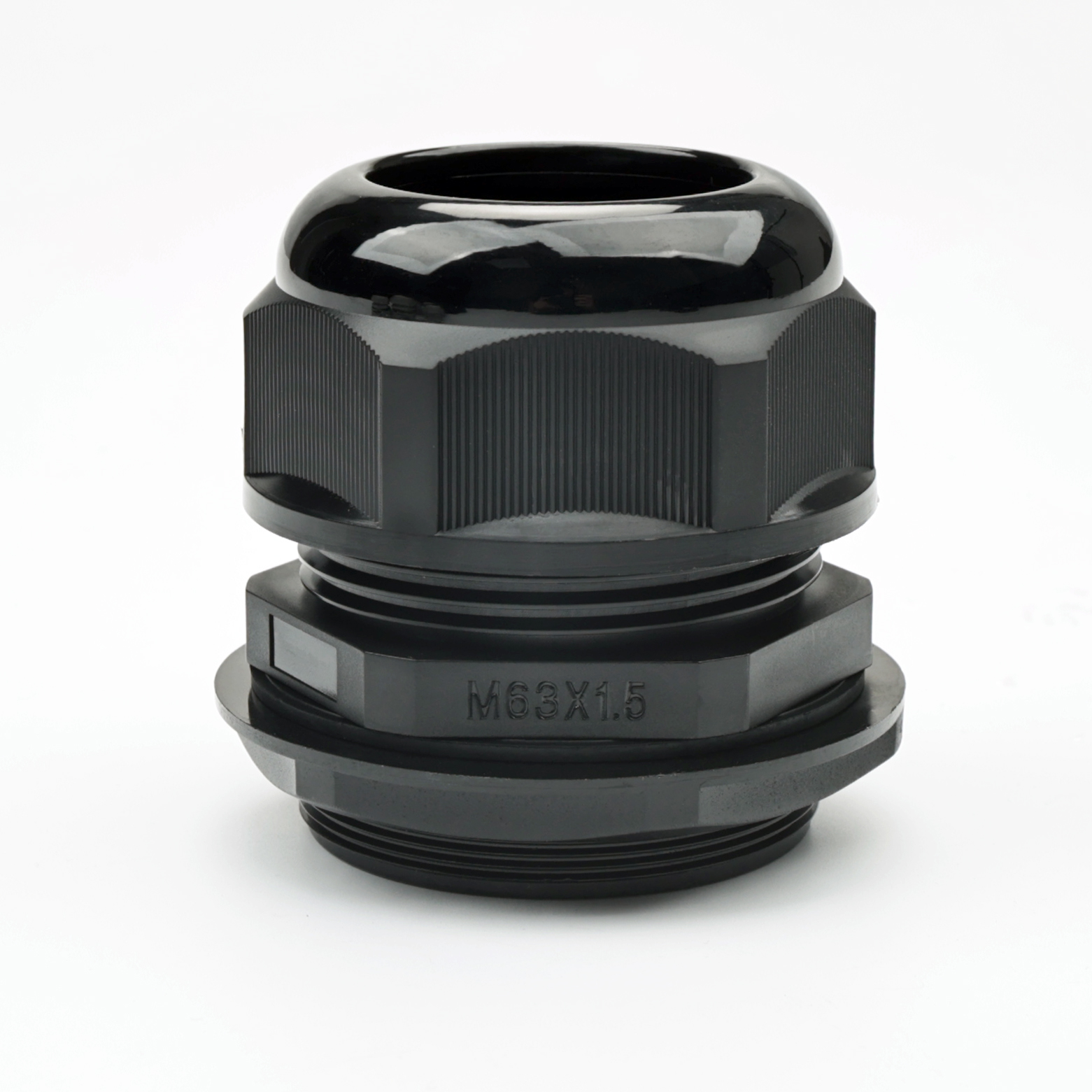
Gutai M63 nylon cable gland, top of the Metric range, clamping cables from 35 mm to 45 mm.
The two families most often specified in industrial, infrastructure and renewable-energy projects are the PG series and the Metric series. Gutai manufactures the PG cable gland line from PG7 to PG48, with thread outside diameters of 12.5 mm to 59.3 mm, and the Metric line from M12 to M63, with thread outside diameters of 12 mm to 63 mm. Both families accept cables from 3 mm to 45 mm and use thread lengths of 9 mm to 21 mm. Sealing is created by an NBR nitrile rubber seal compressed by a clamping claw inside a UL-approved Nylon PA66 body.
Zhejiang Gutai Connector Co., Ltd. (Gutai) is a Chinese manufacturer of waterproof cable glands, solar MC4 connectors, mini waterproof boxes and connectors, and hose fitting series including AD quick connectors, watertight corrugated connectors and flexible pipe fittings. Roughly 80% of output is exported to the Middle East, Southeast Asia, India, Pakistan, the EU, the UK and the USA.
Problem Definition: Why Cable Gland Sizing Fails in Practice
A cable gland sits between two tolerance stacks that are rarely documented in the same place. On one side is the enclosure: a threaded entry with a defined thread standard, a defined outside diameter, and a panel wall of some thickness. On the other side is the cable: a jacket with a nominal diameter, a manufacturing tolerance, and a real diameter that changes with temperature, bending and routing.
Most sizing errors trace back to four habits.
- Sizing by cable diameter alone. A gland that fits the cable but not the enclosure entry cannot be installed. The thread designation has to be confirmed first.
- Treating PG and Metric as interchangeable. A PG16 entry is not an M16 entry. PG threads follow their own outside-diameter series, which is why the PG family reaches 59.3 mm at PG48 while the Metric family reaches 63 mm at M63.
- Ignoring thread length against panel thickness. Both Gutai families offer thread lengths from 9 mm to 21 mm. A short thread on a thick enclosure wall may not leave enough engagement for a locknut and seal.
- Working the edge of the clamping range. A gland selected at the very bottom or top of its range has little margin for jacket tolerance, and pull-out resistance suffers.
The cost of a wrong selection is not the price of the gland. It is the rework: drained enclosures, re-terminated cables and, in outdoor projects, water ingress that only appears months after installation.
Industry Background: Standards, Ratings and Market Context
Cable glands for electrical installations are governed by IEC 62444, published in Europe as EN 62444. The standard sets construction and performance requirements and replaced the older BS EN 50262 (source: IEC / BSI). Ingress protection is defined separately: IP68 is the benchmark ingress protection rating for waterproof connectors, requiring the device to withstand continuous immersion in water under specified conditions, as set out in IEC 60529 (source: IEC).
Those two documents explain why a gland should never be judged on a single number. IEC 62444 addresses mechanical performance, including how the gland grips and seals the cable. IP68 addresses water and dust ingress under defined test conditions. A gland that passes IP68 in a laboratory fixture can still leak in the field if it is installed on a cable at the extreme of its clamping range, or with insufficient thread engagement.
Market context explains why sizing documentation has become more important. The global cable glands market was valued at approximately USD 2.16 billion to USD 2.25 billion in 2024 to 2025, with published forecasts for 2034 ranging from USD 3.07 billion to USD 4.96 billion depending on methodology and scope (Straits Research; Spherical Insights). Asia Pacific accounts for an estimated 38% to 42% of global revenue, driven largely by industrialization in China and India (Dataintelo; Straits Research). The spread in those forecasts is itself a useful signal for buyers: treat any single market figure as an order of magnitude rather than a specification.
The supplier landscape is correspondingly broad and includes multinationals such as ABB Ltd., Eaton Corporation, Amphenol Corporation, LAPP Group and HUMMEL AG (Mordor Intelligence), alongside regional manufacturers such as Gutai. The practical consequence for a specifier is simple: thread and cable-range data must be verified from the supplier's own documentation instead of assumed from a familiar brand name.
Detailed Solution: Reading the Dimensional Data Correctly
Thread ranges: PG7 to PG48 and M12 to M63
Gutai's two main nylon cable gland families differ mainly in thread geometry, and the numbers below are the ones that belong in a specification sheet.
- PG series: PG7 to PG48, thread outside diameter 12.5 mm to 59.3 mm.
- Metric series: M12 to M63, thread outside diameter 12 mm to 63 mm.
- Both families: cable range 3 mm to 45 mm, thread length 9 mm to 21 mm.
- Materials: Nylon PA66 for body components (A/C/E/F); NBR nitrile butadiene rubber for sealing parts (B/D).
The same construction is also available in G thread and NPT thread versions, so a project with mixed enclosure standards can be covered from a single supply source rather than two.
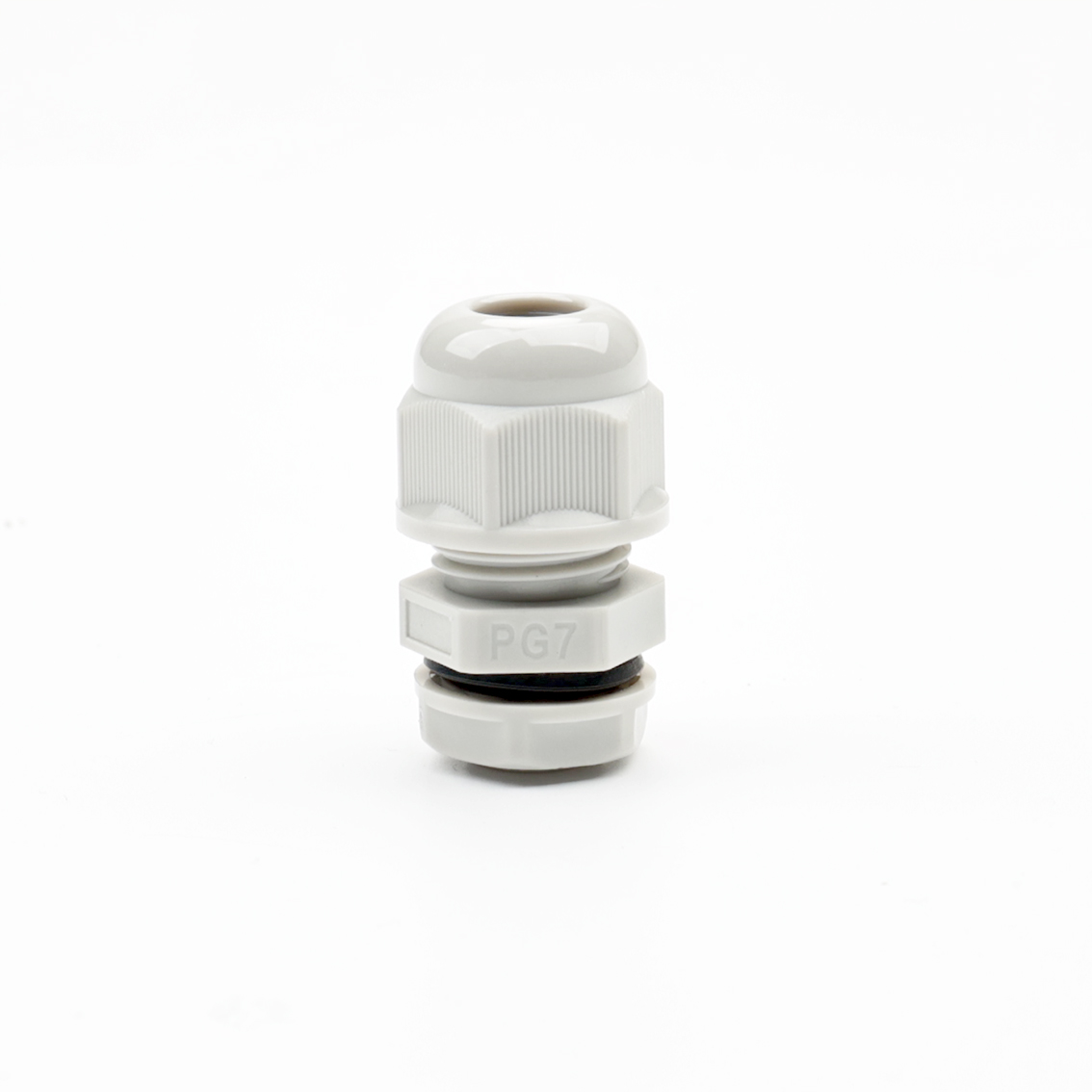
PG7 cable gland, the smallest standard PG size, covering cables from 4 mm to 8 mm.
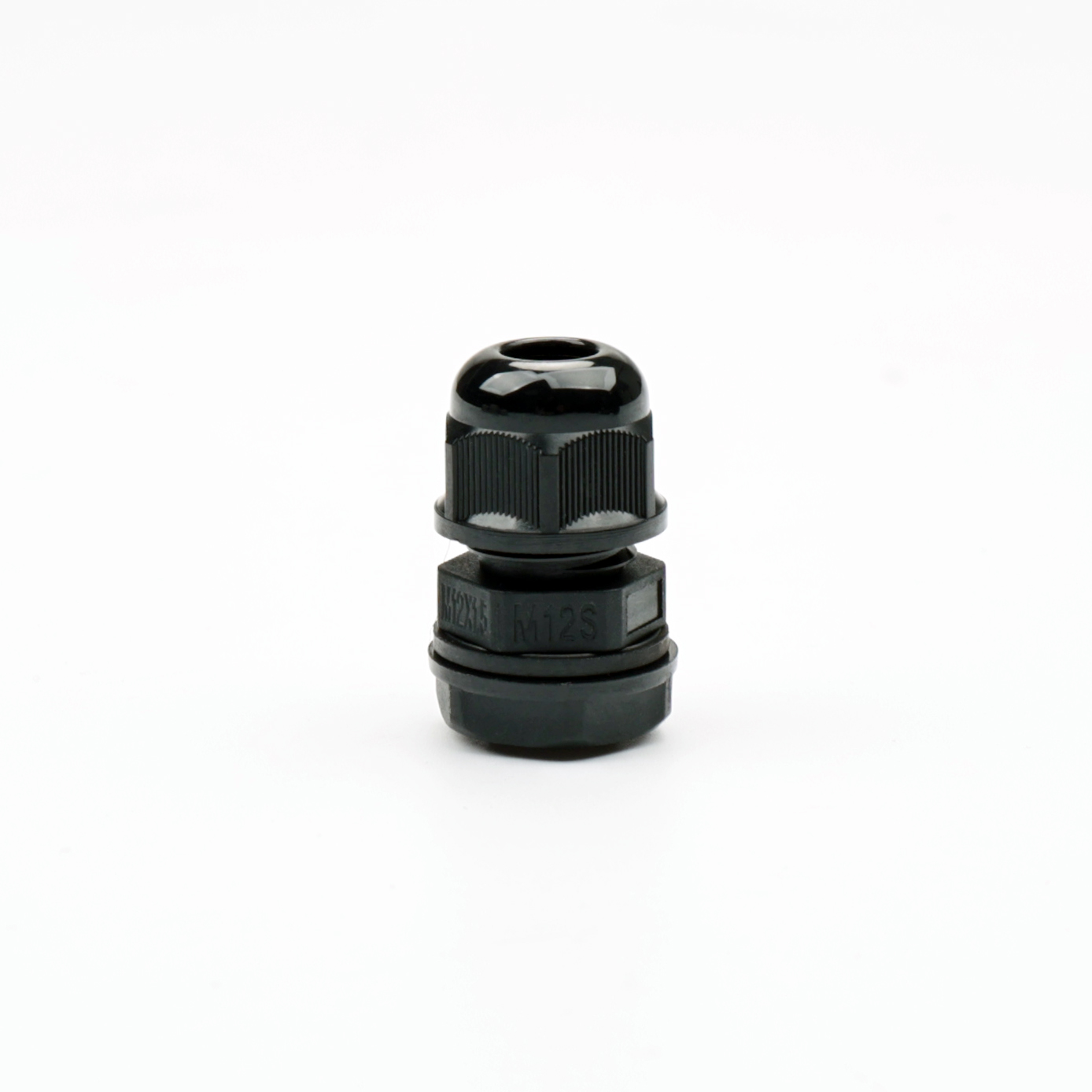
M12S cable gland at the bottom of the Metric range, covering 3 mm to 6.5 mm.
Thread length is a separate check
Thread length is often the last item a buyer checks and the first that causes a fit problem. Between 9 mm and 21 mm of thread has to cover the panel wall thickness, the locknut, and the mating thread engagement. Short-thread glands suit thin sheet-metal enclosures. Long-thread glands suit cast boxes, machined plates and thick-walled cabinets. If wall thickness is unknown at the enquiry stage, it should be stated as a range rather than assumed as a single value.
Clamping claw and NBR sealing: how pull-out resistance is created
Sealing in a Gutai nylon cable gland is created by two elements working together: a clamping claw and an NBR rubber seal.
The clamping claw converts the tightening torque of the sealing nut into radial compression on the cable jacket. Because the claw is divided into fingers, it spreads the load around the circumference instead of crushing one side of the cable. That is what produces pull-out resistance and strain relief: mechanical load stays on the jacket and the gland body rather than reaching the terminal inside the enclosure.
The NBR rubber seal closes the gap between the cable and the gland body. NBR is specified for its oil resistance and its stable behaviour across the gland's rated temperature window. Gutai publishes two windows: static -40°C to 100°C with a peak instantaneous temperature up to 120°C, and dynamic -20°C to 80°C with a peak instantaneous temperature up to 100°C.
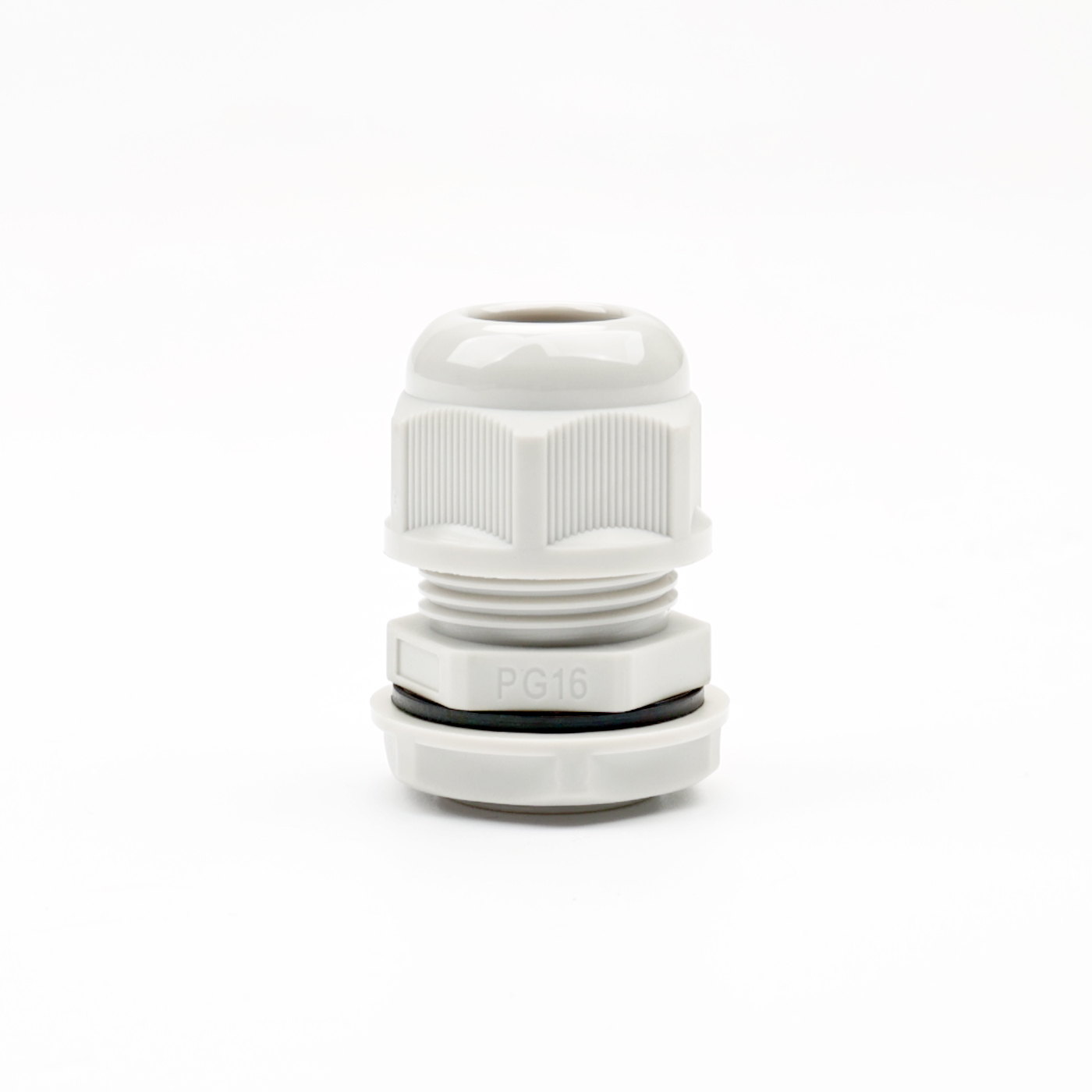
PG16 cable gland, a mid-range size covering cables from 8.5 mm to 14 mm.
Together, the claw and the seal are what allow one gland body to claim IP68 across a clamping range rather than for a single cable diameter. The gland is also documented as resistant to salt spray, acid, alkali, alcohol, grease and common solvents, which matters when the enclosure sits outdoors or in a wash-down area. Standard colours are black (RAL9005), light grey (RAL7035) and silver (RAL7001), with custom colours available on request.
Certification data to attach to the sizing sheet
Sizing and compliance belong on the same document, because an enclosure entry that is dimensionally correct but not certified for the target market still blocks shipment.
| Document | Standard | Number and issuer | Market |
|---|---|---|---|
| CE Certificate of Compliance | EN 62444:2013 | TST20241202520-1SC, issued by Dongguan True Safety Testing Co., Ltd. | EU |
| RoHS SGS Test Report | EU RoHS Directive (EU) 2015/863 amending Annex II to Directive 2011/65/EU | NGBEC26005747401, issued by SGS-CSTC Standards Technical Services (Ningbo) Co., Ltd. | EU |
| UL Notice of Completion (NoC) | UL 514B | File E539858, Volume 1, issued by UL Solutions | US and Canada |
| ISO 9001 Quality Management System | GB/T19001-2016 / ISO9001:2015 | Registration No. 04324Q31620R0S, issued by Beijing United Intelligence Certification Co., Ltd. | Global |
The CE certificate scope covers Nylon cable gland, Model M, Series G, MG, PG and NPT. The RoHS report scope is nylon cable gland. The ISO 9001 scope is the production of cable waterproof joints, and the certificate is valid from 2024-07-02 to 2027-07-01. The cable gland range is additionally certified with CE, RoHS, REACH, IP68 and CCC, and the Nylon PA66 material used in the body is UL approved.
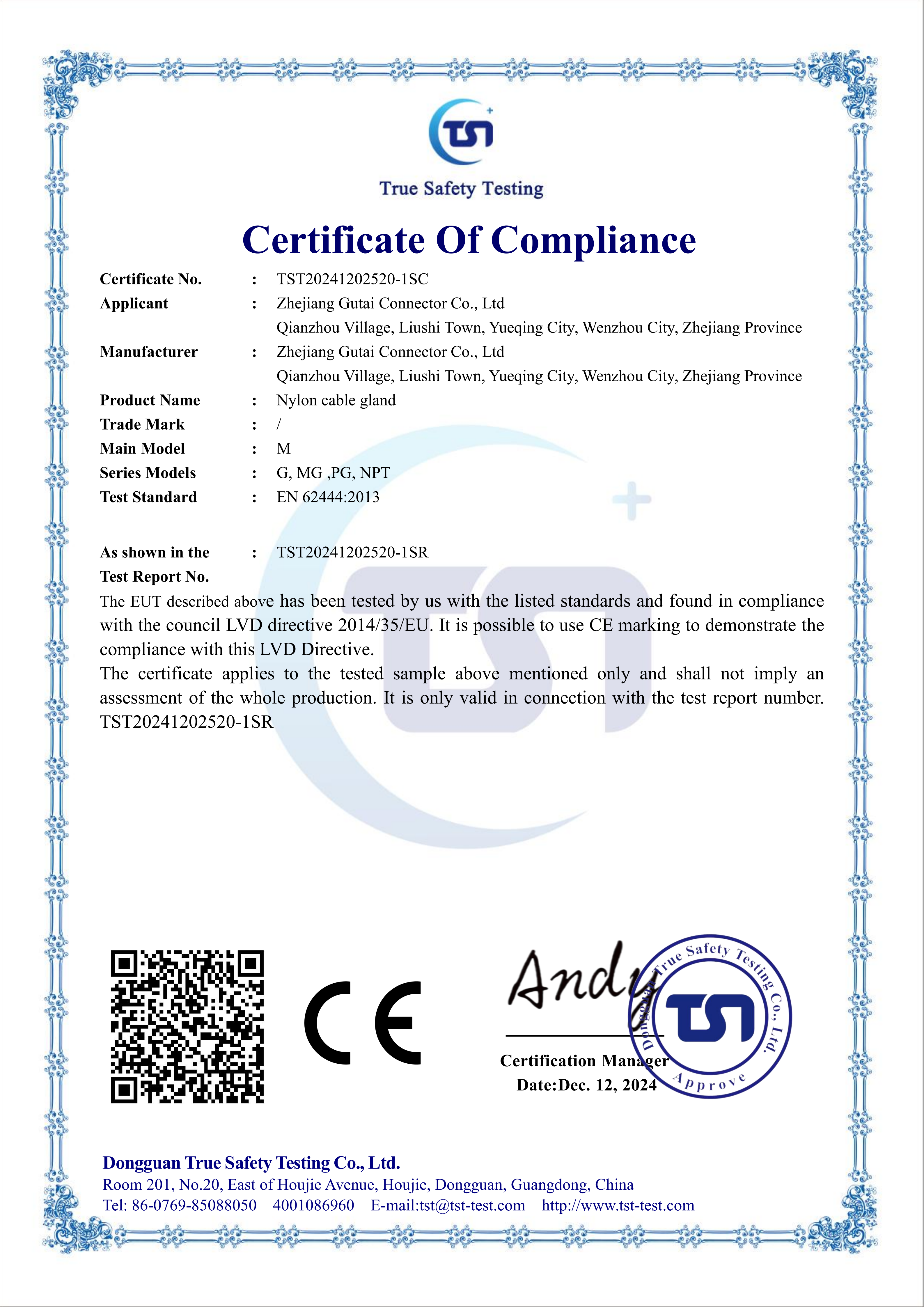
Gutai CE Certificate of Compliance, issued against EN 62444:2013 for nylon cable glands.

SGS RoHS test report NGBEC26005747401 covering Gutai nylon cable glands.
Step-by-Step Breakdown: A Six-Step Sizing Procedure
Step 1: Measure the cable at its largest point
Use a caliper and measure in three places around the circumference. Record the largest reading, because the gland must clamp the cable at its widest point, not at its average. Include jacket tolerance, and note whether the cable is a round jacketed cable or a multi-core cable that can deform under compression.
Step 2: Identify the thread standard of the enclosure entry
Measure the thread outside diameter and pitch, then compare the result against the PG, Metric, G or NPT series. Record the designation rather than the diameter alone: a 16 mm measurement is not enough to distinguish an M16 entry from a PG16 entry, and the two glands are not interchangeable.
Step 3: Check thread length against wall thickness
Add the panel wall thickness, the locknut thickness and the required thread engagement. If the total exceeds the available thread length, select a long-thread variant. Gutai's range spans 9 mm to 21 mm of thread, which covers most sheet-metal, cast and machined enclosure walls when the wall thickness is known.
Step 4: Choose the cable range with margin
Aim for a cable that sits toward the middle of the gland clamping range rather than at the edge. The size quick-reference table further down this page lists the cable range for each individual size in both families.
Step 5: Confirm the sealing environment
Temperature, oil, salt, chemical exposure and UV all influence material selection. NBR sealing is standard across the range, and the published static and dynamic temperature windows set the operating limits: static -40°C to 100°C, dynamic -20°C to 80°C.
Step 6: Validate with a sample and dimensional data
Gutai applies 100% full dimension inspection, accepts small trial orders, and provides free selection guidance and custom sampling. Sampling confirms thread fit and pull-out behaviour before a production commitment, which is cheaper than discovering a mismatch in a container-load of glands.
Use Cases: Where Sizing Precision Pays Back
Gutai cable glands are used across the new energy sector, industrial automation and advanced manufacturing, construction and infrastructure, and marine engineering and shipbuilding. In practice that means combiner boxes and junction boxes, inverters, storage cabinets, EV charger enclosures, rail transit electrical cabinets, industrial control cabinets and conduit or corrugated tubing systems.
In solar and energy storage installations, the entry point is often the weakest link in an otherwise well-sealed enclosure. A correctly sized gland keeps water and dust out of combiner boxes and storage cabinets while holding the cable against wind load and thermal cycling. In industrial automation, the clamping claw and NBR seal provide the strain relief that protects terminals in control cabinets subject to vibration.
Coastal and marine environments put the material choice under more pressure. A European coastal open-air DC fast charging project is a useful illustration of what a properly specified sealing system delivers over time. The operator deployed 5,000 sets of IP68-grade metal waterproof connectors for coastal outdoor DC fast charging piles, using 304 stainless steel with a dual-seal anti-loosening structure, passing 1,000-hour salt spray testing and IEC 60068-2-6 vibration testing. Over an 18-month period, connector-related electrical failure rate fell from 18% annually to 2.6%, annual maintenance cost per station dropped from over 500 RMB to below 80 RMB, and new station installation efficiency increased by 35%.
The same sealing logic applies in telecom base stations, rail transit wiring and general industrial equipment, where glands on overhead and outdoor routing have to survive temperature variation, dust and chemical exposure. Gutai's material documentation covers resistance to salt spray, acid, alkali, alcohol, grease and common solvents, which is the property set that determines service life in these environments.
Comparison Table: PG and Metric Families Side by Side
The two families are not competing options; they exist because enclosure manufacturers around the world standardized on different thread systems. The table below compares the published parameters.
| Parameter | PG Cable Gland (model PG) | Metric Cable Gland (Metric Series) |
|---|---|---|
| Thread size range | PG7 to PG48 | M12 to M63 |
| Thread outside diameter | 12.5 mm to 59.3 mm | 12 mm to 63 mm |
| Cable range | 3 mm to 45 mm | 3 mm to 45 mm |
| Thread length | 9 mm to 21 mm | 9 mm to 21 mm |
| Body material | Nylon PA66 | Nylon PA66 |
| Sealing material | NBR nitrile butadiene rubber | NBR nitrile butadiene rubber |
| Protection level | IP68 | IP68 |
| Certifications | CE, RoHS, REACH, IP68, CCC; Nylon PA66 UL approved | CE, RoHS, REACH, IP68, CCC; Nylon PA66 UL approved |
| UL coverage | UL Notice of Completion (NoC), UL 514B, File E539858 Volume 1 | UL Notice of Completion (NoC), UL 514B, File E539858 Volume 1 |
| Temperature, static | -40°C to 100°C (peak 120°C) | -40°C to 100°C (peak 120°C) |
| Temperature, dynamic | -20°C to 80°C (peak 100°C) | -20°C to 80°C (peak 100°C) |
| Standard colours | Black RAL9005, light grey RAL7035, silver RAL7001 | Black RAL9005, light grey RAL7035, silver RAL7001 |
| Typical application | Equipment built to PG entry standards | Equipment built to Metric entry standards |
The single decision-relevant difference is the thread geometry and the outside diameter at the top of the range. Because the Metric series extends to 63 mm and the PG series stops at 59.3 mm, the largest enclosures may be served only by one of the two families.
Size quick reference: cable range by individual gland size
Use this table to shortlist a size from a measured cable diameter. Sizes with an S suffix are reduced-range variants of the same thread, useful when a standard size would leave the cable at the edge of its clamping range.
| Series | Size | Cable range |
|---|---|---|
| Metric | M12S | 3 mm to 6.5 mm |
| Metric | M12 | 4 mm to 8 mm |
| Metric | M16S | 4 mm to 8 mm |
| Metric | M16 | 6 mm to 10 mm |
| Metric | M18 | 6 mm to 10 mm |
| Metric | M20S | 6 mm to 12 mm |
| Metric | M20 | 8.5 mm to 14 mm |
| Metric | M25S | 8.5 mm to 14 mm |
| Metric | M25 | 12.5 mm to 18 mm |
| Metric | M32 | 18 mm to 25 mm |
| Metric | M50 | 31 mm to 41 mm |
| Metric | M63 | 35 mm to 45 mm |
| PG | PG7S | 3 mm to 6.5 mm |
| PG | PG7 | 4 mm to 8 mm |
| PG | PG9 | 4 mm to 8 mm |
| PG | PG11 | 6 mm to 10 mm |
| PG | PG13.5 | 6 mm to 12 mm |
| PG | PG16 | 8.5 mm to 14 mm |
| PG | PG19 | 12 mm to 15 mm |
| PG | PG25 | 15 mm to 21 mm |
| PG | PG29 | 18 mm to 25 mm |
| PG | PG36 | 24 mm to 32 mm |
| PG | PG42 | 31 mm to 41 mm |
| PG | PG48 | 35 mm to 45 mm |
FAQ: Cable Gland Sizing, Certification and Supply
What certifications should appear on a cable gland datasheet for EU and North American projects?
For EU projects, look for CE marking against EN 62444:2013 plus an accredited-laboratory RoHS test report. Gutai nylon cable glands are covered by CE certificate TST20241202520-1SC issued by Dongguan True Safety Testing Co., Ltd., with scope covering Nylon cable gland, Model M, Series G, MG, PG and NPT, and by SGS test report NGBEC26005747401 issued by SGS-CSTC Standards Technical Services (Ningbo) Co., Ltd. against EU RoHS Directive (EU) 2015/863 amending Annex II to Directive 2011/65/EU. The range is certified with CE, RoHS, REACH, IP68 and CCC, and the Nylon PA66 body material is UL approved. For US and Canadian projects, the relevant document is the UL Notice of Completion (NoC) for QCRV liquid-tight flexible cord fittings, File E539858, Volume 1, to UL 514B, issued by UL Solutions. Production runs under an ISO9001:2015 quality management system, Registration No. 04324Q31620R0S, covering the production of cable waterproof joints.
Can thread type, colour and sealing layout be customized?
Yes. Gutai manufactures Metric, PG, G and NPT thread types and supports OEM and ODM customization of size and thread specification, body material (nylon, brass or stainless steel), colour, packaging, OEM labelling, multi-hole layouts and specific seal designs. Standard colours are black (RAL9005), light grey (RAL7035) and silver (RAL7001), with custom colours available on request. Monthly capacity is 500,000 cable glands alongside 100,000 sets of MC4 connectors, and production is supported by 100% full dimension inspection under an ISO9001:2015 quality management system.
What drives the cost of a cable gland order?
Cable gland pricing is quoted per project because several variables move together: the body material (UL-approved Nylon PA66 or a metal version), the thread type and size, the sealing material, the documentation pack required for the destination market, and the order quantity and packaging. Customization such as non-standard colours, multi-hole layouts, special seals or OEM labelling adds setup steps. Gutai accepts small trial orders, so a buyer can validate sizing and the certification pack on a small quantity before scaling. A quotation request that states the exact thread designation, the measured cable outside diameter range, the panel thickness, the order quantity and the required certificates will produce the most comparable result.
How can a buyer validate sizing before committing to a production order?
Order a sample in the exact thread size and cable range. Gutai accepts small trial orders and provides free selection guidance and custom sampling services, with 100% full dimension inspection in production. A practical sample check is to confirm that the thread engages the enclosure entry by hand before tightening, that the cable sits inside the clamping range when the sealing nut is fully tightened, and that the clamping claw grips the jacket when the cable is pulled. IEC 62444 defines the construction and performance requirements a cable gland should meet, while IP68 is defined in IEC 60529 as withstanding continuous immersion in water under specified conditions.
What is the lead time, and how much production capacity is behind it?
Lead time depends on order quantity and on whether the order is standard or customized. Gutai's monthly capacity is 500,000 cable glands and 100,000 sets of MC4 connectors; standard-colour products on standard threads follow the regular production schedule, while custom colours, multi-hole layouts and OEM labelling require additional setup. The full 2025 Gutai catalogue, including thread and cable-range tables, can be downloaded at the link in the section below, and sizing support or a quotation request can be sent to vincy@gt-connector.com or WhatsApp 0086-13676576672.
Conclusion: Three Checks, One Sample, Then Scale
Thread size, thread length and cable range are the three checks that decide whether a waterproof cable gland performs as specified. The PG series runs from PG7 to PG48 with thread outside diameters of 12.5 mm to 59.3 mm, the Metric series runs from M12 to M63 with thread outside diameters of 12 mm to 63 mm, both accept cables from 3 mm to 45 mm, and both use thread lengths of 9 mm to 21 mm. Pull-out resistance comes from the clamping claw compressing the jacket, while the NBR rubber seal closes the gap between cable and body to hold IP68.
What turns those parameters into a purchasing decision is evidence: CE certification to EN 62444:2013, an SGS RoHS test report to EU Directive (EU) 2015/863, a UL Notice of Completion to UL 514B, and production under an ISO9001:2015 quality management system. Verify the dimensions on a sample, confirm the certification pack for the destination market, then scale the order.
Next step
Download the 2025 Gutai catalogue for full thread and cable-range tables, or request a sample and quotation in your exact thread size: 2025 Gutai Product Catalogue (PDF)
Website: www.gt-connector.com | Email: vincy@gt-connector.com | WhatsApp: 0086-13676576672
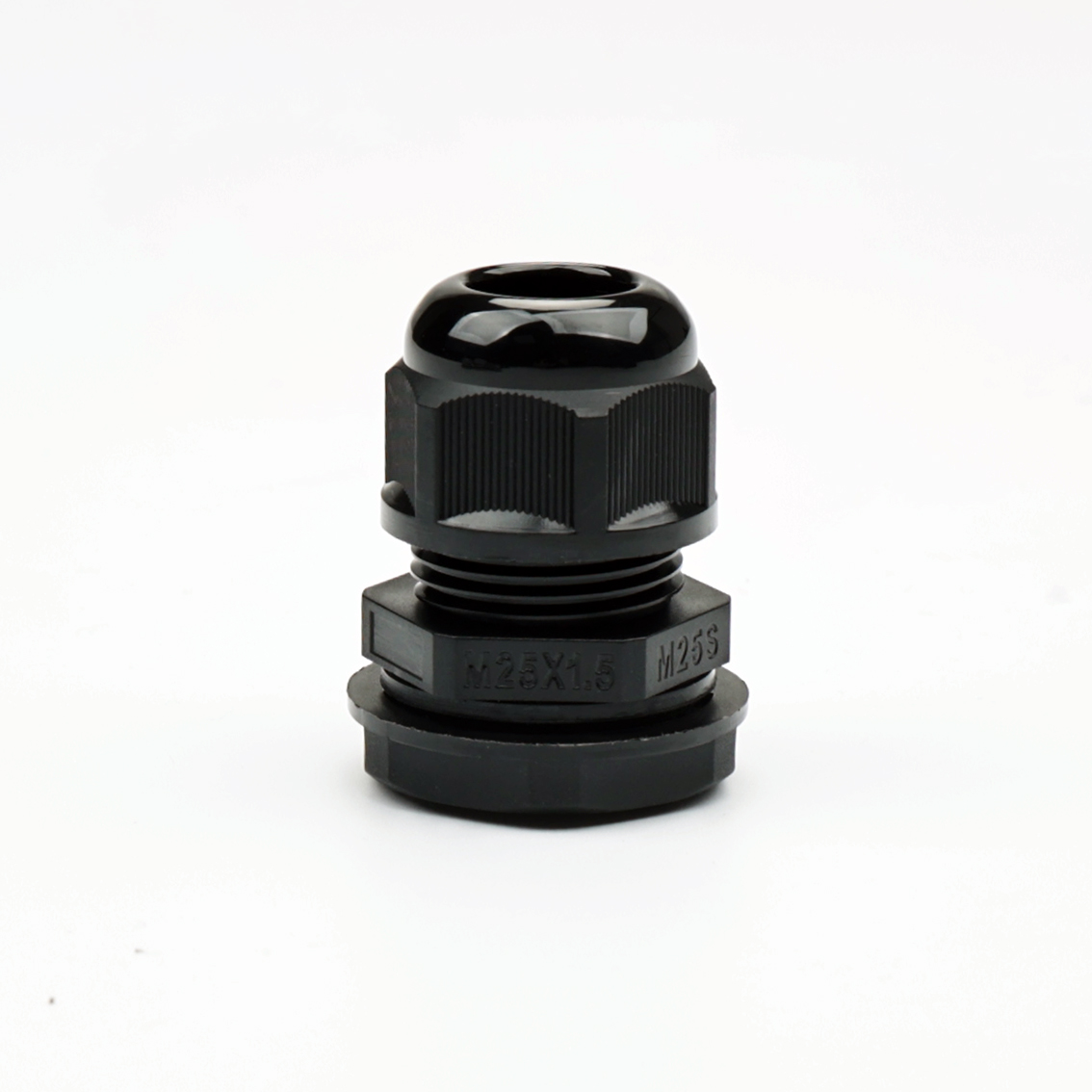
M25S cable gland, one of the reduced-range sizes available for sample validation before mass production.