Before You Commit: Laminating Rolls Warranty and Claims FAQ
Laminating rolls are specified once and re-ordered for years. The specification sheet decides the first shipment; what happens after delivery decides every shipment that follows.
This FAQ is written for the procurement and quality teams who ask those second-order questions before signing: what the warranty actually covers, who answers when a roll fails, how a claim is proven rather than argued, and whether the commercial terms make repeat supply workable. The answers below reflect the documented commitments of Guangzhou Huada Laminating Film Co., Ltd. (HADA), a functional laminating film manufacturer established in 1992 in Guangzhou, China, operating a 40,000 m² facility with approximately 200 employees and exporting to more than 50 countries and regions.
Short answer: HADA's laminating roll film, model HD-RL, carries a 12-month warranty against delamination, color fading, and material defects. Quality complaints receive a response within 24 hours from a dedicated account manager, every shipment is covered by 100% pre-shipment inspection, and MOQ, lead time, and payment terms are fixed well enough to plan a twelve-month stock cycle against.
The After-Sales Problem Nobody Prices In
Delamination, yellowing, and adhesion loss rarely appear on the day of delivery. They surface weeks later, on a running laminating line, as rejected sheets that have already consumed printed stock, machine time, and operator hours.
Three costs follow a failed roll, and only one of them is about the film:
- Output loss — printed sheets that cannot be re-laminated and are scrapped together with the film.
- Line time — stopping, purging, re-threading, and re-qualifying the line before production resumes.
- Proof cost — the administrative effort of demonstrating that the fault sits with the film rather than with the laminator settings, the substrate, or storage.
The third cost is where suppliers separate most sharply. A warranty that names its failure categories, and a response time that is written down rather than implied, convert a dispute into a process. That is the practical difference between a supplier a distributor can stock for a decade and one that has to be re-evaluated every season.
Industry Background: Why Adhesive Failures Drive Most Laminating Roll Claims
Thermal laminating film is a layered product, and its failure modes follow the layers. An industry resource published by PRINTING United Alliance describes laminating supplies as generally polyester-based, and notes that they may use a co-extruded copolymer adhesive. Supplier technical pages in the same category commonly present a PET or polyester base film paired with an EVA adhesive layer.
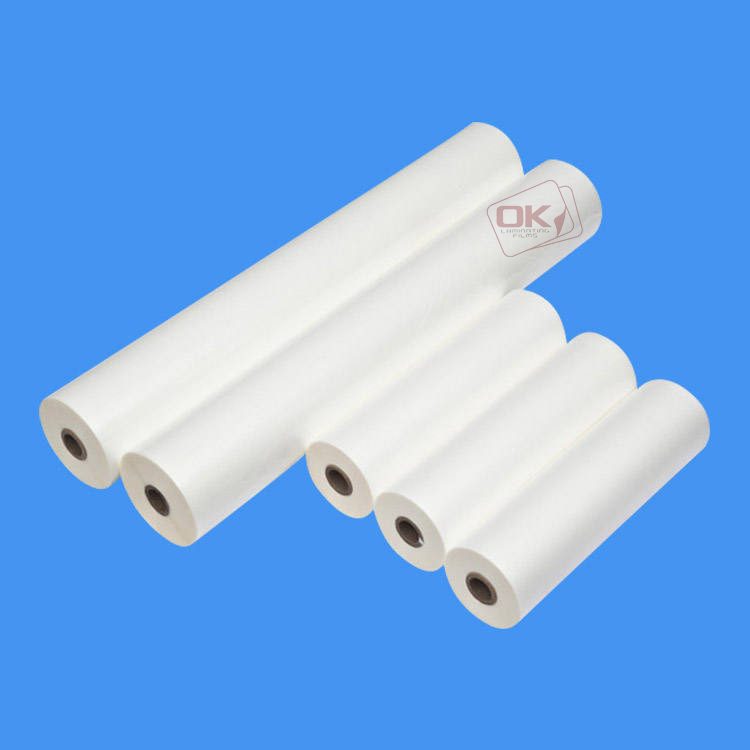
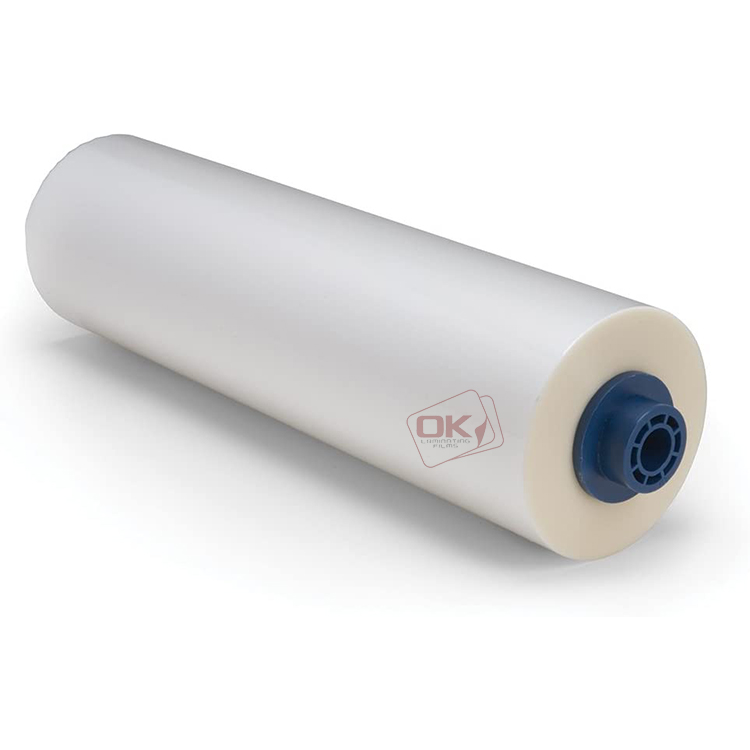
HD-RL follows that construction. The film combines a PET base with an EVA adhesive layer, is supplied in thicknesses from 35mic to 250mic and widths from 100mm to 1300mm, in glossy and matte finishes, with length and packaging customized to the order.
The market itself is not uniform in material choice. Industry report data compiled by Vertex AI Search places BOPP-based films at a 36% share of the thermal laminating machine film market in 2024, which means buyers routinely compare PET, BOPP, and other base films across the same production environment. Each base-and-adhesive combination has its own failure signature, its own activation behaviour, and its own sensitivity to line temperature and speed.
Two consequences follow for after-sales. First, a warranty is only meaningful when it names the defect categories rather than referring vaguely to "quality problems", because delamination and yellowing are technically different failures with different causes. Second, a claim can only be resolved quickly when the supplier can show that the film was within specification at the moment it left the factory — which makes the pre-shipment inspection record as important as the warranty clause itself.
What the 12-Month Warranty Covers
The warranty term runs 12 months and is limited to three named defect categories. Naming them matters: an unnamed warranty leaves the definition of "defect" to be negotiated after the loss has already been incurred.
1. Delamination
Delamination means separation between the PET base film and the EVA adhesive layer. On a finished sheet it appears as edge lift, a cloudy or silvered bond line, or film that peels away after the laminator cools. Because adhesion depends on both the film and the machine settings, a delamination claim is reviewed against the pre-shipment inspection record for that batch together with the lamination conditions reported by the buyer. HD-RL is specified for strong adhesion, no bubble and no wrinkle, which is the performance baseline a delamination claim is measured against.
2. Color fading
HD-RL is specified as anti-yellowing for long-term preservation, and high transparency is a stated product feature. A color fading claim therefore concerns a visible loss of clarity or a shift in the film's appearance within the warranty term. Document protection, ID card and badge lamination, book covers and menus, and retail display work are the applications where this matters most, because the laminated item is expected to remain legible for years rather than weeks.
3. Material defects
Material defects are deviations from what was ordered: thickness outside the quoted band, width outside the ordered slit size, or a finish that does not match the glossy or matte option on the order. Because HD-RL is produced from 35mic to 250mic, slit from 100mm to 1300mm, and packed to customized lengths and packaging, the order confirmation is the reference document for this category. It is also the reason specification detail belongs in writing at quotation stage, not in a post-claim conversation.
Boundary note: a warranty is a remedy route, not a substitute for application fit. Film thickness and finish have to match the laminator and the substrate before the warranty becomes relevant — the warranty covers the film's performance within its stated specification.
Step by Step: How a Quality Claim Is Handled
The sequence below is what a claim looks like in practice, from the buyer's first message to the corrective action on affected rolls.
- Contact your account manager. Each account is served by a dedicated account manager rather than a shared inbox, and quality complaints receive a response within 24 hours. The first reply establishes who is handling the case and what information is needed.
- Identify the roll. Have ready the order number, the roll or batch reference, the ordered thickness, width and finish, and the lamination settings used — temperature, line speed, and substrate. A claim that can be tied to a specific shipment moves faster than a general complaint.
- Compare against the pre-shipment record. Every shipment is subject to 100% pre-shipment inspection. Where third-party verification is required, SGS or Intertek carries out pre-shipment inspection, and AQL sampling defines the acceptance criteria applied to the batch. The record is the shared reference both sides work from.
- Review under the warranty terms. The account manager confirms whether the reported failure falls inside the 12-month warranty categories — delamination, color fading, or material defect — and sets out the corrective route for the affected rolls.
- Feed the outcome into the next order. Resolved claims are used to adjust specification: slit width, micron, finish, roll length, pallet configuration, or packing. A claim that changes nothing about the next order is a claim that will be repeated.
Inspection Before Shipment: The Evidence Behind Every Claim
Most after-sales cost is decided before the container is loaded. Three inspection layers sit behind every HADA shipment:
- 100% pre-shipment inspection — applied to the shipment as a whole rather than to a spot check of selected rolls.
- Third-party pre-shipment inspection — SGS or Intertek, where the buyer or the destination market requires independent verification.
- AQL sampling — acceptance quality limit sampling, which gives both parties a statistical basis for what is accepted and what is rejected before dispatch.
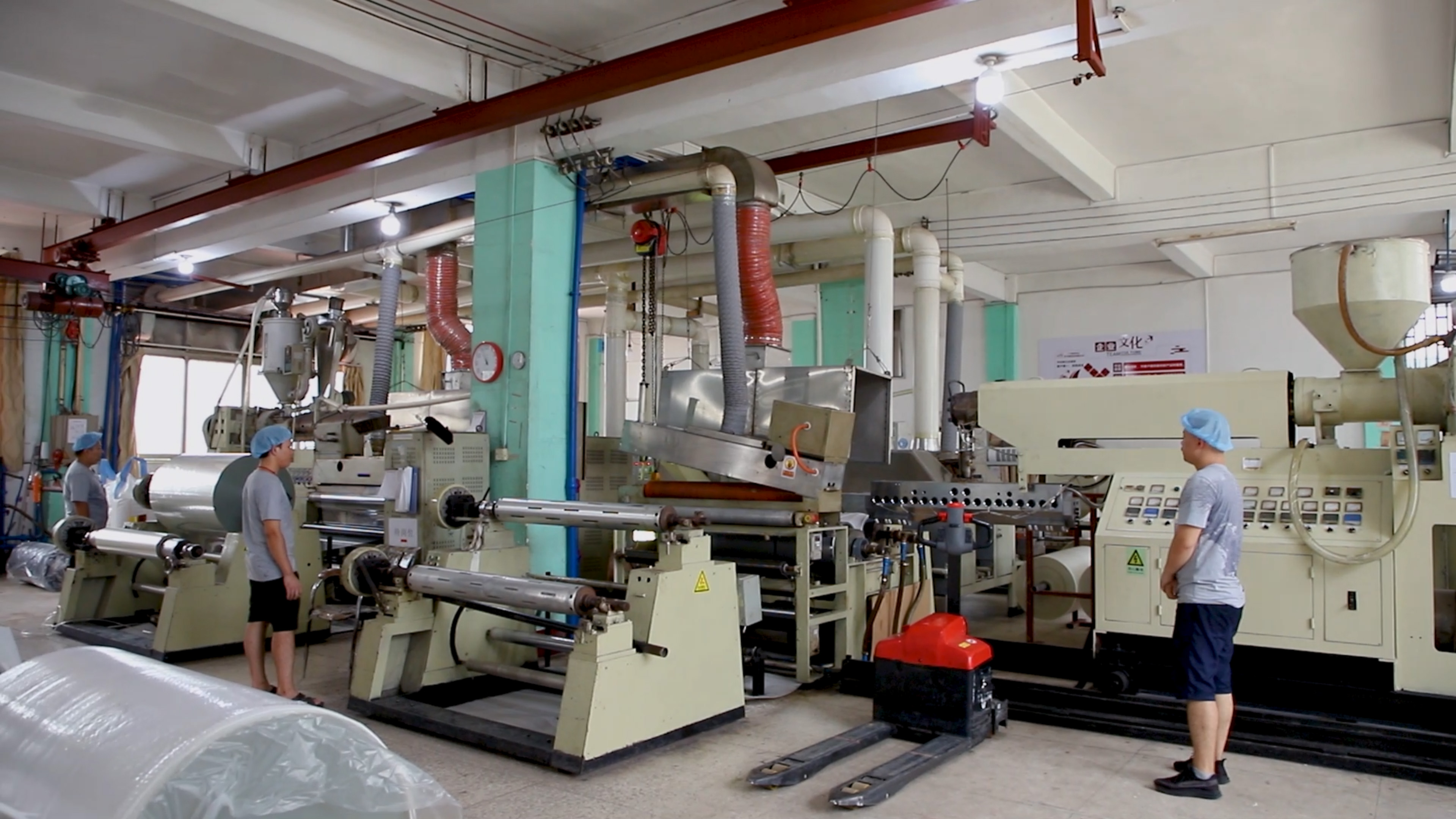
The quality management context around that inspection is documentable rather than verbal. HADA holds ISO 9001, BSCI, SMETA, ROHS, and REACH, along with 22 national patents, and supports the product with a five-engineer R&D team focused on functional laminating films. For a procurement team, the practical value is narrower and more useful than a certificate list: when a claim is raised, the buyer and the supplier are looking at the same acceptance record instead of reconstructing what happened from memory.
Pre-shipment inspection also shapes how the warranty categories are read. A thickness or slit-width claim is answered directly by the order confirmation against the inspection record. A delamination or fading claim is answered by the record plus the reported lamination conditions. In both cases the review starts from evidence that already exists rather than from an inspection commissioned after the failure.
Comparing Claim Types: Coverage and Evidence at a Glance
The table below maps each warranty category to its typical symptom and to the evidence used during review. It is a reference for what to document, not a substitute for the warranty terms themselves.
| Claim type | Typical symptom | Coverage under the 12-month warranty | Evidence reviewed |
|---|---|---|---|
| Delamination | Edge lift, cloudy bond line, film separating after the laminator cools | Covered | Pre-shipment inspection record for the batch, AQL sample results, reported lamination temperature and line speed |
| Color fading | Yellowing or loss of clarity over time, contrary to the anti-yellowing specification | Covered | Roll and batch reference against the shipment record, application and storage conditions |
| Material defect | Thickness, width, or finish outside the ordered specification | Covered | Order confirmation compared with the inspection record (35mic–250mic; 100mm–1300mm; glossy or matte) |
Commercial Terms That Decide Whether Repeat Ordering Works
Warranty protection is only useful if the supply terms allow the buyer to reorder without renegotiating. Three terms carry most of that weight.
| Term | HADA standard | What it means for planning |
|---|---|---|
| Minimum order quantity | 1,000 packs for standard film; 2,000 pcs / 100 rolls for customized sizes | Standard sizes act as the lower-commitment entry point; custom slitting and custom lengths start from the higher tier, so SKU count should be decided before the first PO |
| Lead time | 20–30 days | Reorder point must cover consumption during the transit and production window plus safety stock; for a distributor, this is the single number that decides whether stock-outs happen |
| Payment terms | T/T 30% deposit and 70% before shipment; L/C at sight; OA 30 days | T/T suits first and trial orders; L/C at sight suits larger commitments; OA 30 days supports distributor working capital on established repeat programmes |

Two planning consequences follow directly. First, the MOQ structure creates a deliberate split between standard and customized supply: a buyer can enter at 1,000 packs on standard film, then move to 2,000 pcs or 100 rolls once custom widths are proven on the line. Second, the 20–30 day lead time has to be read together with the 12-month warranty, because a roll delivered late and stored badly consumes warranty time without producing output. Stock rotation and storage conditions belong in the same planning document as the order quantity.
Payment structure interacts with all of this. T/T at 30% deposit and 70% before shipment keeps the first transaction simple; L/C at sight removes payment risk on larger volumes; OA 30 days is what makes a distributor's twelve-month stock plan financeable, because the payment cycle trails the shipment rather than preceding it.
After-Sales in Practice: Three Buyer Scenarios
Scenario 1 — A distributor running repeat stock orders
For a distributor, the warranty is a background condition rather than an active tool. What matters is that the specification does not drift between shipments, that reorder lead time is predictable at 20–30 days, and that the claim route exists if a batch goes wrong. HADA's distributor relationships in Germany, Austria, and the United States have run for more than 10 years with zero quality complaints recorded — the outcome that repeat-order planning is built to produce.
Scenario 2 — A converter needing custom widths
Converters who laminate against a fixed sheet size rarely buy standard slit rolls. Customized sizes start at 2,000 pcs or 100 rolls, with widths anywhere from 100mm to 1300mm and thickness from 35mic to 250mic, produced on three automated lines with an annual capacity above 10,000 tons. The 12-month warranty applies to those custom rolls on the same terms, which is why the order confirmation has to carry the exact slit width and micron before production begins.
Scenario 3 — A brand owner or importer testing the supply
A first order is a risk assessment, not a purchase. The 1,000-pack standard-film MOQ keeps the initial commitment proportionate, 100% pre-shipment inspection with AQL sampling gives the buyer an acceptance record from the first container, and SGS or Intertek inspection can be added when the destination market requires independent verification. The 24-hour complaint response is the part of the relationship that gets tested first if anything goes wrong.
Long-Term Support: What a Decade-Long Distributor Relationship Shows
A warranty is a document; a decade without claims is evidence. HADA has supplied distributors in Germany, Austria, and the United States for more than 10 years with zero quality complaints recorded across those relationships. That outcome rests on continuity in four areas rather than on any single commitment.
- Manufacturing continuity — operations since 1992, over 33 years in functional laminating films, with an 80% export ratio across North America, South America, Europe, Australia, and Southeast Asia.
- Specification stability — HD-RL is produced to a defined structure (PET plus EVA), a defined thickness band (35mic–250mic), and a defined width band (100mm–1300mm), which is what allows a repeat order to match a previous one.
- Documented quality control — ISO 9001, BSCI, SMETA, ROHS, and REACH, plus 22 national patents and a five-engineer R&D team working on functional film development.
- Logistics position — the Guangzhou facility sits roughly 30 minutes from Baiyun International Airport, with access to the ports of Guangzhou and Shenzhen, which keeps a 20–30 day lead time credible rather than aspirational.
For a procurement team, the relevant reading is not that long relationships exist, but that they exist without a claim history. Zero recorded quality complaints over a decade implies the warranty was rarely needed — which is a stronger signal than a generous warranty that is used often.
FAQ: Warranty, Claims, and Long-Term Support
What quality documentation supports a laminating roll warranty claim?
Every HADA shipment is covered by 100% pre-shipment inspection. Where independent verification is required, SGS or Intertek performs the pre-shipment inspection, and AQL sampling defines the acceptance criteria applied to the batch. Around that record, HADA maintains ISO 9001, BSCI, SMETA, ROHS, and REACH, together with 22 national patents. In a claim review, the inspection record for the specific batch is the document that establishes whether the film met specification before dispatch, which is why it shortens the review rather than extending it.
What exactly does the 12-month warranty cover, and how quickly is a complaint answered?
The warranty runs 12 months and covers three named categories: delamination between the PET base and the EVA adhesive layer, color fading contrary to the anti-yellowing specification, and material defects such as thickness, width, or finish outside the ordered specification. Quality complaints receive a response within 24 hours from a dedicated account manager, who handles the case from first report through to the corrective action on the affected rolls.
Which payment terms are available, and how do they affect cash flow?
HADA accepts T/T with a 30% deposit and 70% before shipment, L/C at sight, and OA 30 days. T/T keeps a first or trial order administratively light; L/C at sight is typically used where the order value warrants bank intermediation; OA 30 days lets distributors and repeat buyers align payment with their own sales cycle instead of pre-funding stock. The choice affects working capital more than it affects price, so it should be agreed at quotation stage rather than after the order is confirmed.
What is the minimum order if I want to trial laminating rolls before committing?
The MOQ is 1,000 packs for standard film and 2,000 pcs or 100 rolls for customized sizes. The standard-film tier is the practical entry point for a first order, and it still carries the full pre-shipment inspection process with AQL sampling. Custom-width slitting between 100mm and 1300mm, and custom thickness from 35mic to 250mic, moves to the customized-size tier — which is why buyers usually confirm the finished sheet size before placing a trial.
How long is lead time, and how should it be planned against the warranty period?
Lead time is 20–30 days. Because the warranty term is 12 months, the order-to-output window determines how much of that protection is actually available in production: a roll that sits in storage for months consumes warranty time without generating output. Buyers typically set the reorder point from consumption during lead time plus safety stock, and rotate stock so the oldest rolls run first. If a first evaluation order makes sense for your application, the specification to send is sheet size, substrate, laminator type, and required finish — HADA's team can confirm the matching HD-RL thickness, width, and packing, and quote against the 1,000-pack standard tier or the customized-size tier.
Conclusion: Buy the Warranty as a Process, Not a Clause
After-sales terms are easy to write and hard to operate. What separates a usable warranty from a line in a quotation is whether it names its defect categories, whether someone answers within a defined window, and whether both sides can point to the same inspection record when something goes wrong.
In HADA's case the structure is specific: a 12-month warranty against delamination, color fading, and material defects; a 24-hour response from a dedicated account manager; 100% pre-shipment inspection with SGS or Intertek and AQL sampling available as independent verification; MOQ of 1,000 packs on standard film or 2,000 pcs / 100 rolls on customized sizes; a 20–30 day lead time; and payment through T/T, L/C at sight, or OA 30 days. The distributor relationships in Germany, Austria, and the United States that have run for more than a decade with zero recorded quality complaints are the outcome those terms are designed to produce.
Next step
Send your sheet size, substrate, laminator type, and required finish to the HADA team for a specification match and a quote against the standard or customized MOQ tier. Sample rolls and the current product catalogue are available on request.
Website: www.huada168.com | Email: brian@huada168.com | WhatsApp: +86 189 2958 9411
Guangzhou Huada Laminating Film Co., Ltd. — No.15, Shantangpai Road, Gaoweiqiang, Jinpen Village, Zhongluotan Town, Baiyun District, Guangzhou, Guangdong Province, China. Tel: 020-87451312.
Have Questions or Need More Details?
Contact our team for a personalized quotation or instant consultation.
Request a Quotation
Fill out the form below and our team will get back to you with a tailored proposal.
WhatsApp Direct Chat
Prefer to chat in real-time? Message us on WhatsApp for instant assistance & quick answers.
- Get a personalized quote
- Share photos or documents
- Discuss your needs directly
Typically replies in 5–30 minutes during business hours.