How Laminating Rolls Are Made: Inside a 33-Year-Old PET Film Factory
How Laminating Rolls Are Made: Inside a 33-Year-Old PET Film Factory
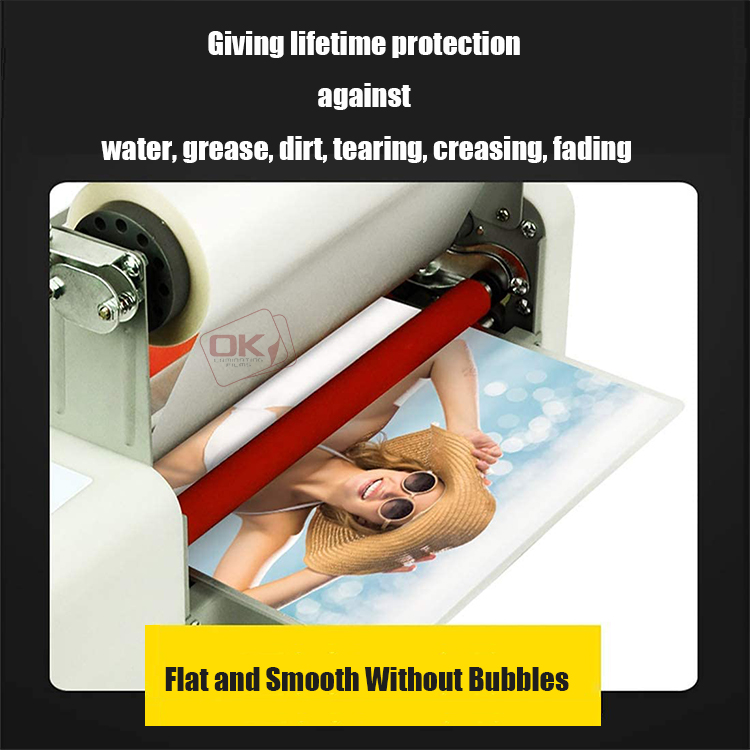
Laminating roll film: a PET base film combined with an EVA adhesive layer, produced by Guangzhou Huada Laminating Film Co., Ltd. in Guangzhou, China.
Laminating rolls are made in four broad moves: a PET base film is coated with an EVA adhesive layer, the coated web is dried and cured, the finished jumbo roll is slit to the ordered width, and the slit rolls are inspected and packed. Every property a buyer notices later — clarity, adhesion, bubble behaviour, edge curl, yellowing resistance — is decided during those moves, not at the laminator.
Guangzhou Huada Laminating Film Co., Ltd. (HADA) is a laminating film manufacturer founded in 1992 and based in Baiyun District, Guangzhou, China, producing laminating rolls, laminating pouches and related functional films. Its 40,000 sqm facility runs three automated production lines and exports to more than 50 countries and regions. This article uses that facility as a working example to explain what actually happens between raw material intake and the finished roll, and which stages buyers should ask about when comparing suppliers.
Problem Definition: Why the Manufacturing Process Is a Procurement Question
Most comparisons of laminating rolls begin with four numbers: thickness, width, length and price per roll. Two rolls can match on all four and still behave differently on the same laminator, because the variables that separate them are process variables rather than catalogue variables.
The failure modes that converters, print finishers and distributors report most often — bubbling after lamination, edge curl on thin gauges, weak adhesion on toner-heavy prints, delamination after trimming, yellowing after months in storage, static that attracts dust during handling — originate upstream. They are produced or prevented in base film quality, adhesive formulation, coating uniformity, drying, winding tension and slitting accuracy. None of them appear on a standard specification sheet, and none can be confirmed by visual inspection at the loading dock.
That is why the question “how are laminating rolls made?” behaves like a buying question rather than a factory-tour question. A buyer who understands the production sequence can ask targeted questions and interpret the answers, instead of comparing only the parameters that are easy to print.
Industry Background: A Market Measured in Billions, Decided in Microns
Lamination film is a large, globally traded category with several overlapping segment definitions, which is why published market figures differ depending on the scope being measured.
- DataM Intelligence estimates the global lamination films market at US$ 6,842.11 million in 2024, with food and beverage as the primary end-user segment.
- The same source places Asia Pacific at a 36.87% revenue share of that market in 2024.
- Data Bridge Market Research values BOPP thermal lamination films at US$ 3.5 billion in 2024, with a projected 5.2% CAGR through 2033.
- Future Market Insights values PET (BOPET) lamination films for packaging at USD 10.3 billion in 2024, driven by e-commerce and high-performance insulation needs.
Scope matters when reading these figures. Fortune Business Insights sizes the broader lamination film market at USD 9.01 billion for 2025, while Market Research Future reports USD 3.40 billion against a narrower definition. A buyer citing category growth in an internal business case should state which definition is being used, because the numbers are not interchangeable.
On the supply side, the largest global names in lamination and graphic roll film include Cosmo Films, Jindal Poly Films, Taghleef Industries (Derprosa) and GBC (ACCO Brands), according to Fortune Business Insights. Alongside these large-format producers sits a layer of regional manufacturers that serve converters, distributors and private-label programs with customized widths and shorter runs. Production transparency matters most in that segment, because the buyer is purchasing to a written specification rather than to a globally recognized brand.
Two technical reference points are useful when evaluating quality claims. ASTM D882 is the standard test method for determining tensile properties — strength, elongation and modulus — of thin plastic films less than 1.0 mm thick. In the European Union, plastic materials and articles intended for food contact must comply with Commission Regulation (EU) No 10/2011, which sets migration limits and a positive list of permitted substances.
Detailed Solution: What a 40,000 sqm Laminating Film Factory Contains
Guangzhou Huada Laminating Film Co., Ltd. has been producing laminating film since 1992 and holds more than 33 years of specialization in the industry. The company employs 200 people across a 40,000 sqm facility in Guangzhou, a commercial hub in South China, and operates three automated production lines with an annual capacity exceeding 10,000 tons.
The product portfolio covers Glossy Laminating Film, Matte Laminating Film, Laminating Roll Film, BOPP Film, OHP Film, PVC and PP Binding Covers, PET Crystal Film, PET Tempered Film and Cold Lamination Film, with the primary focus on laminating pouches and laminating rolls. Around 80% of output is exported to more than 50 countries and regions, with main markets across North America, South America, Europe, Australia and Southeast Asia. The site is roughly a 30-minute drive from Baiyun International Airport, with straightforward access to the major ports of Guangzhou and Shenzhen — a logistics detail that matters to importers planning consolidation.
Documentation includes ISO 9001, BSCI, SMETA, RoHS and REACH certifications alongside 22 national patents. A five-engineer R&D team covers formulation, coating and application development. For a buyer, the R&D headcount is the more revealing figure of the two: it indicates that the adhesive and coating layers are developed in-house rather than purchased as a finished web.
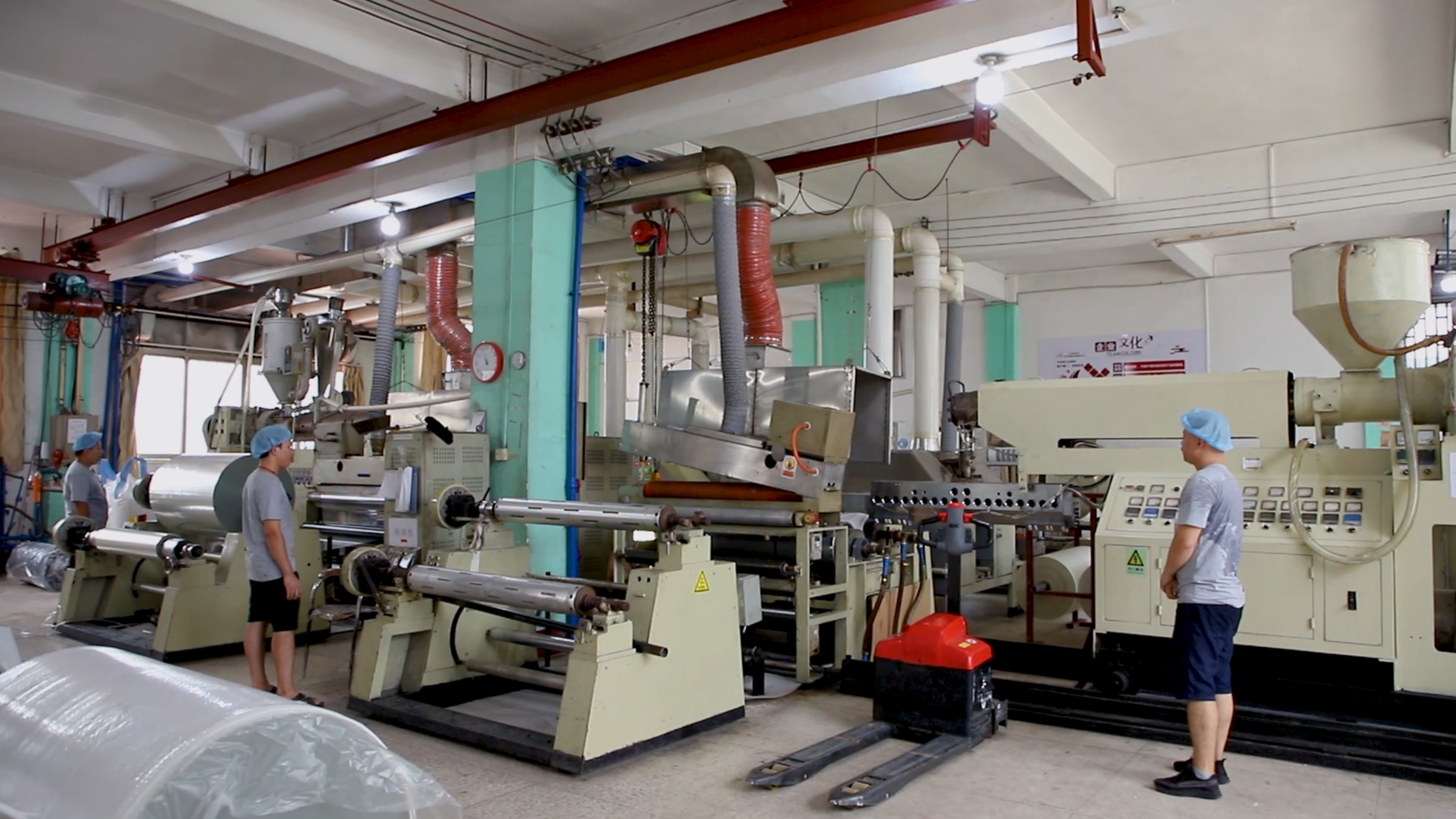
Coating and finishing equipment at HADA’s Guangzhou plant, where PET base film is combined with an EVA adhesive layer.
Step-by-Step: Following One Roll of HD-RL Film Through the Plant
HD-RL is HADA’s thermal laminating roll, built on a PET and EVA structure. The verified specification is a thickness range of 35mic to 250mic, a width range of 100mm to 1300mm, customizable length and packaging, and a choice of glossy or matte finish. The film is specified as suitable for all standard thermal laminators. The seven stages below explain how those parameters are actually produced.
Step 1 – Incoming material control
The process begins with two inputs: PET base film and EVA resin. Base film gauge, optical clarity and surface quality set the ceiling on the finished roll’s transparency, while the resin grade determines how the adhesive layer behaves under heat. Incoming material is the stage where sourcing discipline is either visible or absent. Buyers evaluating anti-yellowing claims in particular should ask where the base film originates, how each incoming lot is verified against the declared specification, and whether lot traceability is retained through to the finished roll.
Step 2 – Adhesive layer formulation
The EVA layer is the functional half of the PET + EVA structure. In a thermal laminating roll this layer softens under the heat of the laminator and bonds to the printed surface; in a cold laminating film, the same job is done by a pressure-sensitive adhesive that works at room temperature. Formulation choices determine adhesion strength, activation temperature, odour and long-term stability, which is why R&D activity concentrates at this stage rather than at the end of the line. Compliance work also starts here, because RoHS and REACH restrictions apply to the substances used in the adhesive and coating layers.
Step 3 – Coating and thickness control
Coating is where the declared micron range is created. HD-RL is offered from 35mic to 250mic, and each thickness corresponds to a controlled coating weight applied to the base film. Uniformity across the full web width, not merely the average value, is what prevents bubbles and wrinkles when the film passes through the laminator nip. Thin gauges from 35mic to 75mic demand tighter tension control, while heavy gauges up to 250mic demand sufficient drying and cooling capacity.
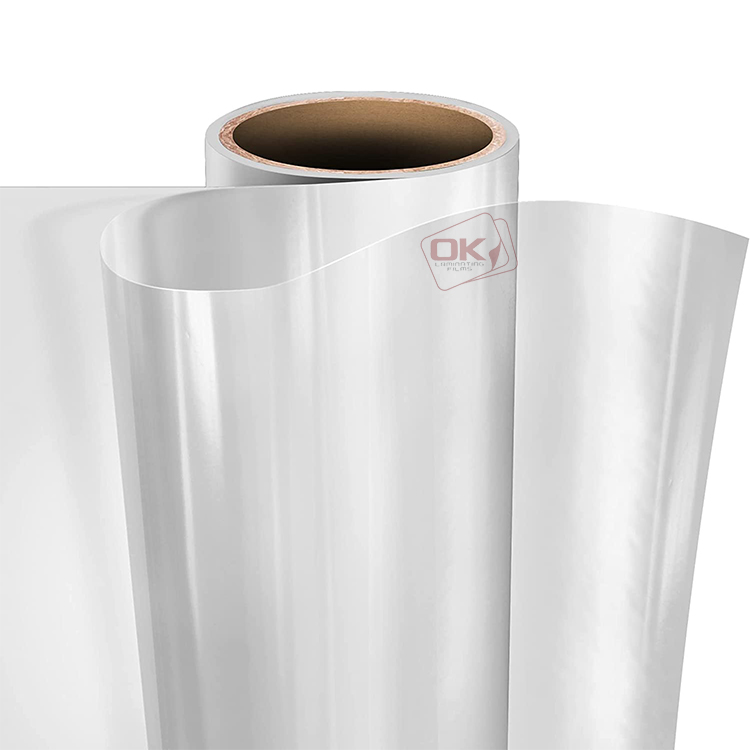
A finished coated web before slitting. HD-RL is supplied in thicknesses from 35mic to 250mic and widths from 100mm to 1300mm.
Step 4 – Drying and curing
After coating, the web is dried and cured so that residual solvent and moisture are removed before winding. The stage is invisible in the finished product but reappears later as bubble formation, delamination or odour in the customer’s process. It also links directly to the “no bubble and no wrinkle” property HADA specifies for HD-RL — a claim produced at the dryer, not at the packing table.
Step 5 – Surface finish and functional properties
Finish selection happens at the surface stage: glossy film for maximum image vibrancy, matte film for anti-glare and fingerprint-resistant surfaces. HADA specifies anti-yellowing as a design objective of HD-RL for long-term preservation, alongside high transparency, strong adhesion, and waterproof and scratch-resistant performance.
Anti-static behaviour is a requirement rather than a default. HADA’s application documentation lists anti-static properties as a special requirement for film used around electronic components, together with FDA food contact compliance and UV resistance for outdoor use. Buyers laminating electronic labels, component documentation or outdoor signage should raise that requirement at the specification stage, because it has to be engineered into the coating rather than added afterwards.
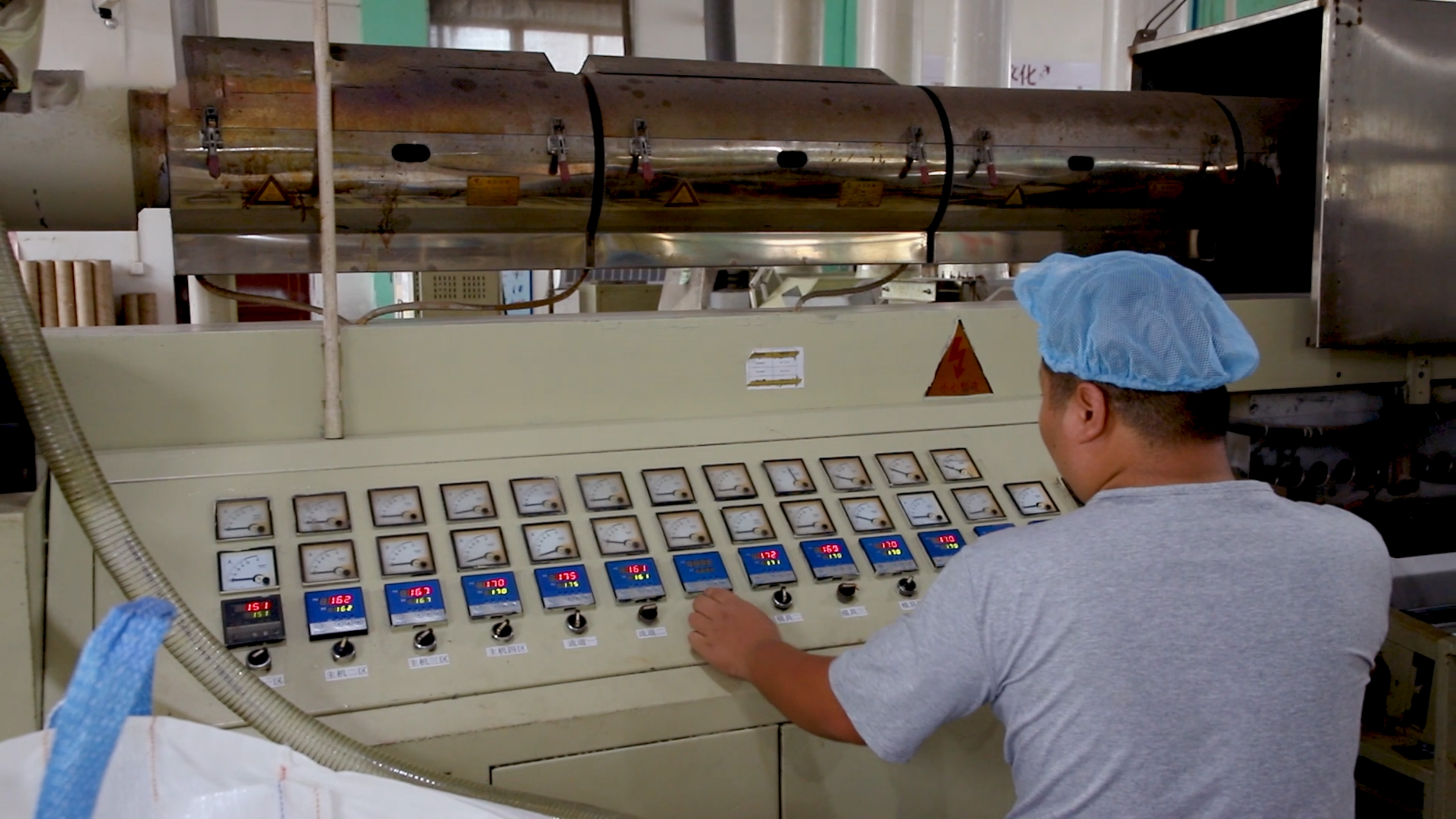
Operator control during production. Finish selection and functional requirements such as anti-static and anti-yellowing are set at the coating and surface stage.
Step 6 – Slitting to the customer’s width
Finished jumbo rolls are slit to the ordered width, anywhere between 100mm and 1300mm. Slitting accuracy determines edge quality, and edge quality determines whether a roll tracks straight through a laminator or wanders and creases. Length and packaging are both customizable, which matters to distributors who sell under their own brand rather than the manufacturer’s.
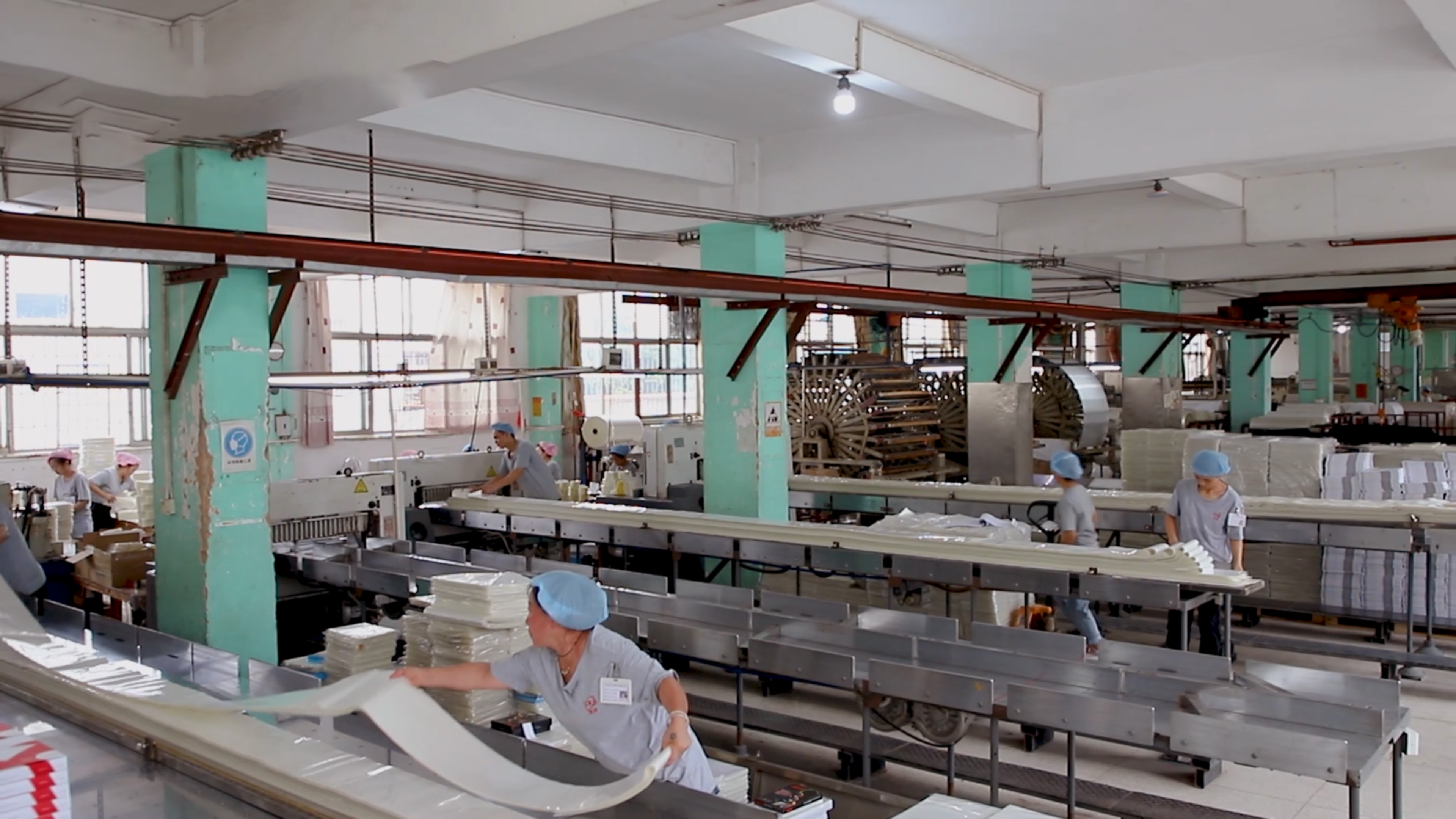
Slitting the coated web to order. Custom-width laminating rolls from 100mm to 1300mm are produced in-house.
Step 7 – Inspection, packing and lead time
HADA performs 100% inspection before shipment rather than statistical sampling. Monthly capacity runs at 150,000 packs of 100 pieces each, with a standard lead time of 20 to 30 days and a minimum order quantity of 1,000 packs. For buyers scheduling production rather than retail replenishment, the practical question is not only the quoted lead time but how the supplier allocates capacity when demand spikes — an area where a long-running customer relationship is more informative than a capacity chart.
Use Cases: Where Laminating Rolls Are Actually Run
HD-RL operates under room temperature and normal pressure conditions and works with pouch laminators and roll laminators. HADA documents three operating modes for the product, and each corresponds to a different buyer profile:
- Batch processing in an office — documents, ID cards and badges, book covers and menus laminated in runs.
- On-demand lamination in retail — stationery and print shops laminating individual customer jobs to order.
- Continuous production line integration — packaging, label, poster and banner lamination inside a converting or print finishing operation.
The documented functions are protection against water, dust and wear; improved durability and appearance; document preservation over time; and improved colour vibrancy for printed material. Documented applications include document and photo lamination, ID card and badge lamination, book cover and menu lamination, packaging and label lamination, and advertising poster and banner lamination. The relevant industries span office supplies, education and school, retail and stationery, advertising and graphics, printing and packaging, photo and digital printing, and ID card and badge production.
Special requirements shift with the scenario: FDA food contact compliance for food packaging and menu covers, UV resistance for outdoor use, anti-static properties for electronic components, and glossy or matte finish options for brand consistency across a product line.
A reference project: ten years, 600,000 packs a year, zero quality complaints
One HADA customer — a brand importer and distributor operating in Germany, Australia and the United States — has purchased 600,000 packs of lamination film per year for more than ten years, selling under its own brand for office document lamination and stationery protection. The reported result over that period is zero quality complaints and a 25% reduction in the customer’s lamination failure rate. The program includes customized anti-counterfeiting coating technology and 24/7 technical support for lamination process optimization. For a buyer assessing process credibility, this reference is more useful than a capability statement, because it ties production consistency to a measurable commercial outcome over a decade.

The five-engineer R&D team behind HADA’s formulation, coating and application development work.
Comparison Table: What HD-RL Specifications Mean in Production Terms
The table below maps each verified HD-RL parameter to the production stage that creates it, and to the question a buyer can use in a supplier conversation.
| Verified parameter | HD-RL specification | Production stage that determines it | Question to ask a supplier |
|---|---|---|---|
| Material structure | PET + EVA | Base film intake and adhesive coating | Is the adhesive EVA-based, and how is each base film lot verified? |
| Thickness range | 35mic – 250mic | Coating weight control on the base film | Is uniformity measured across the full web width or only as an average? |
| Width range | 100mm – 1300mm | Slitting | What edge tolerance is held after slitting? |
| Length | Customizable as per request | Winding | How is winding tension set for my roll diameter? |
| Finish | Glossy and Matte | Surface treatment | Are both finishes produced in-house or outsourced? |
| Performance features | High transparency; no bubble and no wrinkle; strong adhesion; waterproof and scratch-resistant; anti-yellowing for long-term preservation | All stages, from material intake through drying | Which of these are tested, and against which method? |
| Equipment compatibility | Suitable for all standard thermal laminators | Adhesive activation profile | What activation temperature range does the film require? |
| Packaging | Customizable as per request | Final packing | Can packaging be branded for private-label distribution? |
For market context rather than product comparison, the table below summarizes third-party reference points that buyers often cite during category planning. These figures come from different research scopes and are not directly comparable with one another.
| Reference point | Value | Source |
|---|---|---|
| Global lamination films market (2024) | US$ 6,842.11 million; food and beverage as primary end-user segment | DataM Intelligence |
| Asia Pacific share of lamination film revenue (2024) | 36.87% | DataM Intelligence |
| BOPP thermal lamination films market (2024) | US$ 3.5 billion; 5.2% CAGR projected through 2033 | Data Bridge Market Research |
| PET (BOPET) lamination films for packaging (2024) | USD 10.3 billion | Future Market Insights |
| Largest global players in lamination and graphic roll film | Cosmo Films, Jindal Poly Films, Taghleef Industries (Derprosa), GBC (ACCO Brands) | Fortune Business Insights |
FAQ: Manufacturing Questions Buyers Ask Before Ordering
1. What certifications cover HADA laminating roll film?
HADA holds ISO 9001, BSCI, SMETA, RoHS and REACH certifications alongside 22 national patents. RoHS and REACH are the relevant frameworks for restricted substances in the film and adhesive layers. For food contact applications, the European Union framework is Commission Regulation (EU) No 10/2011, which applies to plastic materials and articles intended for food contact and sets migration limits and a positive list of permitted substances; HADA’s application documentation lists FDA food contact compliance as a special requirement for such scenarios. Because applicable requirements differ by region and end use, buyers should request the current certificate set for their destination market before placing a bulk order.
2. What can be customized on an HD-RL order?
HADA operates in OEM and ODM mode. Customization covers product size, thickness, logo and packaging. Within the HD-RL platform, thickness ranges from 35mic to 250mic and width from 100mm to 1300mm, length can be set to the buyer’s request, and both glossy and matte finishes are available. Packaging can be customized for private-label distribution. This customization work is supported by a five-engineer R&D team and three automated production lines with an annual capacity exceeding 10,000 tons.
3. What determines cost and minimum order quantity?
The stated minimum order quantity is 1,000 packs of 100 pieces, and monthly capacity of 150,000 packs means larger programs fit within normal scheduling. Cost is driven mainly by four variables: thickness, because material consumption scales with micronage; width, because slitting yield changes with roll width; finish and functional requirements such as glossy, matte, anti-static or UV-resistant performance; and packaging customization together with documentation requirements for the destination market. HADA does not publish list pricing across the range, so buyers should request a quotation stating thickness, width, length and packaging specification.
4. How can a buyer validate film quality before committing to bulk volume?
Three verification steps are practical. First, compare the declared PET + EVA structure against the specification sheet and confirm thickness and width ranges in writing. Second, request a tensile property report referencing ASTM D882, the standard test method for tensile properties of thin plastic films less than 1.0 mm thick, which covers strength, elongation and modulus. Third, run the film on your own laminator with your own printed stock, because adhesion and bubble behaviour depend on the combination of film and substrate. HADA supports this process with 100% inspection before shipment and a 12-month warranty against delamination, colour fading and material defects.
5. What is the lead time, and what happens if something goes wrong?
Standard lead time is 20 to 30 days, with monthly capacity of 150,000 packs. After-sales terms include a 12-month warranty against delamination, colour fading and material defects, a 24-hour response time for quality complaints, a dedicated account manager, and free replacement or full refund for non-conforming goods with priority re-production for bulk orders. Buyers are welcome to send application details and specification requirements to brian@huada168.com or via WhatsApp at +8618929589411 for a quotation and sample discussion.
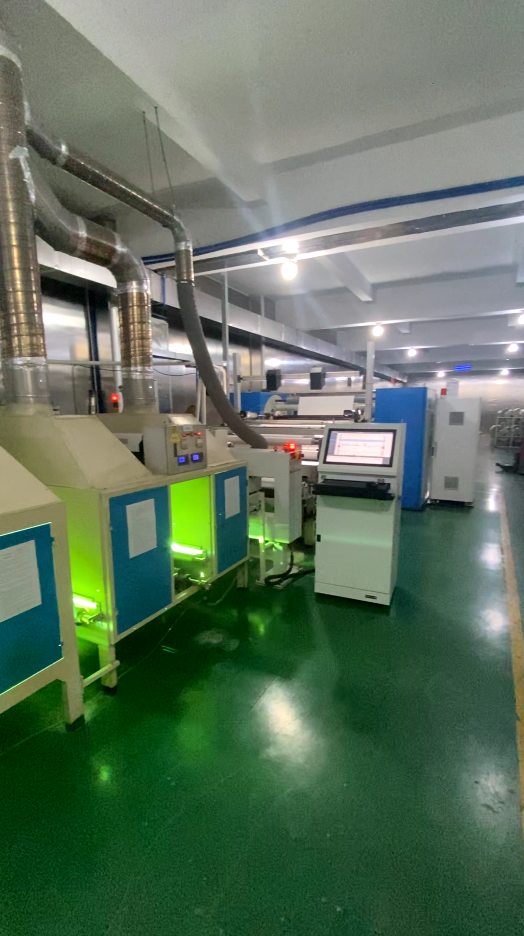
Workshop overview at HADA. Wholesale laminating rolls, OEM projects and private-label programs are supported from the Guangzhou facility.
Conclusion: Product Literacy Starts at the Coating Line
Laminating rolls are a coated product, not a cut product. The base film establishes clarity and dimensional behaviour, the EVA layer establishes adhesion and activation, the dryer establishes bubble-free performance, and the slitter establishes whether the roll runs straight. A specification sheet can describe the outcome; only the process explains how it is achieved.
For buyers in the research and evaluation stage, that distinction changes the questions worth asking. Instead of comparing only micronage and price, compare where the base film comes from, whether the adhesive is formulated in-house, how coating uniformity is measured across the web, what functional requirements such as anti-static or anti-yellowing are engineered at the surface stage, and how inspection is carried out before shipment. At HADA, those stages sit inside a 40,000 sqm facility with three automated production lines, 200 employees, a five-engineer R&D team, 22 national patents and ISO 9001, BSCI, SMETA, RoHS and REACH certification — and they are backed by a 12-month warranty and 100% inspection before shipment.
Next step
If you are specifying laminating roll film for a packaging, printing or distribution program, HADA can confirm thickness, width, finish and packaging against your application. Request a sample or quotation to validate HD-RL on your own laminator.
Email: brian@huada168.com | WhatsApp: +8618929589411 | Website: www.huada168.com