Laminating Film Anatomy: PET and EVA Layers Explained
The Anatomy of Laminating Film: How PET and EVA Layers Shape Pouch and Roll Performance
A laminating film is not one material. It is a two-layer composite in which a PET (polyester) carrier layer supplies transparency, stiffness and dimensional stability, while an EVA (ethylene-vinyl acetate) adhesive layer melts under heat and bonds the film to the printed sheet. Every thickness figure printed on a pack is the sum of those two layers — and the split between them, not the total alone, decides how a pouch or a roll behaves inside a thermal laminator.
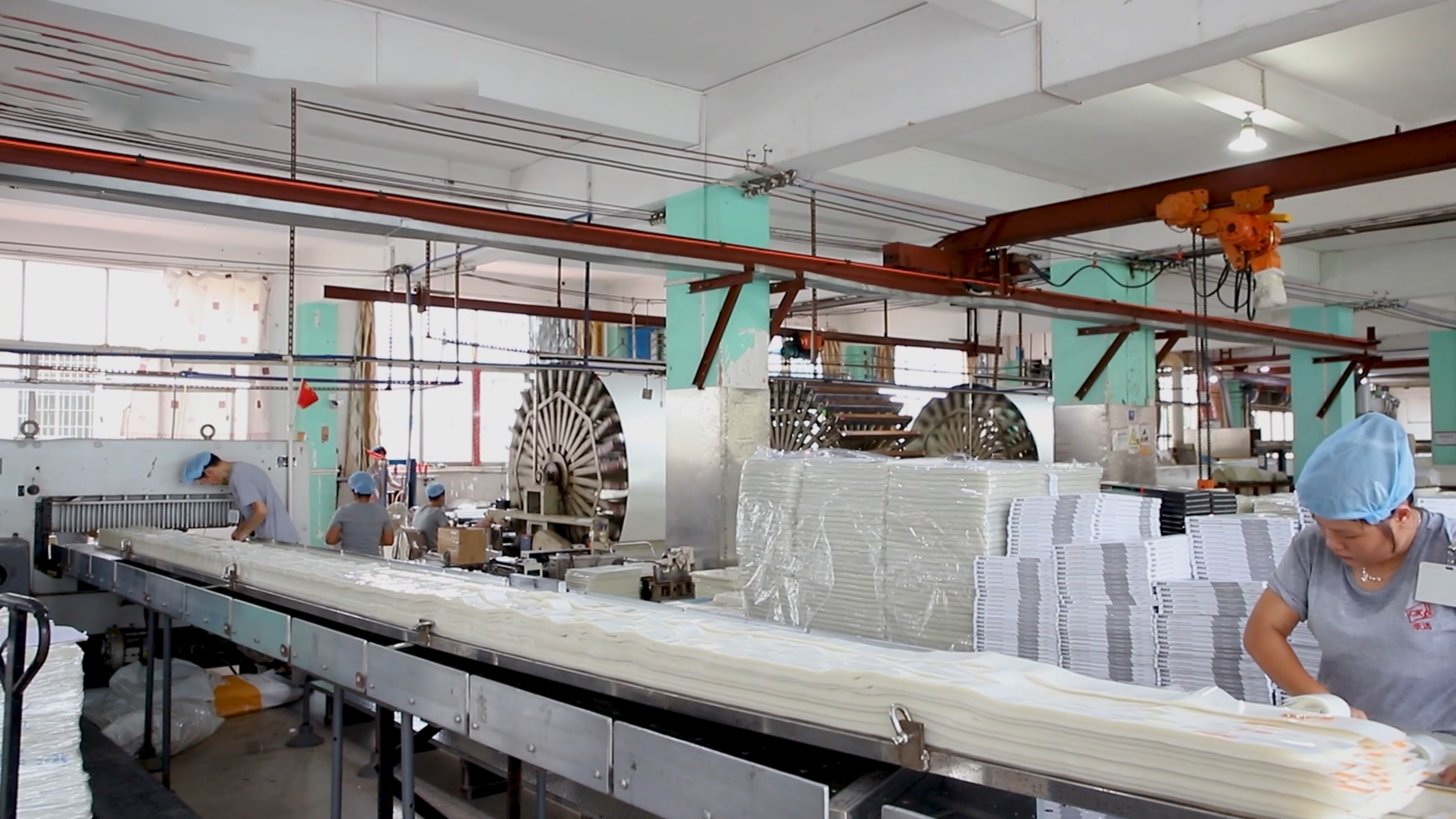
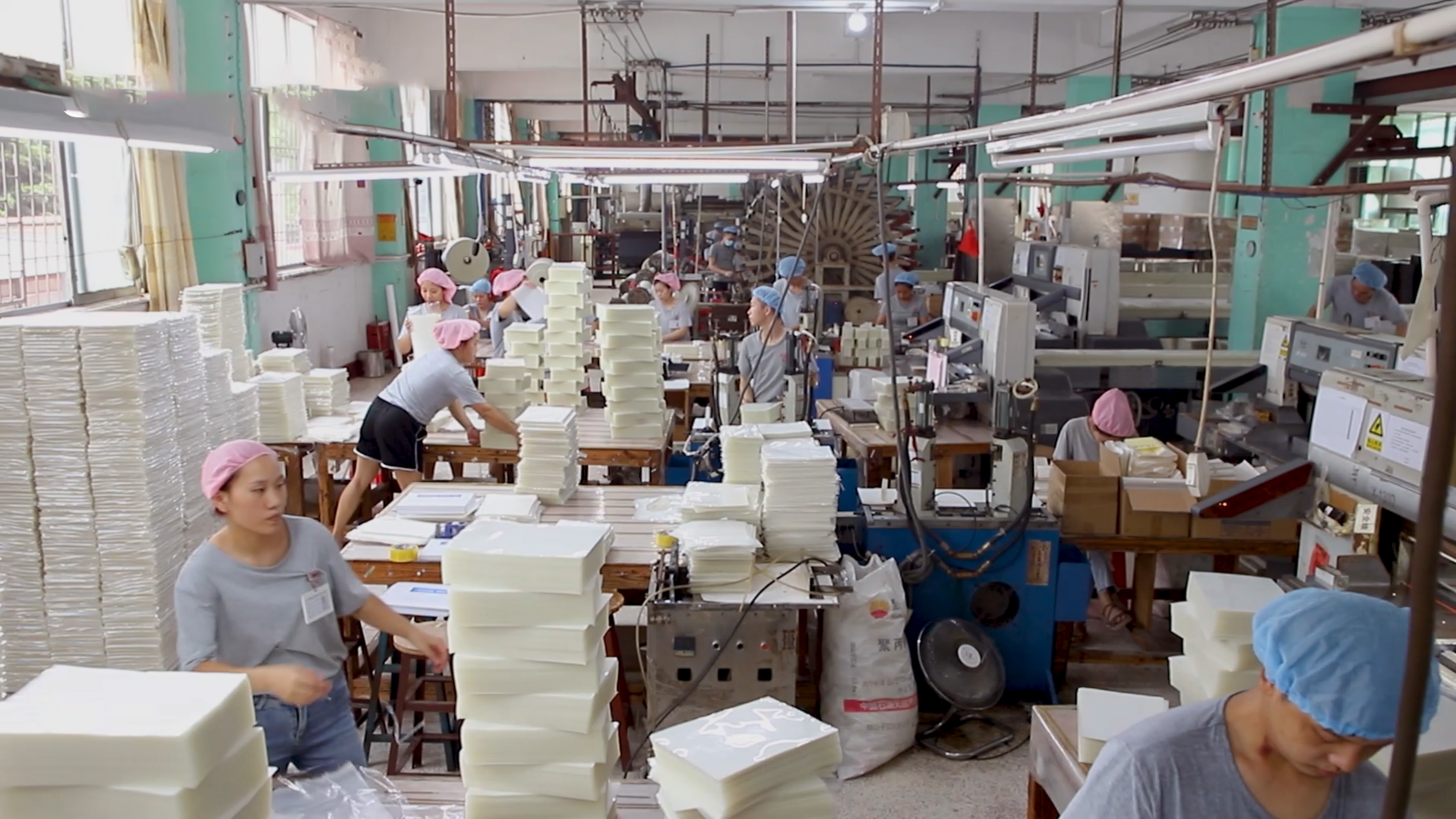
HADA's HD-A4-80MIC pouch is specified as 80mic (50/30): 50 micron of PET plus 30 micron of EVA, in an A4 sheet of 216 × 303 mm, packed 100 pieces per pack and 10 packs per carton, in glossy or matte finish. The HD-RL roll film uses the same PET + EVA construction but spans a 35mic–250mic thickness range and a 100 mm–1300 mm width range, with length cut to order. Both formats are produced by Guangzhou Huada Laminating Film Co., Ltd. (HADA), a Guangzhou-based manufacturer founded in 1992 that runs three automated production lines with annual capacity above 10,000 tons.
The Problem: Two Films Labelled “80mic” Are Not the Same Film
Procurement teams comparing laminating film quotations usually compare one number: total micron. That number is a total, not a specification. Two pouches both marked 80mic can carry different PET-to-EVA ratios, and the ratio changes four things a buyer will notice on the production floor:
- Stiffness and handling. PET carries the body of the film. A higher PET share produces a firmer sheet that feeds more predictably in automatic and semi-automatic laminators.
- Adhesive reservoir. EVA is the layer that actually bonds. Too little EVA relative to the substrate and ink coverage can leave marginal adhesion, particularly on heavy ink or coated stock.
- Bubble and wrinkle risk. Air entrapment and wrinkling are process outcomes driven by how the adhesive flows and cools under the roller, which is a function of the EVA layer and the machine settings it is paired with.
- Long-term appearance. Yellowing over time is an optical property of the composite, so the quality of both layers matters for documents or badges meant to be kept.
A second, quieter problem is format mismatch. Buyers sometimes price a job in pre-cut pouches when the run length and sheet size point to roll film, or buy roll film for a low-volume office task where a pre-cut pouch would need no setup at all. The construction may be identical; the economics and the workflow are not.
Industry Background: A Material-Driven Market
Lamination film sits inside a large and still-growing materials category. DataM Intelligence values the global lamination films market at approximately USD 6.84 billion in 2024, with Asia-Pacific accounting for a 36.87% revenue share and a projected CAGR of 7.0% from 2025 to 2032. Grand View Research reports that plastic-based materials held a 57.31% share of the wider packaging laminates industry in 2024, which is consistent with PET/EVA thermal film remaining the default document-protection construction.
Market sizing for this category is not uniform, and buyers should treat any single figure with care. Market Research Future estimates the laminating film market at USD 3.40 billion, against DataM Intelligence's USD 6.84 billion and Grand View Research's USD 6.55 billion for packaging laminates. The gap reflects definitional differences — stationery-focused thermal film versus industrial packaging laminates — rather than a contradiction in the underlying demand. The practical takeaway for a buyer is that construction literacy matters more than market headlines: the same market contains office-grade 80mic pouches and 250mic industrial roll film, and they are not interchangeable.
The supplier landscape is correspondingly broad. Market Research Future lists 3M, ACCO Brands (GBC), Avery Dennison and Fellowes among the major global players, alongside a long tail of regional converters — a structure in which a buyer's real differentiation comes from being able to read a construction sheet rather than from brand recognition alone.
The Anatomy: What Each Layer Actually Does
The PET layer: structure, clarity, surface
PET is the outer carrier. It is the layer that gives the finished laminate its body and its optical quality, and it is the layer that faces the outside world once the document is sealed. In HADA's product data, the finished pouch and roll film are described as high transparency, scratch-resistant and anti-yellowing for long-term preservation — properties that are generally attributed to the carrier layer rather than to the adhesive. For a buyer, this means the PET share is the component to scrutinise when the job involves handling, repeated use, display in light, or archival intent.
The EVA layer: the heat-activated bond
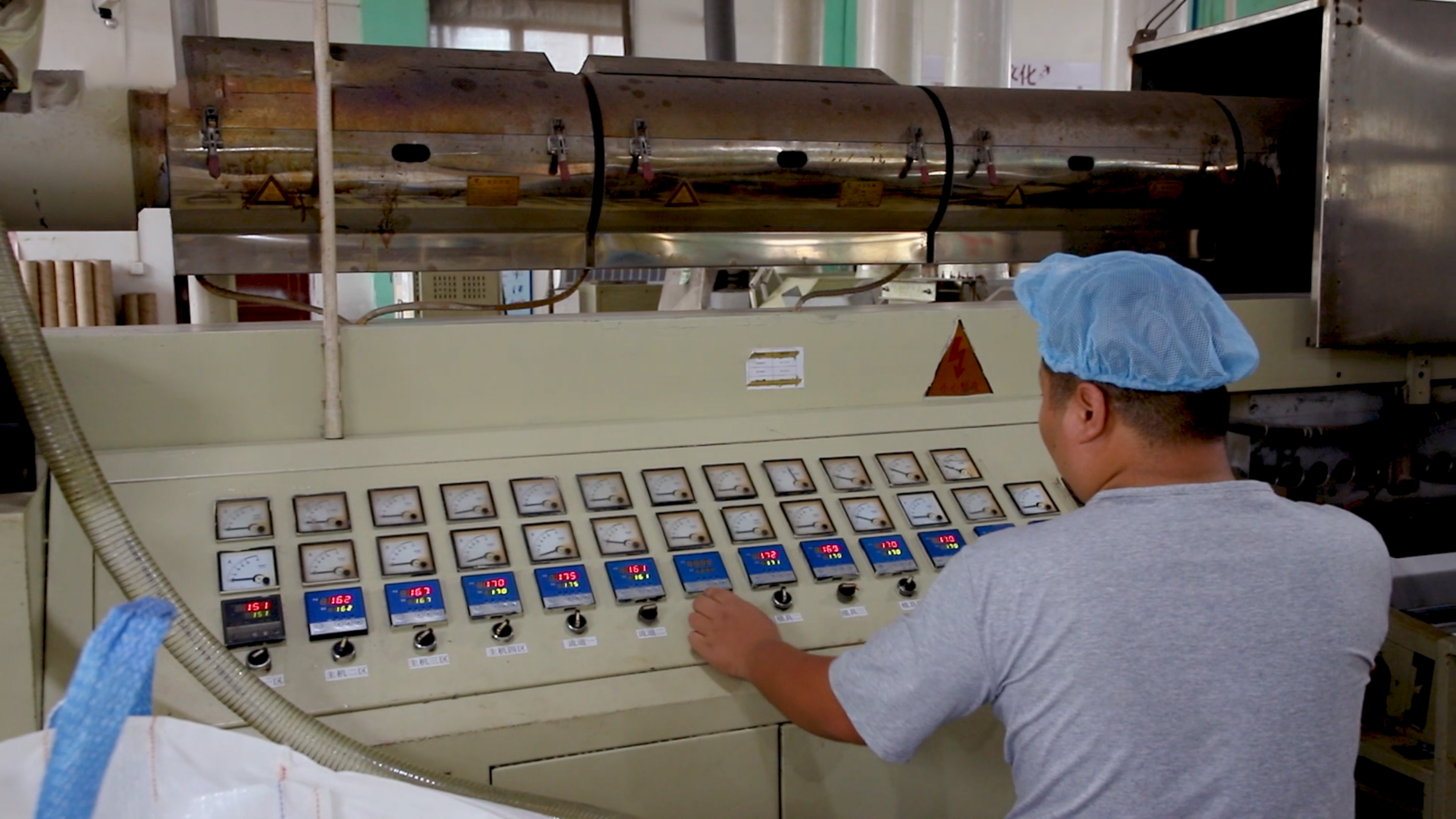
EVA is the adhesive. It softens at laminator temperature, wets the printed surface, and then re-solidifies as the rollers cool it, which is the moment the bond is actually made. HADA specifies strong adhesion as a finished-film feature, and the EVA share is what governs how much adhesive is available to wet a given surface. Heavy toner coverage, coated paper and thicker card all consume more adhesive than a plain office sheet, which is why the same 80mic pouch can perform differently on a plain document and on a fully inked brochure.
Reading a thickness ratio correctly
The bracket after the total thickness is the split. HADA publishes three pouch specifications in this format, and reading them side by side shows how the PET and EVA shares shift with total gauge:
- 80mic (50/30) — 50 micron PET plus 30 micron EVA. PET is about 62.5% of total thickness; the adhesive is about 37.5%.
- 3Mil / 75mic (38/37) — 38 micron PET plus 37 micron EVA, roughly an even split, with the adhesive share close to half the film.
- 5Mil / 125mic (75/50) — 75 micron PET plus 50 micron EVA, i.e. 60% carrier and 40% adhesive.
Both micron and mil appear in supplier documentation because office markets in North America quote mil while most Asian and European specifications quote micron; HADA publishes both on the same line so the two conventions can be matched without conversion. Roll film is documented differently again: the HD-RL range is expressed as 35mic–250mic with no fixed split, because a roll specification is agreed per order together with width and length.
| Layer | Position in the laminate | Function in the finished film |
|---|---|---|
| PET | Outer carrier layer | High transparency, stiffness and handling body, scratch-resistant surface, anti-yellowing behaviour for long-term preservation |
| EVA | Heat-activated adhesive layer | Melts under the laminator roller, wets the printed sheet, re-solidifies to form the bond; drives strong adhesion and the no-bubble, no-wrinkle result |
| Composite | PET + EVA together | Waterproof and scratch-resistant surface, high-clarity finish, suitability for all standard thermal laminators |
Why Pouch and Roll Formats Behave Differently
A pouch and a roll can share the same PET + EVA chemistry and still behave differently, because the format determines what the operator does with the film. A pouch is a finished sheet, pre-cut to size: HD-A4-80MIC is 216 × 303 mm for A4 documents, and the 3Mil/5Mil Letter pouch is 229 × 292 mm (9 × 11.5 inch), both packed 100 pieces per pack and 10 packs per carton. The sheet is already the right size, so the operator places the document, feeds the assembly, and moves on. Glossy and matte versions are available in both.
Roll film removes the sheet step and hands sizing back to the machine. HD-RL runs from 35mic to 250mic in thickness and from 100 mm to 1300 mm in width, with length cut to the customer's request and packaging also customizable. That width range is what makes roll format viable for wide-format graphic work and for continuous laminators, where pre-cut A4 sheets would either be too narrow or require trimming after the fact. The trade-off is setup: roll film needs the machine to be threaded, tensioned and aligned, which only pays back when the run is long or the sheet size is non-standard.
The consequence for specification writing is straightforward. When a buyer asks for “80 micron”, they have specified a total. When they ask for “80mic (50/30), A4, glossy, 100 pieces per pack”, they have specified a construction, a finish, a size and a carton configuration — and only the second version can be quoted and inspected without ambiguity.
Step-by-Step: Specifying a PET/EVA Construction
- Start from the substrate, not the film. Note the paper weight, coating and ink coverage of the sheet being protected. These determine how much EVA the surface will absorb and how much heat the assembly needs.
- Set the total thickness. 80mic is the balanced general-purpose gauge in HADA's pouch range; 3Mil/75mic and 5Mil/125mic sit either side of it for lighter or firmer handling requirements.
- Check the split, not only the total. Confirm the PET/EVA ratio in brackets — 50/30, 38/37 or 75/50 — because that is the part of the specification that governs stiffness versus adhesive volume.
- Choose the finish. Glossy and matte are both available across the pouch and roll ranges; glossy maximises clarity, matte changes the surface appearance and reflection of the finished piece.
- Choose the format against the workflow. Pre-cut pouches for discrete sheet sizes and manual or semi-automatic operation; roll film for continuous machines, wide formats and long runs.
- Lock the dimensions. A4 at 216 × 303 mm, Letter at 229 × 292 mm, or a roll width within the 100–1300 mm range with the length specified.
- Fix the packaging and carton configuration. The standard pouch pack is 100 pieces per pack and 10 packs per carton; roll packaging and pouch packaging can both be customized, and HADA offers OEM/ODM customization of size, thickness, logo and packaging.
- Validate before scaling. Run the intended thickness and finish on the actual document stock and the actual laminator, and judge bubbles, wrinkles, adhesion and edge finish rather than judging the film on a plain test sheet.
- Confirm compliance paperwork for the destination market. Match the certificate and test reports to the specific film being supplied, not to the supplier's general capability list.
- Agree commercial terms last. HADA quotes a MOQ of 1,000 packs and a production lead time of 20–30 days, with 100% inspection before shipment.
Where Each Construction Is Used
HADA lists the applicable industries for both formats as office supplies, education and school, retail and stationery, advertising and graphic, printing and packaging, photo and digital printing, and ID card and badge. The construction choice inside those industries follows the substrate and the workflow rather than the industry label.
- Office and school documents. A4 80mic (50/30) glossy pouches in the 100-piece pack format cover routine document protection, where the balanced PET share gives enough body for handling without making the sheet hard to feed.
- Certificates, badges and ID work. Listed among HADA's applicable industries; these jobs put a premium on high transparency and anti-yellowing, because the finished piece is kept and shown rather than filed.
- Photo and digital printing. High-clarity output is the deciding feature; both glossy and matte finishes are available so the surface can be matched to the print.
- Menus and advertising graphics. Matte finishes are commonly selected where reflected light on a displayed piece is a problem, while glossy is used where colour depth matters more than glare.
- Printing and packaging production. Roll film in widths up to 1300 mm and thickness up to 250mic serves continuous and wide-format setups where a pre-cut A4 sheet is the wrong unit entirely.
Format preference at scale is visible in third-party market reporting as well as in supplier order books. Accio Work's 2024 best-seller analysis identifies high-micron thermal pouches in the 80–150 micron band, together with A4 150-micron sheets, among the top-selling segments in document protection — a medium-reliability source that should be verified against a buyer's own market data before it is used in planning. The regional picture is clearer: Asia-Pacific's 36.87% share of the 2024 lamination films market, as reported by DataM Intelligence, indicates where the heaviest production and consumption of both formats is concentrated.
One long-running supply relationship illustrates why construction discipline is worth the specification effort. A brand importer and distributor operating in Germany, Australia and the United States has taken 600,000 packs of lamination film per year for more than 10 years, sold under its own brand for office document lamination and stationery protection. Over that period the account has recorded zero quality complaints and a 25% reduction in its customers' lamination failure rate, supported by a customized anti-counterfeiting coating and 24/7 technical support for lamination process optimization.
Comparison: Pouch and Roll Constructions Side by Side
| Attribute | HD-A4-80MIC pouch | 229×292×3Mil/5Mil pouch | HD-RL roll film |
|---|---|---|---|
| Material | PET + EVA | PET + EVA | PET + EVA |
| Thickness and composition | 80mic (50/30) | 3Mil / 75mic (38/37) and 5Mil / 125mic (75/50) | 35mic–250mic |
| Size / width | A4, 216 × 303 mm | Letter, 9 × 11.5 inch (229 × 292 mm) | Width 100–1300 mm, length customized |
| Finish | Glossy and matte | Glossy and matte | Glossy and matte |
| Packaging | 100 pcs/pack, 10 packs/carton | 100 pcs/pack, 10 packs/carton | Customizable |
| Performance features | High transparency; no bubble and no wrinkle; strong adhesion; waterproof and scratch-resistant; anti-yellowing | High transparency; no bubble and no wrinkle; strong adhesion; waterproof and scratch-resistant; anti-yellowing | High transparency; no bubble and no wrinkle; strong adhesion; waterproof and scratch-resistant; anti-yellowing |
| Typical production setup | Discrete A4 sheets, standard thermal laminators | Discrete Letter-size sheets, standard thermal laminators | Continuous and wide-format work, wide range of sheet sizes |
Read across the table and the differentiator is not the chemistry — every line is PET + EVA with the same performance claims. The differentiators are the thickness split, the delivered size, and the packaging unit, which is precisely why a construction-level specification is the only version that can be compared like for like.
FAQ: Construction, Compliance and Ordering
What compliance documents should a buyer verify for PET/EVA laminating film?
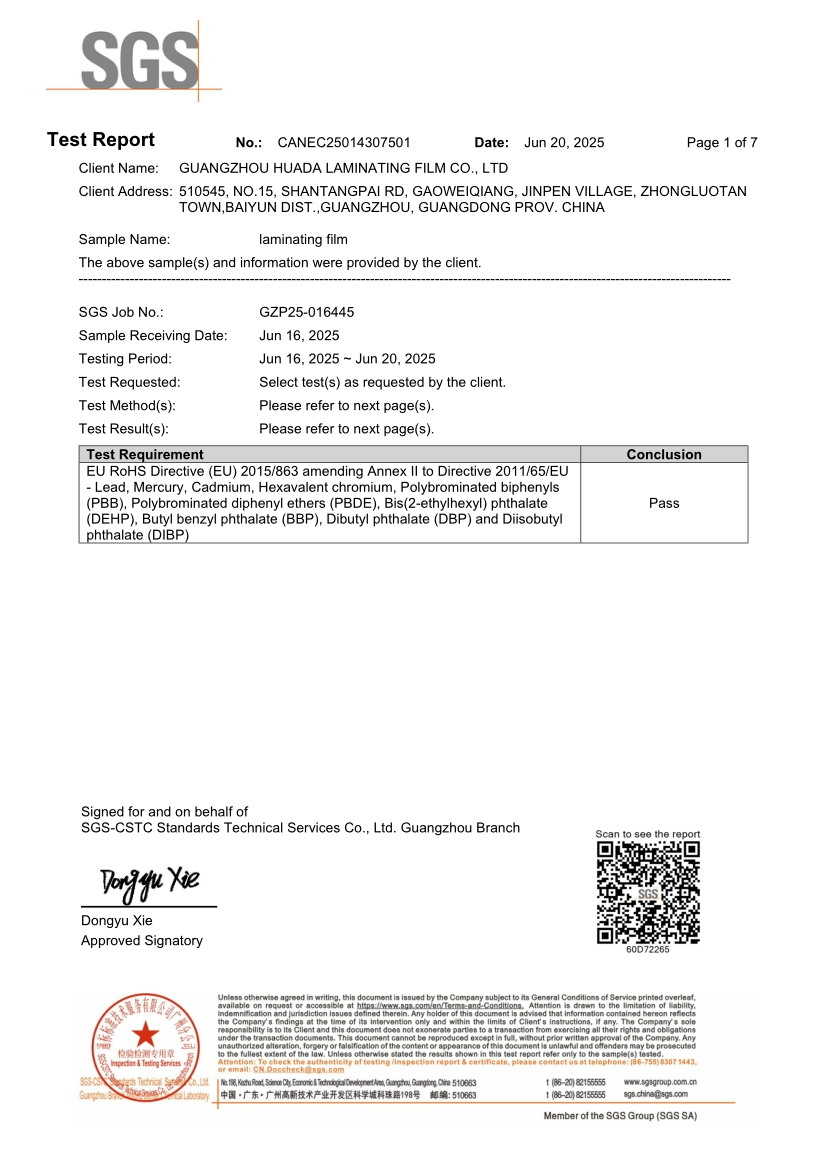
Match the document to the film, not to the supplier. HADA holds an ISO 9001:2015 quality management system certificate (certificate No. 127878, issued 24 April 2024, valid to 26 June 2027, issued under CNCA and assessed against GB/T 19001-2016 idt ISO 9001:2015), together with SGS-CSTC test reports covering RoHS (No. CANEC25014307501, issued 20 June 2025), REACH/SVHC (No. CANEC25014307503, issued 23 June 2025) and a PET plastic film SVHC screening test (No. CANEC25014307505, issued 20 June 2025). For films intended for toy-related applications or items children may touch in the EU market, buyers should additionally check EN 71-3 chemical migration limits, published by AFNOR as NF EN 71-3.
Can pouch thickness, size and packaging be customized?
Yes. HADA operates an OEM/ODM model with customization of product size, thickness, logo and packaging. Monthly capacity is 150,000 packs based on 100 pieces per pack, the MOQ is 1,000 packs, and every order is 100% inspected before shipment. For roll film, thickness (35mic–250mic), width (100–1300 mm), length and packaging are all specified per order.
How does the PET/EVA split affect what a buyer pays for?
Material volume tracks total micron, and the split allocates that volume between carrier and adhesive. A 125mic (75/50) pouch contains considerably more material than an 80mic (50/30) pouch, and a roll order priced by width and length scales differently again. HADA does not publish list prices; the comparable unit is the quoted price per pack at a stated thickness, split, size, finish and carton configuration. Buyers evaluating cost should request the quote in that form, because a roll width matched to the job can also reduce trim waste compared with pre-cut sheets on long runs.
How should a buyer validate a construction before committing to volume?
Test the exact specification on the exact substrate. Ask for the thickness and split you intend to buy, run it on your own laminator at your own settings, and judge transparency, bubbles, wrinkles, adhesion and edge finish on the real document stock — including heavy ink coverage if that is what the job involves. Buyers can request samples and a quotation for the specific construction via www.huada168.com or by contacting HADA directly at brian@huada168.com.
What is the lead time, and what happens if the film underperforms?
Production lead time is 20–30 days, with 100% inspection before shipment. HADA provides a 12-month warranty against delamination, colour fading and material defects, a 24-hour response time for quality complaints, a dedicated account manager, and free replacement or full refund for non-conforming goods, with priority re-production for bulk orders. To start a construction review, send the intended thickness, split, size or width, finish and annual volume to brian@huada168.com or WhatsApp +8618929589411.
Conclusion
Laminating film performance is decided at the construction level. The PET layer supplies clarity, body and surface resistance; the EVA layer supplies the bond; and the ratio between them — 50/30 in an 80mic A4 pouch, 38/37 or 75/50 across the 3Mil and 5Mil Letter pouches, and any point in the 35mic–250mic roll range — determines how the film behaves on a given substrate. Format then determines how it behaves in production: pre-cut pouches for discrete sheet sizes and manual or semi-automatic work, roll film in widths up to 1300 mm for continuous and wide-format runs.
A buyer who specifies total micron, PET/EVA split, finish, size or width, and packaging unit has converted a commodity purchase into a repeatable specification — one that can be quoted, inspected and reordered. That is the practical difference between buying laminating film and buying a construction.
Next step: specify before you quote.
Send HADA the thickness and split, the size or roll width, the finish and your annual volume. You will receive a construction-level quotation, sample arrangement for the exact specification, and the compliance documents that apply to the film being supplied.
Email brian@huada168.com | WhatsApp +8618929589411 | www.huada168.com
Have Questions or Need More Details?
Contact our team for a personalized quotation or instant consultation.
Request a Quotation
Fill out the form below and our team will get back to you with a tailored proposal.
WhatsApp Direct Chat
Prefer to chat in real-time? Message us on WhatsApp for instant assistance & quick answers.
- Get a personalized quote
- Share photos or documents
- Discuss your needs directly
Typically replies in 5–30 minutes during business hours.