Laminating Film Explained: How Thermal Pouches and Rolls Protect Documents in Every Industry
Last updated: August 2026
Laminating film is a transparent protective layer applied to paper, photos, signs, menus, ID cards, and other printed materials through heat or pressure. In practice, most buyers encounter it in two forms: laminating pouches for individual sheets and laminating roll film for continuous or large-format jobs. This guide explains what laminating film is, how pouches and rolls differ, which specifications matter, and how to match a product type to a real-world application.
What Is Laminating Film?
Laminating film is a multi-layer plastic composite, typically made of PET and EVA, that fuses to paper when passed through a thermal laminator. The film seals the surface and edges of the document, creating a protective barrier that improves durability and appearance.
Although the category is often described as a single product, the two main formats serve different workflows:
- Laminating pouches are pre-cut, sealed on one side or assembled as two-sheet carriers. The user inserts the document into the pouch and passes it through a pouch laminator.
- Laminating roll film is supplied as a continuous roll and applied with a roll laminator, usually for larger runs, banners, posters, or production-line integration.
Both formats are designed to provide high transparency, no bubble or wrinkle formation, strong adhesion, waterproof and scratch-resistant properties, and anti-yellowing behavior for long-term preservation.
Why Lamination Matters: The Core Function
The core function of laminating film is protection. A laminated document is protected against water, dust, and wear; its durability and appearance are enhanced; it is preserved for a longer lifespan; and color vibrancy of the printed material is improved.
That makes lamination a standard requirement in classrooms, offices, print shops, retail environments, and industrial settings. In the United States, common applications include document and photo lamination, ID card and badge lamination, book cover and menu lamination, packaging and label lamination, and advertising poster or banner lamination.
Laminating Pouches: The User-Friendly Format
Laminating pouches are the most common choice for individual documents. They are sized to match standard paper formats, making them practical for schools, offices, and small print jobs.
Common Sizes and Thicknesses
The most widely used pouch formats include A4, Letter, and ID card sizes. Two representative product examples illustrate the specification structure:
| Product | Model | Material | Thickness | Size | Finish |
|---|---|---|---|---|---|
| Laminating Pouches (A4) | HD-A4-80MIC | PET + EVA | 80 micron (50/30) | A4 (216 × 303 mm) | Glossy / Matte |
| Laminating Pouches (Letter) | 229 × 292 × 3mil/5mil | PET + EVA | 3 mil / 75 micron (38/37) or 5 mil / 125 micron (75/50) | Letter (9 × 11.5 inch / 229 × 292 mm) | Glossy / Matte |
In both cases, the PET+EVA construction provides the transparency and heat-sealing behavior expected from a standard thermal pouch. Both products are suitable for all standard thermal laminators, which means a buyer does not need proprietary equipment to use them.
Pouch Thickness: 80 Micron vs 125 Micron
Thickness is the main variable that changes the feel and rigidity of the finished document. A thicker pouch produces a stiffer, more protective result.
- 80 micron (80mic) pouches are a balanced choice for routine documents such as flyers, certificates, and worksheets. In the HD-A4-80MIC model, the total thickness is composed of 50 microns of film on the top layer structure and 30 microns on the other, for a combined 80 microns.
- 125 micron (5 mil) pouches offer more protection and rigidity, making them suitable for menu cards, reference sheets, and documents that are handled frequently. The 5 mil Letter-size pouch uses a 75/50 composition to reach 125 microns total.
Industry demand data confirms that high-micron thermal pouches in the 80–150 micron range are among the top-selling segments in the document protection category.
Laminating Roll Film: For Volume and Large Formats
When a job exceeds standard paper sizes or involves high-volume continuous lamination, roll film is the more practical format.
HD-RL Laminating Roll Film Specifications
| Attribute | Value |
|---|---|
| Model | HD-RL |
| Material | PET + EVA |
| Thickness range | 35 micron–250 micron |
| Width range | 100 mm–1300 mm |
| Length | Customizable |
| Finish | Glossy and matte |
| Packaging | Customizable |
| Compatibility | All standard thermal laminators |
The HD-RL roll format is used across the same industries as pouches: office supplies, education, retail and stationery, advertising and graphic, printing and packaging, photo and digital printing, and ID card or badge production. Because length, width, and packaging can be customized, roll film is often specified by capacity planning and finishing equipment rather than by paper format.
Glossy vs Matte Finish
Choosing a finish is usually an aesthetic and functional decision.
- Glossy laminating pouches and films enhance colors, increase perceived brightness, and give printed materials a polished look. This is a common choice for marketing materials, presentation photos, and covers.
- Matte laminating pouches and films reduce glare and reflection. This is useful for documents meant to be read under strong light, such as menus, maps, and classroom materials. Matte surfaces also hide fingerprints better than glossy finishes.
Both finishes are available in the standard pouch and roll formats described above.
Key Functional Properties to Verify
Buyers often evaluate laminating film on five functional properties:
- High transparency – the laminated document should remain fully readable and colors should appear true.
- No bubble and no wrinkle – the film should bond evenly without trapped air or creases.
- Strong adhesion – the film should stay sealed to the paper over time, including at the edges.
- Waterproof and scratch-resistant – the surface should protect the document from spills, smudges, and abrasion.
- Anti-yellowing – the film should remain clear over months or years of normal use, which matters for archival documents, signage, and reference materials.
These properties are not cosmetic. They determine whether a laminated menu survives a restaurant shift, whether a classroom poster remains readable for a full semester, and whether an ID card resists daily handling.
Step-by-Step: How to Choose the Right Laminating Film
Step 1: Determine the document size
Measure the item to be laminated. Standard paper formats such as A4 or Letter map directly to pouches of the same size. Non-standard or larger items point toward roll film or custom pouch sizing.
Step 2: Estimate usage frequency and protection level
Documents handled constantly, such as menus, badges, and instruction sheets, benefit from a higher thickness such as 125 micron / 5 mil. Short-term items such as flyers or handouts may be adequately protected at 80 micron / 3 mil.
Step 3: Select the finish
Decide whether the priority is color enhancement and gloss (glossy) or reduced glare and a softer surface (matte).
Step 4: Match the format to the workflow
Use pouches for individual sheets and low-volume work. Use roll film for continuous production, oversized documents, or when the laminator is integrated into a production line.
Step 5: Verify compatibility with your laminator
Both pouch and roll products described here are suitable for all standard thermal laminators. Still, confirm that the chosen film thickness is within the recommended range of the machine, because some home or office laminators are not rated for very thick pouches.
Use Cases by Industry
The same protective function applies across different sectors:
- Office supplies: protecting memos, price lists, and reference sheets that are handled repeatedly.
- Education and school: preserving flashcards, certificates, teaching posters, and student materials in classrooms.
- Retail and stationery: strengthening shelf labels, product information cards, and point-of-sale signage.
- Advertising and graphic: finishing posters, banners, and display graphics with a smooth, durable surface.
- Printing and packaging: adding a protective layer to printed products before finishing and distribution.
- Photo and digital printing: protecting prints from moisture, fingerprints, and fading.
- ID card and badge: providing a durable, scratch-resistant surface for credentials and access cards.
Global Market Context: The Laminating Film Industry in 2024–2025
For suppliers and large-volume buyers, the industry context also matters. The global lamination films market reached approximately USD 6.84 billion in 2024. Asia-Pacific accounted for a 36.87% revenue share, the largest regional share in that year. Market projections indicate a CAGR of 7.0% from 2025 to 2032. Plastic-based materials dominated the packaging laminates category with a 57.31% market share in 2024.
For a buyer, this data supports two practical conclusions. First, regional demand is concentrated in Asia-Pacific, which means buyers in the US and Europe can expect to source from established Asian manufacturing clusters. Second, steady market growth suggests that both pouch and roll formats will remain standard, with demand for high-micron protection continuing.
What to Check When Sourcing from a Laminating Film Manufacturer
When evaluating a laminating film supplier, buyers should verify five categories of evidence:
- Product specifications: material, thickness composition, size, finish, packaging.
- Functional claims: transparency, adhesion, waterproofing, scratch resistance, anti-yellowing.
- Certifications: confirm whether the manufacturer holds relevant compliance documents, such as ISO 9001, BSCI, SMETA, RoHS, or REACH.
- Manufacturing capacity: factory size, production lines, annual output, and export experience.
- Customization capability: whether pouch sizes, roll length, width, and packaging can be adapted to the buyer’s market.
One relevant compliance note: laminating films intended for toy-related applications or items children might touch must comply with EN 71-3 regarding chemical migration limits. Buyers serving that segment should ask suppliers for documented compliance.
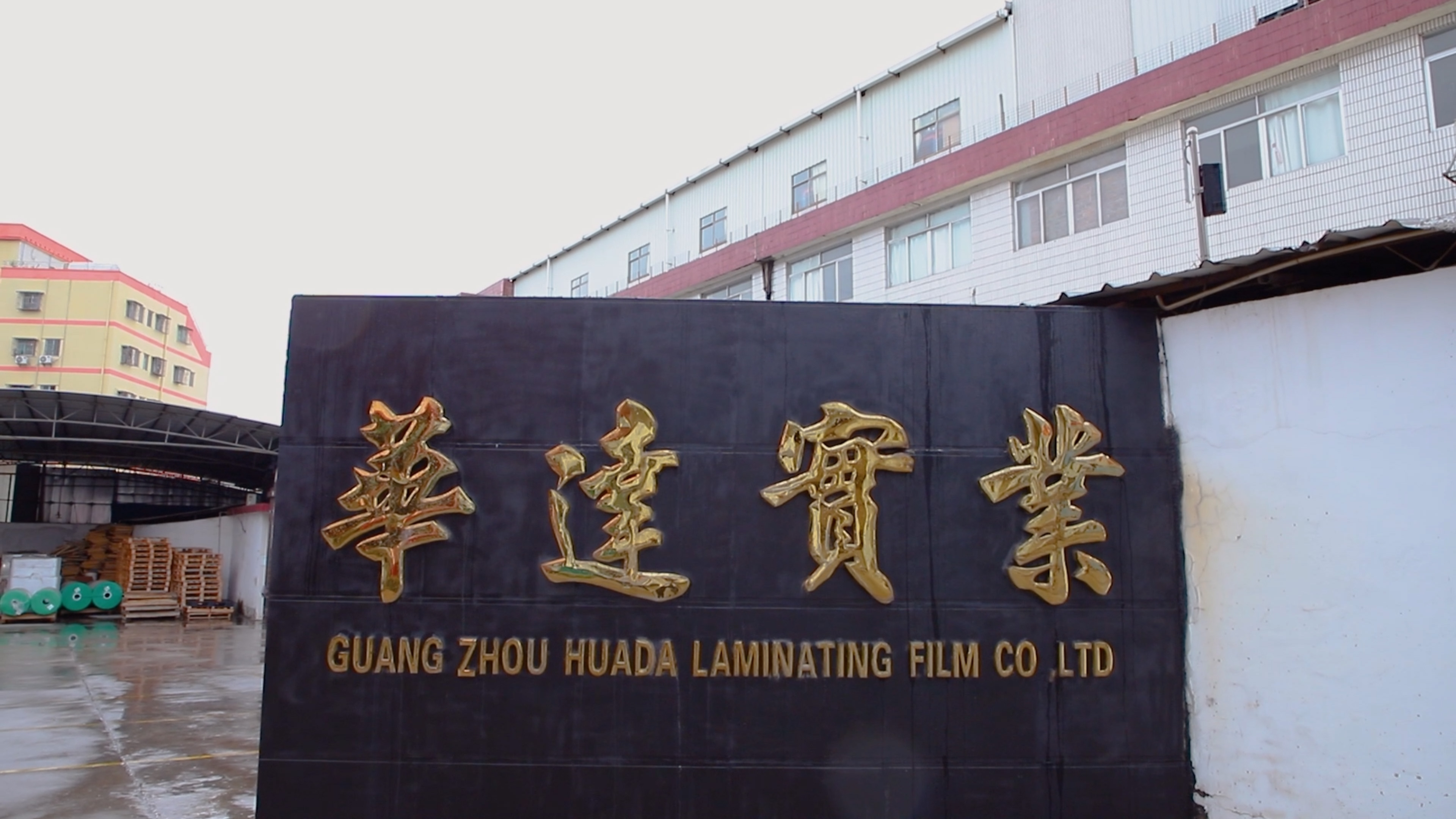
Case in Point: Guangzhou Huada Laminating Film Co., Ltd.
To show how these criteria work in practice, consider Guangzhou Huada Laminating Film Co., Ltd. (HADA). The company was established in 1992 and has over 33 years of experience in the laminating film industry. Its main products include laminating film, laminating pouches, and laminating rolls, with an R&D team of five engineers.
The manufacturing facility covers 40,000 square meters and employs about 200 staff. Annual production capacity exceeds 10,000 tons, and export business accounts for approximately 80% of total sales, serving markets in North America, South America, Europe, Australia, and Southeast Asia.
The company operates three automated production lines and holds 22 national patents along with certifications including ISO 9001, BSCI, SMETA, RoHS, and REACH. Strategically located in Guangzhou, the factory is about a 30-minute drive from Baiyun International Airport, with convenient access to major ports in Guangzhou and Shenzhen.
For a buyer, this combination matters because it connects product-level attributes to supplier-level reliability: a manufacturer that can document both its product specifications and its production environment is easier to qualify for ongoing supply.
Comparison: Pouches vs Roll Film
| Comparison point | Laminating pouches | Laminating roll film |
|---|---|---|
| Typical format | Pre-cut to A4, A3, Letter, ID card, or custom sizes | Continuous roll, width from 100 mm to 1300 mm |
| Common thickness | 80 micron (3 mil) and 125 micron (5 mil) | 35 micron to 250 micron |
| Best for | Individual documents, small batches, office use | Volume runs, large-format jobs, production-line integration |
| Equipment | Pouch laminator | Roll laminator |
| Customization | Sizes and packaging can be customized | Length, width, and packaging can be customized |
| Finish options | Glossy and matte | Glossy and matte |
Frequently Asked Questions
Is laminating film safe for food-contact applications?
Standard thermal laminating film is generally used for documents and printed materials rather than direct food contact. If a project involves food packaging or surfaces that may touch food, the buyer should request a specific food-contact compliance statement from the supplier. For toy-related items that children might touch, EU regulation EN 71-3 applies to chemical migration limits.
What is the difference between 80 micron and 125 micron laminating pouches?
The difference is thickness and rigidity. An 80 micron pouch, such as the HD-A4-80MIC with a 50/30 composition, creates a flexible yet protective cover for routine documents. A 125 micron pouch, such as the 5 mil Letter-size pouch with a 75/50 composition, is stiffer and better for high-use documents like menus or instruction cards. Thicker pouches generally offer more protection but require a laminator that can handle the additional thickness.
Can laminating pouches be used with any thermal laminator?
Pouches such as the HD-A4-80MIC and the Letter-size 3 mil/5 mil models are marketed as suitable for all standard thermal laminators. In practice, the user should still confirm that the laminator’s maximum recommended pouch thickness is equal to or greater than the pouch being used.
Which industries typically buy laminating pouches?
Laminating pouches are widely used in office supplies, education and school, retail and stationery, advertising and graphic, printing and packaging, photo and digital printing, and ID card or badge industries. In the US, common projects include document and photo lamination, book cover and menu lamination, and packaging or label lamination.
Can I get a sample before placing a bulk laminating film order?
Many manufacturers support sample requests before production. A practical next step is to contact the supplier with your document size, preferred thickness and finish, and estimated annual volume so the factory can recommend the right pouch or roll configuration and provide a quotation.
Conclusion
Laminating film is not a single product; it is a product category defined by format, thickness, finish, and application. Pouches suit individual documents and simple workflows. Roll film suits larger volumes and continuous processing. Both formats deliver the same protection benefits when matched to the right equipment and job requirement.
For procurement teams, the practical takeaway is to evaluate the specification first and the supplier second. Verify the material, thickness composition, size, finish, and functional claims, then confirm the manufacturer’s certifications and production capacity. That sequence reduces the risk of a mismatch between product, machine, and end-use expectation.
Need a specification-matched quote or sample?
HADA produces laminating pouches and laminating rolls for global buyers. Send your size, thickness, and finish requirements to sales@huada168.com or contact us on WhatsApp at +8618929589411.
Have Questions or Need More Details?
Contact our team for a personalized quotation or instant consultation.
Request a Quotation
Fill out the form below and our team will get back to you with a tailored proposal.
WhatsApp Direct Chat
Prefer to chat in real-time? Message us on WhatsApp for instant assistance & quick answers.
- Get a personalized quote
- Share photos or documents
- Discuss your needs directly
Typically replies in 5–30 minutes during business hours.