Laminating Roll Film for High-Speed Production: A Technical FAQ for Packaging Printers
Laminating roll film for high-speed production is specified by line compatibility first: thickness, width, roll length, PET/EVA construction, finish, heat response and certification must fit the laminator and the printed substrate before price is compared. This technical FAQ answers the questions packaging printers ask when moving from trial rolls to repeat production, including the 35–250mic thickness range, 100–1300mm width range, glossy and matte finishes, customizable length, and line speeds up to 80m/min. It also separates performance claims from verified evidence, because a number such as 92% light transmittance or 15% lower power consumption is only useful when its test conditions are stated.
HADA, the brand of Guangzhou Huada Laminating Film Co., Ltd., is a laminating film manufacturer founded in 1992 with over 33 years of industry experience, 22 national patents, and a product range that includes laminating roll film, laminating pouches and related films. The company reports a 40,000m² facility, approximately 200 employees, three automated production lines, annual capacity exceeding 10,000 tons, and exports to more than 50 countries and regions. Those facts establish manufacturing scope; they do not replace a line trial or a current roll-film datasheet.
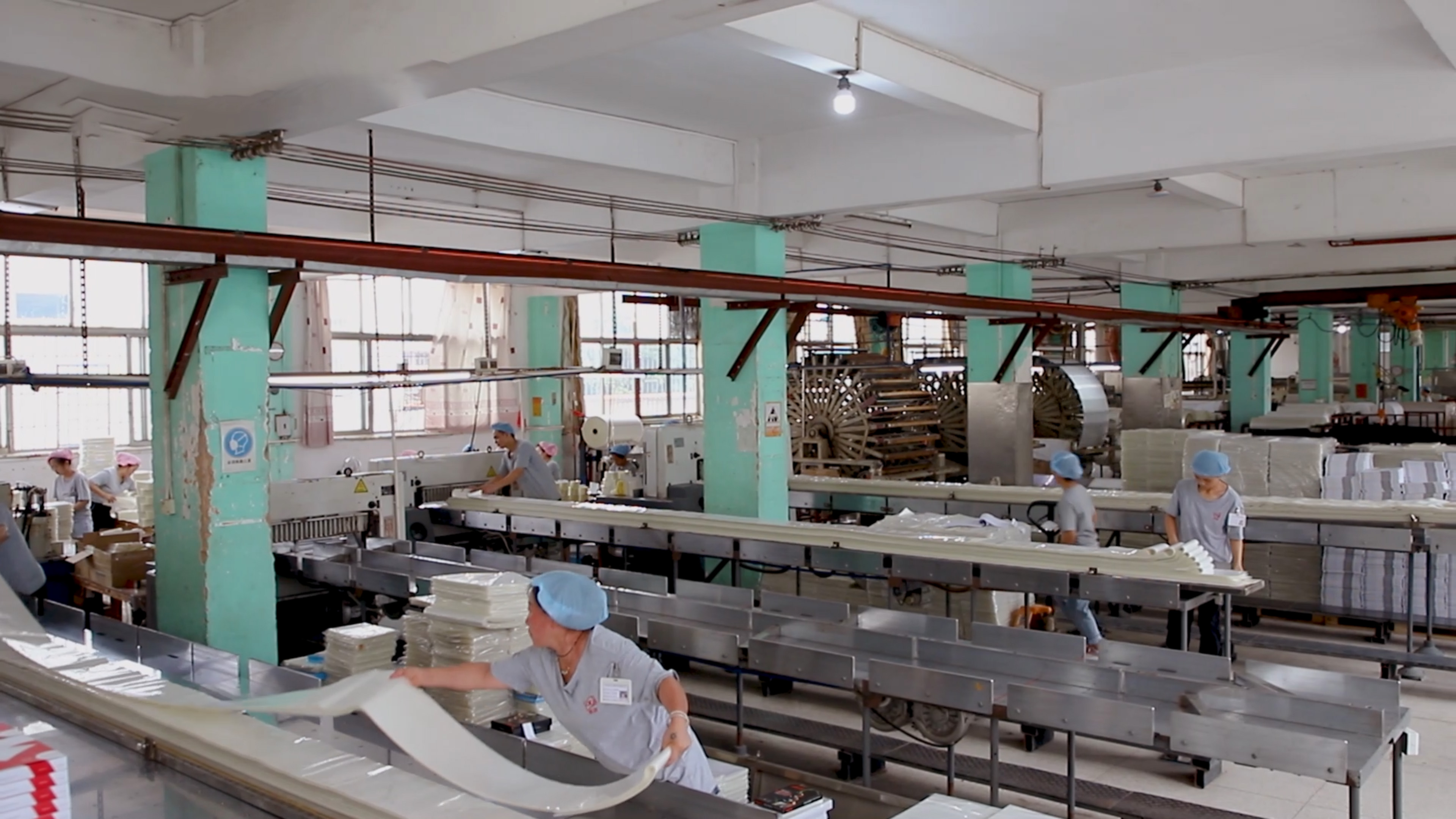
Roll-film slitting is one of the production steps that determines width consistency and edge quality before high-speed lamination.
What makes roll film a different purchasing decision from pouches?
Roll film turns lamination into a continuous process. The buyer is no longer matching a fixed pouch to a document size; the buyer is matching a roll to a laminator, a printed web or sheet, a target finish, a production speed and a downstream cutting or finishing step. That changes the risk profile. A 3% width error or a roll-length shortfall can stop a line; a heat-shrinkage mismatch can create curl or wrinkles; an unverified coating claim can look acceptable in a sample and fail after weeks of heat exposure.
For a packaging printer, the practical question is not “which film is cheapest per kilogram?” It is “which roll construction runs at the target speed with acceptable waste, adhesion, appearance and changeover time?” The answer should be built from a specification table, a line trial and an acceptance record, not from a single headline number.
What specification envelope should a high-speed roll-film RFQ define?
Start with a written envelope. The commercial range discussed for this application is 35–250mic thickness, 100–1300mm width, PET/EVA construction, glossy or matte finish, customizable roll length, and line speeds up to 80m/min. These are selection ranges, not a promise that every combination is available or optimal. A 250mic film at 1300mm width is a different tension, heat and handling problem from a 35mic film at 100mm width. The RFQ should state the exact combination you need tested.
| RFQ field | Range or option to state | Why the packaging printer must confirm it |
|---|---|---|
| Thickness | 35–250mic | Affects stiffness, heat input, adhesion, edge trim and the feel of the finished print. |
| Width | 100–1300mm | Must match the laminator web path, substrate width and trim allowance; edge quality matters at speed. |
| Construction | PET/EVA | PET contributes dimensional and optical performance; EVA is the adhesive layer. Layer split must be stated. |
| Finish | Glossy or matte | Changes visual appearance, surface slip, glare and downstream handling; it is not a cosmetic afterthought. |
| Roll length | Customizable | Controls changeover frequency, splice risk and inventory fit; confirm length tolerance and core size. |
| Line speed | Up to 80m/min | The film must be tested at the target speed, not only at a laboratory speed. |
The table is deliberately a checklist, not a catalogue. If the supplier cannot state total thickness, layer split, width tolerance, roll length tolerance and core dimensions in the same document, the buyer cannot compare offers on equal terms.
Why does PET/EVA construction matter on a fast line?
PET/EVA is a common way to describe a laminating film with a polyester carrier and an ethylene-vinyl acetate adhesive layer. The PET side provides the visible surface and much of the dimensional stability; the EVA side softens under heat and bonds to the printed substrate. In high-speed production, the two layers must behave as one system. If the adhesive melts too slowly, the line must run slower or hotter. If the carrier shrinks differently from the adhesive, the sheet can curl or wrinkle after the nip.
HADA's product documentation for an A4 80-micron thermal pouch specifies a 50-micron PET plus 30-micron EVA construction. That is a pouch specification, not a roll-film specification, but it shows why “80mic” alone is incomplete. A buyer should ask for the same layer breakdown on the roll film being quoted, together with the test method used for adhesion and dimensional stability. A total thickness without a layer split can hide a different adhesive-to-carrier ratio.
How should a printer read optical and mechanical claims?
Performance claims are useful only when they are tied to a construction and a test. In high-speed roll film discussions, buyers may see up to 92% light transmittance, less than 0.5% shrinkage at high temperature, 25% higher tear strength, an anti-yellowing coating for 30% longer lifespan, and 15% lower power consumption. Each one should trigger the same four questions: compared with what baseline, at what thickness, under what temperature and time, and using which test method?
- Light transmittance: Ask for the measured value on the actual film construction and finish. Glossy and matte surfaces do not read the same way, and a clear carrier is not the same as a low-haze carrier.
- Shrinkage: Confirm the temperature, dwell time and sample direction. A “high temperature” claim without a test condition cannot be compared with another supplier's number.
- Tear strength: A 25% higher result needs a stated reference film and test standard. It may be relevant to handling and edge-tear resistance, but it is not a direct promise of line speed.
- Anti-yellowing and lifespan: A 30% longer lifespan claim should identify the accelerated ageing method, the measured colour shift and the end point. It is a comparative claim, not a universal service life.
- Power consumption: A 15% lower figure depends on the laminator, set temperature, line speed, substrate and ambient conditions. It should be demonstrated in a line trial or a documented energy comparison, not assumed from a film datasheet alone.
This is not a reason to reject ambitious performance targets. It is a reason to put them into the acceptance schedule. A packaging printer should record the trial speed, temperature, nip pressure, substrate, roll width and finished appearance, then compare the result with the supplier's claim under the same conditions.
What does low shrinkage at high temperature mean for line stability?
Shrinkage is a line-stability issue before it is an aesthetic issue. A film that shrinks more than expected can pull the printed sheet, change register, create curl at the edges or produce a wave that becomes a wrinkle at the nip. A target below 0.5% at high temperature is meaningful only if the test states the temperature, time and direction. For a high-speed line, the relevant question is whether the film remains flat through the preheat zone, the nip and the cooling section at the speed you intend to run.
Ask for a trial at the highest planned speed, not only at a comfortable commissioning speed. Run the widest and narrowest roll you plan to use, because tension and edge control change with width. Inspect the first metres, the middle of the roll and the last metres. If the film performs at the start of a roll but curls near the core, the problem may be winding tension, roll storage or core condition rather than the polymer construction.
Which certifications and factory evidence should be checked?
For a packaging printer selling into regulated or brand-sensitive markets, certification is a screening step. HADA's certification records include ISO 9001:2015 Quality Management System certification, certificate number 127878, issued 24 April 2024 and valid to 26 June 2027 under CNCA. The company also holds a CE Certificate and RoHS test report from SGS-CSTC Standards Technical Services Co. Ltd., report number CANEC25014307501, issued 20 June 2025, and a PET plastic film SVHC screening test report, report number CANEC25014307505, issued 20 June 2025. A REACH report, number CANEC25014307503, is also listed.
These records support a compliance conversation, but they do not automatically cover every roll-film construction, width, thickness or finish. The buyer should request the certificate or report that names the product family, the test scope and the date, then confirm that the quoted film falls inside that scope. HADA's broader company profile also lists BSCI, SMETA, RoHS and REACH, and reports 22 national patents. The patent count is evidence of declared R&D activity; it is not a substitute for a product-specific test report.
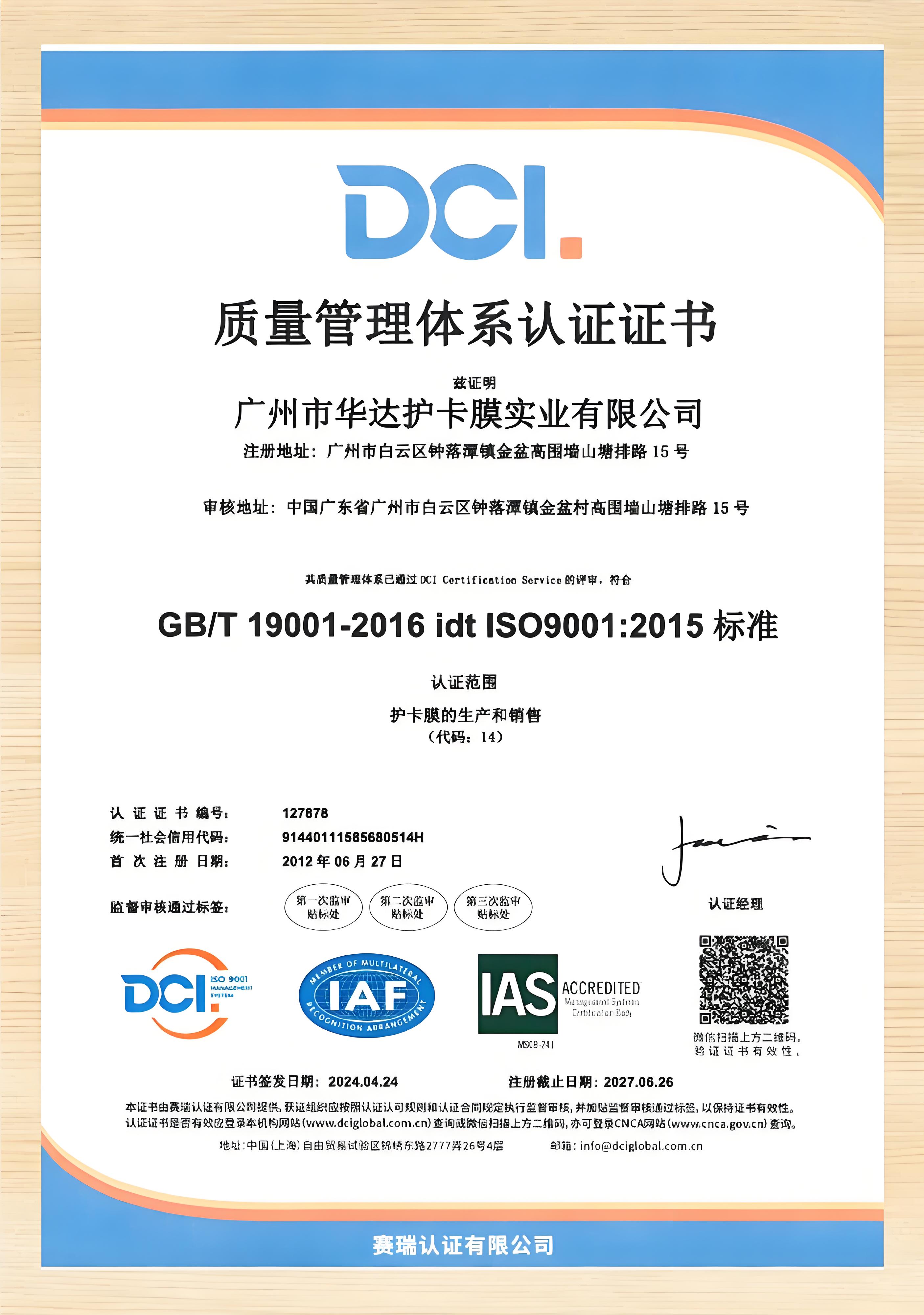
ISO 9001:2015 certification supports a quality-management review; the product-specific report still needs to match the quoted roll film.
Factory evidence should be read in the same way. HADA reports a 40,000m² facility, approximately 200 employees, three automated production lines and annual capacity exceeding 10,000 tons. Those figures help a buyer judge whether the supplier can support repeat orders and changeover. They do not prove that a particular 1300mm glossy roll will run at 80m/min on your laminator. That remains a line-trial question.

R&D capability is part of the supplier review, but product-specific test reports remain the evidence for the quoted roll.
How does OEM/ODM customization affect roll-film approval?
HADA provides OEM and ODM production services, with customization options that include product size, thickness, logo and packaging. For roll film, the practical customization fields are width, thickness, roll length, core size, finish and packaging. The buyer should separate cosmetic customization from line-critical customization. A printed logo on the carton is a packaging change; a change in width tolerance or adhesive layer is a line-critical change that should trigger a new approval.
The purchasing terms provided for HADA list an MOQ of 1,000 pieces for standard lamination film, and 2,000 pieces or 100 rolls for a customized size. Lead time is stated as 20–30 days. Monthly capacity is listed as 150,000 packs based on 100 pieces per pack, which is a pouch-oriented capacity figure; roll-film capacity for a specific width and thickness should be confirmed in the quotation. Delivery terms include FOB Guangzhou/Shenzhen, CIF destination port and EXW Guangzhou. Payment terms include T/T with 30% deposit and 70% before shipment, L/C at sight, and OA 30 days after shipment. These terms are commercial starting points, not a substitute for an order-specific contract.
HADA reports a 10+ year OEM relationship with brand importers and distributors in Germany, Australia and the United States, supplying 600,000 packs of lamination film per year. That is a pouch/film program rather than a roll-film line-speed record, so it should not be used as proof of 80m/min performance. It is relevant to repeat-order discipline, packaging customization and the supplier's ability to sustain a private-label program.
What use cases fit high-speed laminating roll film?
High-speed roll film is a natural fit where the printer needs continuous output and controlled changeover: protective lamination of printed sheets, packaging proofs and display work, menu and certificate runs, and other flat printed formats that are finished through a roll laminator. The film format reduces the manual handling that comes with pouch feeding, but it also raises the importance of web alignment, tension control and roll-length planning.
For a packaging printer, the strongest use case is repeat production with a stable substrate and a known finish. If the job changes width, thickness or surface every few hours, the changeover and waste may erase the speed advantage. If the job runs for long stretches at one width and one finish, a custom roll length can reduce stops and splices. The decision should be based on the production schedule, not on the film format alone.
What acceptance checks should be completed before bulk ordering?
Use a pre-production acceptance protocol that mirrors the final line. The purchase terms for HADA list pre-shipment inspection by SGS or Intertek, AQL sampling and customer on-site inspection as acceptance options. Those are useful controls, but they should be supported by a line trial record that the printer owns. The record should include roll identification, width and thickness, laminator settings, substrate, speed, temperature, nip pressure, finished appearance, adhesion result and any edge trim or curl observed.
| Acceptance check | What to record | Why it matters |
|---|---|---|
| Roll identity | Batch, width, thickness, length, core size, finish | Prevents a later dispute about which roll was approved. |
| Line settings | Speed, temperature, nip pressure, tension | Makes the trial repeatable and separates film performance from machine settings. |
| Substrate | Paper or board grade, coating, moisture, sheet size | Adhesion and curl can change with the printed substrate. |
| Finished appearance | Gloss or matte level, haze, bubbles, wrinkles, edge curl | Connects the technical claim to the visible result the customer will judge. |
| Adhesion and trim | Peel result, trim quality, waste rate | Shows whether the roll is stable at the intended speed and width. |
The trial should be long enough to include a roll change and a production stop. A short sample can hide winding, telescoping or core problems that appear later in the roll. If the printer cannot run a full roll, the supplier should state the roll length and winding condition used for the sample so the result is not overgeneralized.

A test report should be checked for product scope and issue date before it is used to support a customer compliance file.
How should a buyer compare suppliers without overreading the data?
Compare suppliers on the same specification sheet. Require total thickness, PET/EVA layer split, width and length tolerance, finish, core size, roll winding direction, recommended lamination temperature range, certification scope and sample policy. If one supplier reports total thickness and another reports per-side thickness, normalize the basis before comparing. The verified product data in this category shows exactly this problem: HADA reports an 80-micron pouch as a 50/30 PET/EVA total, while other public listings use 2 x 75 or 2 x 80 micron notation. Those values must not be averaged or treated as equivalent without confirming the convention.
This is also where a factory visit or a documented audit helps. A supplier that can trace the roll from film lot to slitting to packing, and that can show the certificate scope for the quoted construction, is easier to qualify than a supplier that answers with a generic catalogue. The buyer does not need a perfect supplier; the buyer needs a supplier whose claims can be checked against the same evidence standard.
Next step for a packaging printer: prepare a one-page RFQ with the target width, thickness, finish, roll length, line speed, substrate and certification market. Ask HADA to confirm the exact roll-film construction, test evidence and sample route for that combination before bulk production is approved.
FAQ: high-speed laminating roll film for packaging printers
Which certifications should a packaging printer verify for laminating roll film?
Verify ISO 9001:2015 for the quality system, and request the CE, RoHS, SVHC or REACH report that applies to the exact film construction. HADA's records include ISO 9001:2015 certificate 127878 valid to 26 June 2027, an SGS CE/RoHS report numbered CANEC25014307501 issued 20 June 2025, an SGS SVHC screening report numbered CANEC25014307505, and a REACH report numbered CANEC25014307503. Check that the product family, test scope and date cover the roll film being quoted; a company-level certificate alone does not prove every width, thickness or finish.
What thickness and width should I specify for a line running up to 80m/min?
Start with the application range of 35–250mic and 100–1300mm, then narrow it through a line trial. The correct choice depends on substrate stiffness, required finished feel, laminator heat capacity, trim allowance and the widest and narrowest roll the machine can control. A high speed alone does not determine thickness. Ask the supplier to confirm the recommended construction for your exact speed, width and substrate, and run the widest roll first because edge control is usually more demanding at maximum width.
Is PET/EVA roll film suitable for both glossy and matte packaging work?
PET/EVA construction can be offered in glossy and matte finishes, but the finish changes the surface appearance and handling behaviour, so it should be approved as a separate sample. Ask for the layer split, total thickness and finish specification together. HADA's documentation shows PET/EVA construction on its pouch range and lists glossy and matte finishes as product options; for roll film, confirm the exact finish and construction on the current datasheet rather than transferring a pouch specification to a roll.
What is the MOQ and lead time for custom roll film?
The supplied purchasing terms list an MOQ of 1,000 pieces for standard lamination film, and 2,000 pieces or 100 rolls for a customized size, with a lead time of 20–30 days. Those terms are a starting point for an RFQ. Confirm the MOQ for the exact width, thickness and roll length, and ask whether the lead time includes slitting, packing and pre-shipment inspection. For a first order, request a written production schedule rather than relying on a general lead-time statement.
Can I request a sample before committing to a bulk roll order?
Ask for a pre-production sample and define the acceptance criteria before it is shipped. HADA's purchasing terms include pre-shipment inspection by SGS or Intertek, AQL sampling and customer on-site inspection, but the supplied terms do not state a free-sample policy. Confirm sample quantity, roll length, charge and courier terms in the RFQ. Run the sample at the intended line speed and record the settings, substrate and finished appearance so the bulk order can be compared with a documented baseline.
How long does production and delivery take, and what should I prepare before asking for a quote?
The stated lead time is 20–30 days, with delivery terms including FOB Guangzhou/Shenzhen, CIF destination port and EXW Guangzhou. Before requesting a quote, prepare the target width, thickness, finish, roll length, core size, line speed, substrate, certification market and expected annual volume. That information lets the supplier confirm whether the requested combination is standard or custom, and whether the MOQ is 1,000 pieces or the 100-roll custom threshold. For a supported next step, send the line details and target specification to HADA so the sample and quotation can be matched to the actual production run.
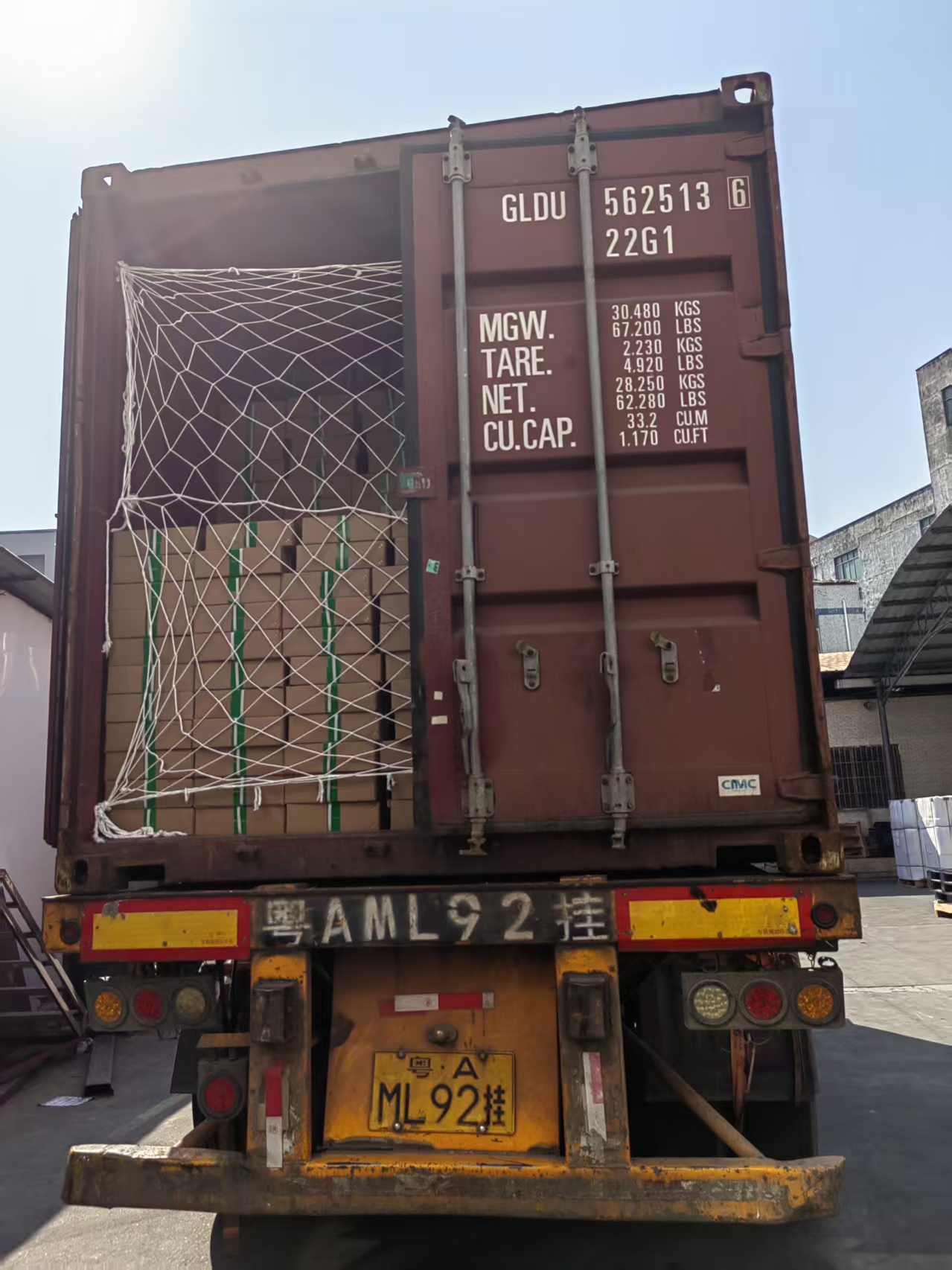
Export packing and container planning are part of the roll-film supply decision, especially for custom widths and long roll lengths.
Conclusion
High-speed laminating roll film is a specification decision before it is a price decision. The buyer needs a defined thickness within 35–250mic, a width within 100–1300mm, a confirmed PET/EVA layer split, a glossy or matte finish, a custom roll length, and a line trial at the intended speed up to 80m/min. Performance claims such as 92% light transmittance, below 0.5% shrinkage, 25% higher tear strength, 30% longer lifespan from an anti-yellowing coating and 15% lower power consumption should be requested with test conditions, not accepted as isolated numbers.
HADA's 33 years of experience, 22 patents, ISO 9001:2015 system, CE/RoHS and SVHC records, and OEM/ODM customization options give a packaging printer a documented starting point for an RFQ. The final approval should still be based on the exact roll construction, the line trial and the acceptance record. That is the difference between a film that looks good in a sample and a roll that performs through a full production run.
Have Questions or Need More Details?
Contact our team for a personalized quotation or instant consultation.
Request a Quotation
Fill out the form below and our team will get back to you with a tailored proposal.
WhatsApp Direct Chat
Prefer to chat in real-time? Message us on WhatsApp for instant assistance & quick answers.
- Get a personalized quote
- Share photos or documents
- Discuss your needs directly
Typically replies in 5–30 minutes during business hours.