Laminating Rolls Supplier Scorecard: How to Evaluate Capability and Delivery Guarantees
Supplier scorecards fail when they measure reputation instead of evidence. Two laminating rolls suppliers can quote a similar price, ship from the same region, and describe themselves in almost identical language — and still behave completely differently the moment your monthly volume rises, your compliance officer asks for a test report number, or a batch arrives that will not laminate cleanly.
This guide is written for importers, distributors, brand owners and converters who are already past the discovery stage and are now comparing shortlisted suppliers. It sets out a five-dimension scorecard, shows which evidence to demand against every dimension, and works through one manufacturer — Guangzhou Huada Laminating Film Co., Ltd. (HADA), a laminating film producer founded in 1992 in Guangzhou, China — so that each criterion has a concrete, checkable data point attached to it.
Quick answer: Score each laminating rolls supplier across five weighted dimensions — production capacity and scalability (25 points), quality system architecture (25), certification coverage and document verification (20), delivery reliability and order terms (15), and after-sales risk transfer (15). Award points only for claims a supplier can support with a figure, a certificate number, or a contractual term. A supplier that cannot produce documentary evidence should score low even when its pricing looks attractive.
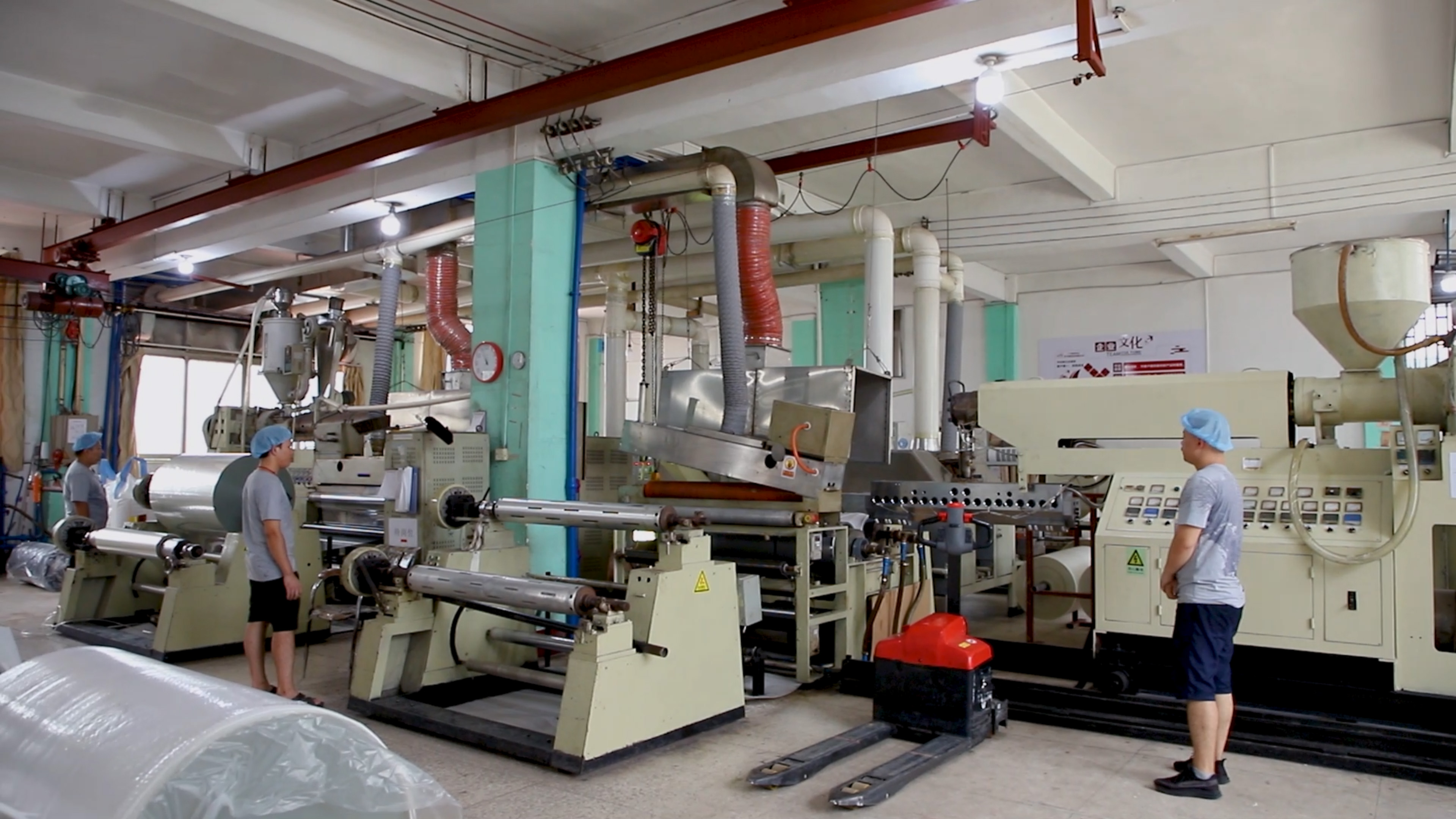
Production equipment is the physical basis for any capacity claim on a laminating rolls supplier scorecard.
Why Supplier Shortlists Break Down at the Evaluation Stage
Discovery content answers a simple question: who makes laminating rolls. Evaluation asks a harder one: can this specific supplier run my volume, prove my compliance requirements, hold my delivery date, and absorb the cost if something goes wrong. Those questions cannot be answered by reputation alone, and they are rarely answered on a supplier's homepage.
Three failure modes appear repeatedly in laminating film procurement:
- Capacity mismatch. A supplier describes itself as a large manufacturer but publishes no monthly output figure, no line count, and no factory footprint. When a peak-season order arrives, lead times stretch and partial shipments begin.
- Certification gaps. A supplier holds a general company certificate but no product-level test report for the specific film grade you are buying. Compliance documents issued for one material are frequently assumed to cover another.
- Unverified delivery terms. Lead time, warranty scope and complaint remedies are agreed verbally, then reinterpreted when a claim is filed.
A scorecard does not replace sample testing or price negotiation. It does something more specific: it forces every qualitative claim into a format that can be verified, weighted, and compared across suppliers before a purchase order is issued.
Industry Background: What the 2026 Laminating Film Market Changes for Supplier Scoring
The lamination films market reached US$ 6,842.11 million in 2024, with the food and beverage segment as its primary end-user, according to DataM Intelligence. That headline hides a wide spread of product scopes: BOPP thermal lamination films were valued at US$ 3.5 billion in 2024 and are projected to grow at a 5.2% CAGR through 2033 (Data Bridge Market Research), while PET (BOPET) lamination films for packaging were valued at USD 10.3 billion in 2024, driven by e-commerce and high-performance insulation demand (Future Market Insights).
Estimates diverge noticeably depending on scope. DataM Intelligence places the 2024 lamination films market at US$ 6.84 billion; Fortune Business Insights projects approximately US$ 9.01 billion for 2025 under a broader definition; Market Research Future reports US$ 3.40 billion under a narrower one. That divergence has a direct procurement consequence: before comparing suppliers, define the product scope you are actually buying, because market size figures and supplier capability claims are both scope-dependent.
Regional weight matters too. Asia Pacific captured a 36.87% revenue share of the lamination films market in 2024 (DataM Intelligence), which is consistent with the density of film producers and converters in the region. Fortune Business Insights names Cosmo Films, Jindal Poly Films, Taghleef Industries (Derprosa) and GBC (ACCO Brands) among the top global players in the lamination and graphic roll film market. For a buyer, the practical reading is straightforward: the supply base includes very large international film producers and a long tail of smaller converters, so a scorecard must be able to separate operational scale from marketing scale.
The Five-Dimension Laminating Rolls Supplier Scorecard
A workable scorecard needs weighted dimensions, an evidence requirement for each, and a rule for awarding points. The weighting below assumes a mid-to-large industrial laminating roll program; buyers in highly regulated food-contact applications should shift weight from delivery toward certification, and buyers running urgent repeat orders should do the reverse.
Dimension 1 — Production Capacity and Scalability (25 points)
Capacity is the first thing to quantify, because it determines whether a supplier can grow with your program or will become a bottleneck. Ask for four figures in writing: monthly output in your unit of measure, annual output, number of production lines, and factory floor area.
HADA's data, as an example of the format to demand, includes a monthly capacity of 150,000 packs (100 pieces per pack) and an annual output of 1,000,000 units, produced on 3 automated production lines in a 40,000 square metre facility with a workforce of 200. The same company profile states an annual capacity exceeding 10,000 tons of film and an in-house R&D team of 5 engineers.
Notice that the monthly pack figure and the annual unit figure use different units — and that this is normal in the industry. Capacity numbers are scope-dependent, exactly like the market estimates above. The scoring rule is therefore not simply which number is larger, but whether the supplier can define the unit, explain what it covers, and confirm which product family it applies to. A supplier that cannot define its own capacity figure cannot be scheduled against.
Dimension 2 — Quality System Architecture (25 points)
Quality is scored by counting documented control points, not by counting adjectives. Three questions do most of the work: Is the quality management system certified? How many inspection stages exist between incoming material and shipment? Is pre-shipment inspection a full check or a sampling plan?
On the first question, HADA holds ISO 9001:2015 Quality Management System certification, certificate number 127878, issued under CNCA on 24 April 2024 against the GB/T 19001-2016 idt ISO 9001:2015 standard, with validity to 26 June 2027. That certificate is a verifiable document, not a claim: the number, issuer and expiry date can be checked independently.
On the second and third questions, the documented control point in HADA's production data is 100% inspection before shipment. AQL-based sampling, a widely used approach in packaging supply chains, is a legitimate alternative — but the scorecard should record which method applies to your order and whether that method is written into the purchase order. The same applies to batch traceability: ask directly whether a defect reported after delivery can be traced back to a production batch, and require the answer in writing.
Supporting technical depth is a useful secondary signal. HADA holds 22 national patents and operates an in-house R&D team, and one of its registered certificates is a Utility Model Patent, certificate No. 19262125, granted 30 June 2023.
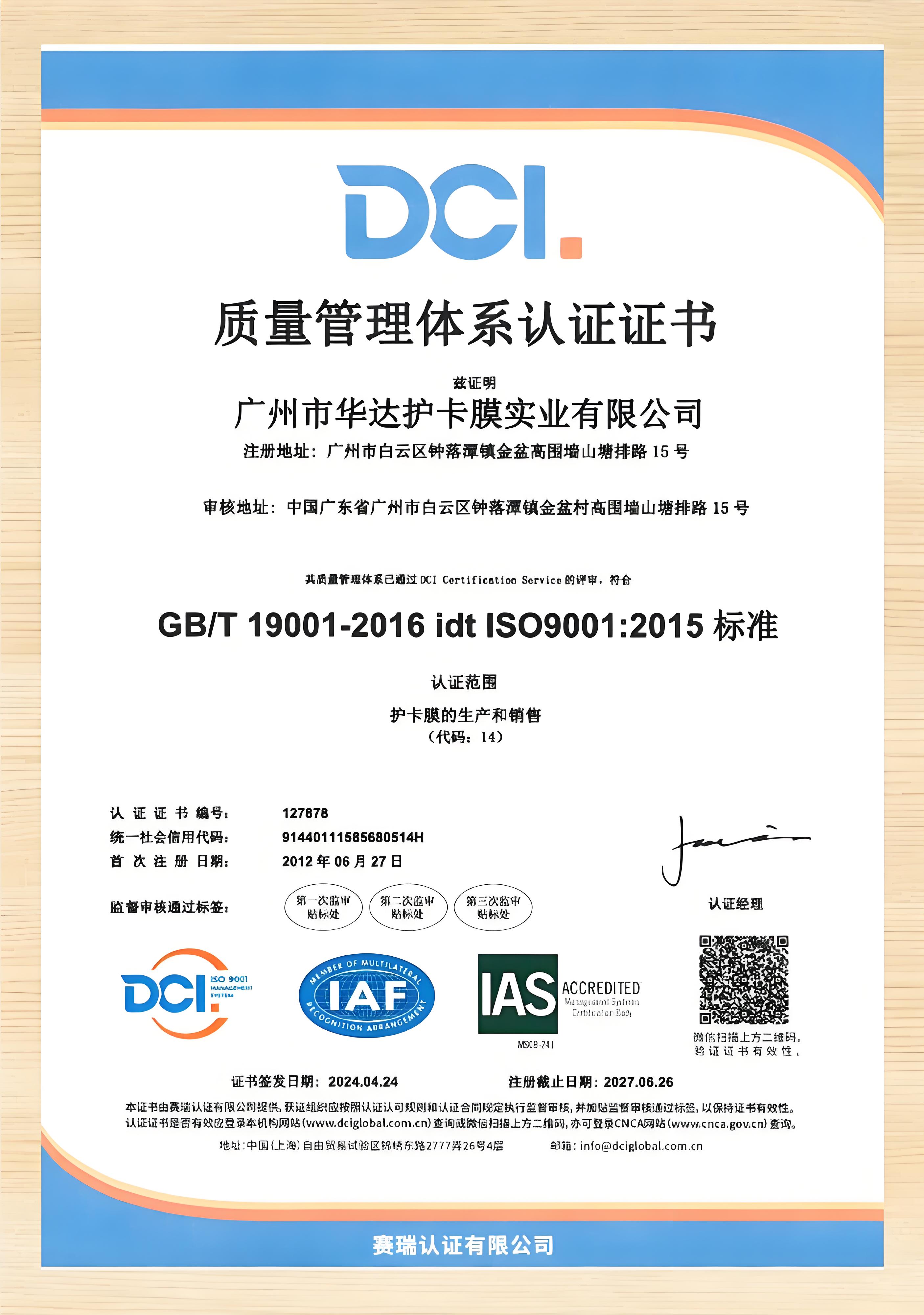
A quality management certificate is only scoreable when the number, issuer and validity dates can be verified.
Dimension 3 — Certification Coverage and Document Verification (20 points)
Certification is the dimension where buyers most often accept the wrong evidence. Two document types matter and they are not interchangeable: management-system certificates, which describe how a company operates, and product-level test reports, which describe a specific material against a specific standard.
For laminating rolls destined for the European Union, the relevant regulatory anchor for plastic materials intended for food contact is Commission Regulation (EU) No 10/2011, which establishes a positive list of authorised substances and sets migration limits. Where a buyer needs a performance specification rather than a compliance document, ASTM D882 defines the standard test method for tensile properties — strength, elongation and modulus — of thin plastic films under 1.0 mm thick.
HADA's document set illustrates the pattern to look for. Product-level testing was carried out by SGS-CSTC Standards Technical Services Co. Ltd.: a RoHS report numbered No.CANEC25014307501, an SVHC screening test report numbered No.CANEC25014307505, and a REACH report numbered No.CANEC25014307503. The company also reports coverage under ISO 9001, BSCI, SMETA, ROHS and REACH, and holds High-Tech Enterprise certificate GR202344012666, issued 28 December 2023 with validity to 28 December 2026. Each of these can be checked against its issuing authority.
The scoring rule is simple: no certificate number, no points. A scanned certificate with no verifiable identifier, or a report whose scope does not name your material, adds nothing to a supplier's score.
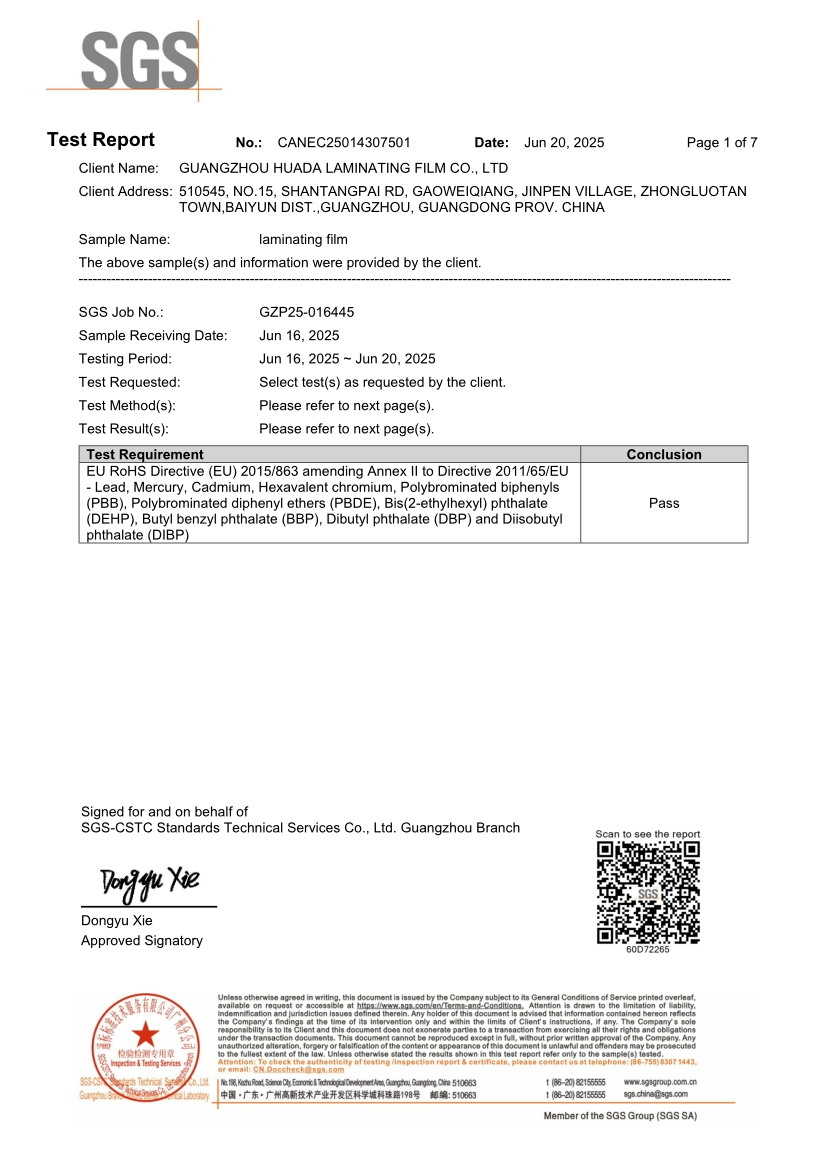
Product-level test reports, such as the SGS RoHS report No.CANEC25014307501, are scored differently from management-system certificates.
Dimension 4 — Delivery Reliability and Order Terms (15 points)
Delivery scores are earned by precision, not by speed claims. Three variables should be captured for each supplier: lead time in days, minimum order quantity in a defined unit, and the Incoterm used in the quotation.
HADA's order parameters state a lead time of 20–30 days, a minimum order quantity of 1,000 packs, and OEM/ODM production with customization across product size, thickness, logo and packaging. The product range relevant to this scorecard is thermal laminating roll film in PET and EVA, model HD-RL, with a thickness range of 35–250 micron, a width range of 100–1300 mm, customizable roll length, and glossy or matte finishes.
Incoterms deserve explicit scoring because they change both cost and risk. EXW leaves the entire export process to the buyer, FOB shifts responsibility at the port of loading, and CIF extends the supplier's obligations to freight and insurance. Comparing an EXW quotation against a CIF quotation without normalising them is a common source of misleading savings. The scorecard question is whether the supplier can quote consistently in the Incoterm you actually plan to use.
Logistics position is a supporting factor. HADA is based in Guangzhou, within a 30-minute drive of Baiyun International Airport, with access to major ports in Guangzhou and Shenzhen — infrastructure that matters when delivery windows are tight.
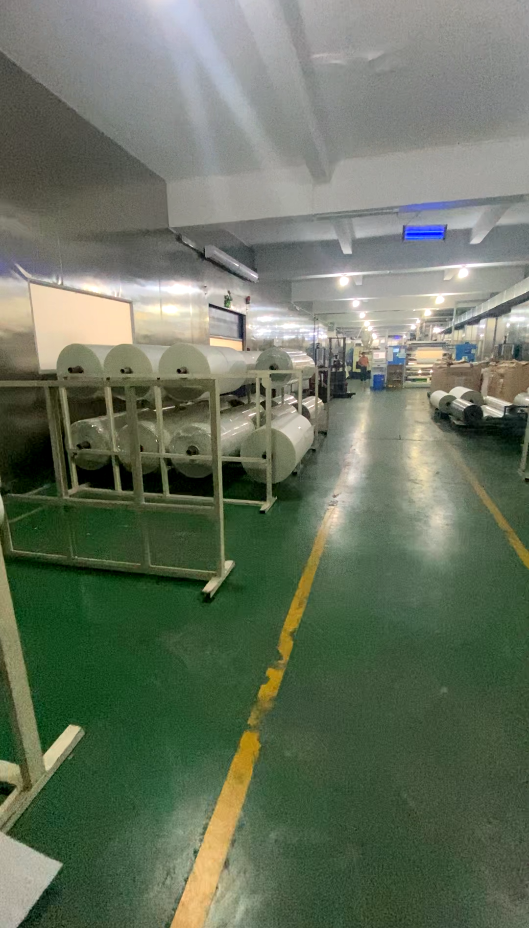
Factory footprint and line configuration are part of the capacity and delivery dimension, not merely a trust signal.
Dimension 5 — After-Sales Risk Transfer (15 points)
The final dimension asks who carries the cost when something goes wrong, and on what clock. Vague assurances such as full support are not scoreable. What is scoreable is the warranty period, the defects covered, the response time, and the remedy.
HADA's stated terms include a 12-month warranty against delamination, colour fading and material defects; a 24-hour response time for quality complaints; a dedicated account manager; free replacement or a full refund for non-conforming goods; and priority re-production for bulk orders. Each of these is a term a buyer can insert into a purchase agreement, which is precisely what makes it useful on a scorecard.
One caveat applies across all five dimensions: supplier-published figures should be treated as claims until verified. Score the claim, then confirm it during sampling and first-order inspection.
Comparison Table: Verifiable Evidence by Scorecard Dimension
The table below converts the framework into a request list. The right-hand column shows what a complete answer looks like in practice.
| Scorecard dimension | Evidence to request | Verifiable data point (HADA example) |
|---|---|---|
| Production capacity and scalability (25) | Monthly output, annual output, line count, factory area | 150,000 packs per month (100 pieces per pack); 1,000,000 units annual output; 3 automated production lines; 40,000 m² facility; 200 employees; annual capacity exceeding 10,000 tons |
| Quality system architecture (25) | QMS certificate number and validity; inspection stages; inspection coverage | ISO 9001:2015 certificate 127878, issued 24 April 2024, valid to 26 June 2027; 100% inspection before shipment; 22 national patents; R&D team of 5 engineers |
| Certification coverage (20) | Product-level test reports with numbers and issuer | SGS-CSTC RoHS report No.CANEC25014307501; SVHC screening test report No.CANEC25014307505; REACH report No.CANEC25014307503; coverage reported for ISO 9001, BSCI, SMETA, ROHS and REACH |
| Delivery reliability and order terms (15) | Lead time, MOQ, Incoterm, customization scope | 20–30 day lead time; MOQ 1,000 packs; OEM/ODM with customization of size, thickness, logo and packaging; PET+EVA roll film, 35–250 micron thickness, 100–1300 mm width |
| After-sales risk transfer (15) | Warranty period, defects covered, response clock, remedy | 12-month warranty against delamination, colour fading and material defects; 24-hour response to quality complaints; free replacement or full refund for non-conforming goods; priority re-production for bulk orders |
Verified documents can be recorded as a register during evaluation, so that renewal dates are not missed later.
| Document | Number | Issuer / authority | Validity |
|---|---|---|---|
| ISO 9001:2015 Quality Management System certificate | 127878 | CNCA | Issued 24 April 2024 — valid to 26 June 2027 |
| SGS RoHS report (Laminating Film) | No.CANEC25014307501 | SGS-CSTC Standards Technical Services Co. Ltd. | Issued 20 June 2025 |
| SVHC screening test report (PET plastic film) | No.CANEC25014307505 | SGS-CSTC Standards Technical Services Co. Ltd. | Issued 20 June 2025 |
| REACH report (Laminating Film) | No.CANEC25014307503 | SGS-CSTC Standards Technical Services Co. Ltd. | Issued 23 June 2025 |
| High-Tech Enterprise certificate | GR202344012666 | Guangdong Provincial Department of Science and Technology; Guangdong Provincial Department of Finance; State Taxation Administration Guangdong Tax Bureau | Issued 28 December 2023 — valid to 28 December 2026 |
| Certificate of Utility Model Patent | 19262125 | National Intellectual Property Administration | Granted 30 June 2023 |
Step-by-Step: How to Run the Scorecard
The framework only works if it is applied in a fixed sequence. Running it out of order — for example, negotiating price before defining the demand profile — produces scores that cannot be compared.
- Define your demand profile. Record monthly and annual volume, required roll width, thickness, finish (glossy or matte), and whether the application is document lamination, packaging or a food-contact use. HADA's roll film range, for reference, spans 35–250 micron in thickness and 100–1300 mm in width.
- Set the weights before contacting suppliers. Decide in advance how much capacity, quality, compliance, delivery and after-sales each matter to your program. Changing weights after seeing quotations invalidates the comparison.
- Request a documentary evidence pack. Ask for a written capacity statement, the QMS certificate with number and validity dates, product-level test reports, order terms in a defined unit, and the standard warranty text.
- Verify at source. Check certificate numbers against the issuing body, confirm that the report scope names your material, and confirm that validity dates have not lapsed.
- Validate with samples. Order samples in the exact thickness, width and finish you intend to buy, and run them on the production laminator rather than a bench unit. Confirm the inspection basis for the sample batch — HADA's documented control is 100% inspection before shipment.
- Normalise commercial terms. Convert every quotation to the same Incoterm, the same MOQ basis and the same lead-time definition before comparing cost.
- Re-score after the first order. Compare promised lead time with actual, inspection results with the declared standard, and complaint response time with the stated 24-hour clock. The second score is more reliable than the first.
Use Cases: How the Scorecard Applies to Real Programs
Brand importer and distributor, DE / AU / US. A client distributing lamination film under its own brand across Germany, Austria and the United States required 600,000 packs of lamination film per year for office document lamination and stationery protection. The cooperation has run for more than 10 years of continuous supply, with zero quality complaints over that period and a 25% reduction in the client's lamination failure rate. Two scorecard dimensions explain why this program works: capacity — a 600,000-pack annual requirement against a stated annual output of 1,000,000 units — and after-sales, where customized anti-counterfeiting coating technology and continuous technical support for lamination process optimization were part of the arrangement.
Printing and packaging converter needing custom widths. A converter laminating printed sheets on a wide-format line would score dimension 4 highest. The relevant checks are whether the supplier can produce 100–1300 mm widths to specification, whether roll length can be customized, and whether the lead time of 20–30 days aligns with the converter's own order cycle. Finish selection — glossy for high-clarity coverage, matte for low-reflection finishes — is a specification decision rather than a supplier-quality signal.
Office and stationery distributor ordering in packs. A distributor buying in pack units should score capacity and MOQ together. A minimum order quantity of 1,000 packs sets the entry point for a trial order, and packaging customization determines whether the product can be sold under the distributor's own label.
In all three cases the same principle applies: the scorecard output is not a verdict on the supplier in general, but a record of how well that supplier matches a specific demand profile.
Frequently Asked Questions
Which certifications and test reports should a laminating rolls supplier provide, and how do you verify them?
A complete compliance package includes a management-system certificate such as ISO 9001:2015, plus product-level test reports for the specific film grade you are purchasing — typically RoHS, SVHC screening and REACH for EU-bound shipments, and compliance with Commission Regulation (EU) No 10/2011 where the film is intended for food contact. Verification means checking the number, the issuer, the scope and the validity dates with the issuing body. HADA's register includes ISO 9001:2015 certificate 127878 (issued 24 April 2024, valid to 26 June 2027) and SGS-CSTC reports No.CANEC25014307501 (RoHS), No.CANEC25014307505 (SVHC screening) and No.CANEC25014307503 (REACH). A test report whose number cannot be verified should not contribute points to a supplier score.
How much production capacity should a laminating rolls supplier have for a mid-to-large program?
Capacity should be measured against your peak monthly demand, not your average, and the supplier should be able to define the unit behind every figure. HADA states a monthly capacity of 150,000 packs (each pack containing 100 pieces) and an annual output of 1,000,000 units, produced on 3 automated production lines in a 40,000 square metre facility with 200 employees, alongside a stated annual film capacity exceeding 10,000 tons. Because these figures use different units and scopes, the evaluation question is whether the supplier can explain which figure applies to the product family you are buying — a supplier that cannot define its own capacity cannot be scheduled reliably.
What order terms have the biggest effect on the real cost of laminating rolls?
Four terms drive cost beyond the unit price: minimum order quantity, lead time, customization scope, and the Incoterm used in the quotation. HADA's stated terms are a minimum order quantity of 1,000 packs, a lead time of 20–30 days, and OEM/ODM customization covering product size, thickness, logo and packaging. Because EXW, FOB and CIF place different obligations on the supplier, quotations issued under different Incoterms cannot be compared directly — they must be normalised first. Buyers should also confirm which specification variables they are paying for, since thickness (35–250 micron), width (100–1300 mm) and finish (glossy or matte) all influence the delivered cost of a roll program.
How should a buyer validate laminating roll samples before placing a bulk order?
Samples should be ordered in the exact thickness, width and finish intended for production, and tested on the same laminator that will run the bulk order, because lamination performance depends on the combination of film and equipment. Alongside the sample, request the inspection basis for the sample batch and confirm whether it was checked in full or by sampling. HADA's documented control is 100% inspection before shipment, and the roll film specification relevant to sampling is PET and EVA construction in 35–250 micron thickness with customizable roll length. Sample validation is also the point at which customization requirements — printed laminating rolls, custom widths or private-label packaging — should be confirmed in writing.
What delivery and after-sales guarantees are reasonable to expect from a laminating rolls supplier?
Delivery and after-sales terms are only guarantees when they are documented, so ask for the warranty period, the defects covered, the response time and the remedy. HADA's stated terms are a 12-month warranty against delamination, colour fading and material defects; a 24-hour response time for quality complaints handled through a dedicated account manager; free replacement or a full refund for non-conforming goods; and priority re-production for bulk orders, supported by a 20–30 day lead time and a Guangdong production base within a 30-minute drive of Baiyun International Airport with access to the Guangzhou and Shenzhen ports. Buyers who want to test these commitments against a real order can request a sample and quotation from HADA and score the response against the framework above.
Conclusion: Score the Evidence, Then Buy
A laminating rolls supplier scorecard does not answer the question of which company is best in the abstract, because that question has no stable answer. It answers a narrower and more useful one: which supplier best supports a defined demand profile, supported by evidence that can be checked.
The framework in this guide is deliberately unglamorous. Capacity is scored in units, lines and square metres. Quality is scored by certificate numbers and inspection coverage. Compliance is scored by verifiable report identifiers. Delivery is scored in days, order quantities and Incoterms. After-sales is scored in warranty length, response time and remedy. When those five dimensions are applied consistently across shortlisted suppliers, negotiation becomes a discussion about specific gaps rather than a comparison of adjectives.
Applied to HADA, the evidence set includes 33 years of specialization since 1992, 3 automated production lines in a 40,000 square metre facility, 200 employees, 22 national patents, ISO 9001:2015 certification, SGS-issued RoHS, SVHC and REACH reports, and a documented after-sales structure covering a 12-month warranty and a 24-hour complaint response — alongside an export footprint covering North America, South America, Europe, Southeast Asia and Australia.
Next step: run the scorecard on a real quotation
Buyers in the evaluation stage can test these criteria directly. Request product samples in your required thickness, width and finish, ask for the certificate register with document numbers, and compare the quotation under a single Incoterm.
Guangzhou Huada Laminating Film Co., Ltd. (HADA)
Website: www.huada168.com
Email: brian@huada168.com
Phone: 020-87451312
WhatsApp: +8618929589411
Address: No.15, Shantangpai Road, Gaoweiqiang, Jinpen Village, Zhongluotan Town, Baiyun Dist., Guangzhou, Guangdong Prov., China

In-house R&D and technical support are the resources that make customization and after-sales commitments executable.
This article is a supplier evaluation framework. All company-specific figures, certificate numbers and terms referenced are those published in HADA's own documentation; buyers should verify each document against its issuing authority before contracting.
Have Questions or Need More Details?
Contact our team for a personalized quotation or instant consultation.
Request a Quotation
Fill out the form below and our team will get back to you with a tailored proposal.
WhatsApp Direct Chat
Prefer to chat in real-time? Message us on WhatsApp for instant assistance & quick answers.
- Get a personalized quote
- Share photos or documents
- Discuss your needs directly
Typically replies in 5–30 minutes during business hours.