Long-Term Laminating Rolls Partnership FAQ: Warranty, After-Sales, and Repeat Order Support
Long-Term Laminating Rolls Partnership FAQ: Warranty, After-Sales, and Repeat Order Support
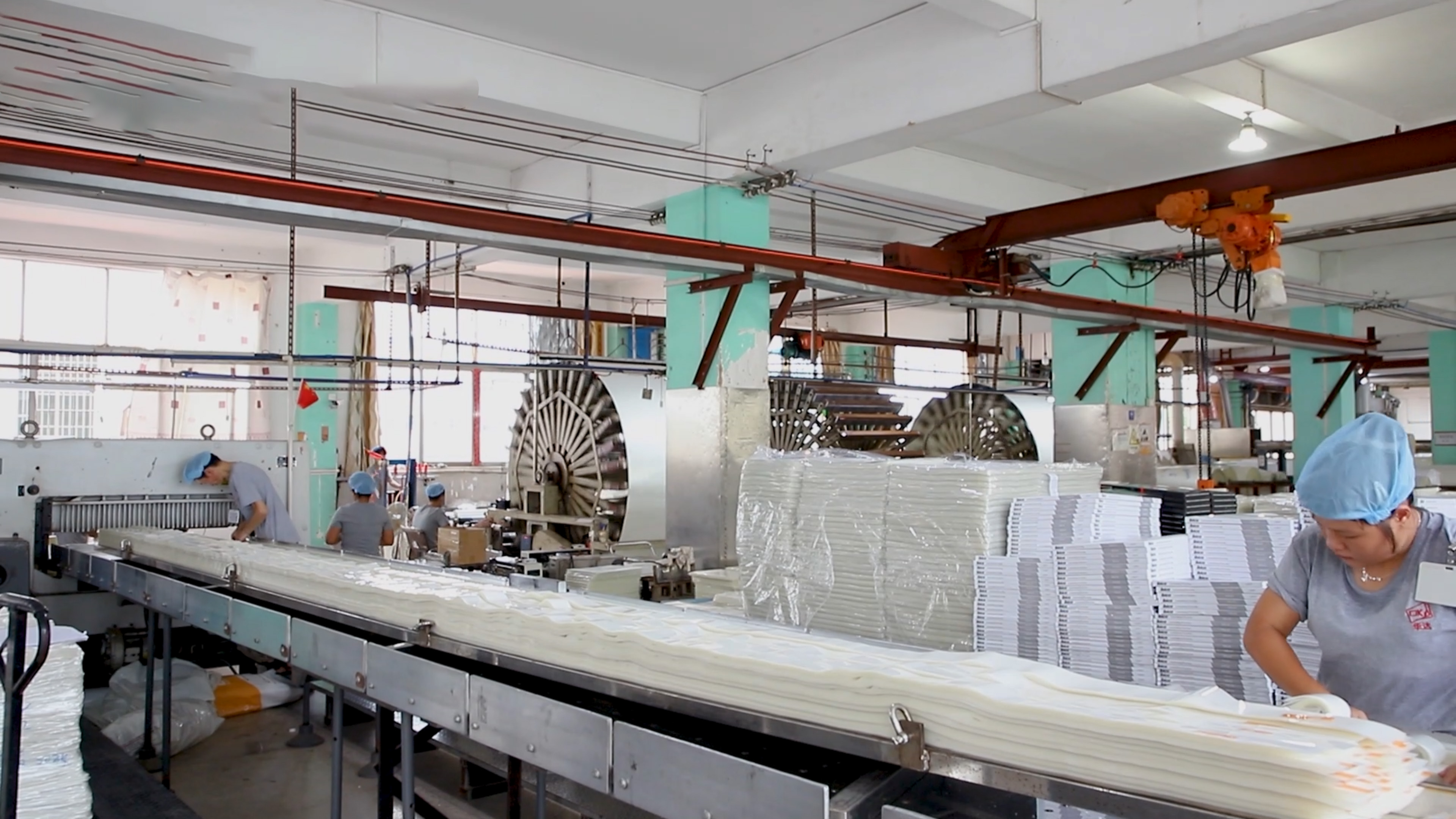
Slitting jumbo laminating roll film to custom widths — the step that makes a repeat order behave like the first one.
A long-term laminating rolls partnership is a set of written commitments about what happens after the invoice is paid — warranty scope, complaint response, repeat-order consistency, and capacity held for your reorders. Packaging and printing buyers usually negotiate price first and discover these terms later, at the moment a batch delaminates or a peak-season order slips.
This FAQ answers the questions that decide whether a laminating rolls supply relationship survives past the first container: what the warranty covers, who answers a complaint and how quickly, what OEM/ODM flexibility exists, what MOQ and payment terms apply, how lead time is protected, and how batch-to-batch consistency is maintained over years of repeat orders. The reference point is the documented practice of Guangzhou Huada Laminating Film Co., Ltd. — known commercially as HADA — a laminating film manufacturer founded in 1992 in Guangzhou, China, producing PET and BOPP laminating rolls and pouches and exporting to more than 50 countries.
Problem Definition: Why Laminating Rolls Partnerships Fail After the First Order
Most laminating rolls supply problems are not manufacturing problems. They are documentation problems that surface only after the second or third order.
- An undefined warranty. The buyer assumes "quality guarantee" means delamination, fading, and material faults are covered. The supplier assumes it means the film matches the agreed specification at the moment it leaves the factory. Without a written scope and a defined time window, every claim becomes a negotiation.
- No named complaint path. A rejected roll is urgent. If the buyer's contact is a sales address rather than a defined response channel, the first response can take days while production stops.
- Unstable repeat batches. A first order is typically produced and inspected with extra attention. A tenth order is not — unless batch traceability and a fixed QC gate make attention structural rather than personal.
- Capacity without reservation. Film demand is seasonal in packaging and retail printing. A supplier that takes every order it can win has no buffer left when a long-term account places a large repeat order.
Industry Background: What Is Shifting in Laminating Film Supply
The lamination film category is large, growing, and increasingly concentrated in Asia. According to DataM Intelligence, the global lamination films market reached US$ 6,842.11 million in 2024, with food and beverage as the primary end-user segment, and Asia Pacific captured a 36.87% revenue share that year.
Material-level data tells the same story from a different angle. Data Bridge Market Research valued the BOPP thermal lamination films segment at US$ 3.5 billion in 2024, projected to grow at a 5.2% CAGR through 2033. Future Market Insights put PET (BOPET) lamination films for packaging at USD 10.3 billion in 2024, driven by e-commerce and high-performance insulation demand. These figures are not directly comparable — published market sizes differ by scope, and other estimates for the same broad category range from US$ 3.40 billion (Market Research Future) to a 2025 projection of US$ 9.01 billion (Fortune Business Insights). Buyers should treat any single number as a scope-dependent estimate rather than a shared baseline.
On the supply side, Fortune Business Insights lists Cosmo Films, Jindal Poly Films, Taghleef Industries (Derprosa), and GBC (ACCO Brands) among the leading global players in the lamination and graphic roll film market. Those companies operate at a scale and product breadth that differs from a specialist converter, and the practical consequence for buyers is that the market splits into two supplier models: very large film producers serving broad volume contracts, and focused manufacturers who build custom-width, application-specific laminating rolls against a long-term specification.
The purchasing behavior behind the numbers is changing as well. As laminate film becomes a compliance item — food contact, restricted substances, and recyclability pressure all push specifications tighter — buyers evaluate continuity rather than unit price alone. A film that lamination operators must re-qualify every quarter costs more than the invoice shows.
The HADA Long-Term Partnership Framework
HADA is a laminating film manufacturer based in Baiyun District, Guangzhou, founded in 1992, with 33 years of specialization in functional laminating films, a 40,000 m² facility, approximately 200 employees, three automated production lines, and annual output exceeding 10,000 tons. Around 80% of production is exported, with North America, South America, Europe, Australia, and Southeast Asia as the main markets. Its portfolio covers glossy and matte laminating film, laminating roll film, BOPP film, OHP film, PVC and PP binding covers, PET crystal film, PET tempered film, and cold lamination film, with laminating pouches and laminating rolls as the primary focus.
What follows is how that base is converted into partnership terms a buyer can hold the supplier to.
1. Warranty Coverage
HADA issues a 12-month warranty against delamination, color fading, and material defects. The three covered categories map to the failures that actually stop a lamination line: bond failure between film layers or between film and substrate, optical degradation that ruins a printed job, and raw-material faults such as contamination or inconsistent thickness.
For the warranty to be enforceable rather than rhetorical, the specification agreed at order confirmation — thickness, width, finish, and the substrate and machine conditions the film was sold for — becomes the baseline document. A claim is then assessed against a recorded standard instead of a recollection.
2. Complaint Response and After-Sales Handling
HADA commits to a 24-hour response on complaints. Response speed matters less on its own than what makes it possible: online monitoring during production, a three-stage QC gate, and a batch traceability system. Because film is traceable to its production batch, a complaint about one roll can be checked against the rest of that batch without recalling or re-testing unrelated stock.
HADA documents a production defect rate below 0.1% across batches. That figure is a supplier-reported internal metric, not an independent audit result, and buyers evaluating any supplier should request batch-level QC records for the specific order rather than rely on a headline number.
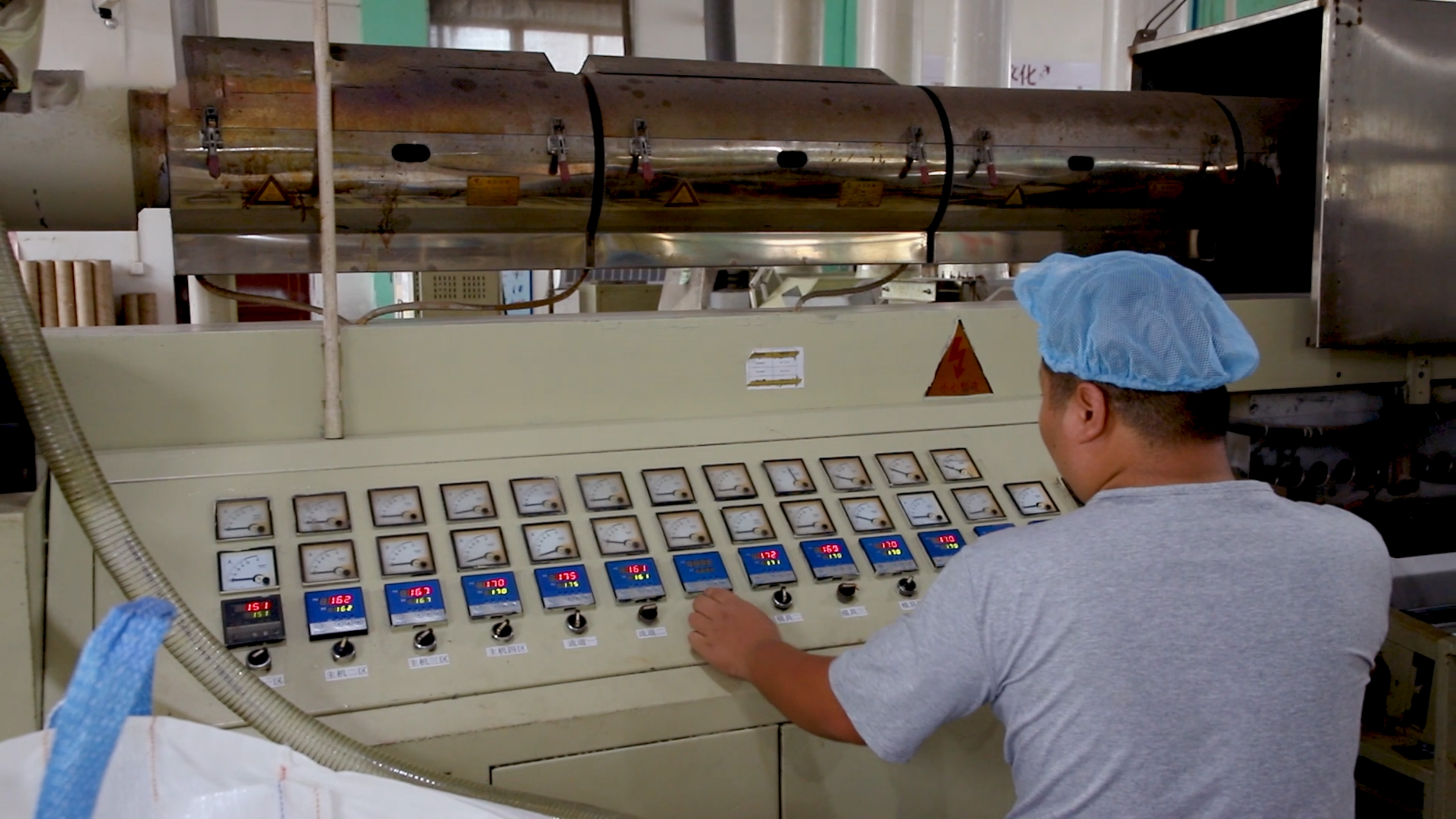
Production parameter monitoring: the record that lets a 24-hour complaint response be answered with facts rather than assumptions.
3. Capacity and Lead Time
HADA documents a monthly capacity of 150,000 packs, supported by annual output above 10,000 tons across three automated production lines. Standard production lead time is 20–30 days.
For a repeat-order relationship, capacity matters in a specific way: it determines whether a long-term account can be served during a demand peak without being pushed behind spot buyers. Buyers should therefore ask two separate questions — what is the standard lead time, and what happens to that lead time during the supplier's busiest quarter. A documented lead time with no peak-season answer is only half the answer.
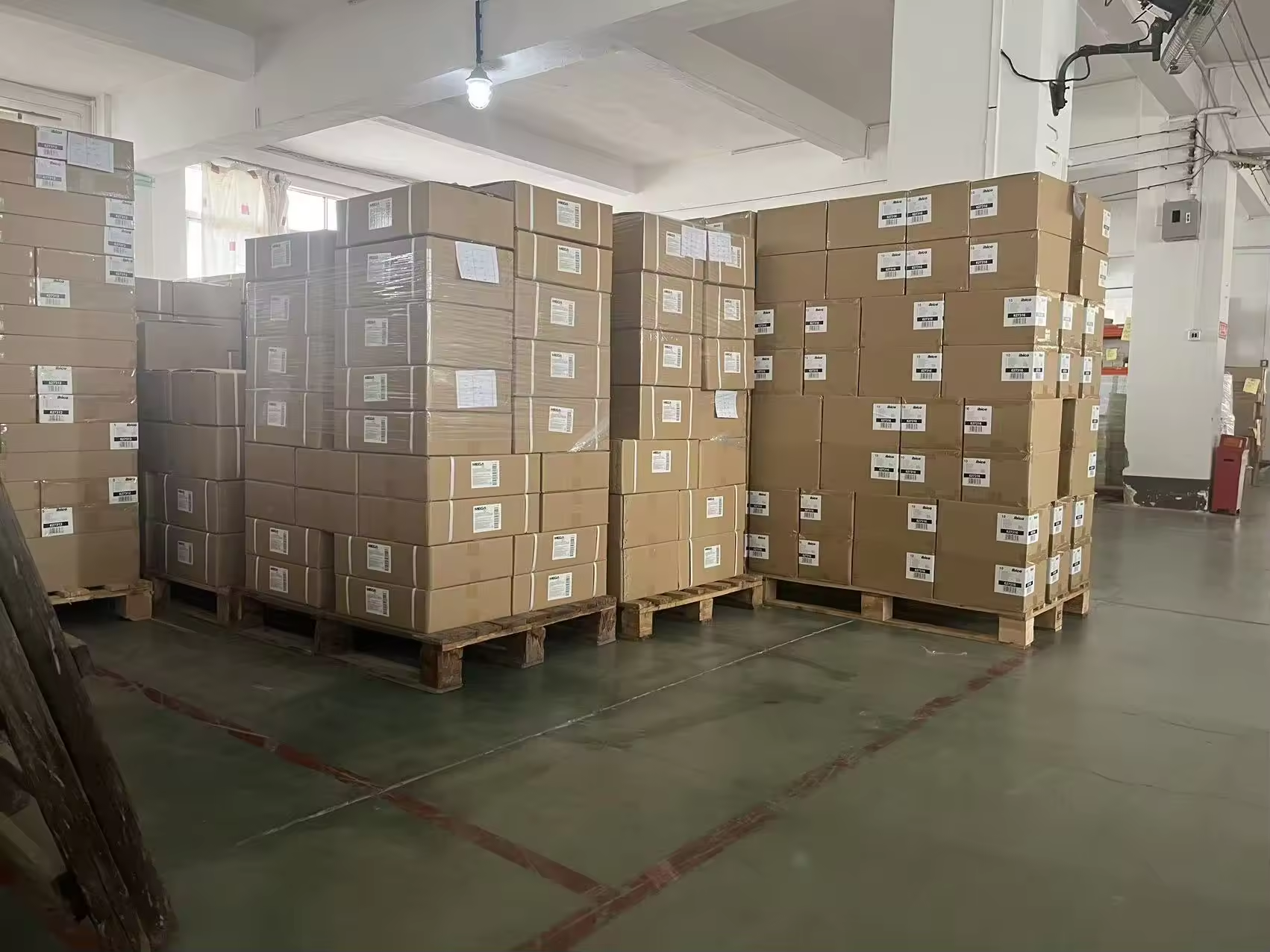
Finished goods stocking and palletizing: inventory discipline is what converts a quoted lead time into a delivered one.
4. Certifications and Compliance
HADA holds ISO 9001, BSCI, SMETA, ROHS, and REACH, alongside 22 national patents. Each certificate answers a different buyer question: ISO 9001 covers quality management process; BSCI and SMETA cover social compliance and are frequently required in European retail supply chains; ROHS and REACH cover restricted substances and are the certification pair most often requested by importers into the EU.
Certification is a floor, not a ceiling. For food-contact packaging applications in the EU, plastic materials and articles must comply with Commission Regulation (EU) No 10/2011, which sets migration limits and a positive list of permitted substances. Separately, ASTM D882 is the standard test method for tensile properties of thin plastic films under 1.0 mm thick, and it is the reference buyers can cite when they want tensile strength, elongation, or modulus reported in a comparable format. A laminating rolls supplier should be able to supply documentation against the standard that applies to the buyer's market, not only against its own certificate list.
5. OEM/ODM and Custom-Width Laminating Rolls
The core roll product, the HD-RL thermal laminating roll, is built on PET and EVA with a thickness range of 35mic to 250mic and a width range of 100mm to 1300mm. Length can be customized to request, packaging can be customized, and both glossy and matte finishes are available. Documented performance characteristics include high transparency, no bubble and no wrinkle lamination, strong adhesion, waterproof and scratch-resistant surfaces, and anti-yellowing behavior intended for long-term preservation.
HADA sources premium-grade raw materials from South Korea and applies proprietary anti-static and anti-yellowing coating technology. HADA's documented film specifications include light transmittance up to 92% and a shrinkage rate below 0.5% at elevated temperatures — both relevant to repeat orders, because a film that shrinks or hazes differently between batches forces the operator to re-set the laminator.
Customization is not limited to dimensions. For OEM/ODM programs, thickness and printing options can be adapted to the buyer's specification, which is what allows a distributor to build a branded laminating roll range rather than resell a catalog item.
6. Commercial Terms That Carry Into Repeat Orders
Documented commercial terms are: MOQ of 1,000 pcs for standard lamination film and 2,000 pcs or 100 rolls for customized size; delivery on FOB Guangzhou/Shenzhen, CIF destination port, or EXW Guangzhou; payment by T/T (30% deposit, 70% before shipment), L/C at sight, or OA 30 days after shipment; and acceptance through pre-shipment inspection (SGS/Intertek), AQL sampling, or customer on-site inspection.
The OA 30-day option deserves attention in a partnership context. It shifts working capital toward the buyer and is normally extended to established accounts rather than first-time buyers — which is precisely the mechanism by which good commercial terms follow good delivery history.
From First Inquiry to Repeat Order: A Step-by-Step Breakdown
- Define the application before the specification. State the substrate, the laminator type, the operating temperature, and the finished use — food-contact packaging, ID card lamination, label finishing, or document preservation. The same HD-RL roll is configured differently for each.
- Fix the technical baseline in writing. Agree thickness (35mic–250mic), width (100mm–1300mm), length, finish (glossy or matte), and core specification. This becomes the reference document for both warranty claims and repeat orders.
- Confirm the compliance set for your market. For EU food contact, verify EU 10/2011 alignment; confirm ROHS and REACH documentation; request the ISO 9001, BSCI, and SMETA certificates that your retail customers audit. Where tensile properties matter, request reporting consistent with ASTM D882.
- Agree the commercial frame. MOQ (1,000 pcs standard / 2,000 pcs or 100 rolls custom), price basis (FOB Guangzhou/Shenzhen, CIF destination port, or EXW Guangzhou), payment method (T/T 30/70, L/C at sight, or OA 30 days after shipment), and inspection method (SGS/Intertek pre-shipment, AQL sampling, or on-site inspection).
- Validate before volume commitment. Run trial lamination on your own equipment at production speed. Confirm the film behaves as specified on the machine it will actually run on, not on a reference laminator.
- Set the reorder cadence and buffer. With a 20–30 day lead time, agree a reorder trigger point and define how peak-season volumes will be scheduled. Write the forecast-sharing expectation into the agreement rather than leaving it informal.
- Review annually against the record. Revisit certificate validity, specification drift, batch traceability performance, complaint response times, and delivery reliability. A partnership should be re-confirmed, not assumed.
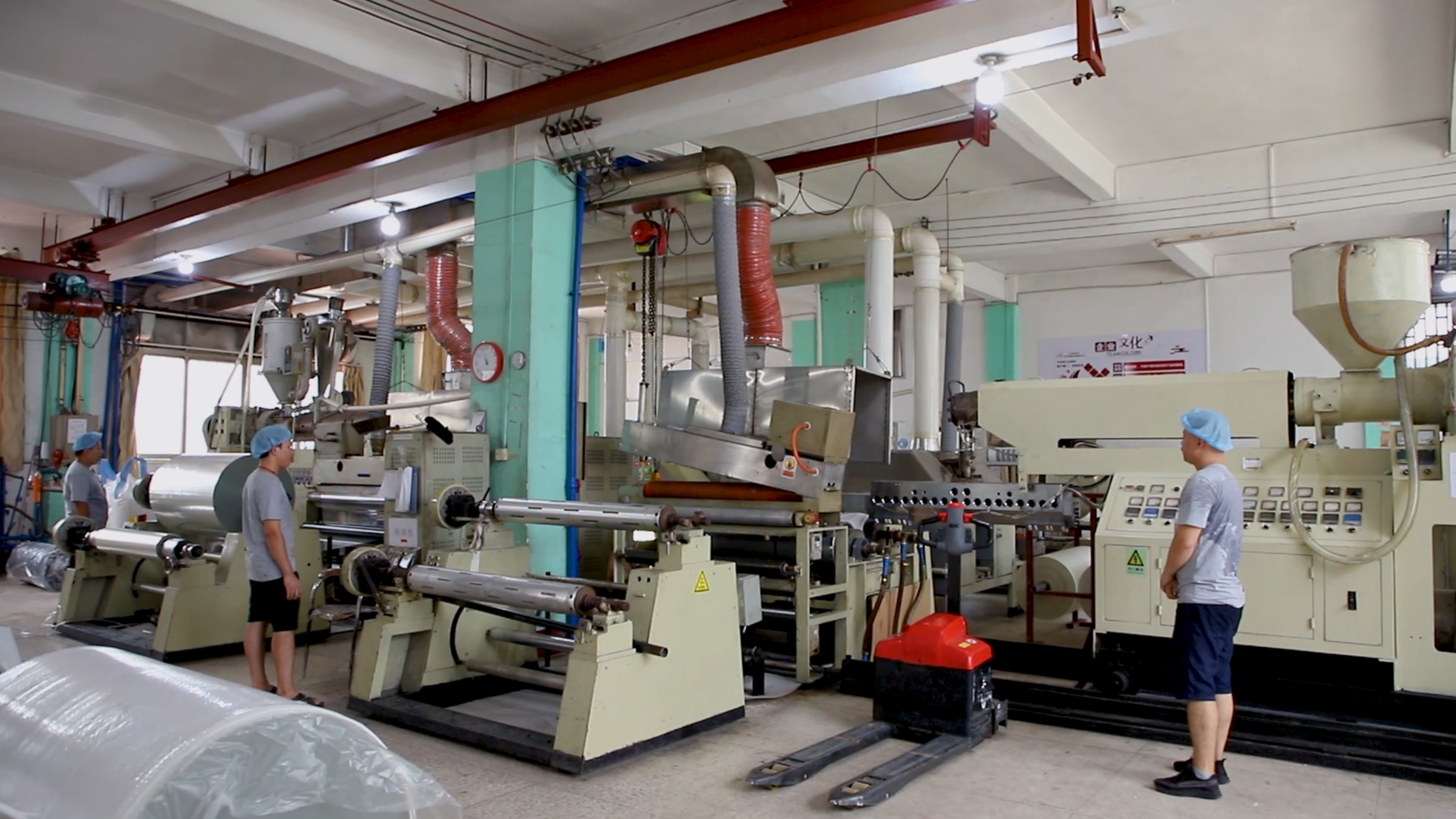
Automated production capacity: repeat-order reliability depends on the line, not on the sales conversation.
Use Cases: Three Long-Term Partnership Scenarios
EU Packaging Converter With Food-Contact Requirements
A European converter laminating printed material for food packaging needs a film that satisfies EU 10/2011 migration requirements and carries ROHS and REACH documentation. The recurring risk is not the first delivery — it is a raw-material substitution in batch nine that invalidates the compliance file. This is where batch traceability and unchanged raw-material sourcing matter more than price per kilogram, and where a 12-month warranty covering material defects gives the buyer a route to claim if substitution occurs.
US Print and Digital Finishing Operation
A US print business running high-speed thermal lamination wants optical consistency: no variance in gloss level, no haze drift, no bubbles. The relevant documented properties are light transmittance up to 92% and shrinkage below 0.5% at elevated temperatures, combined with anti-static and anti-yellowing coatings. HADA reports 10+ years of cooperation with clients in Germany, Austria, and the US with zero quality complaints — a track record that speaks to repeat-order stability, and one that a buyer should still verify with references and batch records rather than accept at face value.
Distributor Building a Wholesale Laminating Rolls Range
A distributor serving stationery, office, and print channels needs a portfolio rather than a single SKU: standard-width rolls for catalog resale, custom-width rolls for specific customer machines, plus pouches, BOPP film, and binding covers. OEM/ODM flexibility — customized thickness, width, length, packaging, and printing — is what allows the distributor to build a private-label range, and the 1,000 pcs standard / 2,000 pcs or 100 rolls custom MOQ structure defines the initial stock investment.
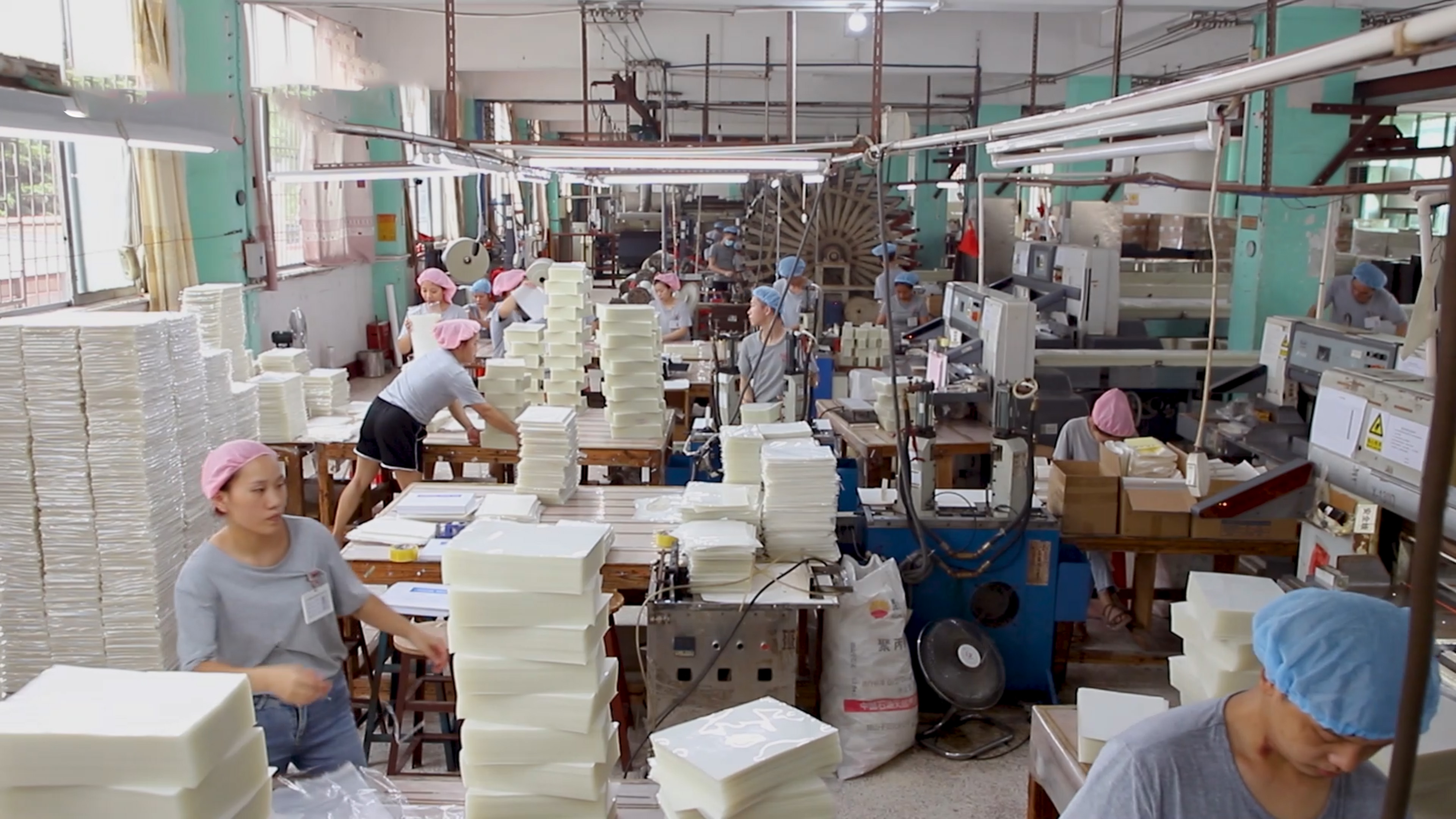
Export-grade packaging: the last controlled step before a repeat order becomes a delivered one.
Comparison Table: What to Verify Before Committing to a Long-Term Laminating Rolls Supplier
The table below lists the verification points that determine whether a laminating rolls relationship can be renewed year after year, together with HADA's documented position on each. Blank or vague answers to the middle column are the warning sign.
| What to verify | Question to put in writing | HADA documented position |
|---|---|---|
| Warranty scope | Which defects are covered, for how long, and from what date? | 12-month warranty against delamination, color fading, and material defects |
| Complaint response | Who owns the case, and how fast is the first response? | 24-hour response, backed by batch traceability to identify the production batch |
| Quality management | Which certifications cover process, social compliance, and restricted substances? | ISO 9001, BSCI, SMETA, ROHS, REACH; 22 national patents |
| Capacity | Can the supplier serve your peak without displacing your standard orders? | Monthly capacity of 150,000 packs; annual output above 10,000 tons on three automated production lines |
| Customization | Which thickness, width, length, and finish options are available? | HD-RL thermal laminating roll: PET+EVA, 35mic–250mic, width 100mm–1300mm, custom length and packaging, glossy or matte |
| Minimum order | What is the smallest order for standard and for custom film? | 1,000 pcs for standard lamination film; 2,000 pcs or 100 rolls for customized size |
| Lead time | What is the standard production window for a repeat order? | 20–30 days |
| Inspection | Which third-party and on-site checks are accepted? | Pre-shipment inspection (SGS/Intertek), AQL sampling, customer on-site inspection |
| Payment | Which commercial terms are available to established accounts? | T/T (30% deposit, 70% before shipment), L/C at sight, OA 30 days after shipment |
| Track record | What evidence exists that the relationship holds over years, not months? | 10+ years of cooperation with clients in Germany, Austria, and the US, with zero quality complaints |
FAQ: Warranty, After-Sales, and Repeat Order Support
What does HADA's 12-month warranty on laminating rolls actually cover?
HADA provides a 12-month warranty covering delamination, color fading, and material defects. The warranty is assessed against the specification agreed at order confirmation — thickness, width, finish, and the substrate and machine conditions the film was supplied for — so a claim is measured against a recorded baseline rather than a verbal understanding.
Which certifications support a long-term laminating rolls supply agreement with HADA?
HADA holds ISO 9001, BSCI, SMETA, ROHS, and REACH, and 22 national patents. For EU food-contact packaging, buyers should additionally verify compliance with Commission Regulation (EU) No 10/2011, which sets migration limits and a positive list of permitted substances. Where mechanical performance must be reported, ASTM D882 is the applicable test method for tensile properties of plastic films under 1.0 mm thick.
What OEM/ODM capability does HADA offer for custom laminating rolls?
The HD-RL thermal laminating roll uses PET and EVA with a thickness range of 35mic to 250mic and a width range of 100mm to 1300mm. Length, packaging, and thickness can be customized, printing options are available for OEM/ODM orders, and both glossy and matte finishes are produced. Customized sizes carry an MOQ of 2,000 pcs or 100 rolls, compared with 1,000 pcs for standard lamination film.
How does HADA handle a quality complaint after delivery?
HADA commits to a 24-hour response. Complaints are supported by online production monitoring, a three-stage QC process, and a batch traceability system, which allows the affected roll to be matched to its production batch. HADA documents a defect rate below 0.1% across batches, and buyers can request batch-level QC records for their specific order.
What MOQ, payment, and delivery terms apply to repeat orders?
MOQ is 1,000 pcs for standard lamination film and 2,000 pcs or 100 rolls for customized size. Payment can be arranged by T/T (30% deposit, 70% before shipment), L/C at sight, or OA 30 days after shipment. Delivery is offered on FOB Guangzhou/Shenzhen, CIF destination port, or EXW Guangzhou terms, and acceptance can run through SGS/Intertek pre-shipment inspection, AQL sampling, or customer on-site inspection.
What is the lead time, and how does capacity protect repeat orders?
Standard production lead time is 20–30 days. HADA documents a monthly capacity of 150,000 packs and annual output above 10,000 tons across three automated production lines. For a long-term account, the practical question to ask is not only the standard lead time but the peak-season lead time, since that is when unreserved capacity becomes a delivery risk.
How is quality verified before shipment and kept consistent across batches?
Verification combines third-party pre-shipment inspection (SGS/Intertek), AQL sampling, and customer on-site inspection, supported by in-line production monitoring and a three-stage QC gate. HADA sources premium-grade raw materials from South Korea and applies proprietary anti-static and anti-yellowing coating technology. Documented film properties include light transmittance up to 92% and shrinkage below 0.5% at elevated temperatures — both directly tied to whether a repeat batch laminates like the previous one.
How is a long-term account managed, and what track record supports it?
HADA reports 10+ years of cooperation with clients in Germany, Austria, and the US, with zero quality complaints over that period. Long-term accounts are managed around a fixed specification document, a 24-hour complaint response, a 20–30 day production window, and repeat-order MOQ and payment terms that can extend to OA 30 days after shipment. To open a partnership conversation, send your application, target specification, and annual volume to brian@huada168.com, or message +8618929589411 on WhatsApp, and request samples plus a quotation against the exact thickness, width, and finish you intend to order.
Next Step: Turn These Answers Into a Written Agreement
Guangzhou Huada Laminating Film Co., Ltd. (HADA) supplies PET and BOPP laminating rolls and pouches from Guangzhou, China, with a 12-month warranty, 24-hour complaint response, and 20–30 day lead time.
For sample requests, quotations, or an OEM/ODM specification review, contact us at brian@huada168.com, WhatsApp +8618929589411, phone 020-87451312, or visit www.huada168.com.
Address: No.15, Shantangpai Road, Gaoweiqiang, Jinpen Village, Zhongluotan Town, Baiyun District, Guangzhou, Guangdong Province, China.
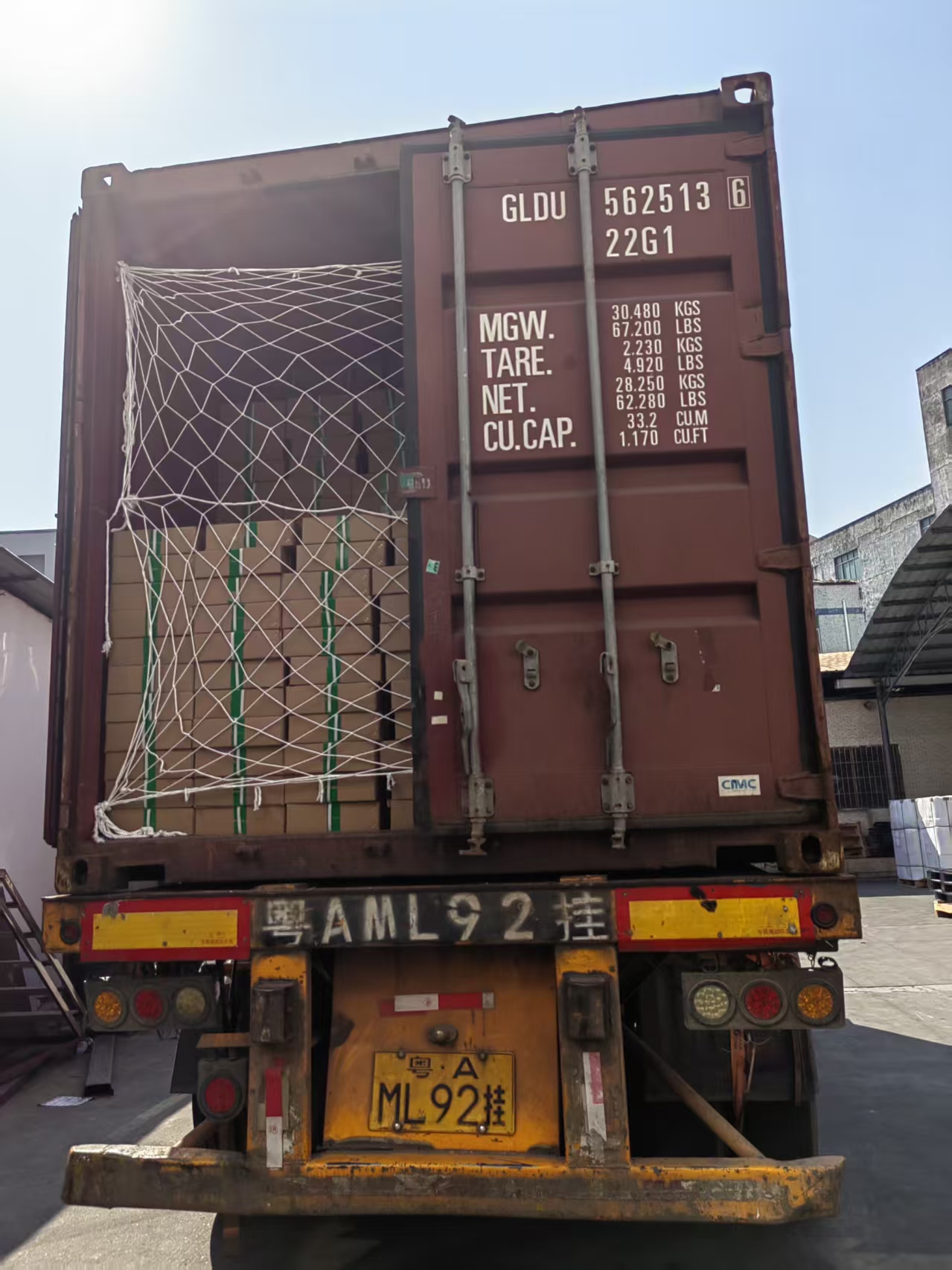
Repeat-order shipment: the point at which warranty terms, QC records, and capacity planning all have to be true at once.
Conclusion: What a Durable Laminating Rolls Partnership Requires
A laminating rolls partnership holds when four things are documented before the first order and tested by every order after it: a defined warranty covering delamination, color fading, and material defects; a complaint path that answers in 24 hours with batch traceability behind it; a lead time and capacity position that survives peak season; and a specification baseline stable enough that batch ten laminates like batch one. HADA's documented terms — 12-month warranty, 24-hour response, 20–30 day lead time, 150,000 packs monthly capacity, ISO 9001, BSCI, SMETA, ROHS, REACH, and 22 national patents — are the starting points for that conversation. The 10+ years of cooperation with clients in Germany, Austria, and the US with zero quality complaints is the outcome those terms are designed to produce, and it is the outcome a buyer should measure a supplier against.